Abstract
Purpose:
Place branding is a discipline with high relevance for a city's policymakers and for hospitality and tourism management, and this is even more true in the context of creative cities. This article explores how the creative class contributes to a city’s brand identity and, by doing so, delivers valuable advice for marketing representatives of creative cities.
Design/methodology/approach:
Our study builds on a qualitative study, interviewing 18 members of the creative class in 3 diverse European cities. Our methodology was based on grounded theory: We simultaneously collected and analysed data and created analytic codes and categories.
Findings:
This article suggests that the creative class is an important enactment stakeholder in the identity formation process of a place, as well as destination marketing organizations (DMOs) and other stakeholders. Additionally, it is demonstrated that the creative class co-creates a city’s brand identity by bringing new rhythms and forms of expression to the cityscape.
Originality:
This article contributes to the fast-growing place brand identity literature by exploring the role of the creative class in the context of cities. It also intends to provide a better understanding of how the creative class co-creates and contributes to their city’s brand identity. Since similar studies do not exist, our article fills an important research gap.
Research limitations/implications:
Our study shares the limitations of qualitative studies, but the resulting conceptual model of brand management in the context of a creative city offers a springboard for future research in this regard.
Practical implications:
City representatives and tourist managers need to understand what is the value-in-use generated by the creative class in the brand identity process and must be aware that the creative class plays a key role in delivering the brand message.
Keywords
Introduction
Place branding is a relatively new concept in the branding literature (Donner & Fort, 2018; Pedeliento & Kavaratzis, 2019), and it has been mainly used by policymakers as a means of differentiation of destinations (Donner & Fort, 2018). In the past decade, place branding has been conceptualized as the process of building a place brand based on its identity and a positive place image (Pedeliento & Kavaratzis, 2019) and is therefore a vital strategy within the field of hospitality and tourism management. As such, an increasing number of cities are making efforts to promote their creativity and attractiveness inside and outside the city (Hospers, 2003). This was especially the case in Berlin, Glasgow and Malmö where the organization of prominent cultural events was employed as a city marketing tool to address social and economic problems in urban areas.
According to Aitken and Campelo (2011), it is crucial to understand relationships between people and places in order to develop a place brand. Indeed, the place brand identity is shaped by shared perceptions across a community, which, in turn, influence stakeholders’ attitudes, values and meanings (Aitken & Campelo, 2011). Brand identity was initially conceptualized as a unique set of brand associations (Aaker, 1996) but has recently evolved to a conceptualization that is dynamic, reciprocal and interactive in nature (von Wallpach et al., 2017). This new definition highlights the role of a continuous dialogue (Gioia et al., 2010; Scott & Lane, 2002) between managers, consumers and stakeholders (von Wallpach et al., 2017) that is embedded in the modern marketing perspective linked to value creation (Kotler, 2020) and the search for true value (Mahajan, 2020; Wakhu, 2020). Literature suggests that place identity results from political, religious, historical and cultural discourses combined with local knowledge (Govers & Go, 2009). Consequently, the place brand-building process consists initially in defining the place identity and then communicate it through the place brand, which should have been preferably co-created with local stakeholders (Aitken & Campelo, 2011; Donner & Fort, 2018; Kavaratzis & Hatch, 2013).
Recent studies highlight the benefits of a multi-stakeholder orientation in the place brand identity formation instead of place branding destination marketing organization (DMO)-centric activities (Saraniemi & Komppula, 2019). Moreover, literature suggests that a participatory approach to place branding encourages stakeholders to play an active role in the overall place branding process (Kavaratzis & Kalandides, 2015; Zenker & Erfgen, 2014). Despite a few examples of the multi-stakeholder perspective of the creation of destination brand identity (Gyrd-Jones & Kornum, 2013; Kavaratzis & Hatch, 2013), this area, despite its overall importance, still remains under-researched. This is even more true in the context of creative cities: creativity became a relevant strategy adopted by some cities and regions to promote economic growth and to create distinct places. Indeed, the creative cities’ approach posits that creativity can be used as an urban regeneration tool, and that creativity can be driven by creative industries and residents (Richards, 2011; Sasaki, 2010; Vanolo, 2015). In the context of creative cities, where the so-called ‘creative class’ is an important stakeholder group for place branding, studies about the active involvement of private and public stakeholders to attract residents, tourists and businesses to a city are rare. Hence, the purpose of this article is to explore how the creative class can influence a city’s brand identity. In other words, how does the creative class, as a key player in a city’s ecosystem, contribute to the formation of a city’s brand identity? In this article, we answer this important question by analysing the development of destination brand identity through the theoretical perspective of co-creative brand management. This states that brand identity results from an interactive and co-creation process involving multiple stakeholders (Ind & Schmidt, 2019).
Theoretical Framework
Place Brands
A place brand is described as a sum of associations in the mind of consumers, which are linked to verbal, visual and behavioural expressions of a destination (Zenker & Martin, 2011). As policy instruments, place brands have a long-term orientation and are used to communicate norms and values (Anholt, 2008; Donner & Fort, 2018; Hankinson, 2010). Literature suggests that place brands are complex (Kavaratzis, 2005), dynamic (Moilanen, 2015) and are co-created by social actors (Pryor & Grossbart, 2007). Pasquinelli and Teräs (2013) argue that a destination brand should be anchored on its identity so as to be meaningful. Moreover, the notion of a destination brand has evolved from being just a catching slogan or an advertising campaign to characterize what a destination stands for. In this domain, scholars have described destination brands as the visual, verbal and behavioural perceptions of a specific city, region or country by its stakeholders (Boisen et al., 2011; Zenker & Braun, 2010). This multifaceted approach to destination branding highlights the role of place reputation (Braun et al., 2013), the quality of life, business or events offered by a place (Klijn et al., 2012), as well as its history and culture (Kalandides, 2011; Kavaratzis & Ashworh, 2015; Kavaratzis & Hatch, 2013).
Place Brand Identity
The tourism literature conceptualizes place identity as an objective reality that concerns to the physical, cultural and historical place characteristics (Hofstede, 2014; Skinner and Kubacki, 2007) or to the sense of belonging degree (Kalandides, 2011; Mueller & Schade, 2012). From a brand management perspective, place brand identity relates to the sender’s perspective, whereas the place brand image is the sum of the receiver’s beliefs, ideas and impressions (Florek et al., 2006; Peighambari et al., 2016). Some scholars, however, posit that place brand identity and place brand image continually interact (Kavaratzis & Hatch, 2013) and reinforce each other (Cai, 2002) in the brand-building process.
Research also shows that place brand identity is a multidimensional construct that combines tangible and intangible components (Hanna & Rowley, 2011; Rodrigues et al., 2019; Rojas-Méndez et al., 2013). For example, some scholars have proposed that the tangible components of place brand identity include the place physique (actual place) and its visual presentation such as logos, symbols and slogans (Pedeliento & Kavaratzis, 2019). On the other hand, the intangible components of the place brand identity include the place vision (Donner & Fort, 2018), place values (Govers & Go, 2009), place strategy (Fernández-Cavia et al., 2018), personality (Ruzzier, 2012; Taecharungroj, 2019) and place relationships (Kavaratzis, 2009).
A great body of studies have focused on the purposes of place brand identity. Research shows that a strong place brand identity is based on a consistent and unique place value proposition (Ashworth & Kavaratzis, 2009; Kavaratzis, 2004; Stock, 2009) that facilitates the relationships with stakeholders (Bregoli, 2013; Konecnik & Go, 2008; Sarabia-Sanchez & Cerda-Bertomeu, 2016) and attracts locals, talents, investors and tourists to a city, region or country (Anholt, 2007). Moreover, it helps to build a positive place reputation and increases the stakeholders’ engagement (Anholt, 2003; Kavaratzis, 2004). Second, a strong and distinctive place brand identity allows to position a place brand more effectively and thus differentiate against competing place brands (Hankinson, 2004; Hanna & Rowley, 2011). Furthermore, it helps to specify what a certain place stands for and its ambitions (Konecnik & Go, 2008).
Several models of brand identity have been proposed in the past two decades. For example, Cai (2002) developed a destination branding model focused on how destinations should be perceived in terms of brand associations, attributes and attitude/affective components. In another trend of research, Hankinson (2004) proposed the concept of a core brand (i.e., personality, positioning and reality) as a brand identity representation. Other scholars investigated the place elements as part of the place brand identity. In this regard, Kalandides (2011) stated that identity includes materiality, practices, institutions and representations, whereas Lindstedt (2011) identified physical settings, human activities and meanings. Drawing from the case study of Slovenia’s brand identity, Ruzzier and De Chernatony (2013) developed a model, which includes mission, vision, values, personality, distinguishing preferences and benefits. In the same vein of research, Martínez (2016) proposed a comprehensive network place brand model that suggests that place brand identities result from geography, institutions and sense of place components.
Literature on place branding identifies three key components of place brand identity, which are central to identity development, namely physics, practices and personality. Place physics relate to materiality aspects and physical assets (Kalandides, 2011; Lindstedt, 2011) and include tangible attributes (e.g., artefacts) and symbols that stand as both visual representations and the essence of place brand identity. For example, cultural and sport facilities, hotels, restaurants, nightclubs, transport infrastructures, historic plaques, decorations and sculptures (Florek et al., 2006; Hanna & Rowley, 2011), as well as temporary retail formats that may contribute to urban renewal (Kalandides et al., 2016). The second component of place brand identity are practices that result from competition and cooperation between stakehoders (Martínez, 2016) such as activities, behaviours, decisions and rituals (Kalandides, 2011; Florek et al., 2006). The place practices include events and rituals such as street parties, ceremonies, parades and artistic performances (Hankinson, 2004; Hanna & Rowley, 2011). Finally, the last component of place brand identity is personality, which relates to the character of locals, the tourists’ profile and the character of the environment (Hankinson, 2004).
Co-creation of Place Brand Identity
Research suggests that place brand identity is linked to the intrinsic nature of a place and results from the interaction among the brand’s infrastructure, the destination and its stakeholders (Hanna & Rowley, 2011). Moreover, Saraniemi (2011) explains that the place brand identity emerges from all the stakeholders’ interplay in the brand-building process. According to Kavaratzis and Hatch (2013), place brand identity is a concept that emerges from a continuous production and reproduction of the interactions between internal and external stakeholders. Pryor and Grossbart (2007) advocate that place brand identity is affected by how stakeholders view a place from an economic, social, political and cultural perspective. In that regard, place brand identity is described as a sum of sociocultural meanings (Botschen et al., 2017; Levy & Lee, 2011) and socio-spatial interactions that occur among residents, local institutions, and other internal and external actors (Mahnken, 2011). This assumption is in accordance to the service-dominant logic (SDL) that posits that value results from a co-creation process (Prahalad, 2004) that is collaborative, culturally based and contextually grounded (Fournier et al., 2008). Nevertheless, the degree of co-creation may vary among stakeholders depending on how much they are prompt to interact in the brand-building process (Guzmán et al., 2019).
According to the dynamic identity-based process of place brand formation (Kavaratzis & Hatch, 2013), a place brand results from a continuous dialogue between several stakeholders, who are key actors in the process of place identity development. This interactive process includes four simultaneous sub-processes, namely the expressing process (in which culture is coveyed through identification); the impressing process (the impression that place identity leaves on several stakeholders); the mirroring process (the overall image of others is reflected on place identity); and the reflecting process (the place identity is embedded in cultural meanings).
Rowley (1997) explains that stakeholders play different roles in the place brand network, ranging from very active to marginal actors in the place brand decisions (Cox et al., 2014; Timur & Getz, 2008). As such, the adoption of a co-creation place brand identity paradigm facilitates the promotion of a place character in terms of brand elements, meanings and attributes. Moreover, it also unveils the destination characteristics in terms of social practices, ways of doing things and social order (Aitken & Campelo, 2011). Consequently, a place brand strategy anchored on a co-creation experience can empower stakeholders’ decisions on brand ownership, brand positioning, representation and governance (Aitken & Campelo, 2011). In other words, an overall understanding of the place identity can hinder brand failures, which are mainly related to the attempt of giving a place a unique (but detached from its identity) brand image (Pedeliento & Kavaratzis, 2019).
Creative Cities
Branding views creativity as a relevant asset, that is, something that the destination has instead of something the destination is (Ashworth & Kavaratzis, 2015). As such, creativity is central to the branding of cities (Dudek-Mańkowska & Grochowski, 2019) and may be used to target external audiences (Miller, 2016). Indeed, creativity allows everyone to express themselves while sharing their own vision of the place (Vivant, 2013). Research suggests that creativity is a function of innate personality traits and a social process that actively contributes to the idea journey process (Perry-Smith & Mannuccu, 2017).
Interestingly, scholars have proposed several definitions of creativity, which are linked to aesthetics and authenticity (Kharkhurin, 2014) and discovery (Martin & Wilson, 2017). In this regard, creativity is conceptualized as involving discoveries of new possibilities and bringing it into being (Martin & Wilson, 2017). In this domain, creative industries are identified as a source of actual economic benefits that contribute to urban competitiveness (Liu & Chiu, 2017) in the domain of creative tourism (Bakas et al., 2019). Research also demonstrates that cultural-creative clusters are aimed at strengthening the place identity and stimulating a more entrepreneurial approach to both arts and culture (Mommaas, 2004), following the assumption that regional development is based on the regions’ ability to harness their cultural entrepreneurship (Ratten & Ferreira, 2017).
European cities as Glasgow, Berlin and Malmö have incorporated creativity as part of their core values (Dudek-Mańkowska & Grochowski, 2019), as a way to provide the basis for economic and social regeneration (Chatterton, 2000; Hall, 2000). A great body of research shows that creativity stimulates uniqueness and distinctiveness when places are attractive and benefit from high levels of reputation (Landry, 2000; Mengi et al., 2017). Creativity is described as a tool that makes the city more attractive to locals, entrepreneurs and investors (Hall, 2000). The literature also stresses that creative cities are entities linked to well-developed creative sectors (economy), as well as dynamic creative economy (society) and a well-designed strategy aimed at supporting creativity (Dudek-Mańkowska & Grochowski, 2019). As such, the sum of resources, assets and the ability to use them in a natural environment will determine the level of creativity of the city (Dudek-Mańkowska & Grochowski, 2019) in terms of a particular creative tradition (e.g., tango dancing in Buenos Aires), a particular cultural ‘scene’ (e.g., artistic colonies in France) or specific events (e.g., Edinburgh Festival) (Richards & Raymond, 2000).
The concept of creative city goes back to the influential works of Peter Hall (1998, 2000) and Charles Landry (2000). As Landry (2000) points out that creative cities are a combination of heritage (past cultural assets) and cultural resources (talent, creativity, connectivity and distinctiveness). This assumption is aligned with the notion of creative milieu proposed by Törnqvist (1983), which is described as ‘quintessentially chaotic’. As Landry (2000) and Hall (2000) focused on creative assets and resources, Florida (2002) argues that creativity is driven by the creative class, which is a group consisting of artists, designers, writers, media people, scientists, innovators and entrepreneurs with shared common goals. The creative class is described as critical thinkers, who are driven by attractive, stimulating and vibrant places to work and live (Hospers & van Dalm, 2005). Moreover, Florida (2002) advocates that cities will be more competitive, depending on their ability to attract creative people, due to their cultural diversity, openness to new ideas and the concentration of ‘cultural capital’. Thus, a tolerant and multicultural society that is open to divergent cultures and lifestyles is the catalyst for the success of creativity (Colman, 2005) and contributes to the vibrancy of the place (Bennett, 2010).
Methodology
With our study, we wanted to analyse how the creative class contributes to the co-creation of a city’s brand identity. Because knowledge within this important field of research is scarce, we followed a qualitative research design and aimed to collect detailed and rich information (Kauppinen-Räisänen & Grönroos, 2015) through the practice of personal in-depth-interviews. Personal interviews are believed as being the method of choice to explore social facts and phenomena in detail and to obtain reliable insights (Rowley, 2012). Essentially, our proceeding was characterized by the basic assumptions of grounded theory (Glaser & Strauss, 1967) with regard to a concurrent collection and interpretation of data. Data interpretation was based on the formation of analytic codes and categories. On the one hand, the coding scheme was deductively developed and based on an extensive review of the existing literature. Among others, the conceptualization of Taecharungroj (2019), who identified six building blocks of a city’s identity, played an important role in the predefined coding scheme. On the other hand, codings were finally inductively developed, while the interviews were analysed (Charmaz, 2006).
The interviews were conducted between October 2018 and February 2019 in three creative European cities within three different countries: Berlin (Germany), Glasgow (Scotland) and Malmö (Sweden). To identify those as creative cities, we looked into the Cultural and Creative Cities Monitor (CCCM) of the European Commission (2017). The CCCM, building on qualitative and quantitative data, shows how good 168 designated cities in 30 European countries perform on a range of measures relating to the ‘Cultural Vibrancy’, the ‘Creative Economy’ and the ‘Enabling Environment’ of a city. As the European Comission (2017) explains, the subconstruct ‘Cultural Vibrancy’ ‘measures the cultural “pulse” of a city in terms of cultural infrastructure and participation in culture’; what they call ‘Creative Economy’ ‘captures how the cultural and creative sectors contribute to a city’s employment, job creation and innovative capacity’; and the last element of the scale, ‘Enabling Environment’, ‘identifies the tangible and intangible assets that help cities attract creative talent and stimulate cultural engagement’. Berlin, Glasgow and Malmö were rated comparably high on the CCCM but belong to three different size clusters—Berlin is a megacity (XXL group of the CCCM), Glasgow a big city (XL group) and Malmö a medium-sized city (L group). The coverage of different city sizes within our sample should make our results more relevant for various cities.
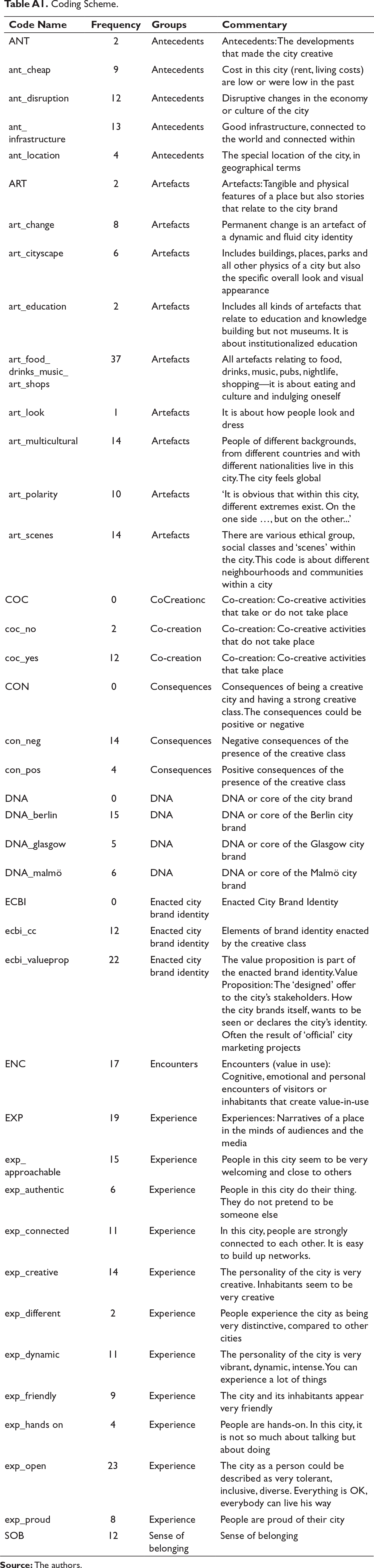
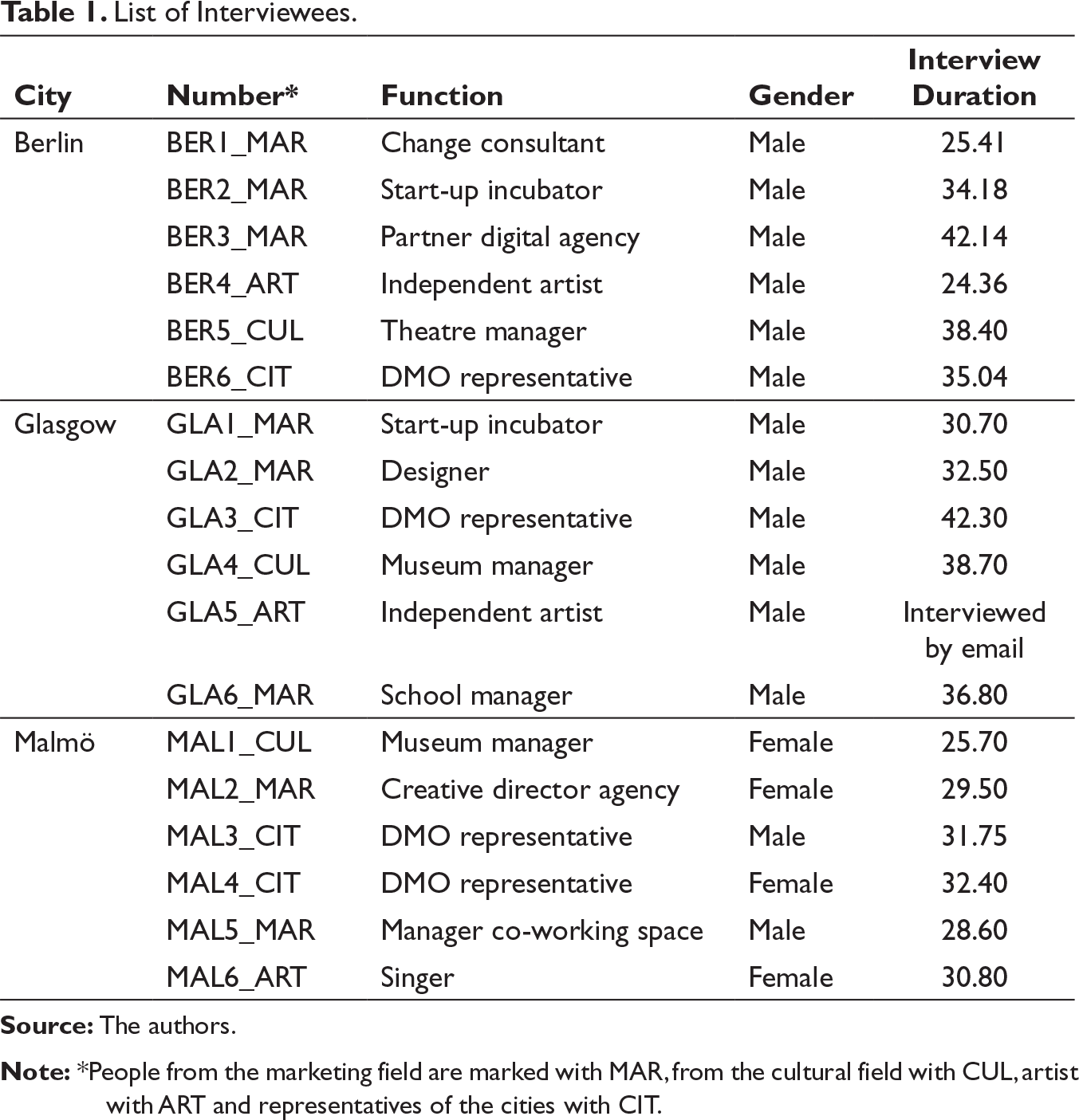
Within the three cities, we conducted 18 semi-structured interviews with people we considered to be representatives of the creative class and with policymakers. To find respondents, we used the snowball sampling technique: artists, museums, galleries and art school managers, social entrepreneurs, creative people from advertising agencies and digital marketing, start-up incubator managers and cities’ marketing representatives were included in the sample. As the interviews with first respondents went on, new participants were recruited until the sample was equally distributed among the three cities, all relevant roles were represented in the sub-samples and further interviews would most probably not contribute to the generation of new insights. The final (anonymized) list of participants is presented in Table 1. Interviews were predominantly carried out face to face or via Skype. The average interview lasted about 35 min. During the interviews, informants shared their views on the contributions of the creative class to their city’s brand identity. The interviews were then transcribed. Data analyses then included various stages (Kauppinen-Räisänen and Grönroos, 2015): first, two to three interviews out of each city were quickly read, and conclusions were drawn implicitly. Then, all interviews were uploaded to the qualitative research software atlas.ti. and analysed individually. The thematic analysis used the pre-developed coding scheme, which was constantly revised and perfected as more interviews and data were considered. Through constant comparison of the codes, the open coding was enriched by axial and selective coding (Moghaddam, 2006). The final coding scheme, which served as a springboard for the development of the conceptual model presented later within the implications section, can be seen in Table A1. During the whole data analysis process, research memos were constantly created to give room to the researchers’ most important ideas (Bringer et al., 2006). Finally, all insights were compared and brought together to a concluding summary. This summary will be discussed within the next section.
Findings
Creative City’s Brand Identity
Like for every other city, the starting point for a creative city’s brand management activities is a clear understanding of the brand identity. The DNA of the three cities included in our sample was described with words such as ‘freedom’, ‘change’, ‘cosmopolitan’, ‘spacy’ and ‘creative’ for Berlin; [multiple sources], ‘forward-looking, dynamic and ‘open’ for Glasgow [GLA3_CIT]; and ‘creative, young and multicultural’ for Malmö [MAL1_CUL]. But a city’s brand identity is nothing that gets constructed—it has emerged over time, sometimes for hundreds or even thousands of years, and is present even if people are not aware of it. How it emerged is not always clear, but interviewees in our sample agree on two things: first, it does not seem to be a planned process, steered by someone in the background [‘without a marketing mastermind behind it’; BER6_CIT]. And second, the development of a city’s identity can be described as a circular or even chaotic process: ‘Did the city brand come first and did it have something for us or did the creative scene come and shaped the city? This is probably a cycle that also strengthens itself, which makes it totally strong’ [BER3_MAR]. Therefore, it appears logical that brand identity cannot be artificially built, but with the goal of later influencing it, it can be analysed in a structured way, as a representative of the Glasgow sample described it:
So the place brand identity of Glasgow is founded in a core principle that people make Glasgow. So, we undertook an exercise about 5 years ago and we were looking at how we sell the city and how we present the city, and what we did was we asked questions of those who had chosen Glasgow as a place to live, to study, to work, to invest. We asked the people of Glasgow, we asked state-quarters within the city, and that was across industry, and all of our kind of key sectors. And it also included academia. And we asked a simple question: what makes Glasgow great? [GLA3_CIT]
The results of such an analysis are often amazing, which points to the fact that not all official brand management activities of the past have had results as anticipated by the city’s management. ‘The brand essence, as we have researched it, amazed us. Some might want to bring it about like this, on us, it is more or less imposed. The Berlin brand essence is actually freedom in different meanings of the word’ [BER6_CIT].
Enacting a Creative City’s Brand Identity Through Enactment Stakeholders
In the context of creative cities, brand identity gets influenced by different stakeholders to various degrees. Our study shows that DMOs and the creative class are both important stakeholders in the enactment of a city’s brand identity. But whereas DMOs enact a city’s brand identity in a more rigid way, based on formal value propositions and on a brand strategy that was developed after analysing the brand, members of the creative class do this more intuitively and spontaneously, and their personal identities as well as artefacts created by them play an important role within this process.
Destination Marketing Organizations and the City’s Value Proposition
DMOs play a crucial role in the enactment of a city’s brand identity. Their formal representatives usually initiate ‘the official’ brand management process by analysing the brand, as the following example of Berlin shows: ‘And that’s why we started to investigate our brand in more detail. So according to the motto: What does the world like [about Berlin]? Self-perception and external perception often diverge, and then we tried to understand that’ [BER6_CIT]. Often, this process leads to a grounded understanding of what makes the city special, as it seems to be true for Glasgow: ‘Obviously, they have the kind of ‘the people make Glasgow’ campaign and, I mean, it’s a very accurate description of the city’ [GLA2_MAR]. Based on the brand insights, DMOs tend to move on within the brand management process by defining a brand strategy and implementing it consecutively to build up brand equity. Once the strategy is set, it is followed more or less rigorously in the various brand-building activities, like in overall approaches to storytelling or in more concrete communication campaigns: ‘I’m not who started to spin that story but it’s definitely kind of a story about Malmö which I think kind of reflects the changes that have happened and I think that the city or the region likes to spin that story’ [MAL2MAR]. ‘[Creativity] was the figurehead of the city, which was particularly important and I know that in the beginning we tried very hard to convey this figurehead’ [BER4_ART].
The Creative Class as Implicit Enactment Stakeholders
Very different to the explicit and rule-based enactment of a city’s brand identity through DMOs, members of the creative class enact a city’s brand identity more implicitly: ‘And in this chaotic process, people have reinvented themselves in a way that we are now amazed to find that it obviously appeals to the world’ [BER6_CIT]. The creative class changes the way a city looks and feels, mainly (a) through creative artefacts and (b) through their personalities.
List of Interviewees.
Other Enactment Stakeholders
Even though DMOs and members of the creative class are important stakeholders in the enactment of a creative city’s brand identity, it must not be neglected that others—people living in the city and visiting the city—are also contributing to a city brand’s identity: ‘I think everyone is important in making Malmö a great place’ [MAL3_CIT] expresses the importance of all people in the city brand-building process.
Stakeholders’ Encounters and Experiences
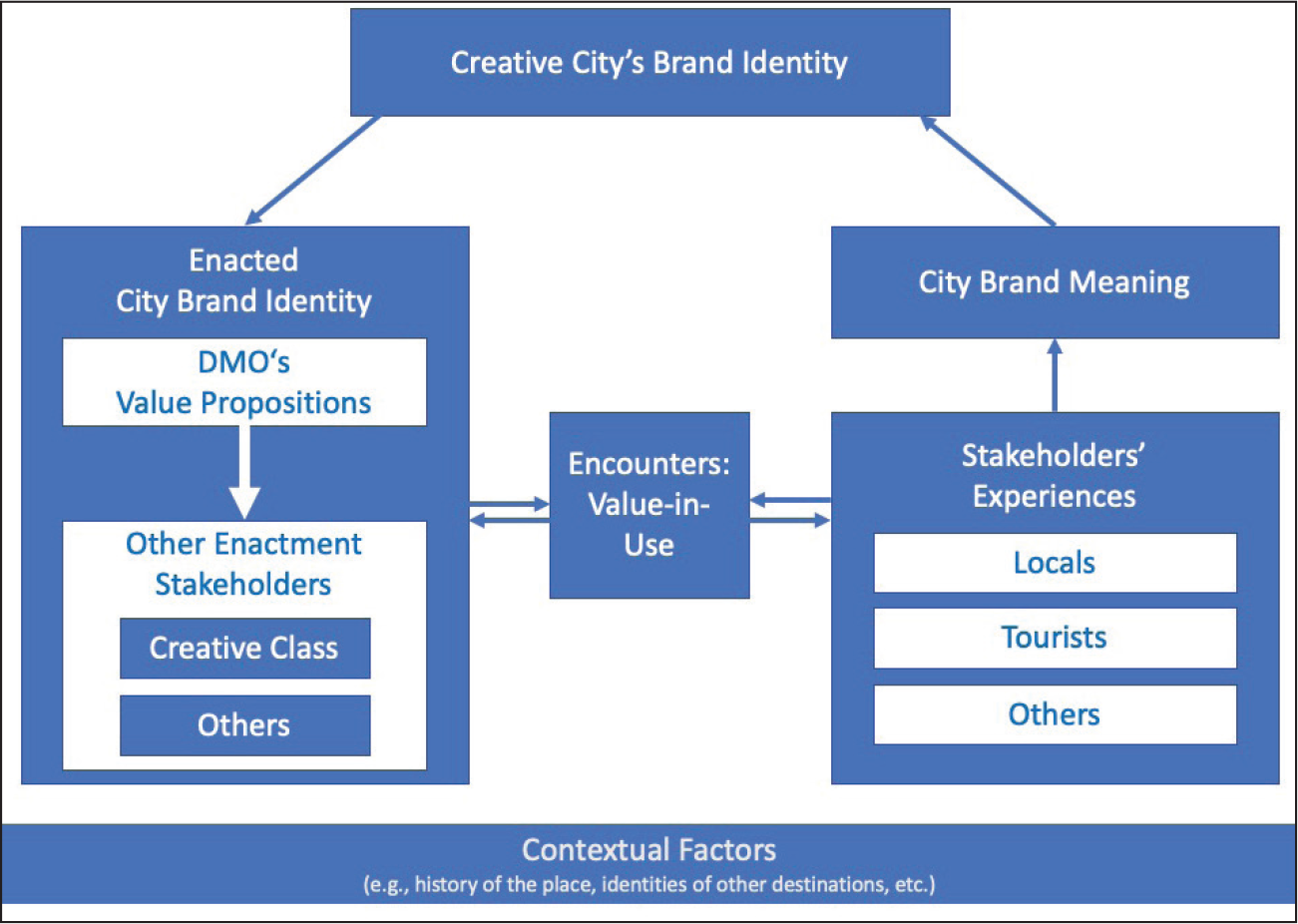
Stakeholders’ enactment of the city’s brand identity results in explicit or implicit value propositions. Only stakeholders’ encounters with those value propositions can create value-in-use for them (Grönroos & Gummerus, 2014; Sandström et al., 2008; Vargo & Lusch, 2004, 2008). The creative class plays an important role in the quality of such encounters: ‘they’re fantastic ambassadors to help you to see, to smell, to hear and taste’ [what the city has to offer] [GLA3_CIT] and ‘so people who then work within that creative class or cultural class would be key to delivering the aspirations of the city’ [GLA4_CUL] express the important role the creative class plays in the delivering of the brand promise. Whereas single encounters are important but rather limited in their overall impact, stakeholders’ experience of a place is more powerful and created through multiple encounters with the enacted place identity. Brand experience can be defined as ‘sensations, feelings, cognitions, and behavioral responses evoked by brand-related stimuli’ (Brakus et al., 2009, p. 52). They represent past and present lived experiences of value beyond the current situation (Frow & Payne, 2007; Helkkula et al., 2012; Tynan et al., 2014). In the case of creative cities, the specific combination of artefacts and affective characteristics of those cities makes it easier to experience the city’s identity, compared to other cities: ‘it’s a place where you can live when you want to experience a lot of stuff’ [MAL2_MAR] and ‘that is what characterizes the image of this city: It happens every day something new’ [BER4_ART]. People connect with those cities more easily (‘you want to be part of the city’ [MAL3_CIT]); they drift along and are open for new experiences (‘what I find really exciting is that [around this area, I have done] 5 guided tours with different city guides […] and we always walked through the same streets and I have always discovered the city differently’ [BER5_CUL]); and the days are not foreseeable and planned, as it may be the case in other cities (‘if you’re in Paris, you know how a typical day will pass: You go shopping, you go to a great restaurant with great food, and in all these places you are surrounded by people who do it all professionally’ [BER2_MAR]). Our study also shows that visitors, tourists and businessmen alike may even absorb part of the city’s identity:
I notice that business people who are interested in working with us want to have a lot of what Berlin is all about, namely not sitting in a formal office with people in a suit, but with people (…) wearing sneakers and sitting on a bulky wastecouch in a creative loft’. [BER1_MAR]
The presence of the creative class is also a strong differentiator for every city, and it may be the strongest reason for tourists to experience a city a second time, as the following quote of one respondent shows: ‘I believe, for those who are looking for something different, perhaps those who come for the second or third time, it is only the creative class that makes a difference’ [BER2_MAR].
Co-creation of City Brand Meaning
It has for long been argued that strong brands possess a clearly defined identity that makes them attractive. The identity builds on an enduring brand core and on brand values that stakeholders experience along various brand touch points. This continuity provides a rather stable perception of the brand over time and serves as a framework for all brand-related activities. Nevertheless, under the more recent co-creative view of brand management, a well-defined identity does not imply a fixed meaning (Ind & Schmidt, 2019). Brand meaning can be defined as a reflection of ‘internal and external stakeholders’ mind-set about a brand’ (Veloutsou & Delgado-Ballester, 2018, 256). Brand meaning is created by a company’s and its employees’ communications and actions, but it is also adapted through other stakeholders, for example, ‘by consumers who create relations, emotions and communities around brands’ independent of the organization (Kornberger, 2010, p. 248). Because stakeholders attach their individual meanings to a brand, the brand’s identity changes continuously. As Coates (2019) puts it, ‘brand identity is kaleidoscopic, a dance of meaning based on context and conversation’.
Our study shows that in the context of creative city brands, stakeholders’ experiences, based on their personal encounters with the city, are influential in creating brand meaning. ‘The brand that I myself perceive is in line with the perception of people who come to Berlin: Berlin equals freedom’ [BER2_MAR], ‘I feel Glasgow is full of substance’ [GLA1_MAR], or ‘there’s more room for trying stuff in this area and there is already, maybe most important, that perception so it becomes itself a reinforcing flywheel’ [MAL2_MAR] may be quotes that show individual facets of brand meaning for the cities such as Berlin, Glasgow and Malmö. Stakeholders’ experience of a place, through the constructs’ influence on brand meaning, changes the place brand identity over time: the mix of both brings new rhythms and forms of expression to the cityscape.
Contextual Factors
Certainly, the process of a creative city’s identity development, which was described previously, is also influenced by contextual factors, like the history of the place or the identities of other destinations. How a city developed over time, where it is located, the city’s infrastructure and how other cities position their brands have, among multiple other factors, influence on a city’s brand identity, its enacted brand identity and its brand meaning. However, these contextual factors are not in the focus of our study because they are not specifically relevant for creative cities. In this regard, creative cities do not differ from other, less creative cities.
Discussion
Our study contributes to a better understanding of how the identity of a creative city is created and sets the ground for further studies in this regard. Our findings support the assumption that it is crucial to understand the relationships between people and places in order to develop a place brand (Aitken & Campelo, 2011) and understand its DNA. The management of a city brand, especially for creative cities, can be interpreted as an enduring negotiation between different stakeholders (Merrilees et al., 2012), where the creative class plays an important role. Indeed, our findings demonstrate that the creative class is an active stakeholder in the brand-building process of cities with different sizes and tipologies. In other words, the creative class enacts naturally the creation of the brand meaning and genuine value linked to the intrinsic characteristics of a place.
Our study also underpins the relevance of the co-creative perspective of brand management, by describing the ongoing, open and fluid brand management process (Iglesias et al., 2013) in the context of city brands. Indeed, some city brand identity emerges naturally over time and is steered by several stakeholders. Brand meaning, even though created through the actions of all participating parties (Ind & Schmidt, 2019), highly depends on encounters of stakeholders with the enacted brand identity, and therefore, DMOs are not in control of the brand management process, in the case of creative cities even less than for ‘normal’ cities. Instead, DMOs act as facilitators of the value creation by giving voice to the city’s stakeholders and allowing them to build the value proposition sometimes out of chaotic and genuine processes. This approach allows the creative class to express itself through different kinds of creative artefacts and co-create value with locals, tourists and policymakers.
Figure 1 summarizes our findings by providing a conceptual model that could be useful for further research activities. For example, based on our findings, researchers may want to measure quantitatively the impact of the creative class on the overall perception of place brands. Since there is no doubt that multiple forces, such as the history of the place, stakeholders’ perceptions of other destinations and current developments, influence the fluid process of identity building, for creative cities and beyond, the model also includes those contextual factors.
The results that we presented in this article are not only relevant for research but the contribution of our study to the practical management of a city’s brand identity is also manifold, and our insights enable representatives of creative cities to understand how the creative class co-creates and contributes to their city brand identity. First, top-down approaches to the management of a city brand will not work in the context of creative cities. Our study supports the notion of Ind and Schmidt (2019, 104) that ‘brand managers have to give up the idea of total control over a brand and accept instead a fluid, uncertain world where strong brands are co-created together with others’. Or as an interviewee from Glasgow puts it: ‘And I think as I said if a rocket-scientist and a musician and a destination marketer come together that’s not a bad thing’ [GLA3_CIT]. This is more than true in the context of creative city brands. Therefore, to not fully lose control, DMOs should continuously generate and interpret insights about their brand and use those insights to shape and adapt their brand’s identity, simultaneously, with other stakeholders. Second, the role of the creative class should be enhanced as to facilitate a place brand identity, aiming to be more dynamic, reciprocal and interactive in nature (von Wallpach et al., 2017). As such, policymakers should understand what is the value-in-use generated by each element of the creative class in the brand identity process. Third, representatives of creative cities must be aware that the creative class plays a key role in delivering the brand message: ‘So people who then work within that creative class or cultural class would be key to delivering the aspirations of the city’ [GLA4_CUL]. Fourth, DMOs should acknowledge that the place brand identity is dynamically co-created and should be audited yearly as to explore new city brand meanings as the result of the creative class activities. Lastly, a co-creation approach to place brand identity benefits businesses and tourists by offering a dynamic and unique value proposition that makes a creative place attractive to work, live and visit.
Limitations and Research
So far, insights into the impact of the creative class on a city brand identity are scarce and predominantly anecdotal, and to our knowledge, corresponding studies do not exist. Even though this article provides first ideas in this regard that are highly relevant for city branding and, consequently, for the hospitality and tourism industry, there is still the need to investigate deeper on how policymakers can facilitate a multi-stakeholder orientation in the process of place brand identity formation that includes the creative class and other potential enactment stakeholders. Therefore, more academic research is needed to identify the drivers and barriers of the process of place brand identity formation in the context of creative cities. Additionally, more efforts are needed to analyse how DMOs can co-create effective place brand strategies within a dynamic city’s ecosystem that includes several enactment stakeholders, by addressing, in detail, its social, cultural and economic dimensions. Our qualitative research was a start to bring researchers’ attention to this important topic—hopefully, more papers will follow. Lastly, this article is limited to the study of three creative European cities. It would, therefore, be relevant to investigate how the creative class co-creates city’s brand identity in a cross-cultural perspective.
Appendix A
Coding Scheme.