Abstract
What are the views, thoughts and visions of an agile software development savvy CEO on how companies will be creating value in times of digitalization? Guest editors of this special issue Marcel Kwakernaak (MK) and Martijn F. Rademakers (MFR) have interviewed the CEO of SeMI Technologies (from semantic machine insights). SeMI Technologies, an American-Dutch technology startup, is seen as a serious player by investors and developers at, among others, Google. A version of the machine-learning-based search engine developed by SeMI Technologies also runs on the website of the Creating Value Alliance (
This interview with Bob van Luijt promises a rich harvest of ideas and insights from a remarkable millennial CEO, artist and university drop-out. Topics range from tech to strategy and organization: from the way databases function to how organizations can make themselves more attractive to the talents they need to create value through the development and application of digital technologies. Readers of this journal might like to explore the interview and compare and contrast it with the opinion piece ‘Where Does Consumerism Stand Today?’ by Philip Kotler. Taken together, both articles take us to the past, present and future of value creation and destruction, and are likely to spark new ideas and visions.
What makes our search engine different from existing ones is that it comes with a built-in machine learning model. So, for example, if you have a document about the Eiffel Tower but you do a search query for ‘landmarks in France’, then our search engine understands that there is a relation between the Eiffel Tower document and your query. As a result, it can show you those results. We sell this technology to companies. It is a B2B proposition. Our customers use it in their stack to enhance their own product and build on it.
We create value with our open-source search engine. However, how we manage to capture value, that is, making money with it is not always understood. I get questions about that quite often, and I like to explain more about this issue.
The reason is that I believe that money is a way in which we can measure the value that we’re creating. I did that for the first time when I was 15 years old. I was working for a business where I had to unpack toothbrushes with names on it, like ‘Marcel’ or ‘Susan’. The man running that business thought, ‘We can sell these things online, but who can build the necessary website for us?’ I was 15 years old and I said, ‘I can build you a website!’ So, he asked me, ‘How much money do you want for it?’ I said, ‘I don’t know.’ I asked my dad and he said, ‘500 euros’. 500 euros is a lot of money for a 15-year-old kid! The shop owner said ‘yes’ to the deal, and that’s how my career in IT started.
Next, I decided to study art because I wasn’t thinking of continuing to work with software. Instead, I started studying music in the Netherlands and the USA, and there I had a teacher who told me: ‘Well, if you’re also working with software, there’s this whole new way of being creative in the world’. Although I was already making money with software, I did not think of it in ways of me being able to be creative with it. But that changed.
More and more people started hiring me to ‘do’ software development for them, and as a consequence, I never finished my master’s degree. My business was growing too fast and took all my attention. As a freelancer, I soon got hired by several corporates. However, I still struggled with the question about what value I was creating. Why was it that people wanted to work with me as a 20-something young guy?
Gradually, I started to understand a bit more about creating value through software development. I saw that software developers have lots of opportunities to unleash their creativity in solving problems for others. Software development is not only about technology. To me, solving problems is at the heart of value creation. Sparked by this notion, I’ve been doing a lot of introspection and also research for my business to learn how we both create and capture value.
However, you can only make money in business if you create value. Try starting a business that does not create value for anyone and see how well your business performs over time. I don’t think it will perform well. There is a weird catch-22 situation, though. Making more money does not mean creating more value. Imagine that we are successfully creating value with our company, which we can measure by the money we make. If we continue creating more value and capture it, and everybody wants to have our stuff, we eventually end up as a monopolist. This is what happened to Microsoft in the 1990s, and current big tech firms might be moving towards. Unfortunately, monopolists are not known for their eagerness to create (new) value for their customers. So that’s why big organizations can build horrible products, destroy value and still make so much money. In that case, value creating and making money are certainly not the same thing.
Before starting SeMI Technologies, I often got questions about business problems relating to unstructured data. They asked me to solve that problem. I found out that this would require very complex machine learning models. Next, the idea emerged to create a search engine with a built-in semantic understanding of what the unstructured data means. Hence, instead of paying a lot of money for expensive data scientists taking a lot of time to build a project around unstructured data, companies now can get the search engine as a ‘solution in a box’. They can be up and running within a week or two. So that’s the opportunity that I saw and how I define the value we create, and capture, when solving a problem. It must be said that ideas like this, to me, are just waiting to be discovered.
What we’ve learned is that in the world of bits and bytes, the amount of value we can both create and capture is much higher than in the world of atoms. For example, if I would build a designer chair that is worth USD 1000, and at the same time I create a software solution for USD 1000, then most probably the markup that I can take from software is significantly higher than that I can take from the chair. Every next chair takes manual work and materials, whilst we can just replicate software by making a copy by pushing some buttons. This is explained by Peter Thiel in his book Zero to One (2014), in which he argues that it is very expensive to create software when going from having no customer (zero) to the first (one). Twitter can be used as an example here. If you would create Twitter at the start, going from zero to one customer, this would be very expensive because you need to build the database structures from scratch. But if you go from the first to the second user, and so on, that are just rows to add in the database. It means moving from a few million dollars investment for the first customer towards a fraction of a dollar investment for the second one. Also, you will enjoy the network effect based on the principle of ‘the more people join in, the better it works’. This is also why we see on these growth charts that traditional products show linear growth, whilst software products show exponential growth.
I would argue that the growth of software products is related to the value that is created. That’s why it is interesting for businesses to invest in digital solutions and digital products. It is just easier to build it with a small team and scale it globally through the Internet, as opposed to what we can do with physical products that need to be distributed physically. Apart from that, even physical products can be enhanced with the help of ever-better software. For example, take the business of making cupcakes. The first thing that I would do if I were a cupcake maker is getting to know more about the cupcake customers such as preferences on how and why to buy them, where to eat them and more. That’s what you can do in the digital space. As soon as you know more about that, things can be connected through the software the factory is running on. Think of enabling, for instance, customers to order their favorite cupcake online while the automated factories run 24 × 7.
There’s a simple experiment that you can do in your organization to understand why that’s a problem. Just go to the marketing department and ask somebody to help you create a data model to represent our customers: ‘please explain to me the key characteristics of our customers’. You will get an answer. Thank you very much, you say, and then you go to the R&D department and ask the same question. Most probably the R&D department is going to give you a definition of the customers which does not even overlap for half with what the marketing department. The same thing will happen if you would ask the sales department and so on. What to do about it is: work the other way around! Get rid of the silos! Start making a definition for what we believe an attractive customer looks like and now the business has to adapt to these definitions. In this way, you can move and innovate much faster (some call it more agile). A barrier to overcome, though, is that software development and data structures are going to drive new value creation, and not everybody will like that to happen. A lot of businesses are reluctant to do that, and I believe that the reason that they’re reluctant is that for a lot of people software and data structures are still a black box. Others might fear for their job, although they might forget that other companies will seize your customers if you don’t move, and you lose your job for sure.
The opposite happens at companies like the Airbnb and Google of this world. They have people in a senior leadership position who understand that digital language; they even speak the language themselves. I think it is crucial for companies to have people on board who speak both business and software development language. It is important because most companies will either transform into software-driven organizations or be disrupted by them. For example: Amazon has moved into a lot of seemingly unrelated businesses. Amazon can do that successfully because it is a software company in the first place.
Another thing is that if you work as a software engineer for a company like Google, you are a small fish in a big pond. If you work for a mid-sized company with a clear vision, you can be a big fish in a relatively smaller pond and have more personal impact.
Search engines are in the middle of the stack. So, to understand the end value that is created, you need to follow this whole chain to see where the end value is created. In the case of Airbnb, it is a person typing on their phone looking for a place to stay. If you go down in that stack you go deeper into abstraction. It is easy to see what the problem was that Airbnb solved. If you go down in that stack to for example the database and want to understand the problem that has been solved, the language that is needed to express that is a little bit more abstract, which makes it a little more difficult to explain what it is. You can try to take away as much as you can, but the abstraction will always exist.
The SeMI search engine/databases are open source, and they come with an open-source license which means you can use them for free, but if you have an issue with them or if you have a problem that occurs, you know that it is your problem. To solve that problem for customers who like the software, but not wanting to solve problems themselves, SeMI sells a range of different licenses. You get the exact same software; only the licenses are different. An enterprise license is interesting for our customers who are dependent on our software for millions. They are happy to pay for that license because they don’t want to solve the problem if anything goes down. They want to be able to call us, it’s like a guarantee for them.
The good thing about the open-source approach is that I don’t have to go on stage and explain we have this fancy AI-based machine learning technology that’s going to solve all your problems. Instead, I can say, ‘Hey, this is the problem that we solve and if you want to try it out if you want to experiment with it, here it is.’ If people want to build their business on top of that without paying us for that, they are free to do so. Some startups do it; may be even bigger businesses than I’m aware of.
An Example of a Stack and Companies Involved Per Layer
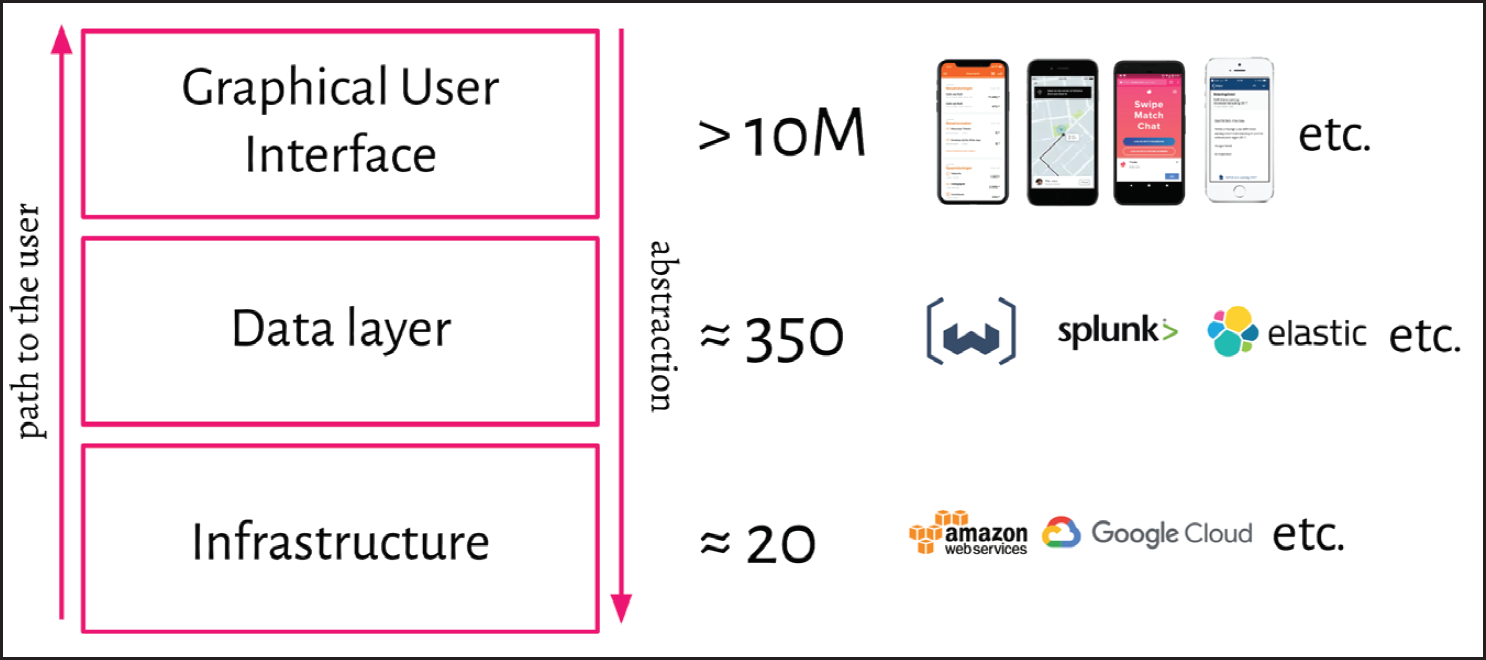
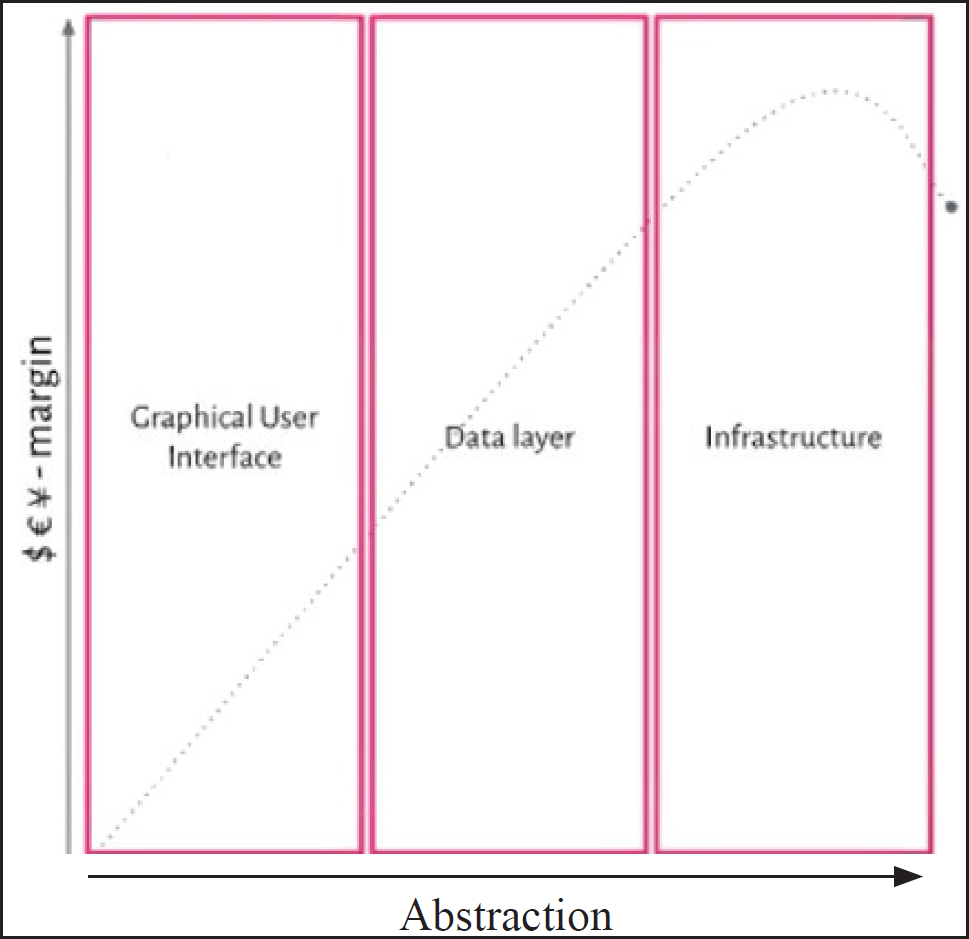
There’s a reason why that is not a problem for value creation. Let me show you something that I very often talk about. If you look at the bottom of the stack (see Figure 1), the infrastructure players are roughly 20 big players like Amazon Web service cool clouds. In the data layer where SeMI sits, there are, roughly speaking, roundabout 350 players. If you look at the graphical user interface layer where the actual end applications sit, you have millions of players, right? This is where your banking app and your Airbnb app are. Now, why is this important to value creation related to open source? If I plot this stack sideways (see Figure 2), then I talk about the abstraction of the problem that needs to be dealt with. In the infrastructure layer, the abstraction is very high; and in the graphical user interface, the abstraction is very low. The margin I can make on these products that I sell is significantly higher in the infrastructure layer than in the graphical user interface layer.
I can give you some numbers. I believe that Uber has a margin of about less than 0 per cent, but if you sell CPUs as Google Cloud does, you have a margin that goes into more than 50 per cent. In our case, the fact that we make it open source available allows others to use it against $0.00 if they’re willing to take the risk of solving the problems that might come from it by themselves, problems that might be difficult to solve because of the abstraction level. But if we sell it with a license, then the margin is so high that we can easily sustain the open-source ecosystem. So that’s how I feel that open source is a good basis for a healthy business, but not if you’re operating in the top layer of the stack (the Graphical User Interface). You must be somewhere below the top of the stack, because otherwise your margin is not high enough to capture enough value to sustain the open-source ecosystem.
The Stack Seen Sideways (Margin vs Abstraction)