




Abstract
Organizations have become increasingly aware that customer value creation is critical to remain relevant and to stay in business. Hence, most organizations have incorporated these elements into their overall mission statement and their organization-wide strategy. Yet many of them struggle to create an organization where employees focus effectively on executing the formulated strategy and on delivering and continuously improving customer value. This article describes how clever and tailored design of goal realization in organizations can foster value creation and embed it in the daily work routines of employees. The key to success is to adopt goal realization in such a way that it creates an environment where employees feel safe, empowered and confident to go after aspirational, value-based goals while creating alignment and connecting employees to the overall goals and objectives of the organization. This is illustrated in a practical manner by presenting the framework as adopted by Google.
Introduction
Organizations are facing a rapidly evolving business environment. Technological and digital advancements increasingly allow customers to judge and compare product quality or service delivery. And with the advancement comes increased expectations, forcing companies and organizations to continuously improve the value they deliver. Denning (2013) refers to this as the Copernican revolution in management:
… a paradigm shift from the 20th Century view that customers revolve around the stationary ‘center of the universe’—the value chain of the organization—to the view that the organization is one of many organizations revolving around the customer. The organization survives and thrives only so long as it is agile enough to meet the customer’s shifting needs and desires.
Companies are responding rapidly to meet these new realities through redesigned strategies and organization-wide (transformation) programmes. Ways of working are changed to enable fast responses to customer feedback and changes in customer demand. Client experiences are visualized and improved through customer journey mappings. Activities are focused on creating great customer experiences and customer delight. Customer value delivery and customer centricity have become central themes in mission and vision statements and are translated into strategies with formalized goals and objectives attached to it. Many, however, struggle with the execution of their programmes. Failure rates are high, and the results achieved are often well below the ambition. Especially companies with legacy struggle to make progress to transform into agile businesses where customer value delivery has become part of the DNA of the organization.
Simultaneously, there is an increasing awareness that employees are a critical factor for organizational success. For most products and services, the human factor is crucial for the quality and functionality that is offered, the speed at which improvements are realized and at which innovation or redesign takes place. Hence, customer value creation crucially depends on the behaviour and contribution of the employees. Insights from psychology and neuroscience show us that in order to create an organization that is high performing and that delivers breakthrough results requires addressing the psychological needs of people. As long as these are unfulfilled, organizations will not be able to truly capitalize on their programmes that target customer centricity and customer value creation.
This article shows how the set-up of a goal realization framework can be used by organizations to speed up customer value creation and delivery. The approach requires explicit attention to tailoring the framework, in order to create drive in the organization, and to foster crucial elements such as psychological safety and trust, autonomy, a sense of purpose and impact of work. In order to do so, the goal-setting framework basically needs to incorporate six key characteristics that directly relate to the psychological needs of employees. This will activate, engage and guide employees towards making significant contributions in terms of value creation. The envisioned approach differs fundamentally from traditional goal-setting and strategic planning practices.
The next two sections substantiate the two challenges that were mentioned earlier regarding the increased need for organizations to become focused on value creation and the challenge of organizations to successfully execute on strategic priorities, such as transforming the organization towards a customer-centric organization. Subsequently, the article provides relevant insights about the human factor of creating organizational success and identifies some crucial elements that impact the degree to which employees will actively contribute. These insights are then taken into account for the design of goal realization. In the final part, we take a look at the framework that Google has used basically since setting up the organization, and that fits very well with the proposed key characteristics.
The Value Creation Challenge
‘Value is a slippery word’, according to Pinder (2015). Using his framework, value can be defined in a fundamental way as Value = Benefits minus Costs. Both Benefits and Costs include a wide range of components, including items such as risk, reliability, ease of use, functionality and considerations that relate to emotional or societal reasons (e.g., through signifying status or a person’s values). In addition, Value is judged in relative terms instead of absolute terms. This means that even if the Value of a service or product is positive in itself, it may not be in demand if alternatives are available that offer a higher Value.
In a stable environment where technological advancement is slow or gradual and where customer preferences are stable, maintaining or incrementally improving the Value offered by slightly increasing the difference between Benefits and Costs year on year will suffice to stay successful (provided that the organization has an attractive starting point for the Value delivered). For most organizations, though, the current reality is quite different, as they are confronted with a fundamentally different setting for value creation so that sustainment or incremental improvement will not suffice:
through technological progress, Benefits and/or Costs of products and services can be improved rapidly and significantly;
products and services are available and accessible to larger geographical client bases due to lower cost of transportation, remote access and better communication possibilities; and
a higher degree of transparency on performance and price enables customers to better compare the value delivery across suppliers and service providers.
The value creation challenge can also be neatly illustrated through the Kano model, which was developed by Professor Noriaki Kano in the 1980s. The model links customer satisfaction to the level at which a product or service achieves (‘implements’) what it is intended to offer. For goods or services that relate to a basic need, satisfaction is not achievable even if the product or service fully delivers in terms of quality/functionality. For so-called delighters, even with some defects or malfunctioning, customers may be satisfied due to the delighting elements that are still offered. This is shown graphically in Figure 1.
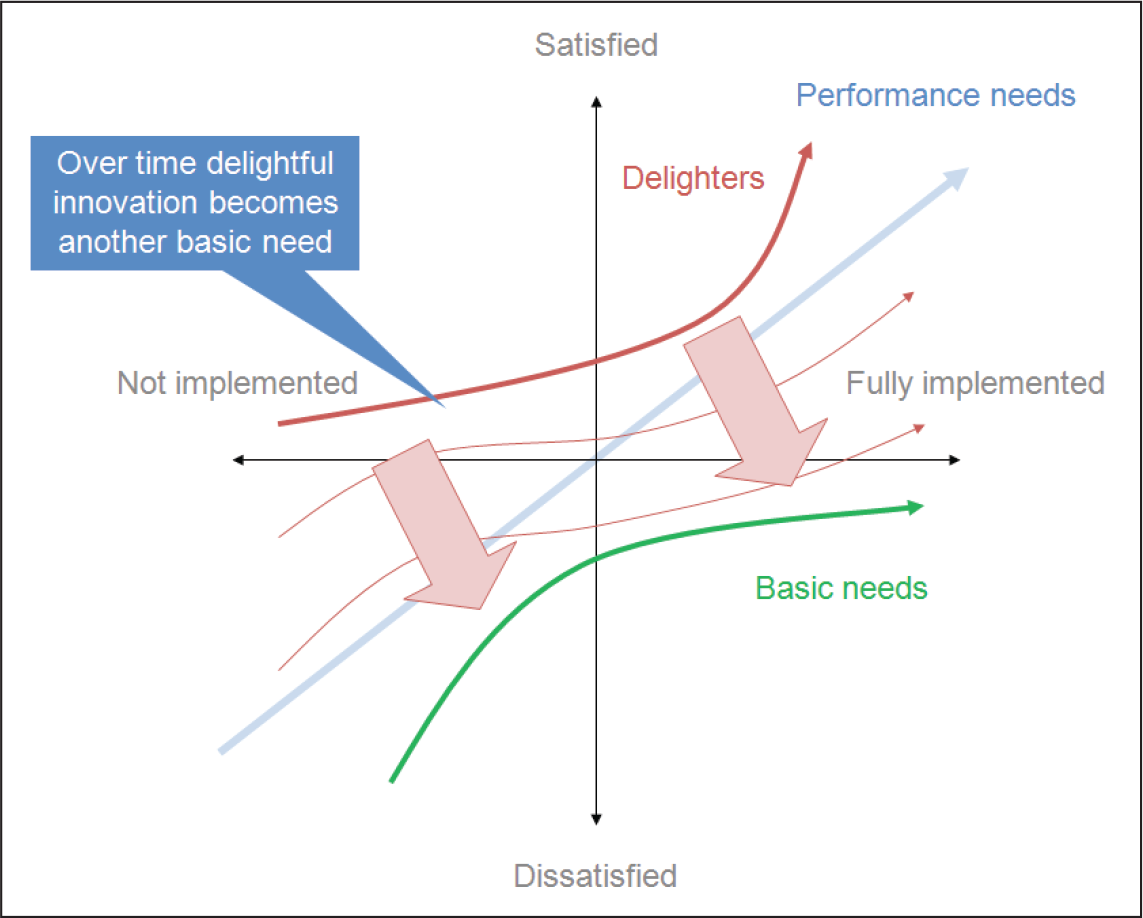
The relevance of the Kano model for our purposes is that over time, products and services move to the lower right-hand quadrant of the diagram. Things that delight us now will become basic needs in the future. This is represented by the two arrows in the figure. The current dynamics that organizations are facing is a strong increase in the speed at which products and services move towards that quadrant. Maintaining current product and service levels while gradually decreasing the price/Cost implies a significant drop in Value for customers as the perceived benefits have moved in the direction of the arrows.
The above implies that many organizations will need to put significant effort in understanding the needs of their clients and to improve the quality, functionality and costs of their offerings on a continuous basis, in order to maintain an attractive difference between Benefits and Costs. And for several, the improvement will need to be significant if they operate in an environment where emerging technology disrupts existing business models. This brings about the need to fundamentally transform the organization not only in terms of the way of working but also in terms of mindset and culture.
The Execution Challenge
‘Ideas are easy, execution is everything’, Doerr (2017). To deal with the new reality and to refocus the organization towards continuous value creation require a consistent and well-designed approach. Many organizations therefore put value creation or customer orientation central when generating their mission, vision and strategic priorities. These then find their way into strategic initiatives and (transformation) programmes.
But translating strategy into results turns out to be a real challenge. According to Sull et al. (2015), around two-thirds to three-quarters of large organizations struggle to implement their strategies. Their surveys show that executional excellence ranks high among the concerns of chief executive officers (CEOs). Mankins and Steele (2005) report that strategies tend to deliver only around 60 per cent of the potential value, while in a recent survey performed by the American Management Association, around 60 per cent of the respondents rated their organization at a 3 or lower (on a 5-point scale) at executing strategy.
Holweg et al. (2018) find that programmes to create continuous improvement using customer-centric ways of working, such as Lean, Six Sigma and Agile, tend to backslide after promising starts where the level of successful implementation drops to one in three. They conclude that ‘...our findings debunk the myth that a “continuous improvement culture” will emerge amongst workers and staff that sustains improvement efforts’.
These high failure rates are confirmed when employees are asked about their company’s business strategies. Less than 10 per cent tend to respond that they fully understand the strategies and know what is expected from them, in order to contribute to the realization of the company goals (Doerr, 2017). FranklinCovey (2004) finds that in an extensive survey of around 11,000 people from hundreds of organizations, only 45 per cent of the respondents state that they understand the most important goals of the organization, and around 50 per cent indicate that they know what to do in order to contribute to the realization of overall company objectives. And when analysing 124 organizations, Sull et al. (2018) find that only around 30 per cent of executives and middle management is able to list at least two-thirds of the strategic priorities of their own companies, while one-third of the respondents was not even able to mention one. Even among executives, they find poor scores as only half of them were able to reproduce all or all but one of the priorities. In addition, they find that employees from C-level to team leaders struggle with understanding the link between strategic priorities and all the initiatives that take place.
Problematic figures are also reported by studies that zoom in on employee engagement. Gallup, a leading research and consulting organization on employee engagement, defines engaged employees as ‘those who are involved in, enthusiastic about and committed to their work’. Their surveys show that only 31 per cent of US workers are engaged. Worldwide, the fraction is only around 15 per cent (Gallup, 2017). Obviously, transforming into an agile, customer-centric organization or continuously improving customer value delivery is much harder if employees do not feel committed to their work and are not enthusiastic about their job.
So, what are the reasons behind the lack of success of organizations in reaping the full benefits of their strategies? Obviously, strategy execution is likely to be of a transformative nature instead of business as usual. Hence, the list of potential factors for failure is probably large. But as Sull et al. (2015) found in their survey, the approach that organizations take to execute their strategies look quite sound at first sight. Strategy is translated into objectives, which are cascaded down the organization to create alignment. Progress tends to be measured, and rewards are provided for performance. Planning is done thoroughly with road maps and milestones, and the strategy is communicated (often relentlessly) by leadership. Apparently then, this straightforward, top-down approach does not create sufficient traction with the employees in the organization. Devising or generating a sound strategy is difficult in itself, but getting employees to execute it seems even more challenging.
With the current pace of technological change and transformation of the business environment, creating major progress in value delivery is essential to remain relevant and requires that improvement and innovation take place rapidly. This requires experimentation and risk-taking, acceptance of failure, learning, and open and honest communication. For employees (and leadership) to embrace all that is not obvious. In addition, with the current high level of automation and digitization, many employees are knowledge workers, especially those in white-collar positions. A strict top-down approach leads to passivity among employees and underutilizes the knowledge of those who actually do the daily work and whose input and ideas about what can be achieved and how this is best done are often essential. Clearly, the traditional approach as mentioned earlier will not do the trick. Strategic programmes and initiatives that focus on (rapidly) improving customer centricity, in order to orientate the organization towards customer value creation, need to find a way to overcome the execution challenge.
The Human Factor in Organizations
There is an increasing awareness that overcoming the two above-mentioned challenges has a clear human behaviour component to it that is critical to success. To create an organization where employees are enthusiastic and use all of their knowledge and capabilities to contribute to success requires explicit attention to their psychological needs. There are three aspects that are undoubtedly important for successfully moving an organization towards high levels of customer centricity and customer value creation: employee motivation, trust and psychological safety in the organization, and the presence of high performing teams. Each of these are directly linked to the psychological needs of employees.
Employee motivation is fundamental to an effective workforce in an organization. Monetary incentives and rewards can be helpful in motivating employees, but according to Pink (2009), ‘... the secret to high performance and satisfaction in today’s world is the deeply human need to direct our own lives, to learn and create new things, and to do better by ourselves and the world’. This leads to three elements that will create inherent satisfaction from activities and create intrinsic motivation:
Obviously, autonomy does not mean full freedom and lack of accountability. And the degree to which autonomy can be shaped for employees depends on their specific jobs, the type of service/business and on various other things. But the ability of employees to at least at some degree influence the what, when, with whom and how in their work will motivate. The concept of mastery has a strong learning component to it, and it is all about making and seeing progress in the things that we do. Finally, purpose is, of course, not defined as financial metrics like firm profit and company revenue.
Trust relates to the degree in which employees are willing to accept being vulnerable due to a positive expectation about the intentions and behaviour of others (De Jong et al., 2016). As such, the level of trust that employees perceive impacts their willingness to cooperate; to take risks and make mistakes; and to share their ideas, thoughts and doubts openly. In a psychologically unsafe environment, employees will refrain from this, keep silent and take a narrow perspective on their job and the role they play in the organization.
The presence of psychological safety and trust in organizations can be objectively measured by neuroscientists. This is done by measuring the level of the brain chemical oxytocin, which signals safety. Using this approach, Zak (2017) has shown that trust levels have a significant business impact. He finds that employees who work in organizations that score relatively high on trust, self-report 50–100 per cent higher levels of energy, engagement and alignment with company purpose. Moreover, they report a 50 per cent higher productivity versus employees who work in an organization that scores relatively low on trust. They also earn a significantly higher income. According to Zak, the latter can only be the case if high-trust organizations have a better performance and are more innovative. The evidence of Zak is supported by De Jong et al. (2016). They use meta-analysis on data from more than 7,500 teams. They find that intra-team trust and team performance are robustly correlated.
But how can a feeling of trust in an organization be fostered? According to Professor Zak’s neuroscientific research, there are several ways management and organizations can do that. These include:
Much of the above resonates with the findings of Google (see Rozovsky, 2015). When they internally analysed the characteristics of high-performing teams, they found out that it is not about the perfect mix of skills that makes a team high performing. Instead, they found that successful teams are characterized by five key aspects:
Among these five, the first one turned out to be the most important one as it is foundational, underpinning the other four aspects and essentially relates to a high level of trust.
The above-mentioned aspects clearly point at a significant number of employee-related items that are crucial to the extent to which companies will be able to capitalize on the potential of the human capital of their workforce. In the next section, the design of goal realization in the organization is discussed with the aim to provide a framework that takes these learnings into account.
Designing Effective Goal Realization Frameworks for Value Creation
There is little debate about the benefits of using structured and formalized goal realization in organizations. Specific goals provide a clear sense of what needs to be achieved, and they lead to better performance than non-specific goals, even if the specific goals are easy for employees or teams to achieve (Kleingeld et al., 2011). And if companies want to turn top-level, organization-wide objectives into action, this requires that:
employees understand what it is being pursued by the organization;
employees know what they are expected to focus on; and
efforts and focus are aligned vertically as well as horizontally throughout the organization.
The above-mentioned items explain why many organizations tend to revert to a top-down approach for goal realization where objectives are rigidly cascaded through detailed top-down strategic planning. As described before, value creation, nowadays requires taking initiative, experimentation, failure and learning, extensive (cross-functional) collaboration and frequent feedback (from colleagues, stakeholders and clients). In such a setting, highly motivated employees who are part of a high-trust organization and who work in high-performing teams will make the difference. Hence, the desired approach is to design a goal framework that ensures clarity and alignment, and guides teams and employees to work on the right things, while fostering motivation, trust and team performance. The resulting framework will deviate fundamentally from a traditional framework.
In Table 1, there are six key characteristics that when included properly in the design of the framework will maximize the probability of success. The final column refers to the key aspects mentioned in the previous section that positively impact motivation, trust and team performance.
Key Design Characteristics for Proper Goal Realization
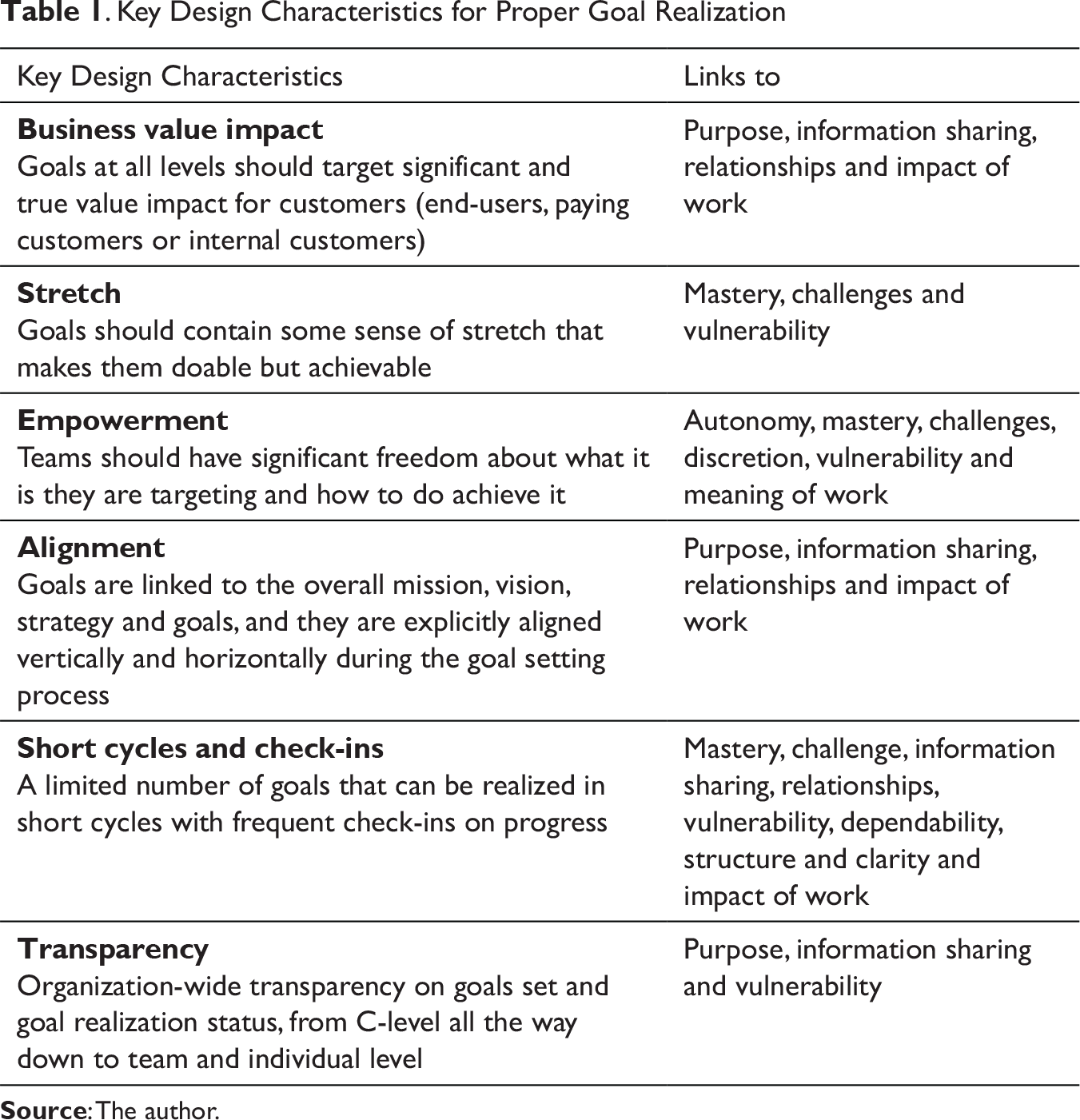
Targeting
The goals pursued should contain some form of
A clear vertical alignment to the goals targeted one level below is obviously needed to ensure that there is consistency from top to bottom. Horizontal alignment is needed to assess interdependencies and to identify what is needed from others. But the benefits go beyond that. By formally building this in, information sharing and relationship building are fostered, both vertically and horizontally, and that increases the level of trust in the organization.
In many organizations, goals are ‘set and forget’ until the time period for which they were set expires and the (disappointing) end result is reviewed. Cadence, rhythm and rigour are key. Although the connotation may be different, they will, in fact, lead to motivation, trust and team performance in the organization.
An Illustration: The Goal Realization Framework Used by Google
Whatever framework for goal realization is used by organizations, the six elements in Table 1 are generic and can be adopted some way or the other in a manner that suits the organization and the context in which it operates. The framework adopted by Google is interesting to look at and can be used to illustrate this. Google uses the so-called Objectives and Key Results (‘OKR’) methodology. They adopted this methodology already in 2000. The methodology was brought to their attention by John Doerr, a venture capitalist who funded them during their start-up phase. Doerr picked up the contours of the concept while working at Intel, where the method was developed building on the management by objectives principles from Peter Drucker. 1
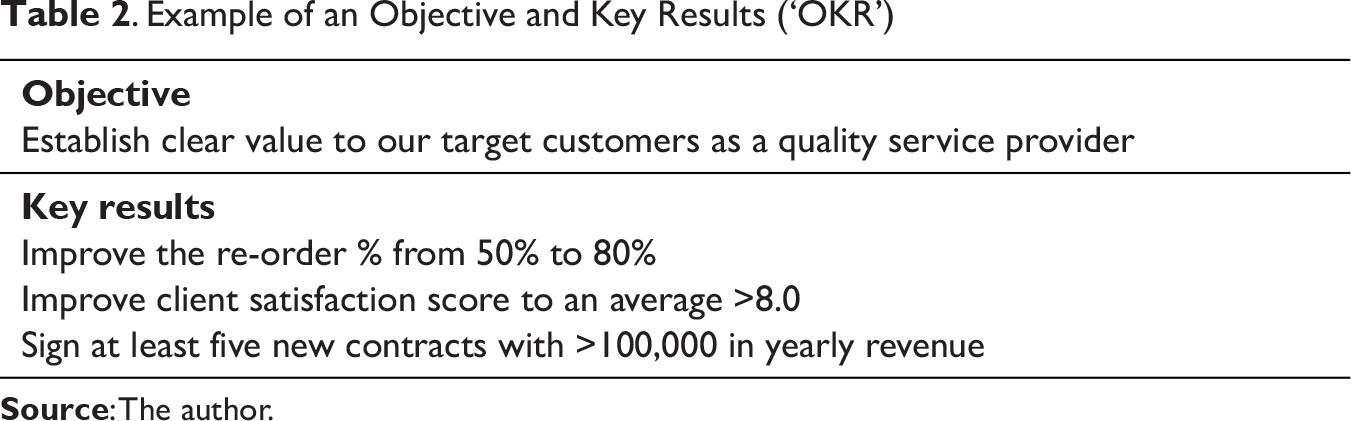
The OKR goal-setting framework is simple and easy to understand. The basic idea is that goals that are targeted are phrased in terms of objectives with key results attached to them. Objectives state what is to be achieved. They need to relate to a significant achievement that is inspirational. Ideally, it is expressed in qualitative terms only. The associated key results state the results that when they are realized, the Objective is achieved as well. Key results are aspirational and quantitative, create a challenge to meet them and allow progress measurement along the way (‘progress-based’). The focus is to realize the key results (as this will, by design, mean that the Objective is achieved). An example of an OKR is provided in Table 2.
Example of an Objective and Key Results (‘OKR’)
At Google, this method for goal setting is then put to work throughout the entire company. The way Google set up its framework is outlined in their OKR playbook, which is publicly available. Table 3 shows how each of the six characteristics find their way into Google’s goal realization framework.
The OKR-framework Used by Google
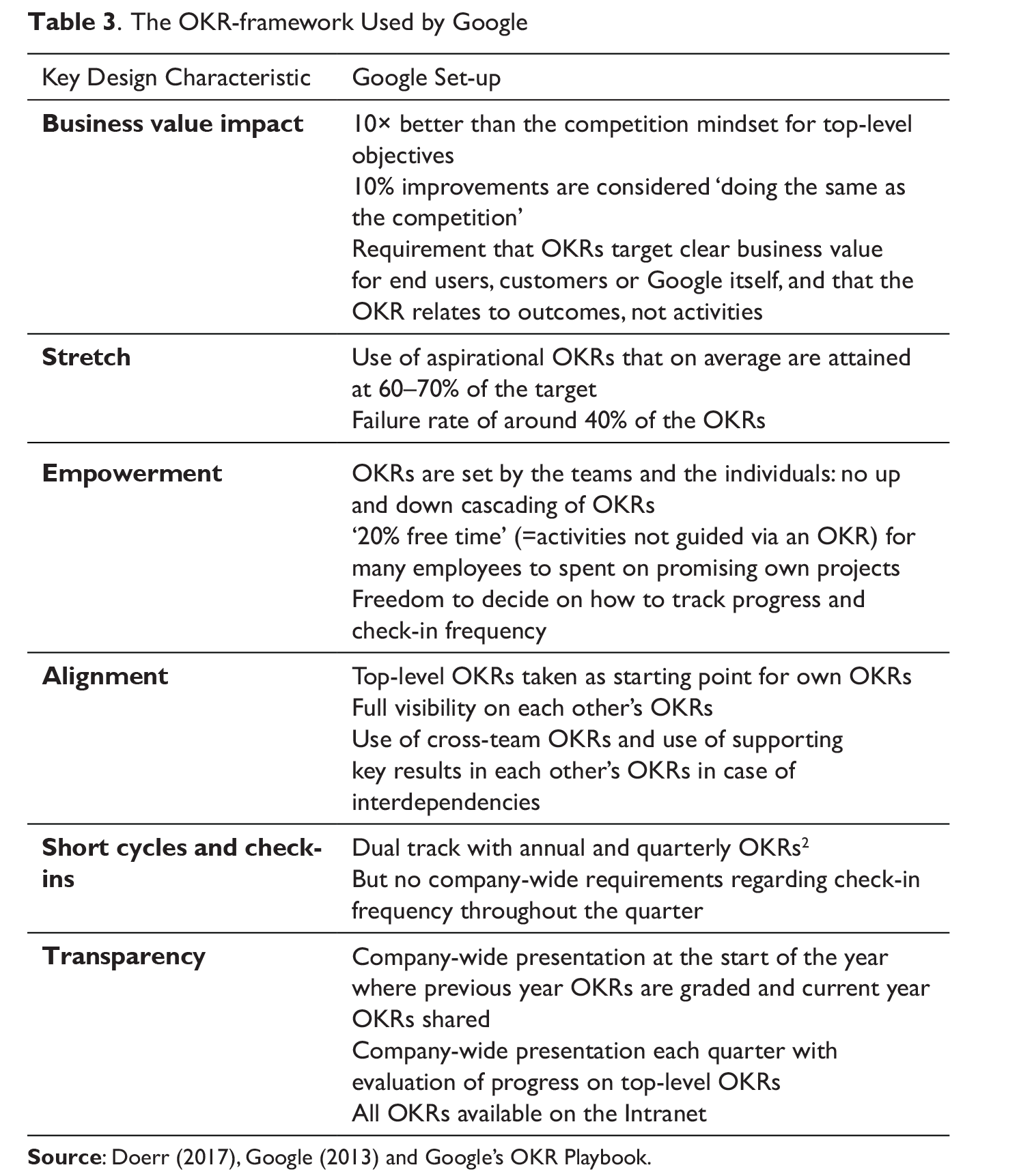
As can be seen from the overview, the designed framework at Google fits nicely with the six characteristics. It relies heavily on transparency, particularly around the company-wide direction and objectives, and on empowerment. The success of Google shows that these annual and quarterly company objectives find their way into the OKRs throughout the entire organization without rigid top-down planning and cascading. The framework apparently creates a level of alignment and a degree of focus that has allowed Google to grow from a start-up in 1998 to the company as we know it today.
Conclusion
Today’s challenging environment forces organizations to put customer value creation central in their daily operations through achieving organizational agility, experimentation, failure, learning and collaboration. For many, this requires a significant shift in the way of working and the mindset of their employees that requires a designed programme with clear direction from the top and alignment throughout the organization. But in addition, employees need to be motivated, need to experience high levels of trust in their working environment, and teams need to be high-performing teams. A traditional approach where goals are set at the top and are then cascaded down, in order to create alignment and to get employees to focus on the organizational priorities, works against all this.
Goal realization can, nevertheless, be of great help to engage and guide employees towards value creation. When properly designed, it can actually support and accelerate the pace at which the organization is being transformed into an agile, customer-oriented organization. There are six key design characteristics that need to be fulfilled for this: business value impact, stretch, empowerment, alignment, short cycles and check-ins and transparency. Together, these characteristics foster employee motivation, trust and team performance, which are prerequisites for sustained value creation. Google is an excellent example of an organization that has designed a goal realization framework that strikes the right balance between top-down guidance and direction and bottom-up execution. Hence, to speed up value creation in the organization, one may want to look at its own framework and assess whether the six key characteristics are sufficiently embedded in the current set-up.
Footnotes
Declaration of Conflicting Interests
The author declared no potential conflicts of interest with respect to the research, authorship and/or publication of this article.
Funding
The author received no financial support for the research, authorship and/or publication of this article.