




Abstract
This article aimed to contextualise social cohesion among different caste groups in the Indian situations and the implications thereof. There have been multiple direct and indirect policies and their execution as well to promote social cohesion. Political representatives also had arranged a promising democratic model of making a cohesive society by writing and executing the Indian Constitution, but, as of now, such a model seems to be on the verge of collapsing. The question of identity, the assertion of multiple identities, the practices of exclusivist behaviour and so on are some of the barriers in the way of developing a cohesive society. Supremist tendencies and continuous discrimination make the situation more complex and persistent of inequality, which poses a credible challenge to cohesion.
Introduction
One of the basic problems that our contemporary modern societies are circumscribed by is the problem of social cohesion. Theoretically, social cohesion is based on social factors that bind people together and promote trust among them. However, the issue of trust is not an uncontested conception. Trust, if taken in an interpersonal sense, promotes social cohesion, but if taken as reliance it can lead to compliance rather than cohesion. Social cohesion has been an enduring subject of inquiry among scholars for a long time, and many scholars have suggested considering social cohesion as a significant arena for policy intervention as it affects larger social and economic development (Ahmad & Hall, 2017; Easterly et al., 2006; Hayami, 2009; Ritzen et al., 2000). Several national governments, such as New Zealand, Canada, Denmark, France, and several international organisations such as Councils of Europe, World Bank, Inter-American Development Bank, and United Nations Economic Commission for Latin America and the Caribbean, etc., had started paying attention to this issue by bringing it into mainstream developmental policy concerns (Ferroni et al., 2008; King et al., 2010; OECD, 2011).
In this regard, the problem of social cohesion has been defined in various frameworks. For example, the Council of Europe (CoE) defined social cohesion as ‘society’s ability to secure the long-term well-being of all its members, including equitable access to available resources, respect for human dignity with due regard for diversity, personal and collective autonomy, and responsible participation’ (de Eupora, 2005, p. 23). The Organisation for Economic Co-operation and Development (OECD) defines ‘a society as “cohesive” if it works toward the well-being of all its members, fights exclusion and marginalization, creates a sense of belonging, promotes trust, and offers its members the opportunity for upward social mobility’ (2011, p. 51). Beauvis and Jenson (2002) described five possible constituent elements of social cohesion, for example, ‘common values and civic culture, social order and control, reduction of wealth disparity and social solidarity, social capital and networks, territorial belonging, and identity’ (p. 2). Other than these policy-oriented publications, Schiefer and Noll (2017) defined social cohesion as a multifaceted, gradual phenomenon that indicates the objective and subjective quality of collective togetherness. After reviewing various sources, the authors highlighted three essential features of social cohesion: social relations, identification and orientation towards common and shared ‘good’. Fonseca et al. (2019) defined social cohesion as interdependent connections between individuals’ needs or motives, shared values and formal or informal institutional environments. In this manner, various approaches and frameworks through which social cohesion has been defined and adopted for policy purposes can be reviewed.
The purpose of this article, however, was not only to review these frameworks but also to make sense of the cohesiveness among different strata of people in Indian societies. Even though the problem of social cohesion has received attention from many international forums, we could not find many studies that have explicitly focused on the condition of social cohesion in India. A study by the Asian Radar examined the levels of social cohesion among 22 countries in southern and eastern Asia, and this study recognised countries such as India, Pakistan, Bangladesh, Nepal, Afghanistan, etc., as having the least cohesive societies in Asia. It was argued that the reasons for such results in a country like India can be attributed to its large population, long and tragic history of communal conflicts, high linguistic, caste and religious diversity, a restrictive caste system, and low human development, among other factors (Croissant & Walkenhors, 2019). Despite these findings, the problem of social cohesion remains largely overlooked. In a conference paper, Mukherjee and Saraswati (2011) attempted to make sense of levels and patterns of social cohesion in India, but their results were based solely on samples from married women. Key dimensions of social cohesion such as trust and belongingness were not addressed. Trust itself is a complex issue when it comes to being taken as a component of social cohesion. Trust is important to have social cohesion; however, in a layered power hierarchy, trust, if taken in a sense of reliance, can be detrimental to social cohesion. Trust, a kind of dependence, is only possible if not reduced to mere reliance. Trust, as a component of cohesion, does so out of goodwill toward the truster; relatedly, a salient kind of vulnerability one subjects oneself to when trusting is vulnerability to the limits of that goodwill (Baier, 1986, p. 244).
People of India, like any other societies, and their representatives have struggled with the problem of maintaining a cohesive society. In fact, though indirectly, many policies were adopted and executed by arranging various social groups, their social positions, their rights, or their trusts in different forms either at the level of community or caste groups, or khaps or religious groups or sects. Political representatives have arranged a promising democratic model for creating a cohesive society by writing and executing different provisions within the Indian Constitution; however, as of now, such a model seems to have been outlived (see Choudhary, 2022). A simple Google search can show how people belonging to other backward classes (OBCs), scheduled castes (SC) and scheduled tribes (ST) – which together constitute around 70% of the Indian population – are living in extremely marginal situations. The economically deprived quality of life impacts their ability to interact and associate with people owing to their multiple vulnerabilities. Given the way inequalities are perpetuating in today’s globalising India along the lines of caste, race, sex, religion, class, language, spirituality, etc., a large section of Indian society is still living a miserable life. Among various features, it is needless to say that caste is one of the most salient features of Indian societies, and stratification along the caste line is not non-existent (Singh, 1997). It is the dynamics of castes and their organisation that affect other dimensions of Indian social life in a significant way. Therefore, this article intends to discern the state of social cohesion among diverse caste groups in the Indian context.
Data Source and Methods
This study is based on the secondary data collected from the second wave of the Study on Global Ageing and Adult Health (SAGE). It is a nationally representative survey conducted among adults in six countries: China, Ghana, India, Mexico, the Russian Federation and South Africa. In India, the survey was carried out across six states: Assam, Karnataka, Maharashtra, Rajasthan, Uttar Pradesh and West Bengal. SAGE (Wave 1) was initiated by the World Health Organization (WHO) in 2007. This longitudinal study aimed to obtain a nationally representative sample of respondents aged over 50 years, with a comparatively smaller cohort of the adult population aged 18–49 years for comparison. The survey adopted multi-stage stratified cluster sampling. For the analysis, household and individual weights were estimated based on six states, age groups, and sex. A detailed description of the sample design and the procedure of the survey has been provided in the SAGE (Wave 2), India national report (Arokiasamy et al., 2020). 1
Outcome Variables
The study is interested in shedding light on the social cohesion of the ST population using individual variables and the composite Social Cohesion Index (SCI). The SCI was constructed by the summation of all variables of social cohesion. The SCI was divided into two groups (strong and weak) based on the median values of the participants. A strong SCI is characterised by values above the median, while a weak SCI is indicated by those below it.
Study Population
The SAGE Wave 2 covered a total of 9116 adults in India. Of the total respondents, 4170 were male, 4946 were female, and 721 (7.91%) belonged to ST groups. Our study focuses on the ST groups. However, in the data analysis, we included other caste groups such as SC, OBC, and general/others for better comparison.
Results
The analysis of the study is divided into two separate sections. The first section attempts to elicit the status of social cohesion using individual aspects among different ethnic groups. The second part presents the overall level of social cohesion among the caste groups using the SCI.
Table 1 shows the multiple aspects of social cohesion among the young and old age population with caste groups in India. Surprisingly, the social cohesion level was lower among the ST population than in the general population (others). The ST population tends to attend a public meeting (32.68%), meet with a community leader (34.08%), participate in organisational meetings (38.55%), visit friends (73.74%), visit someone in a different neighbourhood (72.91%), attend religious services (78.77%), and communicate with the closest friend (76.68%) as opposed to the people who belong to the general caste.
Level of Social Cohesion Among the Caste Groups in India.
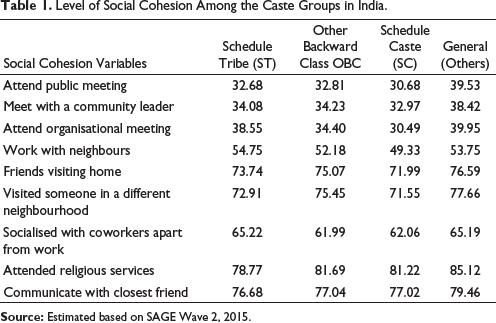
Similarly, people from the OBC and SC also display behaviour and actions akin to ST, as mentioned above. Their social cohesion level is lower when compared with the people from general caste.
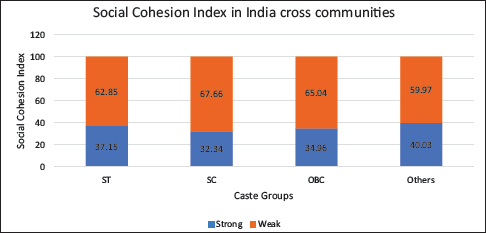
The SCI revealed a sharp inter-difference in social cohesion among the caste groups (Figure 1). The ST population (37.15%) enjoyed less strong social cohesion compared to all contemporary caste groups such as SC (32.34%), OBC (34.96%), and general (40.03%). However, SC and OBC people experience relatively lower level of social cohesion when compared to the general caste.
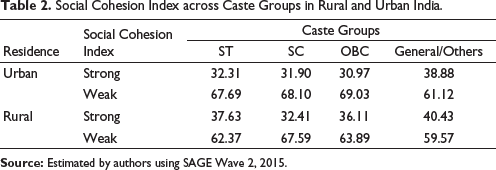
We noticed that place of residence or living has significantly contributed to social cohesion among the caste population. We found sharp rural–urban differences in SCI between the ST and the general population living in urban and rural areas (Table 2). The ST population (32.31%) living in urban areas enjoyed 6.57% comparatively weak SCI than the unreserved population (38.88%) counterpart. The ST population (37.63%) living in rural areas enjoyed strong SCI, though still less than the unreserved population (40.43%). It is surprising to notice that larger proportion of ST population (37.63%) living in the rural areas had strong social cohesion compared to those ST population (32.31%) living in the urban areas. This picture indicates that the ST population in urban areas is not in a position to have a social adjustment, while the ST population in rural areas is socially and culturally indigenous and much more comfortable.
Social Cohesion Index across Caste Groups in Rural and Urban India.
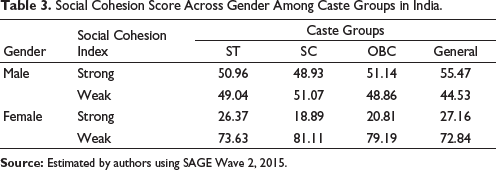
Our study observed a vast gender difference in SCI among the ST population and wider among the SC, OBC and general populations (Table 3). The female population of the caste groups tends to have approximately less strong social cohesion in their social lives than the women of the general caste. Even so, it was a surprising phenomenon that the male population of all caste groups tends to have approximately less strong social cohesion in their social lives than the male people of the general caste.
Social Cohesion Score Across Gender Among Caste Groups in India.
This study revealed that the interaction between the economic status and caste status of the people significantly determines the level of social cohesion in society (Table 4). The study noticed a sharp, consistent progressive trend in group SCI only for ST and SC. On the other hand, the level of SCI seems to rise and fall for OBC and the general population depending on the household’s wealth status.
Social Cohesion Index Among Caste Groups Across Wealth Quantile.
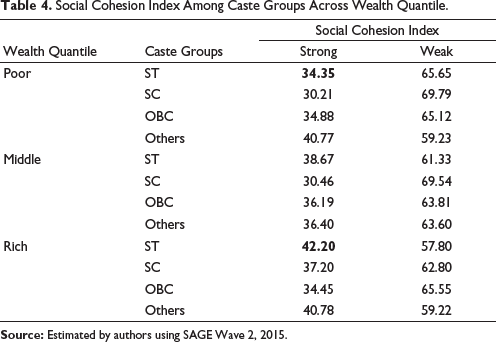
The social cohesion of the people improved with an increase in the household wealth quintile in terms of affiliation with caste status. For example, 34.35% of the ST population with a poor household had comparatively strong SCI, although, when it comes to the wealthy families of the same caste group, 42.20% had strong SCI. A similar progressive, sharp trend was noticed in SCI for the OBC caste group in society.
Respective to inter-wealth quintile comparisons, we observed that the SCI of the ST, SC, and OBC people tends to increase with an increase in the wealth quantile. But, when it comes to inter-caste group comparisons, the SCI found that the ST (34.35%) population with the poor wealth quintile had 6.42% less social cohesion than the general population (40.77%), which belonged in the same wealth quintile. Although the mentioned relationship turned reverse, the ST population with the middle and affluent wealth quintile had comparatively lower social cohesion than the rest of the caste groups in society.
Discussion
This study tried to understand the patterns in the levels of social cohesion of the caste people in India. This particular section is to locate such understanding in the larger discussions. In most cases, the findings of this study indicate that the levels of social cohesion (see Table 1) among the STs are much lower compared to the general population. People belonging to the OBC and SC categories also experience the weakest levels of social cohesion compared to the general population. Additionally, the caste group-wise SCI (as shown in Figure 1) highlights a similar pattern. Such a pattern suggests some important points to be noted: Higher levels of social cohesion lead to improved levels of development or growth – it is a general assumption among scholars and policymakers concerned with social cohesion. In the first scenario, people belonging to the ST category experience the most deprived and marginal social situation. Despite various policy measures, they lag behind not only the population of the OBC and general categories but also that of the SC category (for details, see Virginius, 2001). Social and political exclusion, land alienation, limited access to resources, poverty (Ambagudia, 2019; Sarkar et al., 2006; Sarap, 2017), and state-sponsored development-induced eviction from natural habitats (Choudhary, 2022), are some of the basic factors contributing to the deprivation of STs. But, on the other hand, if we see the holistic dimension of social cohesion (see SCI in Table 2), it suggests that the level of social cohesion among STs is much stronger in comparison to OBC and SC populations. Generally, geographical isolation, primitive traits, distinctive cultural traditions, a traditional customary self-governance system, etc. are some of the basic features for identifying the ST population in India. Their demands for autonomous governance and their traditional way of living can be considered as some important factors affecting the levels of social cohesion among them (in comparison to SCs and OBCs). Such a pattern of SCI among STs tends to contradict some of the existing literature, where it was argued that the lower levels of growth and development in human life lead to weaker levels of social cohesion, social security, social capital, etc. (Akcomak & Weel, 2009; Cilingir, 2016; Croissant & Walkenhorst, 2019; Knack & Keefer, 1997; Majeed, 2019; OECD, 2011; Osberg, 2003; Putnam et al., 1993; Vergolini, 2011). However, ambiguity emerges in the second scenario when we compare the levels of SCI between people belonging to the ST and general categories. If we accept the conclusion of the first scenario, it becomes difficult to imagine possible explanations for why SCI is much weaker among STs in comparison to general category. It is evident that level of backwardness among the STs have significant effect on their possible social cohesion, this is why their level of social cohesion remains weaker than that of people belonging to general category. Table 4 shows that the level of SCI strengthens with the betterment of wealth accumulation among STs; the richer the STs, the stronger the SCI (i.e., 42.20%) – even compared to general population (i.e., 40.78%). Evidence of such ambiguities suggests a more complex association between levels of social cohesion and development than a direct association. More focus is needed on understanding the quality of social cohesion, aligning with existing literature (Easterly et al., 2006; Delhey et al., 2018; Dobbernack, 2010; Golooba-Mutebi, 2005), that argues for considering various socio-political situations, glocal power structures, value systems, economic conditions, government initiatives, ethnolinguistic diversity, inter/intragroup conflict, neighbourhood dynamics, and cultural practices as some fundamental aspects in defining social cohesion in a particular context. The case of STs in India compared to other categories demonstrates that relatively better economic conditions do not guarantee stronger social cohesion, but improvement in economic conditions can enhance levels of cohesion. If we re-examine the SCI pattern in our study, considering not only economic growth and development but also the Indian social context, a different explanation can be made. People in India live in multiple societies by maintaining certain social relations. Such relations are often prescribed in written forms and are being exercised (consciously or unconsciously) by various dominant authorities (or communities) in multiple ways. This ideology of caste-based social order plays a dominant role in determining the nature of such social relations. Caste in India determines one’s way of being in society, their social location, and how one should be treated in society. The pattern of SCI highlights the social situation of Indian societies, and to make sense of this pattern, one needs to understand the nature of caste in India.
The nature or quality of social cohesion depends upon the kind of emotions that get promoted dominantly and the kind of emotions we have for each other (e.g., Vanzella-Yang & Abrutyn, 2021). In Indian societies, caste-based social order is fundamentally organised with the ‘emotions such as hate and repulsion, which are morally disgusting feelings, find their roots in the malignant social that is constitutive of offensive prejudices’ (Guru & Sarukkai, 2019, p. 185). The morally binding feelings whether or not disgusting to others make it difficult to free and non-judgemental interaction between people of different communities and caste groups. Such social order promotes or reproduce emotions such as hate and repulsion among various caste groups, often on the basis of purity and pollution, and creates feelings like disgust against each other (Choudhary et al., 2020). People belonging to the lower strata of the society i.e., people belonging to the SC, ST, and OBC categories, have been the worst victims of such emotions for a long time.
The government of India employed affirmative action in 1935 against such an oppressive caste system and provided the rights of reserving seats to the historically oppressed Dalit castes and the indigenous Adivasi people. Categories such as SC and ST were made to operationalise the reservation policy. Later on, in 1990, another category was created called OBC, which consists of various remaining backward classes of people. Though such attempts have helped to bring some level of educational, economical, and political advancement among these deprived sections, a simple Google search can even demonstrate the kind of caste-based violence they are still facing in their everyday life. People belonging to the SC and OBC categories (except Muslim OBCs) have been the worst sufferers of the hateful emotions propagated by the dominant upper castes.
Caste as an institution organises various social groups into a system of ‘graded inequality’ (Ambedkar, 2014, p. 170). The dominant upper caste tries to reproduce such a system of ‘graded inequality’ persistently by their propaganda machines in order to maintain their superior positions. The propaganda is set up in such a manner that the sufferers or victims are involved in conflict among themselves and hate each other. In such a system of ‘graded inequality’, no caste group wants to perceive themselves at the bottom of the social hierarchy. The victims involved in (physical or ideological) conflicts among themselves prove their status is relatively higher than that of other victims. The lower castes and Dalits are also divided among themselves and involved in competition to become ‘less polluted’ or ‘more pure’ than other fellow Dalit castes. Such a competition to maintain certain kinds of inequality persistently has developed a feeling of hatefulness against each other and is destroying the sense of solidarity among the SCs and OBCs. Many social scientists have also found evidence of such aspects of caste and highlighted that people from historically untouchable communities or Dalits tend to mutually rank themselves, maintain separation, and have emotions such as hate, contempt, or repulsion against each other (Gupta, 1984a, b, c; Moffatt, 1979; Srinivas, 1979; Srinivas, 2000). While such an existing thesis helps us conceptualise the reasons for weaker levels of social cohesion among SCs and OBCs, our findings demonstrate a graded pattern in the levels of social cohesion as well.
Figure 1 shows that the level of SCI is stronger among the dominant general (caste) category (40.03%) in comparison to SC (32.24%) and OBC (34.96%) category population. The levels of SCI among SCs and OBCs remain weaker even if they are becoming richer (see Table 4). Though the dominant general (caste) category is usually more organised and seems socially most coherent as per the SCIs, as shown in Table 4, rich STs experience stronger levels of SCI (42.20%) in comparison to the rich general category (40.78%). This shows that people in caste-ridden societies (across caste categories) experience weaker social cohesion even if they become rich. Aspects such as divisiveness, mutual hatred, contempt, ‘graded inequality,’ etc. will keep harming the potential to experience stronger social cohesion. On the other side, non-Aryan STs, or Adivasis are the communities that fall outside the Hindu-caste system and are less vulnerable to weaker social cohesion. Our findings demonstrate that STs have a better experience of social cohesion even if they are economically backward, and their experience of social cohesion can be much better (even in comparison to dominant general category people) if they become economically more advanced.
Otherwise, if we consider the association between place of residence and the levels of social cohesion in Table 2, a similar pattern is observable. Whether it is in rural or urban areas, people belonging to the SC category experience the weakest level of SCI. The general category population experiences the strongest amount of social cohesion, and STs and OBCs experience second and third strongest levels, respectively. Furthermore, it is also noticeable that people in rural areas tend to experience stronger social coherence across the categories. Such a result supports the age-old classical sociological theories, which argue that people belonging to intimate or small rural spaces are more likely to feel alienated, socially disorganised, and anomic as they come into contact with complex bureaucratised, urbanised, and industrialised societies (see Parker, 1978). It is a general trend that people migrate from rural to urban areas for better job opportunities, improved social situation, education, or a better lifestyle. However, they often feel isolated or estranged from others and from their own values and beliefs as a repercussion. Our study, more or less, suggests the same by demonstrating a decreasing trend in the levels of social cohesion in urban areas. However, some additional patterns can be presented for further study. The result suggests that people belonging to ST and OBC experience the most drastic fall in the strength of social cohesion (which is around 5.32% and 5.14%, respectively) when they move from a rural place of residence to urban areas. Because moving the ST population in city means ‘resettlement, while on the other, which is more real, it means economic, social, cultural, and other forms of loss resulting from the relocation with or without resettlement’ (Choudhary, 2021). The weakest level of SCI can be seen among the SC category population and their condition remains the same (or with a change of only 0.5%) even irrespective of the place of residence. Though the general population, also experiences little change in the level of SCI (i.e., 1.5% only), they experience the strongest level of social cohesion in both rural and urban places.
Moreover, this study also tried to understand the association between caste group-wise SCIs and the sex of the respondent in Table 3. The result highlights a huge gender gap in the experience of social cohesion across caste groups. The levels of SCIs are approximately 50% stronger among male respondents in comparison to females, across caste groups. Female respondents from tribal communities experience lesser levels of social cohesion, which may be a consequence of some cultural practices such as beliefs regarding women and witchcraft, their customary patriarchal self-governance organisation, etc. It is not to say that only females from tribal societies suffer from practices such as witchcraft and witch hunting – females from Dalit communities have also been the worst victims of such degrading practices (Yadav, 2020). The social order in India (i.e., Brahmanical) is such that it organises various social groups in terms of caste and gender hierarchy (Chakravarti, 1993); and women are the worst victims of such social order from every caste. The male-centred Hindu ideologies turned women into dependent and submissive individuals (Dhruvarajan, 1990). As a consequence, female respondents experience weaker social cohesion compared to men. Additionally, if we consider the gap in social cohesion within same-sex, Table 3 shows that males from general categories experience the strongest levels of SCI (55.47%) and males from ST and OBC categories experience approximately 5% lesser in strength in comparison to general category. The least strength in SCI (48.93%) can be found among the SC category male population. Similarly, the lowest levels of strength in SCI (18.89%) can be found among females from the SC category and the strongest social cohesion can be seen among females from the general category (27.16%). Female respondents among SCs are more likely to experience the least levels of SCI most probably because of their ‘double disadvantaged’ (Dunn, 1993) position. On the one hand, they are from Dalit communities face the curse of caste, and on the other hand, they lag in terms of education, employment, or other human development factors (Sabharwal & Sonalkar, 2015; Irudayam et al., 2012).
Conclusions
The question of identity, assertion of multiple identities and the practices of exclusivist behaviour are some of the barriers to developing a cohesive society. The nature of wealth and socio-historical positioning along with notion of purity and pollution constitute a key basis for one to assert a particular identity in Indian society. Supremist tendencies, adherence to such tendency on the basis of non-rational behaviour allows individual to act in a manner that leads to continuous discrimination. Such persisting discriminations complicate the situation that has its originate in embedded inequality and pose a credible challenge to possibility of social cohesion. Lack of trust which is owing to insecurity of being judged and mocked for the vulnerabilities make cohesion outside the small cohort difficult. Earlier studies have shown levels of interaction among different caste groups in urban areas of India having a hierarchical ordering, and that a significant level of segregation including social ostracism exists (Choudhary, 2021; Dupont, 2004). Assigning different nomenclatures has not resulted in better social cohesion among communities or across gender. Women are more likely to feel a lower degree of social cohesion compared to their men counterparts in each category.
Footnotes
Declaration of Conflicting Interests
The authors declared no potential conflicts of interest with respect to the research, authorship and/or publication of this article.
Funding
The authors received no financial support for the research, authorship and/or publication of this article.
