




Abstract
Examining policy beyond mere text, this study passionately delves into the lived experiences of dalit 1 and adivasi 2 students in higher education. The primary objective is to scrutinise the profound impact of public policy on the educational, economic, social and political mobility of these students. Furthermore, it investigates how public policy contributes to their de-marginalisation. Employing an explorative mixed-method approach, the study meticulously gathers data from dalit and adivasi students. The findings unequivocally reveal that public policy not only empowers marginalised students but also plays a pivotal role in cultivating cultural capital for their holistic development, importantly for occupational mobility. This research serves as a robust exploration of the transformative potential of policies, transcending the mere theoretical realm and uncovering the tangible effects on the lives of dalit and adivasi students in higher education.
Introduction
The scarcity of cultural capital in a society is influenced by significant social and cultural factors. Individuals’ ability to acquire or loose cultural capital depends on their historical and contemporary access to resources within society. Bourdieu’s (1977) idea of ‘cultural capital’ presents a crucial framework for comprehending the dynamic interplay of culture in human interaction within society through ‘habitus’. Sorokin (1927) recognises it as a process crucial for securing the future of offspring effectively. Capital, whether social or cultural, serves as a powerful tool enabling individuals to ascend the social and economic hierarchy (Basu, 2019; Bhoi, 2016). Social change and mobility, driven by economic and social marginalisation, result in reduced access to economic, social and cultural resources for individuals. The discussion of marginalisation, often framed within the context of social exclusion, has gained prominence due to prolonged deprivation and exploitation experienced by marginalised communities in Indian society (Bhoi, 2023; Bhoi & Lakra, 2022; Hans, 2013; Messiou, 2006; Opotow, 2014; Still, 2015).
The aspiration to cultivate cultural capital and ensure equitable justice for marginalised people in India through constitutional democracy is evident (Bhoi, 2016; Schar & Keating, 2012). Constitutional provisions play a significant role in uplifting marginalised communities in the country. They focus on identifying and improving the socio-economic conditions of these communities through educational initiatives (Bhoi, 2023as; Saraceno, 2001; Schar & Keating, 2012). The terms ‘indigenous’ and ‘marginalisation’ must be inclusive in sociopolitical discourse and pivotal in the sociopolitical mobilisation of India (Lakra, 2023; Witcher, 2013). Both adivasi and dalit studies were historically caste-centric, with the post-independent period witnessing a caste-centric approach in adivasi studies as well (Bhoi & Lakra, 2022; Elwin, 1951). Despite affirmative action, constitutional provisions and inclusive policies, dalits and adivasis persistently endure deprivation, disadvantages and social exclusion, significantly affecting their socio-economic, economic and political well-being (Bhoi & Lakra, 2022; Coleman, 2003). Although there are challenges in implementing constitutional provisions still the affirmative action and policy remain crucial in shaping societal welfare, especially for marginalised communities in India.
Public Policy and Higher Educational Participation
Public policy in higher education differs significantly in India and the United States (US). Historically, India views public policy as the exclusive realm of government officials (Basu, 2019; Maheshwari & Maheswari, 1987). In contrast, the US employs a dynamic model, with professionals from academia and the corporate sector transitioning into governmental roles with political changes (Gale & Tranter, 2011; Hayton & Paczuska, 2003). The US professionals, spanning various fields, pursue education in public policy to contribute to policy under different administrations (OECD, 2016). Likewise, the United Nations (2018) document affirms that safeguarding social inclusion is achievable through social protection and integrating disadvantaged communities into the broader societal framework. Further, affirmative action, especially reservations, sparks debate in Indian higher education, evolving over four decades (Bhoi, 2021; Rai, 2022; Weisskopf, 2004, 2005). The extensive coverage or protective essence of this policy framework establishes a robust foundation for discussions within the study concerning the development of cultural capital (Hegde, 2015).
Policy Passage and Affirmative Action for Margins
Indian governance, committed to social justice, grapples with executing affirmative action to safeguard rights and uplift marginalised communities. The Government of India implements various educational policies as the passages for de-marginalisation of certain communities, especially for Scheduled Castes (SCs) and Scheduled Tribes (STs), aiming to reduce social inequality through social inclusion and inclusive educational attainment (Bhoi, 2011). Policy serves as the sole mechanism for broadening the participation of various social groups in Indian education, particularly in higher education. The overall higher educational enrolment rates for marginalised communities are significantly low, standing at 14.9% for SCs and 5.5% for STs, in contrast to 79.6% for the non-SC/ST population. The enrolment rates for males from marginalised communities are similarly low, at 14.8% for SCs and 5.4% for STs, compared to 79.8% for non-SC/ST individuals. Likewise, enrolment rates for females from marginalised communities are also lower, with figures of 15% for SCs and 5.5% for STs, compared to 79.5% for non-SC/ST categories (AISHE [All India Survey on Higher Education], 2019; AISHE, 2021; Census, 2011).
These indicate the challenges encountered by marginalised sections in accessing education. Moreover, caste-based discrimination significantly impairs the educational opportunities of SC students, especially in higher education, potentially resulting their dropout or discontinuation of their studies (Bhoi & Lakra, 2022; Kumar, 2021; Sukumar, 2022). Despite affirmative action measures, SCs and STs persistently encounter discrimination, underscoring the imperative for comprehensive initiatives to rectify the historical and ongoing marginalisation and deprivation of resources in the society (Bhoi, 2010; Ibarra, 2001). This exacerbates their marginalisation which pushes them further to the margins of society. This study delves into the pathways and experiences of marginalised individuals, seeking ways to uplift them from marginalisation. Engaging in policy discourse and proposing policies as a means of empowerment for marginalised communities. Investigating policy, it delved into the higher education fellowship system for marginalised in India.
The study investigates the role of the national fellowship scheme in enhancing inclusion and mobility for marginalised communities within higher education, compared to other fellowship schemes. The fellowship system is not novel; its aim is to establish an inclusive environment for those who are less capable or disadvantaged, akin to a mother providing extra nourishment to children with slower growth rates. Similarly, the government implements affirmative action and fellowship schemes to integrate diverse communities into the mainstream. Specifically, the national fellowship system is designed to promote the inclusion of various deprived and marginalised social groups in higher education. This approach resembles providing support and resources to those in need, as Bourdieu (1977) underscores the pivotal role of cultural capital in shaping human capital.
Cultural Capital and Pierre Bourdieu
Education, crucial for social advancement, encompasses knowledge and intellectual abilities. Bourdieu (1977) categories cultural capital into three forms; embodied, acquired through deliberate learning; objectified, represented by possessions like art; and institutionalised, acknowledged through academic qualifications. Embodied cultural capital shapes one’s character, while objectified capital, such as art, may carry economic value, signifying cultural ownership. Institutionalised cultural capital, often in the form of academic credentials, is vital in the job market, allowing individuals to translate cultural capital into economic value (Ibid.). This study investigates the correlation between public policy and state welfare programmes in generating cultural capital, analysed through the experiences of higher education students. Similar to economic capital, cultural capital can be utilised, accrued and transformed into resources accessible to individuals (Bourdieu, 1984). Middle-class parents bolster their children’s educational achievements by imparting linguistic and cultural skills, while working-class children face greater obstacles, perpetuating class disparities. Similarly, this study explores how dalit and adivasi students can leverage state welfare benefits in their educational pursuits. Bourdieu highlights how economic and cultural capital interact, reinforcing class divisions across generations (Bourdieu, 1977). We examine parallels in state intervention, such as the national fellowship system, and the participation of dalit and adivasi students in higher education across generations.
Research Questions
The primary research questions revolve around the national fellowship system and the inclusion of dalit and adivasi students in higher education. It examines the following questions; how higher education has influenced the lives of dalit and adivasi students? What is the role of the national fellowship system for these students, particularly in promoting them in mainstream society? How does the fellowship scheme facilitate higher education, educational and occupational mobility for dalits and adivasis? Essentially, does the creation of cultural capital possible and does that influence the transformation in educational, economic and political aspirations of dalit and adivasi students?
Research Objectives
This study centres on public policy in higher education, particularly examining the experiences of dalit and adivasi students in relation to the ‘National Fellowship’ system and the development of cultural capital. Its main objective is to enhance inclusivity and social mobility in higher education policies. Additionally, it examines the creation or generation of cultural capital for marginalised sections in India. The research also explores inclusivity in educational administration and fellowship schemes in higher education, particularly the accessibility, challenges and impact of the ‘National Fellowship’ scheme on dalit and adivasi students. Furthermore, it investigates how the scholarship scheme contributes to educational, economic, social and political mobility within India’s social welfare model.
Research Methodology
This comprehensive investigative study combines quantitative and qualitative data from primary and secondary sources. Focused on 350 dalit and adivasi (SC and ST) students from 10 universities (200 SC and 150 ST students), the research includes 20 case studies and 10 Focus Group Discussions. The data collection spanned 2018 to 2023, utilising semi-structured interviews and purposive sampling for MPhil and PhD students. Quantitative data are analysed using descriptive statistics, while qualitative data undergo case studies and thematic analyses. Secondary data are collected from articles, books, newspapers, and official records which undergo textual and content analysis. In social welfare and public policy context, semi-structured interviews, case studies and focus group discussions were employed. Ethical standards were maintained by using pseudonyms for cases and universities.
Educational Inclusion, Schemes and Policy Pathway
Several initiatives aim to promote educational inclusion for marginalised sections, specifically dalit and adivasi or SCs and STs. One notable initiative is the Rajiv Gandhi National Fellowship (RGNF), introduced in 2005–06 for higher education and research scholars from SC and ST backgrounds. In 2017–18, it was renamed the ‘National Fellowship for Scheduled Caste Students’, exclusively for SC students (Govt. of India, 2018). Similarly, in 2014–15, the RGNF transformed into the ‘National Fellowship for Higher Education of Scheduled Tribe Students’, rebranded as the ‘National Fellowship and Scholarship for Higher Education of Scheduled Tribe Students’ in 2015–16, after the amalgamation of the ‘Top-Class Education Scholarship’ (Govt. of India, 2018a).
Both schemes, centrally sponsored by the Government of India, provide financial assistance to SC students pursuing MPhil and PhD degrees in sciences, humanities and social sciences. The fellowships support SC and ST students pursuing MPhil and PhD degrees in various fields at recognised universities or institutions, aligning with the UGC Act’s provisions (Govt. of India, 2024; University Grants Commission, 2017). This central scholarship scheme significantly impacts widening the participation of marginalised communities in higher education, although some implementation issues persist, as highlighted by Bhoi and Lakra (2022).
A student named Fagu, aged 29, expressed that the scheme is genuinely expanding the participation of dalits and adivasis or SC and ST students in higher education:
It gives me an opportunity to study and establish myself, and it also creates a platform for historically marginalised groups like dalits and adivasis. Public policy makes it possible for marginalised sections to obtain education and secure good jobs. The higher education fellowship scheme has an impact that will last for generations of dalits and adivasis communities. It enables many dalits and adivasis to participate and expands their opportunities for higher education and better jobs.
According to Fagu, the impact of public policy is evident today, with only a few individuals from these communities’ securing positions in higher education, thereby widening their participation in white-collar jobs. The fellowship scheme plays a crucial role in bringing dalits and adivasis students closer to the steps of social and economic mobility. Caste, which functions as a gateway and cultural capital for privileged communities, as asserted by Sukumar (2022) in his study on caste and merits, has a detrimental effect on underprivileged communities. Nevertheless, public policy plays a pivotal role in fostering positive development for them, aiding in the construction of cultural capital through national fellowships. This profoundly influences education, fostering progress on the social and economic hierarchy, particularly aiding marginalised communities in building capital. This assertion aligns with Bhoi and Lakra’s (2022) previous work on empowering the marginalised in higher education.
Fostering Cultural Capital Through National Fellowship
Initially, the national fellowship scheme allocated 2,000 slots annually for students across various universities, with 1,333 designated for SC students and 667 for ST students, covering diverse subjects. Over time, the allocation increased to 2,000 seats for SCs and 750 for STs, and the scheme was renamed National Fellowships for SCs and National Fellowship & Scholarship for Higher Education of ST Students. In 2020–21, an additional 2,000 fellowships for SC were introduced, reaching the highest number (n = 4,841) of students awarded the fellowship. However, in subsequent years, the fellowship awards for SC students decreased to count 1932 in 2021–22 and 1612 in 2022–23. The number of national fellowship awards for ST students remained constant at 750 in both 2020–21 and 2022–23 (Govt. of India, 2024; University Grants Commission, 2017). Both schemes now include unemployed SC/ST candidates with relevant postgraduate qualifications engaging in full-time research (Govt. of India, 2024).
The government not only presents these facts but actively generates capital for marginalised populations through public policy. Recently, the Indian government recognised the adivasi (tribal) language as the official medium of instruction in schools, a significant step towards empowering adivasi communities (NEP, 2020). Leveraging their language as a valuable resource could become substantial capital for their long-term benefit, drawing on Bourdieu’s (1977) concept of cultural capital. Similarly, we argue that the national fellowship system for SC and ST students can be considered a form of capital when judiciously utilised for academic advancement, leading to social and economic mobility. An exemplar is the transformative odyssey of SC and ST students propelled by fellowships, pivotal in advancing their socio-economic elevation. Bharat (28), hailing from a dalit background, attested to this impactful journey:
During my childhood in the village, I faced various challenges, including economic hardships and caste-based obstacles. However, I managed to overcome these struggles, securing an opportunity for higher education. The Government of India scholarship, and specifically this fellowship, played a crucial role in supporting my academic journey, enabling me to pursue uninterrupted research work.
Critiquing policies and their limitations reveal challenges in assessing the impact and beneficiaries’ utilisation of opportunities. The critique explores the policy’s role as capital for the disadvantaged in terms of social, cultural and political aspects. Blakemore and Warwick-Booth (2013, p. 30) suggest that the maximalist principle of equal opportunity can be realised through positive or affirmative action, exemplified in India through reservations and quotas for jobs and higher education. Aligned with Bourdieu’s framework, policy carves a space for marginalised communities, allowing them to leverage state-sponsored fellowships as institutionalised capital (Bhoi & Lakra, 2022; Rout, 2015).
Educational, Economic and Widening Opportunities
The presented data unfold a narrative of resilience and determination, highlighting an individual’s capacity to confront and overcome societal hurdles. Nonetheless, there is a positive prospect on the impact of diverse widening participation initiatives in education (Baines et al., 2022). The accompanying fellowship/scholarship underscores crucial support systems for educational and economic gain, enabling ongoing academic pursuits as a form of affirmative action (Coleman, 2003) for the deprived sections. Tailored to be inclusive for students from marginalised backgrounds, specifically those from SCs and STs, this initiative significantly boosts educational attainment, particularly in MPhil and PhD programmes, thereby expanding opportunities.
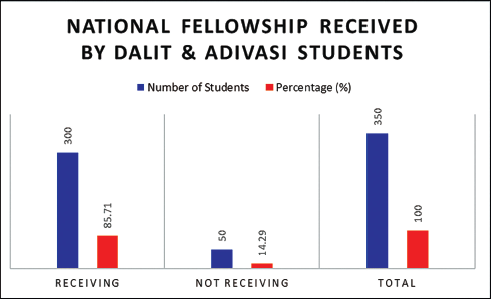
The data presented in Figure 1 illustrate that public policy intervention enables dalit and adivasi, or SC and ST students, to access higher education, thereby widening their participation. The data suggest that around 86% of students have the opportunity to engage in higher education because of government-provided educational access facilitated through public policy intervention. This aligns with the findings of Bhoi and Lakra (2022), who observed a similar pattern of public policy intervention. Conversely, only about 14% of students can pursue their studies without fellowship among the SC and ST students (Figure 1). Therefore, public policy intervention is considered essential to ensure equal participation and enhance the involvement of SCs and STs in higher education, as Hans (2013) perceives it as a shift from marginalisation to inclusion. In this context, Pradosh (29), a student from an ST background, expressed:
Education, unity, and advocacy bring economic and social opportunities to marginalised communities like us. By being educated and united, we can fight for our rights and demand our needs. Really, education provides exposure to make informed choices, contributing to a constructive society. It opens doors to better jobs, societal respect, and the ability to understand and engage in social and political issues as political representatives to demand the rights. All of this is possible because of the fellowship system in higher education for marginalised sections.
Bourdieu (1977) coined the term ‘cultural capital’ to denote symbols, ideas, tastes and preferences employed strategically as resources in social interactions. He views cultural capital as a ‘habitus’, a socially ingrained tendency guiding actions, thoughts or emotions. Likewise, the foundation of national fellowship in higher education inspires aspirations for academic success and an improved lifestyle. Aman (2023) contends that public policy in India plays a pivotal role in shaping the nation’s future and the well-being of its citizens.
The National Fellowship scheme, aiming to uplift SCs and STs in higher education, is widespread in India, particularly in universities offering MPhil and PhD courses. Despite positive intent, the scheme faces systemic challenges hindering students’ access. While the UGC supports around 3,000 students through the ‘National Fellowship’ system, many encounter obstacles during disbursement (Govt. of India, 2024; University Grants Commission, 2017). Delays in financial assistance, transfer-related problems, and institutional and administrative issues within the university and policy execution body contribute to hindrances. Data from 2013–14 reveal delays in fund distribution, with students facing denial and restrictions when contacting the policy execution body (Govt. of India, 2024; University Grants Commission, 2017). Instances across India highlight delays and bottlenecks, impeding the effective implementation and accessibility of the scheme for SC and ST students, despite its higher educational inclusion objectives.
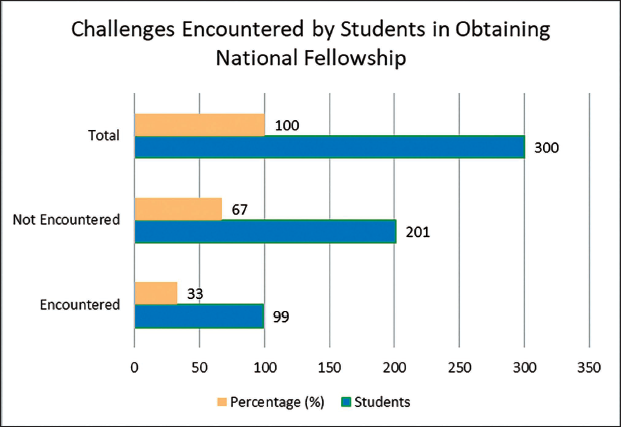
Figure 2 illustrates that 33% of SC and ST students encounter challenges in receiving their national fellowship. Students who have affiliations with universities or institutes and wield political influence often receive their fellowships promptly, as affirmed by Garcia (1997), serving as a testament to the optimistic impact of affirmative action. However, students facing issues encounter obstacles from fellowship release staff to supervisor signatures and even obtaining registrar signatures. Delays also arise in document submission to policy execution body and processing by their staff (Bhoi, 2017; Bhoi, 2022 ; Rout, 2015). Consequently, many students encounter difficulties in accessing their fellowships on time. Additionally, Lima (27), originating from an adivasi background, shared her account of the challenges and experiences related to her national fellowship, conveying a profound sense of hardship in the process:
When I saw my name on the fellowship selection list, I was overjoyed and had high hopes for a smooth research fellowship experience. I expected everything to go smoothly, but the awaited national fellowship award letter never reached me. When I inquired with the institutional authority about the list of selected students, they repeatedly postponed checking, asking me to return the next day or the following week. Later that evening, I discovered that even a general category student had not received their Junior Research Fellowship (JRF) award letter. Surprisingly, the official had made a special phone call to policy execution body for him, inquiring about his letter and fund disbursement, but my case was ignored [Lima (27)].
Even though the national fellowship is crucial for students from marginalised backgrounds, the disbursement process and societal attitudes towards dalit and adivasi students have been disappointing (Bhoi & Lakra, 2022; Govinda, 2006). Enforcing remedial actions could enhance the fellowship system, empowering dalit and adivasi students to effectively utilise it for higher education and advance their career aspirations, as observed by Tully (2008) in the struggle of indigenous people. The findings of this study suggest that acquiring economic and educational resources can serve as a form of cultural capital for marginalised individuals. This aligns with the argument made by Bhoi (2013) and Béland (2007) regarding the significance of cultural capital in influencing social mobility.
Cultivating Cultural Capital
Pierre Bourdieu (1977), the French sociologist, posits that a child’s educational access and success depend on their cultural capital, with habitus and cultural capital perpetuating social inequality rooted in parents’ economic and social backgrounds. Examining the experiences of SC and ST students, the study reveals that approximately 81% leverage the national fellowship as their cultural capital, contributing significantly to academic progress and serving as a foundation for obtaining educational essentials. The fellowship is utilised not only for education but also for positive impacts in institutions, such as presenting research papers, conducting fieldwork and contributing knowledge (Hans, 2013). This underscores that SC and ST students use the national fellowship for both educational development and social mobility, emphasising equality and inclusion in higher education, as argued by Rout (2015). Building on this notion, Falk and Harrison (2000) introduce the idea that the construction of social capital is not only feasible but can also transpire within a relatively short timeframe, a concept often denoted as capacity building.
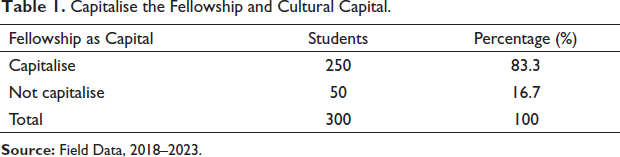
Table 1 illustrates that approximately 84% of SC and ST students receiving fellowships strategically utilise them for academic progression, purchasing books, attending conferences and supporting family members’ educational aspirations. Despite lacking a parental cultural background, they maximise fellowship use for academic pursuits (Aman, 2023; Deshpande & Khanna, 2021). However, some face challenges due to family and social constraints, leading to dropouts and various issues in fully capitalising on their fellowships. The state of effectively capitalising on fellowships plays a crucial role in shaping cultural capital for these students. Further, Pradeep (29), hailing from a dalit background, encountered challenges in securing the national fellowship for his advanced studies. He expressed:
I utilised the fellowship for acquiring books, funding seminar travels, and presenting papers nationally and internationally. With it, I fulfilled a dream by purchasing a laptop and audio recorder for research. Hailing from an ST background, this fellowship enabled my pursuit of higher education, affirming its meaningful application. Unfortunately, clerical staff often display bias, labelling me as ‘backward’ or ‘jangli’ (forest dweller derogatorily). Intentional delays and derogatory remarks imply a misuse of public funds on individuals like me, according to them.
Capitalise the Fellowship and Cultural Capital.
The data indicate that higher education fellowships positively impact marginalised communities such as dalits and adivasis. However, these communities often face derogatory remarks from the staff implementing the policy, leading to psychological distress among students. This aligns with Bates and Connolly’s (2023) assertion that they amass cultural capital on a broader scale than the government, aiming to fill the ‘vacuum’ created by the current policy perspective on cultural capital. Bhoi (2023) similarly contends that dalit students endure significant challenges due to non-cooperation and intentional issues from non-academic staff in the release of fellowship.
National Fellowship and Educational Mobility
Bourdieu (1988) contends that one’s social background and existing societal status play a pivotal role in determining academic success and accomplishments within the realm of academicus. This encompasses factors such as the frequency and venues of academic publications, institutional affiliations, media visibility, political engagements. Likewise, the academic journey for dalits and adivasis poses formidable challenges in terms of entry and sustenance in academics due to their social origin and lack of social connection. It is only through State intervention which can create a hope for creating their cultural capital, establishing them in academia and securing better employment. However, the educational accessibility of dalit and adivasi students has been hindered by many social, economic and educational obstacles. Bhoi (2016) argues that due to the lack of cultural capital from their homes, they struggle with academic challenges more than with the social and ‘academic stigma’ and the various negative connotations attached to them (Bhoi & Lakra, 2022; Guru, 2012). After overcoming all levels of hurdles when they aspire to pursue higher education, especially in research education, they receive supportive assistance from the state through the national fellowship system. Through this system, students from SC and ST backgrounds get an opportunity to pursue higher education and take a step towards educational mobility compared to their parents’ education. Higher education provides them with a chance to climb the higher ladder of education, enabling them to attain the status of white-collar jobs (Wankhede, 1999).
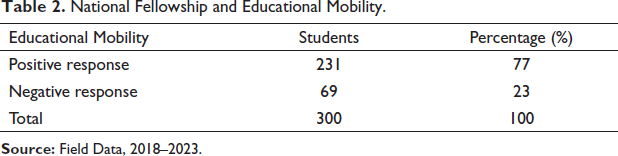
Table 2 shows that 77% of students affirm the national fellowship as a boon for SC and ST students, enabling educational mobility. Underlining the pivotal contribution of the fellowship to their advancement in higher education, particularly in the pursuit of research at the university level, as articulated by Bhoi (2021), the case studies presented in this paper similarly advocate for Rajiv (28) in a comparable fashion. Without it, they might have been confined to traditional occupations. This fellowship is expected to propel them towards upward social mobility and positive transformation in a technologically advanced society, as evidenced by student narratives (Rout, 2015). Contrary to Jayaram (1987) assertion that education aids in status retention, this study shows state intervention facilitating higher education for those from non-academic parental’s capital or social backgrounds, breaking the norm. Contrarily, Wankhede (1999) contended that education serves not only to maintain social status but also facilitates status change through social mobility. Rajiv (28) conveyed that, despite challenges, he attained notable success through the educational advancement provided by the fellowship platform:
During my childhood in the village, I faced economic hardships and caste-based challenges. Overcoming these struggles, I secured higher education through the Government of India scholarship. This fellowship, in particular, has played a crucial role in supporting my uninterrupted pursuit of research in my academic career. [Rajiv (28)]
National Fellowship and Educational Mobility.
The national fellowship plays a vital role in advancing the education of marginalised communities, especially SCs and STs. Providing financial support, it becomes their cultural capital, fostering upward educational mobility. The educational achievements of SC and ST students surpass those of their parents, reflecting a profound and transformative impact. Bhoi (2023), Saraceno (2002) and Schar and Keating (2012) argue that Constitutional provisions empower marginalised sections significantly. This study reinforces that public policy and constitutional measures for dalits and adivasis create substantial capital for them.
In India’s societal landscape, education serves as a catalyst for economic prosperity, social advancement and political empowerment (Bhoi, 2021; Hegde, 2015). Educational mobility initiates shift from traditional to modern occupations, elevating the status of SC and STs. This transition spurs economic progress, empowering individuals for political rights, leading to increased participation in elections. Economic and political mobility facilitates social progress, breaking ties with traditional occupations but exposing them to social animosity and discrimination (Hans, 2013; Hayton & Paczuska, 2003; Heyer, 2009). The transformative journey from disrespect to respect and discrimination to preference is identified as the empowering force of education, propelling SC and STs forward in the social hierarchy through better occupation or white-collar job.
Table 3 indicates that 77% of interviewed students believe that educational mobility enhances economic, political and social progress for SC and ST students. They transition from traditional to white-collar jobs, gaining societal respect and political representation. Students emphasise education as a means to break free from social oppression, enabling a shift to chosen modern occupations rather than hereditary roles (Bhoi, 2021). Echoing Dr Ambedkar’s advocacy for education, they stress the importance of being educated, organised and assertive in fighting for rights (2020, p. 273). Education not only facilitates better jobs and societal respect but also qualifies individuals to comprehend political rights, participate and represent their community (Wankhede, 1999).
To the next level, how policy became a major patronage for social, economic and political change is evident from the narration of Sarita (26), a student from a dalit background who said:
I realise that as people from marginalised communities become educated, organised, and assertive, they gain economic and social opportunities. It’s important for us to get educated, come together, and stand up for our rights. Education not only opens doors to better jobs and respect but also allows us to make informed choices for a positive society. It empowers us to understand our social and political rights, enabling active participation as representatives. I can focus on my studies and dream of becoming an assistant professor (the noble teaching profession) because public policies empower me.
Economic, Social and Political Mobility.
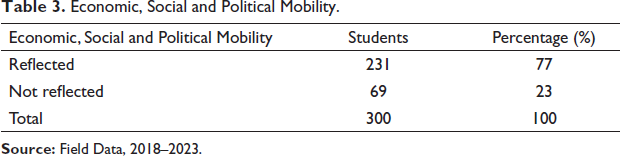
Here, it is argued that educational mobility supported by the national fellowship system can bring changes in society. Particularly, through this national fellowship, most of the students, including Sarita, opined that she could gain higher education only because of this national fellowship, which echoed in Bhoi’s (2021) on educational mobility. Educational mobility can help for an economic, political and socially dignified life in a mobility drift. Connecting to this argument, Anderson and Francois (2023) also claimed that enhancing distributional access in favour of reserved groups or for the marginal communities is crucial, and they argue that public policy plays a substantial role in levelling them up in society.
Curtailment in Fellowship Release and Transfer
Several fellowship recipients face challenges, with some unable to sustain their courses, either dropping out or switching institutions for better prospects after a year or two. Notably, many students encounter delays in receiving their fellowship funds, disrupting their higher education pursuits (Rout, 2015). Despite relying on these fellowships, students endure prolonged waits, ranging from six months to over a year, due to funding bodies’ inefficiencies (Bhoi & Lakra, 2022). Complications arise not only from funding bodies but also from parent institutes withholding paperwork, research guides intentionally halting fellowships and intermediaries causing essential paperwork delays in accessing funds from the government (Ibid.).
Around 33% of SC and ST students encounter delays, transfers and truncation problems associated with the national fellowship, as illustrated in Table 4. Qualitatively, some report receiving nothing two years after selection, facing dismissive officials when seeking disbursement. University blame games between policy execution body and institutions/universities worsen issues, persisting even after filing ‘Right to Information’ (RtI) requests on transfer matters (Gohain, 2014). Some students experience unexplained fellowship termination without recourse or explanation. Despite commendable intent, the national fellowship scheme grapples with execution and distribution issues, including delayed disbursements and arbitrary truncation (Bhoi, 2021). These obstacles unveil hardships faced by student like 27-year-old Sulochona, from an adivasi background, narrating diverse challenges in accessing higher education welfare schemes throughout her academic journey.
I have encountered numerous challenges receiving my fellowship. The bank’s clerical staff and officials caused delays and unnecessary issues at the start. My supervisor and registrar sometimes delayed signing my papers. The registrar’s personal assistant misplaced my documents, causing further delays. Additionally, I faced discrimination at my institute due to my adivasi background, with derogatory comments. Policy execution body’s late fund releases further hindered my education, impacting my study plans, fieldwork, and overall expenses. Despite these challenges, my fellowship gained momentum when members of my community collectively addressed the issues with the university administration. [Sulochona (27)]
Delay in Fellowship Process.
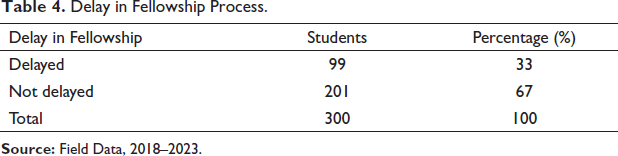
The issues such as unwarranted delays, abrupt transfers and arbitrary truncations of fellowships infiltrate the initiative (Rout, 2015). While the national fellowship scheme is ostensibly commendable, its execution and allocation are marred by formidable challenges. Much like the concept of ‘homo academicus’, Sulochona’s fellowship challenges were resolved through the intervention of the broader academic network of the adivasi student community (Gonzalez et al., 2022). The ongoing issues highlighted above in the implementation underscore the challenges faced by welfare schemes at the higher education level, raising concerns about the effectiveness of the programme and exposing systemic flaws in its execution. Despite challenges, the national fellowship serves as a pathway for the development of dalit and adivasi communities, as indicated in Bhoi’s (2023). Similarly, Maheshwari and Maheswari (1987) and Basu (2021) rightly emphasise that government policy aims to raise living standards and uplift historically disadvantaged people, addressing marginalisation.
State Support Hindered by Academic Snobbery
In academia, the rationale behind protective discrimination or affirmative action is often misunderstood by academic snobbery. In academic snobbery, some teachers, staff and fellow students engage in creating negative perceptions about inclusive schemes and policies (Bhoi, 2016; Guru, 2012). The staff have believed that SC students receive unwarranted facilities and research fellowships without merit, viewing it as a misuse of government funds (Sukumar, 2022). Misconceptions also circulate among students, staff and occasionally teachers, who derogatorily claim SC students receive government money freely. Discrimination persists, with delays in signing reports, intentional obstacles and biased grading, systematically excluding SC and ST students from accessing national fellowships at higher education levels (Rout, 2015; Sukumar, 2022).
Substantiating the earlier claim, the data outlined in Table 5 reveal that 15% of students affirm experiencing difficulties throughout their fellowship implication. The data indicate that 85% of SC and ST students encounter negative social perceptions concerning their national fellowship within their higher education institutions, which also aligned with Sukumar’s (2022) arguments of discrimination in higher education. Further, the qualitative insights reveal a subset of students ascribing their adversities to discriminatory practices by staff, teachers and fellow students, hindering their access to national fellowships (Bhoi, 2016). The recipients of the national fellowship report face sarcastic critiques from peers who disparagingly claim they receive benefits solely due to their caste, reflecting a prevailing discriminatory discourse (Bhoi, 2016; Hegde, 2015; Pathania et al., 2023; Rout, 2015). Furthermore, staff and teachers contribute to the adversarial environment by sarcastically commenting on both the fellowship scheme and the students themselves. Connecting to self-experiences, Sankar (28) said:
I have encountered disdainful attitudes from both fellow students and teachers who perceive the national fellowship as a form of undeserved privilege. Their sarcastic comments and discriminatory practices make it challenging to fully embrace the opportunities the fellowship offers. It’s disheartening to face such attitudes within the academic community, hindering the true potential of the national fellowship in fostering inclusive higher education.
Social Attitudes in Receiving Fellowship.
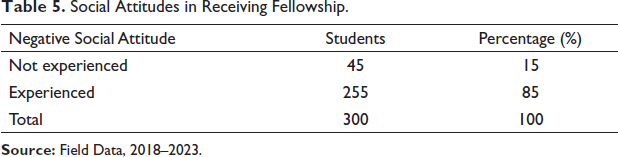
This testimony underscores the importance of addressing not only systemic challenges but also the discriminatory attitudes embedded in the academic environment, which impact the experiences of marginalised students benefiting from national fellowships. This is also apparent in the research conducted by Sukumar (2022) and Bhoi (2023). Furthermore, Sankar (28) elucidated:
Many times, the staff and teachers make mocking remarks about both the fellowship and the students. My fellowships were suddenly stopped because my supervisor told the government to stop the funding. Before that, the university delayed my fellowship for two semesters, hindering my research progress. When I asked the university about it, they made derogatory comments, saying, ‘You “Schedu” people always act like beggars; we won’t release your fellowship papers to receive the fellowship’.
Discriminatory evaluation and academic bias labelled as ‘Schedu’ inflict profound social, academic, psychological and economic detriment upon SC and ST students, worsened by fellowship termination. Echoing these claims, Guru (2012) notes the degradation of marginalised students’ identity and impurity notion attached them (Dumont, 1981), while Pathania et al. (2023) emphasise higher education’s role in addressing threatened identities. Despite these adversities, the national fellowship serves as cultural capital, enabling dalit and adivasi students to attain social, economic and political mobility (Bhoi, 2016). Acquiring fellowships in higher education allows them to establish cultural capital, positioning themselves on national and international platforms—a tangible contribution of public policy as a model for social welfare intervention (Bhoi, 2023; Deshpande & Khanna, 2021; Rout, 2015).
Conclusion
The study evident that the creation of cultural capital is vital to tackle deep-seated inequality, promote educational mobility for dalit and adivasi students, and uplift them from their marginalisation. The passage of public policy really built the cultural capital which is very essential for their de-marginalisation. This support contributes to their economic, social and political progress, while also revealing relational inequalities inherent in the caste system. Structural barriers persist, influencing salaried employment and self-employment. By drawing upon Bourdieu’s (1984) concepts of capital possession and habitus, one can contend that social and public policies may substitute for parental property and education, influencing the transformation of the lives of marginalised individuals. This shift can serve as the foundation for economic, social and political mobility. This study emphasises the effective leverage of the national fellowship scheme for dalit and adivasi students, facilitating their ascent in education, economics and society despite challenges. The historical context reveals caste hegemony, marginalisation and post-independence efforts for socio-economic, educational and political inclusion (Bhoi, 2023).
The national fellowship, a notable government initiative, significantly uplifts dalits and adivasis or SC and ST students in higher education, assuring their representation in higher education and opening a gateway of better employment for them. Bringing in Bourdieu (1988) and his concept of ‘homo academicus’, wherein he emphasised the significance of academic networks in academic progress, parallels can be drawn to the role of state support in connecting dalits and adivasis with their respective networks. This connection serves as a vital support system, enabling them to leverage their fellowship and attain educational accomplishments. Despite facing hurdles in accessing and sustaining their fellowships due to implementation challenges, the overall national fellowship system impact is advantageous for their future academic and career endeavours. The study recommends incorporating assessment entities, tribunals, addressing institutional interventions, giving priority to the most disadvantaged and expanding fellowship coverage. Here, it can also suggest that the fundamental restructuring of higher education is crucial to combat caste-based discrimination, promote dalit and adivasi scholars in higher education, and establish them as inspirational figures for the nation while securing better job opportunities through the fellowship system. Again, it is argued that the public policy-driven initiatives bridge societal gaps, empower marginalised sections and cultivate cultural capital, contributing to an inclusive and equitable society. Applying Bourdieu’s (1970) theory of cultural reproduction, our approach involves unique perspectives, focusing on the accumulation of capital through state intervention, welfare policies and constitutional justice. These elements collaborate to generate and distribute cultural capital, working towards the inclusion and enrichment of dalits and adivasis in a more diverse and inclusive social fabric. The cultivation of cultural capital for dalits and adivasis is assured when there is societal acceptance, effective implementation and successful operation of national fellowships as policy passage in their educational journey.
Footnotes
Acknowledgement
We express our appreciation to the participants who participated in this research. A special acknowledgment goes to Dr Hugo Gorringe for providing steadfast support and guidance during Dhaneswar’s postdoctoral work at the University of Edinburgh, UK in 2023, where the conceptualisation of cultivating cultural capital originated, and the theories for building cultural capital for the marginalised were formulated. We are deeply grateful to the Department of Education, University of Oxford, UK, for affording the opportunity to present our paper and for their valuable comments and suggestions for further enhancement. Additionally, heartfelt thanks to Prof. Jeevan R. Sharma of the University of Edinburgh for his valuable insights into how education and public policy positively impact marginalised dalit and adivasi students, enabling them to pursue higher studies and secure positions in overseas universities. We also acknowledge our respective current universities/organisations for providing the academic platform to develop this paper for publication.
Declaration of Conflicting Interests
The authors declared no potential conflicts of interest with respect to the research, authorship and/or publication of this article.
Funding
The authors received no financial support for the research, authorship and/or publication of this article.
