




Abstract
Urban inequality in India has increased with rising urban population. Urban poor particularly marginalised social groups face multidimensional exclusion in urban areas. The article attempts to engage and understand the multidimensional nature of social exclusion in urban spheres with the theoretical framework of the process of social exclusion. The article also highlights that marginalised social groups experience exclusion and discrimination in various socio-economic spheres. The article attempts to analyse impact of social exclusion on marginalised social groups. The social processes and interactions in urban areas are also determined by the social identities. The article examines the dynamics of multidimensional exclusion in urban spheres based on social identity. The article also suggests policies to make urban landscape more socially inclusive.
Introduction
India has witnessed large scale unplanned and haphazard growth of urban centres over the last few decades. The reluctant urbanisation has resulted into several urban problems and challenges experienced by almost every town in India. Most of the urban centres in India have reached to their saturation limit in terms of vertical and horizontal growth but still fail to provide decent housing and life to the urban resident. The large scale rural to urban migration has not only overburdened the existing urban infrastructure but also resulted into rapid proliferation of slums. Most of the rural–urban migrants are poor unskilled and semi-skilled workers who find it difficult to get sufficient income due to their informal and inconsistent nature of work. Due to low income, the urban poor find it difficult to afford decent housing and are forced to live in slums. Thus, the proliferation of slums is also the result of economic marginalisation of urban poor. Slums which are characterised by poor dilapidated living environment are also the outcome of exclusionary urban process, which denies better quality urban services in urban slums. Inter-social-group inequality in urban areas is more acute than rural areas. Urban poor particularly marginalised social groups face multidimensional exclusion in urban areas. The urban poor who play a crucial role in the construction of urban spaces are often denied right to live in these urban spaces. The prejudices and stigma against marginalised social groups are also acute in urban areas as well. The marginalised social groups experience exclusion in various socio-economic spheres which jeopardises their well-being. Social identity-based discrimination and prejudices deny equal access to employment and livelihood opportunities to the workers from marginalised social groups such as scheduled caste, scheduled tribes and religious minorities. The exclusionary practices in the labour market also cause loss of wages and income to the discriminated groups (Thorat et al., 2023). The economic exclusion also enforces exclusion in other socio-economic spheres. Lack of sufficient income also causes poor access to education, health and good quality accommodation. Besides, the marginalised social groups also experience discrimination and exclusion in access to education, healthcare and housing. Discriminatory behaviour at the academic institutions adversely affects the level of education among marginalised social groups. Due to poor income and exclusionary practices at healthcare centres, they often resort for no-medication during the illnesses. This adversely affects their livelihood due to prolonged illness and remaining out of the labour market for a larger duration. The marginalised social groups are also denied equal participation in the local decision-making process. Even if they manage to participate in the local areas meetings, their opinion is hardly heard and included in the decisions. Thus, marginalised social groups experience multidimensional exclusion in urban areas. The present article attempts to analyse and understand the processes of exclusion in urban areas and its impact on marginalised social groups. The article also aims to suggest policies to make urban landscape more socially inclusive and promoting right to city to all.
The article examines the multidimensional exclusion in urban spheres based on social identity. Indian society is divided on the basis of caste, religion and ethnic identities. Marginalised social groups such as scheduled caste and scheduled tribes have been denied access to socio-economic capital historically. Unequal access to income earning assets, livelihood and education has further deprived these vulnerable social groups. Thus, these groups have been denied socio-economic rights due to their social identity and have been forced to live in acute poverty. Despite constitutional safeguards against discrimination, the vulnerable social groups still face stigma, discrimination and exclusion based on their social identity. It is often argued that the social identity-based discrimination is higher in rural areas. Quite a significant proportion of migrants from marginalised social groups move to urban centres to get rid of identity-based discrimination. However, recent studies in urban areas point that the marginalised social groups face exclusion and discrimination in urban areas as well. The social processes and interactions in urban areas are also determined by the social identities. Residential segregation or social identity-based envelops are witnessed in all the major urban centres in India. Residential segregation is often the outcome of exclusion and discrimination experienced by marginalised social groups in the social-economic spheres in urban areas. These social identity-based envelops and residential segregated areas are inhabited by marginalised social groups and often lack sufficient urban infrastructure and basic amenities. Due to insecurity of tenure and other associated factors often civic services are denied to these localities. Due to development initiatives and welfare measures over the last few decades, the poverty ratio has declined for all the social groups, including marginalised communities. However, the rate of decline of poverty—both rural as well urban is lower for scheduled caste, scheduled tribes and other marginalised groups in India. Besides, inter-group inequality has widened over the last few decades particularly in urban areas in India. The households living in low-income localities, such as slums, residential segregated areas face multidimensional deprivation. The deprivation of one dimension often results into deprivation of other spheres. The economic deprivation often translates into deprivation in access to health, education, housing and other basic amenities which adversely affects the socio-economic well-being of marginalised and vulnerable communities in urban areas (Baud et al., 2009; Chaurasia, 2007; Haan, 2003).
Urban inequality in India has increased with rising urban population. Despite increase in per capita income in urban areas, quite a significant portion of urban population is forced to live in the dilapidated and substandard dwelling with poor basic amenities. Kuznets (1955) explained that with rise in urban population, the urban inequality also increases initially but gradually the inequality comes down (Acemoglu & Robinson, 2002). Thus, there is an inverted U relationship between urbanisation rate and urban inequality. However, in India, urban inequality is still acute despite rapid urbanisation over the last few decades. The major reason for urban inequality is unequal distribution of the benefits of the urbanisation among various groups and communities living in urban areas. Thus, the benefit of urbanisation such as rise in income, better education and healthcare opportunities, better employment, housing and other urban amenities have not reached to all sections of urban society. Unfortunately, quite a significant proportion of urban population mainly urban poor from marginalised social groups have been deprived of basic urban services. Rising urban inequality has made the marginalised groups more vulnerable.
Multidimensional Exclusion in Urban Spheres.
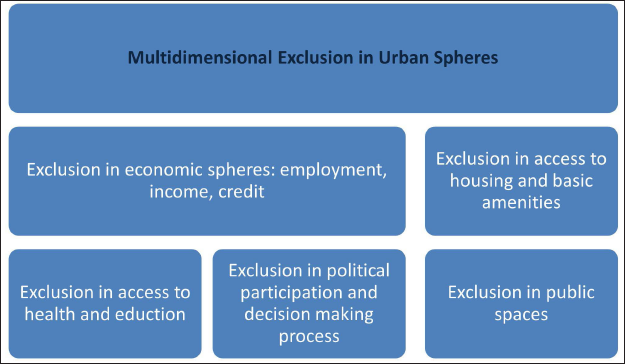
Exclusion in urban spaces often works in the multidimensional and overlapping forms (see Figure 1). Different dimensions of urban exclusion are not often mutually exclusive but often work together and make urban poor further vulnerable. Master plans of the cities that are periodically prepared often perpetuate urban exclusionary processes. These documents often determine who and where will be excluded in the urban process (Harms, 2016). The master plans of urban areas that work as a legal document cause evictions in the name of city beauticians and modernisations. Often pretext of improving urban environments also causes forced eviction of the urban poor. Thus, ‘green eviction’ in the name of sustainable cities increases vulnerabilities of marginalised social groups in urban areas (Baviskar, 2011; Ghertner, 2011). Urban poor who mainly hails from vulnerable social groups are often pushed to the margins in the city. The city master plans are termed as source of paper-based exclusions (Harms, 2016). As David Harvey (2008) puts it, the capitalism and neo-liberalisation forces accelerate the spatial exclusion in urban areas through the dispossessions of land and other urban infrastructures. Social exclusions in urban spheres are often structural in nature. Based on the social identities, such as caste, religion, ethnicity and gender, certain social groups are denied equal access to public spaces and thus causing geographies of exclusion (Harms, 2016; Sibley, 1995). The marginalised social groups who are forced to reside in the fragile urban environment due to their low income face the health and other vulnerabilities. On the other hand, the city beautification and environment improvement processes often target the areas inhabited by urban poor such as slums and resulting forced evictions.
Social exclusion often results into poverty due to denial of equal opportunities in employment and income generating assets. Thus, the social exclusion and inequality translate into persistence of urban poverty (Clert, 1999). Withdrawal of social security benefits and formal employment opportunities due to globalisation and neo-liberalisation also accelerated the processes of social exclusion in urban areas (McGrew, 2000). Neoliberal forces have further enforced the new urban order and moulded the concept of urban and increasing spatial and social inequality. Backtracking of the welfare state, exploitation of urban labour and conversion of organised sector into unorganised sector and reducing democratic spaces have further increased vulnerably in urban spaces. The globalisation and neo-liberalisation processes had resulted into the economic restructuring of the most of the urban centres not only in India but across the globe. The economic restructuring has not only created economic inequalities but also widened the social cleavage in all urban centres in India. This has resulted into the decline in the living conditions of quite a significant proportion of urban population.
Vaughan et al. (2005) comprehensively explained the relationship between spatial segregation and economic deprivation in urban settings. The geography of exclusion and deprivation in urban areas is determined by interlinked social and economic processes. Migration of rural poverty to urban areas in search of decent livelihood results into the proliferation of slums and low-income settlements. As discussed earlier in this article, socio-economic deprivation in the slums overlaps with poor provision of essential urban amenities. Urban public agencies such as municipal corporations also differentiate and discriminate in making provision of basic services to slums and squatter settlements. Thus, the urban processes lead to the urban deprivations in urban spheres. The socio-spatial characteristics of an urban locality significantly influence the quality of service availed by its inhabitants and creation of social exclusion (Power, 2000). Poor living environments and neighbourhoods often overlap with concentration of marginalised social groups in these localities. Thus, social exclusion in urban spheres deprives the poor and marginalised groups in equal participation in socio-economic and political spheres and realise the potential of equal citizens of the city. Spatial and economic exclusion also affects social relations as explores the present article. Wolfe (1995) enlists six dimensions of social exclusion in urban spheres: exclusion in employment, social services, cultural spheres, political decision making, social participation and right to knowledge. However, these six dimensions are not mutually exclusive and are often linked. Exclusion in the urban sphere is inter-lined and multidimensional in nature and perceived in the context of social identities (see Figure 1). Poverty is crucial in the analysis of exclusion in urban spheres as it steers away socially marginalised groups to the poor neighbourhoods and results into the residential segregation (Nowosielski, 2012). Thus, social exclusion also causes cumulative and aggregate disadvantages to marginalised social groups. Exclusionary urban processes often trap the vulnerable social groups particularly migrants.
Cities are engines of economic growth and economic mobility. The better amenities and infrastructure in urban areas and perceived higher education and employment opportunities work as a pull factor for attracting migrants from rural areas. However, despite the bright site of better infrastructure and amenities, the urban areas are also the centres of social exclusion and deprivation. The urban exclusion and deprivation are manifested in the forms of slums and squatter settlements which are witnessed in most of the cities in India. Most of the urban centres in India have envelops where the urban poverty is concentrated. The social mapping of these segregated spaces indicates that mostly marginalised social groups and poor migrants are living here. These socially and economically segregated localities are characterised by poor quality of housing and basic amenities, low income and employment, and poor health and educational opportunities. In India, the urban segregation based on the caste and religious identities is more pronounced than the segregation based on the economic and income dimensions (Haque, 2016).
Exclusionary processes in urban spheres that deny equal access to various socio-economic dimensions deepen the social inequality. While the poor are denied socio-economic capital, the urban elite get the benefits of the most of the economic gains. The concentration of income and other urban amenities also give birth to gated communities (Blakely & Snyder, 1997; Nowosielski, 2012). Access to educational and employment opportunities is also determined by the social identities (Thorat & Newman, 2007). The spatial design of social structure in the urban areas is also important in explaining the marginalisation and social exclusion in urban spheres as geographical concentration and deprivation in access to socio-economic opportunities go hand in hand (Haque, 2016). Thus, social identities are significant in explaining the inequality in urban areas (Sidhwani, 2015). Often spatial distribution of slums coincided with the concentration of marginalised social groups. The present article also indicates towards persistence social inequality in various socio-economic dimensions in urban India. Since the structural adjustment programmes in 1991, both vertical inequality (among people) and horizontal inequality (among social groups) have increased in urban areas (Vakulabharanam & Motiram, 2012).
Inter-linkages of Social Exclusion, Deprivation and Poverty.
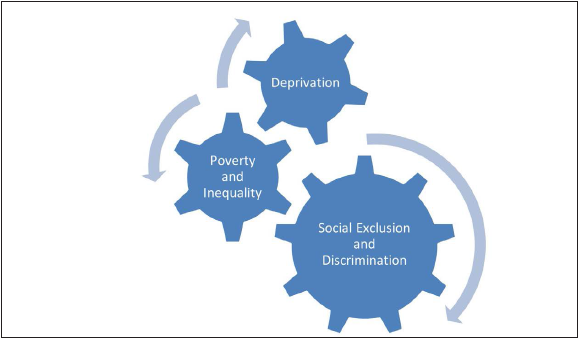
While social exclusion explains horizontal deprivation, inequality and poverty is the measure of vertical economic inequality (see Figure 2). In India, social identity plays crucial role in determining the household well-being. Caste often transforms itself in terms of its practice in urban areas but it still remains as a medium of social exclusion and exploitation (Desai & Dubey, 2011; Mishra, 2020). Despite migrating to urban areas, the discrimination and social exclusion based on the caste-based identities continues. Thus, social construction of caste persists in urban areas as well and significantly determines access to opportunities in various dimensions. Even access to public spaces lack plurality in urban areas due to emergence of social identity-based gated communities (Ali, 2001). Apart from the caste, religious and ethnic identities in terms of Muslim minorities and north-east migrants also face exclusion and discrimination in accessing resources in urban areas. Often the areas inhabited by the marginalised social groups are considered culturally alien to other social groups living in the city as interaction are often lacking (Chatterjee, 2015). Due to prejudices and stereotyping against scheduled caste, Muslims and migrants from north-east, the dominant social group avoid having close interactions.
Sustainable Development Goal 17 aims to achieve poverty and hunger free society by 2030 and ensure equitable access to health, education and energy to all nations and individuals. However, to achieve these goals, social exclusion needs to be replaced with social inclusion. Every inhabitant of the city should have equal and just access to health, education, housing, livelihood opportunities and participation in decision making for the economic resources. Thus, it is essential to remove not only economic deprivation but also social, cultural and political deprivations.
Hilary Silver (2007) describes the social exclusion as progressive multidimensional breaking of the social bonds in the society. Exclusion is also a dynamic social process which denies equal participation in the economic, social, cultural and political spheres and excludes marginalised social in accessing information as well as resources of the society. Apart from this, social exclusion also covers the inclusion with unequal terms and conditions which may be called as differential preconditions. Silver (2007) also finds the nature of exclusion essentially multidimensional in which various dimensions are often organically linked and have causal relationships. For instance, the economic exclusion may lead to social as well as cultural exclusion. This may also cause the exclusion in the decision-making process. Apart from this, the social exclusion needs to be measured and analysed in the social, cultural and geographical context. Social exclusion not only causes economic losses but also results in the humiliation and loss of social recognition.
Theoretical Framework of Multidimensional Exclusion in Urban Spheres
Social exclusion may be defined as denial of equal opportunities in access to various socio-economic dimensions such as education, health, employment, housing and basic amenities, and social, cultural and political participation. Social exclusion and poverty are not synonymous. The incidence of poverty is reported across all the social groups while social exclusion is only faced by the marginalised social groups. However, the poverty may also sometime lead to exclusion in urban spheres. Apart from the economic capital, the marginalised social groups also lack social capital as they are denied access to quality social network in urban spaces. The problem of social exclusion in urban spheres is getting worse as the commercialisation of urban spaces and amenities is happening. Withdrawal of the state in providing urban basic amenities has made marginalised social groups further vulnerable. Thus, the state agencies in urban areas operate in such a manner that it excludes marginalised social groups in accessing resources and full participation in public spheres (Kabeer, 2009). Sustainable Development Goals 2030 also emphasise in eradication of inter-group inequality and exclusion for the creation of equitable, egalitarian and just society for all irrespective of social identity. Exclusion in urban spheres is mostly concentrated, deep and multidimensional in nature. The exclusion in one-dimensions often leads to exclusion in another dimension. Thus, exclusion is not only relative but also rational. The urban social exclusion has adverse consequences on the quality of life, household well-being and aspirations. Multidimensional exclusion in urban spheres also results into multiple deprivations in access to income, employment, education, health, housing and basic amenities, public and private services, and social, cultural and political participation. Urban exclusion based on the social identity also denies the right to city to the inhabitants. The exclusionary process in the urban spheres is also dynamic in nature and transforms itself over the space and time. The major drivers of urban social exclusion in India are caste, religion and ethnic identities. The social exclusion is based on ascribed attributes instead of individual characteristics of members of any society (Thorat & Newman, 2007). The major consequences of urban exclusion are denial of equal opportunity and thus deprivation in socio-economic spheres. Amartya Sen (2000) distinguishes between active and passive nature of discrimination. Active exclusion is caused by public policies which deny access to equal opportunities. Passive exclusion is not linked to the public policies but often causes adverse consequences to marginalised social groups (Thorat & Newman, 2007). However, measuring the multidimensional nature of social exclusion remains a challenge for the social scientists. As the nature of exclusion is also context specific to different urban settings, development of universal indicators for measuring social exclusion remains a challenge. The composite index of indicators of exclusions, such as denial of unequal access to resources, basic social services, denial of equal opportunities and unequal participation needs to be developed for measuring multidimensional nature of social exclusion.
To understand the nature and forms of exclusion in urban spheres, we need to look into the theories of exclusion. Literature on exclusion and discrimination in India does not cover the theories on exclusion. Therefore, we need to analyse the Western theories on exclusion. Becker (1993) in his seminal work on economics of discrimination postulated taste of discrimination theory. Becker explained that people practice discriminatory behaviour as they taste for the discrimination which gives them satisfaction (Ibid.). To taste the satisfaction of discrimination, the person is ready to reduce the profit or income to exclude certain social groups. The basis of this taste discrimination theory is prejudices and stigma that dominant social groups have against the marginalised social groups. Statistical or belief-based theory also explains the discrimination. As per this theory, the people do not discriminate because of taste of discrimination but discriminate due to imperfect information about certain social groups. They presume that the attributes of an individual member of a certain group represent the average attributes of the social groups. In other words, the basis of the discrimination is the belief about other social groups, which may not be correct. Therefore, the prejudice and stereotype against certain social groups are the major driving forces of discrimination (Borooah et al., 2015; Mishra, 2020). Akerlof and Kranton (2010) criticised the limitations of the taste and belief theory in explaining the multiple patterns of discrimination and alternatively postulated the identity theory of discrimination. The identity theory narrates that social context and norms determine the nature and forms of discrimination experienced by discriminated groups. In other words, the discriminatory behaviour of the dominant social group is because of social identity and norms. For instance, the behaviour of the upper caste towards the marginalised groups will be determined by the social context and norms, which distinguishes different social groups into ‘us’ and ‘them’ (Borooah et al., 2015). The prejudice creates stereotypes (mostly negative) against certain social groups which forms the basis of discriminatory behaviour (Ibid.). However, Blumer (1958) contradicts Allport and explains that the basis of the prejudices is not the outcome of individual belief. Rather, the origin of the prejudices is social groups and relative benefits associated with group membership. Due to this relative benefit, the dominant social groups make effort to protect their privileged position through discriminatory behaviour against marginalised social groups. Thus, the social group position acclaimed by the dominant social groups determines its relationship with marginalised social groups. Thus, prejudice and discrimination are determined by social group to social group relations and not by the relations among individuals (Borooah et al., 2015). The social exclusion often operates within virtual and non-transparent social boundaries. These social boundaries control the social and economic interactions among different social groups. Exclusion and discrimination are often practiced across these social boundaries (Silver, 2007). Sen (2000) explained the concept of social exclusion through the capability approach. Denial of access to labour market, income earning opportunities, education, health, housing and social and political participation due to social identity-based discrimination reduces the capability of excluded groups to live normal life in the society. Sen (2000) also differentiates between two major forms of exclusion: unfavourable exclusion and unfavourable inclusion. In the unfavourable exclusion, the certain groups are deliberately kept out from various socio-economic dimensions and in unfavourable inclusion these groups are included on the unfavourable condition, which is equal to exclusion. Thus, as explained earlier the social exclusion denies equal opportunity to the marginalised social groups and is embedded in the social identity. Social exclusion often results into unpleasant outcome for the excluded groups: poverty, inequality, discrimination and deprivation in various indicators are a few of the adverse consequences of exclusion and discrimination. The nature and degree of adverse outcome of social exclusion depends upon the intensity of exclusionary processes (Thorat & Sabharwal, 2010). As discussed earlier, the basis of the social exclusion is virtual social identities rather than personal attributes/characteristics of the individual member of the society.
As discussed earlier, the social exclusion revolves around inter-social relations and perceived stigma and prejudices against discriminated groups. Inter-social relations are also determined by the social group identity, such as caste, religion, ethnicity and gender. Ironically, in urban India also, the caste plays a major role in determining nature and forms of inter-social relations and often results into discriminatory behaviours against scheduled caste. The practice of caste and untouchability is predominant in urban areas as well and causes exclusion and discrimination to the scheduled caste. Despite Constitutional (Article 17) and regulatory framework against untouchability, the scheduled caste still suffer exclusion and discrimination. Caste-based discrimination is practiced in either direct or indirect manner. Nature and degree may vary as per the social and geographical context. Muslims also face exclusion and discrimination due to their religious identities and minority status. Residential segregation and ghettoization of Muslim population are witnessed in almost all cities in India. Apart from this, the migrants from north-east states in India are also the victim of ethnicity-based exclusion and discrimination in different cities in India, including Delhi. Empirical study conducted at Indian Institute of Dalit Studies explains that north-east migrants specially women face exclusion and discrimination in multiple social, economic, cultural and political spheres and are often the victim of violence and denial of equal public space in National Capital Region of Delhi (Mukherjee & Dutta, 2018). The north-east migrants and Muslims in Delhi also suffer with physical segregation.
Multidimensional exclusion in urban spheres can be explained in following dimensions: economic dimensions such as access to employment, credit; exclusion in access to health and education, access to housing particularly rental housing, participation in decision making and social participation in the form of access to group membership. Exclusion in economic spheres happens through complete denial of access to employment or livelihood, discriminatory behaviour at the time of hiring (selective hiring on the basis of social group identity) and also at the work place and not allowed job in high paid work, and unfavourable inclusion in ‘unclean & polluting job’ such as cleaning, etc. Apart from this, unequal and discriminatory wages, discriminatory behaviour at workplace, denial of sale and purchase due to social identity, denial of social security benefits and long-term contracts also mark the economic exclusion for marginalised social groups. Inability in accessing to credit due to lack of collaterals and discrimination further aggravates the economic exclusion for marginalised social groups in urban spheres (Thorat et al., 2023).
Apart from economic spheres, exclusion also occurs in access to health, education, housing and sociopolitical participation. Empirical studies on access to health services indicate the exclusion and discrimination experienced by marginalised social groups while accessing healthcare services (Acharya, 2010). The discriminatory practices based on the social identity are found both in public and private healthcare services. The marginalised social groups either face complete denial of healthcare services or allowed with discriminatory conditions. Discriminatory behaviour is practiced by both doctors and healthcare workers. Discrimination in access to healthcare is practiced in the forms of—avoiding touching, longer waiting time, not listening the health problems, separate sitting arrangement, not allowed to use water and sanitation facilities at health centres, overcharging, social identity based derogatory remarks and not providing full healthcare information (Acharya, 2010; Thorat & Sabharwal, 2010). Marginalised social groups experience discrimination while access to education as well. The nature and forms of discrimination in access to education are discriminatory behaviour by teachers and peers, participation in curricular and non-curricular activities at school, separate sitting arrangement in the class, separate queue for the children from marginalised social groups, discrimination in the role given in the class and forcing to do menial/cleaning job at the school. Apart from this, the marginalised social groups face exclusion and discrimination in participation in group memberships, local decision-making process and access to public spheres and raising the voice for their rights. Marginalised social groups such as scheduled caste, Muslims and migrants from north-east face exclusion and discrimination while accessing housing and basic amenities. Both unfavourable exclusion and unfavourable inclusion is practiced in the housing market. The house owners and real estate agents practice discriminatory behaviour against marginalised social groups. The denial of access to housing—both direct and indirect causes unfavourable exclusion to the marginalised social groups.
The Exclusionary Process in Urban Housing Market Leading to Residential Segregation.
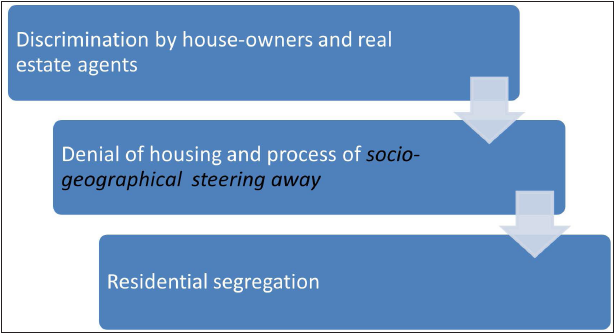
The house owners and real estate agents often put certain preconditions, such as no cooking of non-vegetarian food, company lease, ready to vacate on short notice and higher prices, etc., to give a house on rent. This unfavourable inclusion in the housing market with differential terms and conditions puts additional social and economic burden on the tenants from marginalised social groups. The exclusionary process in the urban rental housing market often causes unpleasant outcomes for the marginalised social groups in the form of higher prices, socio-psychological stress, longer commuting distance, compromise with quality of housing, basic amenities, neighbourhood infrastructure, etc. The vulnerable social groups also suffer with compromise with sociocultural values, such as food, clothes, cultural traditions, etc. Sometimes they also have to vacate their houses without their will due to discriminatory practices of house-owners, real estate agents and neighbours. Another exclusionary phenomenon that needs to be discussed in the social exclusion in urban spheres is—socio-geographical steering away (see Figure 3). This process is the outcome of the discriminatory and exclusionary behaviour of the house-owners and real estate agents who deny housing to the marginalised social groups in the areas inhabited by mainly dominant social groups (Mishra, 2020). Apart from denying housing to the dominant locality, the real estate agents pursue the tenants from marginalised social groups such as scheduled caste and Muslims to search house in the locality where mainly people from discriminated social groups (scheduled caste and Muslims) are living. Thus, the socio-geographical steering away creates social identity-based residential localities, causing physical and social segregation (residential segregation). As discussed earlier, these socially segregated areas are deprived of better social and physical urban infrastructure.
Policy Recommendations
The urban exclusion not only affects the marginalised social groups but also adversely affects the urban social structure and vibrancy of the urban spaces. The exclusionary processes are also the mother of many urban problems, which India and other countries are witnessing. Thus, the urban inclusion policies are inevitable to urban reforms. There is urgent need to develop specific urban programmes which promote and ensure the inclusions of all the sections of urban society. The right to city should be ensured and guaranteed to all the inhabitants of the city as they are equal stakeholders. The article highlights that marginalised social groups experience exclusion and discrimination in various socio-economic spheres. Based on the analysis in this article it can be argued that a multi-pronged strategy is needed to reduce the inter-group inequality in access to socio-economic and political opportunities. Poor and migrants in urban areas especially from the marginalised social groups who are most vulnerable are often left to the functioning of market forces. As discussed earlier, social equity and inclusive access to socio-economic resources cannot be guaranteed by the market forces alone as outcomes of economic transactions are often governed by social identity-based barriers. Policy interventions are needed to eradicate social identity-based social exclusion and discrimination against marginalised social groups such as scheduled caste, scheduled tribes, Muslims and ethnic minorities. Urban policies should be framed and strictly implemented to stop discriminatory practices in school and other academic institutions. The provision of equal opportunity and grievance redressal mechanisms are often unable to stop exclusionary practices at academic institutions. Promotion of civil values towards sensitising the socio-religious and ethnic diversity is needed to eradicate discriminatory practices. Apart from this, promoting social interactions and counselling of peers and teachers for non-discriminatory behaviour should be implemented. Non-discriminatory access to credit and employment is essential for inclusive society. Lack of safeguard and regulation against the discrimination in the labour market further reduces the employment opportunities for marginalised social groups. A regulatory framework should be made for each employer for ensuring non-discriminatory and inclusive work environment irrespective of social identity. Apart from this, nurturing and promoting idea of equality, fraternity and justice is crucial for removing social exclusion in urban spheres. Social inclusion is just not equal and non-discriminatory access to social and economic resources but also recognition of contribution and belonging to the city. Public policy response to urban social exclusion should consider the nature and forms of social exclusion. As social exclusion revolves around the group identity and not the individual identity, there is need for group-specific policies. For instance, apart from general policies for urban poverty alleviation, there is need for the group-specific policies for the urban marginalised social groups such as scheduled caste, Muslims and vulnerable among the migrants.
Footnotes
Declaration of Conflicting Interests
The author declared no potential conflicts of interest with respect to the research, authorship and/or publication of this article.
Funding
The author disclosed receipt of the following financial support for the research, authorship and/or publication of this article: The article is based on some of the research findings of the Postdoctoral thesis entitled ‘Multi-dimensional Exclusion in Urban Spheres’ of the author. The Postdoctoral Fellowship of the author is funded by the Indian Council of Social Science Research, New Delhi.
