




Abstract
Ordinarily, African countries suffer severe resource constraints. Resource constraints refer to insufficient means to meet sustainable economic growth demands. Regarding entrepreneurial activities, a supportive entrepreneurial ecosystem is needed for the large uptake of and sustained interest in entrepreneurship. It is on record that African countries’ dilapidated infrastructure and maladministration, including weak institutions, are reasons sustainable entrepreneurial activities have been less than optimal. The recent COVID-19 pandemic no doubt extended the challenge of entrepreneurship on the continent. Using Pickering and Byrne’s (2014) systematic quantitative assessment technique, we identified, assessed and interpreted available research evidence that assisted us in exploring the impact of resource constraints on African entrepreneurial ecosystem formation, development and growth. We noted that COVID-19 added complexities to perennial questions about making African entrepreneurship ecosystems fit for supporting entrepreneurship development. Although African economies were already constrained in many ways, including their business environment, we conclude that the COVID-19 pandemic brought challenges and opportunities for business management and entrepreneurship. While businesses could adapt in many cases, several aspects—such as government regulations, consumer behaviour shifts and global supply chain disruptions—were beyond their control. Navigating these uncertainties required agility, resilience and an ability to innovate, but it also highlighted the vulnerabilities and risks inherent in the modern globalised economy. This study synthesised the evidence on how COVID-19 intensified longstanding resource constraints within African entrepreneurial ecosystems, revealing that the compounded effects on business education, infrastructure and regulatory processes not only deepened small and medium enterprise (SME) vulnerabilities but also uncovered context-specific opportunities for resilience and innovation that have not been previously documented. Some implications and recommendations for future research are flagged. However, more importantly, we are convinced that African entrepreneurship has long suffered several political, economic, social and technological challenges that compromised its capacity to grapple with the COVID-19 pandemic. To this end, we conclude that a supportive entrepreneurial ecosystem is crucial to SME development. As such, this study reinforces the need for the government to reconsider its approach to supporting SMEs.
Keywords
Introduction
In 2018, Galperin and Melyoki stated that governments in many emerging and low-income countries still needed to improve entrepreneurial activities owing to fragile ecosystems that foster entrepreneurship. With such weak entrepreneurial ecosystems, it is unsurprising that the COVID-19 pandemic hit these economies the most (Lucchini et al., 2025; Srinivas et al., 2024). The fact that these economies were already fragile before the pandemic suggests that the pandemic occurred at an opportune moment when developing nations were ill-prepared to support entrepreneurial development initiatives. It is equally fair to assume that most economies suffered terribly during COVID-19 despite ensuring positive developments, namely firms’ migration to the digital economy. From an entrepreneurial development perspective, the pandemic hindered the functioning of entrepreneurship systems when small firms needed more support to build resilience against emerging operational challenges. Rashid and Ratten (2021) stressed that COVID-19 undermined the capabilities of the entrepreneurship ecosystem’s key functional domains, namely culture, networks and infrastructure, to create a supportive environment for survival, growth and business sustainability. Several researchers have pointed out these and many more limitations in African entrepreneurship ecosystem. The framework for the entrepreneurial ecosystem proposed by Mazzarol (2014), which is mostly argued to have been drawn from Isenberg’s, shows a shared relationship among several factors that significantly impact the expansion of entrepreneurship. These factors include policies and leadership, a conducive culture, quality human capital, availability of appropriate finance, venture-friendly markets for products and a range of institutional supports (Kandukuri, 2023).
Despite this growing body of research, important gaps remain. Therefore, an in-depth examination of the relationships among these components can be complemented by outlining sources of sustainability for entrepreneurial uptakes, especially during a crisis such as COVID-19. Within the African ecosystem, dilapidated infrastructure due to lack of maintenance, overburdensome requirements for business registration and uncoordinated business education have yet to be sufficiently examined and, more so, using Pickering and Byrne’s (2014) ‘systematic quantitative assessment technique’ (SQAT). This methodology is unique because it enables researchers to interrogate databases to identify relevant literature rapidly (Pickering & Byrne, 2014), and was also adopted by a similar study (Umar et al., 2025). In this way, it has flexibility that can improve scientific rigour in reviews. Moreover, the overall destabilisation of normality in economic and social life under COVID-19 negatively impacted entrepreneurship development. In fact, small and medium enterprises (SMEs) entrepreneurial ecosystems suffered more than those of larger firms (Fubah & Moos, 2022; Strydom & Van der Merwe, 2025) due to differing resilience capabilities. Hence, Kuckertz et al. (2020) postulated that only those economies endowed with resilient entrepreneurial ecosystems could resume their pre-crisis activity level more quickly than those with fragile ecosystems, as in many African countries. De Vos (2020) and Hevia and Neumeyer (2020) believe the effects of concomitant COVID-19 interventions, including restricting goods and people, isolating and quarantining people and implementing social distancing, will continue to have significant implications for developing economies as they attempt to revive the small business economy in the post-COVID-19 era. This is because the pandemic impaired the network of entrepreneurial organisations, institutions and entrepreneurial processes that ‘formally and informally coalesce to connect, mediate and govern the performance within the local entrepreneurial environment’ (Mason & Brown, 2014). In that sense, how to rebuild and strengthen entrepreneurial ecosystems in the post-COVID-19 era is a significant concern in many African countries, considering that sustaining the entrepreneurship economy remains a key strategy to the core challenges of poverty, unemployment and inequality in their nations. Secondly, concerns about resource constraints to entrepreneurship development in Africa are not new and have been reported in several studies (Abor & Quartey, 2010; Aidoo et al., 2021; Chakravarty, 2022; Kansheba, 2020; Okpara & Koumbiadis, 2008); yet gaps remain (Girma Aragaw et al., 2025). Thirdly, although past research on COVID-19 and entrepreneurship in Africa has provided valuable insights into the challenges and adaptations of entrepreneurs during the pandemic, it suffers from limitations in sample size, scope and long-term analysis.
Against this background, this article explores the impact of resource constraints on the African entrepreneurial ecosystem and its demonstrable capacity to support SMEs during and after the COVID-19 pandemic. We examine this issue, aware that although the pandemic is technically over, its enduring effects remain, and African countries are still embroiled in the post-COVID-19 economic recovery phase. Therefore, our article aimed to uncover, assess and interpret relevant research to explore the impact of resource constraints on the African entrepreneurial ecosystem using Pickering and Byrne’s (2014) SQAT. Thus, we believe that by examining Africa’s resource constraints in the wake of COVID-19, we can not only extend discussions related to overall entrepreneurial ecosystem development but also foreground significant implications related to the challenges and coping mechanisms of SMEs in Africa. Importantly, we followed the counsel in the literature, recognising that while all ecosystem elements are important, focusing on specific elements of an entrepreneurial ecosystem is potentially a promising direction for future research (Noelia & Rosalia, 2020; Stephens et al., 2022).
This article proceeds as follows: First, we discuss the state of entrepreneurship in Africa, followed by an analysis of the impact of COVID-19. Then, we discuss the method used in gathering data for the article, followed by our discussion of the data. Finally, we highlight some recommendations and implications in the conclusion.
Literature Review
The State of Entrepreneurship Ecosystems in Africa
Africa has suffered from the three-pronged challenges of poverty, unemployment and inequality for many years. While these persist, entrepreneurship is relied upon to dent their stranglehold on the economy and people. The recent devastating attack of COVID-19 on the continent is rumoured to have extended the ruin caused by poverty, unemployment and inequality in households and the economy, considering that African societies are rarely capable of absorbing unforeseen shocks of this size because of the lack of social welfare and business rescue strategies that fall far below societal and industry needs.
On the business front, the apparent lack of resources on the African continent has historically impacted entrepreneurial ecosystem formation, development and growth (Negri et al., 2025). In turn, weak entrepreneurship ecosystems have slowed the rate of entrepreneurship development. Arguably, Africa’s entrepreneurship development is locked in this vicious loop in which a poor entrepreneurship ecosystem results in low entrepreneurial activities, which do not make a strong case for robust entrepreneurship development. Investment by governments and institutional agents connected to the entrepreneurship ecosystem have proved insufficient. Nonetheless, out of the many elements that constitute part of entrepreneurship ecosystems, in this study, we focus on three elements, namely business education, infrastructure and ease of doing business (Lipoko et al., 2021; Onwumere & Egbo, 2008) that we believe are critical to entrepreneurial development and growth in Africa. We further believe that these three macro-factors encapsulate the six domains of an entrepreneurial ecosystem identified by Isenberg (2011): markets, policy, finance, support, culture and human capital. These views are corroborated by Maroufkhani et al. (2018) when they say that an entrepreneurship ecosystem refers to a ‘conducive environment in which entrepreneurial ventures can innovate and prosper’. We address these elements while also reflecting on how the COVID-19 pandemic further impaired the entrepreneurial ecosystem and reversed the growth prospects of many small business players.
Entrepreneurship Education
As far back as 2008, Onwumere and Egbo opined that ‘part of Africa’s underdevelopment is inadvertently tied to the inability of African countries to take advantage of opportunities due to the inadequate entrepreneurial skills and entrepreneurship environment’ (p. 28). Several other researchers, such as Radebe and Vezi-Magigaba (2021) and Astiana et al. (2022), have equally implicated the lack of business education as a factor that has limited the successful engagement of business in Africa. Tengeh et al. (2015) blamed this on the poor integration of entrepreneurship education in the curricula of other programmes besides those within economic and management sciences in a university. What Tengeh et al. were proposing is teaching entrepreneurship across a university. Ndofirepi and Rambe (2017) decried the scourge of unemployment and poverty amongst the youth and called for sufficient entrepreneurship education uptake as a central issue in socio-economic development discussions around Africa. Entrepreneurial development in Africa hinges on business knowledge. Through business knowledge, entrepreneurs can understand the intricacies of fund sourcing—where, when and how they are equally able to determine how to market their products and services and generally stay the course on developing the business (Ndofirepi & Rambe, 2017; Radebe & Vezi-Magigaba, 2021; Tengeh et al., 2015). However in Africa entrepreneurial education occurs in disruptive environments. In Nigeria, for instance, public higher education is epileptic, with varying stages of unrest involving students, academics and non-academic staff (Obadare, 2021). Different types of protests have also disrupted the academic calendar in other African countries, such as South Africa, Kenya and Ghana (Fomunyam, 2017).
This study examines entrepreneurship education rather than general business, due to its unique role in equipping individuals with adaptive skills essential for navigating crises like COVID-19. Specifically, some of these skills include opportunity recognition, risk management and innovative problem-solving (Kandukuri, 2023; Santos et al., 2019). Furthermore, entrepreneurship education fosters systemic resilience by enabling entrepreneurs to pivot their business models, leverage digital tools and secure alternative funding during disruptions (Kansheba et al., 2022; Thukral, 2021). For instance, SMEs owners trained in entrepreneurship education were more likely to adopt e-commerce during lockdowns, thus mitigating revenue losses (Fubah & Moos, 2022). However, we acknowledge that the impact of entrepreneurship education is mediated by external factors such as infrastructure and policy support, highlighting the need for integrated ecosystem interventions.
Infrastructure
Infrastructure refers to several things, from a good road network, electricity and water supply systems to communication, sanitation and health facilities. These are often non-existent or hardly functional in African states (Asitik et al., 2016; The Development Bank of Southern Africa, 1998). Munoz et al. (2022) argue the need for sufficient infrastructure to stimulate entrepreneurship in Chile in their paper. They claimed that for Chile to experience economic growth through entrepreneurship, deliberate infrastructural development was necessary. A similar argument is also incumbent on numerous African countries where entrepreneurship fails to prosper due to infrastructure issues. For example, several African countries struggle with a constant electricity supply. In South Africa, load shedding has become a norm. Nigeria’s electricity crisis has led to reliance on alternative power generation sources (Okonkwo et al., 2021). The economic impact on business sustainability ranges from loss of profit, loss of productivity and damage to equipment to disconcertment (Ateba et al., 2019; Steenkamp et al., 2016).
The 2015–2016 GEM report identified functional infrastructure as a significant factor that can drive economic growth in Africa (Herrington & Kew, 2016). Advancing this argument, Makhathini et al. (2020) found that investing in physical, economic or social infrastructure was essential to promote economic growth. The promotion of economic growth relies on a good network of roads. In this regard, transport systems that depend on functional road networks are essential for an entrepreneur. It is common for petrol and diesel to be scarce in Africa. Infrastructure must be available to sustain businesses, support enterprise development and improve the economy. The shortage of functional infrastructure does not bode well for enterprise sustainability.
Hassle-free Business Formalisation Process
Joshi et al. (2014) believe there is value in formalising a business through registration with applicable bodies. One benefit is that governments can know how many businesses operate in their economy. It is, therefore, fair to assume that African countries should create the necessary environment for the formalisation of businesses. It is equally reasonable to assume that, considering the state of infrastructural decay in Africa, business owners wishing to formalise their venture encounter numerous challenges. One of those challenges is the long time it takes to register a business (Abor & Quartey, 2010; Asongu & Odhiambo, 2019; Nieuwenhuizen, 2019). In some cases, those wishing to register their business have complained about the corruptive practices of those responsible for such activities (Ufere et al., 2020; Williams & Quinot, 2007). Besides, there is a lack of motivation to register a business due to mistrust in the government. The central argument for an easy business formalisation process is in policy development. Nevertheless, government policy is typically seen as an essential element of an entrepreneurial ecosystem (Galperin & Melyoki, 2018) as it sets the parameters of how other domains, including markets, banks and other firms, intervene in the affairs of SMEs. Therefore, a lack of solid policy initiatives in many developing economies sets up SMEs for failure.
COVID-19 and Entrepreneurship Ecosystems Dynamics
As the pandemic unsettled existing social and economic systems, the suffering and threats to entrepreneurship became unavoidable. Apedo-Amah et al. (2020) referred to revenue losses, business closures, mass layoffs, liquidity, decreased demand, liquidity shortages, a drop in sales and lack of certainty as some business losses brought about by the pandemic. The pandemic also resulted in job cuts, business model changes, customer losses (Belitski et al., 2021) and general malaise in business activity. Similarly, in human terms, COVID-19 caused the death of valuable employees and family members, thus eliminating the much-needed human resources capacity in the entrepreneurship ecosystem. Arguably, the COVID-19 pandemic destabilised business operations and suspended the proper functioning of resource agencies that foster entrepreneurial ecosystem formation, development and growth.
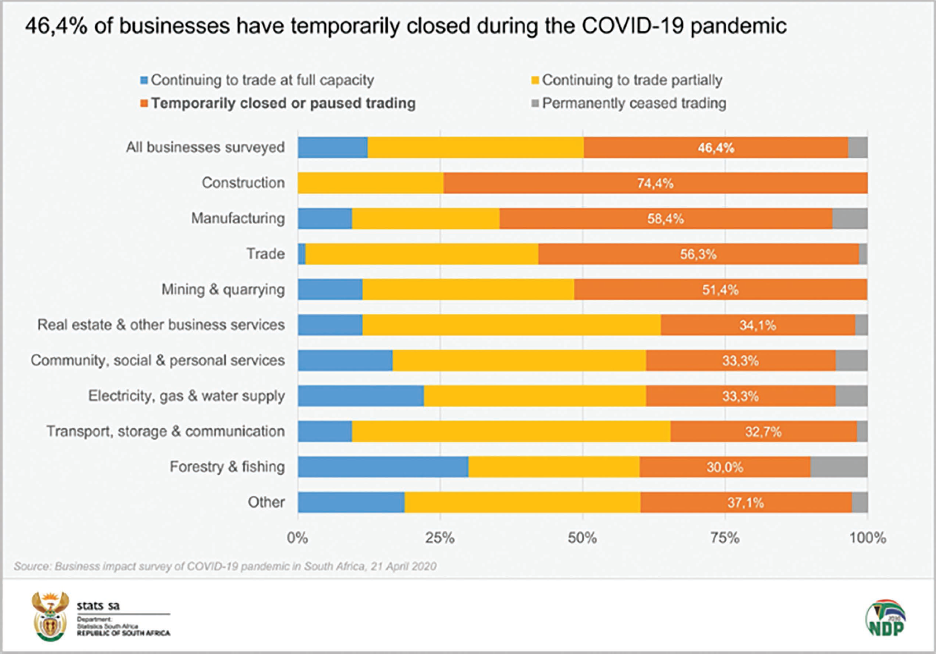
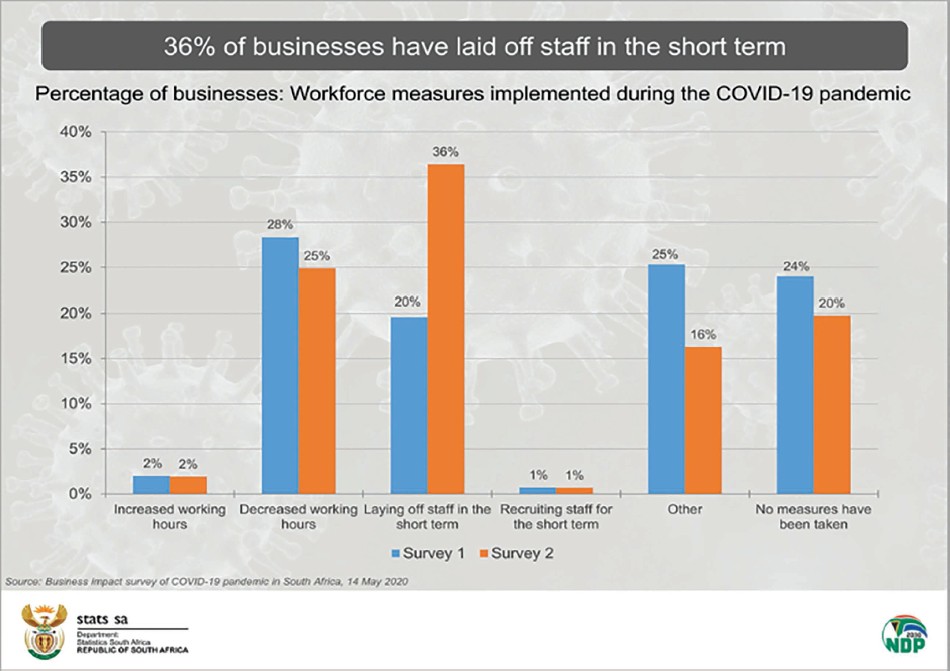
Figures 1 and 2 depict many firms’ experiences in South Africa. Figure 1 shows the number of temporarily closed businesses per industry during the COVID-19 pandemic. Figure 2 illustrates the percentage of businesses’ workforce layoffs. Apedo-Amah et al. (2020) observed that data sets revealed challenges many South African firms face. For example, they could not operate at full capacity, and to cut costs, employers either reduced their workforce or closed their businesses.
In context, the COVID-19 pandemic attacked entrepreneurial ecosystems, rendering firms vulnerable. Fuller-Love and Akiode (2020) stressed that the entrepreneurial ecosystem concerns entrepreneurs’ resource mobilisation for entrepreneurial action.
Kansheba (2020) highlighted that entrepreneurship ecosystems coordinate interrelated factors such as finance, knowledge, culture, infrastructure, institutions and legal and regulatory environments that support the growth of entrepreneurship. Unfortunately, the pandemic restricted the functional contributions of these support services towards capacitating SMEs. Kansheba et al. (2022) underscored that COVID-19 undermined access to these resources, forcing the closure of support organisations such as incubators, instilling reluctance in financial institutions to fund start-ups and suspending social networks between entrepreneurship ecosystem actors. Thukral (2021) reasoned that the attack on the ecosystem translated into the demise of SMEs during the pandemic by incapacitating institutions such as banks, markets and consumers, which undermined the capabilities of SMEs to build resilience and sustain productivity.
Atiase et al. (2017) further detailed how weak political governance, access to credit facilities and electricity and contracting issues, as challenges in African entrepreneurship ecosystems, undermined the growth of entrepreneurial ventures on the continent. In addition, Iwu (2021), in a study of COVID-19 lessons for mitigation and future SME prospects, highlighted the challenges of poor governance systems, red tape, corruption and lack of access to technology as significant resource constraints, debilitating the presence of sustainable entrepreneurship ecosystems in Africa. In summary, the above views suggest that it is prudent to acknowledge that, although many firms failed during the pandemic, the roots of such failures can be traced back to weak entrepreneurship ecosystems that fail to render the necessary resource support to small businesses. Kansheba (2020) is, therefore, justified in suggesting that there is a need to foster the development of entrepreneurship systems if the continent is to realise maximum socio-economic benefits from SMEs.
However, the call for developing entrepreneurship ecosystems is simply lobbying for improved access to entrepreneurship resources, which, regrettably, are scarce in many African economies. Generally, building a capable entrepreneurship support system in Africa has proved elusive. For example, Madzikanda et al. (2021) highlighted the irony of expecting governments to spearhead the provision of entrepreneurship resources, such as public services, universal funding, regulatory environments, physical infrastructure and education, while also engaging in corruption, which undermines the success of small businesses. Makwara (2022) also alluded to the harmful business practices by larger firms that dented smaller firms’ sustainability and growth prospects. Moreover, issues around unstable socio-economic, political and technological circumstances (Kansheba, 2020) defined by issues of poverty, political instability, a deficiency of relevant and effective technology for development, low entrepreneurship education and low market potential (Atiase et al., 2017; Iwu, 2021) hint of a complex operating environment that renders the least support to SMEs. In his view, Dube (2021) referred to the pandemic as a fragile operational context and presumed it would take longer before African economies could recover and foster progressive entrepreneurship ecosystems.
Methodology
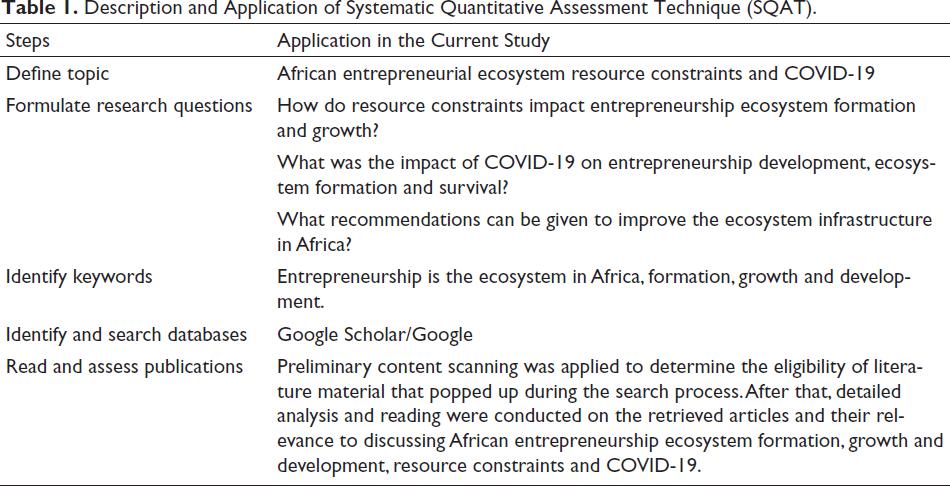
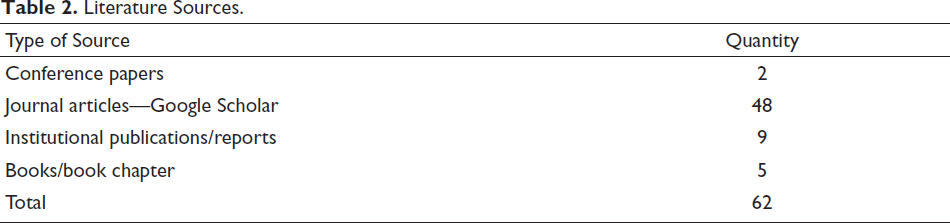
This study used Pickering and Byrne’s (2014) SQAT to purposefully scout, collect and systematically synthesise relevant journal articles, institutional reports, working papers, conference papers and book chapters to answer the research question. The SQAT method followed the five recommended steps of steering a literature review, as delineated in Table 1. Thus, this method gives purpose to the literature review’s nature of the study. It has been argued that a literature review helps one to understand a precise issue or research problem, generate research plans, detect research gaps or debate a specific matter (Snyder, 2019). Similarly, Wahono (2015) saw a literature review methodology as a ‘process of identifying, assessing, and interpreting all available research evidence to provide answers for specific research questions’. To gather literature, we conducted a Google Scholar search using phrases such as ‘ecosystems in Africa’, ‘African ecosystems during COVID-19’, ‘entrepreneurship ecosystems’ and ‘African entrepreneurial ecosystem resource constraints’. We used Google Scholar for three reasons. First, it is a database freely available once one has access to the internet. Second, we believe that Google Scholar guarantees greater access to literature by African scholars on African entrepreneurial ecosystem resource constraints because it houses and gives access to free-publishing journals through which African scholars are likely to publish; this is unlike subscription-based databases such as Scopus and Web of Science. Third, as such, it gives leeway to consider and access grey literature that may be relevant to a study. After generating and analysing a host of literature, 62 sources were found suitable for inclusion in this study. The summary of the sources is presented in Table 2.
Description and Application of Systematic Quantitative Assessment Technique (SQAT).
Literature Sources.
Discussions
This study explored the impact of resource constraints on African entrepreneurial ecosystem formation, development and growth. It presents a reflective intersectional analysis of entrepreneurship ecosystem issues vis-à-vis the challenges experienced by small firms during the COVID-19 crisis. In Figure 3, we forward a conceptual framework that consolidates Isenberg’s six dimensions into three critical variables that we dealt with and their COVID-19-related impact on entrepreneurial activities. The model posits a need to reform the entrepreneurship ecosystem (Chaker & Zouaoui, 2023) in the post-COVID-19 era to help businesses recover.
Africa Ecosystem Resource Constraints (COVID-19-related Impact).
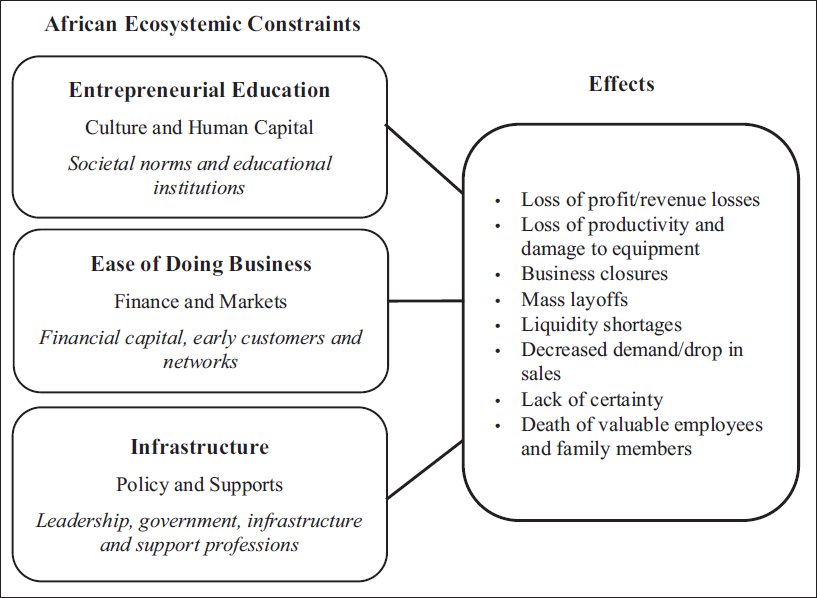
It is trite that COVID-19 added complexities to perennial questions about making African entrepreneurship ecosystems fit to support entrepreneurship development. Given the already constrained business environment in many African economies, the pandemic added: ‘yet another factor that is beyond the control of businesses’ (Catalyst for growth: The impact of COVID-19 on African SMMEs operations) and added complexities to sustaining the functionality of entrepreneurship ecosystems. Several studies (Dube, 2021; Foo et al., 2021) concur that the pandemic disoriented the capabilities of ecosystem players such as banks, large firms and entrepreneurship agencies to effectively support entrepreneurs either because they closed operations or reprioritised resources towards combating the pandemic as in the case of government agencies. The pandemic drew attention to the need to revive economies by supporting the entrepreneurial community, driving economic activities and providing socio-economic safety nets for groups such as employed people and poor communities.
It follows that, in practice, an acute lack of resources to capacitate African entrepreneurial ecosystem formation, development and growth processes posed the biggest threat to reviving the economies in the post-COVID-19 economy. For example, deficiencies in providing business education as a business support service underscored a lack of capacity among entrepreneurs to leverage business management skills to ameliorate COVID-19-related business challenges. Yet, as Bhorat et al. (2018) stressed, skills development through entrepreneurship education is critical for business growth and success. However, positioning the provision of entrepreneurial education as a strategic intervention in building more robust ecosystems is frustrated by the typically low level of education among entrepreneurs (Akhmetshin et al., 2019; Santos et al., 2019; Tengeh et al., 2015) and its perceived lack of effectiveness in stimulating entrepreneurial activity, especially among the youth (Dzomonda & Fatoki, 2019; Mensah & Dadzie, 2020). Chimucheka (2014) also alludes to small business owners’ lower uptake of entrepreneurship education due to limited time constraints that inhibit them from combining running a business with pursuing such qualifications. As such, the closure of educational institutions and support agencies, including the Small Enterprise Development Agency (SEDA), Small Enterprise Finance Agency (SEFA) and National Youth Development Agency (NYDA) (Mazanai & Fatoki, 2011), during the pandemic exacerbated further opportunities to leverage entrepreneurship education to strengthen entrepreneurial ecosystem formation, development and growth.
Furthermore, the longstanding problems of infrastructure development and complex business formalisation processes in Africa worked against efforts to assist in supporting businesses during the pandemic. These significant issues collectively spoke to the culpability of governments in undermining the development of more robust entrepreneurship environments, generally and during the pandemic. Without governments taking committed steps to reduce levels of, for example, red tape associated with business registration, Iwu (2021) believes the capabilities of entrepreneurial ventures like small businesses to contribute to economic development will remain compromised. Opute et al. (2021) further emphasised the significance of governments in promoting entrepreneurship-friendly policies and practices that will aid entrepreneurs in identifying and seizing market opportunities and successfully adapting to economic disruptions like COVID-19. The above views suggest extreme dependency on government actions or inactions and less on other agencies, such as private sector entities, in building and ensuring the functioning of entrepreneurship ecosystems in Africa. Edoho (2016) attributes this phenomenon to the seeming abundance of African state-owned enterprises that discourage private investment in new start-ups and assist the government in seizing dominance across all agents of entrepreneurship development.
In light of the literature findings in this study, African economies grapple with persistent bottlenecks around bureaucratic processes, infrastructure development and entrepreneurship that constrain entrepreneurial ecosystem formation, development and growth. Arguably, while COVID-19 can be blamed for evoking crisis management strategies, such as resilience building, to salvage small business entities’ survival, we believe it has allowed for a new vista of looking at crisis management within the context of the business and entrepreneurship ecosystem.
Post-COVID-19 Futuristic Analysis
We use Figure 3 to argue that while those factors are ever present in the discourse regarding African ecosystem resource constraints, their presence is even more likely to be felt post-COVID-19. Entrepreneurial education, for instance, has yet to be taught ‘the proper way’ (Olutuase et al., 2023). This view is also shared by Igwe et al. (2021) and Undiyaundeye and Otu (2022). These scholars are convinced that tackling unemployment through the imbibing of resourceful skills requires an effective entrepreneurial education framework that not only challenges the status quo but instead contextualises a curriculum that encapsulates national, local and, very importantly, institutional factors. The desirability of a contextually ingrained curriculum is an emergent need. Studies by Iwu et al. (2021) and Makwara et al. (2024) bemoan the absence of context-designed entrepreneurship education curricula in Africa, particularly regarding teaching methods. Hence, they collectively argued that supporting theoretical teaching approaches with contextual examples and action-based methodologies such as simulations, role-playing, real-world projects and case studies could steer entrepreneurial education to a higher level of value.
Regarding ease of doing business, Africa still confronts several obstacles despite attempts to make doing business easier, such as through regional integration programmes (Southern African Development Community/BRICS—Brazil, Russia, India, China, South Africa, Egypt, Ethiopia, Indonesia, Iran and the United Arab Emirates) and infrastructural and governance changes. South Africa’s membership in BRICS has been lauded for its integration into bigger markets, yet corruption, weak infrastructure, access to financing and political stability threaten the realisation of its goals. To improve business environments over the long run, it is essential to combat corruption and improve political conditions in the country. Some other factors that are likely to stand in the way of ease of doing business include social and cultural barriers (Mthembu et al., 2018; Owoseni & Ahwireng-Obeng, 2024), absence of technology and focused innovation (Bétila, 2021; Van der Waldt & Fourie, 2022) and human capital development (Nketiah-Amponsah & Sarpong, 2022).
Poor road networks, unstable energy and limited access to high-speed internet are examples of infrastructural deficiencies that raise the cost of doing business in Africa (Alemu, 2015). Logistics issues and power outages frequently cause problems for many enterprises (Avordeh et al., 2024). Poor road networks are associated with significant challenges in import and export that business owners experience, resulting in expenses that consumers absorb (Mkhabele, 2024). It is common knowledge that inadequate road systems, crowded ports and ineffective customs processes are all over Africa. The post-pandemic context appears gloomy, given that these elements remain present. More focused attention on these and several other debilitating factors by the government and other stakeholders may offer the necessary respite for a sustainable African entrepreneurial ecosystem.
Implications, Limitations, Further Studies and Conclusion
The unique contribution of this study lies in its examination of how resource limitations affect the establishment, growth and evolution of African entrepreneurial ecosystems. Additionally, it offers a thoughtful intersectional examination of the problems facing entrepreneurship ecosystems and the difficulties faced by small businesses during the COVID-19 pandemic. It is, however, not easy to identify any economic sector that has not experienced the negative effects of COVID-19. COVID-19 signalled the end of time for many people around the world. In sub-Saharan Africa, the pandemic’s effect is unimaginable due to dilapidated infrastructure, weak institutions and maladministration.
Despite the valuable insights this study provides into the impact of resource constraints on African entrepreneurial ecosystems during COVID-19, it has some limitations. This study relies on Google Scholar and Google databases rather than subscription-based databases like Scopus or Web of Science, which may exclude certain high-impact, peer-reviewed studies. Nonetheless, using Google Scholar and Google databases has enabled the inclusion of grey literature. Future studies may limit the sample to databases such as Scopus and the Web of Science.
African entrepreneurship has long suffered several political, economic, social and technological challenges. While entrepreneurs and business owners grappled with these challenges, COVID-19 extended the dilemma of remaining in operation or stopping existence. As the literature shows, COVID-19 has presented business operations with mixed consequences. In the short term, unpreparedness and prolonged durations of unproven resilience capabilities harm many firms, with many ceasing operations and others downscaling. COVID-19 also established a new standard that demanded rapid adjustments in business practices, ideas and procedures to capitalise on growing possibilities.
A supportive entrepreneurial ecosystem is considered an important facilitator of SME development. SMEs, on their own, serve several purposes. Socially, they bring a family together in copreneurships (Myeko & Iwu, 2019). They have been linked to a reduction in poverty levels through self-employment/employment of persons to support the partnerships (Napwanya & Chinyamurindi, 2021). Economically, SMEs add to the gross domestic product (GDP) through the taxes accrued to the government (Mpi, 2019). We acknowledge the numerous studies that have been conducted to understand the extent to which COVID-19 exacerbated the conditions for African SMEs. We are, however, yet to see studies that explain the nexus between COVID-19 and SME resource constraints. The call by the United Nations to countries to accelerate poverty reduction, improvement in living standards through decent work and economic growth, including inequality, is realisable through an entrepreneurial ecosystem that supports SME growth and development.
Earlier, reference was made to the difficulty of doing business in Africa. A reasonable assumption would be that, given this difficulty, those who end up establishing a business confront many challenges. It is fair to assume that for African governments to see an increase in small businesses and entrepreneurship, they must have the necessary scrutiny in place for registration and the capability to set up and run a business. Having this in place should expedite the process, not discourage it. Owing to these challenges, it is instructive to examine the state of these businesses and uncover the owner/managers’ specific challenges.
Furthering future research pointers, some interesting questions emerge following the strategy of downsizing adopted by some firms. These questions are:
Is downsizing a realistic measure to curb costs during an economic crisis? Will downsizing necessarily improve firm performance and the economy? What other measures besides downsizing can be used to curb costs and improve performance? And when we debate downsizing and performance improvement, are we reasonably diagnosing a symptom or treating an ‘ailment’?
Future research can explore the above to offer perhaps more realistic support measures for the struggling entrepreneurial ecosystem.
Overall, this study reinforces the need for the government to reconsider its approach to supporting SMEs. In this regard, some lessons can be drawn from the examples in Malaysia (Shah et al., 2020), Taiwan (Huang, 2020), Russia (Razumovskaia et al., 2020) and Saudi Arabia (Nurunnabi, 2020).
Footnotes
Declaration of Conflicting Interests
The authors declared no potential conflicts of interest with respect to the research, authorship and/or publication of this article.
Funding
The authors received no financial support for the research, authorship and/or publication of this article.
