




Abstract
Drawing a Picture
I took this course without extensive prior knowledge. Coming from an engineering background, I had little contact with entrepreneurship so far. However, the description of the course appealed to me. Citizen entrepreneurship (CE) sounded more approachable than pure business entrepreneurship, which I always associated with innovative ideas in start-ups, a lot of capital and risk and a few outstanding personalities with a special ‘founder-gene’. In the beginning, and for our previous presentation, I did literature research and got to know many exciting projects. Through the Participatory Learning and Action approach, we had the opportunity to talk to engaged participants, whether through conversations in the seminar or through interviews. CE has not been described much in the literature under this specific term so far, so I have tried to come up with my own definition and understanding using various literature on entrepreneurship. Slowly I was able to draw my own picture, which I would like to finish in this essay. This is my way of understanding CE.
Oil Paintings Crack
The world as a planet and humanity as a global community are facing more crises and conflicts than ever before. Driven by global climate change and the exploitation of natural resources, new problems and challenges such as unemployment, natural disasters, hunger and poverty are constantly emerging. These issues also have an increasing local resonance. The United Nations, therefore, developed an agenda for sustainable development back in 2015. Overall, 17 objectives, so-called Sustainable Development Goals (SDGs) were set until 2030 to ensure the survival of humanity (United Nations, 2022). This gives rise to questions about how to deal with these issues, how to solve them, and what to try as a next step.
Out of natural development, our society is evolving and constantly changing all the time. This process creates new opportunities and offers alternative approaches for organisation and problem-solving to meet economic and social needs in a broader context (Mitra et al., 2020). On the national level governments are responsible for exploring the needs and expectations of their citizens, identifying problems, and developing improvement strategies to solve them (Gofen, 2015). On the other side, citizens have the duty to participate by increasing their civic involvement and practicing their voice. Currently, however, traditional governmental approaches across the world struggle to find the required solutions and are questioned to be able to solve societal problems (Hjorth & Bjerke, 2006; Mitra, 2020). Consequently, trust is lost and citizens increasingly feel powerless and overwhelmed. Where local governments fail and dissatisfaction emerges, an ’entrepreneurial exit’ opens (Gofen, 2015). Citizens act on their own and have the chance to perform better (Mitra et al., 2020). They are becoming entrepreneurial, meaning developing capabilities such as taking initiative, acting problem-orientated, being innovative and redefining the rules (Gofen, 2015).
But is the entrepreneurial approach of citizens a way of addressing and resolving the existing issues? One thing is certain: the same methodology that caused the problems cannot be used to solve them. An old and cracked oil painting cannot be repaired, it needs new techniques and improved processing to last longer. In the following, a new concept, called CE which is powered by the desire for social change should be introduced as an alternative approach (Hjorth, 2013).
New Techniques Emerge
CE is a term composed of two words, which should be considered individually first. Mitra (2020) relates entrepreneurship to the identification of opportunities for innovations in society, ‘and in the realisation or exploitation of that opportunity through the organisation of resources’ (Mitra, 2020, p. 19). As an innovation, the development of new products, services and processes and the formation of new forms of organisations can be defined. Both concepts enjoy a symbiosis, meaning they depend on and benefit from each other and together they create value. The objectives of business entrepreneurship are focused on increasing profit and stimulating growth by selling products and services successfully to customers. This contrasts with the needs of citizens and society, which consistent with the SDGs ask for better safety, environmental protection, and a stable health and education system. What is lacking is the connection between creating a business and the active involvement of citizens in the development process, because in the end, every business depends on the acceptance and implementation by its customers (Mitra et al., 2020).
Citizen or citizenship as the second part of the term CE, is defined by the Oxford Dictionary as the legal right to belong to a particular country and/or the state of being a citizen and accepting the responsibilities of it. This definition implies that being a citizen entails rights, but at the same time duties and the responsibility of creating and recreating the public space (Hjorth, 2013). Simultaneously citizenship creates identity (Hjorth & Bjerke, 2006).
Connecting the two terms to the concept of CE it often simply starts with having an unsolved problem or need, perceiving it in the individual, local environment, and solving it not only for oneself but in an entrepreneurial way for many at the same time. Ideally, these local challenges can even be transferred to the global society and solved collaboratively (Fortmann, 2018). Entrepreneurial approaches of citizens mostly arise in urban areas and cities, because there many people share a limited space which creates hotspots for problems and ideas and at the same time a place for exchange with a wide range of capabilities and resources (Mitra et al., 2020). Examples of this could be initiatives in which citizens in densely populated areas campaign for the creation or preservation of green spaces such as parks or urban farms. A successful CE project in this field of action is the Park Fiction in Hamburg Altona. The vision was to create an artistically inspired place to wind down from busy city life. Accordingly, citizens of the neighbourhood got together and jointly developed and implemented an alternative to the city’s construction plans. Today, the park is a popular meeting place, event venue, and a green spot on the map always worth a visit (Skene & Schäfer, 2001).
The first important idea lies in understanding that CE is solution-orientated and not profit-orientated like business entrepreneurship in the classic sense. It is more about recognising entrepreneurship as a tool to enable social and economic change rather than focusing on the growth of the business (Mitra et al., 2020). Therefore, the concept of CE belongs to society rather than to economics and, consequently, should be studied differently, as we will see below. It moves citizens from the role of consumers to the role of participants and actors (Hjorth & Bjerke, 2006). As shown in the example of Park Fiction, the main actors usually act out of their own life context and want to solve a problem that affects them directly or others around them (Aschoff & Schwabe, 2013). CE can not only refer to individual citizens, but also to a complex interaction between citizens, regional enterprises, and local institutions or governmental and public organisations, as illustrated by the cooperation between the Hamburg municipality and local residents. In this way, CE acts as a platform, where the interests of citizens of all ages, origins, and social classes can be brought together (Mitra et al., 2020).
Despite that, the example also illustrates that innovation is not necessarily about producing new products or services but can be also understood as creating new organisational opportunities for people to engage and adopt new practices (Hjorth & Bjerke, 2006). This involves allocating resources and disturbing existing patterns with creative methods and actions (Klein et al., 2010). Derived from this, CE cannot be only reduced to economic value creation, but to the creation of a society with more opportunities for citizens (Hjorth, 2013). In sum, it creates public spaces in which citizens can be active (Hjorth & Bjerke, 2006).
Based on all the statements already made, the most important characteristics of CE will be summarised in the following:
CE
works solution-orientated, not profit-orientated. engages citizens as actors rather than consumers. uses entrepreneurship as a tool for social change. acts as a platform to bring together different stakeholders (not only citizens). also understands innovation as a recombination of the existing.
This also can be used to create a distinction from Social Entrepreneurship. The aim of this is as well to solve societal problems. In itself, this approach is not new, it is only becoming more urgent in the face of crises and thus more prominent again (Hackenberg, 2011). The crucial difference between business and social entrepreneurship and CE is that the first two concepts relate and limit entrepreneurship strongly to the entrepreneur and not to the fact that citizens can be engaged to use entrepreneurship as a tool for themselves (Hjorth & Bjerke, 2006).
If the view is broadened, the economy should be made more humane and capitalism should be socialised to make it accessible and acceptable to the wider public. Instead of working towards profit maximisation, a good standard of living, social commitment, meaningful work, and good products should be in the foreground (Fortmann, 2018; Mitra et al., 2020). Entrepreneurship thus becomes a social movement. It is about creating awareness and contact of citizens to entrepreneurial activities while at the same time working together to solve social problems (Mitra et al., 2020). Therefore, CE emerges as a new technique to collaboratively draw a brighter picture of our future.
The Three-piece Canvas
In this section, the theoretical and conceptual underpinnings that guide the understanding of CE will be presented and examined. Due to the elaborated differences between classic entrepreneurship and CE, the underlying research methods and theories must also differ. It is more about understanding the aspects of society and life than just economic or business processes (Hjorth & Bjerke, 2006). Consequently, when citizens are involved, political science, social or citizen science, and citizen economics must be considered in addition to purely economic theories. CE research can of course benefit from existing theories in these different areas, now the challenge is to combine them into one framework.
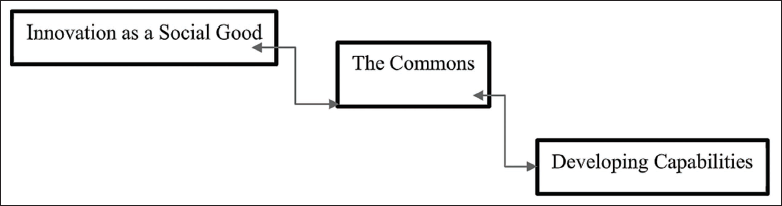
Mitra et al. (2020) describe a combinatorial approach consisting of three fundamental concepts: The idea of innovation as a social good by Schumpeter, Ostrom’s concept of the ‘commons’ and the capabilities approach to economic, personal, and social development by Sen and Nussbaum (see Figure 1).
In the following, the concepts will first be examined individually and their connection to CE will be described before they are combined into one model.
Joseph Schumpeter started to recognise the importance of entrepreneurs between the late 1920s and 1930s (Mitra et al., 2020). He understood that successful innovations that can create new businesses and jobs also benefit society as a whole and can raise the standard of living for everyone. Innovations are, in his view, the recombination of already existing things, for example, the introduction of new production methods, or the reorganisation of markets (Schumpeter, 1997). Schumpeter later also calls innovations ‘creative destruction’ because they question and suppress well-established practices. CE takes the connection established by Schumpeter between entrepreneurship and the resulting societal benefits and extends it to the level of collective effectiveness. A good example of a CE project with the underlying theory of innovation as a good is the Zentralklinik in North Frisia in Germany. On the idea of local doctors and nurses, three hospitals have joined together to form a central clinic to counteract the staff shortages. A concept was developed jointly with the citizens of the area to ensure efficient medical care (Zentralklinik Uthverdum, n.d.). The reorganisation of medical resources as an innovation led to a higher standard of living and benefited the residents.
As a second approach, Elinor Ostrom’s idea of the commons is used. This principle describes the self-organisation and -governance of communities or groups of people, who work together for a common goal or produce, distribute and manage common goods. Thereby common goods include resources or products made from them which exist in a limited number and are shared by people that cannot be excluded from using them (e.g., drinking water, knowledge). Consequently, these resources are affected by over-use, need to be protected and require regulations (Ostrom, 1990). Ostrom identified different strategies for common pool resource management which contain for example mechanisms of conflict resolution. The successful engagement of members to take part in the collective action is based on the ability to generate trust, reciprocity, and strong social capital ties (Ostrom, 1990). The example of Park Fiction is also fitting for this theory since the inhabitants of Hamburg developed their own set of organising rules to collectively manage and govern the resources of the park. If this approach is translated into the context of CE, it can be concluded that common assets should not be managed by public authorities alone, but citizens in their role as participants should get involved in shaping them, thus establishing a process of co-creation (Mitra et al., 2020).
Building on this, the question should be asked of what it takes to achieve this. Being active and engaged requires the development of a range of skills and abilities, such as appropriate methods and techniques for improving original ideas, perseverance, and a belief in one’s ability to determine the course of one’s own life or of society. Only these capabilities enable citizens to move on from their role as observers to designers (Mitra et al., 2020). Sen and Nussbaum’s ‘capability approach is a broad normative framework for the evaluation and assessment of individual well-being and social arrangements, the design of policies, and proposals about societal change’ (Robeyns, 2006, p. 352). The core concept explains a person’s functionings (beings and doings) and capabilities (the opportunities or freedom to realise these functionings) (Nussbaum & Sen, 1993). Forster and Handy differentiate between three sets of capabilities: the individual, the socially created and the external depending on relations (Mitra et al., 2020). When citizens connect this means there is also a connection of different skill sets happening, which in turn can be used to connect the creation of knowledge while at the same time working on the individuals’ well-being (Mitra et al., 2020). If this means idea generation and refinement can be collaboratively learned and taught then the process of applying existing knowledge to a new field, combining or improving existing ideas represents the innovation of an entrepreneurial project of citizens (Faltin, 2008) Bringing these three approaches together, as seen in Figure 1, creates a three-piece canvas as a basis on which the idea of CE can be drawn onto. The parts complement each other and only reveal the full picture when viewed holistically. Actually, they build on one of another and can be understood as building blocks of the complementary framework of CE (Mitra et al., 2020). In the middle, there are the common goods of our society, for example, common health services. These need to be understood as a social good. Through the act of reorganising these services as in the example of the Zentralklinik these goods or commons turn into innovations through a collaborative entrepreneurial process. This process is made possible and is empowered by shared capabilities. In the end, the common health service is limited due to capacity reasons of staff, knowledge and space and therefore needs regulations.
Future Artists
After learning about CE as a possible approach to solving global, societal challenges and after reviewing the underlying theories, the resulting implications should now be derived. CE can be used to influence policy decisions for economic and social development by the government and the organisational strategy of different enterprises and other institutions (Mitra et al., 2020). To enable this process a reorientation of the traditional institutional landscape is needed to enable citizen engagement. Authorities should no longer have a monopoly position over the use and control of common assets but rather appear in the form of assistance, advisors, and as support for legal, strategic or financial questions. In this way, citizens have the chance to act in urban changes and use the resources provided by the government. Accordingly, the public sector evolves into a social sector where common goals are achieved by including citizens and citizenship moves from a formal status to a practice or activity which each individual in the society should feel responsible for (Hjorth & Bjerke, 2006).
Moreover, entrepreneurship is driven to a great extent by technology (Mitra, 2020). To support new forms of peer production and sharing, the use of digital tools (social media, exchange platforms, blockchain, etc.) should be considered and facilitated (Albareda & Sison, 2020). Today, citizens are already networked via digital platforms to a degree like never before. This connection should be used because it opens up new opportunities for innovative cooperation (Aschoff & Schwabe, 2013).
Future research should concentrate on the critical element of how to engage and motivate citizens to be part of social change and encourage them to see that improvement is possible through their own efforts. As already mentioned at the beginning, CE is not yet comprehensively described in the literature, but in practice, there are already many projects that can be summarised under the term CE. Critical observations can be used to identify areas of weakness that research can focus on.
Due to a lack of information and education about the topic, just like me, many people still link entrepreneurship to a risky business setting (Fortmann, 2018). If a way can be found to include them, this narrow-minded picture could change. In the end, CE is also about making the subject accessible to all. This essay could not finish my picture of CE, because just as our society the topic is constantly evolving, but changing my point of view, trying out new techniques, and attempting this course set a starting point. Even though this was an essay inspired by art and creating I want to close with the words of Peter Drucker, an American economist, who said ‘Entrepreneurship is neither a science nor an art. It is a practice’ (Fortmann, 2018, p. 270). And a practice comes to life while practicing.
Footnotes
Declaration of Conflicting Interests
The author declared no potential conflicts of interest with respect to the research, authorship and/or publication of this article.
Funding
The author received no financial support for the research, authorship and/or publication of this article.