




Abstract
In line with Shan and Williamson (2023, Evidential pluralism in the social sciences, Routledge), this article argues that evidential pluralism used in the philosophical enquiry of causation can be employed to examine causal relationships in the business and economics disciplines. We focus on the relationship between unemployment and entrepreneurship, which has created heated and inconclusive debate in the economics of entrepreneurship field. Specifically, we suggest that discrepancies in the literature are due to: (a) the failure to fully capture the mechanism of the relationship; and (b) differences in the methodological and data analysis approaches used in existing studies. We therefore argue that if we want to explore the unemployment and entrepreneurship relationship, we need to capture the underlying pathways that bring together different forms of entrepreneurship and unemployment by considering, for example, structural and labour market factors that may alter the strength and/or direction of the relationship. The case study analysis provides strong support for the use of the evidential pluralism in establishing causal links. We argue that methodological diversity and mixed method approaches can be helpful for exploring mechanisms, but they can be somewhat problematic when examining correlation empirically. Here, the use of panel data may allow us to capture the statistical association more accurately than the use of other types of data and econometric modelling. Finally, we argue that exploring the mechanism ahead of the correlation can allow us to learn more about the underlying relationship among the variables, which can then be modelled and captured statistically. In contrast, examining correlation first can lead to misleading results. Overall, the article concludes that evidential pluralism used in the philosophy of causation can help us to understand causal links and establish causal claims for important economic relationships, allowing effective policy to be crafted. To this end, and as discussed in the evidential pluralism literature (see Russo, F., & Williamson, J. 2007, International Studies in the Philosophy of Science, 21[2], 157–170; Shan, Y., & Williamson, J. 2023, Evidential pluralism in the social sciences, Routledge), evidence of both mechanisms and correlations should be used to support causal hypotheses made in economics and business research. However, we propose that before analysing the correlations, we should conceptually examine the mechanisms.
Introduction
This study argues that philosophy and the methods that have been developed within it can contribute significantly to the understanding of causal relationships. Focusing on the field of social sciences, and specifically on research into the relationship between unemployment and entrepreneurship, this study argues that evidential pluralism (e.g., Beach, 2021; Moneta & Russo, 2014; Shan & Williamson, 2021, 2023; Shan et al., 2024) can be used to unwrap the complexity of that relationship and can explain the lack of convergence in findings in the existing literature. 1 In general, we can say that focusing on the social sciences is important because the mechanisms that influence human actions that lead to specific outcomes are quite complex (see also Kennedy, 2012). This makes the study of relationships between variables in economics and business disciplines rather challenging but at the same time very interesting (e.g., Athey & Imbens, 2017; Granger, 1990; Hoover, 1990; Hünermund & Bareinboim, 2023; Kincaid, 2021; Reiss, 2016).
When we talk about causation, we do not just mean a correlation; rather, we refer to the possibility of one variable affecting another (Asteriou & Hall, 2016). Establishing causation is therefore important for those who make decisions (see Williamson, 2006), whether they be businesses, households or governments (for interesting discussions on causation from a philosophical point of view, see Cartwright, 2004; from an economic perspective, see Hicks, 1980). For example, an economy should want to predict the effect of unemployment on (new and/or existing) entrepreneurship and formulate policies that will push unemployed individuals out of (involuntary) unemployment. Policymakers could thereby improve the living standards of citizens and help to tackle social phenomena such as criminality and depression, which have been found to be associated with high and long-term unemployment rates, and which affect societal and economic well-being. Thus, business economists as well as other social scientists in the branch of the economics of entrepreneurship have tried to build models that, by keeping other variables fixed (known as the ceteris paribus assumption; see Wooldridge, 2014), examine what might happen if the specific variable to be examined changes or is shocked (e.g., Burke et al., 2021; Fotopoulos & Storey, 2016; Saridakis et al., 2014).
Immediately, however, a series of questions may arise from such models, including: are the variables causally linked? Is there reverse causation? What functional form does this relationship have? What are the control variables that should be taken into account in the modelling strategy? What are the implications if the mechanisms of the relationship are not fully explored? Can a relationship hold as a ‘universal law’? These are some of the questions that researchers can approach empirically and/or theoretically. 2 It is arguable whether or not researchers have succeeded in answering these questions, and if so, to what extent (for interesting discussions in the field of economics, see Heckman, 2008; Hicks, 1980; Mill, 2012 [1843]).
Demonstrating causation requires correlation/concomitant variation, sequence (cause precedes effect) and control of other influences, as argued by, for example, Hume (2007 [1739]). Previous research has noted that the use of theory is on the decline (e.g., Davidson, 1990; Hamermesh, 2013), with research being dominated by the use and analysis of data, which, although important, has not allowed the sciences of management and economics to be developed to their full potentials, leading them into a deep replicability and reproducibility crisis (e.g., Dreber & Johannesson, 2023; Duvendack et al., 2017; Maniadis & Tufano, 2017; Saridakis, 2023). Evidential pluralism (Shan & Williamson, 2023) emphasises the importance of both theoretical and empirical support to the exploration and evidencing of causal relationships.
As discussed by Shan and Williamson (2023), for evidential pluralism, the finding of correlation is not enough to make a causal claim. Evidential pluralism emphasises the importance of extracting this statistical correlation and of avoiding forms of bias that can lead to spurious correlations (e.g., failing to control for an important variable in the model). For evidential pluralism, it is rare for even an excellent empirical study to enable causal inferences. However, investigating and understanding the mechanisms that affect the particular relationship can contribute towards coining a theory. It may also help steer researchers away from drawing conclusions based on the fact that a correlation is significant, and assist them with establishing causal links. For example, when studying the relationship between unemployment and entrepreneurship, one may accept, depending on one’s theoretical standpoint, that a negative and/or positive relationship exists. What is important is to understand the mechanism behind any such relationship. That understanding will reveal the role of other influences, be they socio-economic, technological or demographic, on the nature of the relationship. This, in turn, can be used to build a body of evidence that helps with establishing causation and drawing causal inferences, and can thus inform the design of policy interventions.
This article gives a brief review of the way in which the logic of causation has developed. It then turns to evidential pluralism; we cover this in detail, referring extensively to it as we set the problematic relationship between unemployment and entrepreneurship at both the mechanistic-theoretical and empirical levels. We end by exploring the ways in which evidential pluralism can be applied to the unemployment–entrepreneurship case.
Causal Relationships and Evidential Pluralism
Efforts to Understand Causation: An Old Question?
How we conceive and acquire the knowledge of a concept and, more importantly, the seminal steps that lead us towards a scientific basis on which causal relationships can be studied and established take us all the way back to ancient Greece. The preserved ancient Greek philosophical work—including pre-Socratic philosophers (e.g., Thales, Pythagoras, Heraclitus, Empedocles and Democritus)—has influenced the philosophy of science for centuries. Great post-Socratic philosophers, such as Plato and Aristotle, played an important role in shaping scientific and ethical thinking; their works have helped shape what later became rationalism and empiricism, and the development of philosophy in our contemporary times. In particular, we highlight some key aspects that may be related to evidential pluralism (see Shan & Williamson, 2023). These motivate our study and also show that philosophical thought on causality is a product of an old and continuous effort towards understanding what causes what, and why.
The work of ancient Greek philosophers is well-discussed in the existing literature (for a review, see Russell, 1996) and reproducing that discussion here would add little additional value. However, it is helpful to give a flavour of the arguments by way of some examples that show that the notion of causality was part of the ancient Greeks’ philosophical thinking. For instance, focusing on the concept of causation, Plato in Phaedo (60 b–c) tries to show how pain and pleasure are linked in a bidirectional manner (reciprocal causation: X is a cause of Y and subsequently Y is a cause of X), and thus one follows the other in the form of a causal chain. He writes:
3
How singular is the thing called pleasure, and how curiously related to pain, which might be thought to be the opposite of it; for they never come to a man together, and yet he who pursues either of them is generally compelled to take the other. They are two, and yet they grow together out of one head or stem; and I cannot help thinking that if Aesop had noticed them, he would have made a fable about God trying to reconcile their strife, and when he could not, he fastened their heads together; and this is the reason why when one comes the other follows, as I find in my own case pleasure comes following after the pain in my leg, which was caused by the chain.
Plato deals significantly with the concept of causation, as is apparent from other passages of Phaedo as well as his other works. For example, in the Statesman (281 d–e), he states:
Str. Let us consider, in the first place, that there are two kinds of arts entering into everything which we do. Y. Soc. What are they? Str. The one kind is the conditional or cooperative, the other the principal cause. Y. Soc. What do you mean? Str. The arts which do not manufacture the actual thing, but which furnish the necessary tools for the manufacture, without which the several arts could not fulfil their appointed work, are co-operative; but those which make the things themselves are causal.
Through the above passage, Plato acknowledges that there is a complex mechanism that contributes to the final outcome. But this complexity can be separated into the existence of two main mechanisms: the first mechanism directly explains the relationship (i.e., it is the main independent variable affecting the dependent variable). However, there is another mechanism that, even if it does not contribute directly to the final outcome, contributes indirectly. For Plato, however, the first (direct) mechanism is more important than the second (for discussion, see Puddephatt & Prus, 2007).
One may argue that Plato’s mechanistic approach is somehow in line with the mechanistic thinking developed by Shan and Williamson (2023). In evidential pluralism, causation is confirmed when key mechanisms have been explored and established. It can be therefore argued that to understand the underlying mechanisms that connect the variables, it is essential to consider both causal and cooperative functions (see also some interesting discussions in Woodward, 2012; Bandiera & Natraj, 2013; Ruiz-Jiménez et al., 2021; and Brieger et al., 2024). Of course, in the social sciences, establishing causation is a difficult task due to the intricacy of human behaviour, which means that the mechanism that leads to a causal outcome is necessarily complex. But aside from this, establishing causation empirically is highly complex due to the limitations of the observable and measurable variables (although current statistics allow us to handle issues related to unobservable variables and deal with measurement errors).
Turning now to Aristotle, who is often considered to be the first empiricist (although some may argue against this claim) and the founder of scientific justification and method. There is a vast literature on how Aristotle approached the concept of causality. His four types of causes (see Russell, 1996), two intrinsic (material, formal) and two extrinsic (efficient, final), make him a causal pluralist. There have also been different interpretations of empiricism based on his work (regarding, e.g., the teleological/final causation, the existence of causal commensurateness, etc.). This article therefore will not expand on these matters (e.g., Chase, 2011; Huismann, 2016; Russell, 1996). However, it is worth noting that for Stein (2011), Aristotle did not separate causation from explanation, considering both as integral parts of understanding a causal relationship.
Also, it is important to mention that while Russo and Williamson (2007) cast doubts on the use of monistic theories, they were not in favour of causal pluralism when focusing on particular sectors (in their study, they make references to the health sector), suggesting instead that the epistemic theory of causality may be a more appropriate application (for further discussions, see Shan & Williamson, 2023; Wilde & Williamson, 2016; Williamson, 2021b).
The difference between rationalism and empiricism intensified during the period of the development of modern philosophy (see Boehm & Palatnik, 2017). For example, Descartes was an advocate of rationalism who distinguished between formal and efficient causes, but he disregarded Aristotle’s final and material causes (see Flage & Bonnen, 1997). The empiricist Locke, using the senses as the basis of acquiring knowledge, 4 tried to explain the notion of causation but his approach has been criticised as inadequate for establishing true or real causation (e.g., Collins, 1967; Russell, 1996). 5
Hume also criticised Locke’s view of causation, suggesting that there are some relations that produce certain knowledge and others that generate knowledge that is merely probable (for further discussion, see Russell, 1996). For Hume, causation can first be explained via the power of perceived regularities; second, it can be viewed as having a modal dimension (see Harbecke, 2021; Knuuttila, 2021; Read & Richman, 2000). Hume’s approach to causation has inspired other theorists (e.g., Mackie, 1980) and this is discussed analytically in Hausman (1998). In contrast, Kant combines both rationalism and empiricism a priori nature (see Russell, 1996; Kant, 2007 ed.; Cottingham, 2021); however, he does so without rejecting the perception-based approach of Hume (Langsam, 1994; Longuenesse, 2005; Mahmoodshahi, 2004).
The debate about causation has extended to other classical philosophical thinkers, with Russell (1913, p.1) arguing:
All philosophers, of every school, imagine that causation is one of the fundamental axioms or postulates of science, yet, oddly enough, in advanced sciences such as gravitational astronomy, the word ‘cause’ never appears (...) [T]he reason why physics has ceased to look for causes is that, in fact, there are no such things. The law of causality, I believe, like much that passes muster among philosophers, is a relic of a bygone age, surviving, like the monarchy, only because it is erroneously supposed to do no harm.
Russell’s view has sparked a new debate, which, being concerned with what he actually meant and with whether eliminating causation from the philosophical debate may be a way forward (e.g., Nathan, 2023), goes beyond the scope of this article. Other philosophers, such as Lewis, have linked causation to counterfactual statements (see Beebee, 2022). Statistical mechanics, in which causation can be explored in a probabilistic manner, has contributed towards the understanding of causation too, and inspired other frameworks such as the ‘Mentaculus’ framework, in which laws and probabilities can be understood (Loewer, 2020).
In this article, we discuss the way in which a causal relationship can be established by drawing on the foundations of evidential pluralism and focusing on a specific case study that has troubled the economics of entrepreneurship for some time now. Before discussing the case study and linking it to evidential pluralism, we first discuss some key aspects of evidential pluralism.
Evidential Pluralism: Time to Shine in Economics and Business?
Kendall and Stuart (1961, p. 279) argue that ‘a statistical relationship, however strong and however suggestive, can never establish causal connection: our ideas of causation must come from outside statistics, ultimately from some theory or other’. The above argument clearly suggests that the statistical relationship between the variables that emerges after a data analysis is not itself sufficient to make causal inferences. At this point, it should be mentioned that we will be mostly concerned with establishing statistical relationships through regression analysis rather than correlation analysis. Lindley (1990) offers a full description of the differences between these approaches but in simple words, regression analysis is an empirical model that includes a dependent variable and a set of independent variables; the model’s aim is to explain the statistical behaviour of the former in relation to the latter (Wooldridge, 2014). Like correlation analysis, regression analysis does not imply causation (e.g., Asteriou & Hall, 2016; Gujarati, 1995; Wooldridge, 2014). In order to make causal inferences, as Kendall and Stuart (1961) imply, a theoretical or a mechanistic explanation is necessary to establish causal links. 6
One may argue that the philosophical literature on the use of evidential pluralism in exploring causal relationships is therefore invited to enter the arena of the applied econometrics used in social sciences (e.g., Moneta & Russo, 2014; Russo, 2006; Russo, 2011). As discussed by Shan and Williamson (2023) and Williamson (2021a), to make causal inferences two factors must be scrutinised: (a) correlation and mechanism (object pluralism), and (b) association and mechanistic studies (study pluralism). As the authors suggest, combining object pluralism and study pluralism provides the foundation of evidential pluralism. Importantly, Shan and Williamson (2023) emphasise the method where a correlation is established (i.e., conditional on potential confounders) and a potential interaction that may affect the strength and direction of causality is included. Hence, their argument is in line with developments in econometric modelling that highlight important statistical aspects that should be considered; these include inter alia sample size, non-response bias, self-selection bias, omitted variable bias, common method bias, measurement error bias and simultaneity bias. Shan and Williamson (2023) give emphasis to methodological diversity (see also Russo, 2006; Shan & Williamson, 2022), although this has been challenged (e.g., Runhardt, 2021, 2022). We agree to an extent that methodological diversity (or methodological pluralism as referred to by Maziarz, 2019) can provide useful and fruitful insights in statistical association when the appropriate and relevant methodologies are used to assess the predictability and robustness of the statistical model (e.g., Angrist & Pischke, 2010), and we will return to this point later when we examine the case of the potential causal link between unemployment and entrepreneurship.
Moreover, Shan and Williamson (2023) emphasise the importance of establishing mechanisms where the variables are linked together. Although they recognise that defining the term ‘mechanism’ is complicated, diversity in the definition does not undermine the core claim of evidential pluralism. In their work, they argue that the term captures both complex-system mechanisms and mechanistic processes that operate at different levels (e.g., individual/population levels), thus allowing for the exploration of different pathways through which the variables are connected. We argue that methodological diversity (e.g., the use of both qualitative and quantitative methods) perhaps can be beneficial at this stage for revealing and capturing all paths that link the variables together (see also Siewert & Beach, 2023). In social sciences in general, and our case study in particular, the paths of such a relationship may be quite complicated, and ignoring them can lead to spurious inferences.
To this end, we will argue that it may be a better strategy to first explore the mechanism of the association rather than the other way around. Shan and Williamson (2023) suggest that the order makes no difference, but we challenge this assumption. We now turn to our case study, where we concentrate on the old but ongoing debate about the unemployment–entrepreneurship (causal) relationship.
The Role of Evidential Pluralism in Studying the Causal Link Between Unemployment and Entrepreneurship
Unemployment and Entrepreneurship: An Uncertain Relationship?
Unpacking the relationship between unemployment and entrepreneurship has been a major challenge for several decades (see Baptista & Thurik, 2007; Blanchflower, 2000; Blanchflower & Oswald, 1998; Congregado et al., 2012; Faria et al., 2009, 2010; O’Leary, 2022; Parker et al., 2012a, 2012b; Thurik, 2003; Thurik et al., 2008). This is partly because they are important economic variables at both economic and social levels, so that the search for possible correlations and mechanisms between them has triggered in-depth academic and policy research. This section uses the entrepreneurship and unemployment relationship as a case study, in which the use of evidential pluralism—an approach to causation that is gaining ground in the philosophy field (see Beach, 2021; Moneta & Russo, 2014; Russo & Williamson, 2007; Shan & Williamson, 2023)—may be applied to uncover the factors leading to inconsistencies relating to the causal link between the two variables. This is done by examining the statistical correlations produced by studies, and by understanding the mechanism underlying the proposed relationship.
Unemployment is a major economic concern with significant social dimensions (e.g., Pohlan, 2019). Undoubtedly, unemployment affects not only the economic well-being of a society and its economic growth and development, but also the behaviour of its citizens in maintaining law and order and social tranquillity. 7 An increase in unemployment, for example, has been associated with an increase in property crime, violent behaviour (including domestic violence), alcohol consumption, depression and suicide rates and deterioration in both mental and physical health (e.g., Clark & Oswald, 1994; Litsardopoulos et al., 2023; Lucas et al., 2004; Lundin & Hemmingsson, 2009; Popovici & French, 2013; Saridakis, 2004, 2011, 2013; Saridakis & Spengler, 2012; Tiggemann & Winfield, 1984). 8 Also, unemployment has been found to carry long-term penalties when re-entering the labour market (e.g., Arulampalam, 2001). Conversely, entrepreneurship has been associated with economic development and the driving of innovation in sectors across the economy, thus potentially increasing the welfare and happiness of a society’s citizens (e.g., Arauzo Carod et al., 2008; Henderson & Weiler, 2010; Rupasingha & Goetz, 2013; Stephens & Partridge, 2011; van Stel et al., 2005; Wennekers & Thurik, 1999). Importantly, entrepreneurship is considered as a possible answer to unemployment and economic deprivation since it creates new job positions, whether as the equity owner of a new business or as its employee (e.g., Baptista & Thurik, 2007; Cueto et al., 2015; Frankish et al., 2014; Litsardopoulos et al., 2023; Owualah, 1999; Pfeiffer & Reize, 2000; Saridakis et al., 2021). Studying this relationship is therefore important. 9
As already noted, the nature of the relationship (i.e., the mechanism that links unemployment and entrepreneurship) has proven to be quite complex, and empirical results (i.e., correlations) are mixed and inconclusive (for an excellent and detailed discussion, see Storey, 1991). Evidential pluralism has a role to play in unpacking the nature of the causal relationship. Specifically, three (mutually exclusive) propositions have been formulated in the literature: first, that unemployment and entrepreneurship are positively related; second, that they are negatively related; and third, that they are unrelated. The existence of inconsistencies about the relationship between unemployment and entrepreneurship indicates that the two assumptions (see Shan & Williamson, 2023) that evidential pluralism holds to be necessary for the making of causal claims have not been established clearly in the extant literature. Specifically, there is much debate about the statistical evidence on the unemployment and entrepreneurship relationship. To this end, three questions remain unanswered: Are the variables correlated statistically? If so, what is the direction of the statistical correlation? And finally, what is the strength of the statistical correlation? Additionally, details about the mechanism (i.e., a path or process) that links together unemployment and entrepreneurship remain unresolved despite the many attempts to improve theoretical and empirical modelling when estimating the link between unemployment and entrepreneurship (e.g., by including non-linear terms, mediators and moderators in the models). We will discuss these attempts later.
In the next sub-section, the mechanisms that link unemployment and entrepreneurship are discussed. In particular, the rationale of the three propositions documented in the literature—existence of a positive correlation, existence of a negative correlation and existence of no significant correlation—is first explained. Then a simple macro model is built to capture the complex mechanisms underlying the relationship between unemployment and entrepreneurship. There then follows a discussion of the empirical attempts to establish a correlation between the two variables and the challenges that these attempts face, including an explanation of how various forms of bias can be dealt with by using an appropriate statistical framework.
Mechanisms Linking Entrepreneurship and Unemployment: A Conceptualisation Problem?
Following the principles of evidential pluralism, we turn first to mechanisms as important tools when assessing causal claims (see Shan & Williamson, 2023). As mentioned earlier, three propositions have been put forward regarding the link between entrepreneurship and unemployment. The first is based on income choice theory (see O’Leary, 2022) and suggests that unemployment has a positive relationship with entrepreneurship (the ‘recession-push’ hypothesis, also referred to as the ‘refugee’, ‘desperation’ or ‘shopkeeper’ effect). 10 Thus, as unemployment increases, entrepreneurship increases (e.g., Parker, 1996; Robson, 1991; Saridakis et al., 2014). This has been interpreted as a turn towards entrepreneurship, albeit necessity entrepreneurship rather than opportunity entrepreneurship (see Storey, 1991, 1994). As the opportunities in wage employment are limited, the need for survival leads to the creation of new businesses. The phenomenon of necessity entrepreneurship is particularly noticeable in developing economies, where entrepreneurial rates are high despite low GDP per capita (see the discussion in Deakins & Freel, 2012). Although one may argue that many of these firms have low prospects of growth, they can play an important part in reducing poverty levels and increasing household economic well-being (see Saridakis et al., 2021). In developed economies, however, economic contraction may act as an impetus to seek new opportunities, such as filling a specific market gap or perhaps solving a social problem by utilising the available workforce. This search for new business opportunities could, given the appropriate government financial support, advice and incentives (e.g., tax incentives), stimulate economic growth, pushing the economy to return to its equilibrium faster (Deakins & Freel, 2012). However, studies also show that in developed economies around 50% of businesses will fail within 5 years of inception, and of those that survive, only a small proportion will grow (e.g., Saridakis et al., 2008; Storey, 1994).
The second proposition suggests a negative relationship between unemployment and entrepreneurship (the ‘prosperity-pull’ hypothesis). This negative relationship (for support, see Bergmann & Sternberg, 2007; Fotopoulos, 2014; Johnson & Parker, 1996; Keeble et al., 1993) suggests that as unemployment increases, the incomes of households decrease significantly, which decreases the demand for goods and services. This, in turn, reduces firm profits and increases the probability of firm exit. New firms may struggle to obtain access to credit to finance their ventures (see Storey, 1994) and they may need to self-finance in the short term. Hence, it can be argued that in times of economic uncertainty, business activity decreases and the risk of failure increases (e.g., Ferreira & Saridakis, 2017). This can deter potential entrepreneurs, who may not want to risk investing their capital until more prosperous times return. Interestingly, Berglann et al. (2011) show that individual and aggregate unemployment can have oppositive effects on entrepreneurship, with individual unemployment affecting entrepreneurship positively, and aggregate unemployment affecting it negatively.
However, there is also a third opinion, which is that unemployment and entrepreneurship appear not to be related (e.g., Delmar & Davidsson, 2000; Keeble & Walker, 1994). Proponents explain the lack of correlation by reference to the validity of the previous two opinions, asserting that unemployment and entrepreneurship are simultaneously possessed by two opposing forces that neutralise each other. The magnitudes of the effects need to be similarly sized for them to cancel each other out and render any correlation small or non-significant. However, this could occur when, say, the time determination of the analysis has not been clarified and separated. Short-term unemployment may have a negative relationship with entrepreneurship, but long-term unemployment may have a positive effect on business startups. Consequently, a failure to distinguish the type of unemployment may generate the finding that there is no relationship between the two variables.
Resolution of the problem should be sought at both theoretical and empirical levels if we are to understand the complex but interesting relationship between unemployment and entrepreneurship. To do that, we can draw on the principles of evidential pluralism, which is an approach used in philosophy to allow the understanding of causal relationships (e.g., Shan & Williamson, 2023). Understanding the mechanisms of the relationship between unemployment and entrepreneurship, and establishing a solid empirical relationship between the variables can increase the confidence level of assertions about a true causal relationship rather than one that is spurious. To do this, evidential pluralism suggests deviating from general assumptions such as, entrepreneurship and unemployment are positively linked due to the ‘recession-push’ hypothesis, or entrepreneurship and unemployment are positively linked due to the ‘prosperity-pull’ hypothesis. What is important is to examine the potential paths of the relationship.
To make the above argument clearer and also to show how complex this relationship may be, a graphic example at the macro/national level is provided. Specifically, Figure 1 shows how a ‘simple’ relationship between unemployment and entrepreneurship hides a rather complex relationship that must be explored at the macro level. In the figure, a distinction is made between short-term and long-term unemployment (see Cowling & Mitchell, 1997; Glocker & Steiner, 2007), and we try to interpret the possible channels of the relationship between entrepreneurship and unemployment. Let us focus first on the lower part of the diagram before we discuss the upper part.
A Simple Model of Unemployment and Entrepreneurship with Moderation and Mediation Effects and Reverse Causation at Macro Level.
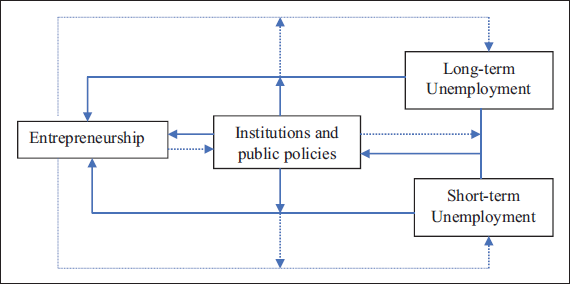
We can assume that short-term unemployment can bring about two possible relationships with entrepreneurship, one negative and one positive. To determine this relationship, it is important to take into account the existence and application of institutions and public policy (e.g., Bilan & Apostoaie, 2023; Haini et al., 2022; Imarhiagbe et al., 2021; Parker & Robson, 2004). For example, in a developing country characterised by weak institutions, poor unemployment insurance benefits and inadequate entrepreneurial policies and incentives, entry into entrepreneurship may be inevitable for survival. In contrast, in a developed economy, institutions and public policies (Storey, 2017) can, by offering unemployment insurance benefits in case of failure, encourage opportunity entrepreneurship and reduce economic uncertainty, thus also encouraging innovation and new business establishment in short-term unemployment (see, e.g., Bilan & Apostoaie, 2023). It is also important to remember that there is a relationship between unemployment, on the one hand, and institutions and public policy, on the other. For example, a welfare state might offer high unemployment insurance benefits, which could be seen as a policy that conflicts with, say, high capital allowances and tax incentives for establishing a new business (see some interesting discussion about the case of Portugal in Baptista & Thurik, 2007). In such circumstances, a rational economic agent would choose the security offered by the unemployment insurance benefit rather than embark on a risky entrepreneurial activity, especially in times of economic unrest. 11 Delaying the venture would preserve savings, which could be used in the future to fuel a business idea.
Omitting to include individual institutional and policy variables—or interacting them with other variables (e.g., unemployment)—leads to a misspecified model (see, e.g., the omitted variable bias discussed in Wooldridge, 2010). Moderating the unemployment variable with an institutional/policy variable can considerably affect the strength of the association. Importantly, as shown in Saridakis et al. (2016), the direction of the association between unemployment and entrepreneurship can change (from positive to negative or from negative to positive) after the occurrence of a structural break due to changes in legislation and regulations. These structural changes can be known a priori or allowed to be detected statistically (see Andrews, 1993; Ditzen et al., 2021). Recently, Haini et al. (2022) found that institutional quality has a positive effect on entrepreneurial activity and moderates the effect of income inequality on entrepreneurship.
Looking at the upper part of Figure 1, we can assume a positive (and perhaps a less likely negative) relationship between the two examined variables. Long-term unemployment significantly reduces human capital and thus the possible opportunities for wage employment (see interesting discussions in Arulampalam, 2001; Bagliano et al., 2019; Edin & Gustavsson, 2008). Hence, assuming there were some savings to begin with, once the safety net of savings is exhausted, then the inflow to entrepreneurship increases (see, e.g., Alba-Ramirez, 1994). This positive relationship could become stronger if policies and institutions encourage entrepreneurship, especially if they specifically target the long-term unemployed. For example, duration of unemployment can subsidise the business planning, which can affect firm survivability and growth (see also Gruber, 2022). Although the direction of the relationship may be the same, the expected magnitude of the relationship may differ significantly in economies with strong institutions and public policies versus those with weak ones by facilitating entrepreneurship through financial support, guarantees and advice for withstanding competition (see the discussion in Haini et al., 2022). Therefore, knowledge of the relationship’s mechanisms is important not only for the direction of the relationship, but also for its potential strength and magnitude. Of course, the duration of unemployment 12 depends in part on the generosity of the welfare state as well as on policies that encourage and help with the transition to entrepreneurship, and the available opportunities for wage employment.
So, with the above example, we could come to the following conclusions:
The effect of unemployment on entrepreneurship is moderated by the existence and implementation of institutions and public policies that promote entrepreneurship. The impact of individual policies and institutions can differ and have opposite results, hiding the nature of the moderation.
Failing to consider and control for these variables when modelling the relationship between unemployment and entrepreneurship can lead to biases (e.g., omitted variable/selection bias), which makes inferences about causality harder (see Shan & Williamson, 2023 for an extensive discussion on the issues of confounding and biases). We address such issues in the next section. Returning to Figure 1, note that we have separated out short-term and long-term unemployment, which to some extent captures the effect of unemployment duration. In other words, the approach views the relationship between entrepreneurship and unemployment as dynamic, which allows the effect of unemployment on entrepreneurship to vary over time. It is important to mention that omitting dynamics from the model can lead to misspecification issues, thus causing bias. Additionally, the figure captures the (potential) endogenous relationship (reverse causation) between unemployment and entrepreneurship (usually referred to as ‘Schumpeter effect’ or ‘entrepreneurial effect’ in the literature). Specifically, in a perfect labour market, we can assume that since entrepreneurship creates new jobs, it can have a direct and immediate effect on short-term unemployment since a number of unemployed will enter employment. At the long-term level, the effect of entrepreneurship on unemployment is less predictable because, as already noted, a large number of the existing firms will exit the marketplace, pitching both business owners and employees into unemployment. As such, it can be argued that policies that help extant businesses are important for strengthening the effect that entrepreneurship can have on unemployment in the long run.
Establishing a Correlation Between Unemployment and Entrepreneurship: A Misspecification Problem?
Quantifying the relationship between entrepreneurship and unemployment is far from simple. For example, the way in which entrepreneurship and unemployment are measured can lead to significant statistical concerns (e.g., detection, performance and reporting biases; Eble et al., 2017) about the claims of the established correlations and their associated magnitude; these issues are in line with concerns raised within the evidential pluralism (see Shan & Williamson, 2023).
It has been argued that entrepreneurship is a slippery concept (Penrose, 1959) and can be proxied differently, such as via Value Added Tax (VAT) registration data, official or self-reported self-employment data (e.g., incorporated/unincorporated self-employment, unpaid family workers) or new bank account data (see Storey, 1991). The way statistical agencies proxy, measure and record self-employment can vary within and between countries. This reduces compatibility, which makes it difficult to draw meaningful comparisons (e.g., Fotopoulos & Storey, 2019). The potential implications of mismeasurement of the studied variable for causal claims have also been discussed in the evidential pluralism literature. 13 Some authors who have recognised this pitfall (e.g., Parker et al., 2012a; Saridakis et al., 2016; van Stel, 2005) have used harmonised business ownership data to estimate their models. Taira (1985) shows that the widely used Labour Force Surveys may not be able to capture the unemployment rate accurately. A measurement error (in the dependent and/or independent variable) that is unlikely to be random noise can thus be present in the model, and this can generate a bias in the measured effect of unemployment on entrepreneurship (e.g., Wooldridge, 2014).
The estimated model may suffer from other types of model misspecification. For instance, it may omit important (confounding) variables from the study, or it may use an incorrect functional form (see Asteriou & Hall, 2016; Wooldridge, 2014). While the former has been discussed extensively in the evidential pluralism literature (see Shan & Williamson, 2023), the latter has received less attention. An early study by Hamilton (1989) suggests that unemployment may have a non-linear effect on entrepreneurship, and this assumption has been supported by subsequent studies (e.g., Faria et al., 2009; Faria et al., 2010; Ritsilä & Tervo, 2002). It has also been proposed that unemployment and entrepreneurship reflect changes in an underlying third variable, such as Gross Domestic Product (GDP) growth (see Plehn-Dujowich & Grove, 2012). Additionally, it can be argued (despite some controversy; see, e.g., the discussion of Gibrat’s Law in Audretsch & Thurik, 2001) that the direction of the relationship runs from entrepreneurship to unemployment but with a time lag effect (i.e., it would take time for a start-up to grow and start employing more people and the effect might be small given the failure rate for new enterprises). Thurik et al. (2008) find that ‘entrepreneurial’ effects are stronger than ‘refugee’ effects. However, and as discussed in Storey (1994), increased employment through, say, entrepreneurial activity is one of the parameters that can reduce unemployment, which suggests that other factors may also play a significant role (e.g., discouraged workers, migration patterns).
Existing research also suggests that differences in regulatory policy and different levels of employment protection legislation can affect entrepreneurship (e.g., Román et al., 2011; Taylor, 2011). For example, Katz and Meyer (1990) suggest that unemployment insurance benefits are linked positively to long-term unemployment. As discussed in Chetty (2008) and Gruber (2022), among others, unemployment insurance benefits can have a moral hazard effect that can affect entrepreneurship because a long-term unemployed individual faces an increased opportunity cost for leaving unemployment (e.g., Lafneur et al., 2017). Carrasco (2008) shows, for example, that unemployment insurance benefits reduce the probability of entering entrepreneurship. Also, Millán et al. (2012) find that unemployment insurance benefits increase the likelihood of switching from entrepreneurship to wage employment. Hence, ensuring that the modelling approach accounts for changes in legislation and regulations, and allows for policy-related break points and policy interaction effects (see Saridakis et al., 2016) can lead to model improvements and add to the understanding of the predictive effect.
Moreover, distinguishing between short-run and long-run effects—despite the difficulties of separating out the effects as well as of measuring the speed of adjustment 14 —and sub-sample estimations (e.g., by gender) can also provide some useful information about the nature and structure of the underlying relationship (see Cheratian et al., 2020; Cowling & Mitchell, 1997; Parker, 1996; Saridakis et al., 2014, 2018). Importantly, one may argue that selection bias (see Wooldridge, 2014) is important to measuring the effects of unemployment on entrepreneurship. Some individuals may have uninterrupted time in entrepreneurship, while others switch occupational activities and experience unemployment spells during their lifespan. Also, some individuals may stay in unemployment longer than other individuals who experience only short spells of unemployment. These individuals may differ significantly in terms of, say, aspiration and ability, as well as their human, finance and network capital (e.g., Abraham et al., 2019; Bagliano et al., 2019; Rözer et al., 2020).
As discussed by Shan and Williamson (2023), failure to address these biases (e.g., simultaneity bias, omitted variable bias) may explain the lack of correlation or the variation in correlation between entrepreneurship and unemployment. In the empirical literature, there is an abundance of articles that seek to estimate the relationship between unemployment and entrepreneurship at different aggregation levels (e.g., individuals, regions and nations). It can be argued that the difficulties of understanding the mechanism of the relationship, as well as the empirical challenges of estimating the model, are sufficient to explain any inconsistent findings that emerge from the various models, tests of endogeneity or Granger causation tests (see Asteriou & Hall, 2016) used in the literature to examine different data. The empirical studies can be grouped into those that use (a) cross-sectional data, (b) time series or (c) base the analysis on panel data. As shown in Figure 2, panel data combines time series and cross-sectional data.
Types of (Quantitative) Analysis Between Unemployment and Entrepreneurship.
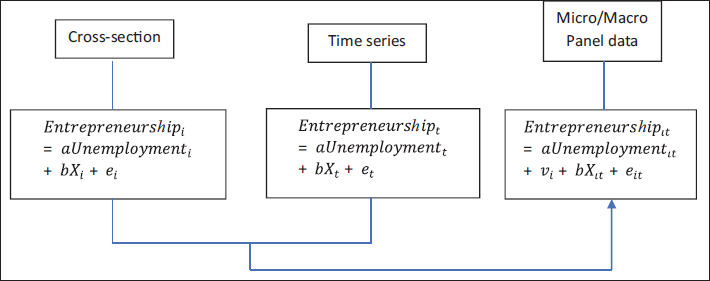
Let us start with the studies that use cross-sectional data (see also Maddala, 1983). Although the data used is often quite rich in terms of individuals, it has some important disadvantages. First, the dynamic relationship between entrepreneurship and (short-term and long-term) unemployment cannot be investigated in depth (although it can be approximated by using survey questions that ask about the spell of unemployment). Second, the data cannot capture changes in policy and institutions that are likely to be associated with greater, lower or stagnant entrepreneurial rates. Third, it is difficult to investigate and deal with simultaneity bias (other forms of bias, such as self-selection bias and omitted variable bias, are easier to deal with). In contrast, panel data can deal with time-invariant unobserved heterogeneity and thus the panel data model can suffer less from omitted variable bias (Wooldridge, 2010). Consequently, the conclusions about the statistical relationship between unemployment and entrepreneurship are less effective when cross-sectional studies are used.
More reliable results for the relationship between unemployment and entrepreneurship may come from research that uses time series or (macro/micro) panels. Time series analysis (see Charemza & Deadman, 1997) commonly focuses on yearly or quarterly national data, whereas in panel data studies (see Wooldridge, 2010) the researchers use the disaggregated data of a specific economy (e.g., regional analysis) or include a group of various economies that are often categorised or analysed within a spectrum of similar characteristics (e.g., economic development, geographical location). In time series as well as in panel data, the investigation and treatment of the problems occurring in cross-sectional studies are easier to handle since the researcher can use tools such as dynamic specifications 15 to explore possible structural breaks that may have come from changes in legislation and public policy (with temporary or permanent effects in the series), and also to examine and correct for possible reverse causation. In time series, however, it is more difficult to include a large number of variables in the specification (see Gujarati, 1995), and consequently, the model can suffer from omitted variable bias; moreover, many of the local variations can be lost in the process of aggregation.
However, unlike micro panels, the extended information over the time horizon offered by time series analysis allows structural breaks to be studied efficiently, and it can also capture short-run and long-run effects. The use of macro panels overcomes the weaknesses of the cross-sectional and micro panels, and can perhaps be considered to be a more appropriate and efficient way of capturing a relationship. Below, we focus on approaches that use macro panels to estimate the entrepreneurship and unemployment relationship, adding to the detailed literature on the econometric approaches to entrepreneurship discussed in Parker (2018a). This approach to estimating the correlation between entrepreneurship and unemployment reduces the likelihood of producing a spurious correlation (see Shan & Williamson, 2023).
Parker (2018a) covers a significant range of survey-based models, time-series models, quasi-experimental methods and micro panels (pooled models, random/fixed effect estimators) in depth. Hence, these models are not covered here. Instead, we demonstrate how macro panels enable a number of the concerns identified above to be managed statistically when estimating the association between entrepreneurship and unemployment. To this end, an empirical model that can be calculated using a macro panel, assuming that

In this model, one can first investigate whether unemployment is an endogenous variable. To do this, the individual effects and common models of unemployment with entrepreneurship as an exogenous variable lagged one period (as provided for in the original procedure discussed in Hendry, 1995) can be estimated. That is

Then using the equation:

One can estimate the entrepreneurship equation, including the errors of the previous model
To incorporate the case where unemployment is treated as an endogenous variable, it is important to recall that there are two sets of exogenous control variables:


Based on the Granger representation theorem, an error correction model (ECM) can also be built. This is a short-run model that incorporates a mechanism that restores a variable to its long-run relationship from a disequilibrium position (see also Baltagi, 2006; Westerlund, 2007). The short-run relationship can be represented as follows:

where the coefficients of exogenous variables
A panel model can also allow for the investigation of structural breaks (e.g., Di Iorio & Fachin, 2007; Hansen, 1992), suggesting a different association of unemployment and entrepreneurship before and after a potential break occurred (

In the case that
Finally, a simple model that addresses selection bias can be built (see Cameron & Trivedi, 2022; Heckman, 1976, 1979), given that there are individuals with continuous

where
Alternatively, a model can measure the endogenous treatment effect (endogenous treatment-regression models), where the indicator variable or dummy


Searching for Mechanism or Correlation First: A Research Dilemma?
A valid question is whether the search for mechanisms ought to precede the empirical evidence. Cartwright and Hardie (2012) emphasise the importance of theory to explaining how causes operate to generate the theoretically proposed and empirically estimated effects. However, Shan and Williamson (2023), while recognising that the making of causal inferences requires the establishment of both theoretical mechanisms and correlation, suggest that the order in which they are extracted is not essential to the research. We respectfully argue that in social sciences, it is probably preferable to first investigate the mechanism of the relationship upon which a theory can be based rather than to initially establish a correlation. Here, we assume that reliable correlation can only be established in a large-scale sample (e.g., Schönbrodt & Perugini, 2013). Shan and Williamson (2023) also suggest that sample size should be taken into account when making inferences about causation.
Let us assume that research into the relationship between unemployment and entrepreneurship begins with empirical evidence (following, e.g., the suggestion of Golder et al., 2023). This may lead to some incorrect conclusions and policy implications. It can be argued that the proof of a statistical relationship based on an atheoretical model may ignore important issues such as differences in the results at the short-run and long-run levels, simultaneity bias or other forms of bias (e.g., selection bias) that come from a misspecified model that ignores confounders or structural breaks that can mediate and/or moderate the relationship between the studied variables (see also Brodeur et al., 2020). 16 In this case, the relationship will not be true. Also, an empirical model may be able to explain an economy with certain characteristics, but it might not perform well when used to examine economies (or regions) that have other structural characteristics and different micro/macro entrepreneurial and social welfare policies (e.g., Baptista & Thurik, 2007; Fotopoulos & Storey, 2019; Saridakis et al., 2016). Policy designs that rely on an established relationship evidenced within a specific economy may, however, have no effect or an insignificant effect when applied to a different economy. 17 In other words, extrapolating to one economy the effect of unemployment on entrepreneurship found by studying another economy requires there to be a certain degree of similarity between the two economies. Evidential pluralism suggests that carrying out robustness checks (e.g., estimation of different sample sizes, sub-sample estimations) and taking the mechanistic process into consideration (e.g., Russo & Williamson, 2007; Shan & Williamson, 2023; Wilde & Parkkinen, 2019; Williamson, 2019b) can mitigate the risks of extrapolating causal claims from one economy to another. We explain this in more detail below.
As already discussed, unemployment insurance benefits may affect the duration of unemployment, and the effect of long-term unemployment on entrepreneurship should be differentiated from the effect of short-term unemployment. Furthermore, entrepreneurship should be differentiated into necessity-based and opportunity-based entrepreneurship. Unemployment benefits vary according to a country’s economic stage of development, its needs and potentials, and whether the benefits target specific labour market groups (e.g., low-skilled workers, those actively searching for a job) (D’Ambrosio & Scrutinio, 2022; OECD, 2018; Tatsiramos & van Ours, 2014). Similarly, the effects of macroeconomic, industrial, social and economic development/entrepreneurship policies should be taken into account when studying an economy in a specific geographical area or a set of countries with some degree of economic dependency, so as to outline the possible pathways of the unemployment–entrepreneurship nexus (see Bilan & Apostoaie, 2023 for some detailed and interesting discussions).
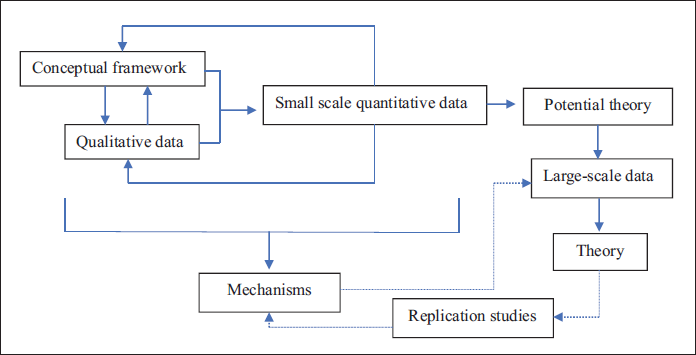
This perhaps makes it necessary to search for a theoretical foundation for the mechanism that explains the relationship (see also Hoover, 2012 for an interesting discussion of inferential problems and counterfactual problems in causal analysis in economics) before turning to empirical modelling and the statistical support extracted from large-scale datasets (see Figure 3). As suggested here, a conceptual framework is necessary to kick-start the research. Qualitative research can make a contribution by offering, for example, grounded theory (see Glaser & Strauss, 1967), through which qualitative data can be collected and analysed in order to understand the potential mechanisms of the relationship. A new theory can be created, or an existing one can be adapted based on the characteristics of the examined sample. A qualitative approach can also be useful for exploring what drives the transition from unemployment to entrepreneurship. Of course, a theory-based model can be misspecified if the theory itself is wrong. To this end, analysis that incorporates qualitative results and small-scale quantitative findings can help towards understanding the studied relationship. This can lead to a more concrete theoretical model, upon which an empirical model can be built and tested to prove a causal relationship between variables (see also Parker, 2018a, 2018b). Follow-up (replication) studies should be carried out to investigate the mechanisms of a certain economy or group. These should be tested at a large scale so that new evidence can inform and improve the theory, as well as allow extrapolation of causal inferences (see Shan & Williamson, 2023).
Theory Development.
Conclusions and Future Directions
This article contributes to the discussion of causality in social sciences by examining the role that evidential pluralism (e.g., Shan & Williamson, 2023) can play in the causal enquiry arena. In particular, it draws on the economics of entrepreneurship field and discusses the theoretical and empirical arguments that have been put forward about the causal relationship between unemployment and entrepreneurship. Given the differences in the theoretical frameworks employed and the discrepancies in the available empirical results, we are left with two options. The first is to abandon efforts to uncover the relationship between the two phenomena; the second is to continue with our investigations. In this article, we are in favour of the second approach, and we suggest that this can be done through the use of evidential pluralism (see Shan & Williamson, 2023). We suggest that continuing our efforts has merit for two reasons that are at the core of evidential pluralism.
First, the diversity in theoretical frameworks requires further investigation to explore the underlying pathways through which the variables are linked. For example, we suggest that mechanisms that involve different types of entrepreneurs (e.g., opportunity vs. necessity entrepreneurs, naïve vs. ex-entrepreneurs) as well as types of unemployment (e.g., short-term vs. long-term unemployed, male vs. female unemployment) should be explored, along with different structural and labour market factors and policies that may mediate and/or moderate the potential relationships among all the variables. This may allow the capture of some common mechanisms for similar groups (e.g., economies, gender) and also some interesting different and heterogeneous pathways (see Siewert & Beach, 2023). The knowledge of mechanisms between groups can act as the basis for the extrapolation of causal claims between (homogeneous) groups (see Shan & Williamson, 2023; Wilde & Parkkinen, 2019). From a policy perspective, this is crucial since it can allow policymakers to craft effective policy that tackles unemployment for specific groups (e.g., long-term unemployed, older workers, women). Hence, our analysis provides further support to Shan and Williamson (2023, pp. 45–46), who suggest that ‘only by learning about these mechanisms can one determine whether extrapolating an intervention to a new context is likely to be successful’.
Second, the discrepancies in the empirical findings may lie in the different methodological approaches 18 and types of datasets that have been used to explore this relationship. Hence, we argue that focusing on (macro) panels may be a more appropriate empirical strategy to deal with the different sources of bias discussed in the evidential pluralism and econometrics literature, and to capture the dynamic nature of the underlying relationship. We argue that panel data may be superior for exploring the unemployment and entrepreneurship relationship. For example, one may argue that the entrepreneurship and unemployment variables are both subject to local variations and affected by important socio-demographic changes and regional policies. Additionally, panel data, especially from macro panels, allows us to capture dynamic effects and provide useful information (e.g., state dependence evidence). We also suggest that international comparative studies should be carried out cautiously since there may be differences in, say, definition reporting and recording, as well as constraints in the availability of various controls. Such issues can lead to misleading empirical inferences about the relationship and thus may not allow extrapolation of causal claims (e.g., Shan & Williamson, 2023; Wilde & Parkkinen, 2019).
Evidential pluralism reinforces the importance of establishing correlations and mechanisms in economics and the business disciplines. It is also evident that it is necessary to apply evidential pluralism to unpack causal relationships. However, and in contrast to Shan and Williamson (2023), we argue that the order of the examination matters. We suggest that understanding the mechanism of the relationship is crucial, and should be explored first. This is due to the complexity of relationships that involve human behaviour cannot be captured empirically because of data or computational constraints that may or may not be overcome in the future. We argue that methodological diversity and mixed method approaches (see Johnson et al., 2019; Kuorikoski & Marchionni, 2023 for useful discussions) can help us to explore potential mechanisms that connect the variables. These can form the basis of an empirical model, which can be estimated using large-scale panel data. Also, we argue that although methodological diversity can be helpful when exploring mechanisms, it can be rather problematic when examining correlation (see also Runhardt, 2021, 2022).
Overall, this article challenges previous approaches used to examine the relationship between entrepreneurship and unemployment, and critically explores their (implicit) underlying assumptions and findings. Erroneously drawn or inconsistent conclusions limit not just academic understanding but also inhibit policymaking and public understanding. Hence, we urge that the search for the unemployment and entrepreneurship relationship continues, but within the context of evidential pluralism. We suggest that researchers first carefully examine the mechanism (using mixed method approaches) before estimating the model using large-scale data. We also suggest that panel data may be more appropriate for extracting the correlations between the variables under examination since that data can deal with various statistical issues (such as omitted variable bias and inverse causality) and capture potential dynamic patterns. Moreover, evidential pluralism can be used not only as a causal enquiry of new or uncertain relationships, but also as a way of reassessing the validity of well-established relationships in the economics and business literature.
Footnotes
Acknowledgements
I would like to express my gratitude to the Editor and the referees for their constructive comments. Additionally, the article has greatly benefited from the insightful comments and suggestions provided by Jon Williamson, Chris Hand and Miguel Ángel Mendoza González.
Declaration of Conflicting Interests
The author declared no potential conflicts of interest with respect to the research, authorship, and/or publication of this article.
Funding
The author received no financial support for the research, authorship, and/or publication of this article.
