




Abstract
This article assesses how knowledge diffusion modulates the effect of the mobile phone on entrepreneurship or doing business in sub-Saharan Africa. The empirical evidence is based on Generalised Method of Moments in which mobile phones are interacted with three knowledge diffusion variables, namely, education, internet penetration and scientific output. Ten variables of entrepreneurship are used. The following three main findings are established. First, the net effects from interacting mobile phones with the internet and scientific publications are negative, whereas the corresponding net impact from the interaction between mobile phones and education is positive on the cost of doing business. Second, the mobile phone interacts with education (the internet) to have a positive (negative) net effect on the time needed to construct a warehouse whereas, the corresponding interaction with the internet yields a net negative effect on the time to enforce a contract. Third, there is a positive net effect from the interaction of mobile phones with education on the time to start a business. Given the construction of the education variable, the positive net effects from education are consistent with corresponding negative net effects from the other knowledge diffusion variables.
Introduction
This article has three main motivations, namely, the high potential for mobile phone penetration in sub-Saharan Africa (SSA); the imperative of private sector entrepreneurship to accommodate unemployment related to the sub-region’s rising population and gaps in the entrepreneurship or doing business literature 2 . Throughout this study the terms, ‘mobile phone penetration’, ‘mobile telephony’, ‘mobile’ and ‘mobile phones’ are used interchangeably. We substantiate the motivating dimensions in chronological order.
First, although more developed economies in Asia, Europe and North America are witnessing saturation levels in the penetration of the mobile phone; there is a great room for its penetration in Africa (see Asongu, 2018; Penard et al., 2012). This potential for mobile penetration can be leveraged by policy to address socio-economic challenges, by facilitating entrepreneurship and enhancing efficiency in small- and medium-sized enterprises.
Second, according to the United Nation’s population prospects (UN, 2009), the population of Africa is projected to double by the year 2036 and to represent about 20% of the world’s population by 2050. A serious challenge confronting African countries in the post-2015 development agenda is high unemployment. Accordingly, although youth unemployment has been documented to represent one of the most challenging policy syndromes in the post-2015 agenda (AERC, 2014), there is a growing body of literature maintaining that the burgeoning population growth in Africa can only be efficiently accommodated by private investment and entrepreneurship in the medium and long terms (Asongu, 2013a; Brixiová et al., 2015). Although mobile phone innovation can be a means to boost entrepreneurship to tackle rising unemployment, the empirical evidence on linkages between mobile phones, knowledge diffusion and doing business has not been established in the literature. The concept of mobile phone innovation refers to the complementarity of the mobile phone with knowledge diffusion policy variables to achieve development outcomes. Hence, the aim of the study is to assess how education, the internet and scientific output can modulate the effect of the mobile phone on entrepreneurship. The definition and conception of mobile phone innovation is consistent with recent institutional (Asongu & Nwachukwu, 2016a) and inclusive development (Asongu & Nwachukwu, 2016b) literature.
Third, the bulk of underlying literature has focused on inter alia: the cost of doing business (Eifert et al., 2008); legal challenges to doing business (Taplin & Synman, 2004); intensity by which trade influences business cycle synchronisation (Tapsoba, 2010); determinants of entrepreneurship in East Africa (Khavul et al., 2009); the influence of labour regulation externalities on the cost of doing business (Benjamin et al., 2010); the intension of undergraduate students to become entrepreneurs (Gerba, 2012; Ita et al., 2014); motivations behind female entrepreneurs (Singh et al., 2011); the nexus between youth entrepreneurship and financial literacy (Oseifuah, 2010); the long-term influence of entrepreneurial training in poverty reduction (Mensah & Benedict, 2010); the role of knowledge economy in doing business (Tchamyou, 2017) and the role of mobile phones in modulating governance for entrepreneurship (Asongu et al., 2018). Accordingly, Asongu and Nwachukwu (2016a) assess the role of the mobile phone in the diffusion of knowledge for better governance in SSA, whereas the present study is not focused on governance as outcome variable, but on doing business.
This study unites the above strands by using three mobile phone innovation variables (quality of education, internet penetration and scientific output) to assess how knowledge diffusion modulates the effect of mobile phones on 10 doing business indicators. The positioning of the study extends macroeconomic literature on the employment of information and communication technologies (ICTs) for entrepreneurial purposes, notably: emphasis on entrepreneurs that are continuously innovating because of evolving skills and financial resources (Best, 2015); the use of social media to promote entrepreneurship (Jones et al., 2015; McCann & Barlow, 2015; Wang, 2016); knowledge sharing in entrepreneurial success (Allen et al., 2016); the use of social entrepreneurship to drive technology (Mulloth et al., 2016); the creation and discovery of innovation opportunities (Hang et al., 2015; Wan et al., 2015); innovations in technology that are offering novel opportunities due to the road-mapping of patents (Jeong & Yoon, 2015); doing business avenues that are associated with an ageing population (Kohlbacher et al., 2015) on the one hand and emerging ecosystems on the other hand (Overholm, 2015); research collaborations (McKelvey et al., 2015) and scientific entrepreneurial business opportunities (Maine et al., 2015). Moreover, this study steers clear of the bulk of studies on the use of ICT for social change and development outcomes, notably: the distributional externalities of growing technologies (see Cozzens, 2011), especially in sustainable development (Alkemade & Suurs, 2012); the relevance of mobile phones in social outcomes (Amankwah-Amoah, 2015, 2016; Amankwah-Amoah & Sarpong, 2016; Brouwer & Brito, 2012; Islam & Meade, 2012; Mira & Dangersfield, 2012) in both developed nations (Thakur, 2012) and developing (Gupta & Jain, 2012; Sonne, 2012) countries.
The rest of the study is structured as follows. The theoretical underpinnings and related literature are covered in the second section while the data and methodology are presented in the third section. The fourth section discloses the empirical results, whereas the fifth section concludes with future research directions.
Theoretical Underpinnings and Related Literature
Theoretical Underpinnings
The relevance of knowledge diffusion in economic development is well documented in the literature (Anyanwu, 2012; Asongu et al., 2016b; Chavula, 2010). Most narratives are consistent with the view that there is a two-way causal relationship between the diffusion of knowledge and economic prosperity. Neoclassical economic development models acknowledge know-how and technology as some form of public goods and services that are entirely exogenous to the economic systems in place. Conversely, new economic development models are based on two interpretations of economic development, namely: the neo-Schumpeterian and endogenous perspectives (Howells, 2005). According to the new models of growth, technological advancement is the product of citizenry engagements via the mobilisation of important ‘human capital’-related resources (see Romer, 1990).
Cognizant of the above, technological progress is conceived by the new growth theory from the view of a private excludable commodity. Furthermore, knowledge generation that is potentially linked to the creation of new intellectual capital (and other forms of technological rewards) is acknowledged as a private good (Solow, 1994). Although some private characteristics pertaining to technology (such as monopolistic power and patents) have been emphasised in several economic development models, some scholarly perspectives maintain that proceeds from monopolistic power are not permanent (Uzawa, 1965). Romer (1990) is of the view that technology can be endogenous and exogenous at the same time. In essence, some technological features predispose the underlying technology to take the character of a public commodity as time unfolds. The author further maintains that the technology often enjoyed by nations is heterogeneous because of cross-country spillover in technology. With this underpinning in mind, advancement in technology could result in disequilibrium in processes of economic and human developments which are exogenous to cross-country differences in economic prosperity (Verspagen, 1997). This is broadly consistent with a narrative from Rosenberg (1972) maintaining that the degree by which new technologies are employed for productive purposes is essential in eliciting economic development. The above theoretical views are in line with the intuition that mobiles phones can be innovated for entrepreneurial activities.
The above theories are consistent with contemporary literature on the relevance of knowledge spillover in entrepreneurship (Acs & Sander, 2012; Ghio et al., 2015; Hayter, 2013). This contemporary stream of literature on the theory of knowledge spillover for entrepreneurship argues that the creation of new enterprises result from avenues that are built on knowledge generated but not exploited at the commercial level by academic research institutions or incumbent corporations (Acs & Sanders, 2012). Whereas incumbent corporations may largely not recognise the potential of such opportunities/avenues, the underlying knowledge is leveraged by potential entrepreneurs to create new corporations. It is important to note that mainstream research institutes and incumbent corporations are sometimes unwilling to engage new processes and products that are inconsistent with their principal technological trajectories and main competences. The premise that entrepreneurship is a mechanism through which knowledge can be commercialised beyond the source of knowledge is consistent with fundamental scholarly literature, which recognises the relevance of knowledge as a prime source of commercial and technological opportunity that ultimately boosts economic prosperity and development (Ghio et al., 2015). According to Kuada (2014), entrepreneurs can be considered as individuals who are bold enough to simultaneously challenge mainstream assumptions in society and combine seemingly unrelated types of knowledge and expertise in creating new enterprises and/or improving existing ones. This conception of entrepreneurship has motivated scholars to argue that learning and knowledge constitute elements in entrepreneurship and the economic prosperity of nations.
It is important to substantiate the above theoretical underpinnings with the three fundamental theories on ‘innovation and entrepreneurship’. Consistent with Parker (2012), three broad classes are apparent, notably: models of creative destruction; models of innovation and implementation cycles and models of production within the framework of information asymmetry.
The first strand articulates Schumpeter’s theory of business cycles and creative destruction (Schumpeter, 1927, 1939). According to the theory, history is characterised by periods in which, well-talented entrepreneurs introduce revolutionary quality innovation that substantially improve existing technologies. Economic booms are typical of these periods and owing to the diffusion of innovation, imitators are encouraged to enter the market and consequently reduce the profits enjoyed by pioneers of the innovation. In the ensuing process of ‘creative destructive’, old technologies are replaced with new technologies, partly because the latter technologies rely on the former technologies for their introduction. Examples of ‘creative destruction’ include, inter alia: the replacement of steam locomotive by electric and diesel trains; of postal mails by electronic mails and of the telegraph by the telephone. There is a growing stream of literature with in-depth analysis on creative destruction and disruptive Schumpeterian innovations (see Aghion & Howitt, 1998; Parker, 2012).
With regard to the second strand on ‘innovation and implementation cycles’, Schumpeter’s theory suffers from two principal insufficiencies. On the one hand, cycles are largely generated by assumption and are exclusively exogenous and supply driven, with no articulation of demand and demand expectations. Accordingly, the underlying theory is linked to long-wave cycles instead of short-wave cycles that have more policy, practical and economic relevance. Models have been proposed to address the highlighted concerns (Shleifer, 1986). It is important to note that an innovation is not synonymous to an invention because after an invention, firms could postpone the commercialisation of the underlying invention (i.e., the process of innovation) to a later date.
In the third strand on ‘models of production under information asymmetry’, several models indicate that entrepreneurs are constrained by information asymmetry from taking initiatives that create new and/or exaggerate existing business cycles from an aggregate perspective. Three main channels of information asymmetry influence such entrepreneurial behaviour, notably: (a) adverse selection, when lenders are unable to distinguish genuine entrepreneurs from those with a hidden agenda; (b) moral hazard, when entrepreneurs can conceal profits accruing from mandated projects with the purpose of avoiding compliance with their financial obligations towards lenders; and (c) high cost incurred by lenders in verifying entrepreneurs’ returns on funded projects. The third theoretical model is closest to the positioning of this study because knowledge diffusion variables can complement the mobile phone in order to mitigate informational rents or information asymmetry associated with entrepreneurship. The narrative in the third strand is broadly consistent with recent African development literature on the connection between knowledge sharing and ‘reducing information asymmetry’ in order to boost access to finance for entrepreneurs and other economic operators (Asongu et al., 2019; Tchamyou & Asongu, 2017; Tikri & Gajigo, 2014).
Mobile Phone Modulation with Knowledge Diffusion Channels and Entrepreneurship
This section is engaged in two fundamental strands, notably: the connection between the mobile phone and knowledge diffusion channels, on the one hand and how knowledge diffusion variables modulate the effect of the mobile phone on entrepreneurship, on the other. The strands are substantiated in chronological order. First, on the connection between the mobile phone and the three knowledge diffusion channels (education, internet penetration and scientific output), the following are noteworthy.
From the dimension of human capital, education is an important ingredient in the stimulation of innovation. This narrative is consistent with Rosenberg (1972) who substantiates that a prerequisite for the employment of innovation technology (and by extension its effective exploitation) is human capital. Moreover, via the mobile technology, individuals can consolidate their abilities to improve general societal wellbeing through continuous education (Dakhi & de Clereq, 2007; Kwan & Chiu, 2015). Hence, the use of mobile applications for development purposes is logically contingent on the level of the user’s education. Another channel by which the mobile phone can be modulated to increase knowledge diffusion is ICT: a complementary ICT tool. Accordingly, the internet can modulate the mobile phone to diffuse knowledge more comprehensively than an isolated mobile phone. This narrative is broadly consistent with neoclassical economic growth models on important sources of innovation in poor countries (Abramovitz, 1986; Bernard & Jones, 1996; Kwan & Chiu, 2015). The channel of scientific output (or knowledge creation) builds on the evidence that knowledge creation and knowledge diffusion are complementary in innovation output (Kwan & Chiu, 2015). In essence, when individuals contribute to new knowledge by means of scientific publications, the diffusion of such knowledge through social interactions among individuals ultimately contributes to increase social and economic wellbeing in the country.
In the second strand, we engage how the discussed knowledge diffusion variables modulate the effect of mobile phones on entrepreneurship. Accordingly, when the mobile phone is innovated with knowledge diffusion variables, it improves conditions for entrepreneurship by inter alia: reducing informational rents and/or information asymmetry associated with constraints to entrepreneurship. Moreover, such mobile phones reduce constraints to starting and doing business by, among others: increasing access to relevant and timely information (Mchombu, 2003) and boosting the user’s ability to cheaply and timely exchange information. Such positive externalities facilitate access to developmental inputs and bridge gaps to expanded capabilities (Smith et al., 2011).
In the light of this clarification, when the mobile phone is modulated with knowledge diffusion variables, relevant networks are created that could enhance entrepreneurship, partly because networks have been recently established to be relevant in the performance of Small and Medium Size enterprises (Haddoud et al., 2017). Entrepreneurship can ultimately be boosted if the underlying modulation of the mobile phone mitigates a number of constraints to the starting and doing of business, notably, the: cost of business start-up procedures; number procedures to enforce a contract; number start-up procedures to register a business; days required to build a warehouse; days required to enforce a contract; days required to register a property; years needed to resolve an insolvency; hours required to prepare and pay taxes; days required to exports and days required to start a business. These constraints are consistent with recent African entrepreneurship literature (Asongu & Tchamyou, 2016; Tchamyou, 2017).
Literature Review on Entrepreneurship
Contemporary literature on entrepreneurship in Africa has failed to engage the connection between the mobile phone’s penetration potential, innovation policy variables and the doing of business. According to Alagidede (2008), much scholarly research on the underlying topic is not focused on Africa because its business environment is perceived as excessively risky. The cost of doing business in the continent has been examined by Eifert et al. (2008) who have concluded that the relative performance of African businesses is undervalued by mainstream indicators. Taplin and Synman (2004) have discussed legal positions with reference to challenges of and changes in the doing of business in South Africa. The degree of responsiveness of business cycle synchronisation to trade is investigated by Tapsoba (2010) who has established that some causal impact is apparent. According to Khavul et al. (2009), considerable family and community relations influence the growth of businesses and/or entrepreneurs in East Africa. Moreover, members of the family also serve as a flexible and reliable source of cheap labour, which is instrumental in saving cost at the initial stages of an enterprise (Kuada, 2009). Bardy et al. (2012) investigate the influence of foreign direct investment in social responsibility to document interesting practical and theoretical patterns on the nexus. The influence of externalities from labour regulation on the cost of doing business has been examined by Paul et al. (2010) who have concluded that indicators from the World Bank on the doing of business do not provide a holistic picture of workers’ employment.
Gerba (2012) has investigated entrepreneurial intensions by Ethiopian undergraduate students to draw the conclusion that motivations behind intentions to become an entrepreneur are strongly influenced by studies/courses on the doing of business. Determinants of decisions behind entrepreneurship among Nigerian women are assessed by Singh et al. (2011) who arrive at the following motivational features: environments that are characterised by social recognition and economic deregulation, family capital and education. The nexus between financial literacy and youth entrepreneurship in South Africa is investigated by Oseifuah (2010) who concludes that the former is a strong determinant of the latter. The long-term externalities of entrepreneurship training are investigated by Mensah and Benedict (2010) who establish that poverty-mitigating hand-outs from the government only reduce poverty in the short run, with corresponding violent demonstrations and protests that are unavoidable. On the contrary, opportunities and training for entrepreneurship provide small enterprises with possibilities of consolidating existing and creating new businesses that ultimately reduce poverty in the long term. The engaged challenges to the doing of business in Africa from scientific literature are broadly consistent with narratives from policy reports (see Ernst & Young, 2013; Leke et al., 2010) and a literature survey (Kuada, 2015) on the subject.
In more recent literature on entrepreneurship in Africa, Tchamyou (2017) has examined the role of knowledge economy in the doing of business, whereas Asongu and Tchamyou (2016) have investigated the effect of entrepreneurship on knowledge economy. A two-way causality is established in the findings, notably that knowledge economy is conducive for entrepreneurship and entrepreneurship further boosts knowledge economy. Other more contemporary studies have focused on, inter alia: developing strategies to harness the power of parallel entrepreneurship in Africa (Eskor, 2017); strategic initiatives for African entrepreneurship from innovation to sustainability (Kolo, 2017); entrepreneurship as a solution to youth unemployment (Chigunta, 2017); non-farm entrepreneurship in rural SSA (Nagler & Naudé, 2017); the role of formal institutions in entrepreneurship within an economy dominated by the informal sector (Adom, 2017); insights from an emerging economy into revitalising serial entrepreneurship in SSA (Amankwah-Amoah, 2018); sustainable entrepreneurship in SSA within collaborative systems (Juma et al., 2017) and the relevance of reseeding Africa with entrepreneurship and institutions to accelerate economic development (Eshun, 2018).
Although the theoretical literature is critically engaged, the primary purpose of highlighting some studies in the empirical literature is to clearly demonstrate how the positioning of the study steers clear of existing empirical literature. To the best of our knowledge, the extant literature has failed to engage how modulating the mobile phone with knowledge diffusion channels affects entrepreneurship. The study is even more relevant, given the three motivations from policy and academic circles outlined in the introduction.
Methodology and Data
Methodology
Specification
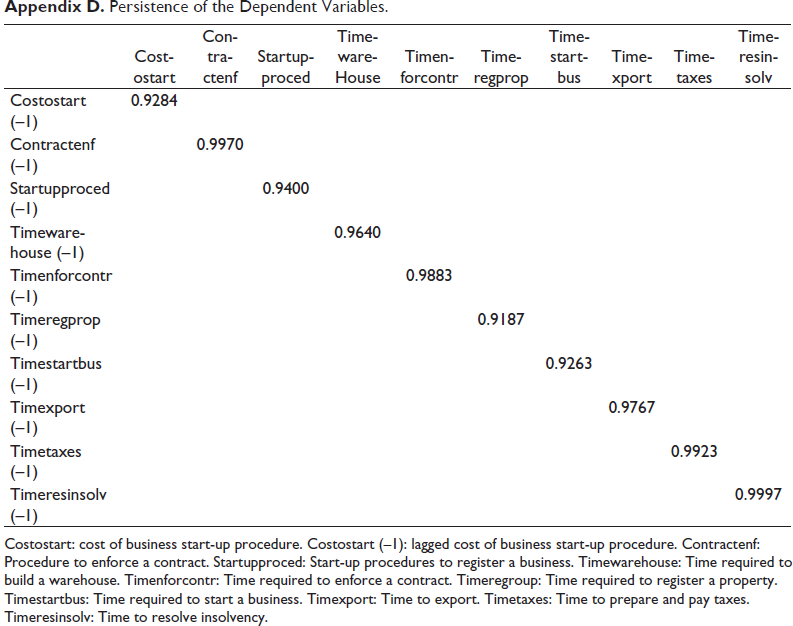
A two-step generalised method of moments (GMM) estimation approach is adopted for five main reasons: (a) the number of cross sections or countries (49) is considerably higher than the periodicity in respective cross-sections (13); 3 (b) the outcome variables are persistent as shown in Appendix D because their correlation coefficients with respective first lags are higher than the rule thumb threshold of 0.800; (c) since the GMM estimation technique is compatible with a panel data structure, cross-country variations are not eliminated in the regressions; (d) inherent biases in the difference estimator are corrected with the system estimator; and (e) the estimation procedure controls for endogeneity by accounting for simultaneity in the explanatory variables using an instrumentation process. Moreover, usage of time-invariant variables also increases the bite on endogeneity. Of the five points raised, the first two are justifications for the use of GMM whereas the last three are associated advantages. We have provided justifications for the first two with respect to the data structure (i.e., N>T) and behaviour of the dependent variables (i.e., persistence).
The study adopts the Roodman (2009a, 2009b) extension of Arellano and Bover (1995) because, compared with traditional GMM techniques, it mitigates the proliferation of instruments (or restricts over-identification) and is more efficient in the presence of cross-sectional dependence (Baltagi, 2008; Boateng et al., 2018; Love & Zicchino, 2006).
The following equations in level (1) and first difference (2) summarise the standard system GMM estimation procedure:


where Bi,t is a starting or doing business indicator of country i at period t, σ0 is a constant, I is an innovation policy variable (educational quality, internet penetration and scientific output), M represents mobile phone penetration, IM is the interaction between an innovation policy variable and mobile phone penetration, W is the vector of control variables (GDP growth, population growth, foreign direct investment, foreign aid and political stability), τ represents the coefficient of auto-regression that is one for the specification, Ξ t is the time-specific constant η i is the country-specific effect and ε i,t the error term 4 .
Since the estimation is based on interactive regressions, it is important to briefly discuss shortcomings that are associated with such types of regressions. According to Brambor et al. (2006), all constitutive terms are involved in the specifications. Moreover, the corresponding estimated coefficients are considered as conditional effects. These underpinnings from Brambor et al. (2006) are in line with more contemporary literature on interactive regressions (Balli & Sorensen, 2013). Moreover, since the squared terms of the interactive indicators are not emphasised in the problem statement under investigation, quadratic terms are not considered in the assessment of the modulating role of policy variables in the effect of mobile phones on entrepreneurship.
Identification and Exclusion Restrictions
It is important to briefly discuss properties of identification and exclusion restrictions that are relevant for a sound GMM specification. All explanatory variables are considered as suspected endogenous or predetermined and only time-invariant variables are acknowledged to exhibit strict erogeneity. This is consistent with recent literature (see Asongu & Nwachukwu, 2016b; Boateng et al., 2018). Moreover, time-invariant variables or years are unlikely to become endogenous after a first differences (see Roodman, 2009b). Hence, the procedure for treating ivstyle (years) is ‘iv (years, eq(diff))’ whereas the GMM style is employed for predetermined variables. Given this emphasis, years affect entrepreneurship exclusively via the suspected endogenous indicators. Moreover, the statistical relevance of the underlying exclusion restriction is examined with the Difference in Hansen Test (DHT) for the exogeneity of instruments. In essence, the null hypothesis of the DHT should not be rejected for the time-invariant indicators to elicit the entrepreneurship variables exclusively through the suspected endogenous indicators. Therefore, in the results that are reported in the section that follows, the assumption of exclusion restriction is validated if the alternative hypothesis of the DHT related to instrumental variables (IV) (year, eq(diff)) is not accepted. This is broadly consistent with the standard IV procedure in which, a rejection of the null hypothesis of the Sargan Overidentifying Restrictions (OIR) test is an indication that the instruments affect the entrepreneurship variables beyond the suspected endogenous variable mechanisms (see Asongu & Nwachukwu, 2016c; Beck et al., 2003).
Post-estimation Information Criteria
Four post-estimation diagnostics tests are used to assess the validity of estimated models (see Asongu & De Moor, 2017, p. 200). First, the null hypothesis of the second-order Arellano and Bond autocorrelation test (AR (2)) in difference which is a position for the absence of autocorrelation in the residuals should not be rejected. Moreover, the second-order Arellano and Bond autocorrelation test (AR(2)) is exclusively reported because it is more relevant as information criterion than the first-order test. In essence, some studies exclusively report the higher-order tests with no disclosure of the first-order test (Asongu & Nwachukwu, 2016c; Narayan et al., 2011).
Second the Sargan and Hansen over-identification restrictions (OIR) tests should not be significant given that their null hypotheses are the positions that instruments are valid or not correlated with the error terms. Accordingly, whereas the Sargan OIR test is not robust but not weakened by instruments, the Hansen OIR test is robust but weakened by instruments. To limit identification or restrict the proliferation of instruments, in corresponding specifications the instruments should be lower than the number of cross-sections. A means of addressing the underlying conflict is to adopt the Hansen test and avoid the proliferation of instruments as much as possible. Such instrument proliferation is avoided in this study by ensuring that the number of instruments in each specification is lower than the corresponding number of cross sections.
Third, the DHT for the exogeneity of instruments is also employed to investigate exclusive restrictions emphasised in the identification strategy and hence the validity of results from the Hansen OIR test. Fourth, a Fisher test for the joint validity of estimated coefficients is also provided.
Data
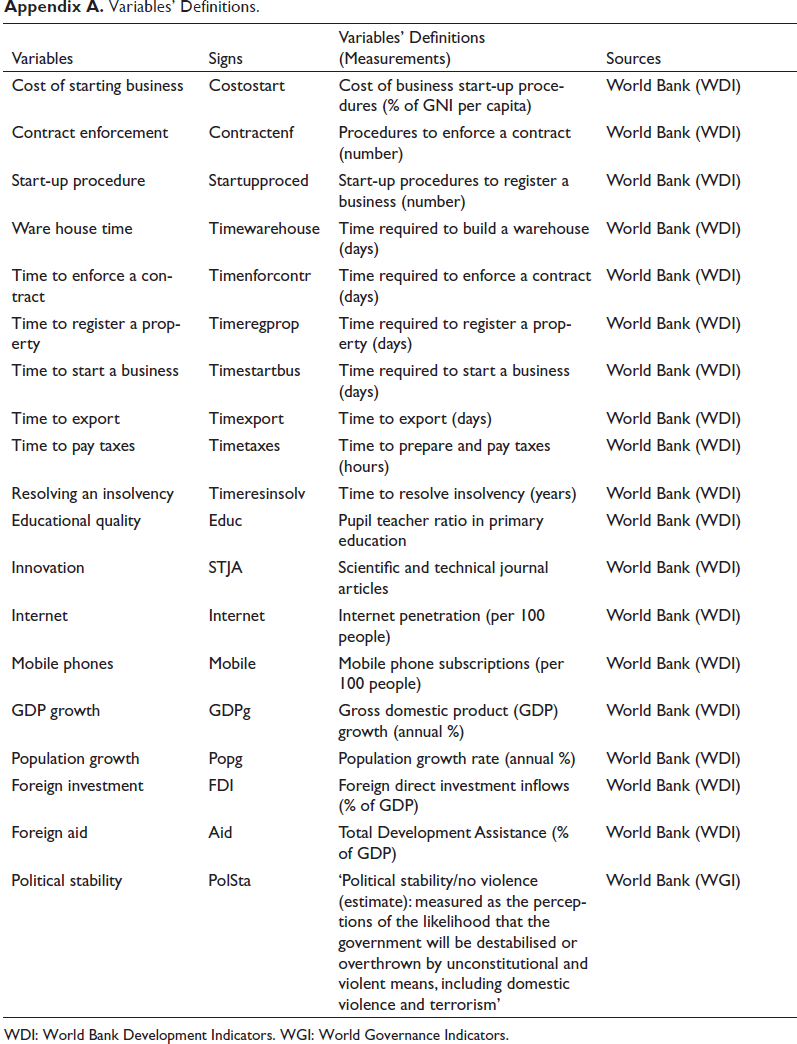
The study assesses a panel of 49 countries in SSA with data from World Development Indicators (WDI) and World Governance Indicators (WGI) of the World Bank for the period 2000–2012. In accordance with recent doing business literature (Asongu & Tchamyou, 2016), 10 dependent variables on entrepreneurship are used, namely: cost of business start-up procedure (as a percentage of Gross National Income); procedure to enforce a contract (number); start-up procedures to register a business (number); time required to build a warehouse (days); time required to enforce a contract (days); time required to register a property (days); time required to start a business (days); time to export (days); time to prepare and pay taxes (hours) and time to resolve an insolvency (years). In the assessments, contingent on the characteristics (or construction) of independent variables (i.e., positive signals versus negative signals), a decrease in these variables proxying for constraints to entrepreneurship implies positive conditions for entrepreneurship. It is important to note that an increase in a variable that is a negative signal denotes deteriorating quality, whereas an increase in a variable considered a positive signal suggests the contrary.
The mobile phone is measured with mobile phone penetration (per 100 people). Consistent with recent mobile phone innovation literature (Asongu & Nwachukwu, 2016a), three of the four pillars of the World Bank’s Knowledge Economy Index are used as knowledge diffusion variables, notably: education, innovation and ICT. First, the quality of education is measured with the ‘pupil–teacher ratio’ in primary education. Both the comparative importance of primary education and data availability constraints motivate the choice of this indicator. Although there are issues in degrees of freedom with respect to other indicators of educational quality (e.g., ‘pupil–teacher ratio in secondary education’), primary education has been documented to be more associated with positive development externalities when countries are at early stages of industrialisation (see Asiedu, 2014; Petrakis & Stamatakis, 2002). In the light of the construction of the pupil–teacher ratio, we expect it to modulate the mobile phone by increasing constraints to doing business. This is essentially because an increasing ratio denotes decreasing quality in primary education.
Second, concerns about degrees of freedom in other innovation indicators (e.g., trademark and patent applications) motivate the use of the number of Scientific and Technical Journal Articles (STJA) published annually as a proxy for innovation. Third, internet penetration (per 100 people) is used as the complementary ICT indicator because mobile phones which are connected to the internet are more likely to be beneficial for entrepreneurs than those that are not. Borrowing from Tchamyou (2017), five macroeconomic and institutional control variables are adopted, namely: GDP growth (annual %), population growth (annual %), foreign direct investment inflows (annual %), foreign aid or total development assistance (% of GDP) and the political stability/no violence (estimate) which measures the perceptions of the likelihood that the government will be destabilised or overthrown by unconstitutional and violent means, including domestic violence and terrorism.
With the exception of foreign aid, the remaining four control variables are expected to positively affect the doing of business. It is important to note that the effect on entrepreneurship may be contingent on market expansion and dynamism. For instance, the incidence of an external flow on a specific constraint to the doing of business depends on how resources are skewed to affect specific entrepreneurship indicators.
First, GDP is expected to improve conditions for the doing of business because it is associated with growth opportunities. Unfortunately, if GDP growth is not broad-based, but focused on a few industrial extractive sectors, the effect of GDP growth may not be so favourable to the doing of business, especially if the fruits of the corresponding economic prosperity are not evenly distributed across the population. Second, whereas a burgeoning population represents significant domestic business opportunities, the corresponding effect on entrepreneurship can also be negative if much of the population relies on imported commodities. Third, foreign direct investment may either crowd-out or increase domestic business opportunities depending on whether there is net positive or negative inflow. Fourth, development assistance is expected to negatively influence entrepreneurship conditions because for the most part, handouts from Donors are likely to have exclusively limited effects. This is consistent with the conclusions of Mensah and Benedict (2010) on government handouts. Fifth, political stability is a natural determinant of the doing of business.
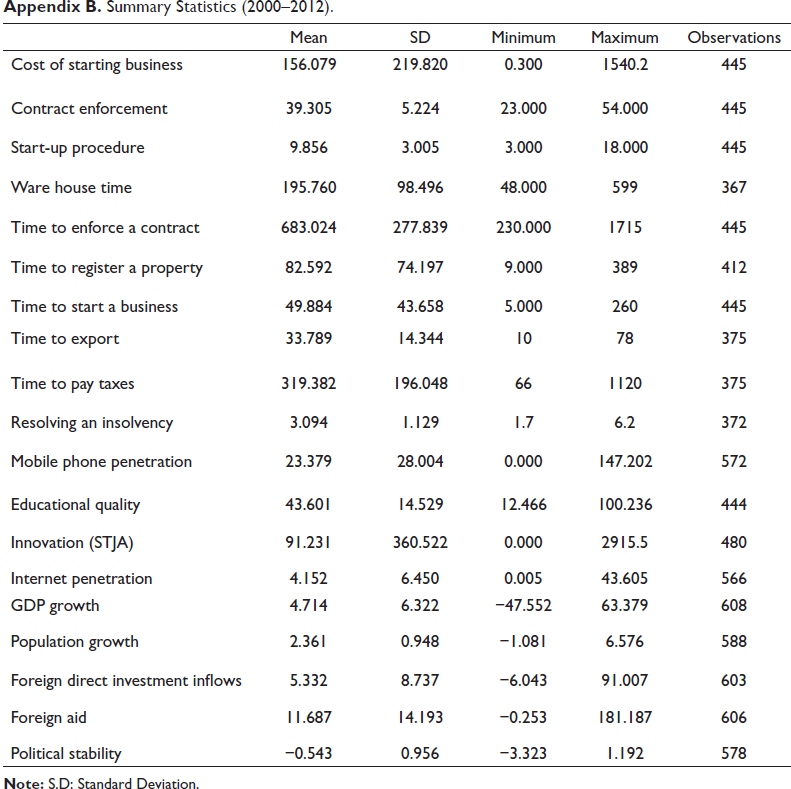
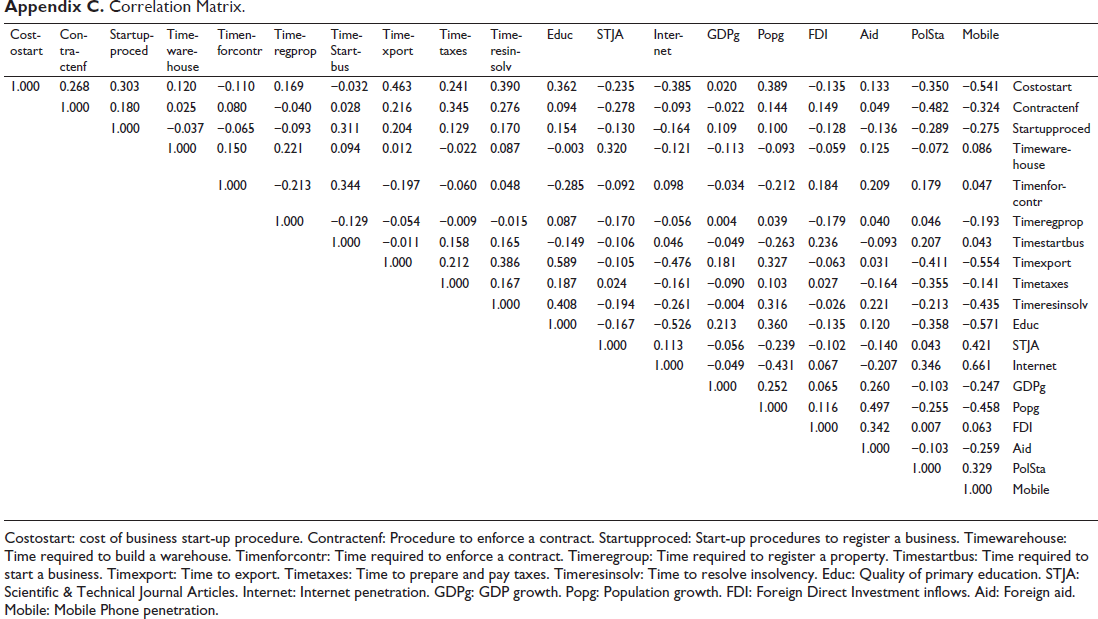
The definition of variables and corresponding sources are disclosed in Appendix A, whereas the summary statistics are provided in Appendix B. A correlation matrix used to avoid concerns about multi-collinearity is provided in Appendix C, whereas evidence of persistence in the outcome variables is provided in Appendix D. These appendices are helpful for the data analysis on a number of fronts. From Appendix B, it is apparent from mean values that the data is comparable. Moreover, the corresponding standard deviations also indicate that reasonable estimated linkages would emerge from the regressions. The purpose of the correlation matrix in Appendix C is to avoid concerns of multi-collinearity. As indicated in section ‘Methodology’, Appendix D enables the study to assess persistence in the outcome variables. Establishing persistence is a condition for the choice of the GMM estimation strategy. It is important to note that the data is from a secondary source (i.e., World Bank Development Indicators). Hence, extensive narratives that are consistent with ‘primary data collection’ are not engaged. The engaged narrative on appendices covers corresponding issues in data cleansing, data processing and precautions needed for this study.
Empirical Results
Presentation of Results
Tables 1, 2, 3 and 4, respectively, present the first, second, third and fourth sets of specifications on linkages between mobile phone innovation and entrepreneurship. Table 1 focuses on the: cost of business start-up procedure; procedure to enforce a contract and start-up procedures to register a business. Table 2 is concerned with the: time required to build a warehouse; time required to enforce a contract and time required to register a property. In Table 3, emphasis is put on the: time required to start a business; time to export and time to prepare and time to pay taxes, whereas Table 4 focuses on the time required to resolve an insolvency. For each doing business indicator, there are three specifications pertaining to each modifying or policy variable, namely: educational quality, internet penetration and scientific output.
Mobile Phone Innovation and Doing Business (1st Set of Specifications).
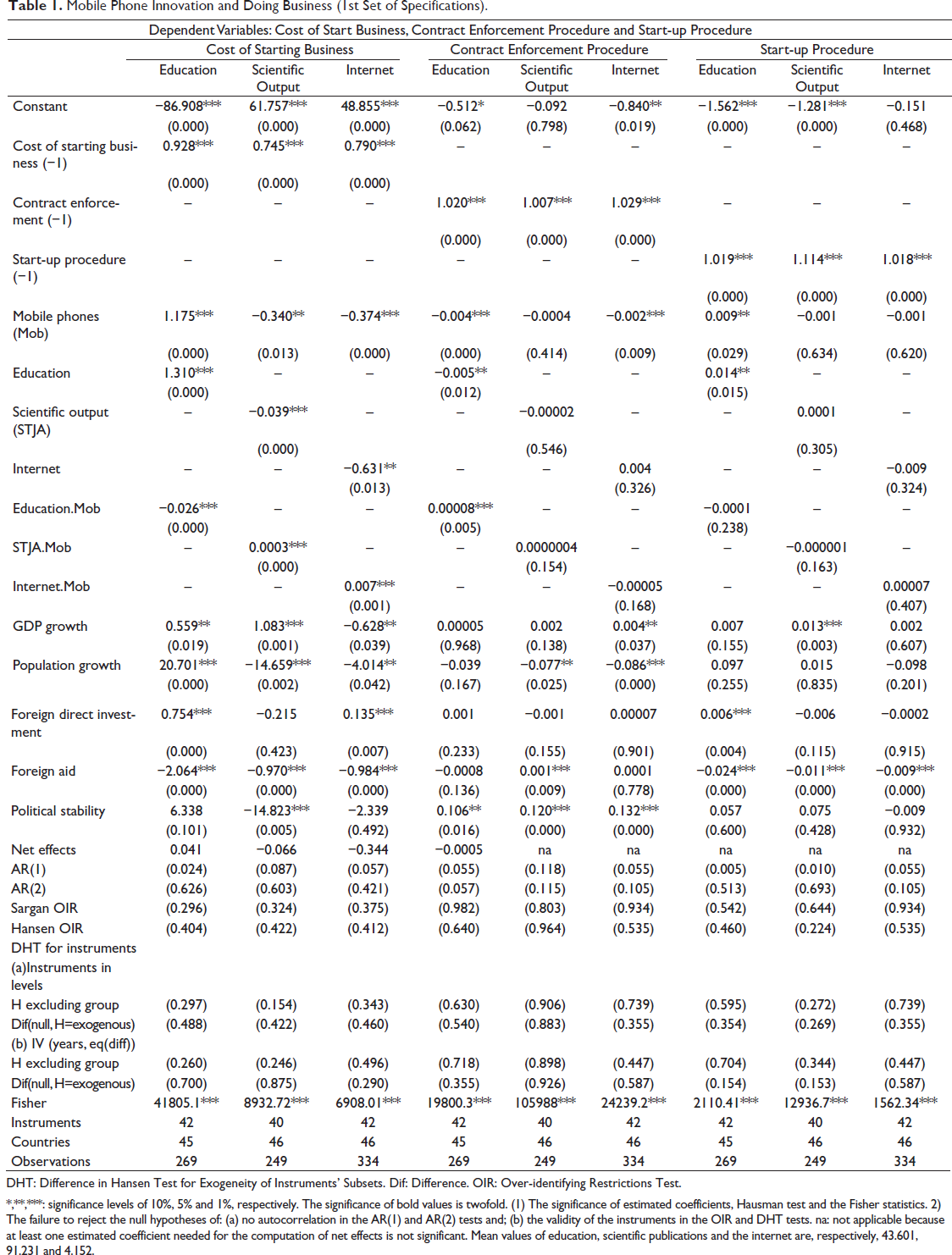
*,**,***: significance levels of 10%, 5% and 1%, respectively. The significance of bold values is twofold. (1) The significance of estimated coefficients, Hausman test and the Fisher statistics. 2) The failure to reject the null hypotheses of: (a) no autocorrelation in the AR(1) and AR(2) tests and; (b) the validity of the instruments in the OIR and DHT tests. na: not applicable because at least one estimated coefficient needed for the computation of net effects is not significant. Mean values of education, scientific publications and the internet are, respectively, 43.601, 91.231 and 4.152.
Mobile Phone Innovation and Doing Business (2nd Set of Specifications).
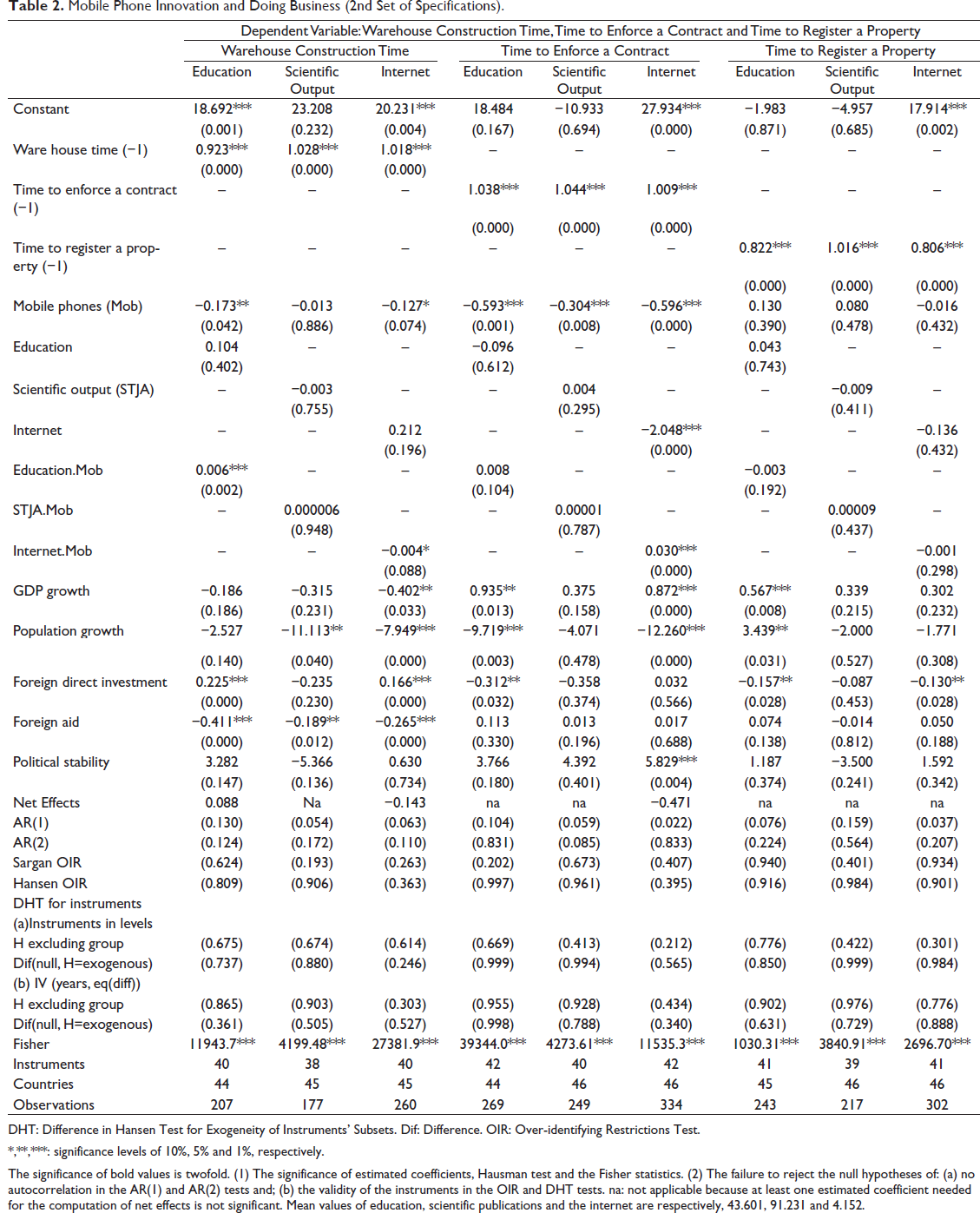
DHT: Difference in Hansen Test for Exogeneity of Instruments’ Subsets. Dif: Difference. OIR: Over-identifying Restrictions Test.
*,**,***: significance levels of 10%, 5% and 1%, respectively.
The significance of bold values is twofold. (1) The significance of estimated coefficients, Hausman test and the Fisher statistics. (2) The failure to reject the null hypotheses of: (a) no autocorrelation in the AR(1) and AR(2) tests and; (b) the validity of the instruments in the OIR and DHT tests. na: not applicable because at least one estimated coefficient needed for the computation of net effects is not significant. Mean values of education, scientific publications and the internet are respectively, 43.601, 91.231 and 4.152.
Mobile Phone Innovation and Doing Business (3rd Set of Specifications).
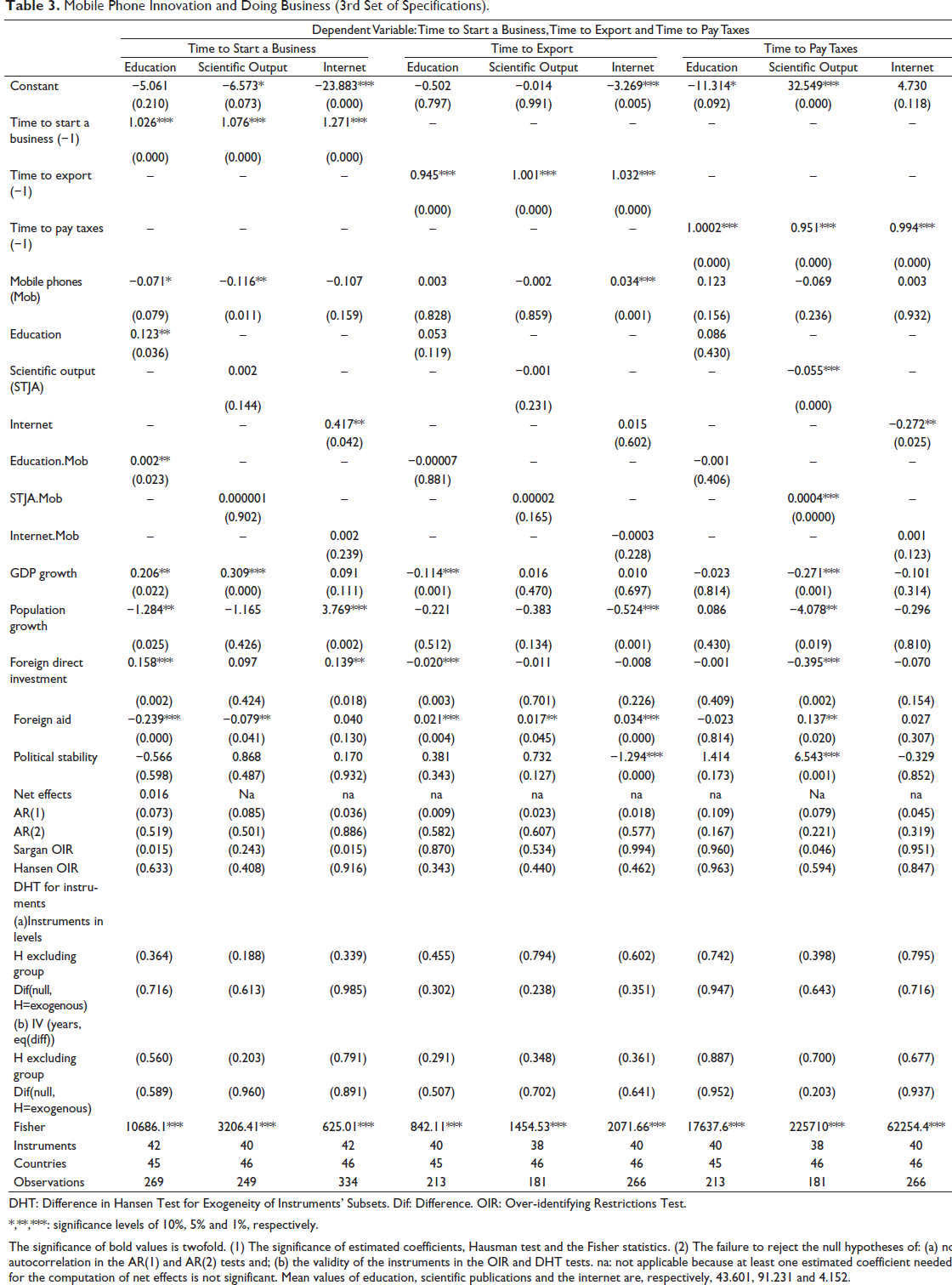
DHT: Difference in Hansen Test for Exogeneity of Instruments’ Subsets. Dif: Difference. OIR: Over-identifying Restrictions Test.
*,**,***: significance levels of 10%, 5% and 1%, respectively.
The significance of bold values is twofold. (1) The significance of estimated coefficients, Hausman test and the Fisher statistics. (2) The failure to reject the null hypotheses of: (a) no autocorrelation in the AR(1) and AR(2) tests and; (b) the validity of the instruments in the OIR and DHT tests. na: not applicable because at least one estimated coefficient needed for the computation of net effects is not significant. Mean values of education, scientific publications and the internet are, respectively, 43.601, 91.231 and 4.152.
Mobile Phone Innovation and Ending Business (4th Set of Specifications).
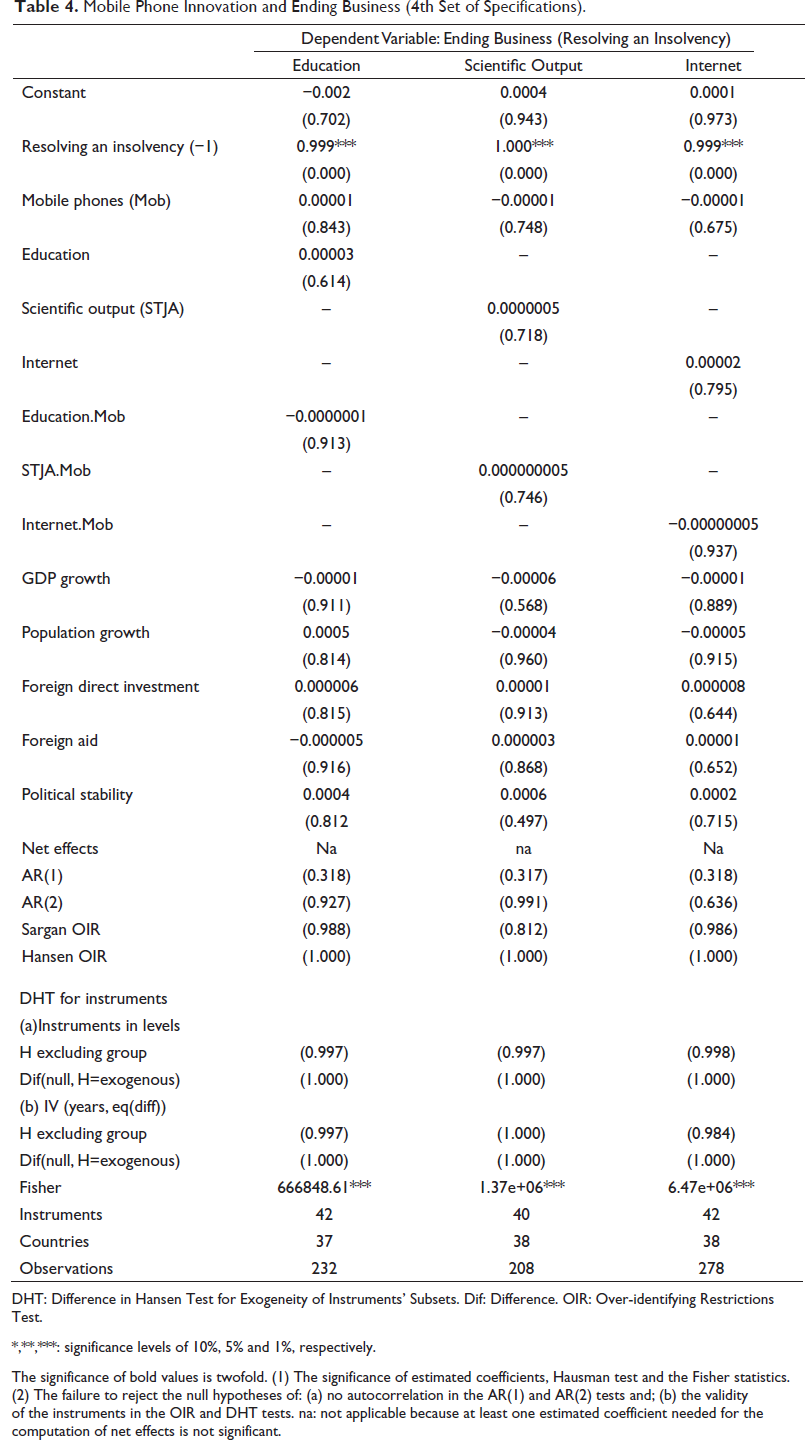
DHT: Difference in Hansen Test for Exogeneity of Instruments’ Subsets. Dif: Difference. OIR: Over-identifying Restrictions Test.
*,**,***: significance levels of 10%, 5% and 1%, respectively.
The significance of bold values is twofold. (1) The significance of estimated coefficients, Hausman test and the Fisher statistics. (2) The failure to reject the null hypotheses of: (a) no autocorrelation in the AR(1) and AR(2) tests and; (b) the validity of the instruments in the OIR and DHT tests. na: not applicable because at least one estimated coefficient needed for the computation of net effects is not significant.
Consistent with the discourse in the methodology section, four information criteria are employed to assess the validity of the GMM models with forward orthogonal deviations. Based on these criteria, two estimated models are not valid, notably: the education-oriented specification in the regressions on ‘contract enforcement procedure’ in Table 1 and the ‘scientific output’-related specification in the regressions on the ‘time required to enforce a contract’ in Table 2. This is essentially because the null hypothesis of the second-order autocorrelation test in difference is rejected, which implies the presence of autocorrelation in the residuals.
The net effect is computed to examine the overall impact of the innovation policy variable on mobile phones for doing business. For example, in Table 1, in the second column, the net effect from the interaction between mobile phones and education is 0.041 ([−0.026× 43.601] + 1.175). The mean value of education is 43.601; the unconditional impact of mobile phone penetration is 1.175, while the conditional impact from the interaction between education and mobile phones is −0.026. It is important to note that unconditional effect of mobile phone penetration is used because the purpose of the study is to assess how selected policy variables modulate the effect of mobile phones on entrepreneurship. The ‘na’ sign that denotes ‘not applicable’ is used when at least one estimated coefficient required for the computation of the net effects is not significant.
The following findings can be established. In Table 1, the net effects from interacting mobile phones with internet and scientific output are negative whereas the corresponding net impact from the interaction between mobile phones and education is positive on the cost of doing business. Second, in Table 2, the mobile phone interacts with education (the internet) to have a positive (negative) net effect on the time needed to construct a warehouse whereas, the corresponding interaction with the internet yields a net negative effect on the time to enforce a contract. In Tables 3 and 4, with the exception of a positive net effect from the interaction of mobile phones with education on the time to start a business, net impacts are not apparent from the other specifications because at least one estimated coefficient required for their computations is not significant. Moreover, Table 4 has little relevance because of instrument proliferation, notably the number of cross sections in all three specifications is lower than the corresponding number of instruments. With the exception of Table 4, most of the control variables are significant.
Further Discussion of Results and Policy Implications
Further Discussion of Results and Policy Implications
From a general perspective, the findings show that there is great potential for mobile phones to be modulated with education, internet penetration and scientific productivity to enhance entrepreneurship and/or reduce constraints to the doing of business. However, not all net effects could be computed because at least one estimate (unconditional effects, conditional impact or both) required for their computations is not significant. This implies that the innovation instruments can be improved for entrepreneurship to be boosted. But before we discuss how corresponding knowledge diffusion variables can be consolidated, it is important to articulate the relevance of knowledge diffusion in the light of specificities of entrepreneurship dimensions considered in the regressions. Hence, in what follows, we first discuss a strand on negative net effects, then another strand on positive net effects before a last strand on insignificant effects.
On the first strand, negative net effects have been established when the mobile phone is modulated with: (a) scientific output and internet penetration to affect the ‘cost of starting a business’; (b) education to influence ‘contract enforcement procedures’; and (c) internet penetration to affect the ‘time to enforce a contract’ and ‘time required to construct a warehouse’. The only interaction that has resulted in an unexpected sign is the second (i.e., education, the mobile phone and contract enforcement procedure), because education is expected to yield a positive net effect in order for increasing units in the educational variable to modulate the mobile phone in decreasing constraints to entrepreneurship. It largely follows from findings that knowledge diffusion variables can complement the mobile phone to: reduce the cost incurred in procedures for starting a business; decrease the number of days required to enforce a contract and reduce the number of days needed to construct a warehouse.
The above effect on decreasing constraints to doing business can be achieved because the mobile phone when modulate with the engaged channels, reduces the need for an entrepreneur to physically move from one place to another. This is essentially because such a modulation boosts entrepreneurs’ capabilities of acting-at-a-distance without the need to be physically available where actions occur (Shaikh & Karjaluoto, 2015; Smith et al., 2008; Ureta, 2008). This narrative is consistent with Brown et al. (2001), Katz (2003) and Ling and Pederson (2005) who have shown that the mobile phone can be innovated to overcome constraints that are related to the mobility of people and physical distance. These advantages are more apparent with smart phones because of internet availability in the phones.
In relation to the second strand, positive net effects have been established when the mobile phone is modulated with education to affect the cost of starting a business, the time to start a business and the time required to construct a warehouse. As earlier explained, a positive net effect articulates less constraint to entrepreneurship owing the construction of the educational variable. The results imply that complementing the mobile phone with human capability in the perspective of quality education can lead to positive development externalities. This narrative is consistent with Sen (1999) capability approach framework and recent human capability literature (Smith & Seward, 2009), especially studies on the relevance of mobile phones in human development (Kwan & Chiu, 2015; Sen, 1999, 2010; Smith & Seward, 2009; Ureta, 2008)
Third, we now discuss how each dimension of knowledge diffusion can be consolidated.
Internet penetration can be increased by addressing concerns associated with inadequate infrastructure as well as issues related to the affordability of the internet service. Based on the summary statistics, compared to the mobile phone penetration which has a range of 0.000–147.202, the corresponding range of internet penetration is 0.005–43.605. It follows that more than half of mobile phones are not connected to the internet and creating an enabling environment to make this connection possible could substantially limit constraints to doing business and boost conditions for entrepreneurship in SSA. For instance, universal coverage schemes via the provision of internet infrastructure and low internet pricing are some possible measures that can be undertaken by policy makers. In essence, the role of the internet as an interface between mobile phones and entrepreneurs can be enhanced by engaging internet policies designed to boost access, reach, efficiency, adoption, cost effectiveness and interactions. Cost and infrastructure in the ICT sector can be, respectively, reduced and boosted by liberalising the ICT sector and increasing competition within the sector. The policy recommendation has a high potential of achieving more positive entrepreneurial externalities because as we have seen in the motivation of this study, whereas, SSA is the region in the world with the least internet penetration, it is at the same time the sub-region with the highest growth rate in ICT penetration. Quality education can leverage on the mobile phone to boost entrepreneurship in the sub-region. This is broadly consistent with the engaged literature, notably: Gerba (2012) on Ethiopian undergraduate students; Ita et al. (2014) on Nigerian undergraduates; Singh et al. (2011) on female entrepreneurs in Nigeria; Oseifuah (2010) on youth entrepreneurship in South Africa and Mensah and Benedict (2010) on quality entrepreneurship training. The implication here is that, to improve the potential for quality education on entrepreneurship, there is need for more funds to be allocated towards improving educational infrastructure, the training of teachers and adaptation of academic curricula to challenges in technical and vocational education. Information technologies should also be associated with curricula upgrade because recent literature has shown that whereas education plays a vital role in the creation of knowledge, creating mechanisms for appropriate diffusion of such knowledge is pivotal to human and economic development externalities (Dakhi & de Clereq, 2007; Dunlap-Hinkler et al., 2010). The role of scientific innovation in promoting the use of mobile phones in the promotion of entrepreneurial opportunities and reduction of doing business constraints has been confirmed by our findings, especially in reducing the cost of starting a business. Entrepreneurial development in countries in the sub-region by means of scientific productivity can be boosted if the policy of ‘reverse engineering’ is critically acknowledged as an indispensable policy orientation by countries that are at an initial stage of industrial development. This policy requirement is consistent with the knowledge economy and intellectual property rights literature which maintains that processes of acquisition of knowledge and learning in less developed countries are more imitative and adaptive in nature (see Bezmen & Depken, 2004; Tchamyou, 2017). The policy direction is also consistent with narratives that much of the East Asian Miracle was achieved through entrepreneurial activities which were based on copying technology commodities from more advanced nations (see Kim, 1997; Kim & Kim, 2014; Kim et al., 2012; Lee, 2009). The policy direction is also in accordance with the role of intellectual property rights in boosting scientific publications in Africa (Asongu, 2014a) on the one hand, and on the other hand, Kim et al. (2012) who maintain that less developed countries need alternative forms of property rights that are consistent with their challenges to doing business.
Theoretical Implications and Contributions
Two principal theoretical contributions of this study are related to the literature, notably: catch-up in entrepreneurship variables and complementary tools for reducing information asymmetry by means of the mobile phone in order to enhance the doing of business. First, on the catch-up patterns, it is apparent from the estimated lagged values that some indicators on entrepreneurship are more persistent (non-stationary or non-convergent) than others. Three principal patterns are apparent. The first pattern on both stationary and non-stationary variables includes: warehouse construction time; time to register a property; time to export; time to prepare and pay taxes and time to resolve insolvency. The second tendency that consistently displays non-stationary variables encompasses: contract enforcement procedure, number of start-up procedures, time to enforce a contract and time to start a business. The third pattern which consistently shows variables that are stationary is exclusively limited to the cost of starting business. Note should be taken of the fact that, the information criterion for establishing catch-up is that, the estimated absolute value corresponding to the lagged dependent variable should be between the interval of zero and one (Asongu, 2014b; Fung, 2009).
The economic meaning of convergence is that common policies in the light of the dependent variable are feasible among countries. Hence, it is more feasible for sampled countries to adopt common policy initiatives in the indicators of entrepreneurship that are stationary. This conception and interpretation of convergence for cross-country policy harmonisation is consistent with catch-up literature, which has been substantially documented within the perspective of neoclassical models of growth (Barro & Sala-i-Martin, 1992, 1995; Barro, 1991; Baumol, 1986; Mankiw et al., 1992) and recently extended to other areas of economic development, namely, in the performance of financial markets (Asongu, 2013b; Bruno et al., 2012; Narayan et al., 2011) and factors (macroeconomic and institutional) that can drive uprisings like the 2011 Arab Spring (Asongu & Nwachukwu, 2016d). It is important to note that a common denominator of both the non-contemporary and contemporary studies is that evidence of reducing cross-country variations in the dependent variables being investigated is a basis for the adoption of common policies.
Second, in terms of information sharing, the engaged policy variables can be innovated with the mobile phone to further reduce information asymmetry in order to facilitate entrepreneurship. It is well acknowledged that information asymmetry is an important constraint to the doing of business. Our findings broadly show that the innovation variables by means of the mobile phone can decrease constraints to the doing of business. In essence, an increased association of the mobile phone with the internet, quality education and improvements of scientific output can boost competition by substantially reducing informational rents previously enjoyed by privileged entrepreneurs. In other words, the mobile phone can be complemented/innovated with the underlying policy tools to enhance ‘doing business efficiency’. This is broadly in accordance with the theoretical framework of efficiency in the financial intermediary sector, by means of information sharing offices like private credit bureaus and public credit registries (see Claus & Grimes, 2003; Tchamyou & Asongu, 2017). Therefore, in analogy, the theoretical underpinnings of sharing information for financial efficiency in the banking industry can be extended to the innovation of the mobile phone with knowledge diffusion channels in order to decrease constraints to doing business and increase avenues of entrepreneurship.
Conclusion and Future Research Directions
This study has assessed how mobile phone innovation affects entrepreneurship in SSA with data for the period 2000–2012. The empirical evidence is based on GMM and mobile phones are interacted with three knowledge diffusion variables, namely, education, internet penetration and scientific output. Ten variables of entrepreneurship are used and the following three main findings are established. First, the net effects from interacting mobile phones with the internet and scientific publications are negative whereas the corresponding net impact from the interaction between mobile phones and education is positive on the cost of doing business. Second, the mobile phone interacts with education (the internet) to have a positive (negative) net effect on the time needed to construct a warehouse whereas, the corresponding interaction with the internet yields a net negative effect on the time to enforce a contract. Third, there is a positive net effect from the interaction of mobile phones with education on the time to start a business.
Given the construction of the education variable, positive net effects from education are consistent with corresponding negative net effects from the other knowledge diffusion variables. The main policy implication is that mobile phone innovation (by means of internet penetration, scientific output and quality education) decreases constraints of entrepreneurship. Suggestions on how to boost these knowledge diffusion channels have been engaged. Other implications for policy and theory have been discussed.
Overall, improving mobile innovation by means of quality education, internet penetration and scientific productivity has the potential of addressing major unemployment challenges of SSA in the post-2015 development agenda. This is in the light of evidence that the burgeoning population growth (and associated unemployment) in the sub-region can only be accommodated by the private sector (and not the public sector) in the long term (see Asongu, 2013a). Owing to the lack of space, economic participation and unemployment variables have not been used in this study. Future research can address this caveat by investigating mechanisms by which the mobile phone can be modulated to reduce unemployment and boost inclusive development in the light of the sustainable development agenda.
Another limitation in the study is that country-specific effects are not considered in the modelling exercise. Although the elimination of these country fixed effects is consistent with the theoretical underpinnings of the GMM estimation approach, future studies can assess if the established linkages withstand empirical scrutiny when further investigated within the framework of alternative estimation approaches. Moreover, in future studies, alternative doing business indicators as those employed in Munemo (2017) should be considered. When considering the suggested future research directions, when the GMM is employed, it is worthwhile to correct for potential small sample bias and when quadratic regressions are involved, cheques are worthwhile to ensure that the presence of interaction effects is free from spuriously capturing the left-out square terms of the variables used to construct the interaction term. Although in the corresponding interactive regressions, the use of mean values for the computation of net effect is consistent with contemporary interactive regressions literature (Nchofoung et al., 2021, 2022; Tchamyou et al., 2019), the attendant net effects can change with extreme values of the moderating variables.
Variables’ Definitions.
Summary Statistics (2000–2012).
Correlation Matrix.
Persistence of the Dependent Variables.
Footnotes
Declaration of Conflicting Interests
The author declared no potential conflicts of interest with respect to the research, authorship and/or publication of this article.
Funding
The author received no financial support for the research, authorship and/or publication of this article
