




Abstract
Abstract
In two remote regions in the Caucasus (Georgia), the tourism sector gains importance as a source of income. Based on the theory of planned behaviour (Ajzen, 1991), a structural equation model was applied to explore the factors that determine the intentions of private households to enhance their activities in the tourism sector. The strongest influence was exerted by subjective norm followed by perceived behavioural control. Underlying beliefs showed that the family had the strongest influence on subjective norm, suggesting that interventions should also target the social environment. Furthermore, bank loans can foster the perceived ability of enhancing touristic activities while personal illness was perceived as a significant threat. The background factor, experience, indirectly influenced the intention to enhance touristic activities.
Keywords
Introduction
Starting in the early 1990s, the agricultural sector of Georgia began to suffer from reduced revenues due to a lack of resources and widespread uncertainty about demand following the disintegration of the Soviet Union (Didebulidze & Urushadze, 2009, p. 241). This can be seen, for example, in the drop in the number of livestock during this time period (GeoStat, 2013, pp. 52–53). At the same time, the share of the agricultural sector in the composition of the gross domestic product of Georgia declined whereas the share of the service sector rose while the share of people employed in the agricultural sector roughly stayed the same (ILO, n.d.; World Bank, 2015). Especially in rural regions, which rely heavily on agriculture, ways to generate income from sources other than agriculture were and continue to be a necessity.
In the two regions—Kazbegi (Greater Caucasus) and Bakuriani (Lesser Caucasus)—that are the focus of the present study, tourism has the potential to be a productive entrepreneurial activity for generating alternative revenue. While Bakuriani has a long-standing tradition as a winter sports resort, Kazbegi has become increasingly popular as a summer destination. Some private households have ‘jumped on the bandwagon’ (Leibenstein, 1950) and are offering rooms for rent, starting up small cafés or providing services and materials for mountain and hiking tours. In addition to the financial gains for the two regions as a whole, tourism-related activities offer private citizens the opportunity to increase their prosperity at the household level.
The present study explored the factors that influence intentions to engage in tourism activities. The theory of planned behaviour (TPB; Ajzen, 1991) supplied the theoretical framework for the study. Consistent with the TPB, we focused on attitudes, subjective norms, and perceived behavioural control in relation to the behaviour of interest, and we also examined underlying beliefs that drive local households towards entrepreneurial endeavours in the tourism sector. We relied on IBM SPSS AMOS 22 (Arbuckle, 2011) to test the underlying measurement model using a simultaneous confirmatory factor analysis and then to calculate three structural equation models. These analyses confirmed the basic TPB model suggesting that this theory holds not only in individualistic cultures where it has usually been applied but also in collectivist cultures. In a second step, salient beliefs were added to the basic model. They show that for the households in the sample, the opinion of the social surrounding—mainly of the family—plays an important role. At the same time, financial issues and illness are viewed as potential obstacles to enhancing tourism supply. These factors can be targeted in order to facilitate private entrepreneurial efforts. Lastly, we incorporated experience in the tourism sector as a background variable and found that experience had a mediated (but no direct) effect on intention. The influence of entrepreneurial experience on intention was mediated mostly via subjective norm and perceived behavioural control raising the perceived support of significant others as well as the perceived degree of control over enhancing tourism activity.
Analytical Framework
Since its inception, the TBP (Ajzen, 1991, 2012) and its predecessor, the theory of reasoned action (Ajzen & Fishbein, 1980), have been successfully used to explain, predict and change behaviour in a variety of domains, ranging from voting choice (Fishbein, Ajzen, & Hinkle, 1980) to marijuana consumption (Ajzen, Timko, & White, 1982), from use of birth control pills (Fishbein, Jaccard, Davidson, Ajzen, & Loken, 1980) to starting a new business (Liñán & Chen, 2009; Tatarko & Schmidt, 2016), from cooperation in the prisoner’s dilemma game (Ajzen, 1971) to women’s choice of career orientation (Sperber, Fishbein, & Ajzen, 1980) and pro-environmental behaviour (Ando, Kayo, Susumu, Matthies, & Kanbara, 2015; Wang, et al., 2016), to name a few examples (for an overview, see Ajzen, 1985, pp. 16–18; Fishbein & Ajzen, 2010, p. 181).
In the field of tourism research, the theory of planned behaviour has also been applied to study various research questions. Ye et al. (2017) examined yound adults’ travel decisions, Quintal et al. (2010) found significant impacts of subjective norm and perceived behavioural control on intentions to visit Australia, while Zhang et al. (2018) use the TPB to analyse tourists’ intentions to consume local food. Sparks & Pan (2009) analysed Chinese tourists regarding their intentions to travel abroad using the TPB. In an analysis of travel behaviour formation, Hsu & Huang (2012) developed an extended TPB model and Al Ziadat (2015) applied the TPB to study the revisit intentions of international tourists in Jordan. Nunkoo & Ramkissoon (2010), on the other hand, consider the TPB a valuable approach to study community support for tourism. They advocate enhancing the model by a gender component that is hypothesized to moderate the influence of perceived control on the behaviour (Heiny, 2017.)
According to the theory, three latent constructs explain intention, namely, attitude towards the behaviour, subjective norm and perceived behavioural control. Attitude is a person’s positive or negative evaluation of the behaviour and reflects beliefs about the behaviour’s likely outcomes (behavioural beliefs); subjective norm is the perception of social pressure to engage or not to engage in the behaviour, based on the perceived expectations of important referents (normative beliefs), such as the person’s partner, parents, friends or colleagues; and perceived behavioural control refers to the perceived ability to perform the behaviour, taking into account beliefs about potentially facilitating or interfering factors such as lack of financial resources, cooperation by others and business experience (control beliefs). The three explanatory constructs of intention (attitude, subjective norm and perceived behavioural control) are not necessarily independent. They are correlated due to common external causes and interactions among attitude, subjective norm and perceived behavioural control are possible (Ajzen & Madden, 1986, p. 459; Yzer, 2007, pp. 111–115). The TPB assumes that intention has a strong causal influence on behaviour (Fishbein & Ajzen, 2010), but the intention–behaviour relation was not examined in this study which focused only on the determinants of intentions.
We started by defining the behaviour under study in terms of its target, action, context and time elements (Ajzen & Fishbein, 1977; Fishbein & Ajzen, 1975). The idea was to examine the tourism sector as a potential source of household income and, therefore, all activities in this sector were considered. Since not all private households offer the same services in the tourism sector, it seemed prudent to ask broadly about tourism-related activities in general (i.e., our criterion involved generalised action and context elements). Early in the questionnaire, respondents were given a list of possible services, including accommodation, lending of equipment (such as horses, skiing or hiking equipment), serving as a guide or providing gastronomy, and they were asked to indicate which of these options apply to them. Because the participants consisted of households already involved in tourism activities and also those not (yet) involved, we chose the term ‘enhance’ to describe the action. The time frame was set as ‘in the next 12 months’. Hence, the objective of the present investigation was to explore the intentions of households to ‘enhance the tourism supply in the next 12 months’.
Mediation by the Background Variable ‘Experience’
Although the TBP postulates that intention is explained by attitude, subjective norm and perceived behavioural control, Ajzen and Fishbein (2010) and Ajzen (2012) make it clear that other variables, termed background factors, can and should also be considered. Depending on the behaviour and population under study, relevant background factors may include demographic characteristics, political attitudes, personality traits, past experience, etc. The underlying idea is that people’s varying experiences and predispositions can lead to the formation of different beliefs in relation to a given behaviour. Inclusion of such factors in the analysis can thus foster knowledge on possible origins of behavioural, normative and control beliefs, the basic explanatory constructs in the TPB (Fishbein & Ajzen, 2010, pp. 224–227 and p. 253).
Consistent with this view, the authors assume that background factors have no direct effect on intentions but instead, their influence is mediated by the theory’s more proximal determinants of intentions. Furthermore, we hypothesised that mediation only takes place via beliefs that have a statistically significant relation to the corresponding latent construct. Thus, only behavioural beliefs that are significantly associated with attitude towards the behaviour have the potential to mediate the effect of a given background variable on intention. And the same holds for normative and control beliefs. In addition, a precondition for mediation is that the mediator itself is significantly correlated with the outcome variable, that is, intention (Baron & Kenny, 1986, p. 1176).
Because enhanced tourism typically involves several family members, the focus in the current study was on households rather than on single persons. For this reason, some of the usual demographic variables, for example, gender and age were not of major concern. 1
During the pretest in our study regions, we recognised that households active in the tourism sector seemed to have made this decision as a household rather than this being an individual choice. This could be related to Georgia being a collectivist culture in which family ties are more important than in individualistic cultures.
Empirical Analysis
Structural equation modelling (SEM) was used to analyse the model proposed by the TPB. The advantages of structural equation modelling include: (a) enabling the simultaneous estimation of relationships between latent construct and manifest variables (b) providing model fit values to assess whether the modelled structure resembles the empirical covariance structure, (c) allowing the computation of indirect effects and tests of mediation and (d) accounting for measurement error (Hox & Bechger, 1998; Kline, 2011, pp. 105–106; Pearl, Glymour, & Jewell, 2016). Analyses were carried out using IBM SPSS AMOS 22 (Arbuckle, 2011). Other applications in the field of tourism research have also used SEM (Kiatkawsin, & Han, 2017).
The data used in our analyses stem from a quantitative household survey that was conducted within the project ‘Analysing Multiple Interrelationships between Environmental and Societal Processes in Mountainous Regions of Georgia (AMIES)’ in the summer of 2011, funded by the Volkswagen Foundation. The module on behavioural intentions was completed by 129 households in Kazbegi (Greater Caucasus) and 118 households in Bakuriani (Lesser Caucasus) adding up to a total sample size of 247 cases. In each case, the questionnaire was completed by one representative from the household. This person was involved in the decision-making process of the household and served as a proxy for the whole household.
Salient beliefs were elicited in a pretest with open-ended questions (Fishbein & Ajzen, 2010, p. 184). The respondents were asked to list advantages and disadvantages of carrying out the behaviour, to name people who would approve of them showing the behaviour and people who would not approve, and to record factors that would foster and factors that would hinder them in performing the behaviour (Fishbein & Ajzen, 2010, p. 327). The data from both regions were jointly analysed because the areas: (a) are similar in both their potential for tourism activities and their terrain (remote regions and mountainous) and (b) contained both households already involved in the tourism supply and households not (yet) involved in the tourism supply.
Measurement Models
The descriptive statistics of the items that were used for the reflective measurement of the latent constructs attitude (ATT, 3 items), 2
Other semantic differentials which are more common for applications of the theory of planned behaviour such as ‘good–bad’ were assessed in the survey as well. However, the empirical analysis showed that the subset of items which were used here have the best psychometric properties.
Descriptive Statistics of Model Variables (n = 247)
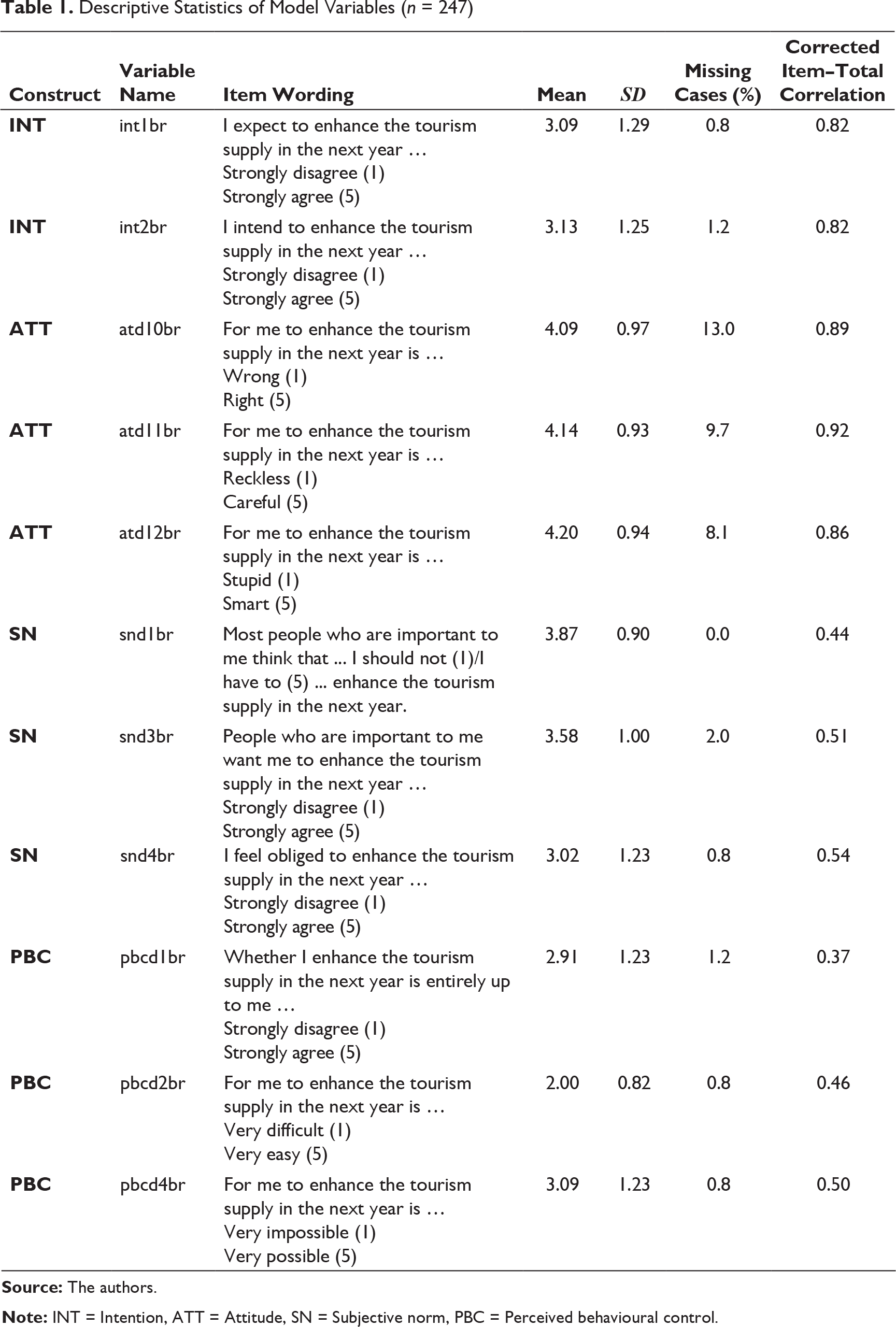
With the exception of two perceived behavioural control items (pbcd1br and pbcd2br), all means exceeded the median scale score of 3, indicating a slight tendency towards an intention, a positive attitude and an encouraging subjective norm with respect to enhancing the tourism supply in the next 12 months. The responses to the perceived behavioural control items were relatively neutral, with mean values close to the median, providing only a slight hint of perceived inability to enhance the tourism supply. However, the substantial standard deviations indicate that the sample was heterogeneous and not all households answered affirmatively. The highest mean values were found for attitude, implying that people generally had a favourable attitude towards tourism enhancement. While households in our sample still perceived some semblance of control over the behaviour, of the four latent constructs that were assessed, the means of the perceived behavioural control items were the lowest.
Overall, missing values were below 2 per cent with the exception of the higher missing values found for the 3 attitude items (13, 9.7 and 8.1 per cent, respectively). There is no theoretical reason to believe that the missing data follow a certain pattern, and Little’s (1988) MCAR test indicated that the data is missing completely at random. If data is indeed MCAR, the maximum likelihood estimator in AMOS renders efficient and consistent estimates (Arbuckle, 2011, p. 270; Schafer & Graham, 2002, p. 164). Consequently, the data were analysed using the full information maximum likelihood (FIML) estimator. 3
AMOS offers an asymptotically distribution free estimator to account for non-normality, but this estimator requires a large sample size (n ≥ 2,000). Therefore, FIML is the best option at hand.
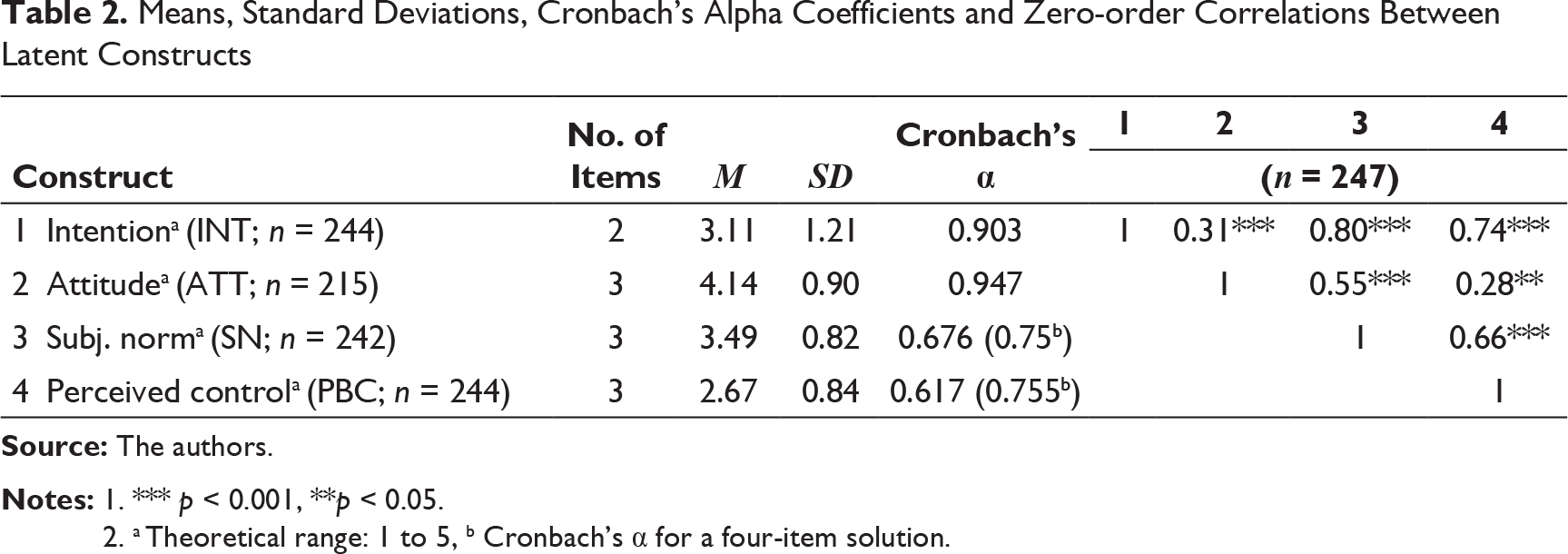
Means, Standard Deviations, Cronbach’s Alpha Coefficients and Zero-order Correlations Between Latent Constructs
2. a Theoretical range: 1 to 5, b Cronbach’s α for a four-item solution.
Table 2 presents a summary of the key values for the latent constructs. The values presented in the first half of the table (means, standard deviations and Cronbach’s alphas) were calculated using IBM SPSS Statistics 22. The factor correlations, located in the second half of the table, are the result of a simultaneous confirmatory factor analysis of all four latent constructs, which was carried out in AMOS.
The mean values of the constructs reflect what was already apparent in the mean values of the single items. Internal consistency of the constructs intention and attitude is excellent (Cronbach’s alpha > 0.9). Two values are provided for subjective norm and perceived behavioural control. For instance, if the subjective norm variable snd2br (‘It is expected of me that I enhance the tourism supply in the next year’) is included in the scale, Cronbach’s alpha for subjective norm is 0.75. However, this variable caused problems in the overall model due to very high correlations with the intention items and was excluded.
A similar effect occurs when the perceived behavioural control variable pbcd3br (‘I am confident that I could enhance the tourism supply in the next year if I wanted to’) is used to measure perceived behavioural control alongside those variables mentioned in Table 2—Cronbach’s alpha increases here to 0.755. At the same time, this variable shows comparatively high correlations with items used to measure intention and subjective norm, causing an overall negative effect on model fit. For both subjective norm and perceived behavioural control, the lower Cronbach’s alpha values were accepted for the sake of model fit. According to Kline (2011, pp. 69–70), values around 0.7 can be considered as adequate, while values below 0.5 are too unreliable because more than half of the variance would be caused by unaccounted variables. Values of 0.8 or 0.9 are considered to be good or very good, respectively (Brown, 2015, p. 309).
The second half of Table 2 shows the zero-order correlations among all model constructs. All correlations are significant and positive. With values above 0.5, the correlations of the independent constructs attitude and subjective norm, and subjective norm and perceived behavioural control can be considered high. The independent constructs attitude and perceived behavioural control have a correlation of medium strength. Both the correlations of intention and subjective norm and intention and perceived behavioural control are very high according to rules of thumb, while intention and attitude correlate at a medium level.
Basic Structural Model (Model 1)
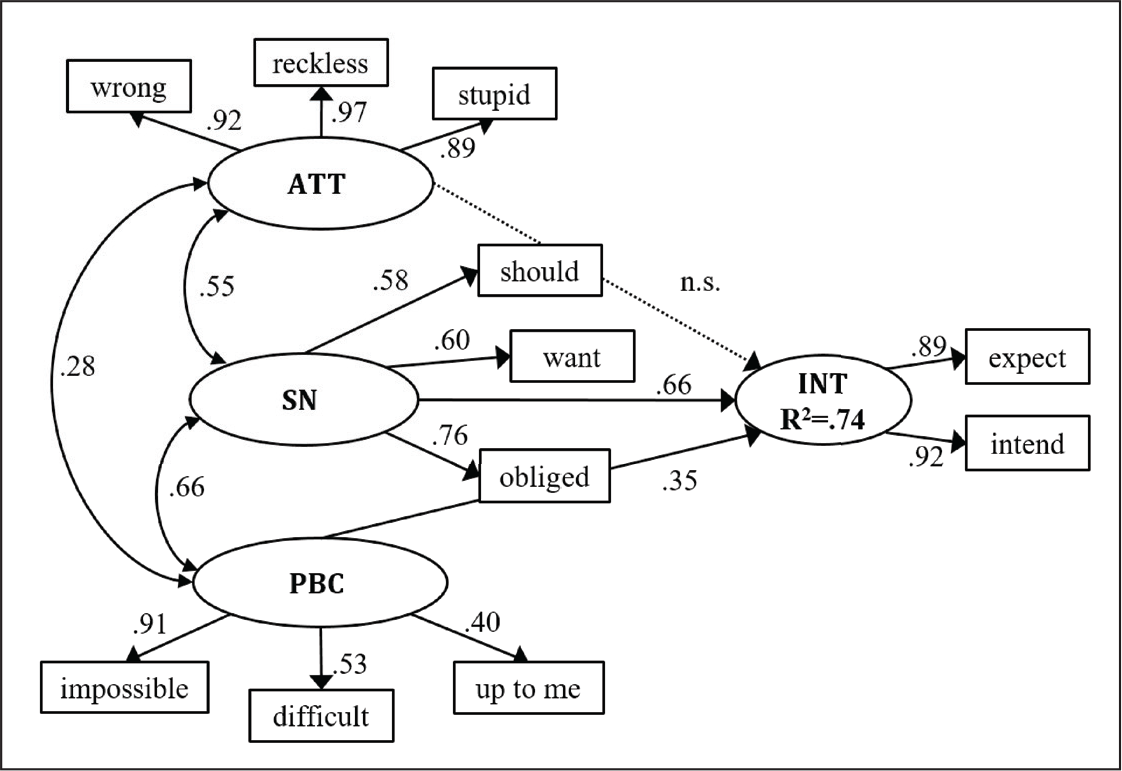
Model fit values of the basic model all indicate a very good fit (χ²/df = 1.378, p = 0.06, RMSEA = 0.039, p-close = 0.0745 and CFI = 0.99). Figure 1 shows the results of the structural equation model for the basic TPB. The regression weights in the model are partial regression coefficients, which were calculated while keeping the other explanatory variables constant and correcting for the correlations of the independent constructs with one another (Kline, 2011, p. 105). With a standardised regression weight of 0.66 (SE = 0.319, p < 0.001), subjective norm had by far the largest influence on intention, being almost twice as large as the same value for perceived behavioural control (standardised regression weight = 0.35, SE = 0.276, p < 0.001). Attitude failed to have a significant impact on intention. Comparing the partial regression weights to the zero-order correlations of the explanatory constructs with intention (see Table 2) reveals that the absolute values of the regression weights are all lower than the correlation coefficients, indicating that the independent constructs share some covariance with each other. Together, all the independent latent factors explained 74 per cent of the variance in intention to enhance touristic activities.
Incorporation of Beliefs (Model 2)
In the next model, the basic model was supplemented by the belief-based measures, which were modelled as formative indicators, creating so-called multiple indicators and multiple causes (MIMIC) constructs (Hauser & Goldberger, 1971, pp. 95–98; Kline, 2011, pp. 282–286).
Descriptive Statistics of MIMIC Items
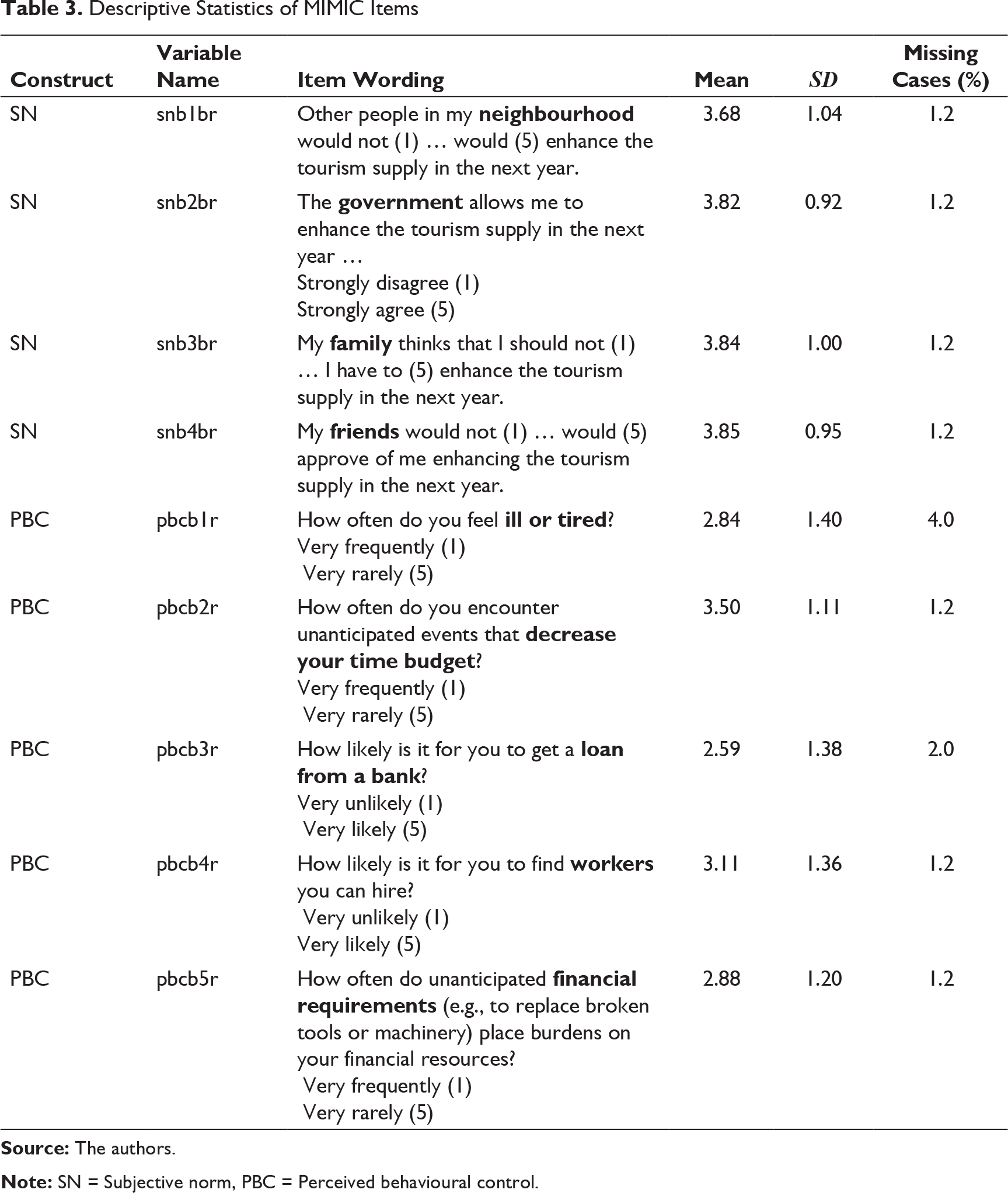
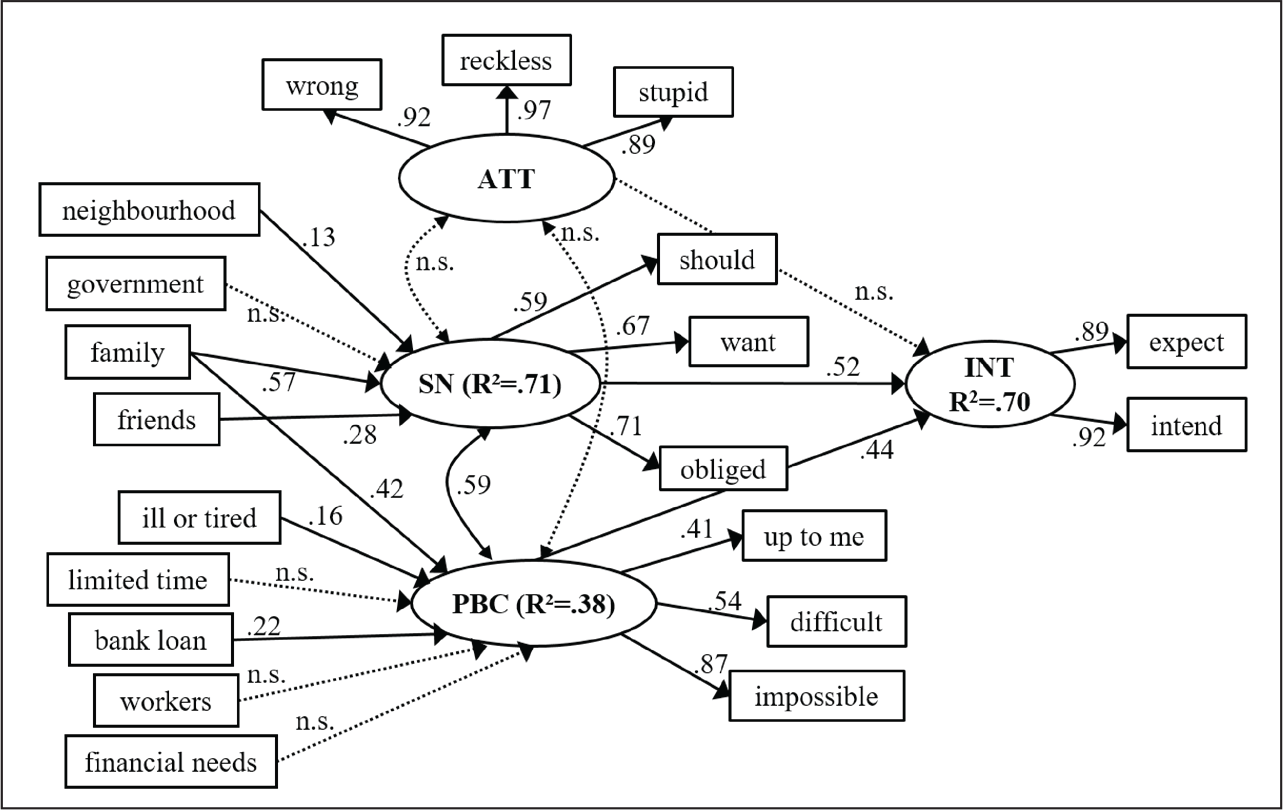
All MIMIC constructs fit the data well, displaying very acceptable values for the model fit tests of the chi-square difference, model fit p-value, RMSEA, p-close and CFI according to recommended thresholds. The formative indicators of subjective norm and perceived behavioural control showed no signs of multicollinearity. As a criterion for construct validity, the R² value of the formative constructs should be ≥ 0.3. With an R² value of 0.76, subjective norm satisfies this criterion whereas perceived behavioural control only shows an R² value of 0.23.
After incorporating the perceived behavioural control MIMIC construct into the overall model, the R² value increased to 0.38 due to a modification: An analysis with the covariance matrix 4
AMOS does not compute modification indices for incomplete data. Using a covariance matrix of the data renders results similar to the raw data and allows the computation of modification indices.
Figure 2 illustrates the estimated TPB model with the MIMIC constructs for subjective norm and perceived behavioural control and with the suggested regression of perceived behavioural control on snb3br. Overall model fit shows that the formative indicators belong to the same index (Diamantopoulos & Winklhofer, 2001, p. 272). With the exception of the model fit p-value, fit indices show acceptable or good fit. Similar to the simpler basic model without MIMIC constructs, attitude has no significant influence on intention. In contrast to the basic model, the model with MIMIC components shows no significant correlations between attitude and the other two explanatory constructs. With an R² value of 0.70 for intention, subjective norm and perceived behavioural control still explain a quite high amount of variance in intention, but now with different shares of contribution: While the influence of subjective norm on intention decreases by 0.14, the influence of perceived behavioural control on intention increases by 0.09. This change in path coefficients could be influenced by different sample sizes for the basic and the integrated model due to missing values.
The beliefs underlying the latent constructs can provide information about what drives the formation of the latent constructs. The beliefs with significant influences were ‘family’, ‘friends’ and ‘neighbourhood’ (variables snb3br, snb4br and snb1br, respectively) in the case of subjective norm and ‘getting a loan’ and ‘feeling ill or tired’ (variables pbcb3r and pbcb1r, respectively) in the case of perceived behavioural control. For subjective norm, the strongest impact came from what the family thinks the respondent should do followed by what the friends would approve of and what neighbours would do. What the government allows, on the other hand, did not exert a significant influence on households’ intentions to enhance their tourism supply. Two of the five control beliefs exerted a significant influence on perceived behavioural control with a slightly larger effect from getting a loan than from feeling ill or tired. There was, furthermore, a significant and comparatively large influence of what the family approves of (snb3br) on perceived behavioural control.
Integration of Background Variable (Model 3)
SEM allows the straightforward analysis of mediation in the overall model. A mediator is a variable in a causal chain. An independent variable X can have a direct effect on the dependent variable Y, but it can also have a mediated effect on Y via Me (i.e., Me is a mediator). Mediator variables are always endogenous and convey an indirect effect of an explanatory variable onto a dependent variable (Kline, 2011, pp. 105–106). In this, the function of a mediator variable switches from effect to cause (Baron & Kenny, 1986, p. 1173). It is possible that in addition to the mediated, indirect effect, the independent variable has a unique effect on the dependent variable, but this does not have to be the case (Kline, 2011, pp. 105–106). If the size of the effect of X on Y significantly decreases by adding a mediating variable, it is obvious that part of the observed effect is mediated by Me (Baron & Kenny, 1986, p. 1176). It is also possible that there is no true relationship between X and Y after controlling for Me if Me influences both X and Y, but in this case, Me would not be a mediator and rather simulates an effect of X on Y. The standardised indirect effect of X on Y via Me can be computed by multiplying the two standardised direct effects of X on Me and Me on Y (Arbuckle, 2011, p. 426).
The advance of structural equation modelling techniques allows estimating indirect effects without the detour of calculating several regression analyses, thus testing the significance of modelled paths is straightforward (Little, Card, Bovaird, Preacher, & Crandall, 2007, p. 226). Even more important, structural equation models enable the researcher to examine structures in which several items are used to measure one construct. The classic approach by Baron and Kenny (1986), for example, can handle scales that are made up of an average of items used to measure a construct, but as soon as multiple items are to be modelled as separate indicators, structural equation modelling techniques are the method of choice (Iacobucci, Saldanha, & Deng, 2007, pp. 144–145).
The data show that almost 60 per cent of the households in the sample did not offer any touristic services while the remaining 40 per cent offered between 1 and 5 different kinds of services. It is assumed that the degree of past experience influences the beliefs that underlie the latent constructs in the TPB. Because the initial analysis revealed that the attitude construct did not exert a significant influence on intention, we hypothesise that there is no mediated influence via attitude. Furthermore, some of the beliefs included in the questionnaire did not have a significant impact on the corresponding constructs. In other words, these beliefs had no empirical connection with the constructs and, therefore, did not contribute to their formation. There was therefore no reason to assume that the effect of experience would be mediated by these beliefs. Consequently, background factors were presumed to have a mediated effect via significant beliefs only.
Bootstrap samples were used to test the significance of indirect effects. As indirect effects usually have a non-normal distribution, confidence limits are imbalanced. Bootstrap samples have the advantage of providing more accurate confidence limits and show the most statistical power (Mackinnon, Lockwood, & Williams, 2004, pp. 99, 117). Since bootstrapping requires a full data set, missing values were imputed in AMOS using the regression imputation technique. Bootstrap samples (2,000) are then used to calculate confidence intervals and p-values for direct, indirect and total effects. Overall model fit after the inclusion of the variable experience 5
Experience was modelled to have an effect on all beliefs and constructs in the first step to enable stepwise testing of the proposed relationships.
The effects of experience on the beliefs assessed by snb1br and snb3br were significant with values of 0.132 and 0.236, respectively, while the effect on snb2br was insignificant. However, the effect on snb4br was not significant (p = 0.066) as well. This partially confirms the hypothesis that the effect of experience is not significant for insignificant items and significant for significant items. The hypothesis cannot be confirmed for item snb4br. Regarding perceived behavioural control beliefs, this hypothesis has to be rejected because experience did not exhibit a significant effect on any of the control beliefs. After the analysis of the effect of experience on beliefs, the insignificant direct effects were eliminated from the model to make it more parsimonious. The output revealed that without the insignificant paths, other paths had become insignificant (namely, experience on snb1br and on attitude). Removing the effect on snb1br did not change the significance of the influence of experience on snb3br, leaving this variable as the only belief that is significantly influenced by this background factor.
After removing the insignificant effects of experience on beliefs from the model, we tested if experience has direct effects on subjective norm and perceived behavioural control. In order for a mediation to exist, there should be significant direct effects of experience on subjective norm and perceived behavioural control. Two-tailed significance of the bias-corrected bootstrap samples shows that both effects were significant at p < 0.005, and the standardised effect sizes were similar, with 0.233 for subjective norm and 0.195 for perceived behavioural control. The directionality of the effects was as hypothesised. Experience did not have a significant effect on attitude.
As postulated by the TPB, the background variable experience had no direct effect on intention. A direct path was modelled from experience to intention and also proved to be insignificant (b = 0.086, bootstrapped p = 0.186).
Since attitude was ruled out, indirect effects on intention are possible via the constructs subjective norm and perceived behavioural control. A special case was presented by variable snb3br (‘My family thinks that I should not … I have to enhance the tourism supply in the next year’), which was also significantly influenced by experience. To take a closer look at the indirect effects from experience on intention mediated by subjective norm, perceived behavioural control, and snb3br, a model containing only these significant paths from experience was tested. Model fit was good (χ²/df = 1.535, model fit p = 0, RMSEA = 0.047, p-close = 0.671, CFI = 0.964) and corroborated the modelled structure. This model provides evidence for a significant indirect effect of experience on intention mediated by snb3br, subjective norm and perceived behavioural control.
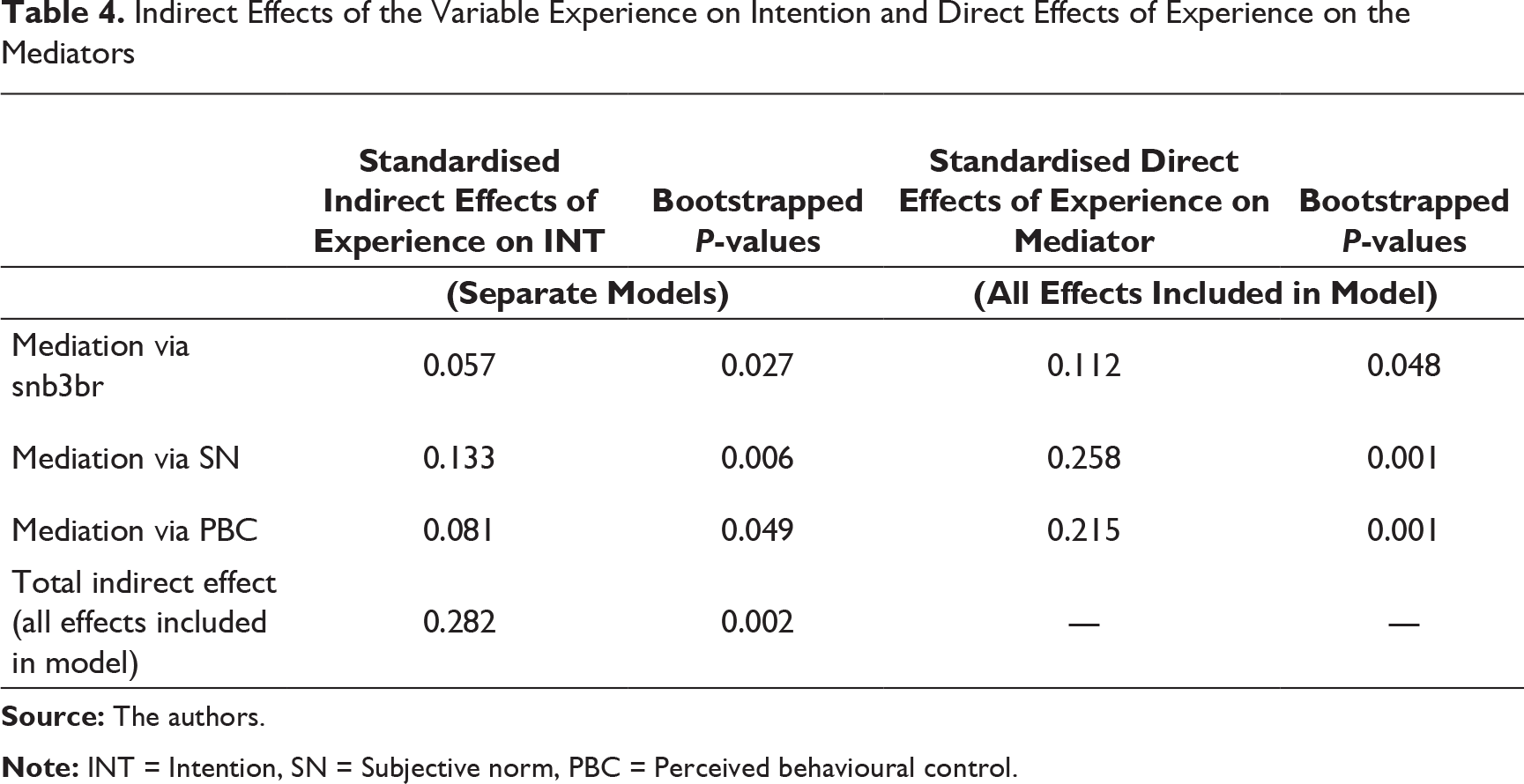
Further models were calculated that only contained one path from experience to each of the respective mediators (i.e., snb3br, SN and PBC) to assess the magnitude of mediation via each mediator. Model fit indices of these models were slightly worse, indicating that the omitted paths are generally valuable (the fit index values for χ²/df were between 1.6–1.7, model fit p = 0, RMSEA between 0.5–0.54, p-close between 0.284–0.464 and CFI between 0.952–0.958). The results of the differential analysis of indirect effects are presented in Table 4.
Indirect Effects of the Variable Experience on Intention and Direct Effects of Experience on the Mediators
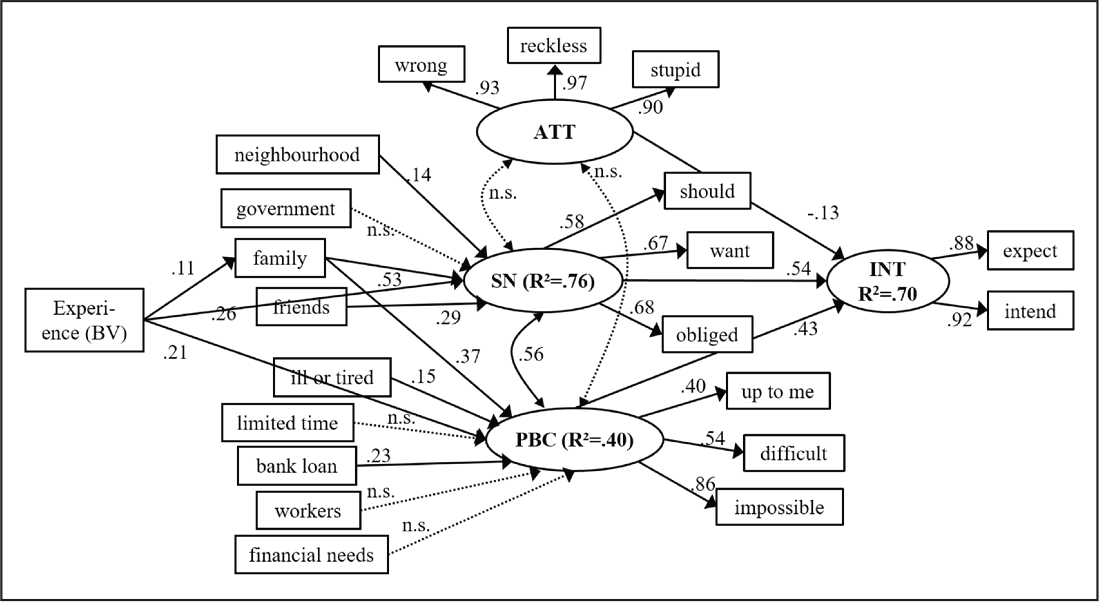
The amount of explained variance in intention is still at 0.70, as was the case for the integrated model. A change of explained variance is not to be expected since experience is not an additional explanatory factor, which was also empirically proven by confirming that experience does not have a direct effect on intention. The background variable experience can rather provide insight into what influences the latent constructs. Unlike the basic and the integrated model, this model shows a significant influence from attitude to intention. Surprisingly, this effect is negative (–0.13) whereas the underlying hypothesis proposed that the more positive the attitude, the higher the intention would be. However, looking at the zero-order correlations from the confirmatory factor analysis shows that attitude and intention are positively correlated. This shift in the algebraic sign from positive to negative could arise from multicollinearity among the three explanatory constructs (Deegan, 1972; Grewal, Cote, & Baumgartner, 2004).
Discussion
Three general models were estimated: the basic model (Model 1) containing only reflective indicators, the integrated model (Model 2) with MIMIC constructs containing reflective and formative indicators, and a third model which added experience as an exogenous variable to the integrated Model 2 (Model 3). Four of the six structural relationships were roughly the same for Models 1 and 2 and, with values of 0.74 and 0.70, R² is also very similar. Given Armitage and Conner’s (2001, p. 481) finding that the average variance accounted for was 39 per cent in their meta-analysis of the efficacy of the TPB, the constructs in the models presented here explained a fair amount of the variance in intention. As hypothesised, the construct subjective norm had a significant positive effect on intention and so did the construct perceived behavioural control. Although the size of the effect shifted, both models confirmed that subjective norm had the strongest effect on intention. The hypothesis that attitude has a positive effect on intention could not be confirmed. This is in line with Fishbein and Ajzen’s (2010) statement that the coefficients may change given different contextual conditions (pp. 184–201).
Both models showed a significant positive correlation of subjective norm and perceived behavioural control, and the basic model further corroborated the hypothesised correlations between attitude and subjective norm and attitude and perceived behavioural control. However, these last two correlations could not be confirmed for the integrated model: Due to the formative indicators used to explain subjective norm and perceived behavioural control in this model, the full model contained significant correlations between the formative indicators that are also linked to attitude and reveals that there are, in fact, significant relationships between all explanatory constructs. During the process of constructing the model in the way that it is presented here, empirical implications of the results of various statistical procedures (i.e., mostly exploratory factor analyses, confirmatory factor analyses and computation of modification indices) were considered.
It has to be noted that this approach of modifying the initial model is not strictly confirmatory, but is model generating (Jöreskog, 1993, p. 295). While the p-value of the global chi-square test is insignificant for the basic model, the integrated model and the model with the mediation of the background variable show significant p-values. In the case of structural equation modelling, the hypothesis test for p-values has low power and may lead to the erroneous rejection of a true model (Kline, 2011, pp. 193–194). Because of this shortcoming, a combination of different kinds of model fit indices is reported to evaluate different aspects of model fit. Looking at inferential, descriptive and incremental fit measures, a more comprehensive picture of model fit is given. Altogether, model fit values of all three models are in the range of acceptable to good fit. The overall assessment of the models, therefore, is that they give a valid theoretical structure to the empirical data.
The bivariate correlations of formative and reflective indicators of subjective norm and perceived behavioural control show that the subjective norm construct possessed more validity than the perceived behavioural control construct. In the case of subjective norm, the bivariate correlations corroborated the significant influences found from beliefs on subjective norm in the structural equation model, while the comparison of correlations and the SEM coefficients for the perceived behavioural control construct shows that the relationships were not as clear. A meta-analysis by Armitage and Conner (2001, p. 481) revealed mean correlations of 0.50 for subjective norm measures and 0.52 for perceived behavioural control measures. Here, the mean correlation of the significant subjective norm beliefs with the direct subjective norm measures is 0.44.
For perceived behavioural control, it is difficult to determine how to calculate such a mean correlation because the bivariate correlations and the SEM coefficients provide different indicators of which items have a close relationship with perceived behavioural control. So, whereas the measurement of the perceived behavioural control construct within the overall model did show some difficulties (although according to the model fit results of the single perceived behavioural control construct, all values indicate that the proposed model structure fits the empirical data very well), the measurement of subjective norm was, both within the model and separately, very adequate.
Looking at the significant standardised weights and the formulation of the formative indicators, we can see that subjective norm was mostly determined by family, while friends and neighbours had a less important but significant influence on the construct. These groups of people live in close vicinity to the respondents, and the model revealed that they compose the social network in which the respondents act. What is allowed by the government was thought to be important as a regulatory authority, but the empirical analysis proved otherwise: The government did not belong to the groups of significant others that contributed to the formation of subjective norm in the sample. Of the five hindering and facilitating factors that were assessed as components of control beliefs, two were found to be important for the households sampled here. Key importance was attributed to getting a loan from a bank, and the frequency of feeling ill also played a role for perceived behavioural control over enhancing tourism supply.
Reviewing the suggested modifications furthermore revealed that what the family thinks should be done—which was originally only directed at subjective norm—had a highly significant, positive influence on perceived behavioural control. The more the family thinks that the household should enhance the tourism supply, the higher is the perceived control over this behaviour. The influence of this formative indicator on perceived behavioural control was larger than that of the significant formative perceived behavioural control items, thereby emphasising the role the family plays in perceived control.
The mediation analysis showed that experience exerted a significant indirect effect on intention, which was mediated by subjective norm, perceived behavioural control and snb3br (family). With a standardised total effect of 0.28, this effect was quite strong indicating the importance of a respondent’s current involvement in touristic activities and the extent of such involvement for the formation of an intention regarding enhancement of or starting such activities. The fact that the influence of experience on subjective norm, perceived behavioural control and the normative belief item snb3br was positive indicates that the more experience the respondents have, the higher are the values on subjective norm and perceived behavioural control, meaning that significant others are more in favour and perceived control of such activities is higher. In other words, the more experience someone has, the more likely it is that the person will have a positive intention to enhance his or her activities in the tourism infrastructure.
Since the effects of experience were mediated by other factors, the incorporation of this variable did not add to the explained variance of intention. However, including experience in the model enhances the understanding of underlying reasons for the manifestations of constructs (Doll & Ajzen, 1992). Our analysis showed that whether or not a household already had experience in the tourism sector and how diversified that household/person’s offers were, both had an influence on factors that in turn influenced intention. This finding has implications for interventions that are intended to target the underlying structures of the latent constructs. On the one hand, the beliefs that significantly influence subjective norm and perceived behavioural control should receive careful consideration when formulating recommendations for interventions. On the other hand, experience is an important variable that exerts a considerable indirect effect on intention, meaning that giving an individual the opportunity to gain initial experience in the tourism sector will increase the likelihood that the person will develop an intention to enhance such activities.
The hypothesis that the mediated effect through perceived behavioural control is larger than the effect that is mediated through other constructs was rejected. It might be argued that this rejection derives from the fact that subjective norm had a stronger influence on intention than perceived behavioural control. However, looking at the standardised direct effects of experience on subjective norm and perceived behavioural control, we see that experience also had a stronger effect on subjective norm than on perceived behavioural control (0.258 and 0.215, respectively). So, if respondents are already providing services/products in the tourism sector, the people in their surroundings will also support expanding already existing activities. This effect of experience was even slightly stronger than the effect it had on the participants’ personal perception of control.
Of the three calculated models, only the last one provided evidence for a significant influence of attitude on intention. A confirmatory factor analysis of the basic model showed that there was a highly significant correlation between attitude and intention (r = 0.31, p = 0.000) indicating that attitude and intention were in fact related. Attitude also correlated with subjective norm (r = 0.55, p = 0.000) and perceived behavioural control (r = 0.28, p < 0.05), which indicates multicollinearity among the explanatory factors. The shift in the algebraic sign from positive to negative for the bivariate zero-order correlation of attitude and intention compared to the regression of intention on attitude could also be caused by multicollinearity and indicates a suppression effect. Suppression would mean that the effect from attitude on intention changes when the effects of other factors or variables are included in the calculation (Darlington, 1968, p. 179; Kraha, Turner, Nimon, Zientek, & Henson, 2012, p. 8).
Conclusion
The analysis of behavioural intentions regarding enhancement of touristic activities of rural Georgian households with the TBP (Ajzen, 1985) provides three decisive results that have implications for policymakers and NGOs active in the region. First, the overall model shows that the key constructs in explaining behavioural intentions for the sampled households are subjective norm and perceived behavioural control. This finding is surprising considering that attitude is generally the strongest component according to a meta-analysis of the efficacy of the TPB whereas subjective norm is found to be the weakest predictor (Armitage & Conner, 2001, pp. 481–482). Since most of the studies analysed in the meta-analysis were carried out in Western societies, and few examples of studies in collectivist cultures such as the Georgian culture (House, Hanges, Javidan, Dorfman, & Gupta, 2004; Tkeshelashvili, 2009) were included, it is possible that the cultural background has implications for the relationships proposed by the theory.
Ybarra and Trafimow (1998, p. 369) pointed out that ‘a majority of behaviours in individualistic cultures are also likely to be attitudinally controlled. But in collectivistic cultures, where the collective self is stronger and more accessible, more behaviours are likely to be under normative control’. Fishbein and Ajzen (2010, pp. 308–309) also acknowledge that behavioural, normative and control beliefs are likely to differ depending on the target population and can therefore vary across cultures. The same is true for the direct measures of attitude, social norm and perceived behavioural control because beliefs serve as the foundation of these constructs. Furthermore, they argue that such background factors such as personality, general attitudes and values, sociodemographic and contextual variables, and culture are more distant influencers, which affect intention and behaviour via beliefs. Our analysis confirms that the theory can be applied in a collectivist culture and that beliefs provide insight into what lies behind the latent constructs. Furthermore, our study shows that entrepreneurial experience is an important background factor influencing intentions via the theory’s more proximal determinants.
Second, the analysis of the relative importance of the underlying beliefs, which are the informational foundation of behaviour (Ajzen, 2005, p. 123; corroborated by Hrubes, Ajzen, & Daigle, 2001, pp. 173–175) shows that the family has the strongest influence on subjective norm. While friends and neighbours also exhibit some influence, the government does not have a significant effect on the formation of subjective norm. It is these underlying significant beliefs that should be the target of interventions with the aim of changing behaviour (Ajzen, n.d.). For the populations in our two rural regions, the data indicated that the government is not important for intentions concerning an enhancement of the tourism supply. Nevertheless, the government can influence the conditions of the households on the macro level and thereby change the setting in which the respondents operate (Coleman, 1990, pp. 400–402, 772–777). For instance, the analysis suggests that financial support and assistance in times of illness positively influence the intention to enhance tourism supply, although these problems could be alleviated by government action, whether or not the government approves of this behaviour is not important for the respondents.
Regarding perceived control over the action, it was found that interventions to promote contributions to the tourism industry should be directed at possibilities for financial loans and assistance in case of illness. The question of whether or not they can find additional workers is generally not important for respondents, but they feel threatened by possible illness and overexertion. An unexpected decrease in available time is also not important, and the same is true for unanticipated financial requirements as long as finances are available via loans. 6
Other financial instruments may also be of importance. However, since the pretest suggested that loans are important for the inhabitants, we focused on this factor in our study.
Third, experience in the tourism sector leads to a higher likelihood of an intention to enhance touristic activities. The constructs subjective norm and perceived behavioural control and the normative belief regarding ‘family’ mediate the influence of experience on intention. Since there was no direct influence of experience on intention, experience seems to influence how the support of significant others is perceived and the degree of control a respondent feels. In this way, the variable experience is in itself a context variable because it determines the setting for the formation of psychological factors. By shaping the circumstances for action, experience establishes the framework for the individual behaviour.
Tourism can serve as an additional source of income for private households in both Kazbegi and Bakuriani. The integrated model tested here has shown that in order to foster this development, policies and NGOs should take the strong social bonds of households into account by targeting, for example, not only the individual, but also the social aggregate and in particular the family. Furthermore, perceived control could be increased by guaranteeing reliable loans and having safeguards in place for times of illness. Experience is a context factor that has a positive impact on intentions to enhance activities in the tourism sector via significant others and perceived control.
Although it has been argued that the research areas are similar regarding some characteristics, they also differ regarding others, for example, structural conditions. It is, therefore, reasonable to assume that the modelled relationships may likewise differ. A more differentiated analysis to examine the discrepancies between groups is still pending. In any case, the use of more cross-cultural studies incorporating multi-level analysis would be very useful in future research to systematically study the effect of changing contexts. It is furthermore possible that perceived control moderates the influences of attitude and norm on intentions, that is, attitude and norms could exert influences of varying strength depending on the amount of perceived control (Yzer, 2007). An examination of these 18 moderation effects should also be the subject of future analyses.
Footnotes
Acknowledgement
We thank Lisa Trierweiler for proofreading the manuscript and her brilliant suggestions on formulations which made our article a lot more reader friendly.
Declaration of Conflicting Interests
The authors declared no potential conflicts of interest with respect to the research, authorship and/or publication of this article.
Funding
This research was funded by the Volkswagen Foundation.