




Abstract
The crisis, following the spread of the COVID-19 pandemic across the globe, has been unprecedented in terms of the extent to which it has been mathematised, such that both our understanding of it and responses to it have been largely guided by mathematical or epidemiological models. Mathematical certainties seem to have provided a reliable guide for action and anticipation in the midst of looming uncertainties unleashed by the spread of the virus. States, too, have mostly relied on mathematical projection to dole out policies for precaution and control, as the strange ‘fix’ between prevailing uncertainties and mathematical certainties, has provided the rationale for acting urgently and, literally, imposingly. Instead of attending to the fragility and diversity of human worlds mathematics of the pandemic has produced sweeping, but, ‘critical sounding’ generalisations and governments, world-over, have been too ready to act on their behest, often to the great detriment of the working poor and marginalised sections of society. This article offers a critical evaluation of this ‘fix’ and more generally of the mathematics of the pandemic with the help of Ludwig Wittgenstein’s Remarks on the Foundations of Mathematics. The argument is that in the absence of a proper appreciation of the sociality of mathematics we create certain pictures of the mathematical, with very concrete consequences at the level of policy and implementation, which demean and dehumanise instead of helping us out in times of need and despair. A case is made for a mathematics which is more sensitive to our vulnerabilities, desires and capabilities, as an alternative to solutionism which has come to dominate our life with and in crisis.
Introduction
It is widely recognised that Wittgenstein wrote most extensively on mathematics and logic through the course of his life and some of his insights and ideas which have now become commonplace in the social sciences were first articulated and subsequently elaborated and re-worked through and across these registers. I consider the conversation of his thought with the motely of techniques which constitute mathematics as supremely important, and would argue that there is much to be learned from it, especially for those looking for anthropological entry points into this seemingly closed and inhibiting domain.
In my engagement with Wittgenstein’s thought, the point that has struck me again and again is that he enables us to think of the human and the mathematical together, which means that while underscoring the autonomy of mathematics he nevertheless places it within a human form of life. He shows, by attention to details, how mathematics or more precisely logic, absorbs and informs life. By bringing the question of life and background practices that influence our talk about mathematics, to the centre of his philosophical work, he implores us to think afresh on notions such as mathematical necessity, reference, solvability and proof. The importance of these moves by Wittgenstein cannot be over-estimated, particularly for researchers in the social sciences and humanities who are constantly given over to the temptation of beginning with the idea that mathematics is social and in the process reduce it to a pre-given social category. Wittgenstein’s remarks on mathematics show that a more rewarding track to take is to explore the ‘location’ of the social in mathematics, to approach mathematical practice from the margins, to see how the means of mathematical work are settled and how eventually its autonomy and the concurrence it inspires are secured.
Having made these general remarks, I would now like to add specifically that reading Wittgenstein, particularly Remarks on the Foundations of Mathematics (1956), has acquired a new, politically charged and unusually compelling force for me since the COVID-19 outbreak world-over. 1 Observing an explosion of hastily produced scientific and mathematical research about the pandemic and a constant generation of speculative facts, which have ensnared both public and policy imagination, I was often led back to Wittgenstein’s insight, that our ways of speaking about mathematics might project certain pictures of it as truer than others and thus occlude the fact it is very much a part of human form of life and hence given over to its strength and vulnerabilities, to constant damages and acts of repair. 2 Forgetting this, leads to the belief that mathematics is plainly referential, that what it refers to actually exists and due to which its normativity subtly shifts or shades into an external-prescriptive value.
It is often forgotten, due to a de-contextualised approach to philosophy in general, that Wittgenstein’s so called later philosophy, a large part of which deals with mathematics, responded to the darkness of its times. The central argument of this article is that it can shed light on the darkness of our times as well, particularly, by casting a complex critical net over our mathematical and statistical attempts to dispel it. Through numerous penetrating remarks Wittgenstein questions the stand-aloofness of mathematics from life and shows how, both, mathematics informs life and is informed by it in turn. Wittgenstein’s caution that taking mathematics otherwise will have damaging consequences for life, as it nourishes belief in technologism, the cult of progressivity and mathematical solutionism, could (hopefully!) stimulate us into developing a more critical understanding of the ‘mathematical’ in our own times. This becomes particularly urgent because we witness an unforeseen increase in scientific and mathematical prophecies that not only spell doom and encourage fatalism but have also foreclosed other ways of thinking about the pandemic, often with the cruellest consequences for the needy and the dis-privileged. In this article I pick up certain strands of the multi-faceted investigation that unfolds in the pages of RFM and use them to offer a critique of the mathematical modelling of COVID-19.
An important aspect of the argument is to explore what kind of form of life it is, which mathematics of this kind ‘forms’ and is ‘formed’ by. An explorative answer offered is that prophetic mathematics makes epistemology redundant and obsolete in front of ontology, a point which I’ll show emerges out of my efforts to read Wittgenstein alongside the unfolding of the Pandemic. Apropos this answer, I also argue that the founding assumption which drives current mathematical research into the causes, consequences and ways to tackle the pandemic is that a state of affairs, the worst possible, is assumed to exist and the question then becomes what mathematics can discover about this already constituted domain. The heady competition which results between mathematical models, becomes a self-serving exercise, with models vying amongst themselves, as to which can add more bite to the already in place machinery of precaution and control.
The article is divided into five sections including this introduction. In the next section, I briefly show how the Wittgensteinian theme of the connectedness of mathematics with ‘form of life’ emerges against the backdrop of discussions on well-known rule following considerations. This discussion will put mathematics amidst the whirl of life, not as we will see, in order to dissolve it into non-identity, but to attain a clearer focus on its inner workings. In the third section, I take up a few examples, drawn from some extremely informative and critical readings of mathematical modelling already available in the public domain, to underline some guiding assumptions behind the mathematics of the pandemic. In the penultimate section, I organise my reflections on the issues raised in the third section by means of a set of thoughts drawn from RFM. After this, a brief conclusion is offered which recapitulates and adds to the points raised throughout.
Mathematics and Form of Life
Wittgenstein’s remarks on rule-following, highlighted most notably by Saul Kripke as constituting a major contribution to philosophy even if separated from everything else that Wittgenstein ever wrote, are, in my reading, about the capacity of a practice to completely symbolise itself (Kripke 1982). 3 By raising sceptical doubts over any and every symbolic presentation of a practice, Wittgenstein in a sense argues for a necessary gap between justification and doing. This means that a practice can never be fully coded into a rule by means of symbols such that its execution is merely a deductive consequence or a post-facto unfolding of the rule. To put it simply, no precision of justification can match up to the certainty with which a practice is followed. This is so because an isolated practitioner can always claim to have followed the rule by giving an intended interpretation to it which is in accord with the step she takes while, say for example, following an arithmetical series or doing a calculation, et cetera. Thus, any step whatsoever can be aligned with a rule, supposedly framing the practice from the outside as it were, throwing in jeopardy the very standards of right and wrong.
Wittgenstein wards of these sceptical misgivings by taking recourse to the category of usage or ‘custom’. Taking a cue from a recent interpretation of the said remarks, it could be argued that it is usage which enables the leap between justification and doing (Livingston 2012). This medial category not only puts a practice and its symbolic codification in touch with each other but also brings to relief the idea that the relationship between these elements of the triad is dynamic and hence subject to regular and often unforeseen changes. Between unreflective practice and over-reflective symbolism lies the register of everyday usage which shows that participation in a practice requires mastery of a technique(s), which in turn creates its own realms of access and necessity, over and beyond what a rigid symbolism can ever capture. The moment techniques are brought into picture; scenes of instruction, the aspect of training, and questions such as what are the bounds of the communal, what constitutes the ‘we’ of community, become important. The fact that they are placed within such multiple hues of the ‘social’ gives symbols their efficacy as signposts and keeps unreflective behaviour free of doubts.
Now, what Wittgenstein argues, holds as much for mathematical practice as for any other practice, in fact, much of what he says is elaborated through a detailed consideration of mathematics, spread over a number of writings. What emerges through the course of his multi-pronged observations is that mathematical formalism cannot be viewed as existing separately and authoritatively, apart from the life with in which it is shaped and practices in which it lives and finds purpose in. Further, Wittgenstein’s remarks have the potential to show that mathematics is pre-eminently and internally social, that is, in the very shaping of mathematics social factors play an essential role. He illustrates that there can be no mathematical formalism in itself, viewed in separation from multiple search strategies and effective procedures where it is employed. Reading Wittgenstein it becomes clear that, these frictional grounds and criss-crossing surfaces constitute the ‘foundations’ of mathematics and not some exterior reality (Platonism) or purified and meaningless symbolism (Formalism) or laws of logic residing in a realm of their own (Logicism). Forgetting this, foundational work, philosophical or mathematical, may assume that what is required is to fix mathematical rules and to purge them off the clutter of practice. Any crisis befalling the symbolic casketing of mathematical practices, which are bound to arise as Wittgenstein repeatedly insists, is interpreted as influencing the whole of mathematics and mega strategies of repair, like Russell and Whitehead’s Principia Mathematica (1927), are recommended which essentialise mathematics by presenting a static and life-shorn view of it. 4 Wittgenstein’s attempt, instead, is to put life and society back into mathematics by drawing out and pursuing the implications of the seemingly inane idea that mathematics is a human activity. With these two themes, the connectedness of mathematics with life and the other that we do not need mathematics of mega-repair but one which responds to our desires, capabilities and vulnerabilities in times of crisis, it is time now to review the mathematics of the pandemic and see how it has turned into a self-absorbed and self-serving exercise.
Mathematics of the Pandemic
Tim Rhodes and Kari Lancaster (2020) have noted in a recent publication that the spurt in mathematical modelling since the outbreak of the COVID-19 pandemic has played a crucial role in shaping, what they call as, anticipatory governance. 5 This form of governance relies on developing technologies of prevention and precaution, anticipating the future as embodying projected possibilities, often taking into account the farthest and the least likely. However, they point out that what is truly novel with mathematical modelling in the contemporary context is the manner in which it has generated unprecedented public and media interest, becoming integral to policy and bio-social deliberations and hence going beyond the exclusive domains of science and expertise. For one thing, this most clearly demonstrates for them, the often hidden from view, entanglement of science and society which perhaps has been no more evident, and hence far from hidden, than in the present. They argue that mathematical models are particularly befitting examples of what they call as ‘evidence-making intervention’ as opposed to ‘evidence-based’ science, as they literally make evidence while intervening in the here-now, unlike the latter which intervenes only on the basis of already constituted and sorted evidence. This performative and enactive dimension of mathematics-in-action not only alerts them as to its emergent character but also to the messy and multiple processes through which it is materialised. Based on this they argue that mathematical models are best seen as boundary objects which, ‘have the power to afford multiplicity by creating space to move objects across epistemic boundaries into varieties of concern’ (ibid). Observing how numbers and metrics travel across the social offers them an excellent illustration of how ‘matters of fact’ translate into ‘matters of concern’ as science becomes a matter of public deliberation and is recognised with regard to its emergent character and seen not only as responding to contingency but also as embodying it.
That mathematical models are materialised as ‘public troubles’, they argue, should not be seen as a failure of governance but as opening the possibility of more participatory governance as well as of more participatory science. And by participatory model they mean a model which, ‘acts here as a boundary object which does not so much seek to ‘bring-in’ the expertise of publics into models (as consultative approaches might do) than ‘bring science out’ of its networks of bounded expertise into publics’ (ibid). They recognise that mathematical modelling so far has remained oblivious to the social effects it generates and materialises, but hope that since models will continue to inform our response to and in uncertainty, the need for more ‘participatory collaborations’ and of reorienting science and policy accordingly will be recognised. By underlining this as the most important need of the hour they end their paper. This is an important effort in the present context to make mathematics discussable, but in my view they fail to raise the most important critical questions which could be asked now on the role of mathematical modelling in making the pandemic legible. Let me explain by taking the example of a case study they offer in their paper.
Drawing on examples from the models produced by Imperial College in UK they focus on three numerical estimates that have percolated into public communication and have greatly influenced policy orientation. 6 These three numbers are 510,000, 250,000 and 20,000; projected number of COVID-19 deaths in the three respective scenarios of ‘doing nothing’, ‘mitigation’ and ‘total lockdown or suppression’. By tracking the ways in which these numbers have travelled, generated controversies and invited deliberation and scrutiny beyond the bounds of the scientific, they argue that they should be seen as malleable, situated and fluid and must be interrogated keeping in mind the relations they enter into. Their argument regarding viewing these numbers as caught in the tangle of social life is well taken but the aspect they leave outside the purview of critical analysis is, why among numbers such as these, there are some which wrest greater hold of policy and public imagination than others. For example, why the above numbers became in themselves a convincing enough reason for the UK government to go for complete suppression and lockdown and the possibility of trying out other preventive measures was completely foreclosed? Why is it that what Rhodes and Lancaster argue for, that is to view these numbers as primarily in circulation and thus open to deliberation and scrutiny, doesn’t come along so easily.
My answer to this question, following the lead of Wittgenstein, is that they miss the normative aspect of mathematics completely. Further, having missed this aspect they quite naturally fail to pay attention to the way in which the normative is shaped and sustained through practices in a shared form of life. Wittgenstein cautioned us that normativity and necessity of mathematics, if not located within the motley of techniques which constitute it and in connection with the facts of natural or ecological, to which I may add, social history, acquires absolutist or magical dimensions. In this case, for example, numbers appear as designators of truth or more precisely of the potentially true and ring the alarm bell that if they are ignored, it will be at our own peril. Instead of being seen as indexes of operations they hover as independent or autonomous entities with quasi-referential properties. Thus, it seems that they ‘pick out’ something from the unknown and hence must be accepted in their objectity.
Mathematics indeed presents us with rules of description but acceptance of a mathematical proposition is, as Ian Hacking has emphasised, an ‘event in the experience of proof’ (Hacking 2010, emphasis mine). Choices, social and contextual, enter into the production of mathematical propositions and believing in them involves moments of collective and communal decisions which betray deeper and underlying agreements in life, language and logic. Ironically, producing as well as believing in such numbers ends up saying more about us instead of a simple tracking down of the elusive virus and its effects. Thus, mathematics is social, not only in its effects, but already in its deep and fundamental recesses.
Researchers in Mathematics Education, Arul and Tathagata (2020) have argued passionately and convincingly in a recent piece that modelling of the COVID-19 crisis, which is currently in vogue, in its zeal to produce ever new models and simulations of the same, has betrayed the pretensions of a politically neutral mathematics. In a radically critical move, they lay bare the assumptions that go into the making of supposedly non-partisan mathematical models, in process demonstrating how mathematics is political and informed by various social and cultural factors through and through. To their credit they do not say so by making the bland case that mathematics is political or social, extrinsically, but by taking apart the choices and decisions that inform the very making of it. They see an unprecedented rush among scientists from different disciplines to take stock of the crisis and to offer thinly evidenced interpretations and hastily considered remedies of the same. And, in this they recognise the symptoms of a deeper malaise. They examine the choices which end up shaping the mathematical modelling of the pandemic and make a very pertinent observation that not only do they do not reflect social or cultural reality but are mathematically compromised as well.
Taking example of the stereographic projection of a sphere into a flat map they remind us that such a mapping makes sense only when continuous one to one mappings are in question but as per differential geometry any such mapping is bound to result in distortion, as evidenced by huge differences between actual sizes and map sizes of the continents. It is clear that in this case a particular kind of mathematics takes precedence in public perception and subtly seeps into the way world geography is perceived. What happens is that the internal plurality of mathematics is sacrificed and what is favoured is merely a narrow dimension of it. Clearly, such a choice has very definite social and political consequences, but what I am suggesting is that choices like these can themselves be sociologically examined. It can be asked, as Arul and Tathagata do, what is that mathematical models choose to model? In simplifying a situation in order to model it how much of the situation is incorporated within the model and what is left out? These questions pertain to the degree of complexity that mathematical models choose to acknowledge.
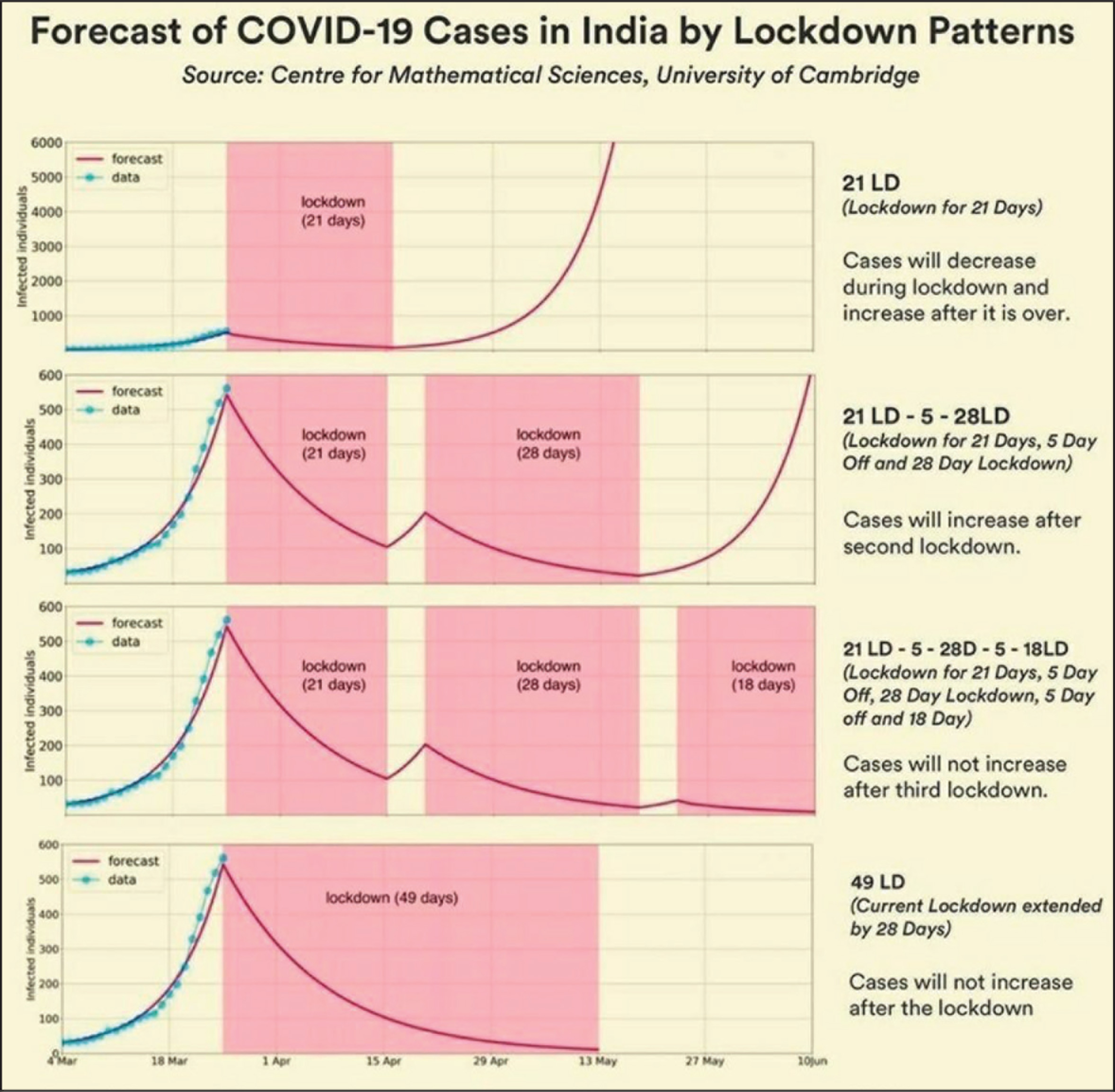
Taking the example of a widely circulated model in Indian media and also on social media platforms such as WhatsApp and Facebook they argue that although the model made a case for a 49-day lockdown period for India it did so on the basis of two highly questionable assumptions (Singh and Adhikari 2020). Building upon the traditional SIR (susceptible, infected, recovered) framework, the above model tried incorporating with in it ‘age-based social contact’ as a new variable and suggested that minimising it will put a halt to the spread of the virus. 8 The sure shot solution it offered was packaged in a language of urgency as it ruled out differentiated or staggered lockdown on the basis of a supposedly plain numbers speak. It was certainly a good move to figure into the model ‘age’ and how it impacts ‘social contact structure’ but to assume, (a) asymptomatic cases to be zero at the time of imposing the lockdown and (b) that a total lockdown is indeed possible and will completely eradicate all social contact beyond home, is not only socially or culturally but also mathematically naïve. Further, to fix the number 10 as the limit below which if the number of infections are reduced then the pandemic could be seen as under control, is simply arbitrary. 9 It seems a rather wishful choice as a safe limit in country of 1.33 billion.
For further analysis readers are referred to the comprehensive and multi-levelled critique presented in Arul and Tathagata (2020) but what is baffling is the certainty such crudely designed models inspire. Even though they lead towards no clear understanding of the virus spread and its containment, policy decisions with enormous social impact are frequently taken on their basis. 10 What is strange is that, decisions with very real and not infrequently disastrous implications for people, mostly at the lower rung of the social ladder, draw upon an incredulous ontology of the unknown. This deliberate ploy for not knowing SARS-CoV-2, by foregoing the classical strategy of test-trace-isolate, and yet acting with full certitude on the basis of half-baked models signals towards the emergence of a new mode of governmentality.
That the tested model of test-trace-isolate has been knowingly ignored and yet governments world-over haven’t shied away from making policies on the basis of mathematical-epidemiological models which do not withstand even the most liberal scrutiny suggests that what is at stake is something over and beyond a simple managing of populations. Instead of attending to the fragility and vulnerability of human worlds, the state becomes a clear champion of the ontology of the unknown, of an unknown real, fuelling the production of prophetic science with its dangerous and fear inducing prognostications. What models seek to portray is how dangerous the virus can be and more sensational the numbers are, more they seem to reach deeper, like a bait-casting rod, into the universe of the fast-mutating virus. 11
The belief in mathematical ontology, that coats mathematical objects with an impenetrable exterior, thus endowing them with unshakeable existence, complements well the ontology of elusive existence, like that of the virus. The ‘non-temporal’ nature of mathematics harmonises with the temporal ascendance of the virus, such that it is always ahead of our ways of knowing it, and the states act as per the directives of this magical fit or promise of a fit. Although, a matter for considerable analysis, I believe this to be synonymous with the displacement of the human from current academic as well as policy horizons. Crises such as these often lead towards fatalistic proposals of abandoning the human altogether, inspiring a desire for mega-strategies of repair. What if, what is needed is simply reconceiving the human existence differently instead of leaving it all to science or to make-do with absent-minded euphemism that all this might lead to some good for climate and earth? Let me now close this section by taking one more example which further corroborates the argument presented so far.
The last example I take is that of, Case Fatality Rate (CFR), the ratio of number of deaths from a disease upon the number of people who are tested positive for it in a certain period, which has served as an important guide for devising policy strategies to counter the COVID crises. In a recent piece, Carlo Caduff (2020) has drawn our attention to the fact that in the absence of systematic and extensive testing this index has given us numbers which are strange, way off beam and hence extremely variable. Even a highly respected medical journal such as The Lancet published an article in which the scientists estimated the CFR to be as high as 20 per cent! (Baud et al. 2020). A most astonishing estimate even from the most alarmed standpoint! Also, he points out that the CFR flattens out a number of complicating factors such as people with symptoms are more likely to die than those without, thus giving us an inflated sense of mortality rate, confusion between ‘patients who die with virus and those who die from it’ and the fact the most of the tests being done are RNA (ribonucleic acid) tests and not planned serological tests which can give better estimates of the spread of infection in a population (ibid). And added to this, the variation in CFR across countries and even within countries at different times, depending upon more testing, changing epidemiological approaches and policy adjustments, has meant that it can at best be a heuristic tool and that too with a very limited efficacy. Yet we have seen that terms such as CFR, flattening the curve and positivity rate have come to acquire such ideological force that amidst looming chaos and confusion what remains constant, paradoxically, is only the veneer of their transparency. At this point, I want to ask a different question than the studies cited so far in this section raise, which is, what explains the currency of such mathematical approaches which not only remain blissfully ignorant of the complexity of the social but are also naïvely confident about certain pictures of the ‘mathematical’. Instead of taking this question head on I take examples from RFM, as per the stated objective of the article, and show how we can profitably look for an ally in Wittgenstein for complicating the received and dominant sense of the same.
Remarks on the Foundations of Mathematics
Following reflections on selected remarks from RFM are offered to show that if our mathematics is not re-located as residing within our form of life it gets tinged as mysterious and distant, of which the mere mortals can only be beneficiaries but never creators and most certainly not, questioners.
There are numerous remarks of similar kinds to those given below, spread across the pages of this magnificent text and if I have selected them it is not due to any particular reason. Taken together they demonstrate the need for multi-pronged descriptions of mathematical work so that mathematical ‘discoveries’ are pinned back to contexts of ‘invention’ and ontological assumptions are palliated by rug and dust procedures through which mathematics comes to be.
Now, let us proceed with the remarks, which respectively have to do with; mathematics and life, mathematical self-evidence and mathematical questioning.
In the context of examining logical inference, early in the pages of RFM, following remark appears:
But still, I must only infer what really follows! – Is this supposed to mean: only what follows, going by the rules of inference; or is it supposed to mean: only what follows, going by such rules of inference as somehow agree with some (sort of) reality? … Logic is a kind of ultraphysics, the description of the logical structure of the world, which we perceive through a kind of ultra-experience (with the understanding e.g.). (emphasis mine) (6e: δ8)
12
And then a few remarks later an example is offered,
For example: a regulation says ‘All who are taller than five foot six are to join the … section’. A clerk reads out the men’s names and heights. Another allots them to such-and-such sections.- ‘N.N. five foot nine.’ ‘So N.N. to the … section.’ That is inference.
In the first remark above Wittgenstein points out that conceiving the logical/mathematical as plainly referential or as inferential tidying up of the empirical creates the impression that it is a kind of ultraphysics. It appears as if laws of logic describe a reality and are thereby true of it and because of it, residing in the medium of understanding, which is lodged in the faculty of the mind. Wittgenstein is drawing our attention towards how our talk about mathematics mystifies the nature of mathematical work and makes even simple processes like drawing inferences as intrinsic to the very nature of things and hence directly perceivable, like the relationship between smoke and fire. What is implied by Wittgenstein’s remarks is not that there is no law to logic but that the normativity of logic has to be located in the human form of life. The objective of this, as I’ve read Wittgenstein, is to show how the politics of life implicitly structures mathematics. Life is life because it has a form and that form not only informs mathematics but is also in turn informed by it.
The second quote cited above is about what kind of an activity drawing an inference is. It answers to a requirement, in this case of slotting people according to their heights, which itself is required for something else and so on, for example for military training or for a sport, et cetera. It makes sense in relation to a given set of rules which inhere in practice and can even be symbolised in relation to it. For example, I don’t find it accidental that in his Foundations of Arithmetic (Frege 1960), while in the process of defining what a number is on the basis of one to one mapping, Gottlob Frege takes recourse to a waiter’s act of pairing plates and knives (Frege 1960: 82) or Bertrand Russell in order to clarify Frege’s understanding of the number on the basis of his slightly updated idiom takes the example of heterosexual monogamous marriages to elaborate on the same idea (1914: 16). After all, when all is said and done, mathematics is founded, if at all it is founded on something, on these facts of life. Radicalising this thought further, let me leave this interpretation here with the remark that, to imagine a new mathematics a new politics of life will have to be imagined as well. 13
Now, the following remark, squarely and more explicitly, locates mathematical ‘self-evidence’ into our life with mathematics.
‘The axioms of a mathematical axiom-system ought to be self-evident.’ How are they self-evident, then? (113e: δ1)
‘Suppose I now say: it is quite indifferent why it is evident. It is enough that we accept it’. (emphasis mine) (113e: δ2).
‘It is not our finding the proposition self-evidently true, but our making the self-evident count, that makes it into a mathematical proposition’ (emphasis mine) (114e: δ6)
These remarks by Wittgenstein take on a particularly urgent tone in our times when viewed against the kind of self-evidence and unquestionable status that mathematical models and algorithms have today. I see these remarks as an invitation to reflect closely on ‘our’ ‘acceptance’ of self-evidence as a more intriguing fact than self-evidence itself. They not only underscore the idea of acceptance as central to mathematics but also put the ‘we’ back into it and thus also bring it under the purview of questioning and reflection. Who the ‘we’ are who ‘accept’ a mathematical proposition as ‘self-evident’?
Wittgenstein brings the ball back from the court of reality to our own, as if making us accountable for the mathematics we have. He seems to be telling us that it is important to figure in what mathematics assumes and what it takes for granted, notwithstanding its appearance as a purely mechanical-deductive system. What gives a mathematical proposition, say an axiom, ‘self-evidence’ is how it is used and made effective both within and outside of mathematics, without which it would be a statement without meaning and purpose. Just like, we make numbers more understandable and pliable by rounding them off to a nearest multiple of ten and take this to be given, we accept any mathematical procedure because it is followed as a social practice. Between its framing as a rule and its execution in practice lies the gap in which ‘form of life’ spreads out and holds the two together in relative stability. Wittgenstein’s remarks, such as these, shift the locus of our interest in mathematics, asking us to wonder about mathematical certainty and self-evidence instead of explaining them away. Accordingly, I suggest, our critique of mathematical modelling must necessarily involve a deeper appreciation of sociality that it embodies.
Moving on,
We only see how queer the question is whether the pattern Φ (a particular arrangement of digits e.g. ‘770’) will occur in the infinite expansion of π, when we try to formulate the question in a quite common or garden way: men have been trained to put down signs according to certain rules … What if someone were to reply to a question: ‘So far there is no such thing as an answer to this question’? … So, e.g., the poet might reply when asked whether the hero of his poem has a sister or not—when, that is, he has not yet decided anything about it …. The question—I want to say-changes its status, when it becomes decidable. For a connexion is made then, which formerly was not there. (138e: δ9, emphasis mine)
It might seem that in mathematics, while expanding a series for example that terms of the series are given and if someone doesn’t know whether a particular string of digits, like ‘770’, occur in the expansion, it is only due to human incapability to fully know it. But quite apart from a person’s ability to know an answer to a question like above there is always a simple ‘yes’ or ‘no’ answer which exists. But Wittgenstein in a typical counterintuitive move reminds us that for the question, whether ‘770’ occurs in the expansion of π or not, ‘ground’ of its asking has to be ‘invented’, else it simply hangs in air and is mathematically uninteresting. It is not as if the answer is already there and is to be simply discovered instead the purpose of inquiry must be demonstrated first, because it is to this to which the end is internally connected. So the question might make sense if say approximation of π up until certain digits is required for the purpose of calculating the area of an enclosed surface, for a specific end, et cetera.
Having said this, it should not be construed that Wittgenstein is plainly denying the objectivity of mathematics or that something ‘is there’ but telling us that even ‘something there’ can only be known from within our practice, through established procedures and with the application of suitable techniques. The standard of what is ‘there’ or the standard of ‘correctness’ are firmly placed with in a form of life so that even for a super-surveyor of truth, like God for example, she has to go by the technique to produce an answer. Take for instance the example Wittgenstein takes. Asking a poet or a novelist about a particular character in her on-going work will not make any sense unless she has a plot line through which the very possibility of having such a character is invented first. The question can be answered, once a decision is made, regarding its validity. Here, I take Wittgenstein as trying to restore the material weight of questioning, something we gravely need if we are not to be misled by the wizardry of extraordinary answers.
However, as Wittgenstein shows through many of his remarks in RFM, when we forget to place mathematical techniques in the midst of life, we get misguided about the nature of mathematical practice, yielding to the alluring pictures associated with such powerful words as ‘end’, ‘infinity’ and ‘incompleteness’. Wittgenstein attempts to restore the appropriateness of words such as these by locating them within the dynamic, contextual and unfinished character of the mathematical enterprise, ridding them from the clutches of pre-conceived finality and context free determinations. Isn’t, we require something similar amidst the onslaught of words such as positivity rate, flattening the curve and case-fatality-rate? As these words are drilled into our heads and acquire magical/absolutist dimensions, don’t we need to put them back into touch with the practice within which they emerge? With these set of thoughts, let me now close the article with a very brief conclusion.
Conclusion
If this article really has an argument it is as follows. A fast mutating virus, like the coronavirus, seems always to exceed our ‘known’ and ways of knowing and kindles a belief in the ontology of the unknown. This inscribes a ‘lack’ at the very core of our efforts in grasping the virus and mapping its effects, thus legitimising the ideology of ‘preparedness’ by giving it obligatory and moralistic connotations (Caduff 2014). After all, it is said, this is the least and the best we could do. However, preparedness, in cases such as these takes larger than required dimensions and a rushed sense of urgency and panic takes hold, replacing little and more concrete acts of repair and reconstruction. Ironically, the reigning ontology of the unknown is complemented by a mathematics which equals the ever-adaptive newness of the virus (it is ‘novel’ Coronavirus, after all!) through its production of sensational numbers. It appears, the greater the abyss of the unknown, deeper we can reach into it through our mathematics. A mathematics, which through its ontological certainties, precludes any discussion of ways of arriving at supposed truths and revelations.
This article has questioned this conjunction between the ontology of the unknown and ontology of the mathematical ‘known’ through a reading of Wittgenstein’s text Remarks on the Foundations of Mathematics. By drawing on Wittgenstein’s remarks it has tried to argue that in the absence of any sustained understanding of the sociality of mathematics we create certain pictures of the mathematical which demean and dominate us by inducing an unhealthy solutionism in the face of terrible crises which require, more measured, layered and flexible responses. Not to say that to live with the uncertainty created by the virus we need to make our mathematics uncertain but to re-humanise it by re-claiming it. And, as examples drawn from Wittgenstein show, this means, putting it back in touch with the politics of life which gives it legitimacy and normative force and perhaps, more importantly, by re-imagining it.
Footnotes
Acknowledgements
Discussions with Professor Roma Chatterji, Dr Sumbul Farah and Mr. Rajat Kumar have helped in shaping my ideas. I thank them for their insightful remarks on an earlier version of this article. I am also grateful to the anonymous reviewer for helpful comments on the presentation of the argument.
The author declared no potential conflicts of interest with respect to the research, authorship and/or publication of this article.
Funding
The author received no financial support for the research, authorship and/or publication of this article.