




Abstract
Background
Social media and serious games are key drivers of engagement in medical education.
Objective
This review explores the current challenges faced when integrating web-based learning into teaching curricula.
Methods
A literature review included studies on social media and web-based games in medical education.
Results
From 219 references, 14 studies highlighted two key challenges medical educators encounter.
Conclusions
Exciting opportunities exist for the adventurous educator to wield new electronic teaching methods.
Introduction
From the dawn of human consciousness, data has advanced from primitive analog categorization to the vast arrays of contextualized data now housed in storage centers. The advent of the World Wide Web in the late twentieth century indelibly changed not just education, but all aspects of modern life. By 2010, the shift from Web 1.0 to Web 2.0 was well underway. The role of the user radically changed from passive consumer of web pages to active creator of content in the form of posts, comments, and channels. 1 Concurrently, medical education saw a transition away from solely didactic teaching, with web-based resources exceeding traditional methods in some cases. 2
This era saw exciting changes in the realm of web design and its three fundamental languages. If HTML and CSS are the number of cars and aesthetics of the train, respectively, JavaScript is the engineer smoothly facilitating a tour of the countryside. Gastroenterologists have used web applications built with JavaScript to assist in decision-making regarding blood-thinners, endoscopy, and thromboembolic risk. 3 Social media is synonymous with Web 2.0, and perhaps synonymous with what the average person calls “the Internet.” The concept is the same: a dynamic process of viewing and creating information. Social media interactions include a pathologist sharing an anonymized image, nephrology fellows discussing the loop of Henle in a forum, and a professor building a quiz for a web-based lecture series. It is used in healthcare across a wide range of use cases, from networking to medical education. 4
Getting a picky toddler to eat has found many tireless parents reaching into the game developer skill set. The potential for a game to make an arduous task more enjoyable has long been recognized, and in the modern age games have extended into many “serious” domains of life. Gamification is defined as “the use of game design elements in non-game contexts.” 5 The formidable obstacle of advancing through medical education lends itself to gamification. Interactive elements such as a points system, digital rewards, and leaderboards have resulted in increased use of learning materials, and no negative outcomes. 6 Quiz games and simulations continue to be evaluated for their effect on learning outcomes. Medical education traditionally has combined didactic, clinical, and Socratic teaching. Quiz games following a game show format occasionally showed up at the end of a course before the big exam. As medical education continues to evolve to meet the learning preferences of millennials and beyond, there is an ongoing need for innovative teaching approaches.
Objectives
Web-based resource use has increased to meet the changes in how students assimilate information. The goal of this review is to look at the recent literature on social media and games in medical education, and explore the challenges encountered by educators seeking to integrate these powerful tools into healthcare training.
Methods
Search Strategy
In the summer of 2024, PubMed searches were conducted for all English-language medical studies that were published since 2014. The searches were limited to this time frame to focus on technologies and practices relevant to the Web 2.0 era, ensuring alignment with current educational trends. The first search was for game studies using the following keywords to search titles and abstracts: “game” AND “medical” AND “web.” The second search was for social media studies, and the following keywords were used: “social media” AND “medical” AND “education.”
Summary of Game Articles.

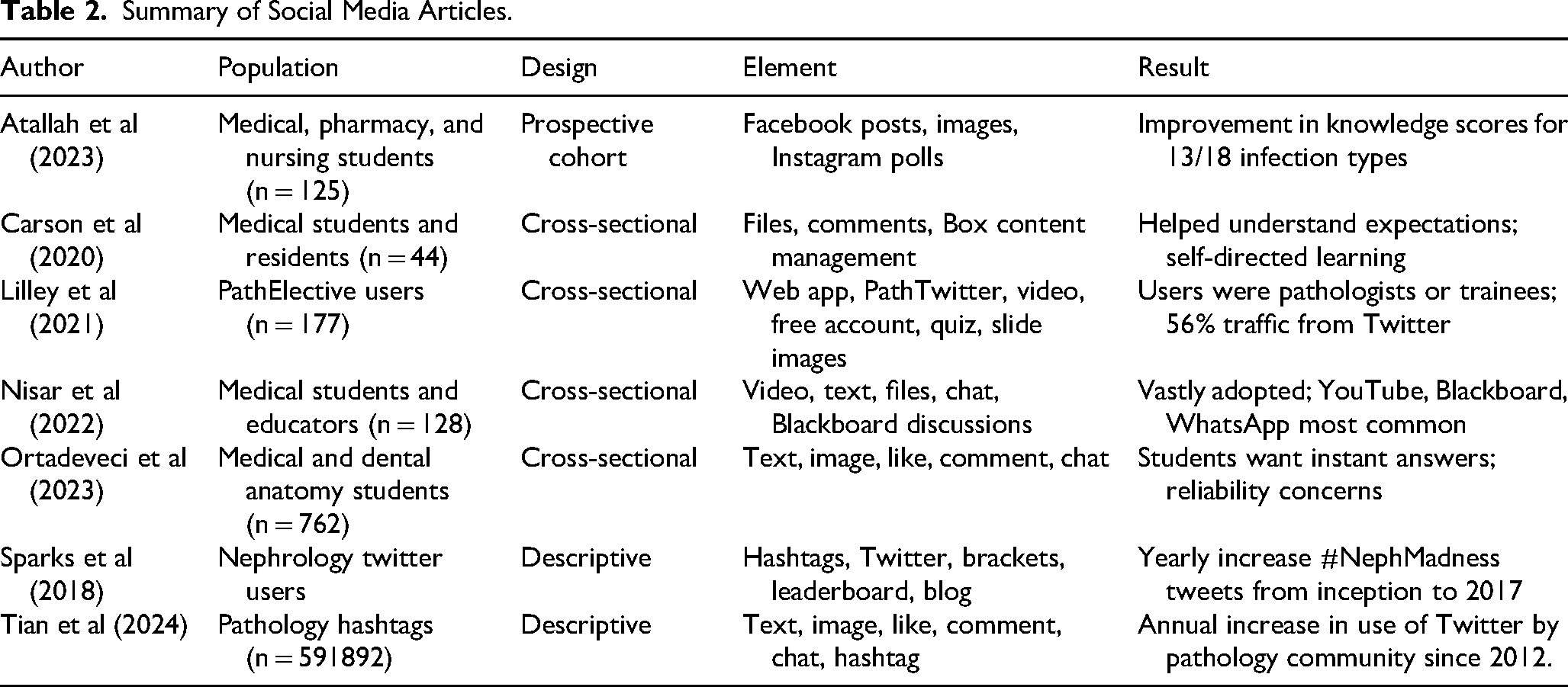
Summary of Social Media Articles.
Inclusion and Exclusion Criteria
The first 100 titles and abstracts from each PubMed search were screened for eligibility. Articles were included if they addressed social media or web-based games in health professions education. Excluded were studies focused on patient self-management or public education. Selected full texts were reviewed and organized with EndNote.
Categorization
The articles were then comprehensively reviewed and categorized according to the findings. The results of the review highlighted two key challenges to integration of games and social media into teaching curricula: developing a balanced, immersive game poses time constraints at the department level; accommodating blended learning styles and addressing digital reliability is met with slow adoption rates.
Results
Description of Included Studies
The initial search yielded 219 titles. After exclusion of ineligible studies, review articles, perspectives, and commentaries, the sample was narrowed to the 14 studies in Tables 1 and 2. The sample included the following study types: descriptive, cross-sectional, cohort studies, and randomized controlled trials. Articles were from the following countries: Australia, Canada, Lebanon, Malaysia, Netherlands, Saudi Arabia, Thailand, Turkey, and the United States. The following medical specialties were highlighted: Radiology, Pediatrics, Orthopedic Surgery, Internal Medicine, Emergency Medicine, Family Medicine, Hepatology, Infectious Disease, Nephrology, Pathology, and General Surgery. Social media sites included Instagram, X, Facebook, YouTube, and WhatsApp. Game types included escape rooms, simulators, and multiple-choice quizzes in a variety of game configurations.
Discussion
Medical education is striving to keep up with a generation of learners born into the internet age. There is an overall trend away from solely didactic teaching, and towards incorporation of self-directed, student-centric learning. Educators are scrambling to find ways to drive engagement with course content, leading to the integration of games and social media into traditional methods. Two key challenges loom overhead for the fearless teacher!
Challenge #1: Designing an Engaging Experience with Resource Constraints
Game Balance
There is no doubt that video games enhance recall: anyone who has played Oregon Trail has not forgotten dying of dysentery. Interest in these memory-enhancing effects has led to the study of a preponderance of games - from various configurations of multiple-choice quizzes to escape rooms. The quiz is a teaching method that can be fashioned into a game or infused into a slide presentation to enhance interactivity. The quiz most commonly takes the form of a clinical vignette presented in a question stem, with the student tasked with selecting the most appropriate response or next step in management. A 2021 review of this interactive method showed almost universally increased post-test scores. 7 Burgon et al conducted a trial evaluating the quiz in increasing physician adherence to standard-of-care. They implemented a gamified quiz featuring digital feedback and peer benchmarking in the form of a leaderboard and found a 37% decrease in care variation in diabetes diagnosis and treatment, improved scores between paired cases, and an increase in diabetic eye exam referrals along Medicare MIPS guidelines. 8
Cohort and cross-sectional studies have shown mixed results. In a study from Thailand, students taking a multiple-choice, web-based quiz on Kahoot! were compared with students taking a paper quiz. In the Kahoot! group a leaderboard was shown on a screen in the classroom. Final examination score 2 weeks later, and student satisfaction were not significantly different between the groups. 9 In a study of medical students taking a quiz in a competitive, Tic-Tac-Toe layout the non-game group had higher exam scores, perceived learning and retention. 10 The 2022 RADGames had a turnout of 97 students from 15 Canadian medical schools. 11 Students and radiology residents used a combination of platforms(Zoom, AhaSlides, Facebook Messenger, PowerPoint) to administer an image-based, gamified quiz to overwhelmingly positive feedback. Cohort studies are planned to further evaluate the effectiveness of the game, due to the potential for driving interest in an underrepresented medical specialty. The widespread use of the gamified quiz is consistent with other reviews that found assessment, achieved through scoring and digital trophies, and competitive challenge by way of teams and leaderboards to be the most common game attributes. 6
The prominence of the gamified quiz complementing traditional methods reflects the granularity with which the educator can balance question difficulty and student knowledge. Quiz games should not be so easy that engagement suffers, nor so difficult as to cause frustration and overthinking. Developing a balanced quiz game places resource and time constraints on a department, as it often requires multiple cycles of student feedback and difficulty adjustments.
Game Immersion
From the boom in the 1980's to the sprawling open-world games of today, video games offer a multimedia experience and go beyond the quiz in their potential to mimic reality. A team in the Netherlands approximated the “holy grail” of an intervention that is educational, entertaining, and maintains stewardship of educator time and other resources. Delirium is known to add to the complexity of patient care and can affect prognosis. A web-based video game was designed to simulate the experience of caring for a delirious patient over a 4-day period, with choices made by the player affecting improvement or deterioration in the patient's mental status. Students in the Delirium Experience arm were better able to provide guideline-aligned care recommendations than the control groups. 12 A follow-up study in 2020 found that roughly half of students will make “dark play” choices that exacerbate delirium, in order to understand the patient experience. 13
The level of immersion in a video game depends on audiovisual quality, narrative, and dimensionality, and correlates with capturing a player's attention. 14 A team in Australia developed a gamified quiz to enhance knowledge of safe and effective use of vancomycin. 15 Leaning heavily into storytelling, the quiz was interspersed in a humorous live-action video and was viewed by staff of three hospitals. A 2D web-based game was developed that can be customized for most communication scenarios, featuring characters that can express a range of emotions based on player input. 16 More immersive still is a 3D virtual escape room developed by Krishnan et al and built with the Unity game engine. Players solve puzzles that assess knowledge of hepatitis B virus immunization, diagnosis, and treatment. Improvement was seen in post-intervention scores in a cohort study. 17 Experiences in this space will doubtless be pushed to even greater heights as augmented reality and virtual reality are introduced in clinical simulation-based learning. Development of these more advanced experiences requires technical expertise above and beyond web design. A professor may weave a creative narrative, but be limited by funding at the institutional level. The dual demand of student engagement and resource constraints remains a formidable barrier.
Challenge #2: Overcoming Slow Adoption Rates of New Technology
Asynchronous Learning
To keep up with “digital natives,” tech-savvy educators harness a hybrid learning approach to provide on-demand, asynchronous educational content. In contrast, program directors and established faculty may have varying levels of digital fluency. The vast majority of students and educators use social media, 89.1% and 88.8%, respectively. 18 Instagram, YouTube, X, and WhatsApp can be used to network, discuss, and share educational content and research. Facebook posts have been used to promote antibiotic stewardship and combat antimicrobial resistance. 19 Academic interest extends beyond these legacy applications to more bespoke learning solutions: Lilley et al built a web application featuring a free account to access multimedia pathology modules, with an end towards receiving official elective credit. 20 Pathology and other subspecialty clerkships are not baked into the clinical curriculum, and must be sought out as electives. This avenue of free, asynchronous learning was found to be acceptable to users of the web app during a time when in-person electives were limited by the pandemic. Twitter was successfully used to drive traffic to the website. In a similar vein, a team at Mayo Clinic scraped almost 600,000 tweets and observed annual growth on pathology twitter, during a time when global activity was decreasing. 21
In an innovative use of software to supplement teaching rounds, an inpatient medical team used Box to upload articles pertinent to the clinical rotation and files outlining student expectations. 22 Students were assigned short presentations on a clinical topic, such as interpretation of an ABG. The Box notes feature was used to provide feedback to individual learners, or as a means for students to post specific questions from rounds outside of work hours, much like discussion forums online. Survey responses were mixed on the subject of feedback, but the system helped students understand expectations and supported self-directed learning. Medical education must overcome the challenge of institutional inertia to align with students who prefer on-demand information.
Content Reliability
The annual distance in miles of content scrolled by users of the internet is the equivalent of 30,000 round-trips to the moon, and both have their share of junk. Misinformation abounds, and descriptive studies have revealed that students are motivated to use social media to learn, but have concerns about reliability of information. 23 It has been proposed that social media platforms at the university level, with professors as web administrators, would simultaneously increase student-centricity and reliability concerns.
Perhaps no specialty has embraced social media and games as wholeheartedly as nephrology. NephMadness finds increasing numbers of nephrology community members discussing which of 64 current nephrology topics has the most potential to affect patient care. 24 Winners are determined by a “Blue Ribbon Panel” of experts, providing exquisite quality control. Team Gila Monster won in 2024, on account of exenatide's use in diabetes treatment, and the resultant decrease in negative renal outcomes. The meticulous level of quality control in this example represents an elegant solution to the challenge of minimizing unverified content, and a step towards wider adoption of social media in medical education.
Digital Synergy
The success of NephMadness, at the nexus of games and social media, and the evidence presented in this review, suggests a possible synergy between these two modalities: multiplayer games are social by their very nature. A dedicated education platform could be built that combines elements of both social media and games. No-code app builders allow educators to build dynamic web pages at lower cost and with no prior knowledge of traditional programming. Such a platform would allow students on a monthly rotation to participate in gamified quizzes that are administered in-house by their attending or professor. A leaderboard, team score, digital trophies, and narrative would provide an immersive experience. Learning would be asynchronous as students could discuss, comment, and vote on each quiz question. It would be possible to receive on-demand answers from professors and peers, a measure of quality control. This novel platform would indeed address the key challenges presented in this review.
Strengths and Limitations
This narrative review has several notable strengths. It provides a timely, comprehensive synthesis of literature from 2014 to 2024, drawn from diverse study designs with international, multidisciplinary scope. The breadth of this review allows for the identification of key challenges that offer practical insights for educators seeking to integrate digital tools into their curricula. In addition, by highlighting synergy between social media platforms and gamification elements, the review proposes opportunities for fostering more engaging, student-centered learning environments.
Despite these strengths, the review is subject to several limitations inherent to its narrative design and methodology. As a narrative review rather than a systematic one, it lacks predefined protocols, guidelines, and formal risk-of-bias assessments, which may introduce selection bias in the choice of included studies. The literature search was restricted to PubMed and English-language articles, potentially overlooking relevant publications in other databases and non-English sources. Only 14 studies were ultimately highlighted from an initial 219 references, reflecting a focused but potentially narrow sample that may not capture the full scope of interventions, outcomes, or populations in this evolving field. The studies themselves varied widely in design, sample size, and quality, complicating direct comparisons and limiting the ability to draw causal inferences about the efficacy of games and social media. Lastly, while the review proposes a conceptual platform, it does not include empirical testing, leaving its feasibility and impact as speculative rather than evidence-based.
Conclusion
To quote Wordsworth, being an educator during the information revolution is “the very heaven.” Unlimited opportunities exist to incorporate game-based and asynchronous learning into a medical education curriculum. Although further high-quality studies are needed, the evidence is compelling. Modern students have indicated an acceptance of nontraditional teaching methods and a preference for on-demand answers and feedback. To employ these methods, educators must address the challenges of resource constraints and institutional inertia. The findings in this review suggest a role for an educational platform combining elements of games and social media, addressing the two key challenges presented. This novel platform could then be further evaluated in cross-sectional and cohort studies.
Footnotes
Abbreviations
Acknowledgements
The author thanks the University of Tennessee Health Science Center (UTHSC) Department of Family Medicine for providing access to library resources and institutional support. Gratitude is also extended to colleagues who provided feedback on early drafts of the manuscript.

Ethics
This study is a narrative review of existing literature on the use of games and social media in medical education and did not involve human subjects, primary data collection, or clinical interventions. As such, Institutional Review Board (IRB) approval was not required.
Consent
This narrative review synthesizes existing literature on games and social media in medical education and did not involve primary data collection from human participants. Therefore, informed consent was not required.
Author's Contribution
Clark Lander Smith, MD, conceptualized and designed the narrative review, conducted the literature search, analyzed and synthesized the data, drafted the manuscript, and approved the final version for submission.
Funding
The author received no financial support for the research, authorship, and/or publication of this article.
Declaration of Conflicting Interests
The author declared no potential conflicts of interest with respect to the research, authorship, and/or publication of this article.