




Abstract
Introduction
To promote international collaborative partnerships, the master's program in occupational therapy at Tokyo Metropolitan University was developed in English as a part of the Asian Human Resource Development Project (AHRD project) for Medical Professionals funded by the Tokyo Metropolitan Government.
Objective and methods
In this paper, we focus on describing key concepts underpinning its development and implementation, as well as its successes, and the challenges associated with building partnerships with educational institutions in Asian countries. The AHRD project was implemented to enable the development of human resources from Asian countries to acquire advanced medical skills in Tokyo and contribute to the improvement of medical skills in their home countries, and to act as a bridge between Tokyo and Asian countries and promote both global partnerships with educational institutions and students’ international awareness.
Result and conclusion
Through the AHRD project, graduates from the master's program are expected to contribute to the improvement of health professions in their home country. In addition, based on the network established through this project, we have deepened our ties with Asian countries, developed global education through the continued international exchange of faculty and students, and enabled the development of international collaboration in education and research.
Introduction
Along with the expansion in globalization, an increasing emphasis has been placed on cultivating an international orientation within medical education. In addition to the significance of global education in professional fields, the rehabilitation professions face a growing demand to provide medical care to individuals with diverse backgrounds and collaborate with foreign medical professionals for the development of the professional field. The World Health Organization has identified the development of strong leadership in the global health workforce as a priority. 1 This focus has led to the development of numerous collaborations between high-income countries with well-structured medical systems and low- and middle-income countries (LMICs) with limited infrastructure and medical systems. However, due to the associated financial difficulties, educators and students from LMICs may face challenges in regard to visiting and studying in high-income countries, and education in high-income countries may provide such students with skills that are not relevant or applicable to their own local contexts. 2 The poor understanding and recognition of the medical situations and cultural backgrounds in LMICs may lead to mismatches in terms of the health needs of people in LMICs as well as collaborative education and research activities that do not focus on local priorities. 3 In addition, some “brain drain” may be associated with out-of-country training, particularly for students studying in a host country for long periods who are expected to return to contribute to the development of their own countries as human resources.
In Japan, the number of medical professionals has been increasing under government policies, the education system, and the structured medical system. Japan has the second largest number of occupational therapists in the world working as rehabilitation professionals. 4 Accordingly, since 1976, Japan Overseas Cooperation Volunteers have been sending occupational therapist associated with community rehabilitation to support occupational therapy in LMICs. 5 On the other hand, in institutions of higher education, although exchange programs with high-income countries have been conducted for decades in Japan,6–8 few reports of exchange programs with LMICs have been published,9,10 and official collaboration with Asian countries by the Japanese Association of Occupational Therapists has only occurred relatively recently. 11 To our knowledge, no long-term programs for full-time students in institutions of higher education (with undergraduate and graduate courses in English) have been reported. In addition, Japan has been strengthening its capacity to accept international students. In 2008, the Japanese government devised a plan to accept 300 000 international students by 2020. 12 However, after the stagnation caused by the COVID-19 pandemic, international competition to obtain advanced human resources has intensified, and thus, the Japanese government increased the number of international students to be accepted by 2033 to 400 000. 13 Therefore, in Japan, there is an urgent need to accept more international students and foster additional global human resources following mutual learning.
In the process of globalization, human resource development is crucially important, as is equal and cooperative international exchange based on strengthened two-way relationships. Several Asian countries have already established educational programs for occupational therapy that meet the World Federation of Occupational Therapists' minimum educational standards. 14 In addition to the qualification of occupational therapists, further human resources in advanced education are needed to improve their home countries and build collaborative partnerships with a global background. The master's degree programs in occupational therapy are needed to advance occupational therapy knowledge and practice in Southeast Asia. 15 Moreover, a program for fostering human resources to improve medical skills in LMICs could also be expected to contribute to the global educational environment in Japan. The present paper aims to describe an approach to promote international collaborative partnerships, highlighting the development process of the master's program in occupational therapy at Tokyo Metropolitan University (TMU) funded by the Tokyo Metropolitan Government. In this paper, we describe key concepts underpinning the development process, implementation of this approach, and the successes and challenges of building partnerships with educational institutions in Asian countries. In addition, it provides the future development approach for global collaboration, from the point of health professional education to building initiatives aimed at supporting demand-driven and locally led research, which contributes to enhancing collaborative engagement and mobility among students, lecturers, and researchers in Asian countries and increasing the international competitiveness of higher education in Asia.
Methods
Project Description
Since 2015, the Tokyo Metropolitan Government has funded the Asian Human Resource Development Project for Medical Professionals (AHRD project) to facilitate urban diplomacy through the development of human resources. In many Asian countries, the number of professionals engaged in rehabilitation, such as occupational therapists, is significantly lower than the demand. Therefore, the AHRD project was designed to: 1) enable distinguished human resources from Asian countries to acquire advanced medical skills in Tokyo, thereby contributing to the improvement of medical skills in their home countries and acting as a bridge between Tokyo and Asian countries; 2) encourage the improvement of medical standards in Asian countries through partnerships with educational institutions, facilitated by lectures by TMU faculty members and other educational activities in those areas; and 3) enhance the international and language skills of TMU students who study alongside their peers from other Asian countries. As the primary approach for developing human resources from Asian countries, the Graduate School of Human Health Sciences (including the physical therapy, occupational therapy, and radiology science departments) at TMU accepted students into a master's program in English that had been established for international students. The tuition fees for the program were exempted and the Tokyo Metropolitan Government provided students with scholarships covering 2 years of living expenses. In this paper, we describe the implementation of the occupational therapy department.
Project Setting
The project was developed for Asian countries, especially LMICs in South and Southeast Asia. At the beginning of the project, faculty members reached out to and visited educational institutions in South and Southeast Asia. This project targeted seven institutions in Thailand, Indonesia, Bangladesh, and the Philippines. TMU concluded a Memorandum of Understanding (MoU) with the partner countries and institutions. The project was conducted based on this relationship and publicized by visiting the educational institutions and giving lectures on professional knowledge and skills in Asian countries. During the visits and through relationships with the educational institutions, prospective applicants for the master's program were recruited.
Experience of Developing a 2-Year Master's Program
Key Elements of the Master's Program in Occupational Therapy
The Department of Occupational Therapy, Graduate School of Human Health Sciences, TMU, accepted qualified occupational therapists from South and Southeast Asian countries with the aim of promoting highly advanced medical professional knowledge and skills. In this project, prospective applicants had registered occupational therapist in their home countries and had some clinical experience. To foster advanced professionals, the occupational therapy department developed the master's course in advanced occupational therapy to include assistive products, self-devices, the adaptation of living environments, and health promotion. In the program, students were trained to become highly skilled professionals capable of developing and adapting living environments and assistive devices. In addition, students were required to conduct research in the field. The research areas included basic experiments (eg, motion analysis, body pressure measurements, sight line measurements) for the development of support devices/products for independent living and home environments, assessment and training equipment, and toys and playground equipment, as well as surveys related to the need for these devices or product development. The students were offered and recommended to participate in a training program to become an assistive device planner (accredited by the Association for Technical Aids), which trains specialists in assistive products and technology targeted toward rehabilitation professionals, nurses, care workers, and individuals associated with assistive device suppliers in Japan.
Curriculum of the Master's Program
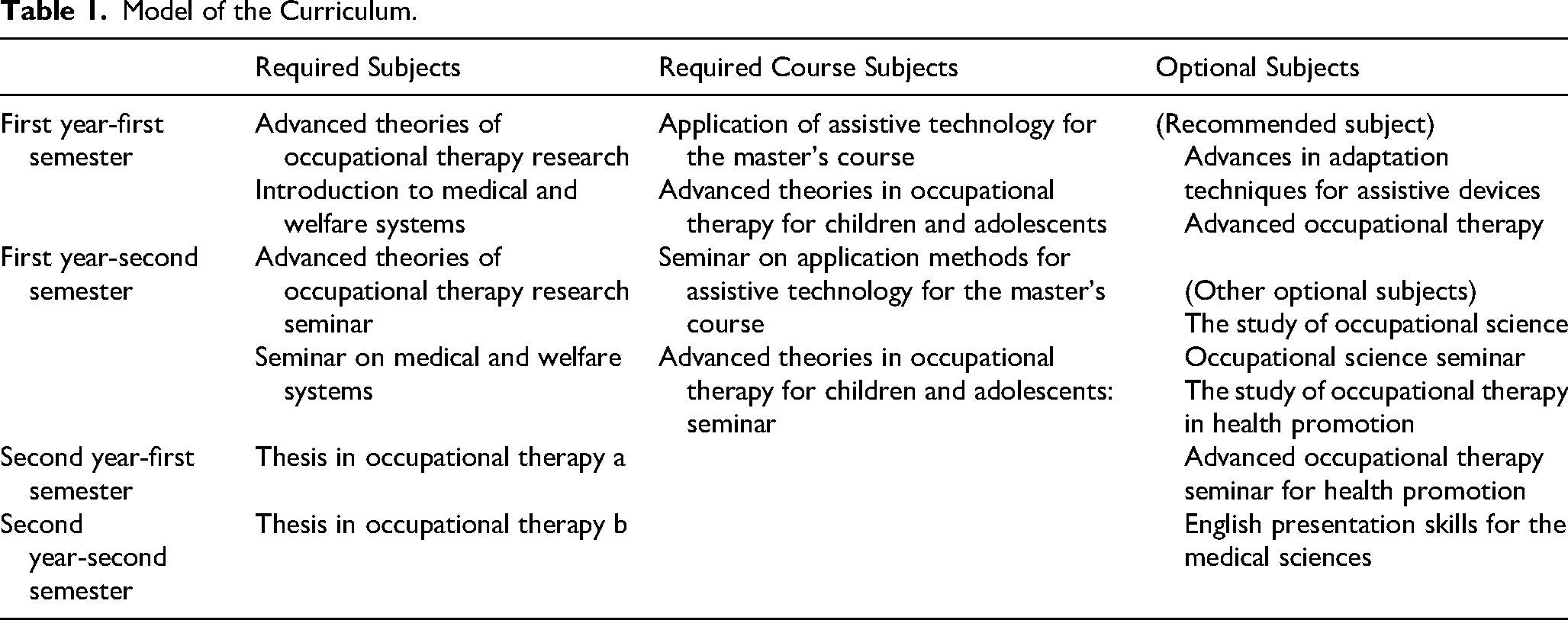
Table 1 shows the curriculum model for international students. The curriculum was created referring to the existing model of the TMU master program. The curriculum was developed from basis-required subjects, including new-set-up subjects, and all subjects, including the following, were prepared in English: Advanced theories of occupational therapy research for learning research skills, Introduction to medical and welfare systems, a special subject for international students to learn about medical and welfare systems through lecturers and clinical visits, Advances in adaptation techniques for assistive devices for assistive device planning, and Advanced occupational therapy, which features omnibus lectures on up-to-date topics in occupational therapy delivered by domestic and international lecturers. Students were also recommended to take Japanese (general and medical) and English academic writing classes.
Model of the Curriculum.
Schedule and Changes in Teaching Style
The first-term students were accepted from October 2017, and then two additional students each term, resulting in a total of 12 students entering the program (Figure 1). The enrollment time was set in October, which is a general enrollment time around the world. However, the academic schedule and enrollment time in Asian countries differ from the typical Western academic calendar, and almost all applicants were occupational therapy practitioners; therefore, the enrollment time was very flexible. In addition, in Japan, the academic year starts in April. Thus, for interactive communication with Japanese TMU students, April enrollment was considered reasonable for managing the program and providing opportunities for exchange with other Japanese graduate students. Consequently, the second-term students enrolled starting in April. As a pre-study, courses on the Japanese language and occupational therapy research theory were provided via an online platform (Google Workshop; Google, Mountain View, CA, USA). The pre-study was basically self-study supported by lectures in the 3 months before starting the master's program. After accepting the first-term students and discussing research knowledge and education in Asian countries with educators, the pre-study for research theory (skills for searching and reviewing the literature) was introduced to the second-term students. These prospective students before enrollment may have had profound knowledge and skills in their area of expertise, but lacked sufficient knowledge and skills in specific areas of academic research theory because of their home countries’ educational systems. Therefore, we based the pre-study program on textbooks related to the research project and conducted it via e-mail and electronic materials. This program aimed to prepare students to learn research theory at the postgraduate level. In the Introduction of medical and welfare systems course and the seminar related to the research project, the contents needed to be adjusted regularly to meet the needs of the students’ home countries and educational backgrounds. However, it was not easy to meet the students’ actual and practical demands. Through changes made after reviewing the contents, the program was improved to meet the demands of the students (eg, adapting a three-dimensional [3D] printer to create assistive products). On the other hand, the lecturers had to teach about the importance of learning to anticipate future health-care needs and challenges, even though the students wanted to know more about basic manual skills in occupational therapy.

Schedule of accepting students and changes.
Due to the COVID-19 pandemic, the third-term students had a 7-month delay and the fourth-term students had a 1-year delay before entering Japan. From the third term, online lectures and peer support were introduced via a cloud platform service (Slack; Slack Technologies, San Francisco, CA, USA). Under the influence of the COVID-19 pandemic, lectures and research support were provided via a video application system (Zoom; Zoom Communications, Inc., San Jose, CA, USA). These changes occurred in response to feedback from faculty and students, as well as the proactive stance that members took to advance the quality and caliber of the program.
English as the Medium for Teaching and Learning
English was adopted as the medium for teaching and learning because it was considered the most common language among partners. Therefore, students enrolling in the master's program were required to prove their proficiency in English. Employing English as the medium of instruction aimed to strengthen the students’ ability to read and contribute to the scientific literature, participate in the discourse, and set-up collaborative networks. In addition, it gave lecturers and TMU students studying with international students the opportunity to cultivate global competence. The use of English was positively received and enhanced the students’ ability to access literature and create research networks. However, a few students struggled with the academic discussions and writing in English, which may have detracted from their experience of the course and their ability to perform academically. These students probably should have learned more academic English skills before enrolling in the master's program. Although the use of English as the medium of instruction was a decision made by all partners after considering the wide-ranging benefits to the students and to the institution, as observed in other settings, 16 the field visits and data collection in Japan were limited because of the students’ low level of Japanese proficiency. Although the students acquired basic Japanese skills, they were insufficient for field visits during the program.
International Experience on Campus and Communication Among Students
Because the students in the master's program came from various Asian countries, they were able to exchange ideas and knowledge with each other, including in Japanese contexts. In the required subjects, international and Japanese students worked together and held regular meetings to exchange opinions for reviewing their research projects. In addition, the Advanced occupational therapy (one of recommended subjects) exposed students to international occupational therapy perspectives. As these activities were conducted mainly in English, Japanese students had the opportunity to discuss and learn about occupational therapy in other countries.
Faculty, Administrative Staff, and Peer Support
During the master's program, two faculty members mainly supervised the international students, and one specially appointed lecturer coordinated the project. Other faculties supported the lecturers and supervised the students’ research activities. The university office of administration supported student enrollment, visa applications, course registrations, and so on. This support was planned to be provided in English, but members of the administrative staff were periodically transferred from one department to another; therefore, some staff members from other departments were unfamiliar with international work, including the use of English. In addition, communication between faculties and administrative staff sometimes required more effort. Additional systematic communication channels and better management within the university could have been helpful. A global campus should include not only lectures in English, but also training programs for lecturers and administrative staff in regard to intercultural backgrounds and support methods for international students. Therefore, more human resources were needed in key educational and administrative positions. In addition, senior students were encouraged to support junior students in terms of studying and daily living.
Results
Achievements of the Master's Program
In total, 12 students from Thailand, Indonesia, Bangladesh, and the Philippines completed the program and earned a master's degree (in occupational therapy). In addition, all students completed an assistive device planner course, thereby gaining knowledge about assistive products and the improvement of living environments. Their research projects were distinguished at the international level and published in international journals (Table 2). An important output of the program was to strengthen research capacity, and while all students completed their research projects and presented their findings at conferences, many students also published their findings. After finishing the program, some graduates contributed to clinical practice and education in the occupational therapy field in their home countries (eg, holding seminars on the use of 3D printers, practicing clinical applications, including assistive products in occupational therapy education courses). Therefore, fostering potential lecturers for occupational therapy schools contributed to the enhancement of education and an increased number of schools in the students’ home countries, thereby strengthening the prospects for an increase in the number of occupational therapists in the future to meet health-care needs. The majority of the graduates became involved in professional training in their home countries, thereby contributing to improving and promoting the level of education. Through this project, TMU has also been deepening its ties with occupational therapy associations and transferring Japanese knowledge and technology through lectures and workshops to occupational therapy practitioners, especially in Indonesia and Bangladesh. In addition, TMU has contributed to creating and strengthening the curriculum for a diploma course at the University of Indonesia and the master's course at the Bangladesh Institute of Health Professions, and been continuously involved in educational support and training for advanced professionals.
Examples of Research Undertaken by the Students in the Program.

Current Status of Program Achievement
Graduates from the master's program acquired advanced medical skills and contributed to improving medical standards and international collaboration in their own countries after returning home. In the occupational therapy field in Asia, where there are few training schools, our graduates are expected to continue to provide educational support as lecturers at training schools in their own countries. In addition to the graduates of this program, we have launched and been running a network with other international students and Japanese graduates of our university (including clinicians) as members since 2023. Through common themes and issues across Asia, we hold regular meetings to conduct research and share information that contributes to the development of occupational therapy and education with the goal of collaborating in international teams and publishing research. We continue to build a platform that allows for ongoing connections, even after graduation, and enables international activities to be carried out with our university as a base. Furthermore, based on the developed master's program, we can receive master's students in English continuously. Through this Asian network, a foundation for international exchange and educational development in the field of occupational therapy in Japan and other Asian countries has been established, with TMU as the hub. Furthermore, these collaborations are expected to play a role in promoting international joint research and projects. In addition, through student exchange programs and regular faculty exchanges through collaboration with training schools in Asian countries, we have established a program centered on an online program (for undergraduate students) in five Asian countries based on an MoU, as well as a short-term training program for undergraduate students to experience the field of occupational therapy in Asian countries.
Discussion
The AHRD project was implemented to promote the development of human resources from Asian countries, help students acquire advanced medical skills in Tokyo and contribute to the improvement of medical skills in their home countries, act as a bridge between Tokyo and Asian countries, and promote both global partnerships with educational institutions and international awareness among students. Through the AHRD project, we have deepened our ties with Asian countries, developed global education through the continued international exchange of faculty and students, and enabled international collaboration and international joint research. In this paper, we have described the development of a master's program for international students as the main approach for developing human resources from Asian countries. In Japan, no specialized master's program in occupational therapy for international students in English had been established. Therefore, the present project, which is based on building strong relationships with institutions in other countries for meeting local demands, is unique. This program also promotes global awareness and an improved educational environment through research cooperation and the development of the professional field. On the other hand, the findings revealed a need to enhance global education on campus and develop further the knowledge and understanding of lecturers and administrative staff in regard to receiving international students.
Based on the relationship with educational institutions, students’ research projects were facilitated to contribute to the development of their improvement in occupational therapy research on both national and international levels, although the focus of the master's program was on the development of human resources for occupational therapy, especially in the areas of assistive devices and pediatrics. Through implementing the project, our department has been able to create an environment in which it can continue to accept international students in a master's program in English and provide classes to meet demands for meeting the students’ local needs. After graduating, many students have already contributed to educational and practical fields to improve occupational therapy in their home countries. Moreover, by having experts (graduate students) from Asian countries live and study in Tokyo for 2 years, they were able to not only acquire specialized knowledge and skills, but also have increased opportunities to interact with the cultures and lifestyles of each country. This, in turn, has led to an improved understanding of Asian countries among the students and faculty on campus, and the accumulation of these experiences has become the basis for continuous exchange between organizations.
This project contributed to the improvement of the global environment on campus. By learning about the domestic circumstances and educational environment in each country, it has also been the basis for improving the learning support environment for international students and deepening international understanding among our students, faculty, and staff. For TMU students, we can continue to strengthen international education on campus by continuing international exchange projects, accepting international students, and developing human resources with a global perspective through cross-cultural experiences. For faculty, we are able to strengthen efforts to deepen international experiences and multicultural understanding based on exchanges with educational institutions in Asian countries. We were also able to strengthen global activities within the school. Moreover, since the beginning of 2020, the COVID-19 pandemic had a major impact on the program through restrictions on the travel and entry of international students into Japan. However, the pandemic also provided an opportunity to create new educational and international exchange methods through the use of IT technology, allowing us to overcome various challenges in global education. Further cooperation building between educational and administrative staff could contribute to a more effective educational environment. To meet the challenges of globalization, institutions of higher learning should acquire and share skills as increasingly international and multicultural societies. In the AHRD project, international interactive experiences for students and lecturers also provide the opportunity to identify different perspectives to tackle global health issues, to share effective practices with foreign colleagues and lecturers, and to learn from each other. In this paper, we showed the outcome of students’ successful results for learning advanced occupational therapy, and the process of collaboration works with institutions in Asian countries for promoting internationalization on campus. As for examining the influence of graduated students’ careers and the effectiveness of program contents, a follow-up survey of students will be conducted.
Conclusion
As globalization expands, in addition to the professional qualification of occupational therapy, human resource development in advanced education with global qualities is crucially important, as equal and cooperative international exchange based on strengthened mutual relationships. The establishment of global environmental education programs in the project under institutional collaborative relationships has been a further step that could allow occupational therapy students and registered occupational therapists to play a more active international role in the future. In addition, the international collaboration and global educational environment fostered through this project have contributed to improving the quality of students and faculty, and a foundation has been built for the sustainable use of the results of the project, even after its completion. The early achievements and successes from this master's program have renewed our commitment to health research in resource-limited countries and universities through the development of highly qualified academics and good-quality academic programs.
Footnotes
Acknowledgments

Ethical Considerations
Not applicable, because this article does not contain any human or animal subjects.
Consent to Participate and for Publication
Not applicable, because this article does not contain any human or animal subjects.
Author Contributions
All authors were involved in the project. NS prepared and reviewed the original first draft of the manuscript. All other coauthors read and approved the final manuscript.
Funding
The authors received funding from the Tokyo Metropolitan Government through the Graduate School of Human Health Sciences, TMU, to implement the project and publish this paper.
Declaration of Conflicting Interest
The authors declared no potential conflicts of interest with respect to the research, authorship, and/or publication of this article.
Data Availability Statement
Not applicable.