



Abstract
Introduction
Teaching faculty is vital to the success of academic institutions. Academic biomedical faculty has faced greater workloads, and limited access to development opportunities. The Academy of Educational Scholars (AES) was designed as a community of practice with an embedded educational research fellowship to address the challenges of building and sustaining educational scholarship as recognized value for academic biomedical faculty careers.
Methods
An educational project-based, one-year faculty fellowship served to identify faculty motivated to join a community of practice. Fellowship curriculum development was guided by a literature review, internal needs’ assessment, and the Kerns six-step framework. The program comprised ten 3-hour workshops and two project critique sessions delivered at monthly intervals over 12 months. Immediate session evaluations and a comprehensive program evaluation were conducted, assessing program value, and improvements in educator confidence in knowledge and skill. Outcome measures included presentations at local and national conferences, numbers of abstracts submitted, publications, grant submissions and new educational roles taken on.
Results
Fellowship graduates from first 2 cohorts demonstrated a statistically significant improvement in knowledge about educational scholarship (p = 0.01) and related skills (p = 0.01). Program satisfaction was 93%. Content analysis revealed the most impactful program features were networking and joining a community focused on educational scholarship. AES fellow-produced scholarship includes 7 local/regional presentations, 10 abstracts, 6 publications, 4 grant submissions, 2 funded educational grants, and 4 new educational leadership roles. AES community activities include an annual retreat, monthly journal clubs, a teaching excellence recognition program, and a scholarship consult service.
Conclusion
Embedding an educational research fellowship into a community of practice is an effective model for building a sustainable teaching academy. Identifying local talent and incorporating member service expectations has minimized cost while incentivizing a volunteer model. Building the community of practice entailed intentional recruitment of mature educational scholars and novice fellows.
Introduction
Academic teaching faculty constitute a core resource necessary for any medical school to thrive. These faculty increasingly face greater clinical and research workloads, pressure to generate revenue, and limited access to programs building and recognizing educational scholarship, all threatening professional vitality, wellbeing and continued faculty engagement in education and academic medicine. 1 Given these competing demands, the academic faculty member's commitment to the school's educational mission relies heavily on sustaining the intrinsic motivation to teach and honing the teaching-related skillset, which is fueled by the degree to which teaching meets basic psychological needs of competence, autonomy and relatedness. 2 Reports of increasing faculty burnout in U.S. academic medicine 3 reveal a direct threat to teaching faculty as a core resource, underscoring the urgent need for feasible and sustainable interventions to reinforce the value of teaching excellence and support faculty engagement, well-being and retention.
The Long School of Medicine (LSOM) at UT Health San Antonio, through its Department of Medical Education (DME) aims to sustain medical education excellence by strengthening the vitality of its academic teaching faculty. Vitality is characterized by high levels of productivity and engagement aligned with institutional goals and leading to professional fulfillment and satisfaction. 4 Drivers of faculty vitality include opportunities for professional development, promotion and tenure, teaching support, and a sense of community.4,5 In 2019, a LSOM DME needs-assessment of faculty educators identified a deep talent pool with limited translation of educational innovation and accomplishments into educational scholarship, highly variable department-level support of faculty development in teaching, and no community of educational scholars at the institutional level. These findings informed the need to create a faculty development program as well as a community or academy of faculty for collaboration and promotion of scholarly work in medical education.
Other academic medical institutions have developed educational fellowships and educator academy programs that offer longitudinal faculty development activities to improve teaching and scholarship skills. 6 These programs fill an important gap by preparing new faculty with skills that are necessary for educators yet are seldom taught in residency or postdoctoral research training programs. While program outcome measures frequently include scholarly presentations, abstracts, publications, or faculty promotion,7–12 limited attention has been focused on developing a long-term community committed to sustaining academic faculty educator career success.
Communities of practice (CoP) have been previously described as a successful framework to facilitate collaboration and productivity for international medical specialty societies 13 simulation programs, 14 and surgical journal clubs. 15 A CoP framework is a structured model that guides the formation and growth of groups whose members share a common concern, passion, or interest and seek to improve through regular interaction. Communities of practice focus on creating a welcoming community, role modeling, mentoring, providing faculty development, and recognizing the necessity to progress toward membership in the community.
Given the dual goals to provide intentional faculty development in education and develop a thriving community of medical education scholars, we selected the CoP 16 framework to inform development of our Academy of Educational Scholars (AES). The CoP framework comprises three key structural aspects: domain, community, and practice. The AES program domain is scholarship in biomedical education. The community comprises LSOM faculty who identify as clinical or basic science biomedical educators. Practice is the dynamic interplay among community members, supporting mutual engagement and affirmation in teaching and educational scholarship activities. A thriving CoP relies on practice being honed via shared knowledge and experiences, thus producing observable outputs in the shared domain for members in the immediate community with expansion to the larger community. 17
The purpose of this report is to describe the development, implementation, and impact of a biomedical teaching academy designed to be reinvigorating and self-sustaining by intentionally embedding an educational research fellowship into a CoP. The overarching goal is to cultivate a rich and cohesive community of educational scholars that reinforces educator identity and value while supporting all LSOM educators. We define an educational scholar as someone who systematically investigates and evaluates educational activities such as teaching practices, curriculum design, or learner assessment, to contribute new knowledge or insights and advance the field of medical education. Our objective was to innovate a faculty development program that would self-propagate a CoP comprised of medical educators. Ideally, the members of the CoP would continue serving the institution as advisors, mentors, teachers, and program committee members, advancing the quality of educational scholarship and achievement at our institution in perpetuity.
Methods
Setting and Participants
The Long School of Medicine (LSOM) at UT Health San Antonio DME together with the Office for Faculty developed a multi-faceted faculty development initiative called the Academy of Educational Scholars (AES). The initiative began in 2021 and is ongoing. The primary pathway to new AES membership was devised to entail completion of a mid-career faculty fellowship that incorporated fundamental educational research training focused on an educational project requirement. We sought to recruit mid-career faculty with teaching experience who were likely to be committed to our long-term goals and actively contribute to the group. Mid-career was defined as individuals who were at least 7–10 years out of training (late assistant professor or early associate professor level). The program design was aimed at preparing teaching faculty for the rigors of a successful academic medicine career where scholarship is valued and success is defined through a faculty promotion and tenure system. The reporting of this study follows the SQUIRE guidelines. 18 The study evaluates an intervention (Educational Research Fellowship embedded in a Community of Practice) to improve educational scholarship and community among biomedical faculty. We describe the development, implementation, and assessment of an educational program, focusing on both processes and outcomes, specifically knowledge, skill improvement, and scholarly productivity. The methodology includes curriculum design, outcome metrics (presentations, publications, grant submissions), and participant satisfaction, aligning with quality improvement and educational evaluation reporting.
Baseline Information on Participant Level of Education Scholarship
A considerable portion of participants had previously attended the LSOM Undergraduate Medical Education (UME) Office's faculty development sessions and then completed some or all the AAMC Medical Education Research Certificate (MERC) sessions required for certification.
Teaching faculty, for the purpose of this program, includes both basic science faculty who teach foundational sciences in a classroom setting and clinical teaching faculty, who teach in clinical learning environments (hospital, clinic, operating room). Only a small number hold advanced degrees, such as a Masters or PhD in education or health professions education. Our assessment revealed that while we had strong educators, there was a gap in translating educational innovations into scholarship through dissemination.
The AES program capitalizes on the revitalizing cycle of fellowship graduates joining the existing AES community of experienced educators to serve as advisors, mentors, teachers, and AES committee members. A limited parallel pathway for membership, legacy membership, was created after the first year for more senior educators who were not part of the initial founding group to join the AES through demonstration of sustained efforts in educational scholarship. The AES website contains descriptors, expectations and application for faculty interested in pursuing legacy membership.
Ongoing recruitment for AES community members occurs via an annual call for new faculty fellow applicants each calendar year and rolling applications for legacy membership. All new members are expected to be actively engaged in the practice of the community through service, such as serving as a core committee member or a peer-mentor for fellows and other educators as a condition of membership.
Program Description and Development
Stakeholders played key roles in shaping both the content and structure of our program. Current faculty shared insights into their perceived knowledge gaps, learning needs, and career goals. Educational leaders helped identify broader educational needs and highlighted existing institutional resources. Institutional leaders ensured the program aligned with strategic priorities and committed the necessary resources. Advisory committees offered best-practice guidance to inform curriculum development. The one-year faculty fellowship was established to focus the AES CoP on providing mid-career experienced educator faculty members with a pivotal developmental opportunity while also providing a means to grow and sustain the CoP itself. The design aimed to solidify the fellow's career commitment to education in academic medicine by providing experiential growth in identity and belonging, a deeper foundation in educational scholarship principles, and success with creating and implementing an educational research project of recognizable scholarship value. The Education Committee developed the fellowship curriculum following Kerns six-step approach 19 as guided by literature review, internal needs-assessment data, and community expertise. (Table 1)
Kern's Six-Step Approach Applied to our Medical Education Fellowship Curriculum.

Note: Each step is interactive and cyclical, supporting ongoing curriculum refinement and alignment with institutional and learner needs.
The program incorporated interactive teaching methods and adult learning principles to produce workshops about curriculum development, assessment, leadership, and scholarship consistent with previously published core content for education scholarship fellows.20,21,22 The final curriculum comprising 10 three-hour workshops and two formal project presentation sessions is delivered at monthly intervals over the span of a year. The first year of the fellowship curriculum relied heavily on AAMC MERC 23 courses offered virtually, in part due to COVID restrictions. MERC is a program within a larger professional development program offered through the Association of American Medical Colleges (AAMC). The program comprises a series of three-hour workshops designed to provide foundational knowledge and practical skills in medical education research for faculty, clinicians, and educators, particularly those with a background in medical education but limited experience in conducting educational research. Appendix 1 summarizes the content of each AES fellow curriculum session, with MERC-based material indicated by an asterisk.
During the fellowship year, fellows are required to design and complete a high-quality longitudinal educational research project, ideally publishable and/or fundable. Peer mentoring was incorporated by AES members serving as mentors to guide fellows’ research projects and build identity and a sense of community and belonging (Figure 1).

Faculty Fellowship Components within the Community of Practice (CoP) structures of domain, community and practice.
The first call for fellow applications occurred in 2022. The application must include an educational research project proposal and evidence the applicant showed motivation and dedication to sustaining educational scholarship practices within the AES community. Department chair support for time in the program is required, since faculty fellows receive no financial support through the medical school. Fellows successfully completing the AES fellowship training are formally inducted into the AES CoP with the expectation of active engagement and service in the community.
Program Evaluation and Data Analysis
AES program leadership and the Evaluation and Writing Committee collaboratively designed a program evaluation to measure the impact of the short-, medium-, and long-term outcomes according to the AES program logic model (Figure 2). For the fellowship portion, structured evaluations of each session and a comprehensive end-of-program evaluation were conducted. Participants provided consent for aggregate, deidentified information to be used in this project.

Logic Model for AES Program. Figure Acknowledgment: Jean Petershack, MD, Elizabeth Hanson, MD and Janet Williams, MD.
14 of 15 graduates completed the pre–post surveys for a 93% completion rate. The dataset was reviewed for missing values, duplicate records, and patterns to identify gaps or inconsistencies.
Short Term outcome measures for fellowship program: Following each educational session, a 5-item survey was sent to participants to assess the session. The survey was created and responses were stored within the secure web-based program, Research Electronic Data Capture (RedCap). It asked participants how useful the session content was to their practice and how effective the session leader was (rated on a 5-point Likert scale). Three open-ended response items were included (best takeaway point, points that were unclear and suggestions for improvement) (Supplemental File 1).
Medium term outcome measures: The overall program evaluation was sent to participants on the first and last day of the program. It contained a self-assessment of related knowledge and skills both before and after the program (Supplemental File 2)
Categorical data (survey responses using 5-point Likert scale) to the queries “How Confident did you feel in your knowledge of educational scholarship?”, and “How Confident did you feel in your skills as an educational scholar?” were compared pre and post program using Wilcoxon rank sum test with statistical significance defined as a p value of <0.05. The effect size was large as is reflected by Cohen d test (d = 1.2). (Table 2).
Paired Comparison for End-of-Session AES Faculty Fellow Program Survey Results (2021 and 2022 Cohorts).
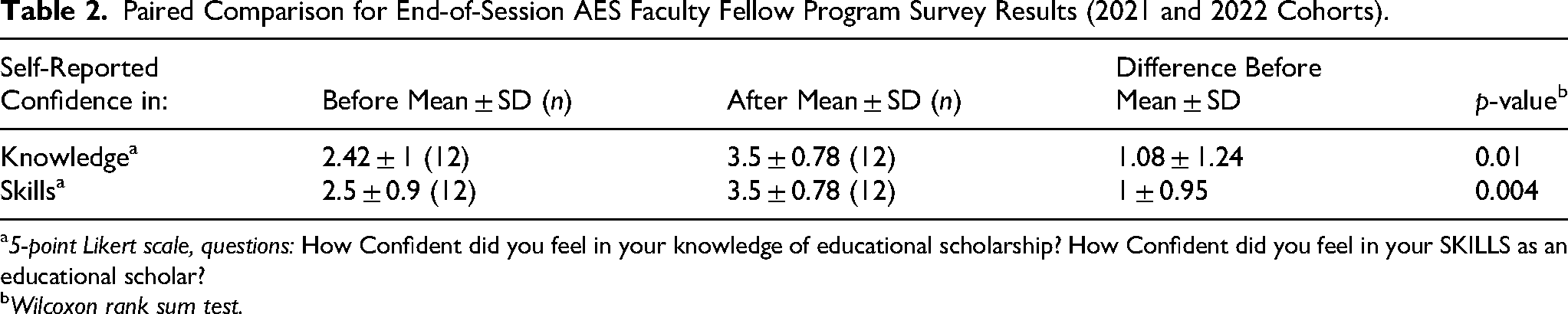
5-point Likert scale, questions: How Confident did you feel in your knowledge of educational scholarship? How Confident did you feel in your SKILLS as an educational scholar?
Wilcoxon rank sum test.
We also collected fellow responses to two open ended questions as part of the end-of-program evaluation. Additionally, free-text responses asked participants to identify the most and least effective sessions, suggest improvement areas, cite the most valuable program component overall, list personal scholarly output resulting from the fellowship year and state how their approach to educational scholarship changed because of program participation.
Long term outcome measures for the program as a whole, tie back to the logic model (Figure 2) and include numbers of education-related presentations at local and national conferences, numbers of successful abstracts, publications, and grant submissions, and being named to new educational leadership roles. CoP is another long-term outcome we are interested in, though specific questions on this aspect were not included in the program evaluations.
Ethics Approval
This project was reviewed by the UT Health San Antonio Institutional Review Board and received an EXEMPT designation. Scholarly output data were self-reported and collected by authors EN and SB.
Results
Short to medium-term outcomes of the AES program include the creation of the AES infrastructure and initial work of each of the four committees as outlined in Table 3.
AES Program Short to Medium Term Outcomes.
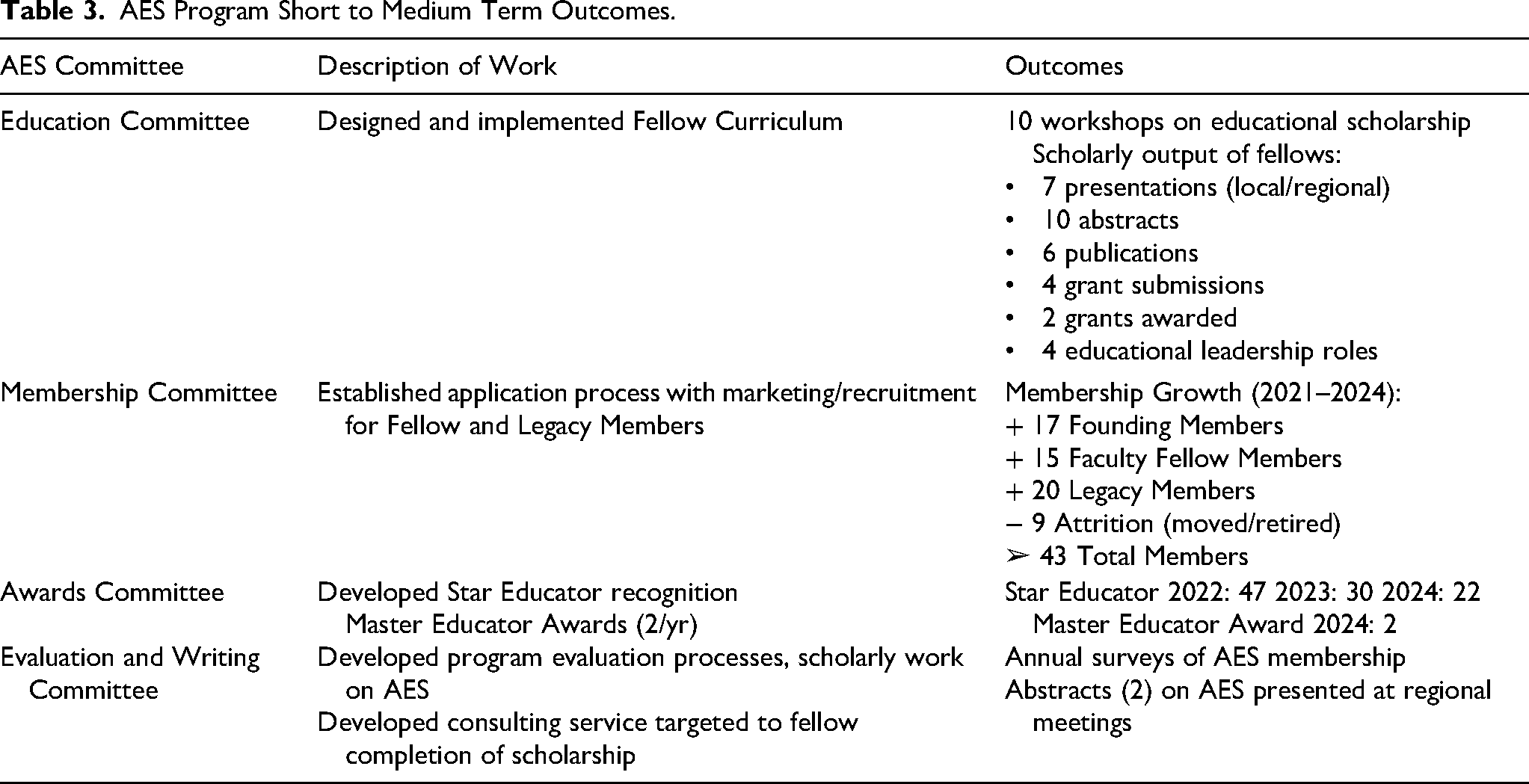
Creation of Star Educator recognition was a short-term outcome that honored 47 LSOM faculty during the first year of the program and 52 in the following two years. AES Star Educators are recognized for their innovative curriculum development, transformative teaching methods, exemplary service as mentors and collaborators, compassionate role modeling as educators, and their ability to inspire and motivate learners and colleagues across departments, with a commitment to reach all learners equitably with intellectual curiosity and humanism.
Medium to long-term outcomes include creation of the AES community, mentorship program, and educational scholarship. The community of practice aspect of the program was identified early in the program evaluation as one of its key benefits.
The AES has grown from the initial 17 founding members to 43 active members through the Fellowship and Legacy pathways, with an ongoing growth of 3–5 members per year anticipated (Appendix 2). Over three years, we have enrolled 18 fellows from 11 different departments, three from basic science departments and 15 from clinical departments. AES members have various degrees, including 26 MD, 13 PhD, one PharmD and one PsyD. Clinical department representation includes Family Medicine, General Surgery, Internal Medicine, Obstetrics and Gynecology, Otolaryngology, Pathology, Pediatrics, and Psychiatry.
AES Program Evaluation Results
Fellowship graduates have continued AES participation with 7 of the first cohort of 9 currently serving on AES committees, 4 teaching in the fellowship program and 6 mentoring new fellow projects. By the third fellowship year, a Fellowship Director was needed, and this position was successfully created to oversee curriculum organization and delivery with Education Committee guidance. One fellowship graduate gained a Department of Medical Education appointment to serve as the inaugural AES Fellowship Director. Three other graduates now serve in LSOM educational leadership roles, an Assistant Dean for Faculty, an Assistant Dean for Undergraduate Research and an Assistant Dean of Health Systems Science. All positions are supported percentage full-time equivalency (FTE) positions. These findings reflect the AES logic model (Figure 2), demonstrating how the program has created tangible long-term impact.
Educational scholarship output from Faculty Fellow members includes local/regional presentations (7), abstracts (10), publications (6), and new educational leadership roles (4) (Appendix 3).
Additional AES community activities include hosting an annual AES retreat, an annual formal AES induction ceremony, and a monthly AES journal club. A teaching excellence recognition program and a scholarship consult service have been instituted.
Although the first year of the fellowship curriculum relied heavily on AAMC MERC courses offered virtually, in part due to COVID restrictions, local development and delivery of content through the AES CoP has steadily increased. After the initial 2 years of the curriculum, AES members now deliver over 90% of the curriculum with yearly adjustments based on fellow feedback. All sessions were rated as ‘useful,’ and the majority ranked as ‘extremely useful.’ Using a pre-post fellowship curriculum evaluation, fellows reported improvement in confidence about educational scholarship knowledge and skills (Table 2). Participants indicated high satisfaction with 92.9% having recommended fellowship participation to a colleague. Content analysis of written evaluation comments revealed that the two most impactful features of the program were being able to participate in networking and become part of a learning community focused on educational scholarship. (Table 4)
Post Program Evaluation Survey Responses Years 1–3 (by Theme).

(n = 15) Of the 15 who responded to the survey, 14 provided written comments. AES: Academy of Educational Scholars Program.
Discussion
Various academies and programs differ widely in purpose and development and continue to evolve to meet nationally recognized needs to recognize teaching excellence, support faculty development, and encourage scholarly activity. Our manuscript adds to the existing literature by describing an innovative approach to creating a feasible, resilient, and self-sustaining educational academy in the face of the current challenges faced by academic biomedical educators. We consider the program feasible in that it is achievable given the currently available resources, constraints, and circumstances. Minimal financial outlay is required given the voluntary nature of all members. The program is self-sustaining in that it can operate, adapt, and thrive relying on its own resources and capacities, ensuring long-term viability. Program resilience is based on having an ongoing cadre of engaged faculty to support and sustain the academy, such that if one person is unavailable others can easily backfill to ensure consistent operations.
The AES is intentionally grounded in a CoP framework to provide a supportive and rewarding scholarly environment with the primary purpose of supporting the academic careers of teaching faculty through an experiential skill-building fellowship to grow educational scholarship, build educator identity, reinforce community belonging and support the retention of academic biomedical faculty educators. Shared rituals such as the AES induction ceremony and AES STAR educator awards reinforce and elevate the community of teachers and scholars at LSOM. Graduates from the fellowship program join the AES as working members of this CoP and continue to serve the community through committee service, leading fellowship program workshops, role-modeling, and mentoring incoming fellows. This reciprocal engagement is foundational to how AES is structured and differentiates it from other programs that offer similar fellowship training to biomedical educators. 24
The AES differs from other educator academies, faculty development programs and medical education research programs. Educator academies vary in purpose which is reflected in member selection processes, membership size and terms. Most academies serve a dual role, being both honorific and service oriented. Service-oriented activities include providing faculty development, networking, and a community of practice. 25 Most educator academies use a type of nomination process for determining membership with half reporting a self-nomination approach.24,25 Academy membership through a self-generated application focused on a mentored educational research project, such as AES uses, has not been reported. Academy size range between 17–250 or greater, 26 so AES size is relatively small. Over half of academies have membership term limits ranging from one to six years,24–25 whereas AES membership is term-limited by no longer participating in the community.
Reported academy budgets range from $10 000 to at least $6 million dollars. Similarly, national medical education research training programs such as the AAMC MERC program require a significant investment of resources for tuition and travel. The LSOM AES budget totals only $6000 and relies heavily on sustained leadership, peer-mentoring, and role-modeling from a core group of AES members and other faculty volunteers. AES began with 17 founding members, growing over 3 years to 43 members. Since AES activities rely on an active and revitalizing CoP, a lower financial commitment has been needed to sustain academy activities, namely the fellowship training. Several centers also offer longitudinal faculty development programs to biomedical educators. 27 However, the AES is unique in integrating graduating fellows into the fellowship program as mentors and teachers for subsequent cohorts. While most faculty development programs target early career faculty, the AES intentionally recruits mid-career faculty. This is noteworthy since mid-career faculty report finding limited opportunities for mentoring and professional development. 28
Rosenbaum et al 29 from the University of Iowa College of Medicine reported benefits of a locally based Teaching Scholars Program, and the importance of peer-physician trainers serving as teaching resources. To populate AES and capture local talent, established faculty with experience in the domains of curriculum development, qualitative research, teaching, scholarly dissemination, and professional development were recruited to join AES through a legacy membership pathway. AES members joining through either the fellowship or the legacy pathway are expected to participate in teaching workshops, provide mentorship, and serve on committees. By utilizing our LSOM community of physician educators to teach in the fellowship program, AES has had relatively low operating expenses and many opportunities for fellowship graduates to practice their skills. While the focus of the Iowa program is on helping trainees develop faculty development programs for their home departments, our AES program serves faculty across all basic science and clinical departments at our medical school, particularly in practicing educational research skills. Participation of different departments was tracked over several years of the Iowa program, noting that basic science departments do not participate. By having an open annual call for applications, and a scholarship focus aligned with the promotion and tenure guidelines for all academic faculty, the LSOM AES has continued to recruit fellows from both the basic science and clinical departments.
Outcomes data on medical education fellows completing a fellowship may focus on scholarly activity such as numbers of presentations or publications, successful grant applications, achieving promotion, or attaining a leadership position. Surveys and CV reviews were the most common tools used to measure outcomes. Interestingly, Lowen et al 30 explored the perspectives of graduates on their skills, self-perceptions, participation in learning communities, and reflective practice using qualitative analysis. Two of the most common themes they identified: identity as educators and community (meet regularly with like-minded people) were similar to what our fellows reported.
Self-identification as a member of a group of educators or a larger “community of practice” 31 with similar values and interests provided a sense of validation, as well as career and networking opportunities. Membership in a community of practice is significant because researchers have found that collegial networks are a significant predictor of academic success. 32 Building a sense of validation, belonging, and collegiality plus gaining experience with academic success all potentially contribute to well-being, career satisfaction and faculty retention.
Our structure fosters the formation of a developmental network 33 of LSOM medical educators, thus supporting and sustaining the CoP as fellows receive guidance from near-peer AES mentors. In return, those mentors experience fulfillment and engagement thus deepening the AES sense of community, and potentially the greater LSOM sense of educator community. With fellowship curriculum and project completion that builds relatedness through experiencing longitudinal mentorship and ongoing CoP support, the faculty fellowship model is designed to foster motivation to participate in educational scholarship by supporting the basic psychological needs of competence both of which would be expected to contribute to intrinsic motivation under self-determination theory. 1 The longitudinal mentorship pathway offers several potential benefits, including improving recruitment and retention of fellows as academy members and reinforcing the active service standard expected of all members.
Strengths and Limitations
We present the creation of a unique academic medicine teaching academy based upon the Community of Practice framework with an embedded faculty fellowship focused on becoming successful in educational research. The fellowship and thus membership targets mid-career faculty with demonstrated dedication to developing a scholarship strength in Teaching, aligned with our institution's promotion and tenure system. The AES was planned as a self-sustaining model that requires minimal funding. Faculty and fellows have been successfully recruited from a broad range of biomedical specialties, including basic science departments.
One study limitation is that we are reporting only three years of outcomes data from a single institution, which may limit the translation of our findings to other institutions or health profession disciplines. Outcomes data will continue to track whether the program sustains its scholarly activity results and whether any faculty well-being or retention data may be attributable. The relatively high number of new educational roles created and populated by AES graduates may become less available in the future. Our analyses are based on participants’ self-reporting and may be subject to recall bias. Our survey was adapted from existing evaluations and modified for this specific program. Survey construction was based on literature review and expert opinion, providing some level of content validity; however, the instrument itself has not been validated. Similar to other faculty development programs, no control group was used as a comparison.
Lessons Learned and Future Directions
Based on program evaluations and outcomes, AES has met its goals to provide educational faculty development for its members and establish a community of practicing educational scholars. Identity formation as an educator and having a sense of community around a shared purpose for educational scholarship was perceived as one of the largest benefits of the program in our post program evaluations. The integration of mentorship throughout not only the fellowship program, but also the entire organization as modeled by leadership, has helped to create and foster a sense of belonging and support for all members. Confidence in one's skills, having a supporting community and developing a strong sense of belonging and community are key factors in faculty satisfaction and well-being. Understanding one's career progression is aligned with the expectations of the academic environment and the system for promotion and tenure also builds satisfaction and boosts faculty retention. The expectation of service as part of membership in AES has allowed us to continue expanding and building our network of both teachers and leaders for the fellowship program and has generated the potential for the academy to be sustainable long term. The initial formation and momentum of the AES fellowship program required intensive time and energy investment by faculty volunteers. This highlighted the need for founding members to build a pool of talent, expertise, instructors, and mentors for the program as quickly as possible. Reliance on the community of educators in our institution has been stimulated through ‘active practice’ by the community, and the AES has grown into a highly valued and respected LSOM resource despite budgetary constraints.
Given the growing participatory community, we predict AES will continue to be member-sustaining and reinvigorating while positively impacting educators across our institution. It is thus important to continue to monitor AES program outcomes, including fellow and CoP accomplishments in educational research and productivity as well as career trajectories.
Going forward, mentor evaluations could be added to assess their perspective and better understand the personal and professional impacts of serving in this role. Assessing mentor experiences could provide valuable insights into the benefits, challenges, and potential areas for program improvement. Additionally, our evaluation committee plans to approach members of AES and qualitatively assess their experience as AES members, and we plan to ask specific questions about the community aspect.
Studying the relationship of CoP participation, educator identity formation, and development of ‘belonging’ will reveal AES effects on faculty recruitment, engagement, well-being, advancement and retention and thus inform future direction of the academy in supporting the resilience of educator faculty as academic medicine continues to evolve.
Conclusion
The Academy of Educational Scholars (AES) integrates an educational research fellowship within a community of practice (CoP) to build a sustainable and resilient teaching academy. By recruiting both experienced scholars and novice fellows, AES fosters mentorship, scholarship, and professional identity development while minimizing costs through voluntary member engagement. This model is unique in embedding service expectations and shared rituals, such as induction ceremonies and educator awards, to strengthen community bonds and elevate teaching excellence. The program is considered feasible because it requires minimal financial investment, relying on local talent and intrinsic faculty commitment. Its resilience stems from a steady cadre of active participants who ensure continuity, adaptability, and long-term growth even when individuals transition out. Graduates become active contributors through mentoring, workshops, and committee service, reinforcing a cycle of reciprocity that distinguishes AES from other educator development programs and ensures sustained academic faculty support and scholarly engagement.
Supplemental Material
sj-docx-1-mde-10.1177_23821205251385009 - Supplemental material for Establishing a Sustainable Teaching Academy by Embedding an Educational Research Fellowship into a Community of Practice
Supplemental material, sj-docx-1-mde-10.1177_23821205251385009 for Establishing a Sustainable Teaching Academy by Embedding an Educational Research Fellowship into a Community of Practice by Erin L. Nelson, Elizabeth Hanson, Sylvia Botros-Brey, Sarah Page-Ramsey, Temple Ratcliffe, Ankur Segon, Kristine S. Vogel and Janet Williams in Journal of Medical Education and Curricular Development
Supplemental Material
sj-docx-2-mde-10.1177_23821205251385009 - Supplemental material for Establishing a Sustainable Teaching Academy by Embedding an Educational Research Fellowship into a Community of Practice
Supplemental material, sj-docx-2-mde-10.1177_23821205251385009 for Establishing a Sustainable Teaching Academy by Embedding an Educational Research Fellowship into a Community of Practice by Erin L. Nelson, Elizabeth Hanson, Sylvia Botros-Brey, Sarah Page-Ramsey, Temple Ratcliffe, Ankur Segon, Kristine S. Vogel and Janet Williams in Journal of Medical Education and Curricular Development
Supplemental Material
sj-docx-3-mde-10.1177_23821205251385009 - Supplemental material for Establishing a Sustainable Teaching Academy by Embedding an Educational Research Fellowship into a Community of Practice
Supplemental material, sj-docx-3-mde-10.1177_23821205251385009 for Establishing a Sustainable Teaching Academy by Embedding an Educational Research Fellowship into a Community of Practice by Erin L. Nelson, Elizabeth Hanson, Sylvia Botros-Brey, Sarah Page-Ramsey, Temple Ratcliffe, Ankur Segon, Kristine S. Vogel and Janet Williams in Journal of Medical Education and Curricular Development
Footnotes
Acknowledgements
Jean Petershack, MD

Ethics Approval
This project was reviewed by the Long School of Medicine Institutional Review Board (IRB) and received an EXEMPT designation. Scholarly output data were self-reported and collected by authors SBB and JW.
Consent to Participate
Participants provided verbal consent for aggregate, deidentified information to be used in this project.
Author Contributions
SBB, JW and EN contributed to the study conception and design. EN was the major contributor in the writing and editing of the first draft of the manuscript. Authors 2–8 provided input, comments and editing. AS performed and analyzed the statistics that contributed to the results of the manuscript. All authors read and approved the final manuscript.
Funding
The authors received no financial support for the research, authorship, and/or publication of this article.
Declaration of Conflicting Interests
The authors declared no potential conflicts of interest with respect to the research, authorship, and/or publication of this article.
Supplemental material
Supplemental material for this article is available online.
Appendix 1. Curricular Sessions for AES Faculty Fellowship (2023-2024 iteration)

| Session Number | Description | Educational Objectives |
|---|---|---|
| 1 | Introduction, outline of program and expectations, library services, Introduction to Conceptual Frameworks |
Remember: Identify the key components of the program, available library services, and examples of conceptual frameworks. Understand: Describe the program structure, participant expectations, the role of library services, and the importance of conceptual frameworks in scholarly work. |
| 2 | *How to refine your research question |
Remember: Define the components of the FINER matrix (Feasible, Interesting, Novel, Ethical, Relevant) Understand: Explain the purpose and importance of each FINER criterion in research question development Apply: Use the FINER matrix to assess and refine a proposed research question |
| 3 | *Intro to Qualitative Research |
Remember: List the key characteristics of qualitative research methodology. Understand: Describe the fundamental principles and purposes of qualitative research. |
| 4 | Maximizing the mentoring relationship |
Remember: Define mentoring, coaching, and sponsorship. Understand: Explain the differences and similarities between mentoring, coaching, and sponsorship. Analyze: Compare the roles and expectations of mentors, coaches, and sponsors in supporting career growth |
| 5 | *Survey Development |
Remember: List the key principles of effective survey design. Understand: Describe the importance of question clarity, response options, and survey structure in educational research. Apply: Construct sample survey questions to minimize bias and enhance reliability. |
| 6 | Curriculum Development |
Remember: List the six steps of Kern's curriculum development model: problem identification/general needs assessment, targeted needs assessment, goals and objectives, educational strategies, implementation, and evaluation and feedback Understand: Describe the purpose and importance of each step in Kern's model within the curriculum development process. Apply: Identify examples of how each step in the curriculum cycle can be approached as a scholarly activity (eg, publishing needs assessments, evaluating educational strategies). |
| 7 | Project Presentations with Founding Members and Local Mentors | Each fellow 5 min presentation, 5 min questions/feedback |
| 8 | Understanding the Educational Value Unit |
Remember: Define eRVU and describe its basic components. Understand: Explain the purpose of eRVU and how it functions within PTAC. Apply: Identify examples of how each step in the curriculum cycle can be approached as a scholarly activity (eg, publishing needs assessments, evaluating educational strategies). |
| 9 | Scholarly Writing for Medical Education – From Idea to Manuscript |
Remember: Identify the key components required for manuscript preparation (eg, abstract, introduction, methods, results, discussion, references). Understand: Describe the purpose and structure of each section of a scholarly manuscript. Apply: Organize data and findings from a completed project according to standard manuscript sections. |
| 10 | Intro to Educational Grant Writing |
Remember: List common requirements and components of educational grant applications. Understand: Explain the rationale behind key best practices in grant writing and submission. Apply: Use recommended tips and strategies to prepare a competitive educational grant proposal. |
| 11 | Project presentations |
*indicates AAMC MERC based session.
Appendix 2. AES Growth Through the Fellowship and the Legacy Pathway

| Year | Founding Member | Faculty Fellow Accepted | Faculty Fellow Inducted | Legacy Member Inducted | Attrition (Retired or Moved) | Total |
|---|---|---|---|---|---|---|
| 2019 | 17 | 17 | ||||
| 2021 | 10 | 6 | 11 | |||
| 2022 | 9 | 17 | 1 | 36 | ||
| 2023 | 4 | 3 | 1 | 1 | 39 | |
| 2024 | 4 | 3 | 2 | 1 | 43 |
Appendix 3. AES Fellow Scholarly Output: (2021-2023 Graduates,n = 12)

| Local/regional Presentations | Abstracts | Publications | Grants Awarded | Leadership/Educational Roles | AES Service | |
|---|---|---|---|---|---|---|
| 2022 | 4 | 6 | 2 | 2 | 9 (2 in leadership roles) | |
| 2023 | 2 | 1 | 2 | 1 | 1 | |
| 2024 | 3 | 2 | 3 | 1 |
References
Supplementary Material
Please find the following supplemental material available below.
For Open Access articles published under a Creative Commons License, all supplemental material carries the same license as the article it is associated with.
For non-Open Access articles published, all supplemental material carries a non-exclusive license, and permission requests for re-use of supplemental material or any part of supplemental material shall be sent directly to the copyright owner as specified in the copyright notice associated with the article.
