



Abstract
OBJECTIVES
This research explores the perceptions of medical students regarding self-assessment techniques in clinical studies at public universities in Anambra State, Nigeria. Specifically, it investigates the benefits of these techniques and their perceived alignment with formal evaluations conducted by supervisors.
METHODS
Utilizing a descriptive cross-sectional study design, data were collected from 273 consenting medical students through an online questionnaire. The questionnaire was developed to capture students’ demographics, experiences with self-assessment, and perceptions of its benefits in relation to supervisor evaluations.
RESULTS
Results indicate a balanced representation of gender among respondents, with the majority falling within the 21‒25 years’ age range, and nearly equal participation from students at the 500 and 600 levels across two institution types, Federal and State. The findings reveal a positive alignment between students’ perception of self-assessments and formal evaluations, with no significant discrepancies observed between institutions or levels of study. Additionally, participants widely perceive self-assessment as beneficial for enhancing confidence, identifying learning gaps, fostering professional growth, and improving communication skills. Furthermore, students from both institutions and across different levels of study report similar perceived benefits from engaging in self-assessment practices.
CONCLUSIONS
There is a strong alignment between medical students’ perceptions of self-assessments and formal evaluations, with no significant differences found across institutions or stages of study. Overall, self-assessment was viewed as valuable for boosting confidence, identifying areas for improvement, supporting professional development, and enhancing communication skills. Further exploration of students’ perspectives will offer valuable insights for educators to design effective learning strategies and promote lifelong learning habits among medical students.
Introduction
Medical field is a dynamic and ever-evolving profession. Its students are exposed to several knowledge and skills for successful practice, but above that, self-awareness is considered an essential attribute to attend to the needs of patients and when it is lacking, students and clinicians may not have sufficient learning.1,2 It has been observed that didactic approach involving seminars and lectures dominate in medical education. 3 However, as future medical professionals transit from pre-clinical classrooms to the clinical settings, there is a heightened need to shift from didactic learning to the practical realm of patient care as the challenges they face are quite amplified. 4 The clinical learning environment should place emphasis not only on theoretical knowledge and skills but also on the ability to critically reflect, introspect, adapt, and grow from experiences. 5 Deep and strategic learning styles, and inculcation of effective skills are needed.6,7 The overall intention is to produce graduates who are personally motivated to achieve success academically and are confident in facing future challenges. Self-assessment is therefore of paramount importance.
Historically, medical education emphasized traditional methods of teaching and objective assessments. Traditional assessment methods often create a passive learning environment, where students are mostly receivers of information rather than active participants. This can result in a superficial understanding of material, insufficient preparation for clinical situations, and low student engagement. These issues highlight the necessity for more dynamic assessment strategies that promote self-directed learning and reflection. However, in the past few decades, there has been a paradigm shift. Researches have shown that today's medical curricula across the globe recognize the importance of reflective practice, self-regulated/directed learning, student-centered teaching activities, placing emphasis on the student's ability to evaluate and monitor their own learning progress.6,8–10 This shift is not just pedagogical but arises from an understanding that self-regulated and self-assessment capabilities are vital for lifelong learning and continuous professional development. The foundation of self-assessment lies in the belief that medical students, when given the right tools and guidance, can be the primary drivers of their own education. By evaluating their performance, they can identify gaps in their understanding, refine their skills, and ultimately provide better patient care. This study therefore appraises medical students’ perceived benefits of self-assessment techniques in their clinical studies as well as the perceived alignment of the assessment to their supervisors’ evaluation. Through this exploration, we aim to confirm from students’ perspective the acclaimed value of self-assessment in molding competent, reflective, and self-aware medical professionals in Anambra State, south-east Nigeria.
Students Perception of Self-Assessment Benefits and Alignment With Supervisors Evaluation
Self-assessment has emerged as a pivotal component of medical education, particularly within clinical studies, where the integration of self-directed learning is increasingly recognized as vital for developing competent healthcare professionals. This literature review explores the benefits of self-assessment from the perspectives of medical students in public universities in Anambra State, Nigeria, while also examining how well students perceive their self-assessment results align with formal evaluations from supervisors.
Benefits of self-assessment
Enhancing learning and reflection
Self-assessment encourages students to actively engage with their learning process, facilitating deeper understanding and retention of clinical knowledge. A study by Preston et al explored medical students’ perceptions of assessment and feedback and their impact on learning and exam performance, utilizing a mixed methods design, including a questionnaire and focus group discussions. Survey results were compared with students’ performance data and academic coordinators’ views. Students’ perceived assessment difficulty aligned with their exam performance, showing improvement in clinical assessments as they progressed. Students valued feedback for improvement and wanted it to be timely, high-quality, and personalized. Academic coordinators noted that some student suggestions were more practical than others. While students had a positive attitude toward assessments, they stressed the need for educators to emphasize their relevance to clinical practice. 11 Reflective practices in education are widely encouraged and integral to professional reviews. While the benefits for students are well-documented, less attention is given to the advantages for educators. 12 Additionally, the literature on reflective practices is often filled with conflicting terminology and complex studies, which can hinder educators’ understanding and adoption of these practices. 12
Educational research evaluating student learning should prioritize competency measures as the main outcome, rather than relying on student perceptions. 13 While student perceptions should not be the primary measure of learning, they can serve as a supplementary tool alongside competency data. 13 Self-assessment is a key aspect of medical education. Meta-analyses of 35 studies were conducted by Blanch-Hartigan to evaluate the accuracy and direction of medical students’ self-assessment, using three methods: correlational, paired comparison, and independent means comparison. 14 Factors like gender, medical school year, and self-assessment type were considered. Results showed students are moderately accurate in self-assessing, with improved accuracy as they progress through medical school. The students tend to overestimate performance more in communication-based assessments than in knowledge-based ones. Female students were found to underestimate their performance more than male students, though gender differences were often underreported. The study concluded that a better understanding of self-assessment inaccuracies requires reporting the direction of over- or underestimation. 14
Building confidence
One of the most significant benefits of self-assessment is its role in enhancing students’ confidence. Self-assessment is a method that allows students to reflect on and critically evaluate their performance, increases students’ involvement in learning, and improves academic achievement. Research by Atrash et al indicates that student's participation in self-assessment during clinical training is advantageous, mainly for individuals undergoing their initial clinical training and in the early stages of their academic studies. 15
Facilitating targeted learning
Self-assessment enables students to pinpoint specific areas where they require further study or practice. A study conducted by Tang et al found that accurate self-assessment is crucial for medical students’ professional development and targeted learning. 16 As part of clinical training reforms at a medical university, rubric-based self-assessment and teacher evaluations were introduced to improve the clinical clerkship process. The authors analyzed the self-assessment results of 119 fourth-year medical students and their corresponding teacher assessments. The study found substantial alignment between student and teacher assessments, though some students overestimated or underestimated their abilities. Students with inaccurate self-assessments need diverse feedback to enhance self-efficacy, confidence, and identify areas for improvement. 16
Promoting communication skills
Another benefit identified in the literature is the enhancement of communication skills through self-assessment. Engaging in self-reflection encourages students to articulate their thoughts and experiences clearly. According to Rania et al, it was observed that the participants, based on the construction of the individual and group reflections, paid greater attention to the dynamics that occurred within the group during the various activities in which they participated, thus allowing them to be more aware of the various factors that affected the importance attributed to the different roles, the climate, and their active participation. They concluded that combined, these factors allowed participants to strengthen their relationships with each other and enhance the cohesion of the group.
Alignment with supervisors’ evaluations
Perception of alignment
While self-assessment has numerous benefits, understanding how these practices align with formal evaluations conducted by supervisors is equally important. Research indicates that students often perceive a significant degree of alignment between their self-assessment results and the evaluations they receive from supervisors. For instance, medical students believed their self-assessment accurately reflected their performance, reinforcing their learning and preparation for formal assessments. 15
Validity of self-assessment
Despite the perceived alignment, the validity of self-assessment as a predictor of performance in formal evaluations remains a topic of discussion. In their study, Holmboe et al. revealed that competency-based medical education (CBME) requires a comprehensive and multifaceted assessment system. The judgments or evaluations made through assessments are crucial for trainees, programs, and the public. When developing an assessment system for CBME, medical education leaders must consider the diverse settings in which clinical training occurs. CBME calls for assessment processes that are continuous, frequent, criterion-based, developmental, and work-based where feasible. These assessments should use quality methods and tools, incorporating both quantitative and qualitative data, and leverage group decision-making to evaluate trainee progress. Like all innovations in medical education, CBME is evolving. According to Holmboe et al., to support CBME, the medical education community needs more collaborative research to address key challenges in assessment, including establishing “best practices” within different institutional contexts and improving faculty training for effective evaluation.
Factors influencing alignment
The perceived alignment between self-assessment and formal evaluations can be influenced by several factors, including the quality of feedback received and the clarity of evaluation criteria. According to Nicol and Macfarlane-Dick, clear and constructive feedback enhances students’ ability to evaluate their performance accurately. 17 In the context of clinical studies, where subjective evaluations may vary, establishing clear standards is essential for aligning self-assessment outcomes with supervisor evaluations. Furthermore, the context in which self-assessment is practiced can impact its effectiveness. A study by Hattie and Timperley suggested that when self-assessment occurs within a supportive learning environment, students are more likely to perceive a strong alignment between their self-evaluations and formal assessments. 18
The literature consistently accentuates the importance of self-assessment in enhancing the educational experiences of medical students in clinical studies. The benefits—ranging from improved confidence and targeted learning to better communication skills—demonstrate its value in fostering competent and reflective healthcare professionals. Furthermore, while students perceive a positive alignment between their self-assessment results and formal evaluations, it is essential to consider the factors influencing this alignment, such as feedback quality and evaluation criteria. As medical education continues to evolve, the integration of self-assessment techniques within curricula, particularly in public universities in Anambra State, in south-east Nigeria, will be crucial. Further research, like our present study, that directly correlates self-assessment outcomes with formal evaluations will provide valuable insights into refining assessment strategies, ultimately contributing to the development of effective and self-aware medical practitioners. There is notable void in the studies investigating Nigerian medical students’ self-assessment practice especially as it pertains their perception. This present study is therefore aimed to understand medical students’ perceptions of the benefits of self-assessment in clinical studies and its alignment with supervisors’ evaluations.
Research questions
What are the benefits of self-assessment in clinical studies based on the perceptions of medical students in public universities in Anambra State, Nigeria? How well do students self-assessment results align with the outcome of their supervisors’ formal clinical evaluations based on the perceptions of medical students in public universities in Anambra State, Nigeria?
Hypotheses
There is no significant difference in the perceived benefits of self-assessment in clinical studies in public universities in Anambra State, based on level of study. There is no significant difference in the perceived benefits of self-assessment in clinical studies in public universities in Anambra State based on school type. Medical students’ perceptions on how well their self-assessment aligns with their supervisors’ evaluation in clinical studies does not significantly vary based on level of study. Medical students’ perceptions on how well their self-assessment aligns with their supervisors’ evaluation in clinical studies does not significantly vary based on school type.
Method
Place, period, and nature of study
The study was conducted at two public universities in Anambra State, Nigeria: Nnamdi Azikiwe University, Awka (a federal university) and Chukwuemeka Odumegwu Ojukwu University, Awka (a state university). Both universities offer medical programmes and were included due to their involvement in clinical education. The study took place over a 6-month period, from July 2023 to January 2024. This was a descriptive cross-sectional study aimed at exploring the perceptions of medical students regarding self-assessment techniques used in clinical education, the perceived benefits of self-assessment, and the alignment of these techniques with formal evaluations by clinical supervisors.
Data collection method
Data were collected using an online questionnaire distributed to medical students. The online format allowed for efficient data gathering across the two universities within the study period.
Reporting guideline and sampling technique
The study follows the STROBE (Strengthening the Reporting of Observational Studies in Epidemiology) guidelines for reporting observational studies statement 19 (Supplemental File 1). The sampling technique used was a multi-stage sampling procedure, which involved selecting students from different levels of clinical training, ensuring a broad representation of students who have had exposure to self-assessment techniques in clinical settings.
Study population
The target population consisted of all 594 medical students in the clinical phase of their education at both universities. These students had already progressed beyond the preclinical years and were involved in clinical rotations.
Inclusion criteria
Consenting medical students enrolled in public universities in Anambra State, Nigeria, at the time of the study and have completed at least one clinical rotation (clinical phase of their education) were included. Students who are in the 400, 500, or 600 levels of their medical education (i.e., those in the clinical class of their studies), and those students who have used or are familiar with self-assessment techniques in clinical settings were also included.
Exclusion criteria
Students enrolled in preclinical years (less than 400 level), and those not currently studying at public universities in Anambra State, Nigeria or those who are not actively involved in clinical rotations at the time of the study were excluded.
Study procedure
In these universities, medical students are required to conduct self-assessments at regular intervals during their clinical training, typically following the completion of clinical rotations or key assessments, such as Objective Structured Clinical Examinations and clinical skills exams. The self-assessment is followed by feedback from clinical supervisors, which helps students to identify their strengths and weaknesses. This feedback is given during scheduled review sessions, ensuring that students have opportunities for reflective learning and continuous improvement.
The instrument for the study was a researcher developed questionnaire titled “Questionnaire on medical students’ perceived benefits of self-assessment techniques and alignment to supervisors’ evaluation” (QMSPBSTASE). This questionnaire consisted of two Sections A and B. Section A was on students sociodemographic data, while section B was in two clusters and elicited information of medical students perceived benefits of self-assessment and how their self-assessment aligned with supervisors’ evaluation. This instrument was validated by three experts, two in measurement and evaluation, Nnamdi Azikiwe University, Awka, Nigeria and one in the department of community medicine, Nnamdi Azikiwe University, Awka. To check for reliability, the instrument was administered to a sample of 30 medical students drawn from Igbinedion University Okada and the Cronbach’s alpha was applied to obtain a coefficient of .710 and .863 for the two clusters in the research questionnaire.
The questionnaire used in this study was self-administered by the participants, meaning that each student completed the survey independently without any assistance. To assess the various items, we employed a Likert scale, which allowed respondents to indicate their level of agreement or disagreement with each statement. The scale ranged from strongly agree to strongly disagree, providing a detailed measure of participants’ perceptions. The administration of the questionnaire was conducted online. Participants were recruited through emails and institutional communication channels, ensuring that all eligible medical students had the opportunity to participate. A link to the online survey was sent to the students, and they were able to complete it at their convenience within the specified time frame. To minimize social desirability bias, we took several steps to encourage honest and candid responses. First, we ensured anonymity by not collecting any personally identifiable information, allowing participants to feel more comfortable expressing their true opinions. Additionally, the introduction to the survey emphasized the importance of providing honest answers, assuring participants that their responses would be confidential and would only be used for research purposes. This was done to reduce the influence of social desirability bias and to promote more accurate data collection. In administering the questionnaire, only the students who were willing to participate were used and they are fully abreast of the purpose of the questionnaire. This they did by given written informed consent.
Statistical analysis
The data collected from the completed questionnaires were first screened for completeness and consistency. Incomplete or inconsistent responses were excluded from the analysis. Descriptive statistics was then used to summarize the demographic characteristics of the participants and the key study variables. For categorical variables, such as gender, level of study, and type of university (Federal or State), frequencies and percentages were calculated. For continuous variables, such as age, means and standard deviations were computed. To compare different groups, chi-squared tests were used to examine associations between categorical variables (e.g., gender, university type) and perceptions of self-assessment benefits. Independent t-tests or analysis of variance were applied to compare self-assessment perceptions across different levels of study (400 or 500 vs 600 levels) and between the two types of institutions (Federal vs. State). If the data did not meet the assumptions for parametric tests, Mann–Whitney U tests were used as an alternative. The alignment between self-assessment and formal evaluations were assessed using Pearson's correlation coefficient to determine the strength and direction of their relationship. Additionally, Cronbach's alpha was used to test the internal consistency of the questionnaire items related to self-assessment and supervisor evaluations. A P-value of <.05 was considered statistically significant. Data analysis was performed using either SPSS version 25 (IBM Corporation).
Ethical considerations
The study follows standard ethical guidelines, ensuring that all participants are fully informed about the study's purpose, and their anonymity and confidentiality were maintained. Ethical approval to conduct this research was obtained from the Anambra State Ministry of Health Ethics Committee with approval number ASMOHREC/2024/21052024/15.
Result
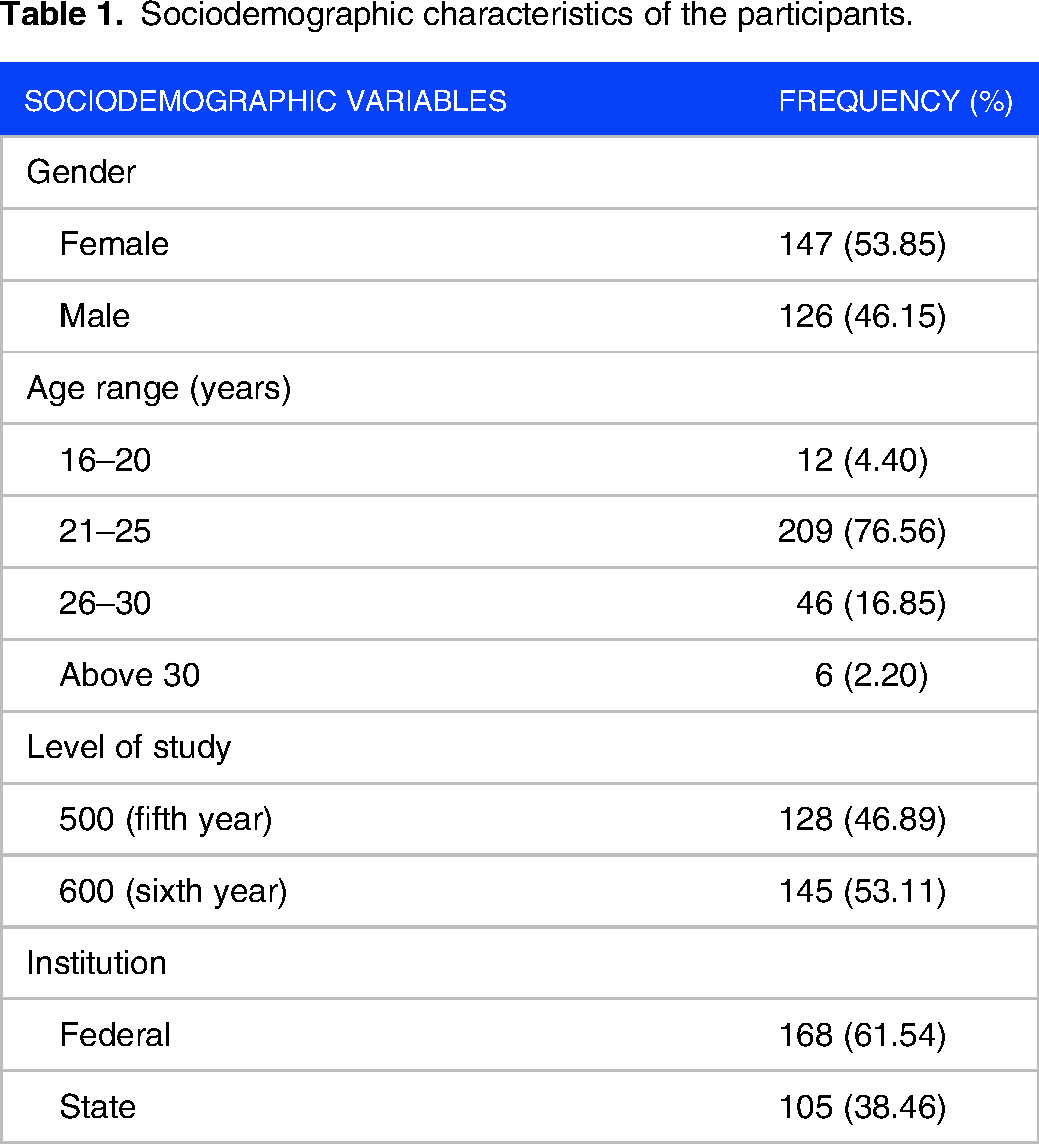
A total of 273 medical students were used as the sample of the study, and these were drawn through a multi-stage sampling procedure. First the 500 (fifth year) and 600 level (sixth year) medical students were purposively sampled because they are considered to have stayed longer in the medical school and experienced more supervisors’ evaluations quite unlike the 400 level (fourth year) students who are new entrants. Then 128 students of 500 level (fifth year) and 145 students of 600 level (sixth year) were sampled for the study. The breakdown is shown in Table 1. The study shows a well-balanced gender distribution within the medical student cohort, with 53.85% being female and 46.15% male. Table 1 shows that sociodemographic characteristics of the study participants. Age-wise, a significant majority (76.56%) falls into the 21-25 age range, while a smaller proportion (4.40%) is situated in the 16‒20 age bracket. In terms of academic progression, the study reveals a near-even distribution between 500 level (46.89%) and 600 level (53.11%) students. Worthy of note is the observation that institutional affiliation leans toward the Federal, encompassing 61.54% of respondents, with the state accounting for the remaining 38.46%.
Sociodemographic characteristics of the participants.
Research questions
What are the benefits of self-assessment in clinical studies based on the perceptions of medical students in public universities in Anambra State?
The item by item response on perceived benefits of self-assessment techniques is shown in Table 2. From Table 2, participants widely affirm that regular engagement in self-assessment practices significantly enhances their confidence in clinical situations (mean = 3.02, SD = 0.769). Moreover, the self-assessment process proves effective in identifying and addressing learning gaps (mean = 3.10, SD = 0.705), fostering comprehensive professional growth (mean = 3.09, SD = 0.742), and deepening their understanding of complex medical concepts (mean = 3.09, SD = 0.693). Deliberation on personal strengths and weaknesses through self-assessment contributes to an increased sense of readiness for challenges in medical studies (mean = 3.12, SD = 0.715) and cultivates a proactive learning approach (mean = 3.10, SD = 0.728). The data also indicate that self-assessment promotes collaborative efforts and the solicitation of insights from peers (mean = 3.02, SD = 0.730), instills a profound sense of responsibility toward individual learning (mean = 3.13, SD = 0.710), and enhances the communication of clinical ideas to peers and examiners (mean = 3.05, SD = 0.702).
Item by item response on perceived benefits of self-assessment techniques.

Hypothesis 1
There is no significant difference in the perceived benefits of self-assessment in clinical studies in public universities based on level of study.
Table 3 shows the t-test analysis of the perceived benefits of self-assessment in clinical studies based on level of study. The comparison of average benefit scores between students in 500 level and 600 level reveals similar results. In 500 level, the mean benefit score is 3.07 with a standard deviation of 0.587, while in 600 level, it's slightly higher at 3.09 with a standard deviation of 0.554. The degree of freedom is 271, and the P-value is .872, which is insignificant.
t-Test analysis of the perceived benefits of self-assessment in clinical studies based on level of study.

Abbreviation: NS, not significant.
Hypothesis 2
There is no significant difference in the perceived benefits of self-assessment in clinical studies in public universities in Anambra State based on school type.
The t-test analysis of the perceived benefits of self-assessment in clinical studies based on school type is shown in Table 4. The comparison of average benefit scores based on the institution type, specifically between students at the State and Federal university, shows similar results. At the State, the mean benefit score is 3.06, with a standard deviation of 0.621, while at Federal, it's slightly higher at 3.10, with a standard deviation of 0.506. The degree of freedom is 271, and the associated P-value is .557 which shows that the benefit scores between the two institutions are insignificant.
t-Test analysis of the perceived benefits of self-assessment in clinical studies based on school type.

Abbreviation: NS, not significant.
Research question 2
How well do students self-assessment results align with the outcome of their supervisors’ formal clinical evaluations based on the perceptions of medical students in public universities in Anambra State.
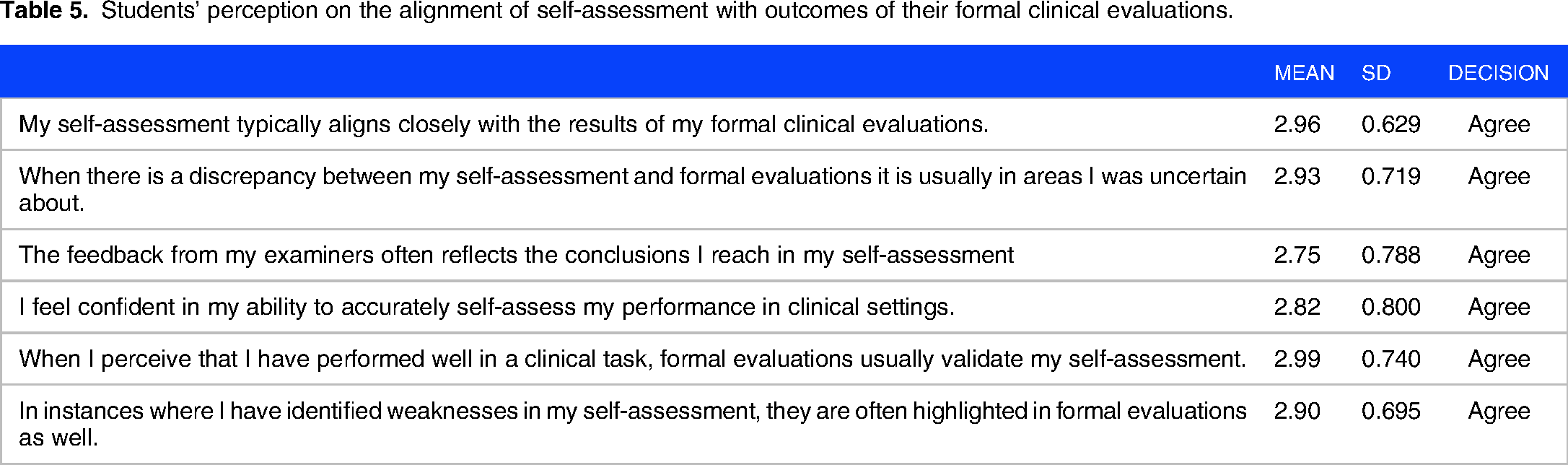
Table 5 shows the students’ perception on the alignment of self-assessment with outcomes of their formal clinical evaluations. From Table 5, the respondents generally expressed agreement (mean = 2.96) that their self-assessments closely match the outcomes of formal evaluations. Moreover, there is a consensus (mean = 2.93) that discrepancies between self-assessment and formal evaluations usually arise in areas of uncertainty. Students also agree (mean = 2.75) that feedback from examiners often mirrors their self-assessment conclusions. Furthermore, the respondents exhibit confidence (mean = 2.82) in accurately self-assessing their performance in clinical settings. When perceiving strong performance, students believe (mean = 2.99) that formal evaluations validate their self-assessment, and identified weaknesses in self-assessment are acknowledged in formal evaluations (mean = 2.90).
Students’ perception on the alignment of self-assessment with outcomes of their formal clinical evaluations.
Hypothesis 3
Medical students’ perceptions on how well their self-assessment aligns with their supervisors’ evaluation in clinical studies does not significantly vary based on level of study.
The level of study and alignment of students’ self-assessment with their formal evaluation outcome is shown in Table 6. The investigation into how the level of study influences the alignment of students’ self-assessment with their formal evaluation outcomes is detailed in Table 5. Specifically, the mean for self-assessment alignment at the 500 level is 2.88, with a standard deviation of 0.50, while at the 600 level, the mean is slightly higher at 2.90, with a standard deviation of 0.44. The results of the t-test (t = 271, P = .686) reveal no statistically significant difference between the two levels of study.
Level of study and alignment of students’ self-assessment with their formal evaluation outcome.

Abbreviation: NS, not significant.
Hypothesis 4
Medical students’ perceptions on how well their self-assessment aligns with their supervisors’ evaluation in clinical studies does not significantly vary based on school type.
Table 7 shows the t-test analysis of responses on the alignment of students’ self-assessment with their formal evaluation outcomes across the two institution types. This study explores how well students’ self-assessment matches their formal evaluations in two different medical schools, State and Federal. In State, the self-assessment alignment has a mean of 2.93 with a standard deviation of 0.504, while in Federal, it is slightly lower at 2.87 with a standard deviation of 0.446. The t-test (df = 271, P = .760) shows no significant difference between the two schools.
t-Test analysis of responses on the alignment of students’ self-assessment with their formal evaluation outcomes across the two institution types.

Abbreviation: NS, not significant.
Discussion
The responses about the perceived benefits of self-assessment techniques among study participants consistently show a positive trend. Overall, these findings highlight the diverse and positive impacts of self-assessment techniques on the academic and professional development of clinical medical students. This conclusion aligns with the studies which all reported a positive perception among students regarding the benefits of self-assessment.19–22 Students believed that self-assessment helped them achieve long-term knowledge retention and follow the course content. In some other studies, both students and faculty viewed self-assessment as crucial for enhancing their medical skills and having significant advantages that foster learning and students’ interest, despite finding it time-consuming.23,24 However, the findings of this study contrast with some other studies which did not find significant benefits from students’ self-assessment practices.25,26
The findings of the present study suggest that the perceived benefits of self-assessment between the two groups show very little difference, and the P-value indicates this difference is not statistically significant. In general, medical students at both the fifth and sixth year levels generally experience similar benefits from self-assessment practices, reinforcing that these benefits are consistent across different stages of medical education. This result supports the findings which reported positive perceptions of self-assessment but found no consistent differences in medical students’ attitudes and preferences for self-assessment based on gender, race, or level of training. 24 Emphasis was placed on practice over the level of training, noting that the more students engage in self-assessment, the more they benefit. The study with dental students in years 2, 3, and 4, showed that over 80% of the students viewed self-assessment as beneficial for clinical training. 20 However, a notable difference was observed between year 4 and year 2 medical students in their adoption of self-assessment; year 4 students needed more encouragement to engage in self-assessment compared to year 2 students. Additionally, the findings of the present study suggest a minimal difference in the perceived benefits of self-assessment between medical students at State and Federal university, with the P-value indicating that this difference is not statistically significant. It is noted the medical students from both types of institutions generally experience similar benefits from self-assessment practices, highlighting a consistent pattern of perceived advantages across different medical institutions in Anambra State. This may suggest that the instructional factors are similar in both institutions. 27
The responses from medical students in Table 5 which showed students’ perception on the alignment of self-assessment with outcomes of their formal clinical evaluations, provided insights into the perceived alignment between students’ self-assessments and formal clinical evaluations and feedback from supervisors. Overall, students agreed that their self-assessments closely matched the outcomes of formal evaluations. However, the variability in individual responses, indicated by standard deviations, highlights the complexity of the relationship between self-assessment and formal evaluations in clinical education. These medical students’ perceptions support findings from studies which established a significant positive relationship between student and teacher assessments.16,23,28 Sharma et al.'s study, for instance, reported a correlation coefficient of .79 between student and teacher evaluations. 23 Conversely, studies found no consistent agreement between students’ self-assessment and tutor evaluations. Some showed higher student assessments, while for others students underrated themselves.29–31 Furthermore, it can be inferred from hypothesis test 3 that the level of study, whether at the fifth or sixth year level, does not significantly impact the alignment of students’ self-assessments with their formal evaluation outcomes.
While previous academic success, 26 age, and level of study32,33 have been identified as factors impacting student assessments, this study observed only a slight and insignificant difference in students’ perceptions of the alignment between self-assessments and supervisors’ evaluations based on the level of study. It is possible that the students at both levels in this study had similar academic successes. This variation might be more pronounced when comparing children to college/university students, who have a better understanding of the purposes of self-assessment. 32 Additionally, results from Table 7 showing t-test analysis of responses on the alignment of students’ self-assessment with their formal evaluation outcomes across the two institution types, suggest that students in both State and Federal universities have similar levels of alignment between their self-assessments and formal evaluations, addressing the research question about this alignment in different medical education settings. This implies that the instructional factors influencing self-assessment may be similar in both types of institutions.33–35
Strengths
The study has a number of strengths. First, there is comprehensive data collection as the study utilized a well-structured questionnaire that covered both sociodemographic data and specific aspects of self-assessment techniques. This comprehensive approach allows for a detailed understanding of the students’ perspectives on the benefits of self-assessment and its alignment with supervisors’ evaluations in clinical studies. It also allows for a multifaceted analysis of the topic. By this knowledge medical students in clinical studies are motivated to adopt self-assessment techniques to improve their studies. Second, there is relevant and contextual component of the study since the study focused on self-assessment techniques in clinical studies within the specific context of public universities in Anambra State, in south-east Nigeria, and it ensures the research addresses a pertinent issue directly relevant to the target population, providing valuable insights into local educational practices.
Limitations
The study has a number of limitations. First, the study has limited geographical scope as the study setting is confined to public universities in Anambra State in south-east Nigeria, which might limit the generalizability of the findings to other areas or types of institutions. Medical education environments can vary widely, and results from one region may not necessarily apply to others with different educational systems or resources. Second, there is potential for response bias as the reliance on self-reported data through questionnaires can introduce response bias. Students might overestimate the benefits of self-assessment or align their responses with perceived desirable outcomes. This can affect the accuracy of the findings regarding the true effectiveness and alignment of self-assessment with formal evaluations. Third, the survey questions are written in a way that has been shown to risk acquiescence response bias (respondents are more likely to select “agree” responses).
Recommendations
Based on the study's findings, the following recommendations are made: medical institutions should refine self-assessment tools with specific criteria, rubrics, or self-reflection prompts to reduce uncertainty and improve accuracy. Both students and faculty should undergo training to emphasize self-assessment as a tool for growth, with faculty focusing on aligning feedback with students’ self-evaluations. Further studies should explore factors causing discrepancies between self-assessment and formal evaluations, such as biases or overconfidence, to enhance accuracy. State and Federal medical schools should collaborate to develop a unified framework for self-assessment and evaluation, promoting consistency across institutions. Further exploration of students’ perspectives will offer valuable insights for educators to design effective learning strategies and promote lifelong learning habits among medical students.
Conclusion
There is a strong alignment between medical students’ perceptions of self-assessments and formal evaluations, with no significant differences found across institutions or stages of study or study levels. Overall, self-assessment was viewed as valuable for boosting confidence, identifying areas for improvement, supporting professional development, and enhancing communication skills.
Supplemental Material
sj-docx-1-mde-10.1177_23821205241308787 - Supplemental material for Self-Assessment Techniques in Clinical Studies in Public Universities in Anambra State: Benefits and Alignment With Supervisors Evaluation as Perceived by Medical Students
Supplemental material, sj-docx-1-mde-10.1177_23821205241308787 for Self-Assessment Techniques in Clinical Studies in Public Universities in Anambra State: Benefits and Alignment With Supervisors Evaluation as Perceived by Medical Students by Nneka Chinyere Ezeugo, Lydia Ijeoma Eleje, Gideon Ebuka Obiasor, Njideka Gertrude Mbelede, Kalu Eke Osonwa, Ifeoma Clementina Metu and George Uchenna Eleje in Journal of Medical Education and Curricular Development
Footnotes
Acknowledgments
We thank all the medical students who participated in the study.
Authors’ Contribution
NC Ezeugo, LI Eleje, and GE Obiasor were involved in the overall conceptual design and implementation of the project, and overall revision of the manuscript. KE Osonwa, IC Metu, and GU Eleje were involved in the writing of this manuscript and overall revision. All the authors were involved in the revision of the manuscript. The authors read and approved the final manuscript.
Declaration of Conflicting Interests
The authors declared no potential conflicts of interest with respect to the research, authorship, and/or publication of this article.
Funding
The authors received no financial support for the research, authorship, and/or publication of this article.
Consent to Participate
Informed consent was obtained from each study participants before the involvement in the study. The collected data were kept confidential and accessed only by the research team member.
Data Availability Statement
The datasets generated during and/or analyzed during the current study are available from the corresponding author on reasonable request.
Ethical Approval
Ethical approval to conduct this research was obtained from the Anambra State Ministry of Health Ethics Committee with approval number ASMOHREC/2024/21052024/15.

Supplemental Material
Supplemental material for this article is available online.
References
Supplementary Material
Please find the following supplemental material available below.
For Open Access articles published under a Creative Commons License, all supplemental material carries the same license as the article it is associated with.
For non-Open Access articles published, all supplemental material carries a non-exclusive license, and permission requests for re-use of supplemental material or any part of supplemental material shall be sent directly to the copyright owner as specified in the copyright notice associated with the article.
