




Abstract
Introduction
Research is important for the advancement of the medical field. Integrating research in the undergraduate medical curricula is crucial. Previous studies have explored medical students’ knowledge of, attitude towards, and barriers to medical research in different countries. We aim in this study to evaluate the knowledge, attitude, and barriers of medical students towards research in a Moroccan medical school.
Methods
We conducted a cross-sectional study including all medical students at Oujda Medical School from the first year to their seventh year. Data were collected using an anonymous, self-administered online questionnaire that had been pilot-tested beforehand. The questionnaire was designed to evaluate students’ knowledge, attitude, and perceived barriers regarding research. Additionally, we analyzed how students’ attitude, knowledge and barriers scores correlated with various sociodemographic variables.
Results
We received 754 completed responses in total. The knowledge score was relatively low, with a median of 2 (IQR 1-3) across 8 questions, indicating limited understanding of research basics. However, the majority of students expressed a positive attitude towards scientific research, with a median score of 3.26 (IQR 3.04-3.5) on ATR scale. Numerous challenges were identified by the students, including time constraints (75.6%), insufficient funding (75%), and inadequate laboratory facilities (72.6%).
Conclusion
Moroccan students displayed a high level of attitude towards research, yet a low knowledge score. This discrepancy may be explained by several perceived obstacles towards research. To enhance students’ engagement in undergraduate research, these barriers must be addressed.
Introduction
Medical research improves patient care by producing evidence for novel medications and treatments, and integrating this evidence into clinical practice. 1 Therefore, investing in medical research is crucial for countries to improve their healthcare outcome, stimulate economic growth, and address local health challenges.2–4 Early involvement of undergraduate students in research has been shown to increase academic output and influence publication rates in medical schools. This promising approach can significantly enhance the research capacity in developing countries.5,6
Medical students have a crucial role to play in contributing to research during their education, often serving as assistants, conducting literature reviews, collecting data, and performing primary analysis. 7 This early involvement not only equips them with essential skills and analytical thinking, fundamental for every physician-scientist, but also motivates them to engage in further research.8,9
In Morocco, students in their final year of undergraduate studies often dedicate their time after completing their licensing exam to prepare their thesis. This project often represents students’ first encounter with research during their undergraduate curriculum. 10 A recent study conducted across various Moroccan medical schools revealed a lower rate of thesis publication in scientific journals compared to other countries. 11 This could be attributed to the lack of knowledge, support, or time. Previous studies have identified gender, financial burden, intentions to join competitive specialties, and academic performance as key factors influencing students’ engagement in research.12–15 Thus, investigative studies are crucial in understanding these dynamics and developing strategies to enhance research output among undergraduate students.
Several studies conducted in developing countries have reported a lack of research knowledge among students, despite their generally positive attitudes towards research.16,17 There is a significant lack of data in the literature on the current situation of undergraduate medical students regarding research in North Africa, particularly in countries where French serves as the primary language of instruction in higher education, such as Morocco. Therefore, this study was designed to assess the attitude, knowledge, and barriers of medical students at the Faculty of Medicine of Oujda towards research. Additionally, it aims to explore any links between the identified factors and the students’ demographic characteristics. The data can offer valuable insights to implement effective changes to the medical curricula in Morocco, ultimately fostering a more research-oriented educational environment.
Materials and methods
Study design and setting
This is a cross-sectional, questionnaire-based study that adhered to the Strengthening the Reporting of Observational Studies in Epidemiology (STROBE) 18 guidelines (Supplementary Table 1) to ensure transparent and comprehensive reporting of data.
The study took place at the Faculty of Medicine of Oujda over the course of the academic year 2022–2023. Data collection lasted approximately four months, starting in April 2023 and finishing in August of the same year. We stopped our data collection for a duration of two weeks during the academic exam season from June 15 to June 26, 2023, to minimize any disruptions to students’ schedules and to ensure a high response rate.
Study population
All undergraduate medical students enrolled at the University of Medicine of Oujda from first-year students to full-time hospital rotators in their seventh year were asked to participate in this study. The aim was to include a diverse array of participants that could be representative of all the students at the Faculty of medicine of Oujda.
Sampling technique and sample size calculation
Based on the data of student affairs office, 2517 students were enrolled in the faculty of medicine for the year 2022–2023. To determine the minimum needed sample size, we used the Epi Info version 7.2.6.0 (Centers for Disease Control and Prevention, 1985, Atlanta, Georgia, USA), employing the following formula:
N = (Z1-α⁄2) ² p (1-p)/d². As described by Charan and Biswas 19 , Z1-α⁄2 was 1.96 at an alpha level of 5%, p is the estimated proportion of an attribute present in the students, and d was the absolute error set at 0.05. Considering a 95% confidence level, a margin of error set at 5% and a 50% expected frequency of students’ knowledge and attitude, the sample size needed was 333.
Data collection
Data were collected using a questionnaire developed on the Google Forms platform (Google LLC, 2008, Mountain View, California, USA). One of the study investigators contacted each academic year representative to be added to the WhatsApp group so that we could communicate with the students. The questionnaire was sent privately to each student via their WhatsApp account. This approach was employed to ensure a high response rate. Accompanying the questionnaire, a detailed explanation of our study, its objectives, the significance of student participation, and how the data will be used was provided, highlighting how their input would bring valuable insights to our research. Participants were required to provide electronic consent before participating. For minors, a legal guardian was contacted to provide additional legal consent. All data collected were handled with strict anonymity and privacy safeguards.
Questionnaire development
An English version of the questionnaire is shown in (Supplementary Table 2). All sections of our questionnaire were adapted from previously validated English questionnaires and adjusted to suit the requirements of our research. However, it is important to note that the original study, from which the knowledge section was adapted, only conducted content validity without providing further details about the validity coefficient. To match our population's culture, the questionnaire was translated from English to French by a native French speaker to ensure clarity and comprehensibility for all participants.
Validity and reliability of the questionnaire
To ensure the cultural adaptation of the translated questionnaire, we conducted content validation through expert opinions to evaluate the clarity, relevance, and appropriateness of the questions. Additionally, a meeting with the study investigators was held to discuss the clarity of the questions and their intended purposes. The reliability of the questionnaire was evaluated through a preliminary study involving 20 undergraduate students. The data from the preliminary study were not incorporated into the final analysis. Following the preliminary study, slight adjustments were made to the questionnaire. The reliability coefficient (Cronbach's alpha) obtained for attitude, knowledge, and barriers in our final questionnaire was 0.81, 0.784, and 0.751 respectively. The final version of the questionnaire comprised 50 items organized into four distinct domains to facilitate a structured collection of data as follows:
Students’ demographics
The first section of the questionnaire gathered essential demographic data from participants, such as participants’ age, biological sex, the current academic year of enrollment, the combined monthly income of their parents in Moroccan dirham (Dh), their city of origin, the educational level attained by both parents, scholarship status and whether they attended a private or public secondary school before joining medical school. The inclusion of these demographic variables was crucial in understanding factors that may influence the attitude, knowledge, and barriers of students towards research.
Students’ knowledge of research
The second section focused on assessing students’ knowledge regarding research through eight multiple-choice questions (MCQs). These questions were designed to test students’ understanding of fundamental research basics such as statistics, database resources, scientific writing, and basic knowledge of the different types of studies. Each question offered the option of “I don't know” alongside other answer choices. This section was reproduced from a questionnaire provided by Memarpour et al. 20
Students’ Attitude towards Research
The third section comprised 32 items, employing a five-point Likert scale designed to assess students’ attitudes towards research. These items were further categorized into five distinct key factors. The first factor, ‘research usefulness to the profession’ (nine items), explored the students’ perception regarding the importance and benefits of research in their academic lives and the advancement of their academic experience. The second factor, labelled ‘Research anxiety’ (eight items), examined any feeling of tension, fear, or stress accompanying students in the understanding of research. The third factor, ‘positive attitudes’ (eight questions), explored the degree of enjoyment and appreciation derived from being engaged in research activities. The fourth factor delved into students’ opinions about the “relevance of research to life” (four items), examining how students perceive the applicability of research to their daily lives. Lastly, the fifth factor is known as “research difficulty” (three items), examined the troubles that students face in understanding and grasping research principles. Finally, the ATR (Attitude towards research) scale, which is sum of the five factors together was used to measure the overall attitude towards research. This questionnaire section was reproduced from a framework provided by Papanastasiou et al 21
Students’ Barriers to Research
The final section assessed potential barriers to students’ participation in scientific research using ten items answered on a five-point Likert scale and explored perceived obstacles identified by previous studies. This section was adapted from a tool provided by Amin et al. 17
Data analysis
Students’ knowledge of research
In the knowledge evaluation section, participants’ responses were graded by awarding one point for each correct answer and zero points for incorrect responses or instances where they indicated “I don't know”. Then, we divided the cumulative score of all the questions by eight. This approach yielded a score ranging from zero to eight for every participant. A score less than four reflected a poor knowledge foundation, while a score between four and six indicated an intermediate level of knowledge, and a score more than six reflected a high level of knowledge. The level of knowledge was determined by calculating both the median and the interquartile range.
Students’ attitude towards research
The attitude scale includes statements that cover both positive and negative aspects of research (anxiety/difficulty). To make sure that higher numbers on the ATR scale reflect a positive attitude, we reversed the scoring for all negatively worded questions. The ATR scale is the sum of the five research factors (research usefulness, positive attitude, relevance to life, research difficulty, and research anxiety).
To independently determine the score of each factor, we calculated the total by adding the scores of all items within that factor. Then, we divided this total by the number of items in the factor. To analyze the results, we calculated the median and interquartile range for each factor and the ATR scale. We obtained a score ranging from one to five for each factor. A score result between three and five reflected a high score, indicating a higher perception of the factor, except for research “difficulty” and “anxiety” factors, where a high score reflected a lower perceived factor. Conversely, a score between one and three was considered a low score reflecting a low perception of the factor, except for research “anxiety” and “difficulty”, where it reflected a highly perceived factor.
Students’ barriers to research
For the barriers assessment scale, we described the data by calculating the percentage of students who acknowledged each barrier. Additionally, we calculated the sum score of each item along with other items in this section, and subsequently divided this total by ten, the total number of items in the barrier section. These scores reflected the “burden of barriers” faced by students. A score between three and five reflected a high perceived burden of barriers, while a score between one and three indicated a low perceived burden of barriers. The level of “burden of barriers” was described by calculating both the median and the interquartile range.
Statistical methods
The data were stored and analyzed at the Laboratory of Epidemiology, Faculty of Medicine and Pharmacy, Oujda. The analysis was performed using IBM SPSS Statistics, version 26.0 (IBM Corp., 2019, Armonk, NY, USA). A descriptive analysis was conducted, where quantitative variables were described using mean and standard deviations (SD) or median and interquartile range (IQR), and the qualitative variables were described using percentages. The normality of score distributions in each section was tested using the Shapiro-Wilks test, and accordingly, Mann-Whitney and Kruskal-Wallis tests were implied to measure the association between students’ demographics and their attitude, knowledge, and barrier scores. The significance level of the p-value was set at 0.05. When significant differences were found using the Kruskal-Wallis test, pairwise comparisons between groups were conducted using post hoc Mann-Whitney U testing with Bonferroni adjustment. 22 Moreover, a multivariate analysis was conducted using multivariate logistic regression to assess the predictors (demographic factors) on students’ knowledge, attitude, and barriers. 23 The effect sizes for Mann-Whitney U tests were evaluated using the rank biserial coefficient (rrb) for similar values associated with a dichotomous predictor variable. The effects were classified as small (rrb = 0.11 to <0.28), medium (rrb = 0.28 to <0.43), and large (rrb ≥ 0.43). 24
Ethical Considerations:
We obtained ethical approval from the Ethics Committee for Biomedical Research at the Oujda Faculty of Medicine and Pharmacy, Mohammed Premier University of Oujda, Morocco (approval number: 10/2023).
Results
Participants’ demographic characteristics
This study involved the participation of 754 students enrolled from the first year to the seventh year of their academic year of study. Their ages ranged from 17 to 29 years, with a mean ± SD age of approximately 21.17 ± 2.28. Among the participants, 55.7% were female. The study predominantly included individuals from urban areas, comprising 91.1% of the total sample. Additionally, almost half of participants, constituting 47.7%, reported a monthly family income exceeding 10 000 Dh. Further details on individual and socio-demographic characteristics can be found in Table 1.
Socio-demographic characteristics of participants.
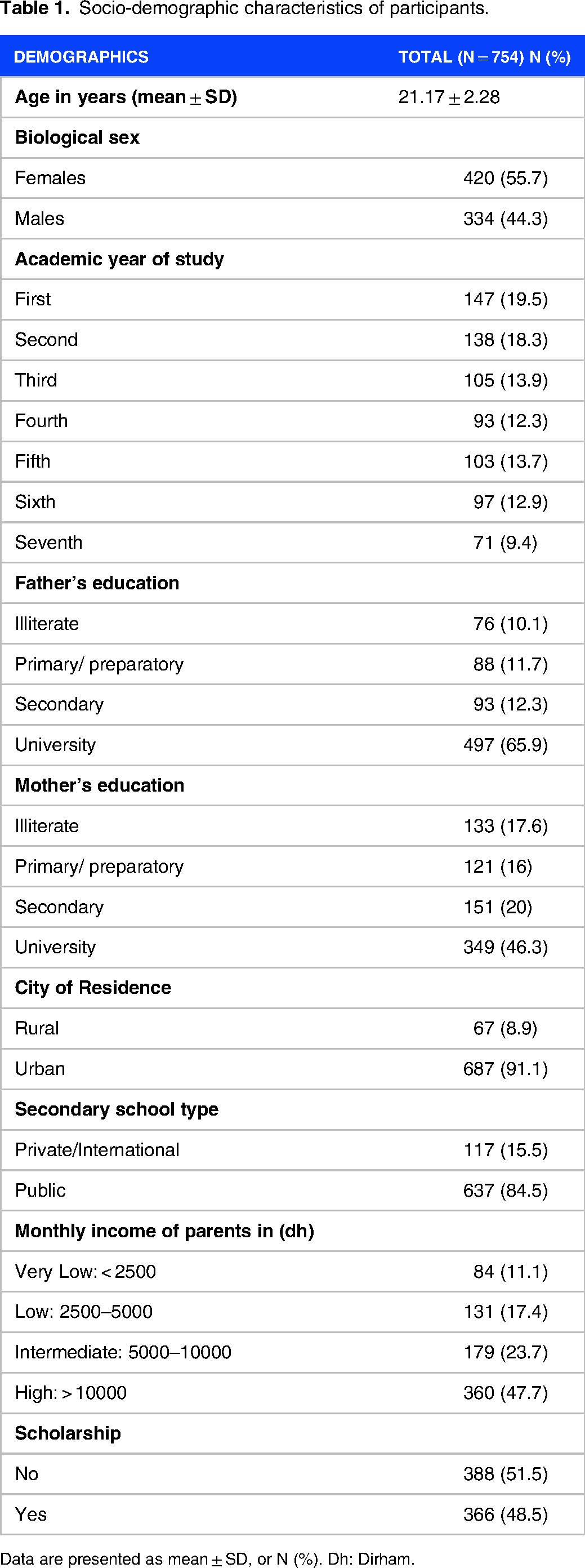
Data are presented as mean ± SD, or N (%). Dh: Dirham.
Students’ knowledge towards research
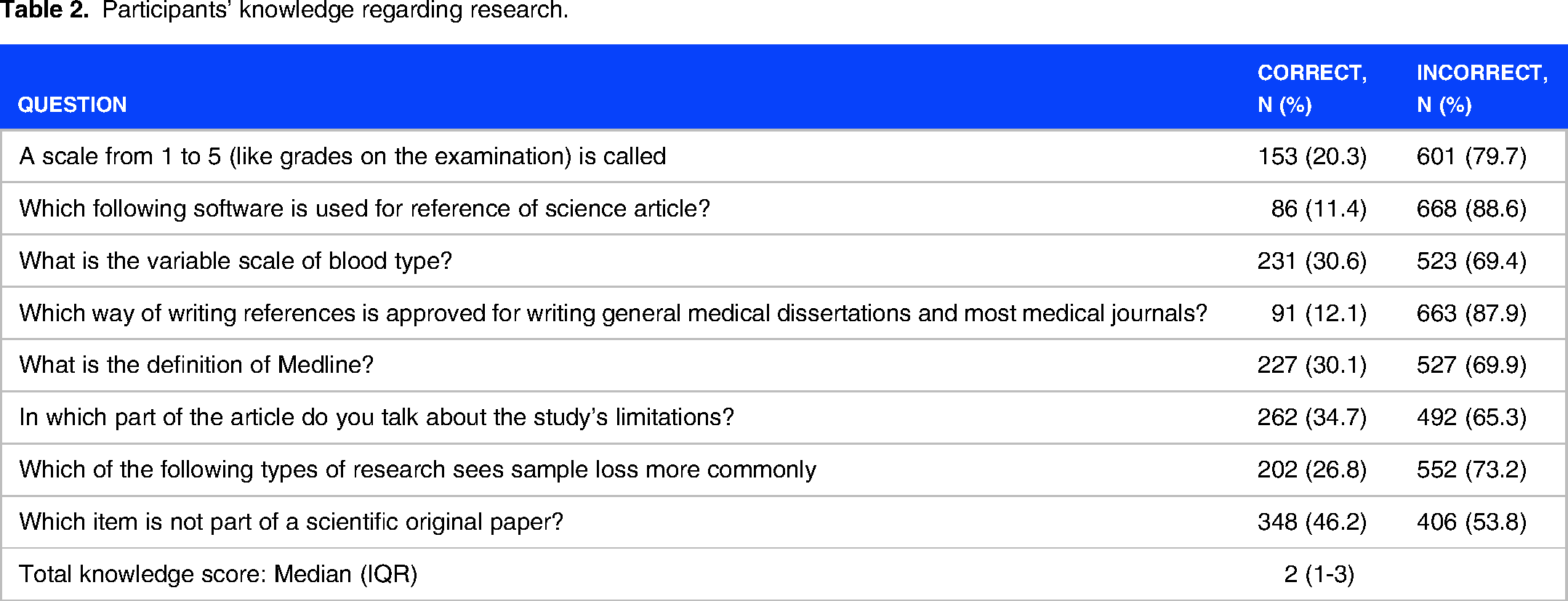
On a scale of eight questions, a median (IQR) score of 2 (1-3) was obtained for included medical students. This reflects a poor level of knowledge. Out of 754 students, 20.3% knew some basic statistical concepts like the ordinal scale, while 30.6% could differentiate nominal variables from other types of variables (Table 2).
Participants’ knowledge regarding research.
Students’ attitude towards research
The median score of student participants for the factor ‘research usefulness’ was 4.38, IQR (4-4.63), indicating that research has a high value in students' professional lives and their careers. 'Students’ anxiety’ had a median score of 2.75 IQR (2.25-3.25), reflecting a high level of stress and fear among students concerning the research process. The median score for the third factor, ‘positive attitudes', was 3.88 IQR (3.5-4.13), suggesting that students enjoyed participating in research activities. ‘Relevance of research to life’, obtained a median score of 2.75 IQR (2.5-3), indicating that research is rarely used in students' personal lives. The last factor, ‘research difficulty’ showed a median score of 2.67 IQR (2- 3.33), suggesting that students struggled to understand and process research basics. The overall ATR scale had a median of 3.26 IQR (3.04- 3.5), which indicates a generally positive attitude among students towards research.
Students’ perceived barriers towards research
The majority of students (75.6%) reported a lack of time as a critical barrier. Similarly, 75% pointed out the absence of proper funding as a considerable obstacle. In addition, 72.6% reported facing challenges due to inadequate laboratory facilities. Additionally, a closely related percentage of students, 72.9% indicated a lack of motivation or reward as a deterrent to their research activities. Correspondingly most of the students lack the appropriate knowledge necessary for conducting research (69.3%), while 45.8% reported a lack of interest.
Other barriers included the lack of appropriate mentoring (personalized support) (59.2%), additionally, 42.6% of students expressed concerns about the inefficiency of faculty staff in delivering the necessary knowledge. Access to resources was another issue with 58.2% of students mentioning inaccessibility to databases as a barrier. Finally, 48.7% of students experienced denial of research autonomy by faculties.
The median score for all participants for the burden of barriers was 3.7 IQR (3.3-3.5), reflecting a generally high burden of perceived barriers towards research among the student participants.
Association between students’ demographics and their knowledge scores
Univariate (Table 3) and multivariate analysis (Supplementary Table 7) showed similar results. There was a statistically significant difference observed in the association between academic year and knowledge score (overall p < 0.001). Post-hoc analysis revealed that final-year medical students were significantly more knowledgeable compared to other students from different years of enrolment (Bonferroni corrected alpha set at 0.0024; Supplementary Table 3). However, there was no statistically significant difference in the knowledge level across other demographics (Table 3).
Comparison of student's knowledge scores according to their demographics.
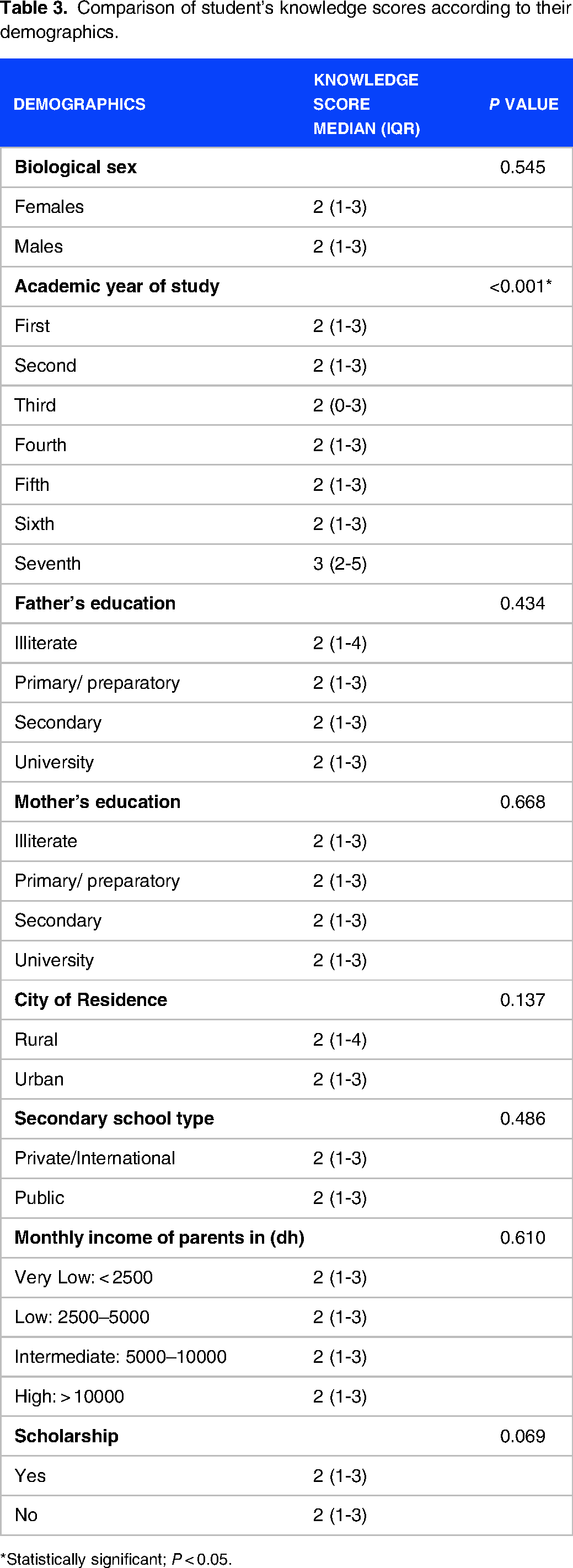
*Statistically significant; P < 0.05.
Association between students’ demographics and their attitude scores
Females had a higher perception of research utilization in their academic careers and were more anxious about research compared to males. These differences were statistically significant (p = 0.001 and p < 0.001, respectively). There was a statistically significant difference in research difficulty scores between males and females (p = 0.013). However, the median scores were similar for both genders. The rank biserial correlation of rrb = 0.11 indicates weak practical significance, likely due to the greater variability in scores among males.
The academic year was significantly correlated with positive attitude (overall p = 0.009) and with research relevance to life, research difficulty, research anxiety, and the overall ATR scale (overall p < 0.001 for the last four). Post hoc analysis revealed that final-year students perceived research to be significantly more relevant to their lives and experienced significantly higher research anxiety compared to other academic years, with the exception of fourth-year students. Moreover, final-year students found research significantly more difficult than other academic years, whereas first-year students found it significantly less difficult, except when compared to the second year. For the ATR scale, first-year students had an overall significantly more positive attitude towards research compared to other academic years, except the second and third years. Regarding the positive attitude score, post hoc analysis could not detect statistical significance between the various academic years of enrolment (Bonferroni corrected alpha set at 0.0024; Supplementary Table 3
Very low family income was significantly associated with a low perception of research usefulness in professional life (Bonferroni-corrected p = 0.001) and low research anxiety (Bonferroni-corrected p < 0.001) compared to high family income (Bonferroni-corrected set at 0.0083; Supplementary Table 5). Living in an urban area was significantly associated with a high perception of research usefulness in professional life (p = 0.014) (Table 4). Having an illiterate mother was correlated with a low perception of research usefulness in academic life compared to having a mother with a university education (Bonferroni-corrected p = 0.006, with the corrected alpha set at 0.0083; Supplementary Table 4).
Comparison of student's attitude scores according to their demographics.

*Statistically significant; P < 0.05. ! Mann Whitney, †Kruskal Wallis tests.
Multivariate analysis showed similar results regarding research usefulness to professional life, relevance of research to life, research anxiety, research difficulty, and the ATR. However, the association between monthly income and research anxiety showed significance only in the univariate analysis. For the research usefulness in the professional life, the multivariate analysis showed a significant association with biological sex only, in contrast to the univariate analysis, which indicated significance with other demographic variables (Supplementary Table 6).
Association between students’ demographics and their perceived barriers burden scores
Females were significantly correlated with a higher perceived level of barriers (p = 0.005). There was also a significant correlation between barrier burden scores and the mother's education (overall p = 0.047), the academic year of enrollment (overall p < 0.001), and parents’ monthly income (overall p = 0.014) (Table 5).
Comparison of student's barriers burden scores according to their demographics.

*Statistically significant; P < 0.05.
Post hoc analysis revealed that having an illiterate mother was significantly associated with a lower perceived level of barriers compared to having a mother with a university education (Bonferroni-corrected p = 0.007, with the corrected alpha set at 0.0083; Supplementary Table 4). Additionally, first-year students experienced a significantly lower perceived level of barriers compared to other academic years, except for second-year students. Second-year students had significantly lower perceived barriers compared to sixth-year students (Bonferroni-corrected p = 0.001, with the corrected alpha set at 0.0024; Supplementary Table 3).
Regarding parents’ monthly income, post hoc analysis showed that students with very low income experienced significantly lower perceived barriers compared to those with high income (Bonferroni-corrected p = 0.006, with the corrected alpha set at 0.0083; Supplementary Table 5). The findings of the multivariate analysis were similar across all demographic factors, except for parents’ income, which only showed significance in the univariate analysis. (Supplementary Table 7).
Discussion
A lack of research knowledge and proper resources among medical students is a challenging issue encountered in multiple countries. Several previous studies have reported a low level of knowledge about research among medical students. This can lead to a loss of interest and motivation to learn and pursue research opportunities which can have a negative impact on both their career progress as well as the advancement of the medical field and patient care. 20 Although similar studies exist, our targeted population differs significantly in demographics, medical education, and resource availability. In Morocco, research training within the medical system remains challenging despite recent reforms. The Moroccan medical education system lacks a comprehensive research training program beyond the thesis requirement. Additionally, there is a language barrier between French, the official language of medical education, and English, the predominant language of global research. 10 Compounding this issue, English is introduced in Moroccan public schools only at the middle school level, typically when students are around 13 years old, 25 as a result, medical students may find it even more difficult to engage in research when they reach medical school. These unique challenges in resources, medical education, and demographics highlight this population's need for focused investigation. This cross-sectional, questionnaire-based study is the largest and first-ever conducted to assess the knowledge, attitude, and barriers towards research faced by medical students at a Moroccan medical school.
Our study showed that the students had a generally poor level of knowledge. Despite this knowledge gap, students displayed a positive attitude towards research reflecting a general interest in research work. However, this willingness was met with high levels of accompanying anxiety and perceived difficulty associated with research. This suggests that even though students are inclined towards engaging with research, they may face stress and difficulties that could prevent them from participating in research activities. Previous studies conducted in various countries, including Jordan, Egypt, and six other Arab nations, supported our study by reporting similar findings.16,26,27 These findings revealed that while students generally have a positive attitude towards research, there's a notable gap in their knowledge level. On the contrary, studies from India and Libya appeared to have successfully bridged the gap between students’ knowledge and attitude towards research where their medical students not only exhibited positive attitude but were also knowledgeable about research.28–30 This acceptable level of knowledge observed in students is likely attributed to the mandatory aspect of research as part of the curriculum, as it is the primary reason why students engage in research work at the undergraduate level. 28 However, this mandatory nature of research might contribute to a sense of obligation rather than genuine interest, which can result in a lack of intrinsic motivation, fostering a negative attitude despite a high level of knowledge.20,31
In the current study, seventh-year students exhibited a higher knowledge level than their peers in earlier years, a finding that aligns with research from both India and six Arab universities,16,32 where students in their final or clinical years consistently demonstrated superior knowledge compared to those in earlier academic stages.
Nevertheless, despite this increased knowledge, seventh-year students experienced higher levels of anxiety and difficulty towards research compared to their peers except for fourth-year students. This could be explained by the fact that these students face heightened expectations and pressure as they near the completion of their thesis, which makes them aware of the relevance and implications of research, including its complexity. 10 Interestingly, seventh-year students exhibited a more positive attitude towards research compared to their peers, as indicated by the Kruskal-Wallis test. However, this significance was not reflected in the post hoc test after adjusting the p-value, likely due to family-wise error. 33 Therefore, it's possible that the observed positive attitude among seventh-year students could be a statistical artifact rather than a consistent trend. This contrasts with findings from six different medical schools across the Arab world, 16 where clinical-year students also reported lower levels of anxiety towards research compared to those in their basic years. However, unlike our study, their students exhibited a statistically significant decrease in positive attitudes towards research during their clinical years. Notably, both studies observed that female participants significantly valued the usefulness of research in their careers. Interestingly, while our study found higher anxiety levels among females, they reported that males exhibited the highest anxiety.
In our study, we found no significant difference in knowledge levels between genders. This finding is consistent with some studies but contradicts others. For instance, Amin et al 17 reported similar results to ours, showing no gender-based differences in knowledge. However, Bin-Ghouth et al's 34 research found a significant difference, with females exhibiting higher knowledge levels.
The univariate analysis revealed that students living in rural areas, having mothers with lower educational backgrounds (illiteracy) compared to mothers with higher education, and coming from families with very low incomes compared to high incomes, generally perceived research as less useful in their professional lives. In contrast, the multivariate analysis did not identify any statistically significant associations. This aligns with Assar A et al's 16 findings that having a mother with a university degree is associated with more positive attitude towards research and a higher perception of its usefulness. This may be because students from low socioeconomic backgrounds often feel disconnected from research opportunities and may not consider research relevant to their careers, viewing medicine as a field that requires personal sacrifice with limited immediate rewards. 35 Interestingly we found that students from families with the lowest income showed the lowest level of anxiety towards research compared to students from high-income families. In the multivariate analysis, these findings were not statistically significant.
Furthermore, the study identified several barriers that students might face in their journey towards research. The primary barriers were the lack of time due to the educational burden followed by lack of proper funding, inadequate laboratory facilities, and lack of motivation or reward. Similar barriers were reported by several previous studies.20,27,30,31 Contrary to our findings where lack of appropriate monitoring and training was considered less significant compared to time constraints, Syrian medical students perceive a lack of adequate training, shortage of research facilities, and unavailability of research mentors as more significant barriers towards research than lack of time due to academic overload. 36
Moreover, the low perception of research barriers burden among students was associated with male gender, being in the first year compared with other years except for the second year. This could be due to the lower exposure to the complexities of research during the initial years of study compared to that of more senior students. Having illiterate mothers, as opposed to mothers with a high educational background, and coming from low-income families compared to high-income families, were associated with lower perceived barriers. However, the significance of the association with low income was only evident in the univariable analysis. This highlights the two extreme ends of the spectrum, suggesting that both a mother's education and family income contribute to the perceived barrier burden among students. This could be explained by the possibility that students from lower-income families or with less educated mothers may not prioritize research as highly, leading them to perceive fewer barriers in this area.
Study strengths and limitations
Due to the large sample size, which significantly surpasses the minimal required threshold, and the uniformity of the educational system across medical schools in Morocco, 10 we believe our study's results can be reliably generalized to other medical institutions within the kingdom. However, the use of convenience sampling may have introduced a nonresponse bias, where students who did not participate in our survey could have provided different findings compared to those who did. This is because non-participants might be less interested in research. Although our questionnaire was derived from previously validated questionnaires, we did not test for the validity coefficient of the translated version. Additionally, a major limitation is that our results are based on self-reported data, which we were unable to independently verify.
Despite these limitations, this study offers valuable insights into the barriers to research encountered by medical students at the Faculty of Medicine in Oujda, Morocco. These findings will equip higher education policymakers with valuable information needed to address these barriers, enhance students’ participation in research activities, and provide them with the necessary knowledge to potentially lead their research projects in the future. Moreover, the use of a previously validated questionnaire enables us to compare our findings with other studies conducted in similar contexts.
Perspectives and recommendations
In countries with limited research resources like Morocco, students can be introduced to research by joining small working groups. In these groups, they would receive lectures on research fundamentals and then start working on simple studies such as cross-sectional survey studies, case reports, and case series. Medical schools could encourage students to seek research grants and scholarships and to investigate funding opportunities beyond government sources, thus addressing the issue of inadequate funding. 37 Additionally, allocating a dedicated time slot for research activities within the student curriculum could effectively reduce the time constraint barrier caused by educational overload.
Morocco has the potential to enhance its higher medical education by adopting English as the primary language of instruction. This shift could facilitate research for students, as it would eliminate the need for transitioning from French to English, a challenge compounded by their initial transition from Arabic to French. Notably, students have already demonstrated a positive attitude towards this initiative, indicating readiness and support for such a change. 38
Despite the difference in the characteristics of the targeted population from previous studies, there were some similar findings to our study. Thus, further investigations should be conducted to determine the common factors and provide a better understanding of the patterns of knowledge, attitude, and perceived barriers of medical students towards research.
Conclusion
Although the majority of students showed positive attitudes towards clinical research, they lacked a fundamental understanding of research principles. Our findings suggest that students in their later years of study have better knowledge, yet higher perceived anxiety and difficulty towards research. Several barriers need to be addressed to enhance students’ participation in clinical research such as lack of time, funding, and poor availability of research facilities and access to scientific databases. This may be done by integrating research into the medical curriculum, providing mentorship programs for students, and seeking research grants and scholarships.
Supplemental Material
sj-docx-1-mde-10.1177_23821205241296985 - Supplemental material for Knowledge, Attitude, and Perceived Barriers of Undergraduate Medical Students Towards Research. A Cross-Sectional Questionnaire-Based Study in Morocco
Supplemental material, sj-docx-1-mde-10.1177_23821205241296985 for Knowledge, Attitude, and Perceived Barriers of Undergraduate Medical Students Towards Research. A Cross-Sectional Questionnaire-Based Study in Morocco by Imane Chenfouh, Mariam Atassi, Asmae Yeznasni, Asmae Lekfif and Naima Abda in Journal of Medical Education and Curricular Development
Footnotes
Author contributions
Consent to participate
Consent from all participants was obtained prior to the participation in the study. The study aims were clearly stated to the participants and we informed them that no personal data would be collected.
Declarations and statements
The authors declare that there are no financial or non-financial disclosures relevant to this paper.
Data availability statement
All data will be available from the corresponding author upon reasonable request.
Ethical consideration
This article obtained ethical approval from the Ethics Committee for Biomedical Research at the Oujda Faculty of Medicine and Pharmacy, Mohammed Premier University of Oujda, Morocco.
Declaration of conflicting interests
The authors declared no potential conflicts of interest with respect to the research, authorship, and/or publication of this article.
Funding
The authors received no financial support for the research, authorship, and/or publication of this article.

Supplemental material
Supplemental material for this article is available online.
References
Supplementary Material
Please find the following supplemental material available below.
For Open Access articles published under a Creative Commons License, all supplemental material carries the same license as the article it is associated with.
For non-Open Access articles published, all supplemental material carries a non-exclusive license, and permission requests for re-use of supplemental material or any part of supplemental material shall be sent directly to the copyright owner as specified in the copyright notice associated with the article.
