



Abstract
Reflective practice, critically reflecting on one's actions or attitudes to engage in the process of continuous adaptation and learning, has proven to be an effective strategy for improved patient care. Additionally, literature supports applying reflective practice for professional growth in medical providers. When contemplating professionalism training in physician assistant (PA) education, it is important to consider how to obtain buy-in from students. One way to do this is to link professionalism to the students’ future career as a PA. The School of Physician Assistant Studies at Pacific University (the Program) created an Online Orientation Reflective Practice Assignment that was implemented during online orientation. Students were prompted to use reflective practice to create detailed “plans for success.” The goal of this assignment was to reduce common professionalism missteps students often experienced. Data regarding the number of professionalism encounters per cohort, broken down into occurrences by curricular phase (didactic vs clinical), was tracked and collated using Microsoft® Excel®. The data was analyzed to determine trends. Implementation of the Online Reflective Practice Assignment for all PA students at the beginning of their education has increased student awareness of the Program's, and the profession's, expectations regarding professionalism and accountability. Thus far, the resulting number of professionalism missteps have not decreased year-over-year. We hypothesize that this is due to the difficulty meeting increased administrative expectations and burdens put on students during the pandemic. Students’ use of reflective practice to review what went wrong and to create plans to avoid missteps in the future allows them to focus on productive next steps in building their professional identity. Implementation of the Online Orientation Reflective Practice Assignment has better prepared students for the expectations of the PA profession and provided them with a solid foundation to build their professional identity throughout their education and into their careers.
Keywords
Introduction
Reflective practice, critically reflecting on your actions or attitudes to engage in the process of continuous adaptation and learning, has proven to be an effective strategy for improved patient care. Additionally, literature supports applying reflective practice for professional growth in medical providers. 1 Innovative programs that address teaching professionalism within medical curricula have been implemented across allied health professions. The foundation for many of these programs is “reflection,” which is regarded as a core skill in professional competence. 2 The ability to reflect in real time to determine what happened (performing a critical review of the incident) and what can be done differently in the future (how this will change future practice) is essential as students work through professionalism missteps. 3 Utilizing reflective practice in medical education can better prepare students for the demands of clinical practice and encourage them to understand the importance of administrative tasks. 4
Reasons for teaching professionalism to, and assessing professionalism among, medical and physician assistant (PA) students include patient expectations; the association between professionalism and improved clinical outcomes (and the association between unprofessional behavior and adverse outcomes); accreditation organization requirements; and observations that professionalism can be taught, learned, and assessed. 5 The Physician Assistant Education Association (PAEA) requires professional and legal aspects of health care be taught to students as part of their core competencies for new PA graduates. 6 Additionally, PAEA and other organizations that oversee PA's through their certification and licensing created competencies for the PA profession that include professionalism and ethics. 7
Professionalism has often been referred to as a “hidden curriculum” 8 in medical education. Research shows that students must have buy-in to the topic of professionalism and that it must be viewed as more than a tick box activity. 9 Furthermore, faculty need to effectively support students in their professional growth, especially in the areas of communication and accountability. 9 One way to do this is to link professionalism to the students’ future career as a PA.
PA students place high priority on the demonstration of medical knowledge in the pursuit of post-graduate employment. What students fail to realize is employers assume entry-level competence based on successful completion of board exams. The faculty at the School of Physician Assistant Studies at Pacific University (the Program) have observed that future employers want to know that students possess the necessary habits and traits to be a good colleague and employee. This is clear in the types of questions employers ask about applicants’ skills and strengths. These skills include communication, listening, ethical conduct, a sense of responsibility, leadership skills, and their approach to handling stress or frustration (emotional intelligence). Medical education, now more than ever, must include more than ensuring students can diagnose and treat patients. It must also include both training and expectation setting about the student's future profession. 10
Methods
Prior to the implementation of the Online Orientation Reflective Practice Assignment (Supplemental Material A), citations for student professionalism missteps were not consistent and did not always capture minor missteps that could escalate or turn into a pattern. The goal was to create a consistent, step-wise approach to professionalism encounters with students. We hypothesized that introducing reflective practice early in a students’ curriculum would result in fewer overall professionalism meetings with students and, therefore, fewer total professionalism encounters per cohort. A professionalism encounter was quantified as one of three types of interactions with students:
Email communication for lesser infractions or first-time offenses. Professional Performance Reports (Supplemental Material C) for needed follow-up to email communication. Academic and Professional Committee meetings with students for issues where repeated mistakes were made or for missteps that were deemed more serious including academic or ethical challenges.
The Online Orientation Reflective Practice Assignment and subsequent professionalism check-ins were later built into a more comprehensive professionalism curriculum that all students participated in. This included check-ins with the entire class, individual check-ins with students, student self-evaluations, and peer-evaluations.
The Online Orientation Reflective Practice Assignment grew out of faculty discussions regarding graduate employment references. Faculty wondered if students understood that faculty are responsible for providing these references. Faculty began compiling employment reference forms, building a compendium of employer questions as the basis of an in-depth discussion of the behaviors and attitudes they are asked to attest to. Faculty suspected that students would be open to learning about professionalism topics that directly affected their ability to work or secure a job. Using this information, faculty began tying student professionalism into their ability to positively complete a new graduates’ employment reference forms. A variety of evaluation questions from different employers were collected most of which asked questions about professionalism; specifically, questions about communication, listening skills, ethical conduct, documentation, leadership skills, approach to handling stress or frustration, and the ability to manage their workload.
The article, Reflective practice in health care and how to reflect effectively, 3 which walks readers through utilizing reflective practice and the importance of making a plan in real time when missteps occur, was included in the assignment to help students understand the value and importance of reflection. Additionally, a variety of short videos from different stakeholders speaking on professionalism were researched and curated for this assignment. Links to these videos can be found in the Online Orientation Reflective Practice Assignment (Supplemental Material A). Lastly, common themes and issues observed in previous cohorts were identified and reflective questions were built around these topics. The Online Orientation Reflective Practice Assignment has not been validated or pilot tested at this time.
All professionalism encounters are documented in internal Program documents and are stored on a shared drive. To collate this quantitative data, faculty categorized data by cohort, type of professionalism encounter, and the phase (didactic vs clinical) in which the encounter took place. Data was then collected in an Excel® table (Table 1) including the total of each specific encounter type.
Total professionalism encounters per cohort.
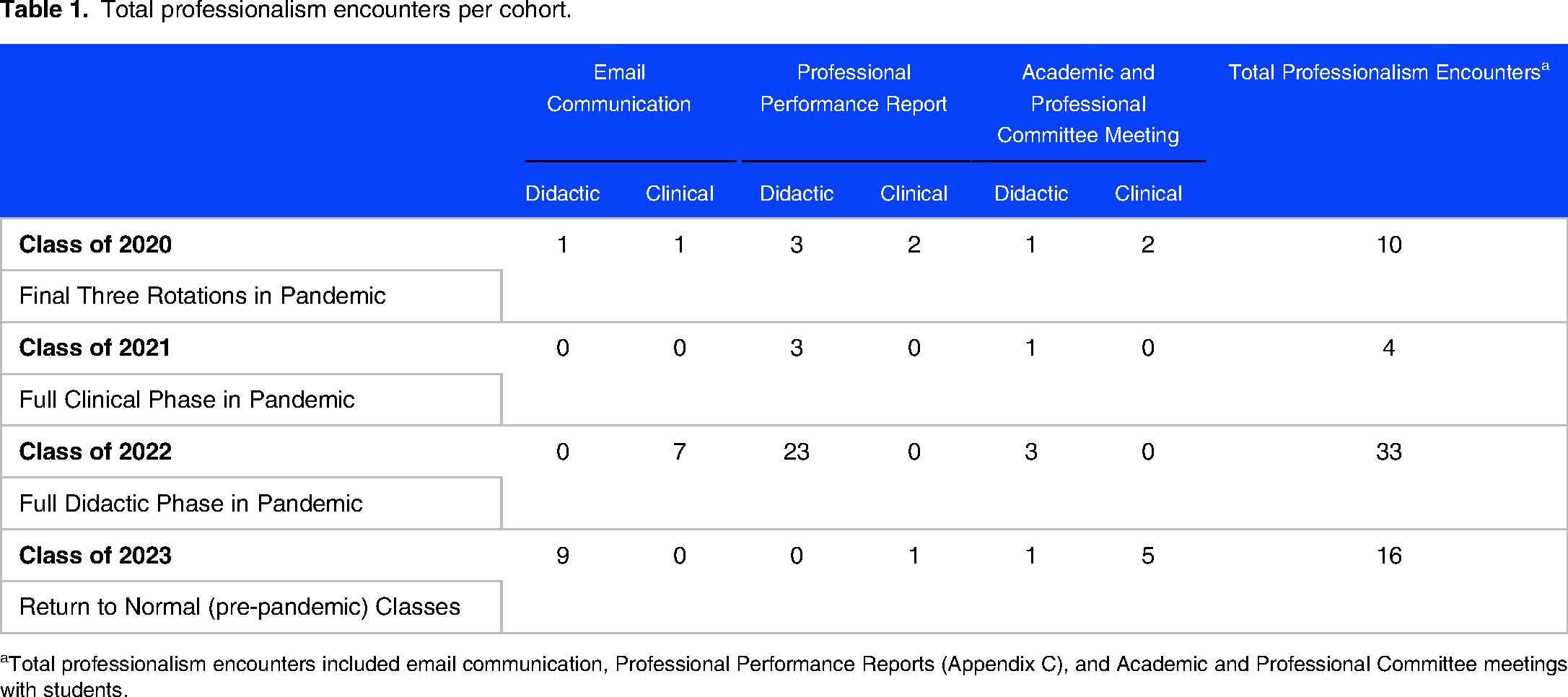
aTotal professionalism encounters included email communication, Professional Performance Reports (Appendix C), and Academic and Professional Committee meetings with students.
In anticipation of publication of this article, Pacific University's Institutional Review Board was consulted. They determined this project was not under their jurisdiction given the professionalism encounter data was collected as Program and curricular data and is considered important for assessing professionalism training for the Program's students. Data would be disseminated for publication with no identifiable information on individual students. Data was gathered at the School of Physician Assistant Studies at Pacific University's campus in Hillsboro, Oregon, from 2018 through 2023. Inclusion criteria: all students who entered the School of Physician Assistant Studies at Pacific University. Exclusion criteria: all Pacific University students who did not enter the School of Physician Assistant Studies. Sample size was predetermined based on the number of matriculated students to the Program (∼60-65 students per cohort). Informed consent of subjects was waived by Pacific University's Institutional Review Board. Program students were instructed to answer the reflective practice questions in the assignment displaying thoughtful, critical analysis with appreciation for the Program's and the PA profession's expectations. Additionally, students were required to perform in-depth personal self-reflection with development of detailed plans when prompted. Students were also provided a rubric (Online Orientation Reflective Practice Rubric, Supplemental Material B) with explicit expectations on what was required to successfully complete the reflection assignment.
The Online Orientation Reflective Practice Assignment was posted to Pacific University's online learning management system (Moodle). Students were required to complete it along with other orientation tasks prior to attending their first course. This assignment was originally implemented in 2018 for the class of 2020, and has been executed annually every year since. Each year, the incoming cohort of PA students, totaling 60 to 65 students, complete this assignment prior to entry to the Program. Their responses are then reviewed by faculty advisors and feedback is provided to the student if their reflections are not detailed enough or at the level expected of a graduate student.
Results
Implementation of the Online Reflective Practice Assignment for all PA students starting at the beginning of their training has resulted in consistent accountability regarding professionalism expectations. In the quantitative evaluation, it is of note that the number of professionalism meetings with students increased during the pandemic and have begun to trend downward in the last year. It was anticipated that this curriculum would reduce professionalism meetings; however, the opposite has occurred. We hypothesize that this is due to the difficulty meeting the increased administrative expectations and burdens put on students, faculty, and staff during the pandemic.
The Class of 2020 had a normal didactic phase, but was the first clinical phase class that was affected by the pandemic, with the last 4 months of their rotations severely impacted. This class experienced a total of 10 professionalism encounters; 5 of these encounters occurred in the didactic phase, and 5 in the clinical phase. Missteps in the didactic phase included late submission of coursework or administrative documents. Issues in the clinical phase included late submission of clinical evaluations, inappropriate communication, and preceptor concerns regarding a student's general knowledge.
The Class of 2021 had the last 5 months of their didactic phase, and all of their clinical phase, impacted by the pandemic. They experienced a total of four professionalism encounters, all of which occurred in the didactic phase. These professionalism missteps included late submission of coursework or administrative documents, issues with professional communication, and ethical concerns.
The Class of 2022 had their entire didactic phase impacted by the pandemic, meaning their didactic phase was entirely remote, with the exception of skills and workshop instruction. They experienced a total of 33 professionalism encounters; 26 of these encounters occurred in the didactic phase, and seven in the clinical phase. The majority of missteps in the didactic phase included late submission of coursework or administrative documents; however, there were a few students that also had missteps in professional communication, tardiness, unexcused absences, and ethical misconduct. This class's clinical phase was only minorly affected by the pandemic. Issues in the clinical phase included inappropriate communication, students not performing reflective practice as expected, and tardiness.
The Class of 2023 had both their didactic and clinical phases return to normal (pre-pandemic) class settings and schedules. They experienced a total of 16 professionalism encounters; 10 of these encounters occurred in the didactic phase, and 6 in the clinical phase. Missteps in the didactic phase included late submission of coursework or administrative documents, professional communication, unexcused absences, and ethical misconduct. Issues in the clinical phase included missed deadlines, ethical misconduct, and professionalism concerns.
Discussion
This assignment has allowed program faculty and staff to have meaningful and engaging professionalism encounters with students. Setting expectations with students early in their PA education, before they arrive on campus, has allowed for student-driven, productive, and effective conversations regarding professionalism set-backs. While there was an increase in the number of professionalism encounters faculty and staff had with students, especially during the height of the pandemic, faculty noted these meetings are more goal focused and less about specific disciplinary actions when compared to pre-pandemic meetings. The students’ use of reflective practice to review what went wrong and to create plans to avoid missteps in the future allows them to focus on productive next steps in building their professional identity. Additionally, this assignment has allowed faculty to accurately and positively speak to students’ abilities to be good colleagues in their employment reference forms.
This assignment will be more successful if paired with a longitudinal professionalism curriculum that allows students several opportunities to engage in reflective practice and reminds them of expectations of their future profession. This is something that will need to be individually tailored to each program's unique curriculum.
There were limitations to the data collected on students’ perception of the assignment as student pre/post attitudinal data was not obtained. Additional data to consider gathering would be student feedback and preparedness scores regarding their understanding of professional behaviors and expectations of the profession. This would be helpful to know at the entrance to the program, at the beginning of the clinical phase (following didactic phase), and at the end of the program/graduation. Additionally, a limitation of this study was the sample size of participants was fixed with the total number of program students entering each cohort.
Overall, the implementation of this assignment has better prepared students for the expectations of the PA profession and provided them with a solid foundation to build their professional identity throughout their education and into their careers.
Conclusion
The implementation of the Online Reflective Practice Assignment, initiated at matriculation, sets the stage for a proactive approach to professionalism, enabling students to create detailed plans for success in their education and future careers. Despite the increased number of professionalism encounters during the pandemic, the assignment has allowed for facilitated mentorship in faculty-student interactions.
The data presented highlights the significance of early intervention and expectation setting for students entering the PA profession. While the number of professionalism encounters increased during the pandemic, the Online Orientation Reflective Practice Assignment's value lies in preparing students for the demands of clinical practice and instilling a sense of personal accountability. Moreover, the assignment has contributed to more concise and consistent expectations regarding professional behaviors.
To enhance the effectiveness of this reflective practice, integrating it into a longitudinal professionalism curriculum is recommended, tailored to each program's unique curriculum. While the study has limitations, such as fixed sample size and lack of pre/post attitudinal data, the overall impact suggests that the Online Orientation Reflective Practice Assignment serves as a valuable tool in preparing PA students for the expectations of their profession and establishing a strong foundation for their professional identity throughout their education and careers.
Supplemental Material
sj-docx-1-mde-10.1177_23821205241250172 - Supplemental material for Using Reflective Practice to Enhance Student Professionalism
Supplemental material, sj-docx-1-mde-10.1177_23821205241250172 for Using Reflective Practice to Enhance Student Professionalism by Brandy Pestka in Journal of Medical Education and Curricular Development
Supplemental Material
sj-xlsx-2-mde-10.1177_23821205241250172 - Supplemental material for Using Reflective Practice to Enhance Student Professionalism
Supplemental material, sj-xlsx-2-mde-10.1177_23821205241250172 for Using Reflective Practice to Enhance Student Professionalism by Brandy Pestka in Journal of Medical Education and Curricular Development
Supplemental Material
sj-docx-3-mde-10.1177_23821205241250172 - Supplemental material for Using Reflective Practice to Enhance Student Professionalism
Supplemental material, sj-docx-3-mde-10.1177_23821205241250172 for Using Reflective Practice to Enhance Student Professionalism by Brandy Pestka in Journal of Medical Education and Curricular Development
Footnotes
Acknowledgements
The author would like to thank Alison McLellan, PA-C, MMS, for co-creating and leading the professionalism curriculum at Pacific University's School of Physician Assistant Studies, without which this article would not have been possible. The author would like to thank Saje Davis-Risen, PA-C, MSPAS, for her mentorship and guidance in the PA education world. Additionally, a sincere thank you to Jane Fitzgearld, MBA for copy-editing.
Declaration of conflicting interests
The author declared no potential conflicts of interest with respect to the research, authorship, and/or publication of this article.
Ethics
Pacific University's Institutional Review Board determined on 1/30/2024 this study is not under its jurisdiction. IRB Reference Number 009-24.
Funding
The author received no financial support for the research, authorship, and/or publication of this article.
Supplemental Material
Supplemental material for this article is available online.
References
Supplementary Material
Please find the following supplemental material available below.
For Open Access articles published under a Creative Commons License, all supplemental material carries the same license as the article it is associated with.
For non-Open Access articles published, all supplemental material carries a non-exclusive license, and permission requests for re-use of supplemental material or any part of supplemental material shall be sent directly to the copyright owner as specified in the copyright notice associated with the article.
