




Abstract
OBJECTIVES
Smartphones have become a powerful instrument in academic life for medical professions worldwide. Global lockdown due to COVID-19 pandemic culminated in the closure of educational institutions and resulted in shifting to online teaching. In our newly implemented competency-based medical education curriculum (CBME) for medical graduates, self-directed learning (SDL) is one of the teachings—learning methods. Smartphones are an essential tool for SDL in medical school. This main objective of the study is to determine the usage of health apps in a tertiary care teaching hospital to encourage the medical students and compulsory rotatory residential internship (CRRI) to continue SDL process.
METHODS
This cross-sectional questionnaire-based study was conducted for the period of 30 days for medical students and CRRI's at a tertiary care teaching hospital. The population was selected using convenient sampling method. This anonymous questionnaire was validated by the experts and the questions encompassing knowledge, attitude and perception (KAP Survey) of the students toward smartphone medical apps was utilized for this survey.
RESULTS
Out of 582 participants, only 250 students (43%) have participated in the survey. Our study shows that 95% of students were handling android smartphones, and 84% of them were using various medical applications on them and it leads to SDL.
CONCLUSION
The impact of the lockdown has increased SDL. Majority of the students (51.8-69.8%) have agreed that medical apps enhanced their SDL and helped them to study independently.
Introduction
Traditionally, textbooks are the primary resources for medical students. The advancement of technology and their usage of electronic gadgets like smartphones have increased rapidly among students. Globally, smartphones have become a powerful tool for students’ especially medical graduates.1–16 Students are always evolving and applying new technologies for their learning needs. Due to COVID-19 pandemic which started in December 2019 in Wuhan (China) and a global lockdown, all institutions suffered especially students’ education which culminated during the lockdown.13,16 Most of the educational institutions, especially medical universities, have shifted to online learning and demonstration during lockdown period.4,11–18 Hence, most medical institutions have changed their methods of teaching for their students due to this transition from traditional to exclusively online learning. Shifting to online learning was made easy for the medical graduates because they are already familiar with online textbooks, video lecture modules, computer-based exams, etc. Self-directed learning (SDL) plays a vital role in adult education and teaching modalities.6,9,12,16 SDL composites of various important teaching and self-learning methods. 5 Hence, the appropriate usage of SDL at medical colleges and universities to prepare the students for better future good clinical practices.6,9,12 SDL have an essential tool for self-learning that has gradually shifted from teachers to students. This program helps the students increase their activity and responsibility for their own learning. 12 Faculty can utilize the SDL strategies to guide the students and also take personal responsibility for their independent learning. Students should maintain themselves as well as their time management and course workload, this will make them more interactive and engaging with the teachers. 13 Smartphones are now an essential tool for SDL in various medical colleges.9,14 Recently, the National Medical Commission (NMC) has newly implemented competency-based medical education (CBME) curriculum to improve the quality of medical education to the graduates as well as patient care. With the implementation of the CBME in 2019, NMC dictates 309 hours of SDL for the entire Bachelor of Medicine and Bachelor of Surgery (MBBS) course, which comprises 98 hours in the first year, followed by 85, 66, and 60 hours in the second, third and final year, respectively. 15
According to an estimate, more than 13 000 mobile applications relating to health are available on different platforms to monitor the health of individuals. Health apps are more helpful in training as well as encouraging the health care workers to provide easy access to multiple activities such as appointments, appointment reminders, reference ranges, body surface area calculators, blood pressure, diabetes, and many others. Hence, the use of medical apps is a tremendous help in our day-to-day lives regarding the diagnosis, treatment, and follow-up of patients. A friendly user version of medical apps is available in the apps store to download onto mobiles and to increase popularity among medical students as well as young clinicians.4–7,10,11
Based on the present trends, one can speculate by using smartphone apps that will groom medical students for their future professional lives. For this reason, several medical institutes have started using this new technology as a SDL tool for teaching and learning purposes to provide a practical guide to budding clinicians for their upcoming professional demands.3,6,9,14,16 With the on-going COVID-19 pandemic, medical students have used their time effectively to engage in SDL, apart from online teaching classes. This main aim of the study is to determine the usage of health apps by (KAP Survey) in a tertiary care teaching hospital to encourage medical students and compulsory rotatory residential internship (CRRI) to continue the SDL process.
Materials and methods
Type of study
A cross-sectional questionnaire-based study was done.
Study duration
The duration was from 29-1-2022 to 28-2-2022 (30 days).
Study institution
The study has been conducted in Annapoorana Medical College & Hospitals, Salem, Tamil Nadu, India.
Study participants
The participants were purposely sampled and selected using a convenient sampling method. Because the online teaching method was implemented for all phases of MBBS and to get various opinions regarding medical apps usage, recruitment of medical students was done from the first year to the final year includes, CRRIs. We recruited the medical students and the CRRI for this study based on the convenience. The students were ≥18 years of age, who are using android mobile phone for more than one year, were included. The students’ ≤17years of age were excluded from the study. About 582 medical students were recruited from the first year (n = 149), second year (n = 143), third year (n = 05), final year (n = 141), and CRRI (n = 144). We obtained ethical approval for the study from our Institutional Human Ethics Committee and the informed consent was waived off by the same committee.
Name of the Ethics Approval Committee
AMCH-IEC.
Date of approval for the study
15/05/2021.
Approval number
AMC/IEC/Proc.No.93/2019.
The data collection tool 6
The anonymous questionnaire was prepared and reviewed by the subject experts, psychologists, or other researchers to ensure the given questions 6 are relevant and appropriately structured. Peer validation of the questionnaire was done. Additionally; the survey investigated the impact of Medical Apps toward SDL. About 25 questionnaires were validated and uploaded in a Google form and the link was shared with all phases of MBBS students, including CRRI.
Survey question type
Questions were closed-end and Likert scale format scoring.
Briefly, the questionnaire consists of
Demographic data of participants Questions on knowledge about medical apps and types of apps Questions on attitude and perception about the usage of medical apps in SDL Impact of COVID-19 lockdown on SDL using medical apps
Statistical analysis
Percentages will be calculated for categorical variables. Means and standard deviations (SD) will be calculated for numerical variables. Continuous variables will be compared using Student's t test for normally distributed variables. The Chi-squared test and Fisher's exact test will be used to compare two groups using GraphPad Prism online software. p-Values < .05 will be considered as statistically significant.
Results
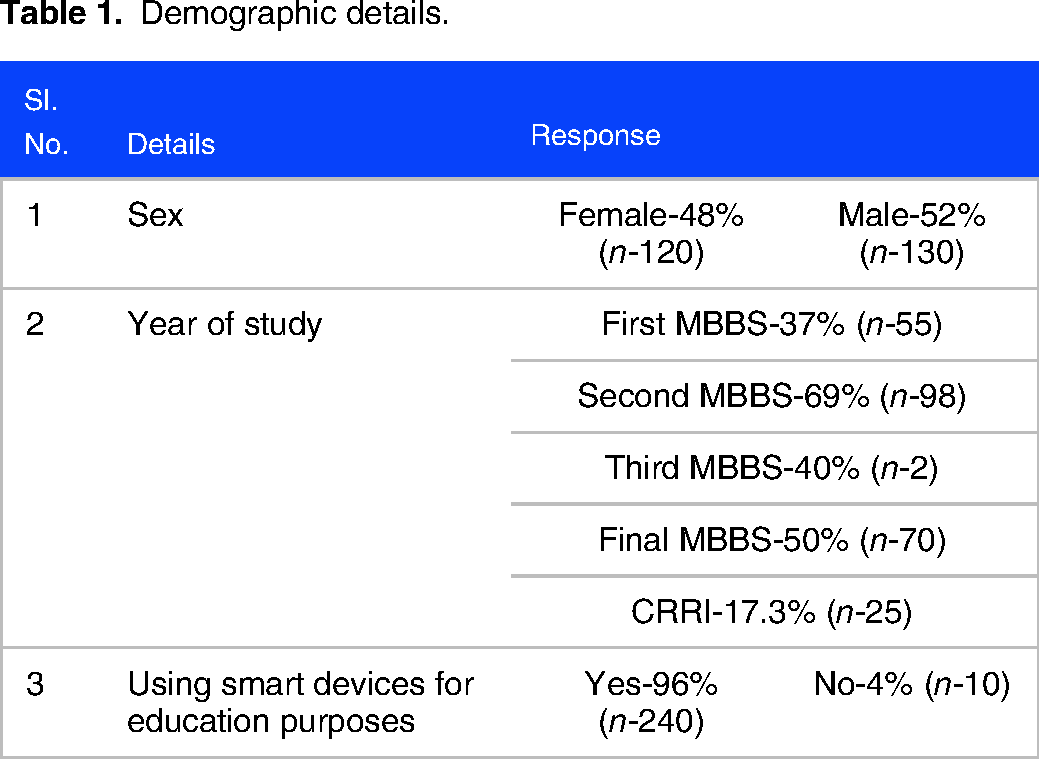
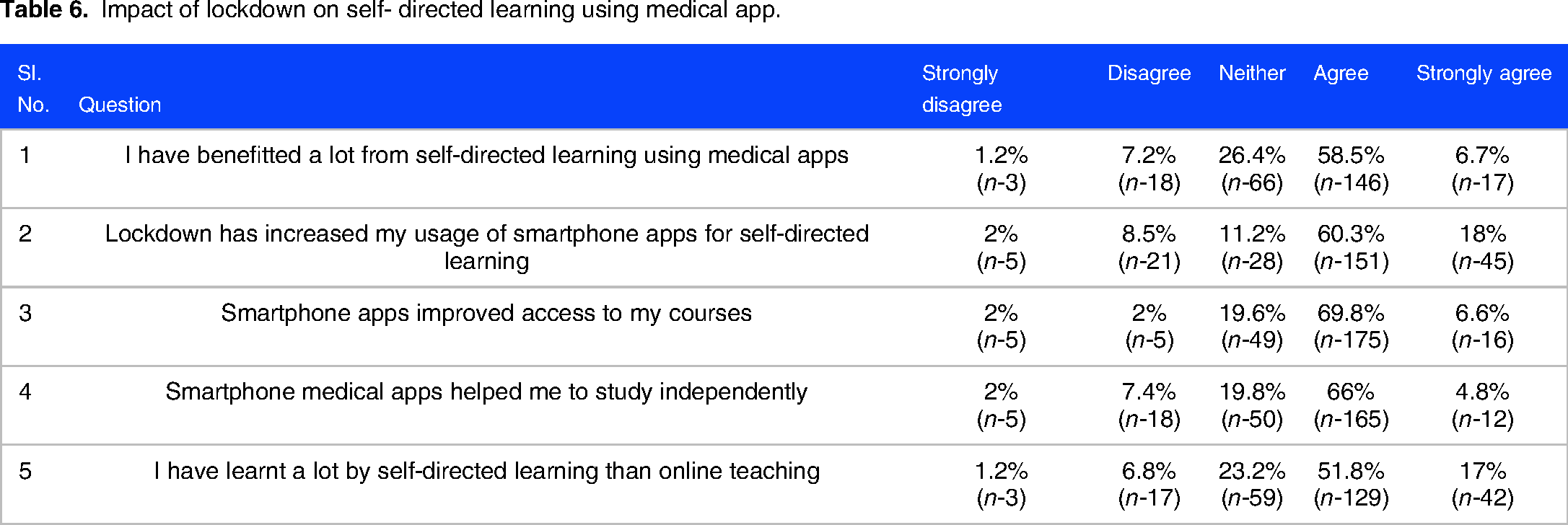
Among 582 students, from first MBBS till CRRI, only 250 (43%) have participated in the survey. The response for this study is obtained more from male (52%) compared to female (48%). Participants’ demographic details are given in Table 1. In this study, most of the recruited participants have experienced with regular usage of android smartphone. Responses to knowledge on health apps and usage of smartphone and medical apps for learning purpose are given in Tables 2 and 3. About 95% of the students have knowledge on medical apps and 59% of the students are educated by the medical educators to install medical apps in their android smartphones. Nearly, 43% of the medical students use heath apps on regular basis. Statistical significant (p < .05) was observed between the students’ knowledge on the use of medical apps on regular basis as well as recommended by medical educators (p ≤ .0001). Medical students ranging from 54.5% to 70.4% have agreed to use medical apps, journals, books, websites on their smart devices for seeking medical information (Table 4). Students’ perceptions related to medical apps ranging from 32% to 71.6% have agreed that medical apps enhances knowledge, user friendly, quality, point-of-care, safety and reliable medical information (Table 5). The response of Student's to impact on SDL due to medical apps range from 51.8% to 69.8% to improve the access of the course independently and online teaching (Table 6).).
Demographic details.
Knowledge regarding smartphones and medical apps.

Usage of smartphones and medical apps for learning purpose.

Student's attitude toward smartphone medical apps for learning purposes.

Students’ perceptions related to medical apps.

Impact of lockdown on self- directed learning using medical app.
Discussion
Usage of smartphones and its applications are increased in the past decades. Recently, there is a transition in the usage of smartphones from mobile phones and further upgraded into touch screen, large displays increased the efficiency of operating systems and the spacious memories which extends from 4 GB to 128 GB RAM to read, manage, and store large number of data's digitally instead manually. 16 In the present study, questionnaires have keenly focused on medical students’ knowledge, attitude, and perceptions (KAP Survey) toward health apps to emphasis on the SDL tool. Most of the Indian literatures have published related to the smartphone technology and its utilities which are served as a SDL tool for medical as well as dental graduates.6,9,14
In the present study, the response rate was higher in male students compared to female. The response rate (43%) was poor when compared to other studies from India1,2,6 and much better than the studies from the United States and United Kingdom.10,11 Higher response rate was reported in most of the Indian studies2,6 may be due to the distribution of questionnaires to the students in person and a compulsory lecture schedule rather than an online survey.
The majority of medical students use smartphone medical apps at least once a day, and agreed that it makes a positive effect on their education.2,3,6–14 According to a survey from India (90%) and England (84%), which was published in the year 2017 and 2012, medical students believed that smartphone and related medical apps have great endeavor to get their medical information as well as education, respectively.2,3
Our study shows that 96% of students have smartphones, and that 84% of them use various health applications for information. This is also highly similar to the studies from India.2,6 Nearly 93.0% of students agreed that they were aware of medical apps and had one or more medical apps installed on their Smartphone. Medical apps widely used by our students were Medscape (43%), which is similar to other studies in India2,6 and Sayed et al from Saudi Arabia. 7 Ephorates was the most popular app used in the United States and United Kingdom.10,11 In Pondicherry and other states of India, other important mobile apps were used namely Epicollect5 and ROME as SDL tools for UG medical graduates.4,17–20 In our study, 46% of students use smartphone apps at least once a day which is similar to other studies.1,2,6,7,11 The students who have submitted their responses said that they found it to be very easy to install and user-friendly, during the research. The attitude of medical students was approximately 71.6% with a combination of agreeing and strongly agrees that medical apps are beneficial and allows faster access to medical information, as shown in Table 4. In the present study, the recorded data response was quite similar to other studies from India2–6 and Saudi Arabia. 7
Regarding the total perception of the students, 91.9% were agreed and strongly agreed that medical apps are essential point-of-care tools and user-friendly. Mudgal et al, conducted an assessment study from India, recently in 2022 on knowledge, attitude, and practices of smartphones as learning tool for UG medical students. 6 However, 70.4% of the students have agreed that they obtained information from medical apps is highly reliable when compared to textbooks and other resources. Few studies have published responses on the field of dental students with the impact of medical apps as SDL tool during COVID-19 lockdown.3,17,21,22
In Table 6, the feedback was recorded on the positive side; that the majority of the students ranging from 51.8% to 69.8% have agreed that medical apps enhanced their SDL which and helped them to study independently. Around 65% of students agreed that they had learnt more through SDL than online teaching.
Limitation of the study
Due to time constraints the population was limited only to the medical graduates (250 respondents out of 582). Hence, there was no pilot testing as well as involvement of other populations like dental, engineering and arts college students for this digital survey. The students have been recruited based on the convenience sampling method hence power analysis was not done for this study. We generated only a limited data based on the availability of the students’ responses to analyze the tool for the SDL.
Conclusion
This study has made us to understand the knowledge and perception of health apps among medical students. During the lockdown the impact of SDL among medical students has been increased with the help of health apps and various websites which is related with the medical information. We also encourage our students to continuously acquire the innovative information from health apps and also to appreciate the usage of smartphones toward SDL.
Supplemental Material
sj-docx-1-mde-10.1177_23821205241235014 - Supplemental material for Assessment of Smartphone Medical Applications as a Self-Directed Learning Tool for Medical Students and Compulsory Rotatory Residential Internship—A KAP Survey
Supplemental material, sj-docx-1-mde-10.1177_23821205241235014 for Assessment of Smartphone Medical Applications as a Self-Directed Learning Tool for Medical Students and Compulsory Rotatory Residential Internship—A KAP Survey by Natarajan Shanmuga Vadivoo, Krishnan Sudha and Balasundaram Usha in Journal of Medical Education and Curricular Development
Footnotes
Acknowledgments
The authors are grateful and acknowledge all students and CRRIs who participated in the study.
Author Contributions
Conception, definition of intellectual content, data analysis, and manuscript editing and reviewing were done by N. Shanmuga Vadivoo, K. Sudha, and B. Usha.
Literature search, data acquisition, and manuscript preparation were done by N. Shanmuga Vadivoo.
Declaration of Conflicting Interests
The authors declared no potential conflicts of interest with respect to the research, authorship, and/or publication of this article.
Funding
The authors received no financial support for the research, authorship, and/or publication of this article.
Guarantor
N. Shanmuga Vadivoo.
Supplemental material
Supplemental material for this article is available online.
References
Supplementary Material
Please find the following supplemental material available below.
For Open Access articles published under a Creative Commons License, all supplemental material carries the same license as the article it is associated with.
For non-Open Access articles published, all supplemental material carries a non-exclusive license, and permission requests for re-use of supplemental material or any part of supplemental material shall be sent directly to the copyright owner as specified in the copyright notice associated with the article.
