



Abstract
BACKGROUND
Pulmonary physiology is a challenging, necessary component of pediatric pulmonary fellowship education. Our pediatric pulmonology fellowship program provided this education utilizing a flipped classroom approach but satisfaction with the method was declining. Evidence suggests that adult learners benefit from an engaging lecture method, but no evidence exists to compare the flipped classroom approach to the engaging lecture approach for pulmonary physiology education.
OBJECTIVE
To develop the most effective physiology curriculum for pediatric pulmonary fellows by comparing the flipped classroom approach to an engaging lecture method.
METHODS
Five physiology teaching sessions were assigned to the flipped classroom method and 5 to the engaging lecture style. Anonymous surveys assessing satisfaction, utilizing a five-point Likert scale, were completed by fellows at the end of each session. An unpaired t-test was used to compare responses.
RESULTS
Seven pediatric pulmonary fellows enrolled in the study. The average attendance per session was 5 fellows. There was no significant difference in fellows’ perceived understanding of the assigned physiology topic prior to the flipped classroom versus engaging lecture sessions. Fellows’ perceived understanding of the topics improved after both session types, with significantly more improvement after the engaging lecture sessions. Fellows also reported that engaging lecture sessions were more useful and improved their test-taking confidence. They were more likely to recommend engaging lecture sessions to future pulmonary fellows.
CONCLUSIONS
Pediatric pulmonary fellows benefited from the use of the engaging lecture style for physiology education.
Introduction
Pulmonary physiology is a challenging, necessary component of pulmonary fellowship education yet the best method to teach physiology to pulmonary fellows is unknown. The challenge of physiology education is not unique to a pulmonary fellowship.1,2 Malcolm Knowles has proposed that adult learners become more self-directed in their learning as they mature and suggested that educational methods should be adapted to this concept. 3 An interactive learning style is often preferred by adult learners.4–6 The flipped classroom method is one form of an interactive educational model. Prior to a flipped classroom session learners independently complete preassigned work to learn the important concepts needed for the session. Then, during the sessions, the learners actively engage to apply the concepts and participate in an interactive discussion. The flipped classroom method has been shown to improve learning when compared to traditional teaching methods and the use of this method became more popular during the COVID-19 pandemic during a time of mandatory switch to remote teaching.7,8
The Nationwide Children's Hospital Pediatric Pulmonology Fellowship Program has trialed multiple methods to teach pulmonary physiology with varying degrees of satisfaction among fellows and faculty. 9 Fellows typically scored around the national program average for normal development and physiology content on the annual in-training exam. Most recently the flipped classroom method was utilized for physiology education at our institution but there was significant fellow dissatisfaction with this method. For this method fellows were assigned a book chapter to read and a set of questions to answer prior to the start of each session. Questions and answers were then reviewed during the session. Another educational method, the engaging lecture style, utilizes short periods of lecture interrupted by interactive sessions such as problem sets or open discussions. Pre-work is not typically required for this method. In a cohort of dental students, the engaging lecture method improved physiology material retention and satisfaction scores when compared to traditional didactic lectures. 4 No evidence exists to compare the flipped classroom approach to the engaging lecture approach for pulmonary physiology education. The aim of this study was to develop the most effective physiology curriculum for pediatric pulmonary fellows by comparing the flipped classroom approach to an engaging lecture method.
Methods
The study involved the pediatric pulmonology fellowship program at Nationwide Children's Hospital in Columbus, Ohio during the 2020–2021 academic year. This is a 3-year long fellowship with 1 to 3 fellows per year. The Nationwide Children's Hospital Institutional Review Board reviewed the study and determined that this protocol met the criteria for exemption from IRB review. Separate ethics approval was not requested by the IRB. The study was determined to not require written consent but subjects were provided with an information sheet explaining the details of the study and participation was voluntary. The textbook Respiratory Physiology The Essentials by John B. West 10 was used for educational content. One chapter of physiology content was assigned to each session for a total of 10 sessions. The teaching method utilized in each session was randomized 1:1 between the flipped classroom and engaging lecture styles. Fellows were instructed to read the assigned chapter before each educational session for both the flipped classroom and engaging lecture sessions to allow for consistent fellow workload. Due to the COVID-19 pandemic, all educational sessions were conducted virtually in live video conference sessions. A single pediatric pulmonologist served as the faculty member for each educational session throughout the academic year. This faculty member has had extensive experience in providing fellowship education. Prior to the initiation of the study, the faculty member participated in a hospital-sponsored, interactive workshop on the engaging lecture method.
Flipped classroom sessions required attendees to answer questions on the assigned chapter prior to the start of the session. Questions were created by the faculty member based on the assigned chapter content for the session. One fellow was assigned in advance to lead each session, and both reviewed the questions provided and educated their co-fellows on the topics discussed. The faculty member was available for assistance if needed but sessions were primarily driven by fellows.
In contrast, the engaging lecture-style sessions were led by the faculty member who created a PowerPoint with several 5 to 10-minute didactic sections based on chapter content, broken up by interactive components. These interactive components included facilitated discussion of important diagrams/images from the assigned reading, case discussions, and question-and-answer discussions. The interactive components allowed learners to immediately apply the concepts taught in the didactic components. Both types of sessions lasted on average 45 min to 1 h.
Anonymous surveys assessing satisfaction, self-perceived understanding, and test-taking confidence, utilizing a five-point Likert scale, were completed electronically by the fellows at the end of each session. Survey results were collected in a REDCap database. The survey was not a validated survey but was reviewed and approved by multiple faculty members prior to its use.
Statistical analysis
An unpaired t-test was used to compare responses between the 2 education styles using the GraphPad Prism 9 statistical analysis software. Faculty documented session preparation time and satisfaction with each session at the completion of the session in a REDCap database.
Results
Seven of 9 pediatric pulmonary fellows enrolled in the study. Two pulmonary fellows who graduated prior to the study completion were excluded from the study. Participants included first through third (final) year fellows. Average attendance per session was 5 fellows per session due to unforeseen scheduling conflicts.
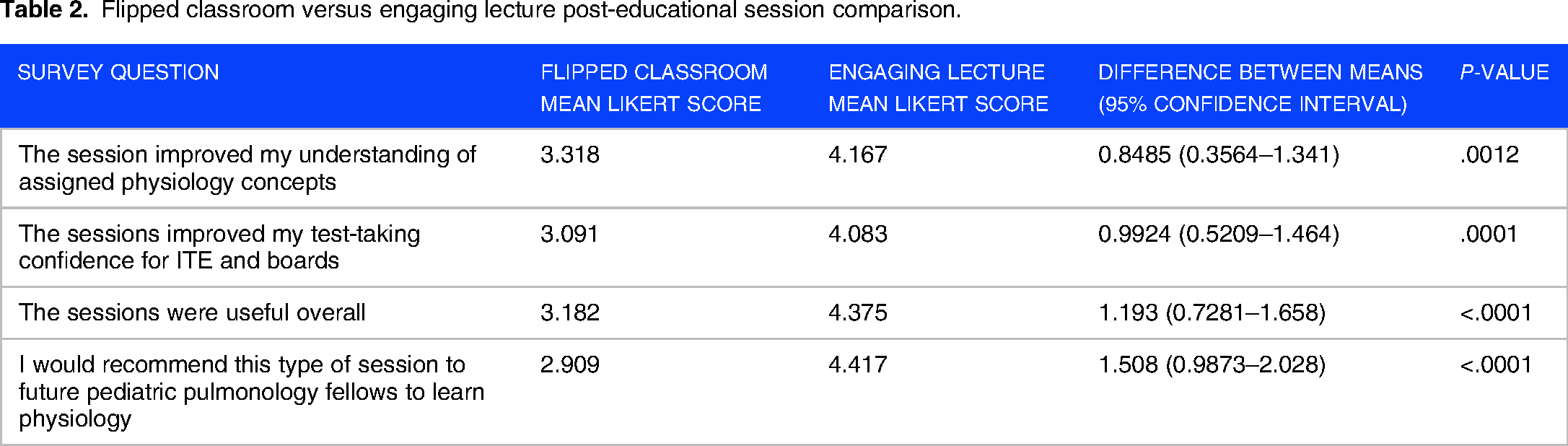
There was no significant difference in fellows’ perceived understanding of the assigned physiology content prior to the flipped classroom versus engaging lecture sessions (P = .0966). Fellows’ perceived understanding of the physiology topics improved after both session types (Table 1). Fellows reported significantly more improvement in their perceived understanding after the engaging lecture sessions (P = .0012). Fellows also reported that the engaging lecture sessions were more useful and improved their test-taking confidence when compared to the flipped classroom method (P < .001 and P = .001). They were more likely to recommend engaging lecture sessions to future pulmonary fellows (P < .0001) (Table 2).
Understanding of physiology material before and after flipped classroom (FC) and engaging lecture (EL) sessions.

Flipped classroom versus engaging lecture post-educational session comparison.
Faculty reported that it took more time to prepare for the engaging learning sessions, but the sessions were perceived to be easier to facilitate. Fellow's active participation was similar during the question review parts of each session. The engaging lecture sessions had more built-in didactic time, limiting the interactive time compared to the flipped classroom session.
Discussion
Adult learners have been shown to benefit from interactive teaching techniques when compared to a more traditional lecture-style method.4–6 Throughout the various levels of education physiology has proven to be perceived as a difficult subject to both understand and to teach.1,2 Pulmonary physiology education is a challenging component of pulmonary fellowship but there is a paucity of literature on preferred teaching methods in this population.
Our study demonstrated that fellows’ self-reported understanding of physiology content and satisfaction was greater after engaging in lecture versus flipped classroom educational sessions. This method improved fellows’ perceived understanding of the physiology content and improved test-taking confidence. Faculty felt that the engaging lecture sessions took longer to prepare for, but were easier to facilitate, making the effort feel worthwhile for the sole faculty facilitator in this small study.
A small sample size is a limitation in our study as we were limited to an individual pediatric pulmonary fellowship with only 7 eligible fellows and not all fellows were able to attend every session. This limited our ability to use power calculation to determine and recruit a specific sample size. Another limitation was reliance on learner-subjective self-assessments as the outcome was based on a nonvalidated survey tool. Due to the timing and nature of the study, in training exam scores could not be used to reflect learning.
We did not assess the impact that could have contributed from having a fellow direct the flipped classroom session with faculty assistance versus having a faculty member primarily responsible for the engaging lecture sessions. Primary faculty responsibility for the session could have had an impact on fellow satisfaction. It's possible that a perceived lower workload for fellows for the engaging lecture-style sessions could have impacted impressions of the educational sessions. The flipped classroom sessions primarily focus on questions without the active, faculty-driven didactic sessions including in the engaging lecture sessions could have also impacted results.
Despite these limitations, our study adds to the limited available research on the best teaching methods for physiology education in pediatric pulmonary fellowship programs. Fellows perceived a greater increase in their understanding of the material with the engaging lecture method although this didn’t reach statistical significance. Furthermore, this method was preferred by both the trainees and the presenting faculty as well. Moving forward, we plan to evaluate participants’ in-training exam scores to objectively assess physiology knowledge. This exam is completed in February each fellowship year and physiology questions account for about 10% of the exam. It is the most widely available objective method to evaluate retention of the physiology material.
We hope this study will serve as a pilot, prompting a larger trial of the engaging lecture method in a multicenter fellowship program study. The ability to demonstrate success with the engaging lecture method in a larger, combined fellowship group could provide immense benefit as many programs struggle to teach physiology effectively. This collaboration, if successful, could have the added benefit of decreasing faculty preparation time for the sessions as the work could be shared among many programs. In addition, this information would be equally applicable to adult pulmonary/critical care fellows as physiology is an important part of their curriculum as well. Programs directors in many specialties could also apply the engaging teaching method to a variety of other curricular aspects.
Conclusion
In conclusion, this study demonstrates that the engaging lecture style improved fellows’ satisfaction with pulmonary physiology education when compared to the flipped classroom method. Further studies need to be done to measure objective differences in material understanding between the 2 methods.
Supplemental Material
sj-docx-1-mde-10.1177_23821205231221722 - Supplemental material for Novel and Engaging Teaching Method for Pulmonary Physiology
Supplemental material, sj-docx-1-mde-10.1177_23821205231221722 for Novel and Engaging Teaching Method for Pulmonary Physiology by Lisa M. Ulrich, Sabrina Palacios, Debra Boyer and Stephen Kirkby in Journal of Medical Education and Curricular Development
Footnotes
Authors’ contributions
Lisa Ulrich, Sabrina Palacios, and Stephen Kirkby contributed to the study design, data interpretation, and manuscript preparation. Debra Boyer contributed to data interpretation and manuscript preparation.
Funding
The author(s) received no financial support for the research, authorship, and/or publication of this article.
Declaration of Conflicting Interests
The author(s) declared no potential conflicts of interest with respect to the research, authorship, and/or publication of this article.

Supplemental material
Supplemental material for this article is available online.
References
Supplementary Material
Please find the following supplemental material available below.
For Open Access articles published under a Creative Commons License, all supplemental material carries the same license as the article it is associated with.
For non-Open Access articles published, all supplemental material carries a non-exclusive license, and permission requests for re-use of supplemental material or any part of supplemental material shall be sent directly to the copyright owner as specified in the copyright notice associated with the article.
