



Abstract
INTRODUCTION
The circumstances of the COVID-19 lockdown offered an opportunity to develop remote educational strategies in medical education.
OBJECTIVES
To assess medical students’ experiences with online e-learning (OeL) satisfaction, intellectual environment, and communication during the COVID-19 pandemic.
METHODS
A cross-sectional study was conducted at the College of Medicine, University of Bisha, Saudi Arabia. A self-administered questionnaire (21 items) was used to evaluate OeL in three domains of satisfaction (nine items), intellectual environment (seven items), and communication (five items). Students from years one to six were invited to fill out the questionnaire form with five-point Likert scale responses. Descriptive statistics, one-way analysis of variance (ANOVA), and independent t-test were used to evaluate the association between variables.
RESULTS
Out of 237 participants, 96.6% (158 male and 71 female) responded to the questionnaire. Most students (86.5%) preferred the blackboard for their e-learning. The mean total scores were 30.18 ± 6.9 out of 45 for satisfaction, 19.67 ± 5.4 out of 25 for communication 25.43 ± 5.1 out of 35 for the intellectual environment. Over 50% of the students rated moderate scores on satisfaction and intellectual environment domains. About 85% of the students rated moderate scores in the communication domain. Male students rated higher significant scores than female students for satisfaction (31.3 ± 6.3 vs 27.6 ± 7; P < .001) and intellectual environment (26.3 ± 4.32 vs 3.5 ± 6.1; P < .001). There were no significant differences in students’ responses to the tested domains related to GPA level. Significantly higher levels of scores for satisfaction (33.3 ± 5.6 vs 28.8 ± 6.9; P < .001) and communication (21.2 ± 4.5 vs 18.9 ± 5.7; P = .019) were obtained by clerkship students than pre-clerkship.
CONCLUSIONS
Medical students’ experiences with e-learning are encouraging, which might be more effective with continuous training programs for students and tutors. Although OeL is an acceptable methodology, further studies are needed to analyze its impact on the target learning outcomes and students’ academic achievement.
Introduction
Since December 2019, the world has challenged exclusive struggles due to the COVID-19 pandemic. 1 The disease spread and became a global issue that affected every aspect of life, including medical education. 2 The pandemic forced educational institutions to shift from face-to-face teaching to e-learning to meet emerging demands. 3 As a result, most medical schools paid great attention to online education to be a part of modern medical education. 4
Online e-learning (OeL) is a pedagogical model using information technologies to deliver educational sessions to learners in remote locations.5,6 It has become a global phenomenon due to the emergence of new technologies and widespread internet adoption. 7 OeL allows learners to interact with instructors and peers, access more learning resources, and construct knowledge using laptops, mobile, and other electronic devices.5,8 Internet-based learning, computer-based learning, virtual classrooms, and digital collaboration represent different e-learning tools. 5 A study revealed that students’ online learning experiences are influenced by various situations, such as technology, institutional commitment, the established physical and social environment, and learners’ and tutors’ characteristics. 4 The OeL has played an essential role in medical education and has several benefits in enhancing students’ learning. 6 Worldwide, online education has steadily become an integrated part of modern medical education. 4
The circumstances of the COVID-19 lockdown allowed assessment of medical teaching methodologies and offered recommendations to adopt a new approach and develop remote educational strategies.4,9 Concerns have been taken about the effectiveness and benefits of these programs for medical curriculum compared with traditional face-to-face learning. 4 However, the measure of usability features of OeL, such as satisfaction level, communication enhancement, and environment, might improve this type of educational experience. 10
Before the COVID-19 pandemic, Saudi Universities at undergraduate levels were experienced with OeL format11,12; however, a comprehensive medical curriculum in online design has not been implemented. Moreover, a shift from physical learning to online learning during the pandemic puts the educational system under a challenge, 4 since medical students’ and tutors’ actual feelings and opinions are unclear. 13 This new situation provides an opportunity to assess such an educational strategy. However, it is difficult for institution authorities to take adequate measures to improve and guarantee the effect of OeL without asses its use from instructors’ and learners’ points of view. Many factors, including instructor characteristics, student experience, and educational environment, can impact students’ satisfaction with e-learning. 1 Despite there is increasing evidence in documented the effectiveness of e-learning during the COVID-19 pandemic in Saudi medical schools.8,14–16 There is a lack of information about medical students’ perspective regarding e-learning at the University of Bisha, Southern Saudi Arabia. 17 Therefore, the present study aimed to evaluate medical students’ experience with OeL regarding satisfaction, communication enhancement, and intellectual environment. Exploring students’ perspectives towards OeL provide valuable information for medical schools to improve their e-learning powers to face similar future crisis and enhance education outcome.
Methodology
Study design and setting
A cross-sectional study was conducted between June 01, 2021 and August 31, 2021 at the University of Bisha, College of Medicine, Bisha, Saudi Arabia (UBCOM). The UBCOM offers 6-year MBBS program by implementing an integrated student-centered curriculum. Various instructional strategies of interactive lectures, seminars, problem-based learning, team-based learning, practical sessions, and bedside teaching are conventionally utilized to deliver the medical curriculum at UBCOM.18,19
Participants
Medical students from clerkship (years 6 and 5), pre-clerkship (years 4, 3, and 2), and foundation year (year 1) were included in the study. In addition, demographic details of students, including age, gender, year of study, and grade point average (GPA) score, were collected. Students who did not consent to the study, were absent from the class during the day of survey orientation, applying to withdraw, or not registered for complete courses of the academic year were excluded from the study.
Sampling and sample size
A stratified random sampling technique was adopted to select students based on academic year and gender. Students were randomly selected from each stratum to obtain the required sample size. Calculating the sample size was done by assuming a 50% prevalence of good perception of e-learning in terms of satisfaction, communication, and intellectual environment. A standard formula (n = z2 × P (100-P)/d2) was used to calculate the sample size, with the following parameters: n = the number of samples; Z = the level of statistical significant set up at the level of 95% confidence interval (1.96); d = the acceptable margin of error (5%); P = the anticipated prevalence (50%). The minimum sample size obtained was 215. Then 10% was considered to avoid non-response cases, giving a total of 237.
Instrument
A self-administered questionnaire containing 21 items was designed to evaluate students’ experiences with OeL regarding satisfaction, communication enhancement, and intellectual environment. The development of the instrument was done after an extensive review of the current literature.1,2,8,20 The instrument items were categorized into three domains. The first part comprises nine items to measure students’ satisfaction with e-learning. The second part consisted of five items to evaluate the students’ opinions about e-learning in enhancing communication and interaction. The third part consisted of seven items to assess the intellectual environment of e-learning. A pilot study was performed among 15 medical students from different academic years to evaluate questionnaire validity. The participants in the pilot study were not included in the actual survey. Subsequently, some items were revised and modified without changing the essence of their meaning by four authors (nos. 1, 2, 3, and 8). The 21 items with sub-items were included in the final scale (supplementary file 1). The students’ responses to the questionnaire items were based on a five-point Likert scale, which was arranged as strongly disagree (1), disagree (2), not decided (3), agree (4), and strongly agree (5). Among the 21 items, three negatively worded items in the scale were reverse scored by assigning them from 5 to 1. The higher score, the more likely the students consider it a positive response.
Data sampling
The online questionnaire forms were distributed to the students after requesting verbal consent and requesting timely completion and return. The students have been voluntarily asked to indicate their agreement level on a five-point Likert scale. Students who returned questionnaire forms with complete responses were included in the analysis.
Calculation of the scores
The total mean scores of each instrument domain were calculated and subcategorized into three levels of perceptions: poor, moderate, and good. Firstly, the students’ satisfaction domain was evaluated by nine items, with possible total mean scores ranging from 9 to 45 and grouped as poor (score from 9 to 20), moderate (score from >20 to 32), and good (score from >32 to 45). Secondly, the communication domain was assessed by six items with possible total mean scores from 6 to 30 and categorized as poor (score from 6 to 13), moderate (score from >13 to 21), and good (score from >21 to 30). Thirdly, the intellectual environment domain was assessed by the 7 items with possible total mean scores ranging from 7 to 35 and grouped as poor (score from 7 to 15), moderate (score from >15 to 25), and good (score from >25 to 35).
Ethical approval
Verbal informed consent was obtained from students who agreed to participate after explaining the purpose of the study at the commencement of the survey. Following obtaining informed verbal consent from selected participants, they were requested to sign a list to confirm participation. In addition, an attached cover letter explaining the study procedure was distributed along with a questionnaire for each student. Filling out the online questionnaire and submission by the student was considered a declaration of agreement to participate in the study. The Research Ethics Local Committee of the College of Medicine, University of Bisha, Saudi Arabia, approved the study protocol, including the verbally informed consent procedure (UBCOM/ H-06-BH-087 (04/21)).
Statistical analysis
Data was entered and analyzed in Statistical Package for Social Sciences 22.0 (SPSS, Inc., Chicago, IL, USA). The statistical analysis was conducted first to estimate the validity and reliability of the instrument using Cronbach's alpha, with a value of 0.70 or higher being acceptable. Descriptive statistics were utilized and presented as mean scores, standard deviations (SD), and proportions. One-way analysis of variance (ANOVA) and independent t-test were used to test the association of students’ gender, academic level, and GPA scores with e-learning satisfaction, environment, and enhancing communication. Tukey's HD post hoc test for multiple comparisons was performed to determine the different pairs. All P-values of <.05 were considered as the criteria of significance.
Results
Cronbach's alpha was 0.89 for the total items (n = 21) of the questionnaire, 0.753 for the satisfaction domain, 0.77 for the communication domain, and 0.707 for the intellectual environment domain, which indicates the validity and reliability of the instrument.
Of 237 medical students recruited, 229 (96.6%) responded to the questionnaire. Of these 229 participants, 158 (69%) were males, and 71 (31%) were females, their age range between 18 and 26 years old (mean 21.5 ± 1.75) and GPA between two and five (mean of 4.17 ± 0.7).
Students of the first academic year represent 35 (15.3%), the second year 64 (27.9%), the third year 40 (17.5%), fourth year 31(13.5%), fifth year 44 (19.2%) and sixth year 15 (6.6%)
The study revealed that most of the students (198; 86.5%) preferred the blackboard forum, followed by Zoom (18; 7.9%), Google Hangout (7; 3.1%), and Microsoft Team (6; 2.6%) for OeL. Almost half of the students, 48.5% (n = 111), preferred iPad devices for their e-learning, whereas 37.6% (n = 86) preferred laptops (Figure 1).
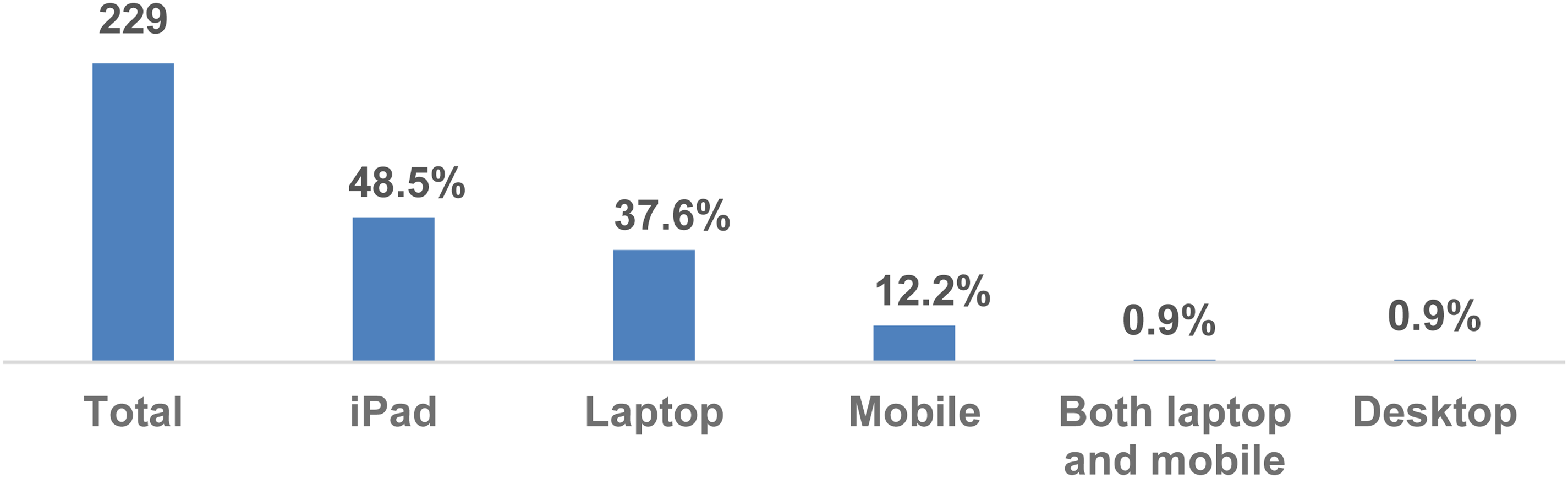
Frequency of electronic devices preferred by medical students (n = 229) during distance e-learning.
Table 1 summarizes the mean scores of the three instrument domains, namely satisfaction, communication enhancement, and intellectual environment scales. The mean total scores were 30.18 ± 6.9 out of 45 for satisfaction, 19.67 ± 5.4 out of 25 for communication 25.43 ± 5.1 out of 35 for the intellectual environment. More than 50% of the students rated moderate scores on satisfaction and academic environment domains. About 85% of the students rated moderate scores in the communication domain.
Sum of students’ mean scores on the three instrument domains.

Table 2 represents students’ responses to the items assessing e-learning in terms of satisfaction. One hundred and twenty-six (55%) of students indicated that their experience with e-learning was fair and good. About 62% of students were satisfied with their living arrangements. Moreover, 70% of students perceived that some disciplines are not suitable for e-learning.
Students’ responses on the items assessing e-learning satisfaction.

Table 3 shows students’ response rates on each item of the communication scale. More than half students gave positive responses for the following items: “possibility of effective discussion between students”, “e-learning promotes interaction”, and “e-learning gives the opportunity to ask questions” (Table 3).
Students’ responses on the items assessing the role of e-learning in communication enhancement.

Table 4 shows students’ response rates on each item of the intellectual environment scale. The highest response rate (78.8%) was reported for the “availability of sufficient technology as important tools in e-learning”. More than 60% of students perceived that “the study platform of the university was useful”, “accessibility to sufficient and quiet study space to meet the demands of e-learning,” and “accessibility to sufficient and stable internet network to attend the e- classes”.
Students’ responses on the items assessing the intellectual environment of e-learning.

Figure 2 compares students’ responses toward OeL by gender, GPA scores, and academic level. Male students rated higher scores than female students for satisfaction (mean = 31.3 ± 6.3 vs 27.6 ± 7; P < .001) and intellectual environment (mean = 26.3 ± 4.32 vs 3.5 ± 6.1; P = .0001). Furthermore, there was no significant difference in students’ scores for the communication category (mean = 20.1 ± 5.3 vs 18.7 ± 5.6; P = .083) (Figure 2A). Based on the students’ GPA scores, there were no significant differences in students’ responses to the three categories when comparing the mean score of the students with GPA ≥ 4.01 to those with GPA ≤ 4.00 (Figure 2B). Regarding total mean scores according to students’ academic levels, significantly higher levels of scores for satisfaction (mean = 33.3 ± 5.6 vs 28.8 ± 6.9; P < .001) and communication (mean = 21.2 ± 4.5 vs 18.9 ± 5.7; P = .019) were obtained by clerkship students compared to pre-clerkship students (Figure 2C). Detailed numerical data of these comparisons are presented in Table 5.
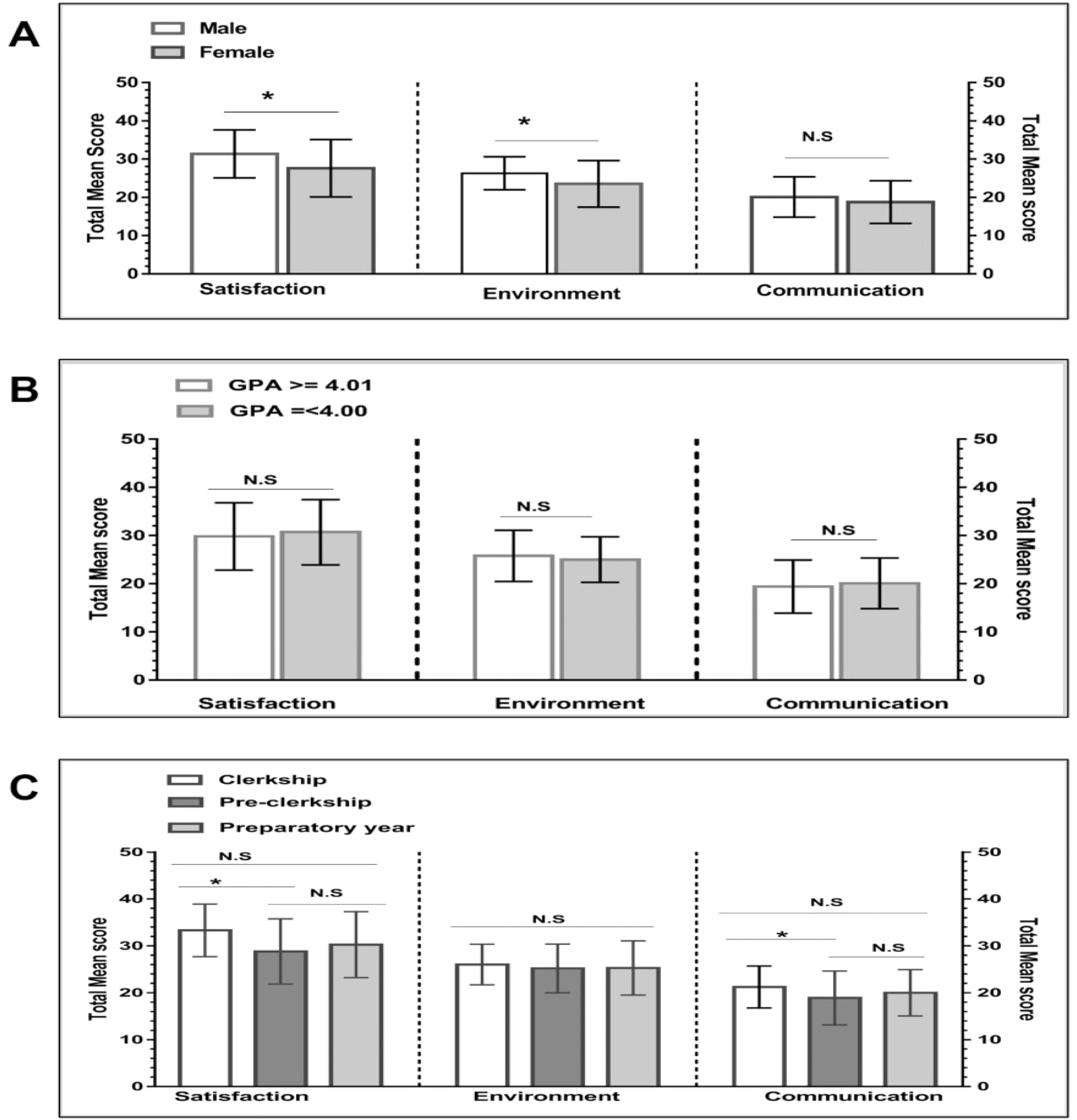
Comparison of students’ responses (mean ± SD) on the three domains of the scale by gender (A); grade point average (B); academic level (C).
Comparison of total mean scores of e-learning in terms of satisfaction, environment, and communication enhancement by students’ gender, academic level, and grade point average (GPA)

Discussion
In the present study, most students preferred the blackboard, the official learning system of the university, to deliver online learning activities during the pandemic. Similarly, the preference for blackboard has been reported among medical students in previous studies in Saudi Arabia.15,20 This learning management system (LMS) provides various options applicable to different teaching methods and is widely used in educational institutions worldwide.21,22 Alokluk stated that the blackboard is a useful LMS that promotes pedagogical gain and constructivist perspectives. Moreover, blackboard provides a collaborative and user-friendly environment for teaching-learning in terms of communication, assessment, and overall information management system. 22 Furthermore, our findings revealed that half of the students prefer to use iPads over laptops and other devices. This could be attributed to the iPad being smaller, having a touchscreen for note-taking, lighter, more compact, and cheaper than a laptop. The benefits of utilizing iPAD in undergraduate medical educations have been documented by many authors.23–26 In a survey of 103 medical students in clerkship curriculum, the participants perceived that iPAD is a useful clinical tool during their rotation and helps them through quick access to clinical information and retrieve electronic medical databases. 24 Studies explained previously the importance of iPAD help medical students in preclinical curriculum to acquire basic medical information.25,27
We used a self-administered 21-item instrument to assess three dimensions of e-learning, namely satisfaction, intellectual environment, and communication enhancement. However, the total scale and subscales were valid and reliable, with good internal consistency. The coefficient of reliability was important to find out how closely related the set of items as a group and that each item measured the underlying construct of student perceptions about online learning. Our results showed that the mean total instrument score was 75.3 out of 110, indicating that medical students expressed a good perception of their experience with OeL. A study conducted at King Abdulaziz University, Jeddah, in Saudi Arabia, revealed that medical students were moderately accepted to e-learning during the COVID-19 lockdown. 20 Moreover, a study found that synchronized online classes were well-accepted by the medical students at Qassim University, central Saudi Arabia. 8 However, global studies proved that online learning was an effective teaching and learning tool during the COVID-19 pandemic.4,6,13,28
Regarding the satisfaction subscale, most students proved moderate to high satisfaction with online learning. The study findings showed that 62% of students were satisfied with the living arrangement of OeL, and 55% indicated that their experience with online learning was fair and good. Likewise, a moderate level of satisfaction with e-learning was reported among medical and dental students in Saudi Arabia. 29 Moreover, our figure is almost similar to that reported in China, where 62% of medical students were satisfied with the online learning program provided by their institution, 4 but higher than the 26.8% reported in Jordan. 5 The moderate level of satisfaction found in our study could be because this is the first time medical students have joined this new learning modality. Current literature suggests that distance learning is strongly linked to students’ prior experience with both students and tutors. 5 Rajeh et al. indicated that efforts to increase students’ satisfaction and intention with e-learning should be directed to adopting easy and useful e-learning platforms. In addition, training and motivating students to continue e-learning and increasing their confidence to ensure the effective and efficient use of such teaching modalities. 29
Although our students rated high scores for most satisfaction items (Table 2), 70% perceived that some disciplines are unsuitable for online learning. This agrees with other studies, which found that online teaching did not allow medical students to acquire competencies in clinical subjects and practice skills needed for clinical practice and future professionals.1,30 Therefore, for future and emergency situations as well as COVID-19 outbreaks, medical teachers need to understand the best choice of curriculum content for distance learning and face-to-face learning. Moreover, considerations should be made regarding the application of online learning in aspects of students’ different learning phases. 4
Research evidence mentioned several important consents related to students’ satisfaction with e-learning training, such as online interactions, computer efficiency, online skills, teacher support, course design, teacher feedback, quality of information and activity, and technical support.16,31 In the present study, more than 90% of students rate moderate to high for the intellectual environment, with total mean scores of 3.6 ± 1.2. Our students perceived sufficient technology as an important tool in the e-learning environment. Likewise, a study conducted among health science students in Croatia indicated that technology could thus help them make their e-learning environment more flexible. 32 In Jordan, technical resources, infrastructural and institutional redness resources reported are major challenges for implementing distance learning.3,5 Research evidence indicated that the ability of faculty members and institutions to create an attractive online learning environment that uses the right technology and understands its educational approaches had the most significant impact on student satisfaction with emergency distance learning.10,33 A study carried out in 10 countries across four continents indicated that the effects of e-learning quality on the students’ performance were strongly mediated by their satisfaction with e-learning. 31
The relationship between tutor and student is based on collaboration and communication, which requires adapting quickly to new situations using different communication technology. 31 Connecting through portable electronic devices and virtual platforms promotes quick availability and increases frequent meetings between students and their tutors. 34 In this study, the students believed that OeL fosters communication and interaction. Nevertheless, only about half of them perceived that e-learning enhances effective discussion and allows them to interact with peers and tutors. The possible explanation for this moderate rate might be that some of our students are poorly motivated to engage in e-learning or encounter communication challenges. However, technical issues related to poor internet connection, computer skills, failures of overloaded servers, and communication platforms were communication barriers.1,31 The benefits of e-learning in enhancing communication have been discussed in the literature. For example, a study examined the virtual learning strategies used in population health nursing course during the COVID-19 pandemic. Manakatt et al. 34 stated that students are better able to connect with clinical faculty and stakeholders through digital platforms.
There were significant differences in both satisfaction and environment subscale between male and female students. Male students were more satisfied with e-learning and its environment than female students, which agrees with elsewhere studies.4,13 The possible explanation for this difference may be that males have more computer skills and are more easily adaptable to e-learning. On the other hand, females usually have more sensitive feelings and place higher demands on themselves, which keeps them worried and in stressful situations. 13 There were no significant differences in OeL acceptance in the present study related to students’ GPA levels.
On the contrary, another study found that a higher GPA is a significant predictor of a high e-learning acceptance measure among Saudi medical students. 20 Furthermore, A study conducted among undergraduate medical students at the College of Medicine, Majmaah University, Saudi Arabia, found that students with the highest GPA grades significantly shifted to consult the online educational resources than those with lower GPA. 14 However, online open educational resources significantly improve grade achievement by the students at the end of the course. 14
Unpredictably, our finding revealed that clerkship students were more delighted with OeL in terms of satisfaction and communications than pre-clerkship students. Generally, medical students in clerkships need more experimental and clinical practice in real-life situations than in pre-clerkships. In addition, medical students need contact with patients to master desired professional skills, exposed to patient care and physical healthcare environments. 32 Therefore, further studies are required to ensure the applicability of e-learning to complement traditional teaching methods in clinical clerkship.
The study has several limitations that need to be addressed in future studies. First, this is a cross-sectional study designed in a single medical school. Therefore, the results may not be generalized to other schools and must be validated by further studies. However, a longitudinal survey could give adequate time to a comprehensive estimation of the benefits of e-learning in medical curricula. Second, the study sampled only medical students; therefore, further studies should include faculty members, college administrators, and technical staff for a better understanding of e-learning and its other related factors. Third, although the study determined several pros of e-learning, we did not evaluate their educational outcomes.
Conclusions
In conclusion, the study revealed that medical students’ experiences with e-learning are encouraging in terms of satisfaction, communication enhancement, and intellectual environment. Therefore, establishing continuous training programs about using e-learning resources is essential for preparing students and tutors to improve their skills in mastering OeL. The positive opinions about online learning give insight for medical educators to embed OeL as an educational methodology in the medical curriculum. However, the selection and design of curriculum contents that fit e-learning are required. Although medical students accept the OeL methodology, further studies are needed to analyze its impact on the target learning outcomes and students’ academic achievement.
Supplemental Material
sj-docx-1-mde-10.1177_23821205231173492 - Supplemental material for Climate of Online e-Learning During COVID-19 Pandemic in a Saudi Medical School: Students’ Perspective
Supplemental material, sj-docx-1-mde-10.1177_23821205231173492 for Climate of Online e-Learning During COVID-19 Pandemic in a Saudi Medical School: Students’ Perspective by Karimeldin MA Salih, Suaad Elnour, Nahid Mohammed and Abdullah M. Alkhushayl, Ali A Alghamdi, Ibrahim A. Eljack, Jaber Al-Faifi, Mutasim E Ibrahim in Journal of Medical Education and Curricular Development
Footnotes
Declaration of conflicting interests
The author(s) declared no potential conflicts of interest with respect to the research, authorship, and/or publication of this article.
Funding
The author(s) received no financial support for the research, authorship, and/or publication of this article

Supplemental Material
Supplemental material for this article is available online.
References
Supplementary Material
Please find the following supplemental material available below.
For Open Access articles published under a Creative Commons License, all supplemental material carries the same license as the article it is associated with.
For non-Open Access articles published, all supplemental material carries a non-exclusive license, and permission requests for re-use of supplemental material or any part of supplemental material shall be sent directly to the copyright owner as specified in the copyright notice associated with the article.
