




Abstract
Objectives
Participation in medical specialty organizations can provide medical students and residents with additional research, advocacy, networking, and leadership opportunities. Although past research has looked at individual specialties in the United States, little is known about trainee involvement in Canadian organizations. Therefore, the aim of this study is to review the opportunities available for medical students and residents within Canadian medical specialty organizations.
Methods
The websites of 71 Canadian medical specialty organizations were reviewed to assess levels of trainee participation.
Results
Of the 71 organizations reviewed, 42 (59%) allow medical students and 67 (94%) allow residents to become members. Most organizations allow trainees to attend their annual conference (83% for students and 93% for residents), and the mean cost of attending the most recent virtual conference was $114 (range: $0–$475) for students and $142 (range: $0–$475) for residents. Twenty-two organizations (31%) have travel awards for students and 37 (52%) have awards for residents. Research grants are available in 41 (58%) of organizations for students and 56 (79%) for residents. Formal mentorship programs exist in 16 (23%) organizations for students and 25 (35%) for residents.
Conclusion
To our knowledge, this study highlights for the first time the scholarly opportunities available to trainees within Canadian medical specialty organizations.
Introduction
Participation in professional societies may enhance the education of medical students and residents through additional research, advocacy, networking, and leadership opportunities. Future physicians may be unaware of these opportunities available to them. Current studies have explored trainee involvement within American professional organizations of various medical specialties, including dermatology, 1 orthopedic surgery, 2 otolaryngology, 3 ophthalmology, 4 and radiology. 5 However, the level of involvement of trainees in Canadian professional organizations to our knowledge has yet to be described in the literature. Therefore, the aim of this study is to review the opportunities available for medical students and residents within Canadian medical specialty organizations.
Methods
Three investigators (M.T., A.W., M.S.) independently reviewed the websites and bylaws of the 71 Canadian national specialty societies as recognized by the Royal College of Physicians and Surgeons 6 and the College of Family Physicians of Canada in 2021. Policies on trainee involvement within the organizations were recorded, including membership, leadership positions, annual meeting attendance, ability to present research, travel and research funding, and formal mentorship programs. Societies were contacted by email in attempt to verify the accuracy of the information. The University of Saskatchewan Biomedical Ethics Board determined this observational study to be exempt from review (exemption waiver number E166 April 19th, 2021).
Results
Of the 71 Canadian medical specialty organizations reviewed, 42 (59%) offer membership to medical students (Table 1), with 22 (52%) being free, and 67 (94%) offer membership to residents (Table 2), with 35 (52%) being free. The mean (SD) membership fees are $23 ($28) for medical students, ranging from $0 to $90, and $31 ($41) for residents, ranging from $0 to $175. There are 27 (38%) organizations that allow medical students to serve on committees and 50 (70%) that allow residents. Formal mentorship programs exist in 16 (23%) organizations for students and 25 (35%) for residents.
Survey of medical organizations for medical students.

Abbreviations: nd, no data; N/A, not applicable; nc, no conference.
Conference fee refers to cost of attending virtual conferences in 2020 or 2021.
Survey of medical organizations for residents.
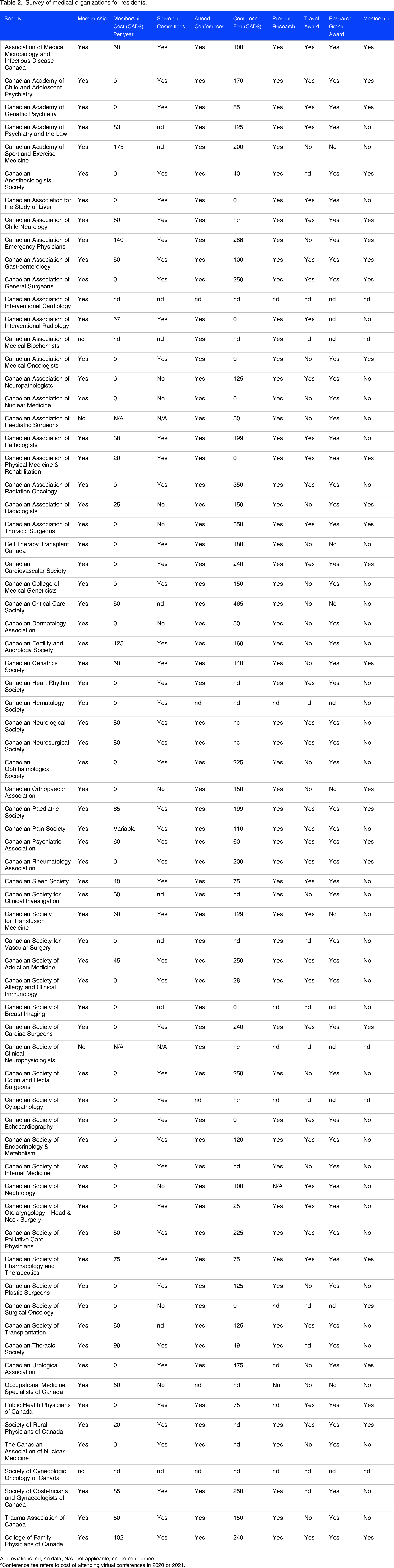
Abbreviations: nd, no data; N/A, not applicable; nc, no conference.
Conference fee refers to cost of attending virtual conferences in 2020 or 2021.
Most organizations allow trainees to attend their annual conference (83% for students and 93% for residents), and the mean (SD) cost of attending the most recent virtual conference was $114 ($98) for students, ranging from $0 to $475, and $142 ($113) for residents, ranging from $0 to $475. Free conference attendance is offered in 8 (11%) organizations for both medical students and residents. Medical students can present research at the annual conferences of 48 (68%) organizations and residents can present research at 60 (85%). Research funding or awards are available in 41 (58%) organizations for medical students and 56 (79%) for residents. Travel awards to in-person conferences are available in 22 (31%) organizations for medical students and 37 (52%) for residents.
Discussion
This study evaluated the scholarly enrichment opportunities offered by Canadian medical specialty organizations to medical students and residents. We found that both medical students and residents have numerous opportunities to become trainee members of medical organizations, attend conferences, present research, and apply for travel and research awards. When comparing the two types of trainees, opportunities were more often available to residents than they were for medical students.
Based on current medical education literature, it is unclear whether involvement in medical specialty organizations is associated with increased trainee competency or interest in the specialty. However, it has been demonstrated that formal mentorship programs are associated with increased career satisfaction and superior career options for trainees. 7 In our study, several organizations had mentorship programs to guide medical students, residents, or early career attending physicians in their desired specialty. Additionally, opportunities to present research at academic conferences may enhance medical student applications for the residency selection process. 8 By presenting research in their desired specialty, students can demonstrate an interest in the field and network with physicians in that organization. Furthermore, involvement in academic conferences may increase the likelihood of a trainee pursuing a career in academic medicine, 8 something that may be seen as desirable for residency programs.
The present study has several limitations that should be considered when evaluating our results. First, our study is limited by the scope of its investigation. With our aim to provide a general overview of what is available for medical students and residents in Canada, only organizations at the national level were assessed. Trainees should also explore opportunities to get involved in their specialty of choice at the regional, provincial, or territorial level. Furthermore, our study is limited by our method of data collection, which used the organizations’ websites that may not perfectly reflect the opportunities available. Furthermore, although several attempts were made to contact each organization, some were unable to verify the data that had been collected. In cases where reviewers did not agree on the data point or it remained unclear, it was described in our results as no data.
Conclusion
Educational and leadership opportunities are important for the professional development of trainee physicians. Although many scholarly enrichment opportunities already exist for medical students and residents, there appears to be room for expansion within Canadian organizations. The involvement of trainees in medical specialty organizations should continue to be encouraged to foster the growth of medical students and resident physicians.
Footnotes
Acknowledgements
The authors extend gratitude to the staff of the medical specialty organizations for verifying collected data.
Declaration of conflicting interests
The authors declared no potential conflicts of interest with respect to the research, authorship, and/or publication of this article.
Funding
The authors received no financial support for the research, authorship, and/or publication of this article.
