



Abstract
In 2018, Gateway Community College reported that of its 5950 students who enrolled that year, 49% had classified themselves as minority. Roughly 28% of those students reported speaking a language other than English in the home setting. 1 Developing course material and assignments that assist all students in the first semesters of a healthcare program are difficult. Successfully accomplishing this task with students whose first language is not English adds to that level of difficulty. This study examined the global classroom achievements of first semester respiratory program students when additional vocabulary and purposeful terminology assignments are given, where the concentrated emphasis is on those students who speak English as a second language.
Introduction
Gateway Community College (GWCC) in Phoenix, Arizona is made up of a very diverse population of students and staff members. It is a Hispanic Serving Institution (HSI), where greater than 25% of its undergraduate students enrolled full-time are hispanic. GWCC also serves large populations of students from other cultural backgrounds who have identified as English as a second language (ESL) students. Along with Nursing, GWCC offers over 28 Health Sciences degree and certificate programs that are of interest to many incoming students. The complicated medical terminology offers a new set of demands that these ESL students face throughout their rigorous course loads. The challenges are felt by staff who feel under-prepared in their teaching methods, and students who are experiencing failure and frustration over misinterpretation of this new medical jargon. Developing a strong foundation from the beginning of these healthcare programs is imperative, as its support is built and continued concurrently with each semester. Systematic and purposeful changes are needed in order to prevent further course failures in ESL students, while remaining inclusive to all students within the respiratory program, and will subsequently increase retention rates.
The respiratory care program at GWCC accepts between 25–28 students per semester cohort. Roughly 10% of those students have disclosed that their native language is not English. Many of these students have received at least one failing grade by the end of the first semester of the program. The demanding nature of this program only permits one course failure repeat during its two-year duration. Many of the campus healthcare programs have similar terms, and students shift to other programs where they feel they may have a chance of success when they’ve failed their first choice. In 2020, 44% of all students in allied health programs were ESL students, and 57% were in nursing programs. As opposed to 47% of English-speaking students in nursing programs, and 55% in allied health programs. 2
Materials & Methods
This research study was completed in a quantitative research manner. Students in three incoming respiratory program cohorts were given an option of completing a survey that was explained would help the program identify how students believed they processed information the best. An anonymous survey containing 3 open-ended questions was presented to students in the first semester of the program at the six-week mark. A paper survey was placed in the students mailboxes, and students were able to turn them in to an envelope outside the classroom. The survey asked the student to disclose their primary language spoken, and then to define the method that they perceived helped them retain information. A third question was also added allowing students to provide additional information that they felt would be beneficial for the instructors to know.
Two course assignments were created and modified based on the student survey results. These assignments were presented to the students in detail within the syllabus, and due by the end of the sixteen-week semester. The course chosen to revise was one required for the first semester of the respiratory program called Respiratory Course Seminar. Students were required to complete vocabulary journals consisting of no less than one hundred medical terms used in the respiratory care profession. Words were chosen by the student, and each coincided with the terms definition and its phonetic pronunciation. Muriel Saville-Troike, a Linguistics Professor from University of Arizona whose work includes,
The second assignment required that the student complete a case presentation of a patient scenario using their chosen vocabulary words in context. Students were presented with the same patient summary, and asked to identify reasons for abnormalities and justification of the patients’ treatment plan. Research has proven that improving ESL students understanding of health literacy can avoid detrimental health outcomes stemming from the patients’ inability to follow the instructions given by providers regarding medications, healthcare prevention and treatment plans. 4 All other assessment and course objectives stayed the same for the remainder of the first semester classes. Programmatic requirements, such as the stipulation of maintaining scores of 75% or greater on all assessments and courses, were explained to all incoming students prior to enrollment.
Intervention and Achievement
Student applications at the start of the program indicated their primary language as English 64%, with English as a Second Language students making up 36%. Incoming respiratory students for Spring 2020 were the first group to be assigned the additional vocabulary journals and patient scenarios. All assignments were completed on time and students received full credit. The data collected was based on the final assessment scores of the final cumulative exam that covered the main respiratory objectives of the first-semester curriculum from Fall 2019 through Spring 2021. The same multiple-choice assessment questions were used the previous semesters, and throughout the duration of the study. Exams were given online with proctored software, and all students were given 75 minutes for completion.
Data was collected for Fall 2018, Spring 2019, Fall 2019, Spring 2020, Fall 2020, and Spring 2021. Score data was divided into two independent groups called “Pre Intervention Score” to describe scores prior to the interventions while “Intervention Scores” included students with intervention procedures (Spring 2020, Fall 2020, and Spring 2021). Descriptive statistics were calculated for both groups and a t-test to show statistical score differences was computed using independent samples with equal variances with a significance level (α) of 0.05 (see Equation (1)).
Statistical formula for t-test with independent samples and equal variances.

Sp = Pooled standard deviation
n1 = Number of observations for pretest
n2 = Number of observations for intervention
µ1-µ2 = Hypothesized mean difference (0)
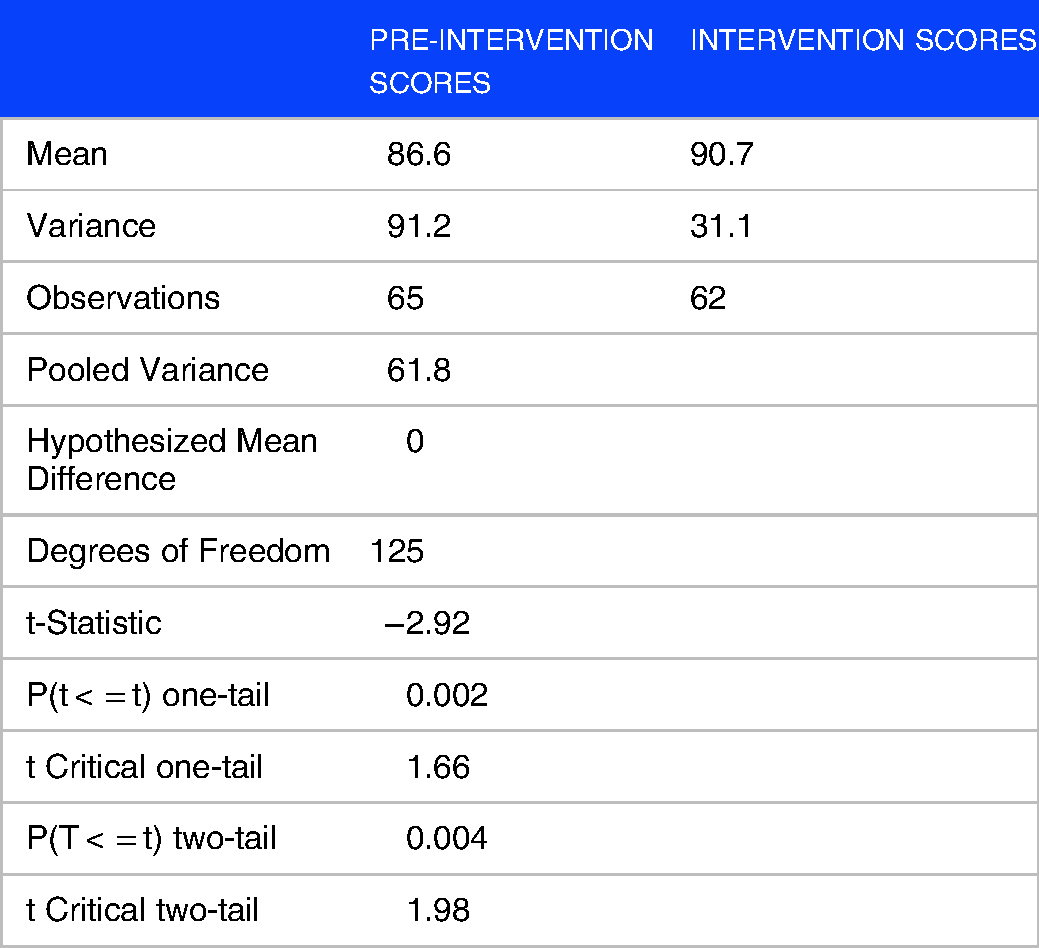
The results show students under the intervention group averaged 4.1 points higher than those students with no intervention. Students in the Pre Intervention groups averaged a score of 86.6 while students in the intervention groups averaged 90.7. The t-test shows that this difference is statistically significant with a p-value of 0.002 (see Table 1).
Results for a Two-sample test assuming equal variances.
In addition to the analysis performed, Gender and English as a Second Language were examined using contingency tables. Both ESL and Gender were tested for statistical differences in their Scores. The results show that there were no statistical differences by gender or students who reported English as a Second Language (see Tables 2 and 3).
Mean scores in the intervention test by ESL and gender.

Score significance by gender and ESL.

Results
A total of 55 surveys were completed by student's in three different first semester cohorts. Forty of the total surveys were completed by English speaking students, with the remaining 15 completed by students who do not primarily speak English. Languages spoken other than English included Spanish, Fullah, Haitian Creole, and Amharic. Both English speaking and ESL students felt that reading and visual learning were the most effective ways they retained information. However, a majority of the surveys completed by ESL students indicated that verbal teaching or lecturing from the instructor was most beneficial means of material retention. Auditory learning implies that students learn best by listening, which is one of the perceptual learning styles that encourages the use of the student's sensory organs to learn. 5 This specific teaching method wasn’t indicated on any of the English-speaking student surveys. ESL students often indicate that they have reinterpreted the information read in the text to their primary language to clarify its meaning. Students who engage in conversational exchanges in their first language often benefit by incorporating word-learning strategies as they connect any prior knowledge of the subject. 6
Incoming respiratory students for Spring 2020 were the first group to be assigned the additional vocabulary journals and patient scenario's. All assignments were completed on time and students received full credit. The data collected was based on the final assessment scores of the final cumulative exam covering respiratory objectives of first semester curriculum from Fall 2019 through Spring 2021. The same multiple choice assessment questions were used the previous semesters, and throughout the duration of the study. Exams were given online with proctored software, and all students were given 75 minutes for completion. One limiting variable within the study include that instruction was moved from a face to face learning environment between the Spring 2020 and Fall 2020 semester. However, all exams were administered consistently, and the course contents remained consistent.
Discussion
This study explored some effective learning retention methods that helped all students’ understanding of medical terminology during the first semester of the respiratory program. Based on the statistical analysis, there was a significant increase of 4 points in final exam cumulative scores once this new curriculum was added within the three semesters observed. While most teaching strategies are individualized, it is especially important for those teaching healthcare to ESL students to use that language with situational content. This must begin with a strong foundation of healthcare literacy and associated terminology that has been spoken, written, read and heard. 7 Frequent assessment also help to determine the students’ ability to recall appropriate language used based on their patient's specific clinical situation.
This study did not find any significant differences in scores based on gender or with those who identified as English as a second language students. A more extensive analysis would be beneficial in identifying whether age, traditional vs. non-traditional students, first generation and demographics make a difference in overall student performance and retention in healthcare programs. A final consideration of the students social and intellectual well-being, and their propensity to seek assistance from instructors play a part in their success. The ability of instructors to foster positive attitudes and maintain high expectations, especially towards ESL students, may provide the incentive they need to continued educational success. 6
Conclusion
It will be difficult to retain those students whose primary language is not English within our healthcare programs if the first task is not the basic understanding of medical language itself. Instructors should present material in a variety of ways allowing students the opportunity to speak and reinterpret it in a way they best retain information. Assignments that concentrate on the students taking an active role in the understanding of vocabulary help develop rich associations with those terms. This helps to properly interpret patient scenario's, and will hopefully lead to better patient outcomes once that student becomes a therapist.
Footnotes
Declaration of Conflicting Interests
The author(s) declared no potential conflicts of interest with respect to the research, authorship, and/or publication of this article.
Funding
The author(s) received no financial support for the research, authorship, and/or publication of this article.
Ethical Approval
Not applicable, because this article does not contain any studies with human or animal subjects.
Informed Consent
Not applicable, because this article does not contain any studies with human or animal subjects.
Trial Registration
Not applicable, because this article does not contain any clinical trials.
