



Abstract
Background and Objectives
The shortage of residency faculty in the pipeline is a growing concern to meet future workforce needs, though there is little research on attracting residents to be future faculty or what factors would influence their interest in this role. The objectives of this study were: (1) To assess the interest of third year residents (R3s) in faculty positions, and the various factors that might positively or negatively affect this decision; (2) to compare whether this changes across the R3 year; and (3) to compare between chief residents and other R3s.
Methods
Longitudinal survey at two points in time for each of three consecutive cohorts of R3s (2016-2018) from a regional network of family medicine residency programs.
Results
Among the final sample of R3s (176/545, 32% response), nearly half were interested in a residency faculty role. Strong positive influences on interest include the teaching role, advising/mentoring role, range of practice scope, and ability to perform procedures; salary and administrative responsibilities detract from interest. Among the matched sample of 96 R3s who also responded at Time 2 (55% response), non-chief residents had an increase in knowledge of and interest in the faculty role across the R3 year.
Conclusions
Nearly half of senior family medicine residents report positive interest in residency faculty positions and in most components of the role. Mentorship may encourage more residents to consider these positions upon graduation or shortly thereafter. More research on other specialties and with career follow up is recommended.
Keywords
Introduction
The shortage of residency faculty in the pipeline is concerning; an adequate physician workforce must be developed to meet future needs.1,2 The specialty of family medicine (FM) has focused attention on this issue. 3 Without sufficient residency faculty to teach the incoming physician workforce, burnout will increase and education quality decrease, ultimately impacting the quality of care patients receive.
Prior research regarding resident interest in residency faculty positions is minimal. It examined desire to teach, prior scholarship, mentorship, and exposure to clinical teaching tracks during residency as some positive influences on residents’ confidence and interest in teaching.4,5 Much more research has been done on resident interest in medical school faculty positions; potential negative influences include family factors, salary difference and debt. 6 Autonomy (defined as personal and organizational efficacy) in one's work has a positive influence—though lack of autonomy can have negative impact.7–9
The business world has significantly more literature on recruitment and retention that the medical field has not yet integrated in research. We considered factors from the business world 10 that impact an individual's productivity and their likelihood to remain with an organization, that would be applicable to graduate medical education, including: engagement; expectations of the organization and role; material and resource support; personal development support; alignment of individual and organizational mission; and colleague dynamics. 11
Recognizing this gap, and desiring to improve the chances of hiring residents into faculty positions upon graduation (a strategy for increasing faculty workforce 12 ) or in the future, we examined these factors through a survey of FM residents in their final residency year. This included those in a chief resident role which in FM is an enhanced administrative role for select residents in their final year. We focused on FM because this is a recognized issue in the discipline, but believe this study and its findings are also applicable to other specialties.
Our objectives were: (1) to assess the interest of third year residents (R3s) in future faculty positions in general and at their own program, and the various factors noted above that might affect this decision; (2) to compare whether this interest changes across the R3 year; and (3) to determine whether there are differences in perceptions and interest in faculty positions among chief residents compared to other R3s.
Methods
The Family Medicine Residency Network (FMRN) is comprised of 31 FM residency programs across the five-state region of Washington, Wyoming, Alaska, Montana, and Idaho (WWAMI). Annually there are about 200 R3s across the affiliated programs, with an average of two chief residents per program.
To generate a large enough sample size for the comparisons, we used a longitudinal survey methodology across three consecutive cohorts of R3 residents from the WWAMI FMRN. We surveyed those graduating in 2016, 2017, and 2018 by email at the start (T1) and end (T2) of their third year of residency. The T1 survey window started in July and ended in September, and the T2 survey window started in April and ended in June; both included an initial email and four reminders.
Survey content included demographic questions and general questions about knowledge of and interest in faculty positions, both at the resident's own program and other programs. The majority of the survey asked participants to rate the degree to which various factors of a residency faculty position influenced their interest in a faculty position. We used a 7-point rating scale from −3 (very negatively influences) to +3 (very positively influences) to assess factors in multiple categories: personal reasons (salary; partner/family; work-life balance; desired schedule flexibility; relationships within program); administrative and organizational reasons (administrative responsibilities; division/proportion of time spent performing different roles such as clinic, teaching, precepting, etc; autonomy; organizational support); teaching reasons (teaching; advising/mentoring; scholarship activity); and practice reasons (range of practice spectrum; continuing inpatient work; continuing OB work; performing procedures). The survey also asked about mentors and role models, satisfaction with training, and chief resident roles, tasks, and structures.
We conducted exploratory analyses to ensure there were no cohort effects or major changes year-to-year between R3 classes. We used descriptive analysis to compare demographics and other variables as well as to assess the general perceptions and interests in factors related to faculty positions among R3s. We report on these descriptive results from T1, the start of the R3 year, to capture the largest group of residents and to lessen the potential of response bias.
For comparative analysis, we collapsed the Likert and other scaled variables; all scalar factor ratings were narrowed to “positively influences” (responses of +1, +2, or +3) or “neutral or negatively influences” (responses of 0, −1, −2, or −3). We then conducted bivariate analyses using the McNemar's test for paired samples to compare whether individual residents had changes in their perceptions and interests for these same factors among residents responding both at T1 and T2. This group of respondents was further separated by chief residents and all other R3s and bivariate analysis was completed using the chi-square test for these between-groups comparisons. In order to compare a sample of chiefs that looked most similar in terms of administrative responsibilities, we combined with the non-chief R3s those chiefs who reported that the chief duties were shared across the entire R3 class. All analyses were conducted using SPSS 19.0. This study was approved by the University of Washington Human Subjects Review Board. Consent to participate was obtained electronically by all subjects prior to completing the survey.
Results
Sample sizes
We sent the survey to 545 R3s across the 3 years of our survey, with 176 total respondents at the start of the R3 year (32% response). Of those who initially responded, 96 responded at the end of the R3 year (55% response) which represent our matched sample (18% response of total original sample). Five individuals clicked the link to the survey but chose not to consent to participate; they were removed from the sample and considered non-responders. Across the 3 years of our survey, response rates at the start of the R3 year ranged from 28 to 36% overall and from 42% to 66% at the end of the R3 year among initial responders.
Demographics
There were more respondents in the first year of our study than in the subsequent two years. We found no demographic differences by year. There were no differences found between those who responded to the survey at the start of R3 year (all respondents) and those who responded to both surveys at the start and end of the year (the matched sample). About 30% of the sample were considered chief residents for analysis. Demographics for all respondents and the matched sample are found in Table 1.
Background and demographics of all respondents and matched sample at the start of R3 year.

Overall knowledge and interest in faculty role
Overall at T1, less than half (n = 74, 42%) of all R3s, inclusive of the chief residents, indicated that they were “knowledgeable” or “very knowledgeable” about what is involved in a faculty role. At the beginning of the R3 year, only 11% (n = 20) of respondents stated that they were “not at all interested” in becoming a residency faculty member, while nearly half were interested in a residency faculty position in the future, and almost a quarter (22%, n = 39) reported they would consider a residency faculty job if it met other criteria they found more important (Table 2).
Overall knowledge and interest in faculty role among all respondents at the start of the R3 year.

We compared all demographic variables to whether all respondents at T1 had any interest in a faculty position and observed no differences in interest by graduation year, gender, marital status, whether someone was a parent, or whether they had a graduate degree. Among those who were parents, those with younger children (pre-school age) were significantly more likely to be interested in faculty positions than those with children who were school aged (n = 28/34, 82% vs. n = 7/16, 44%, P = .005). Additionally, those who had participated in research were significantly more likely to be interested in faculty positions than those who had not (n = 65/84, 77% vs. n = 58/91, 64%, P = .05).
The overall potential influences on interest in residency faculty positions at any program and specific to a resident's own program were also examined. Examining average ratings from the + 3 to −3 scale for all R3s who expressed interest in a faculty position at T1, administrative responsibilities was the only factor rated as having a negative influence on interest. Salary and participation in scholarly activities had low ratings, but were not negative on average. The factors with the most positive influence on interest in faculty roles were having a teaching role and an advising/mentoring role (Figure 1).
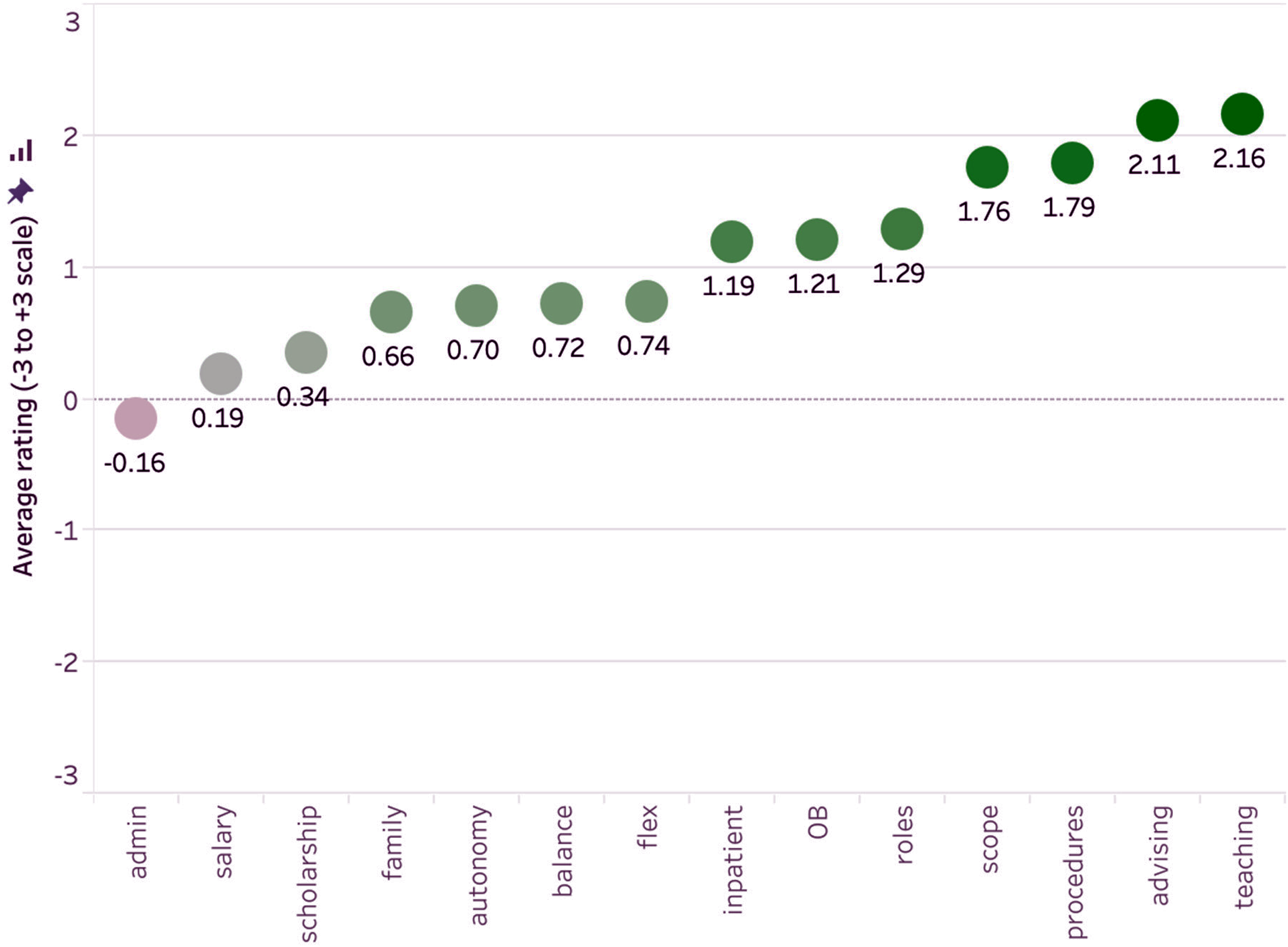
Average ratings of factors that influence interest in becoming a faculty member among all respondents with any interest in a faculty position at T1 (+3 to −3 scale) (excludes those who had no interest or were unsure of interest).
Among R3s interested in a position at their own program at T1, all measured factors were rated positively on average. The ability to be involved in the aspects of education and service that an individual has interest/passion for, the commitment of the faculty to doing quality work, faculty colleague dynamic, and mission alignment were rated as most positively influential (Figure 2).
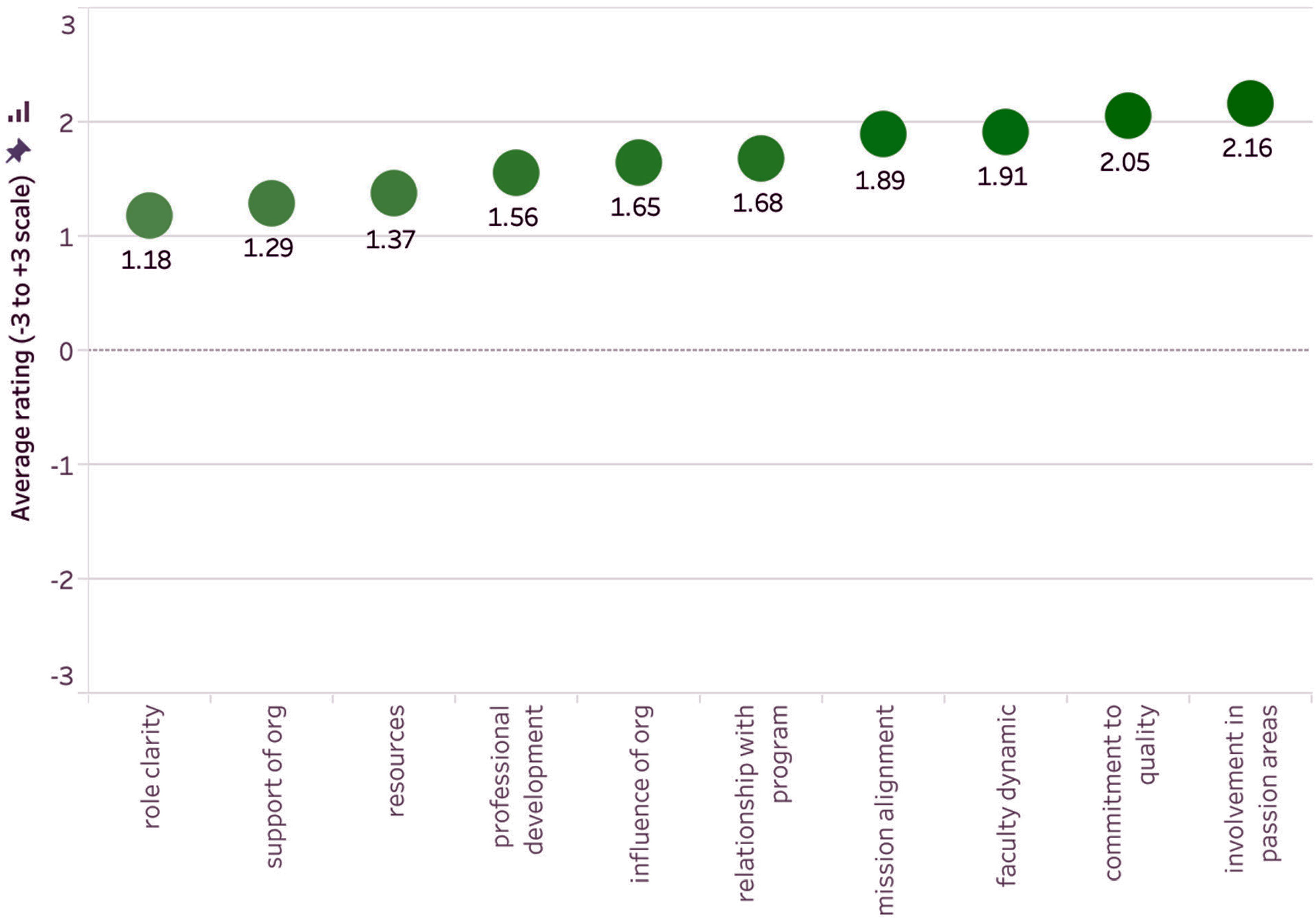
Average ratings of factors that influence interest in becoming a faculty member at one's own program among all respondents with any interest in a faculty position at their own program at T1 (+3 to −3 scale) (excludes those who had no interest or were unsure of interest in a faculty role at any program and those with no interest in role at own program).
Those who expressed no interest in a faculty position at T1 (n = 20) rated 9 of the 13 general factors as negative influences; most negative were: administrative responsibilities (−1.0 on average), work/life balance (−0.65), salary (−0.55), and flexibility (−0.50). This same group also had lower ratings for the factors of faculty positions at their own program than the group interested in faculty positions, but none were negative.
Matched sample: changes among chiefs and other R3 respondents across R3 year
Chief residents had very few changes in their knowledge of or interest in residency faculty positions across the R3 year. Although not statistically significant, there was a trend in chief residents reporting knowing more about what is involved in a faculty role at the end of R3 year than at the beginning (n = 26/30, 87% vs. n = 19/30, 63%, P = .07). They were significantly less likely to report salary as a positive influencing factor at T2 than T1 (n = 3/30, 10% vs. n = 12/30, 40%, P = .004) and otherwise reported no significant changes in factors influencing their interest in residency faculty positions.
The non-chief R3s did not report a change in knowledge of what is involved in a residency faculty role across the R3 year, but did have a significant increase in their interest in becoming a residency faculty member over the course of the R3 year (n = 45/66, 68% vs. n = 54/66, 82%, P = .04). The only significant change in factors influencing interest in the residency faculty position across the R3 year was observed in “desired flexibility of schedule,” with more non-chief R3s reporting this as a positive influence on their interest in faculty positions at the end of the R3 year than at the beginning (n = 32/64, 49% vs. n = 42/65, 65%, P = .04).
Differences between chiefs and other R3s at time 2
At T2, chief residents reported knowing significantly more about what is involved in a faculty role than did other R3s (n = 26/30, 87% vs. n = 29/66, 44%, P < .001). Chiefs were also more likely to report that a mentor or role model influenced their interest in a residency faculty role than other R3s at T2 (n = 20/30, 67% vs. n = 29/64, 45%, P = .04). There were no observed differences between chiefs and other R3s in interest in becoming a faculty member, indicating that something could change their interest in a faculty position, or their satisfaction with residency training.
Chiefs were significantly more likely to rate partner/family reasons as a factor that would positively influence their interest in a faculty position at T2 than other R3s (n = 16/30, 53% vs. n = 19/65, 29%, P = .03). No other differences between chiefs and other R3s at T2 were observed in the rating of factors for either faculty position at any program or at their own program.
Discussion
We were encouraged by the overall interest in faculty positions among the FM R3 residents, and their reported high satisfaction with training. Research indicates that interest in academic medicine decreases over the residency tenure, 8 so it is useful knowing residents’ perceptions of the faculty role and their interest in taking on the role in the future can positively change across the final year of residency. Among our respondents, there was a slight increase of chief residents’ interest in becoming faculty members and a statistically significant increase among the non-chief resident R3s.
We observed that individual values in a job and career can be quite different. If a residency program wants to market a residency faculty role and influence residents’ interest in their own program, we suggest paying particular attention to providing adequate administrative time, aligning individual involvement with areas of passion, supporting a commitment to quality and fostering positive colleague dynamic. We also suggest providing residents, especially chiefs, with faculty mentors who encourage the residency faculty pipeline. Mentorship, and the ability to become an advisor/mentor, were clearly important components of interest in faculty roles. With salary influencing chief residents negatively, particularly by the end of the R3 year (P = .004), working to increase the incoming faculty salary or providing loan repayment options would make the position more attractive. The non-chief R3s show increased interest in faculty positions over the R3 year, though their knowledge of the faculty role was not as robust; ignorance of all that a faculty position entails may be a protective factor that helps maintain or increase non-chief residents’ interest in residency faculty positions. Also, non-chief residents indicated an increase in perceived flexibility within the faculty role over their final year (P = .04). This was not the case for chief residents, who are closer to the realities of faculty and faculty work in their final year, and across the year ranked the flexibility of the faculty schedule lower in its influence on their interest in a faculty role.
Potential limitations of this study include that the variability in chief resident duties across different programs may lead to a varying view of the residency faculty role. We tried to control for this by eliminating from the chief category those who stated the chief role was shared across the entire R3 class. Additionally, some of the factors of potential influence we included in the survey were specific to the FM specialty, such as practice spectrum, inpatient work, OB work, and procedures, and may not be applicable to other specialties. Finally, the WWAMI region is a unique area of the country, and results may not be generalizable, though our variety of programs and large sample size helps mitigate this issue. Recommendations for future research include surveying a sample of residents across specialties about the factors this study found to be significant. For example, further topics for research include what (comparative) salary range is acceptable and when it becomes a factor that detracts from interest in the role, as well as what aspects of schedule flexibility are perceived positively.
Conclusions
Senior FM residents take many factors into account when considering their interest in taking a residency faculty position, and this interest can change across the final year of residency. Strong positive influences include the teaching role, advising/mentoring role, and range of practice spectrum, while administrative responsibilities detract from interest. More research on other specialties or with longitudinal tracking would supplement these findings.
Footnotes
None.
Author's Note
Marcia McGuire is now in a new position and requested using this information (note she was an employee of the University of Washington with Amanda Weidner when this study was carried out) Marcia McGuire, MA Business Change Manager CareMore Health 310.626.5021, marcia.mcguire@caremore.com
Declaration of conflicting interests
The author(s) declared no potential conflicts of interest with respect to the research, authorship, and/or publication of this article.
Funding
The author(s) received no financial support for the research, authorship, and/or publication of this article.
Ethical Approval
This study was approved by the University of Washington Human Subjects Board.
Informed Consent
Consent to participate was obtained electronically by all subjects prior to completing the survey.
Trial Registration
Not applicable, because this article does not contain any clinical trials.