




Abstract
Background:
Self-directed learning (andragogy) or self-determined learning (heutagogy) can be implemented in guided self-study (GSS) with the aim to foster changes in the knowledge and skills of physiotherapy students in a higher education setting. To date, there is a lack of evidence for the use of GSS in higher education for physiotherapy.
Aim:
This study aimed to evaluate the feasibility of developing and implementing GSS in an undergraduate physiotherapy educational program in Switzerland. In addition, the effectiveness of GSS in bringing changes in knowledge and skills was assessed.
Method:
Full-time undergraduate physiotherapy students (n = 49) from the third semester volunteered in this feasibility study. Students were randomly allocated into a GSS group or a control group (CG) in the period from October to November 2019. The GSS group prepared a total of 3 clinical cases. Each case was processed in an 8-day cycle. On day 1, the clinical case (ie, description of a patient and symptoms) and learning goals were provided to the students electronically. The students prepared the cases in groups from days 2 to 7. They were guided 2 times by the tutor (physical meeting and via Skype) during this preparation phase. The results of group work were presented and reflected on during a moderated plenum session (90 minutes) on day 8. The feasibility of this higher education study was operationalized as follows: exposure (“dose,” ie, the number of GSS sessions performed over 90 minutes, as well as the content of the cases and the learning objectives); students’ responsiveness, with an a priori set 100% willingness to participate on day 8; program differentiation, to illustrate differences between the content of GSS cases and the curriculum; and degree of acceptability. In addition, an assessment was made of the total scores in the objective structured clinical examination (OSCE) and written examinations, as well as the amount of GSS. Statistical analyses were conducted using an intention-to-treat approach.
Results:
All 3 GSS sessions on day 8 lasted the scheduled 90 minutes. The content of the presented cases was aligned with the learning objectives. The responsiveness of students willing to participate on day 8 was 42%. In program differentiation, no differences in content were found between the GSS presentation content and the usual curriculum content when compared with the learning aims. Objective structured clinical examination grades and written examination grades were similar for the GSS and CG. The analysis of the focus group interview showed a low degree of acceptability indicating that the students’ workload was high during the GSS period.
Conclusions:
This study showed that this GSS program for undergraduate physiotherapy students in its current form is “feasible with modification.” Modification of the study protocol (eg, better time planning in the academic calendar) is needed to improve the students’ responsiveness. Alternatively, classroom hours may be reduced to favor self-study time. Such adjustments to the timetable should allow the physiotherapy students to better prepare the clinical cases. The effectiveness of the GSS and normal curriculum on OSCE and written examination scores was similar, probably due to the observed low students’ acceptability
Introduction
In the context of continuous progress in medicine and biomedical sciences, health professionals must develop the skills that will enable them to become lifelong learners. 1 Methods from adult education sciences such as andragogy and heutagogy are needed to develop lifelong adult learners.
Andragogy focuses on self-directed learning (SDL), while heutagogy focuses on self-determined learning (SDtL). Andragogy could be defined as the art and science of helping adults to learn. 2 In this context of adult learning, the higher education teacher becomes a facilitator who supports adult learners and detects individual learning needs.
Heutagogy can be described as an extension to andragogy in that it refers to SDtL as a holistic and lifelong learning process. 3 Learners are at the center and know their individual learning needs best. 4 Learning happens by means of self-chosen and self-directed actions. Heutagogy favors student-centered instruction. To date, the method of heutagogy has not yet been strongly established in German-speaking countries.
The Bologna Process recommended for higher education focuses on flexible learning. 5 This includes a proportion of frontal teaching or workshops in combination with self-study. Self-study has been described as the amount of students’ workload for preparation and follow-up of teaching content, reading, chores, examination preparation, and thesis writing. 6 Landwehr and Müller 7 and Rogan 8 specified 3 forms of self-study: free self-study (FSS), individual self-study, and guided self-study (GSS).
The “Rektorenkonferenz der Fachhochschulen der Schweiz” 9 declared that academic programs in Switzerland should combine classroom sessions (eg, lectures, workshops, seminars) and self-study, including FSS and GSS. At the Bern University of Applied Sciences (BFH), this directive has been implemented as a 40-to-60 proportion of classroom to self-study time, respectively. Self-study is important in the context of SDL and SDtL. During the last 8 years, the BFH Health Department, Faculty of Physiotherapy (Switzerland), scheduled GSS as an SDL method when providing theoretical content. Lecturers were able to gather heuristic experiences, but no systematic empirical evaluations of this type of GSS have been conducted. Furthermore, in the context of practical skills learning, GSS was never applied in physiotherapy undergraduate education at the BFH. Hence, evidence about design, implementation, and effectiveness of GSS in the context of practical skills learning is currently lacking. In this feasibility study, GSS has been implemented as a part-replacement to classroom-based activities in the context of theoretical content learning, while it was planned as an add-on intervention in the context of practical skills learning.
Theoretical background and research question
Until now, there has been no standardized procedure to develop and implement GSS in the curriculum of the undergraduate physiotherapy program at the BFH in Switzerland. Landwehr and Müller 7 postulated that GSS should consist of 5 phases. These authors described phase 1 as the preparatory period in which students receive a learning assignment (clinical case description) with learning objectives from the tutor. Phase 2 consists of 2 realization stages in which the students work independently on the learning assignment. Tutors provide coaching (once at phase 1) and checking (once at phase 2) to the students. During phase 3, solutions and learning results are presented to the tutor and fellow students (ie, during a plenary session), while in phase 4, students and tutor reflect on the learning process. Finally, in phase 5 the students give each other peer feedback on their presentations and learning processes. 7
Rogan 8 proposed a theoretical model to describe how undergraduate physiotherapy students may gain knowledge in practical physiotherapy skills using GSS. 8 However, empirical evidence to support this theoretical model is still lacking. Therefore, an empirical education intervention study is planned to gain preliminary evidence. It has been recommended that prior to the implementation of a new research line, the feasibility of a planned study should be investigated. 10 The primary question in the present study was feasibility, while the evaluation of the effectiveness of a GSS intervention is of secondary interest.10,11
This present feasibility study included the cohort of undergraduate physiotherapy students in their third semester (second year) at the BFH, Switzerland. The primary goal of the study was to evaluate the feasibility of a GSS intervention that will be planned in an undergraduate physiotherapy educational program. Feasibility was operationalized as “fidelity of implementation” 12 which was measured by exposure (ie, the “dose” of GSS expressed as the sum of the number of GSS sessions effectively completed), students’ responsiveness (attendance), and program differentiation and acceptability. 13 The secondary aim of this current higher education study was to gather preliminary data on the effectiveness of GSS, using the 4-level evaluation model of Kirkpatrick 14 . Kirkpatrick valuation model includes (1) learners’ satisfaction, (2) changes in learners’ knowledge and skills, (3) changes in learners’ behavior, and (4) changes in patients’ behavior. Kirkpatrick 4-level evaluation model has been used widely in higher education research.15-17
Methods
Study design, setting, quality reporting, ethics
This cohort study used a 2-month, randomized, feasibility, higher education, 2-arm longitudinal design with computer-generated random allocation. Undergraduate physiotherapy students (n = 51) starting their first semester at the BFH were invited to participate in this feasibility study. Feasibility of GSS was assessed during the first and third semester, respectively. The protocol for this feasibility study has been published elsewhere. 18
The workload for the students includes classroom sessions (eg, lectures, seminars) and self-study units. The workload to obtain 1 European Credit Transfer System (ECTS) is defined as 30 hours. The ECTS credits have been described as the student’s workload needed to complete all learning activities (eg, classroom sessions, seminars, self-study, examination preparation) and to achieve the competences or specified learning objectives. The BFH guideline for the undergraduate physiotherapy curriculum defines a workload ratio of 40% required time for classroom attendance (eg, seminars) to 60% time for self-study with a total workload of not more than 40 hours per week.
The CONSORT 2010 checklist for pilot/feasibility studies was used to design this study. 19 This checklist can be used for clinical as well as for educational studies. This study was approved by the Ethics Commission of the Canton of Bern and a study registration can be found in the Registry of Efficacy and Effectiveness Studies (ID: #1834.1). The sample size in the study was based on the minimum recommended for a pilot randomized trial. 20
Participants and recruitment
Inclusion criteria were physiotherapy students of the undergraduate physiotherapy degree course at the BFH in 2018 (Figure 1). Exclusion criteria were physiotherapy students of the 2018 undergraduate physiotherapy course who did not want to volunteer in this study.

Flow of the study design. OSCE indicates objective structured clinical examination.
The school-leaving qualifications and previous knowledge levels of the novice scholars at entry into the undergraduate physiotherapy education program may be very similar due to the rigorous numerus clausus for which an Abitur or a vocational school-leaving certificate is needed. Only 51 of the yearly 350 candidates applying for a study place at the BFH will be selected. From those, 49 students volunteered in this present feasibility study during the third semester. An oral information session was performed at the start of the third semester to recruit study participants. At the end of the information session, declaration forms for informed consent were distributed. The potential participants were given enough time to read the document and to decide for or against enrollment in the study. All volunteers provided written informed consent.
Randomization
Prior to the start of the regular undergraduate physiotherapy course (first semester), students are assigned to groups A, B, C, or D. This approach promotes group learning and keeps the group sizes small for the practical skills lessons. This randomized group allocation was conducted before the start of this study and, hence, not specific to this feasibility study. For the practical seminars, A and B groups and C and D groups are always together. To decide which groups will participate in the GSS in the first or third semester (and vice versa as the control group) of this feasibility study, a second, computer-generated randomization (ie, cluster randomization) was conducted prior to the start of the first semester.
Intervention
The structure of the GSS design was based on a theoretical framework of GSS which has been described and published elsewhere 8 and which was founded in adult learning theories.7,21 The GSS program was multifaceted and followed a student-centered learning approach which was designed to foster knowledge and skills in undergraduate physiotherapy students regarding clinical reasoning in respiratory patients, evaluation of balance and strength in elderly individuals, and examining patients with elbow disorders. In total, 3 GSS periods with different clinical cases (ie, cardiopulmonary, geriatric, musculoskeletal) were scheduled for the GSS group between the start of October and the end of November 2019. Each GSS period was performed in an 8-day cycle (Figure 2). Within each cycle, one of the beforementioned clinical cases was processed (Table 1). Clinical cases were aligned with the module content (ie, examination and investigation in the fields of cardiopulmonary, geriatric, and musculoskeletal diseases) of the undergraduate physiotherapy degree program but were not targeted to the semester examination (Table 1).
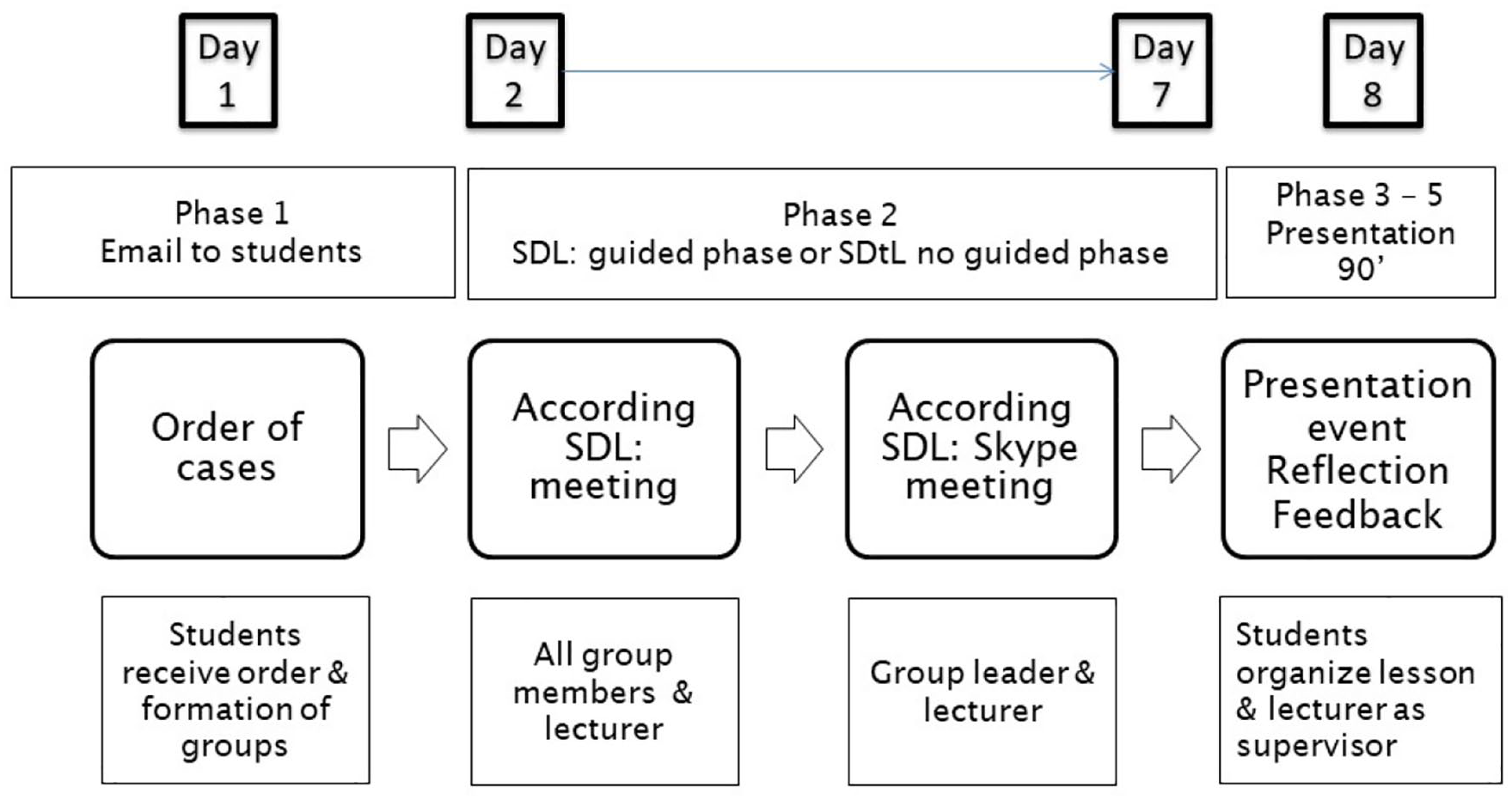
Process flowchart of guided self-study 8-day cycle. SDL indicates self-directed learning; SDtL, self-determined learning.
Overview of the GSS clinical cases proposed in each 8-day cycle procedure.

Abbreviation: GSS, guided self-study.
Each 8-day cycle was divided into 5 phases as specified by Rogan. 8 On the first day of the cycle (phase 1), participants in the GSS group were informed by e-mail about the clinical case description and learning goals. Phase 2 spanned days 2 to 7. Groups could choose between an SDL and SDtL approach. In the SDL setting, each group had the possibility to make 2 appointments with the tutor to clarify questions and processes, 1 on campus (60 minutes) and 1 via a virtual (Skype) meeting (45 minutes). Alternatively, the group could choose SDtL (ie, without additional coaching). The desired method to follow was decided by group members via consensus.
Day 8 included phases 3 to 5. During phase 3, all GSS groups presented the results of their work, while in phase 4, the students reflected on their work within their groups as well as in plenum. Finally, a tutor-moderated in-class plenary session to give feedback about the presentations of the GSS groups was organized (phase 5). The duration of each GSS session was 90 minutes (phases 3-5).
GSS tutor
The tutor was a higher education lecturer from the BFH, holding a PhD in physiotherapy, an MSc in osteopathy and an MSc in adult education. At the time of this feasibility study, he had 19 years of physiotherapy teaching and 4 years of GSS teaching experience. This high level of expertise guaranteed accurate support to the students while working on their cases, clinically sound feedback during their result presentations at day 8, meaningful final reflection assistance as well as a professional guidance during the focus group interview session.
Control group
Students are self-reliant in FSS and performed FSS sessions as scheduled in the traditional curriculum of the bachelor’s degree course. Students allocated to the control group received no e-mailed cases nor other information or duties.
Outcome variables
Primary outcome: feasibility
Feasibility in this study was operationalized as “fidelity of implementation” 12 (ie, exposure or “dose,” students’ responsiveness, and program differentiation) and the degree of acceptability. 13 Fidelity represents the extent to which an intervention is implemented as intended by those who developed it. 22
Fidelity of implementation
The tutor recorded the exposure (“dose”) immediately after day 8 (a) with a yes/no questionnaire if phases 3 to 5 were conducted or not on day 8, (b) with a yes/no questionnaire if the group results and presentations were appropriate and aligned to the learning objectives in phase 3, and (c) the duration of phases 3 to 5 was noted and expressed in minutes.
The criteria of success were set for the exposure as (a) total of 3 sessions of phases 3 to 5 on day 8, (b) presenting content as aligned to the learning aims of the module, and (c) the duration of phases 3 to 5 was set as a criterion a priori at 90 minutes.
Students’ responsiveness was recorded by the tutor in the attendance list immediately after each phase 3 to 5 on day 8. Criteria of success were defined as 100% of the students of the GSS group attending all 3 sessions of phases 3 to 5 on day 8, with 100% of students consenting.
Interfering in an existing curriculum is delicate and challenging. Program differentiation was evaluated by the tutor to a checklist designed with the program provider which recorded similarities and differences between the GSS program and the module content and competences as described in the module’s handbook. This strict alignment was a “conditio sine qua non” to receive permission from the program provider for this study. Therefore, researchers had to develop a GSS design in which the allowance for discovery or the introduction of new knowledge by the students themselves was reduced. Criteria of success were the development of all GSS cases that were performed in cooperation between the person responsible for the module and the tutor. The tutor wrote the case and the person responsible for the module checked it afterwards for consistency with the curriculum content.
Acceptability
After phase 5 at the end of day 8, a focus group session including the students from the GSS groups was conducted to assess students’ acceptability. To avoid bias by the tutor, a priori set questions were used.
Interpretation of the criteria of success was defined as followed: (a) Stop—main study not feasible; (b) Continue, but modify protocol—feasible with modifications; (c) Continue without modifications, but monitor closely—feasible with close monitoring; and (d) Continue without modifications—feasible as is. 10
Secondary outcome
The effectiveness of the GSS program was operationalized by the change in knowledge and skills, 14 using the examination grades as the dependent outcome variable.
Students were assessed at the end of the semester with written (multiple choice; MC) and practical (objective structured clinical examination [OSCE]) competence checks. Multiple choice examination tests knowledge, while the OSCE assesses competences based on objective testing to direct observation. 23 Both types of examinations were already integrated in the existing undergraduate physiotherapy study program. The OSCE consisted of 8 stations. The maximum achievable score in the MC examination was 70 points, and the maximum score for the OSCE was 48 points. The criterion of success was to pass the examination. The threshold to pass the examination was set at 60%.
Data processing and analysis
The primary outcome measures of feasibility are presented in this study using descriptive statistics. To analyze the effectiveness of GSS (secondary outcome), the final grades of the written MC examination and OSCE were used as dependent variables, while the attendance rate of each student in the GSS group on presentation day 8 (phases 3-5) was used as an independent variable. Medians with corresponding interquartile ranges of these secondary outcome measures are presented. To guarantee that the randomization remains unbroken, an intention-to-treat (ITT) analysis was performed, where missing data were replaced by median values of the group to which students were originally allocated. 24 For example, if data were missing in the third session from 1 student, these were replaced by median values of the third session. All students who participated at least in 1 session of the GSS were included for the analysis.
To evaluate if improved adherence resulted in better performance, a nonparametric correlational analysis, using the Spearman rank order correlation, was conducted.
Differences in the MC examination and differences in OSCE results between the GSS group and CG at the end of the third semester were analyzed using the Mann-Whitney U test. All calculations were performed using the Statistical Package for Social Sciences (SPSS) version 25.0 (IBM Corp Released 2017. IBM SPSS Statistics for Windows, Version 25.0. Armonk, NY: IBM Corp)
Results
In this study, 49 undergraduate physiotherapy students in their third semester were randomized into the GSS group (n = 23) and the control group (n = 26).
Primary outcome: Feasibility
Fidelity of implementation
Fidelity of implementation of exposure was fulfilled. All 3 planned GSS phases were conducted in the planned timeframe of 90 minutes. The contents of the presentation on day 8 (phase 3-5) were appropriate to the learning objectives of the curriculum/module (Table 1).
Fidelity of implementation of students’ responsiveness to the GSS program was 42% and, hence, did not fulfill the a priori set criterion of success of 100%. Seventeen students of 23 (74%) participated in the first presentation of GSS clinical case 1, 7 students (30%) participated in the second presentation of GSS clinical case 2, and 5 students (22%) participated the third presentation of GSS clinical case 3 on day 8. One student did all 3 GSS phases on day 8. Thus, the a priori 100% target of 3 attendances per student was not achieved.
Fidelity of implementation of program differentiation determined no duplication of content from the regular program schedule in the evaluation. The case processing was performed in cooperation with tutor and the person responsible for the module. The person responsible for the module evaluated the case. The cases did not represent new content and were congruent with the learning objectives of the curriculum/module.
Acceptability
The findings to the focus group questionnaire are summarized as follows:
1. Was the group composition difficult to arrange? Group formation took place as before in the study
2. How was the workload of the GSS cases compared with the tutorial cases?
Workload of the GSS cases was similar to that of the tutorial cases.
3. Were the case contents suitable for the curriculum?
GSS cases were similar to the curriculum content.
4. Were the GSS well incorporated into the timetable?
No, the GSS was scheduled in time periods with high workload. Not enough time for preparation.
5. How was the number of GSS?
The number of GSS was set sufficiently. The number of GSS could be 4 or even 5 if it is well placed in the timetable (workload).
Secondary outcomes
Table 2 shows the median score and interquartile ranges of the MC examination and the OSCE after 3 GSS sessions. The ITT analysis showed no group differences in median scores for MC examination and for OSCE. Two of 23 students (GSS group) and 3 of 26 students (CG) failed the OSCE examination.
Overview of MC examination and OSCE total scores in median and IQRs.

Abbreviations: CG, control group; GSS, guided self-study; IQR, interquartile range; MC, multiple choice; OSCE, objective structured clinical examination.
Intention-to-treat results are presented.
The Spearman rho correlation indicated a significant positive correlation on student’s responsiveness rate of 74% (n = 17 students) and their final MC results (rho = 0.879; P < .001) and on OSCE results (rho = 0.710; P = .003).
Discussion
This current higher education study aimed to answer the research question: what is the feasibility of the developed study design to improve knowledge changes in undergraduate physiotherapy students during their third semester by implementing a new GSS program? This GSS was designed according to the theoretical framework of Rogan 8 . This study showed that GSS as originally planned and scheduled in the academic timetable is “feasible with modification” 10 regarding students’ responsiveness. The observed low student responsiveness resulted from the circumstance that GSS was not well scheduled in the curricular calendar (ie, in a period with high workload). Thus, the study design in its current form seems inappropriate for evaluating knowledge changes after a GSS program in undergraduate physiotherapy students at the BFH.
The fidelity of implementation of exposure (“dose”) demonstrated that all 3 GSS sessions on day 8 were performed. The contents of the cases were aligned with the learning objectives. The introduction of the topics, reflection, and feedback by the tutor on day 8 lasted 90 minutes as originally intended (phases 3-5). These criteria of success were fulfilled and should be managed when implementing GSS into the curriculum in the same manner as in this current study.
The fidelity of responsiveness indicated that the a priori set target of 100% student attendance was not reached. The first session was well frequented with 17 of 23 students. Thereafter, the attendance decreased, with 7 and 5 students for the second and third GSS sessions, respectively, on day 8. From the evaluation of the acceptability survey, the students’ presence may explain the reported low responsiveness. The main reason was that the students’ program was overloaded with weekly workloads during both modules exceeding 40 hours. The third semester consists of the modules “internal medicine” and “geriatrics,” each of 6 weeks’ duration and the module “musculoskeletal 1” with a duration of 4 weeks. In the last week of the third semester, no classroom activities were scheduled to give the students an opportunity to prepare for their examinations. The scheduling of the GSS in the timetable during the last week was mentioned by the students as the reason for the low acceptance rate. These findings are corroborated by the literature. Kember 25 described that higher teaching hours yielded higher student workload which leads to discouragement of deeper learning and is more likely to result in superficial learning approaches. Studies from medical, engineering, and other demanding education programs showed that increasing instruction time leads to more time spent on self-study, whereas excessive instruction time (>20 time hours per week) decreased self-study time.26-28 Schmidt et al 29 reported that students enrolled in 8 medical schools in the Netherlands with the highest weekly lecturing hours spent less time for self-study, had lower graduation rates, and took more years to graduate as compared with their peers from schools with less weekly lecturing hours.
The findings of the students’ low acceptability of this present feasibility study for reasons of high workload are also corroborated by different other studies. For example, Newble and Entwistle 30 described in their review on learning style and approaches to learning that external circumstances such as high workload and examinations influence students’ learning behavior. Examinations can be a strong stimulus for learning 31 as well as curricular circumstances are a further determinant of learning. 30 It is evident that curricula may influence undergraduate students’ preference for learning environments. 32
Based on the results of the focus group session, the quality of the GSS cases was rated as good. Students recognized the alignment from content and learning aims of the GSS cases with the curriculum description or content. This clear alignment seems to have strengthened the willingness to accept the GSS cases. The clinical cases (Table 2) can be used in the same manner in the next study.
Based on the findings of this analysis, it seems that planning the GSS units in time periods when workload is in a normal range (<40 hours per week) is the most important modification needed to improve feasibility of future studies on the effectiveness of GSS on learning results in undergraduate physiotherapy students. In addition, the workload during the module should be evenly distributed in the timetable. Furthermore, another approach might be to reduce the weekly hours of classroom sessions and replace them by self-study time. This would, however, imply difficult negotiations and thorough change management skills to convince faculty members and program providers of the need of such curricular adaptation.
Fidelity of implementation of program differentiation represented no competing or no similar content findings for all 3 GSS cases compared with the module content of the existing, regular curriculum that the CG followed. The module handbook provides concrete indications of competence objectives, and the definition of learning objectives is described in the module descriptions. The procedure to create the cases seems to be a meaningful approach in order not to provide new content. When creating a case, it seems useful to include the module administrator from the beginning. This procedure guarantees from the beginning that the learning objectives are appropriate to the module handbook and that no new topics will be developed.
Preliminary effect results
This feasibility study also aimed at finding preliminary results of the GSS program on students’ change in knowledge and skills. 14 This study used an ITT analysis that allowed a conservative interpretation of the results. Implementation of 3 8-day GSS cycles seemed to have not changed knowledge and skills in the GSS group as compared with the CG.
This finding may be partially explained by the low responsiveness as it is well known that adherence is key to the success of the GSS intervention.
The students of the GSS group followed only the SDtL approach. They were guided at day 8 during phases 3 to 5. It cannot automatically be assumed that students have enough self-learning or self-management skills at the beginning or during the first half of their degree program. Luckin et al 33 described a pedagogy-andragogy-heutagogy (PAH) continuum as a construct within which students move cognitively, metacognitively, and epistemically to enable learning, arguing that students need to be supported in managing their own learning process. This PAH model could be implemented to support students’ learning processes and enable the transfer from pedagogy to andragogy. Only when andragogy is consolidated, will SDL be offered in GSS.
Because all groups decided for the SDtL method, this study does not allow for conclusions on SDL. Therefore, future studies should focus on the inclusion of SDL for mandatory meetings with tutors. In the preliminary stage, the learning methods must be clarified.
The observed positive, high and statistically significant spearman rho results indicate a strong association between students’ responsiveness to the GSS session and the examination grading (MC exams grade and OSCE exams grade). This finding is corroborated by the results of Fadelelmoula 34 who found that classroom attendance positively impacted students’ academic performance. Another study also concluded that classroom attendance is an important determinant of academic success such higher final grades. 35
Strength of the study
Because of the numerus clausus, groups in this study were homogeneous for the school-leaving certificate, the credit points in the 2-stage professional individual suitability test, and the age of the students. These factors can therefore be excluded as confounders. In addition, a randomization procedure to allocate students to different groups has tradition in this curriculum and might have further increased comparability between the groups under investigation.
Limitation of the study
Despite the assumed high homogeneity of the groups under investigation, confounding variables such as communication, motivation, or self-regulatory skills were not specifically assessed in this feasibility study and could have produced a bias. This study used a randomization procedure; however, the confounding variables may have influenced the results. Further studies should measure these variables prior to the baseline.
Another limitation was the measurement of the number of fidelity of implementation criteria. The literature described 5 fidelity of implementation criteria. 36 This feasibility study measured 3 of the 5 criteria. Adherence of the intervention being delivered as designed and the quality of delivery as the way in which the program was delivered using the techniques, processes, or methods prescribed were not evaluated. This feasibility study used qualitative methods. However, the quality improves if a statistical quantitative measure of fidelity is performed. Future studies should evaluate all 5 criteria of fidelity of implementation and should use qualitative and quantitative methods.
In this study, contamination cannot be totally excluded. For example, if students of both groups exchange information or start to train skills together, a biased result of the effectiveness of the intervention may result.
Due to the given strict alignment between the module’s competences and the clinical cases, students’ creativity and discovery of new knowledge based on self-determination may have been hampered in this current feasibility study (ie, “modified” SDL and SDtL were offered). Perhaps the application of “pure” SDL and SDtL methods is difficult to introduce in the earlier stages (ie, the first 3 semesters) of an undergraduate physiotherapy educational program.
Conclusions
The GSS program that was conducted in the undergraduate physiotherapy degree program of the BFH (Switzerland) was found to be feasible with modification. This study showed that all 3 GSS sessions on phases 3 to 5 on day 8 were implemented as planned (ie, planned duration of 90 minutes) but with a student attendance rate of GSS sessions which was low (42% instead of the expected 100%). The scheduling of the GSS 8-day cycle program into the period of a high workload was considered to be the main reason for this observed low student attendance. Future studies must consider the workload in the timetable when planning GSS.
GSS showed no effects on changes in knowledge and skills between the GSS group and the CG, probably because of the low acceptability.
Footnotes
Acknowledgements
We would like to thank all the participants who participated in this study and Eugen Mischler, Head of bachelor’s degree program Physiotherapy and Deputy Director of the Department of Health for their support. A special thanks to Bennie Ross for proofreading our manuscript.
Funding:
The author(s) received no financial support for the research, authorship, and/or publication of this article.
Declaration of conflicting interests:
The author(s) declared no potential conflicts of interest with respect to the research, authorship, and/or publication of this article.
Author Contributions
This research project was developed by SR and JT. Data collection was undertaken by SR. SR performed the statistical analysis. SR wrote and JT, SZ, and EZ edited the manuscript. All authors read and approved the manuscript.
Availability of Data and Materials
The data generated during the current study are not publicly available due to privacy issues of the higher education institution (Bern University of Applied Sciences), but the anonymized datasets will be shared by the corresponding author on reasonable request.
