




Abstract
Objectives:
Over the past decade, several excellent guidelines have been published on how to enhance the quality of PhD education in Europe. Aimed primarily at preparing students for innovative roles in their fields, they include variously structured approaches to curricular offerings, as well as other program components applicable across specialties (eg: supervisor support, scientific conduct, transferable skills). Since 2012, the interdisciplinary PhD Program in Health Sciences (PPHS) at the Faculty of Medicine of the University of Basel in Switzerland has focused on translating these guidelines into a 21st-century health sciences PhD program.
Results:
The PPHS started in 2012 based on the European Union (EU) guidelines for PhD education. This article describes the resulting interdisciplinary PhD program’s conceptual underpinnings, rationale, structures, and 10 building blocks, like student portfolios, thematic training, interdisciplinary research seminars, student-initiated interdisciplinary activities, financial support of course participation, top-up and extension stipends, PhD supervision, research integrity, alumni follow-up network, and promotional tools including a dedicated website. Students enter from Clinical Research, Medicine Development, Nursing Science, Epidemiology and Public Health including Insurance Medicine, Sport Science (all from the Faculty of Medicine), and Epidemiology (Faculty of Science).
Discussion and Conclusion:
The Basel PPHS exemplifies state-of-the-art PhD education in Health Sciences based on European guidelines and offers guidance to other groups from conceptualization to rollout of an interdisciplinary health sciences PhD program.
Introduction
Health science research is critical for societal health. 1 The current health care delivery and service paradigm demand that researchers use state-of-the-art skills to find innovative solutions to problems inside and outside of academic settings. As a result, over the past 25 years, both in North America and in Europe, the education and resources allocated for future researchers, mainly through PhD programs, has become a focus of much academic policy.2,3
In North America, the bachelor’s/master’s/doctoral scheme and a transferable credit system have been in place for more than a century 4 ; in Europe, they are a very recent development. In addition, North American PhD education has a strong curricular component, whereas European programs are more research-based, with students engaging in research from the start in addition to course work.
In Europe, both the Bologna Declaration of 1999 5 and the Lisbon Strategy of 2000 2 affected the conceptualization of doctoral education and training. Both began with the premise that more and better-trained researchers were needed to make Europe the world’s most competitive knowledge-based economy.2,6-11 From that perspective, policy makers have examined doctoral education and requested that universities develop institutional strategies 2 to train young researchers by and through original research. 12
In 2005, the Salzburg Principles confirmed that research institutions need flexible regulations to create the structures and instruments necessary to advance doctoral training. 13 Since then, the education of competent junior scientists at European universities has become a strategic goal to secure Europe’s position in the global knowledge economy. 1 Furthermore, to meet the expanding employment market needs, the May 2005 Ministerial Conference in Bergen 12 urged universities to promote interdisciplinary doctoral training and the development of transferable skills. In that context, several European Union (EU) forces driving PhD education have emerged, including the Organization for PhD Education in Biomedicine and Health Sciences in the European System (ORPHEUS), which includes around 80 European biomedical and health science faculties and institutions, and the League of European Research Universities (LERU). Working together, these groups safeguard the reputation of the PhD as a research degree, strengthen career opportunities for PhD graduates, and advocate the promotion of research at European universities.
In Switzerland, the Rectors’ Conference of the Swiss Universities 14 has developed a joint position paper on the doctorate acknowledging that their institutions’ common objectives and structures are in line with the European positions. The Rectors’ Conference 14 provides no details regarding PhD education, and each Swiss university structures, designs, and confers its own doctorates. This decentralized education mirrors the Swiss Confederation’s small-scale federalist political system. 15 In fact, along with the Swiss National Science Foundation, the main health science funding agency, the advancement of scientific research is primarily the federal government’s responsibility.15,16
The University of Basel, Switzerland, is a publicly funded university founded in 1460. It currently serves almost 13 000 students, of whom 16% are PhD students. 14 Due to strong collaboration with the pharmaceutical and chemical industries, the University of Basel has become a cluster for health sciences. Its 7 faculties offer numerous PhD programs and establish regulations for the implementation and monitoring of doctoral training. 17 From that perspective, the Faculty of Medicine established the PhD Program in Health Sciences (PPHS) 18 in 2012, following a call by the University Rectorate for funding to stimulate and support the development of doctoral programs. The PPHS was launched as an interdisciplinary, inter-professional PhD training platform for students from 6 health-related PhD disciplines offered by 2 faculties: Clinical Research, Medicine Development, Nursing Science, Epidemiology and Public Health including Insurance Medicine, Sport Science (all from the Faculty of Medicine), and Epidemiology (Faculty of Science).
Thus, the PPHS is a support system for PhD education to optimize students’ scientific, professional, and personal development. The program’s mandate reflects the call to increase inter-professionality at the national and international levels and allows maximum networking across health science disciplines that share methodological and statistical approaches.
The PPHS’s governance is headed by a steering committee consisting of 1 representative professor from each of the 5 participating departments, 3 PhD student representatives, and the program coordinator. Guided by national and international guidelines as well as evidence, contextual factors, and university regulations, they decide on program strategies, operationalize the instruments necessary to roll out those strategies, evaluate the quality of proposed initiatives, and continuously optimize their approaches.
Their aim is that each PhD student is fully integrated into a research group and complies with mandatory university PhD regulations regarding publications and European Credit Transfer System (ECTS) credits. The PhD students are selected by the supervisors. Following the PhD regulations of the Faculty of Medicine of the University of Basel, they require a degree from the University of Basel or other acknowledged institution, usually in form of a master’s degree in the field relevant to the planned area of study. Acceptance to the PhD program and progress (toward completion) are monitored by an interdisciplinary PhD board at the level of the Faculty of Medicine. Main criteria for acceptance are the professional background of the candidate, the fit with the supervisor, the subject of the PhD thesis, the quality of the proposal—in particular the adequacy of the methods—and the fulfillment of the financial guarantee for the whole PhD. A personal PhD committee directly supervises each student’s PhD. The program is thus composed primarily of research-based training, complemented by structured training activities provided through the PPHS’s educational infrastructure. The PPHS has no direct supervisory role.
The PPHS is evaluated by the Rectorate of the University of Basel at the end of a financial period. The evaluation is based on the general academic objectives, the organizational structure, the appointment procedure of the students, the structure and content of the training, the activities of the doctoral students within the program, the supervision concept, the mobility of the students, the internationality of experts, the quality of assurance and reporting, the existing collaborations, and the adequate use of funds. PPHS evaluates each course offering and makes regular surveys among its member students.
As an educational platform, the PPHS’s goal is to enable students to become qualified researchers with a comprehensive knowledge base specific to their discipline, to acquire advanced training, and to enhance their research dissemination skills. And as an example of current innovations in European PhD education in health sciences, we describe the conceptualization, implementation, and primary outcomes of the PPHS at the University of Basel.
The PhD Program in Numbers
Although the PPHS started in late 2012, only in 2015 the PhD students had to register and we can track them. Before 2015, all the PhD students of the included disciplines were automatically members. The number of registered PhD students is growing (2015: 65, 2018: 94). Therefore, we have only very few graduates. The mean time to degree lies between 3 and 4 years. Some graduates continue in the academic world, in their specialized formation as doctor or go to the private sector (Figure 1).
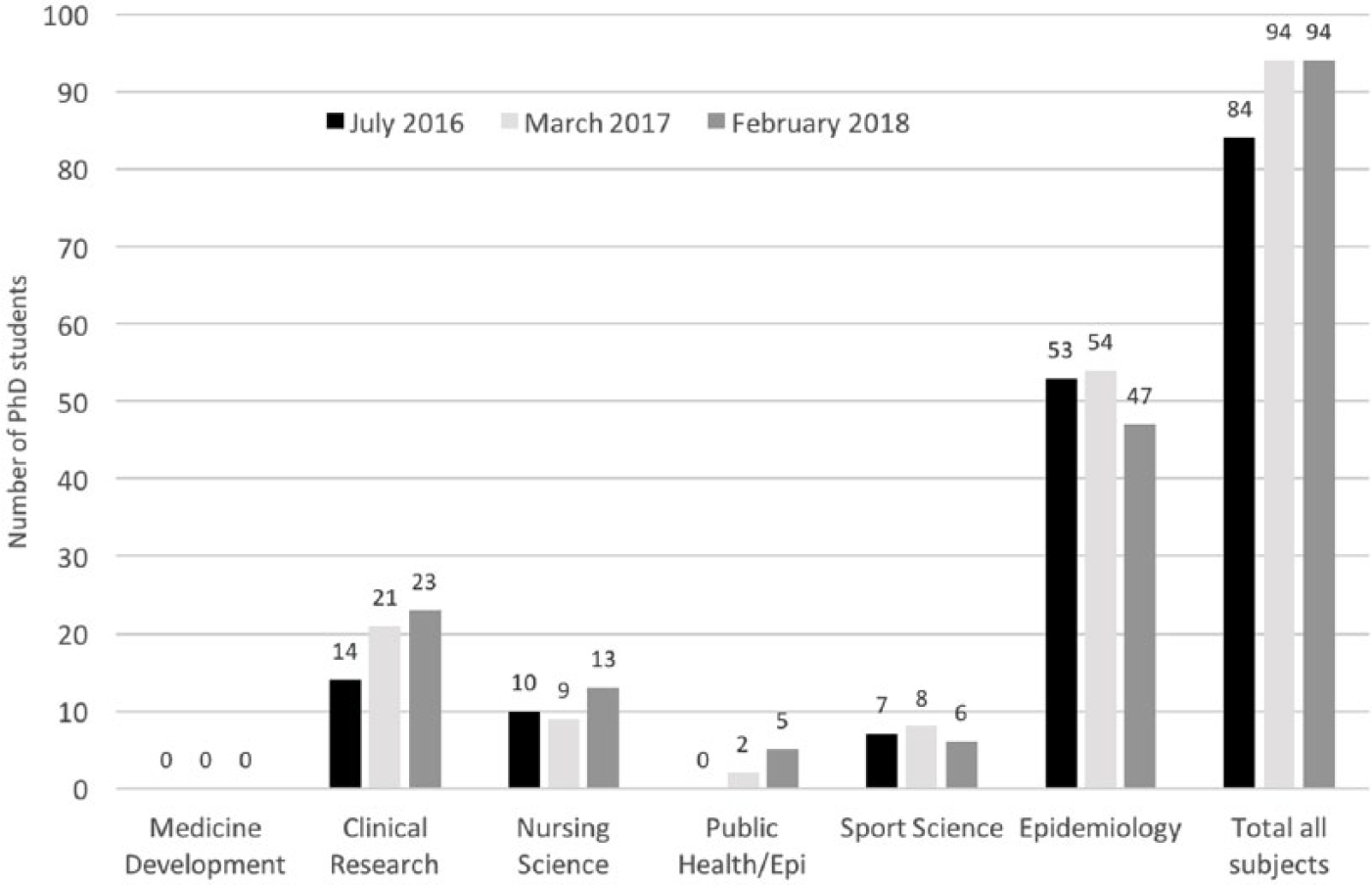
Number of PhD students enrolled in PPHS. PPHS indicates PhD Program in Health Sciences.
The PPHS: Description of its 10 Building Blocks
The PPHS has been conceptually guided by the Salzburg II recommendations, 13 the LERU guidelines for PhD education, 19 good practice in doctoral training, 20 and the ORPHEUS standards 21 (Table 1). It consists of 10 building blocks, all guided by interdisciplinary competencies and supported by a coordination office as well as the transferable skills offerings at the University of Basel (see Figure 2).

Abbreviations: LERU, League of European Research Universities; ORPHEUS, Organization for PhD Education in Biomedicine and Health Sciences in the European System.

The PPHS and its 10 building blocks.
Interdisciplinary competencies as defined by the PPHS
The PPHS competency framework (Table 2) outlines the minimum competencies to be acquired by each student for completion of a health sciences PhD. In addition to assessing existing and lacking competencies, it guides students and supervisors regarding individual training needs. It anticipates and adjusts for the large variability in new students’ methodological and statistical skills. To ensure up-to-date information and meet current and future needs, this framework is continuously revised and adapted.
Interdisciplinary competency framework as defined by the PhD Program Health Sciences.

Abbreviations: CRF, Conditional Random Field; RCT, Randomized Controlled Trial; SOP, Standard Operating Procedure.
The PhD students obtain 3 sets of interdisciplinary competencies during their PhD training (Table 2):
Knowledge and scientific competencies: research methods, information literacy, scientific writing, professional conduct, ethics and integrity, and awareness of interdisciplinary contexts.
Organization and management competencies: project management, self-management, and teaching.
Leadership and personal competencies: communication and leadership.
All PhD students have to submit a Learning Agreement together with a full research proposal of their PhD project after the first 6 months of admission at the University of Basel. The Learning Agreement describes how they plan to fulfill the mandatory 18 ECTS. The PhD Board of the Medical Faculty provides written approval or feedback on the yearly Progress Reports and the Learning Agreement.
PPHS’ 10 building blocks
The PPHS consists of 10 building blocks (see Figure 2), chosen both to reflect the principles of doctoral education (Table 1) and to optimize students’ professional development in view of the 3 sets of competencies (Table 2).
Student portfolio
Each PhD student’s PhD track is individually developed within the framework of the applicable PhD regulations and the PPHS—taking into consideration the student’s professional background, needed competencies, and chosen research type. All also obtain ECTS credits in the 3 competency domains. They report their research in a cumulative dissertation of at least 3 papers. This makes PhD education “highly individual and by definition original” 13 and fundamentally different from bachelor- or master-level studies. The individual PhD track is reflected in an individually compiled student portfolio comprising information on course work as well as the PhD project’s aims and timetable. During the program, each portfolio also contains an overview of the student’s plans regarding attendance of workshops and courses (totaling a minimum of 18 ECTS credits [1 ECTS credit requires 25-30 hours of work]), national and international conferences, teaching activities, and publications. The student portfolio is individualized and tailored to the students’ needs of statistical and other methodological skills as well as competencies specifically required for the proposed PhD studies (see also Interdisciplinary competencies as defined by the PPHS).
Throughout the PhD program, the portfolio not only provides orientation and structure but also serves as a tool to assess progress.24-26 Based on its content, each student is required to write an annual self-assessment for discussion with his or her PhD committee and for submission to the PhD board of the Faculty of Medicine. At this level, the PhD committee and the PhD board will take action to deal with any significant issues such as potential delays and related financial discussions or problems in the supervision of a PhD project. PhD students appreciate this regular written feedback on their performance.
PhD supervision
In line with university regulations, each PhD student is supervised by a specially chosen PhD committee. 27 Each committee meets at least once yearly to discuss the student’s annual self-assessment.
The ORPHEUS network 21 has established best-practice indicators for high-quality PhD supervision, certifying supervisors to mentor students, and to recognize and react to barriers to PhD students’ success.28,29 In addition, an annual PPHS workshop helps senior researchers to promote the quality of their supervisory skills. Fully booked since their implementation, these workshops are highly appreciated by the supervisors.
Thematic training
One key change in PhD education in recent years has been the introduction of a wide range of professional development courses. 20 As students enter the PhD program with widely varying skills, training is available from basic to advanced levels. As all health sciences specialties employ comparable methodological approaches (eg, quantitative, qualitative, mixed methods, implementation science), these form the core content of PPHS training. Therefore, the PPHS offers health science–specific courses valuable across specializations:
“Proposal Writing in Health Sciences,”
“Good Scientific Conduct in Health Sciences,”
“Academic Writing in Health Sciences, “
“Essentials in Health Research Methodology,”
“Walking in the Editors’ Shoes: Peer reviewing and journal editing for young researchers in health sciences,”
“How to prepare a job application inside or outside of academia.”
All courses are optional and there is no defined course sequence. However, the first 4 mentioned courses are more suitable for PhD students in their first year and the 2 courses at the end of the list above are more suitable for advanced PhD students. A new agreement with the structured Swiss School of Public Health PhD Program in Public Health provides free access to further set of methodological and advanced courses.
For all the courses, Learning Outcomes are defined which reflect the competencies framework of PPHS. At the end of each course, students have to take an examination (mandatory) to evaluate if the PhD students have reached the Learning outcomes and hence acquired the necessary competencies.
Various international guidelines underpin the importance of training transferable skills (see also Table 1).20,23 The trans-faculty Transferable Skills Program organized by the University of Basel Graduate Center offers a wealth of courses for all PhD students, enabling skill set enhancement through individualized selections of courses. Students in the Faculty of Medicine can also acquire ECTS credits through participation in these courses, further enhancing cross-discipline networking. This approach follows the European Commission’s Directorate General for Research and Innovation 23 recommendation that “doctoral training must be embedded in an open research environment and culture to ensure that any appropriate opportunities for cross-fertilization between the disciplines can foster the necessary breadth and interdisciplinary approach.”
Financial support for course participation
The PhD students must have the possibility to go to other universities. 28 PPHS financial support is available to all member students to attend external (including online) courses that complement their PhD education. Students can apply for up to 2000 CHF per PhD study in financial support to participate in courses not offered at the University of Basel. To be eligible, courses must be linked to the student’s portfolio, award ECTS credits, and cover competencies essential to the student’s PhD studies.
Interdisciplinary research seminars
Reflecting the European Commission’s 23 promotion of interdisciplinary cross-fertilization in research, PPHS interdisciplinary research seminars encourage networking and stimulate the exchange of diverse scientific perspectives and approaches, contributing to a creative and productive research environment. In this regard, the monthly meetings of the “Methods in Health Sciences” PhD Journal Club offer opportunities for members from all disciplines to present research manuscripts and receive critical feedback in an interdisciplinary peer review environment. In addition to their direct educational value, these presentations promote professional communication skills among peers. Following the peer review and discussion segments, a “meet and greet” period allows students to network and share experiences.
Student initiated interdisciplinary activities
International doctoral education should support bottom-up initiatives, also called student-initiated activities,28(p19) as “the ability to drive initiatives is part of a doctoral candidate’s process of becoming an independent researcher”; hence the annual PPHS call for student-initiated activities. Under the “Invite your expert” competition, which awarded 4 students in 2016, PPHS gives the opportunity to invite an international expert to deliver a lecture at the University of Basel. This encourages the participants to initiate activities autonomously, build transferable skills, and develop independent organizational skills.
Top-up and extension stipends
For students to benefit fully from their programs, their funding must be sufficient “to nurture an open and investigative research mindset.” 28 To allow excellent PhD students the opportunity to deepen their research experience, competitive PPHS top-up and extension stipends are available. Top-up stipends support unplanned and newly emerged projects during the PhD program; extension stipends allow the analysis and publication of additional material at the end. As a PhD’s financing must be guaranteed for 3 years at registration, these instruments add value and research resources beyond the program’s primary scope. In 2015, 10 stipends led to 16 additional publications.
Research integrity
In concordance with the 2015 ORPHEUS conference message 30 that knowledge and awareness of research integrity are central to the career development of all PhD students, starting in 2018, several PPHS courses will focus on good scientific conduct. Given the PPHS program’s interdisciplinary approach, best scientific conduct practices will soon be established across all the participating disciplines. Students are made aware of the University of Basel’s Code for Good Practice in Research 31 as well as the Swiss Academies of Arts and Sciences brochure, “Integrity in Scientific Research.” 32
Alumni follow-up network
Alumni networks help PhD students and the PPHS with career orientation information and feedback regarding the program’s quality.23,33 Regular meetings with alumni expand the PPHS network and facilitate continuous assessment of its career development support. 34
Website and other promotional tools
For profile-raising, networking, and dissemination purposes, an interactive website is the most important PPHS promotional tool (www.pphs.unibas.ch). Offering a group identity in an interdisciplinary framework, 35 it includes links to the social media where current events are regularly posted. In addition, PPHS activities include welcome events for all new PhD students during their first year, a PhD day, and annual PPHS updates via faculty meetings (reaching out to supervisors), all of which raise PPHS awareness among PhD members and their supervisors. Student feedback is collected after each activity via a short questionnaire, and observations are constantly integrated for quality control and improvement.
PPHS coordination
The coordination of a PhD program is an overarching theme and not one of the building blocks (Figure 2). According to Pifer and Baker, 24 PhD program administrators play key roles in establishing and fulfilling the missions, purposes, and processes of PhD education. University management should ensure that relevant staff members have pertinent competences to handle all day-to-day business. 28 The coordinator should be a research professional, normally holding a PhD. He or she must implement, monitor, and execute the designed strategy and activities decided by the PPHS Steering Committee, which comprises the second PPHS operational component.
Budget
The annual PPHS budget is 175 000 CHF, of which one-third is allocated to personnel costs. The remainder funds the activities of the 10 building blocks. The PhD students are paid by their supervisors.
Sustainability of the PPHS depends on continuous funding. Discussions are underway to integrate it within a larger Swiss interdisciplinary structure’s PhD Program in Public Health (Swiss School of Public Health+, SSPH+).36,37 If the plan is adopted, the public health infrastructure will be combined with that of clinical research. Hopefully, such a mix will provide a model that will successfully bolster the academic public health work force. 38
Discussion
This article describes the conceptualization and development, based on European guidelines and international evidence on PhD education,20,28 of the PPHS, an interdisciplinary health sciences PhD program at the University of Basel, Switzerland. As the European Union is showing an increased interest and investment in developing forward-oriented PhD programs, awareness of this program can help universities to reflect on their own initiatives. For those introducing PhD programs, it will help to operationalize the various guidelines. A vibrant and highly functional interdisciplinary program, the PPHS promotes all the ideals put forward on the topic by the Directorate General for Research and Innovation of the European Commission. 23
As a single-faculty project, 39 the PPHS initially grew out of informal collaboration between staff from various health science disciplines. Admittedly, the competitive funding for PhD programs provided by the University Rectorate was crucial for the program’s launch. In countries with fewer resources available,40,41 the PPHS remains relevant, as the program concept and building blocks can be adapted to the resources available. Where budgets are severely limited, the core components to be considered are the student portfolio and supervisor training.
The University of Basel’s individualized PhD tracks, including 18 ECTS points and involving research throughout the 3 years of the PhD, contrasts strongly to US-based PhD programs, which begin with course work, leading to qualifying examinations, followed by a research project. 2 It is beyond the scope of this article to evaluate the pros and cons of both models: both models have clearly emerged from distinct educational and societal contexts. Highly structured PhD programs with large formal course work components 2 are certainly an improvement on the loosely organized PhD tracks formerly common in Europe. The PPHS is a flexible educational platform that allows students and supervisors to plan PhD tracks while ensuring compliance with PhD requirements, course offerings, and other useful instruments. Considering the ultimate goal of optimizing the PhD experience, supervisors of PhD students also receive ample attention 27 ; supervisor courses have been booked out quickly clearly, indicating a strong need for this type of support as well as a willingness to improve supervision.
This article demonstrates that some principles drawn from international guidelines are easily transferred into practice. Others, such as transparent international recruitment of PhD students (Table 1), are more difficult to implement, as they require close collaboration and homogenization of participating institutions’ processes. However, continuous monitoring of international guidelines helps to improve critical structures continuously.
The PPHS needs to be interpreted in the context of a policy that provides major incentives for PhD education. Active integration of national and local programs such as the PPHS into national structures would add further value for PhD students seeking interdisciplinary training and networking beyond those available through their universities.
Footnotes
Funding:
The author(s) received no financial support for the research, authorship, and/or publication of this article.
Declaration of Conflicting Interests:
The author(s) declared no potential conflicts of interest with respect to the research, authorship, and/or publication of this article.
Author Contributions
FK, SD and SDG took the lead in writing the manuscript. All authors provided critical and substantial feedback and helped shape the manuscript. MB, NK, AS, and SDG conceived the original idea. SDG supervised the whole project.