



Abstract
Highlights
There were 19 personalized, interactive, Web-based decision tools for breast cancer prevention and screening.
Breast cancer outcomes were personalized based on individual clinical characteristics (e.g., age, medical history), genomic risk factors (e.g., BRCA1/2), race and ethnicity, and health behaviors (e.g., smoking). The tools did not include contextual factors (e.g., insurance status, access to screening facilities) that could potentially contribute to breast cancer outcomes.
Validation, usability, acceptability, and feasibility testing were conducted mostly among White and/or insured patients with some college education (or higher) in academic settings. There was limited evidence on testing and uptake of the tools in nonacademic clinical settings.
Breast cancer remains a serious public health concern despite the medical advancements made in breast cancer prevention and screening research in the past 50 y. 1 Currently, breast cancer is the most prevalent cause of cancer-related deaths in women. 2 The American Cancer Society estimates that in 2022, approximately 287,850 women were diagnosed with invasive breast cancer, and more than 43,000 women have died due to breast cancer in the United States. 3 Recently, the United States Preventative Services Task Force recommended decreasing the biennial mammography screening start age for women to 40 y (from the previous start age of 50 y), highlighting that 19% more lives could be saved by starting screening at age 40 y for all women.4,5 The implementation of these recommendations will need to involve women in their personal prevention and screening decision-making processes in practice settings. 6
Breast cancer prevention involves breast cancer risk assessment to identify modifiable (e.g., smoking, physical activity) and nonmodifiable risk factors (e.g., family history, genetic mutations) and then taking action to reduce the risk of developing breast cancer during the person’s lifetime. 7 Breast cancer screening involves early detection and aims to reduce the risk of breast cancer morbidity and mortality.8,9 Personalized information on prevention and screening can help women better understand their individual risk and adopt optimal risk management strategies considering their individual (e.g., age), clinical (e.g., comorbidities), behavioral (e.g., past screening), and contextual characteristics (e.g., access to screening facilities), as well as their needs (e.g., newly discovered family history), preferences, and values.10–12
Over the past few decades, several approaches have emerged to facilitate personalized breast cancer prevention and screening decisions in primary care settings.13–15 One such approach includes Web-based, interactive, personalized clinical decision tools. These tools have the potential to revolutionize decisions regarding primary prevention and screening for breast cancer in the United States. 16 For example, the Breast Cancer Surveillance Consortium (BCSC) 5-y invasive breast cancer risk calculator is a widely used, validated, Web-based tool used to assess a woman’s 5- and 10-y breast cancer risk based on her age, race/ethnicity, family history of breast cancer, history of breast biopsy, and breast density.17,18 The tool can be used by health care providers to guide decisions on screening. 19
Overall, the use of Web-based clinical decision tools have been shown to support patient-provider communication, reduce patient anxiety, increase patient knowledge, and promote patient autonomy and involvement in the decision-making process.16,20–23 Contextual characteristics incorporated into tools, such as insurance status, access to screening facilities, or environmental pollutants that increase the risk of cancer, could potentially help address the underlying causes of cancer disparities.24–26 For example, clinical decision tools for bladder cancer include contextual factors such as occupational exposures and drinking well-water to identify high-risk individuals. 27
Recently, the US Food and Drug Administration issued a regulation classifying clinical decision tools as medical devices to help increase the quality of the tools used in clinical settings. 28 However, there are several barriers to integrating clinical decision tools in current clinical care. 29 These barriers include limited time and lack of knowledge among health care providers and patients about the validity, usability, feasibility, acceptability, quality, and uptake of these tools in real-world clinical settings.24,26,30 We aimed to fill this gap in clinical care by reviewing the current English-language, Web-based, interactive tools available to support breast cancer prevention and screening decisions in the United States. The overarching goal of our review was to present evidence on the availability, validity, usability, feasibility, acceptability, quality, and uptake of existing breast cancer prevention and screening clinical decision tools to support the integration of these tools into clinical care by patients and their health care providers.
Methods
Data Sources and Search Strategy
This scoping review was conducted using the Arksey and O’Malley framework 31 and the Joanna Briggs Institute guidelines for scoping reviews. 32 The framework consists of 6 stages to guide scoping review processes, including specifying the research question; identifying relevant literature; selecting studies; data mapping; summarizing, synthesizing, and reporting the results; and expert consultation. We used the Preferred Reporting Items for Systematic Reviews and Meta-Analysis extension for Scoping Reviews (PRISMA-ScR) checklist (Supplementary Table S1). 33 The review was registered in Open Science Framework. 34 Institutional review board exemption or approval was not required since study-level data were used in this review.
A literature search was executed within 6 databases including PubMed, Embase, PsycInfo, Scopus, Web of Science Core Collection, and Cochrane Central. A trained librarian (G.B.) at the National Institutes of Health conducted 2 rounds of preliminary searches and refined the search strategy based on the initial search results. We incorporated relevant keywords, synonyms, MeSH and Emtree terms related to concepts on interactive and personalized clinical tools, online/Web-based calculators/risk prediction models, and breast cancer. We pilot tested 50 papers to ensure that the inclusion/exclusion criteria were suitable for the review. The final search strategy can be found in Supplementary Table S2. We conducted a separate search for additional papers on validation, usability, feasibility, and acceptability testing of the tools. In clinical decision tool development, usability testing assesses the functionality and ease of use of the tool, 35 while feasibility testing evaluates its likelihood of use. Acceptability testing captures the end-user’s engagement and satisfaction with the tool, 36 and validation determines the tools’ ability to replicate the estimated outcomes in independent data sets. 37 Finally, we conducted an additional search to find studies indicating integration and sustained uptake of these tools to support clinical practice by searching for trials and observational studies that evaluated the efficacy, effectiveness, dissemination, implementation, and integration of the tools into clinical practice including electronic health record systems (e.g., Epic).
Study Selection
We included 1) peer-reviewed articles; 2) articles and tools written in English; 3) articles that described the original development of online Web-based interactive personalized clinical decision tools; 4) tools that were accessible through a Web page or screenshots; 5) articles on tool validation in independent data sets and usability, feasibility, and acceptability testing of the tools; 6) articles on the integration and uptake of the tools in clinical settings; and 7) articles involving human participants, samples, and/or data sets. Detailed inclusion/exclusion criteria are provided in Supplementary Table S3.
Search results were imported into the citation software Endnote 20, 38 and duplicates were removed. The studies were screened in Covidence, 39 and relevant data from the studies were extracted using Microsoft Excel. Four authors (D.K., K.W., J.Z., L.S.) manually and independently screened the 3,044 titles and abstracts for eligibility. Full-text screening was performed independently by 4 authors (D.K., K.W., J.Z., L.S.) to identify relevant articles using the eligibility criteria, and discrepancies were resolved through discussion.
Data Extraction
Data charting was conducted using a previously developed data extraction template to ensure reviewer consistency and reliability across all articles. 23 This template was specifically developed to extract information on clinical decision tools. For this study, we updated the template to include new variables guided by the National Institute on Minority Health and Health Disparities research framework. 40 The new variables included physical/built/sociocultural environment and health care systems factors that could potentially influence individual health outcomes 41 and therefore could potentially be considered for personalized risk assessment and tool development. 40 The data extraction template was pilot tested by J.J., D.K., and K.W. (Supplementary Table S4).
We extracted information on the name of the tool, purpose, target population used to develop the tool, data sources, the environment of tool development, methods, individual and clinical characteristics, genomic characteristics, health behavior factors, contextual factors, race/ethnicity, preferential factors, outcomes, target user/s, date of the tool’s last update, validation, usability, acceptability, and feasibility testing and evidence on the tool’s uptake and integration into clinical care. We obtained information on each tool by either viewing the available website using synthetic data inputs or by analyzing screenshots provided within the publication to retrieve the parameters of interest. Authors categorized articles into either prevention or screening decision tools based on the purpose of the tool. For usability, feasibility, and acceptability testing, we extracted information on the name of the tool, purpose, survey and study design, study population, testing environment, outcomes, and results. In addition, we collected information on race/ethnicity, education, marital status, insurance status, and income level of the sample of individuals included in the validation, usability, feasibility, and acceptability testing of the tools. For evidence on uptake, we extracted information on the name of the tool, reference(s), and a summary on evidence of uptake in clinical settings.
Quality Assessment
We conducted a quality assessment of each interactive tool using the International Patient Decision Aid Standard instrument (IPDASi) checklist (Supplementary Table S5). 42 IPDASi scores range from 0 to 63, with 63 being the highest-quality tool.
Results
Search Results
We found 5,237 references through PubMed, Embase, Cochrane, Web of Science, Scopus, and PsycInfo, and after removing duplicates, there were 3,044 articles. After the application of the inclusion criteria, we included 34 articles associated with 19 unique decision tools (Figure 1), with 10 tools for prevention and 9 tools for screening (Tables 1 and 2).

PRISMA flow diagram for record identification.
Summary of the Web-Based Clinical Decision Tools Used to Guide Breast Cancer Prevention Decisions

—, no information available; AABC, Asian American Breast Cancer Study; BBD, benign breast disease; BCDDP, The Breast Cancer Detection Demonstration Project study; BCRAT, Breast Cancer Risk Assessment Tool; BCSC, Breast Cancer Surveillance Consortium; BRCA, breast cancer gene; BWHS, Black Women’s Health Study; CARE, Women’s Contraceptive and Reproductive Experience study; CASH, Cancer and Steroid Hormone Study; CBCS, the Carolina Breast Cancer Study; PI, principal investigator; SEER, Surveillance Epidemiology, and End Results database; SFBCS, San Francisco Bay Area Breast Cancer Study; WCHS, the Women’s Circle of Health Study.
Ask2Me was updated in 2017; Imagine Health was updated in May 2017; RealRisks was updated in May 2023; the Breast Cancer Risk Assessment Calculator was updated in December 2017; Your Disease Risk Calculator was updated in 2020.
Usability testing included determining the most effective risk communication strategy for the application.
Summary of the Web-Based Clinical Decision Tools Used to Guide Breast Cancer Screening Decisions

—, no information available; ACOG, American College of Obstetricians and Gynecologists; ACS, American Cancer Society; AHRQ, Agency for Healthcare Research; AI, artificial intelligence; BCDDP, Breast Cancer Detection Demonstration Project study; BCSC, Breast Cancer Surveillance Consortium; BRCA, breast cancer gene; B-RST, The Breast Cancer Genetics Referral Screening Tool; CISNET, Cancer Intervention and Surveillance Network; DCIS, ductal carcinoma in situ; HBOC, hereditary breast and ovarian cancer syndrome; NCI, National Cancer Institute; OSUWNC, Ohio State University Wexner medical center; SEERS, Surveillance, Epidemiology, and End Results; USPSTF, United States Preventative Services Task Force; WISDOM, Women Informed to Screen Depending on Measures of Risk.
B-RST™ 3.0 was updated in 2023; BCSC 5-y Invasive Breast Cancer Risk Calculator was updated on July 17, 2015; Mammoscreen was updated in 2023; the Stanford Decision Tool was updated in December 2011.
BCSC invasive was updated in November 2023 to include body mass index (BMI), second-degree of family breast cancer, and age at first live birth.
Personalized Tools for Breast Cancer Prevention
These tools were developed for women or men43,46,75,79 with no history of breast cancer or benign breast disease,43,46,49,52,54,56,59,62,75,79 individuals who engaged in less than 150 min/wk of aerobic physical activity, 59 and healthy postmenopausal women. 56 Four tools were developed for use by only health care providers,43,46,49,54 4 tools for only women/adults,59,62,75,79 and 2 tools for both providers and women.52,56 Eight tools were developed in academic medical centers,43,46,52,56,59,62,75,79 1 in a nonprofit hospital system, 49 and 1 in a government agency (Table 1). 54 Five tools were developed in the Northeast (i.e., New England, Middle Atlantic)43,46,62,75,79 2 in the Midwest (i.e., West North Central),49,59 2 in the West (i.e., Pacific),52,56 and 1 in the South Atlantic regions of the United States (Table 1). 54
All interactive tools provided breast cancer risk estimates43,46,49,52,54,56,59,62,75,79 for 5, 10, 15, 20, 25 y or lifetime.46,49,52,54,56,59,62,75,79 Breast cancer risk was predicted using a wide range of inputs such as age, medical history, menopausal status,46,52,59,62,79 height and weight,52,56,59,79 prior breast biopsy,46,49,52,54,56,62 family medical history/history of cancer,46,49,52,54,56,59,62,75,79 age at menarche,46,52,54,56,79 childbirth/pregnancy resulting in live birth history,46,49,56,59,79 and breastfeeding history.46,56 Four tools considered genomic factors such as BRCA1/2 gene mutation status and other genes associated with breast cancer (e.g., ATM, PALB2).43,52,54,79 Health behavior inputs included smoking status,56,59,79 exercise status,52,56,59,79 alcohol intake,52,56,79 aspirin use,56,59 daily multivitamin intake, 59 and servings of food types (e.g., fruits, fish).56,59 Tools also considered use of oral contraceptives 46 and hormonal therapy.46,52,59,79 Seven tools included race/ethnicity, such as Ashkenazi Jewish, Asian or Pacific Islander, Black, White, Hispanic, and Native American or Alaskan Native as breast cancer risk factors.52,54,59,62 However, no tool considered contextual factors. The RealRisks tool aimed to address the patient’s values and concerns by asking the patient about risk uncertainty, distrust of the health care system, and perceptions about health care rationing based on risk assessment results. 62
All interactive tools were internally49,52,56 and/or externally validated.43,46,49,54,59,62,75,79 The validation samples included mostly unmarried (median: 58%; range, 55%–61%), insured (97%), White women (62%; 35%–100%) with a college-level education or higher (41%; 33%–69%) and an annual income of $25,000 to $50,000 (42%) (Supplementary Table S6).43,46,49,54,59,62
Usability, Feasibility, and Acceptability Testing for Breast Cancer Prevention Tools
Studies suggest that 3 (out of 10) breast cancer prevention tools had undergone usability, feasibility, or acceptability testing (Table 3).52,59,62 All of the tools were tested in academic settings. Usability testing was conducted for RealRisks 62 and Imagine Health. 59 Specifically, RealRisks was first evaluated by a focus group of English-speaking women to better understand potential barriers to adopting risk-appropriate prevention strategies for breast cancer and the acceptance of these strategies. These discussions informed the iterative design of RealRisks. In addition, RealRisks was tested for usability among multiethnic English-speaking (14% non-Hispanic White, 71% non-Hispanic Black, 14% other) and Spanish-speaking patients to ensure the interface was accessible to users with various health literacy and backgrounds. 66 Patients were asked to complete the System Usability Scale (SUS) questionnaire, 114 a 10-item questionnaire that measures general usability on a total scale from 0 to 100. The tool received a “good” score (average 80; range, 55–95) among the English-speaking users and an “OK” score (average 67%; range, 55%–75%) among Spanish-speaking users. Overall, usability testing included White (31% range: 9%–71%) individuals with a college education or higher (41%; 27%–54%) (Supplementary Table S6).49,61,66
Summary of the Usability, Feasibility, and Acceptability Testing of Prevention and Screening Tools
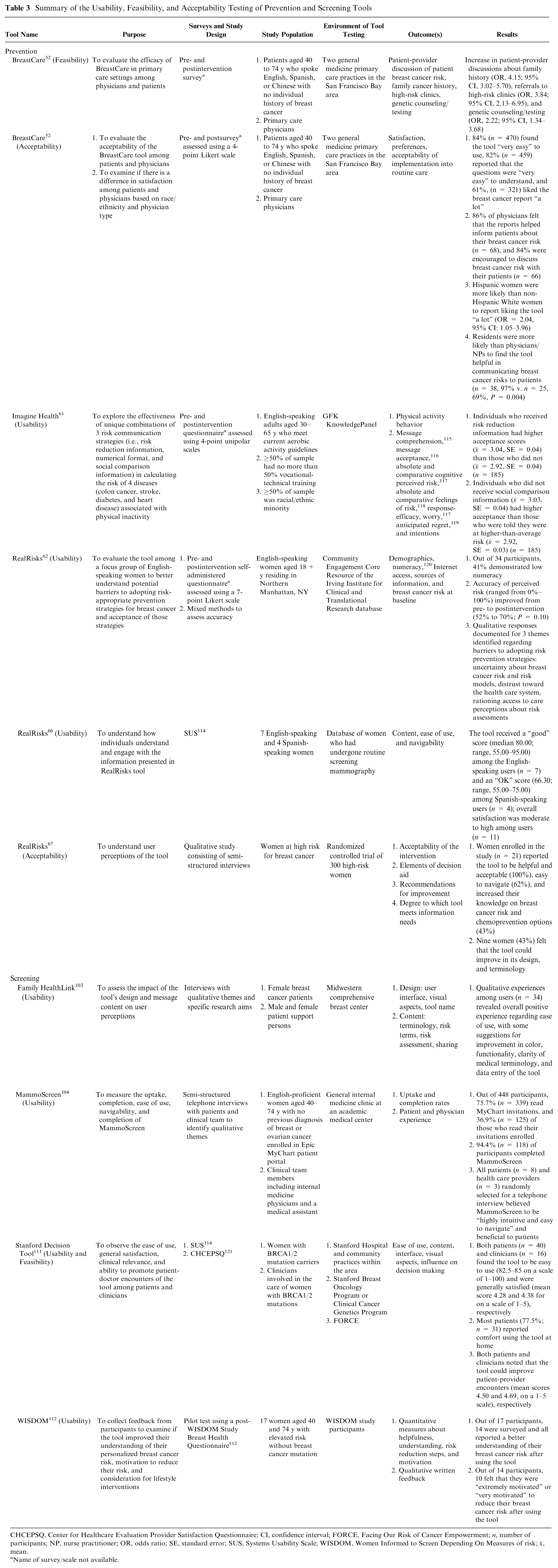
CHCEPSQ, Center for Healthcare Evaluation Provider Satisfaction Questionnaire; CI, confidence interval; FORCE, Facing Our Risk of Cancer Empowerment; n, number of participants; NP, nurse practitioner; OR, odds ratio; SE, standard error; SUS, Systems Usability Scale; WISDOM, Women Informed to Screen Depending On Measures of risk;
Name of survey/scale not available.
BreastCare52,53 and RealRisks62,63 explored the acceptability of these interventions. The acceptability of the BreastCare tool was assessed among high-risk women aged 40 to 74 y with no history of breast cancer. 55 Accordingly, 84% (n = 470) of women using the tool found the tool “very easy” to use, 82% (n = 459) found the tool questions “very easy” to understand, and most women (61%, n = 321) liked the breast cancer report “a lot.” Physicians believed that the reports generated by the tool helped inform patients about their breast cancer risk (86%, n = 68) and encouraged them to discuss breast cancer risk with their patients (84%, n = 66). 55 BreastCare52,53 included messages in English, Spanish, or Chinese and written in plain language to accommodate for individuals with varying demographic backgrounds. The acceptability for RealRisks62,63 was assessed through semi-structured interviews consisting of a sample of mostly non-Hispanic (91%) White (71%) women, in which all women reported that the tool was acceptable. 67 BreastCare 52 was also assessed for feasibility.
Evidence of Uptake of Personalized Tools for Breast Cancer Prevention
We found 3 tools (out of 10), the Breast Cancer Risk Assessment Tool (BCRAT), Claus, and RealRisks that assessed the uptake of these tools in clinical practice settings.62,64,122–130 Studies suggest that BCRAT and RealRisks tools have been directly embedded within electronic health record (EHR) systems in primary care clinics, academic medical centers, and outpatient clinics to prompt patient-provider discussions during a clinic visit.64,122,123,127,129,130 A survey conducted by Park et al. 125 to assess the utilization of breast cancer risk assessment tools found that 86% (n = 215) of genetic counsellors with clinical practices in the United States had used the BCRAT tool to evaluate chemoprevention eligibility in women with a personal or family history of breast cancer. 125 Other reasons for use included surveillance (51%), magnetic resonance imaging eligibility (38%), insurance coverage of genetic testing (9%), and genetic testing eligibility (7%). 125
By contrast, a survey conducted by Yadav et al 122 reported that the BCRAT tool was used by internal medicine residents only in 3.8% (n = 7/183) of their patients. Similarly, studies have found that only 25% of the primary care physicians routinely used the BCRAT tool to evaluate individual risk among women seen in their clinical practice. 124 The reasons for low usage were lack of familiarity with the tool, lack of confidence in their knowledge, and uncertainty about tool’s ability to accurately assess risk.124,131,132 Similar findings were evident among nurse practitioners. For example, a survey conducted by Edwards et al. 126 reported that only 6.5% (n = 4/62) of nurse practitioners had used the BCRAT or Claus tools to assess a women’s risk of breast cancer in a clinical setting. In addition, more than 95% (n = 147/155) of the nurse practitioners were unable to identify the use of the Claus model to assess a women’s breast cancer risk, and 71% of nurse practitioners reported low comfort levels when administering breast cancer risk assessment tools to patients. 126
Several studies explored the uptake of the RealRisks tool in clinical settings.64,128,130 Kukafka et al. 64 found that the use of the RealRisks tool increased the accuracy of breast cancer risk perceptions and chemoprevention knowledge in high-risk women after a clinical encounter with a primary care physician. However, the primary care physicians referred less than half of the women for further high-risk consultations despite the women expressing interest in taking chemoprevention after using the RealRisks tool.64,129 An attempt to increase the uptake of the RealRisks tool in clinical settings is also potentially evident in a study conducted by McGuinness et al. 128 This study explored the impact of missing information in EHR data on automated risk calculations provided by the RealRisks decision tool. The researchers found that EHR data often did not provide sufficient information on family history of cancer, gynecologic history, or history of genetic counseling testing, which were needed to calculate risk using the RealRisks tool. As a result, a new update of the RealRisks tool is considering the use of both self-reported and populated data from the EHR system to inform automated risk calculations. 128
Personalized Tools for Breast Cancer Screening
These tools were developed for average or high-risk women17,81,85,90,94,96,104,108,112 or men 96 with no history of breast cancer.17,81,85,90,94,96,104,108,112 Two tools were developed for use by only health care providers,17,90 and 7 tools were developed for both providers and patients.81,85,94,96,104,108,112 Six tools were developed in academic medical centers,17,90,96,104,108,112 1 in a nonprofit research institute, 94 and 2 in government agencies.81,85 One tool was developed in the Midwest, 96 5 in the West,17,90,104,108,112 and 3 in the South Atlantic regions of the United States.81,85,94
The tools provided breast cancer risk estimates for 5, 6, and 10 y17,90,112 and lifetime. 112 The Stanford Decision Tool108,109 was the only tool that provided lifetime breast cancer outcomes associated with breast cancer screening and prevention strategies (e.g., mammogram ± magnetic resonance imaging, prophylactic oophorectomy/mastectomy) for women with BRCA1/2 mutations.
The tools included family medical history of cancer,17,81,85,90,94,96,104,112 age,17,90,108,112 body mass index,90,112 history of breast biopsy,17,90,104,112 breast density,17,90,112 menopausal status,90,112 family history,17,81,85,90,94,96,104,112 comorbidities, 96 current breast symptoms, 104 history of radiation, 104 and breast augmentation or mastectomy17,108 as predictors of breast cancer risk. Six tools also included genomic characteristics.81,85,94,104,108,112 Health behaviors considered in the tools were screening interval (1 or 2 y) 90 and alcohol intake. 112 The tools also included race and ethnicity categories such as African American/Black, American Indian/Alaskan Native, Asian, Caucasian/White, Hispanic/Latinx, Native Hawaiian/Pacific Islander, other or multiracial, and Ashkenazi Jewish.17,81,85,90,96,104,112 However, no tool considered contextual inputs.
Five tools were internally validated,81,90,94,104,108 and 6 tools were externally validated.17,85,90,96,104 Mammoscreen104,105 and BCSC advanced risk calculator90,91 were both internally and externally validated. The tools were validated mostly among married (median 73%; range, 64%–79%), insured (89%; 60%–90%), White women (90%; 5%–99%), with a college education or higher (54%; 16%–100%) and an income of >$75,000 (37%; 2%–84%) (Supplementary Table 6).17,81,85,90,94,96,104,112
Usability, Feasibility, and Acceptability Testing for Breast Cancer Screening Tools
Four tools for breast cancer screening had undergone usability, feasibility, and acceptability testing with patients, clinical subject matter experts, and health care professionals (Table 3).96,104,112 All tools were tested in academic settings. The usability of the Family HealthLink tool was assessed through a semi-structured interview administered to breast cancer patients (n = 16) and support persons (n = 18) at an academic breast cancer center. 103 Overall, the tool users (n = 34) reported a positive experience regarding the ease of use and design of the tool. The suggestions for tool improvements included color choice, functionality, and clarity of medical terminology. 103 The Stanford Decision Tool 108 reported usability and feasibility testing using the SUS and the Center for Healthcare Evaluation Provider Satisfaction Questionnaire. 121 Patients and clinicians reported ease of use of the tool with high SUS scores of 83 to 85. General satisfaction was 4 for patients and clinicians on a scale of 1 to 5 (1 = least satisfied, 5 = most satisfied). The patients included in the usability and feasibility testing consisted of mostly White women (median: 94%; range: 88%–96%), with a college education or higher (80%; 60%–100%) who were insured (100%) (Supplementary Table 6). No tool reported acceptability testing.
Evidence of Uptake of Personalized Tools for Breast Cancer Screening
A cross-sectional study conducted by Eden et al. 104 reported a high percentage (94%; 314/339) of use of the MammoScreen clinical decision tool among women aged 40 to 74 y, without a history of breast or ovarian cancer, seen at an academic medical center. Moreover, studies suggest that the B-RST 2.0 tool received a state issuance of an education and surveillance policy by the State of Georgia, which aimed to incorporate the screening tool into clinical practice within 9 public health districts across the state.133,134 Accordingly, Brannon Traxler et al. 134 developed an intervention to educate clinical staff and high-risk women about the B-RST 2.0 tool. Following the intervention, the tool was used in 2,159 individuals, and 130 (6.0%) women with a positive B-RST screen were identified for additional screening and genetic testing. 134
Studies also indicate that the BCSC invasive, 135 Family HealthLink, 96 and MammoScreen 104 tools have been integrated into EHR systems at academic clinical centers. However, there is limited knowledge on the dissemination, integration, and sustained uptake of these tools at safety net hospitals and federally qualified health centers (FQHCs). Studies also report barriers to uptake such as incomplete or missing EHR patient data needed for breast cancer risk assessment. A study conducted by Jiang et al. 135 found that race, ethnicity, first-degree family history, and previous breast biopsies were often missing in EHR data and that the inclusion of self-reported data collection in the EHR could improve overall tool performance. 135
Quality Assessment
According to the IPDASi 42 checklist, the average score for the prevention and screening interactive decision tools was 21 (range 9–39; Table 4). The Women Informed to Screen Depending on Measures of Risk (WISDOM) 112 and the RealRisks 62 tools received a score of 39 and 38 out of 63, respectively. The WISDOM tool provided a detailed description of study characteristics based on clinical data and insights from a multidisciplinary team of experts in the development and presentation of tailored risk portfolios and screening options for patients. 112 The RealRisks tool used stories to guide patients in the decision-making process. 62 Only 5 tools presented risk estimates in a variety of different formats such as numbers, categories, or visual or pictorial depictions.17,59,96,104,112
Results from the Quality Assessment of the Interactive, Web-Based Clinical Decision Tools for Personalized Breast Cancer Treatment Using the International Patient Decision Aids Standards instrument (IPDASi) Checklist 42

BCRAT, Breast Cancer Risk Assessment Tool; BCSC, Breast Cancer Surveillance Consortium; BBD, benign breast disease; B-RST, The Breast Cancer Genetics Referral Screening Tool; BWHS, Black Women’s Health Study; WISDOM, Women Informed to Screen Depending on Measures of risk.
Note. The meaning behind the items from the IPDASi checklist. 42
Key Strengths and Weaknesses of Interactive, Personalized, Web-Based Clinical Decision Tools
The Web-based decision tools were validated (internally, externally, or both) and provided sufficient information on the purpose, target audience, and clinical and individual characteristics used to predict breast cancer incidence (Table 5). Key weaknesses included lack of contextual factors and limited information on the validation, usability, acceptability, feasibility testing, integration, and uptake of the tools in diverse populations in nonacademic settings including safety net hospitals or FQHCs.
Key Strengths and Weaknesses of Current Web-Based Clinical Decision Tools

Discussion
Previous reviews have evaluated personalized and interactive Web-based clinical decision tools in breast cancer treatment,23,129 screening,14,129 and prevention128,129; however, these studies have provided limited information on usability, feasibility, acceptability testing, integration, and uptake of these tools in real-world settings.16,136,137 A recent review by Enard et al. 137 evaluated the inclusion of health literacy and insurance status in the development of cancer-related patient decision aids in socially disadvantaged populations. In contrast, we focused on a broader range of characteristics including individual, clinical, behavioral, and contextual factors that could potentially guide breast cancer prevention and screening decisions in clinical practice. Moreover, we evaluated the inclusion of diverse populations and settings in clinical tool validation and testing. To our knowledge, this is the first study to provide a detailed evaluation of the Web-based decision tools available for breast cancer prevention and screening considering contextual factors, characteristics of tool testing, and uptake of these tools.
We found 19 Web-based clinical decision tools that could inform personalized breast cancer screening and prevention decisions in primary care settings. Most tools incorporated age (13/19), race and ethnicity (14/19), family history of breast and/or ovarian cancer (16/19), and patient medical history (10/19) as input characteristics to predict breast cancer incidence. However, few considered health behaviors (6/19), and none considered contextual factors associated with breast cancer risk (e.g., access). Contextual factors such as insurance, income, and economic stability are associated with disparities in breast cancer care and outcomes.138–142 For example, individuals with low economic stability (e.g., low income, unemployment) are less likely to pursue frequent care if they are unable to afford a leave of absence from work or screening services. 139 Studies have shown that a delay in or inability to access care are associated with late-stage diagnoses and worse survival.138–142 There is a need for novel clinical decision tools that could facilitate clinical discussions considering contextual factors that also contribute to individual health outcomes. In addition to economic stability, other contextual factors may also include limited health care insurance, access to fresh fruits and vegetables, travel distance to the nearest health care facility, and access to green spaces for exercise and physical activity. 41 Clinical tools could address these factors by including additional resources on referrals for neighborhood health programs (e.g., exercise programs, food delivery services), contact details of patient navigators and care coordinators, neighborhood transportation services, and insurance navigation programs. These features could potentially help health care providers offer greater support to their patients by engaging in conversations to address patient needs, refer them to services, and facilitate access to these services within their neighborhoods. Moreover, the inclusion of contextual factors into a provider-facing clinical decision tool could also potentially help increase awareness, research, and advocacy among health care providers to address broader contextual factors (e.g., income, education, housing) contributing to health disparities.41,143 The consideration of numeracy and health literacy in the development of clinical decision tools could potentially help increase tool accessibility among patients from diverse backgrounds. Recent tools developed to address contextual factors27,144 include a tool consisting of low-income resources in the region that health care providers could share with their eligible patients. 145 However, there is insufficient evidence on the use of contextual factors as inputs for risk prediction in clinical decision tools.
While all tools included in our analysis were validated, the validation samples were mostly White, educated, and/or insured. Tool validation provides critical information on a tool’s ability to accurately estimate various outcomes of interest in diverse patient cohorts. 146 Studies have shown that tool performance may vary based on the distributions of individual, clinical, and contextual characteristics in diverse cohorts. 147 Therefore, limited representation in validation samples could limit the applicability and effectiveness of these tools in real-world settings. 148 Importantly, using tools that are unable to generate accurate estimates for certain subgroups of the population could perpetuate disparities in cancer care and outcomes.
Overall, there was limited evidence on the usability, feasibility, and acceptability testing of these tools. We found that fewer tools underwent usability (6/19), acceptability (2/19), or feasibility (2/19) testing. The tools included in our study were primarily developed and tested in academic settings. Usability testing could help identify and fix problems with website/mobile applications of the tools. 149 During usability testing, tool developers could assess the tools’ ease of use and the presentation of information considering health literacy and numeracy.150,151 In our analysis, the individuals included in usability testing of the tools were mostly White and insured with some college education or higher. Educational attainment has been shown to be associated with health literacy, 24 and studies have shown that tools that do not consider health literacy are difficult to use and are often neglected by patients despite its utility. 152 Therefore, in future studies, including individuals with different levels of education and health literacy in usability testing could potentially enhance the uptake of these tools.149–151
There was limited evidence on the uptake of these tools in real-world clinical settings. Health care providers’ lack of knowledge about these tools,122,123,129,153 patients’ limited knowledge of their personal risk,154–157 low health literacy and numeracy, language barriers,62,129,158 time constraints,127,129 and health care distrust 159 may have contributed to the limited uptake. Moreover, the tools included in our study were mostly developed and tested in academic settings. There were limited data on the development, testing, and sustained uptake of these tools in nonacademic clinical settings including safety net hospitals, and FQHCs.
Limitations
Four tools were visible only through screenshots, thus limiting our ability to fully assess the quality of the tools. In addition, we were unable to identify the date of the last update for most of the tools, which was necessary to understand the relevance of the decision tool within the current literature. Finally, there were no standards or criteria available to assess the use of the tools in diverse settings. Therefore, we individually assessed race, ethnicity, education, insurance, and income distributions of the samples included in tool testing.
Conclusion
There are several Web-based clinical decision tools to support breast cancer prevention and screening decisions in clinical practice. These tools could facilitate shared decision making between patients and physicians, reduce patient anxiety, and help clarify patients’ personal preferences and values. The development, validation, and testing of clinical tools in diverse populations and settings may improve usability, uptake, and equitable access to these tools.
Supplemental Material
sj-docx-1-mpp-10.1177_23814683241236511 – Supplemental material for A Scoping Review of Personalized, Interactive, Web-Based Clinical Decision Tools Available for Breast Cancer Prevention and Screening in the United States
Supplemental material, sj-docx-1-mpp-10.1177_23814683241236511 for A Scoping Review of Personalized, Interactive, Web-Based Clinical Decision Tools Available for Breast Cancer Prevention and Screening in the United States by Dalya Kamil, Kaitlyn M. Wojcik, Laney Smith, Julia Zhang, Oliver W. A. Wilson, Gisela Butera and Jinani Jayasekera in MDM Policy & Practice
Footnotes
Author Contributions
Conception or design: JJ, DK, LS, KW, JZ
Screening: DK, LS, KW, JZ
Data extraction: DK, LS, KW, JZ
Acquisition, analysis, and interpretation of data: All
Drafting the work or revising it critically for important intellectual content: All
Final approval of the version to be published: All
Agreement to be accountable for all aspects of the work in ensuring that questions related to the accuracy or integrity of any part of the work are appropriately investigated and resolved: All
The authors declared no potential conflicts of interest with respect to the research, authorship, and/or publication of this article. The authors disclosed receipt of the following financial support for the research, authorship, and/or publication of this article: Financial support for this study was provided entirely by the Division of Intramural Research at the National Institute on Minority Health and Health Disparities of the National Institutes of Health (MD000022) and the NIH Distinguished Scholars Program. The funding agreement ensured the authors’ independence in designing the study, interpreting data, writing, and publishing the report. The opinions and comments expressed in this article belong to the authors and do not necessarily reflect those of the US government, Department of Health and Human Services, National Institutes of Health, or the National Institute on Minority Health and Health Disparities. The study funders had no role in the design of the study; collection, analysis, or interpretation of the data; writing of the manuscript; or decision to submit the manuscript for publication.

References
Supplementary Material
Please find the following supplemental material available below.
For Open Access articles published under a Creative Commons License, all supplemental material carries the same license as the article it is associated with.
For non-Open Access articles published, all supplemental material carries a non-exclusive license, and permission requests for re-use of supplemental material or any part of supplemental material shall be sent directly to the copyright owner as specified in the copyright notice associated with the article.
