




Abstract
Two-sided messages, that is, communications that acknowledge both sides of an issue while still advocating for one, are a potential approach for correcting misinformation and fostering openness to correction information. In this article, we explore the effectiveness of using two-sided messages. Drawing parallels between attitude change and misinformation correction, we summarize recent studies demonstrating that individuals with deeply entrenched beliefs become more receptive to changing them when their perspectives are acknowledged in two-sided (versus one-sided) communications. Key mechanisms described include reciprocity and enhanced source credibility. Practical implications suggest that communicators, policymakers, and educators could incorporate two-sided messaging to correct misinformation, particularly targeting individuals with strongly held misbeliefs. By acknowledging the reasons behind the acceptance of misinformation while presenting factual corrections, this approach can bridge divides, encourage openness to alternative viewpoints, and ultimately facilitate belief correction.
In today’s digital age, the rapid spread of misinformation, or information lacking a factual basis, presents significant challenges for individuals and societies alike. 1 From public health crises worsened by vaccine-related falsehoods to political polarization driven by fabricated news, the consequences of misinformation are both far-reaching and profound. 2 In response to these challenges, researchers are working to identify what makes people accept misinformation3,4 and develop effective strategies for correcting it.5,6 Despite these efforts, and some progress made, the most effective approaches for correcting misinformation are still not known, highlighting the need for additional research.
In this article, we focus specifically on correcting mistaken beliefs that people hold strongly. In particular, we review prior work examining the utility of using two-sided messages that argue for one side but also present a few plausible arguments on the other side, without counterargument, to modify strongly held attitudes. We then discuss approaches for using two-sided messages to correct strongly held but misinformed beliefs.
Correcting Misinformation & Links to Changing Attitudes
Attitudes in the United States and globally have become increasingly polarized in recent years, with individuals aligning closely with their ingroups’ views while rejecting the perspectives of outgroups, whether these outgroups are political, religious, or social. 7 This polarization mirrors the societal challenge of misinformation, which can become deeply embedded in group identity. Indeed, a recent large-scale online study concluded that a person’s politics trumps truth. 8
The human brain is predisposed to rely on cognitive shortcuts, rendering people particularly vulnerable to misinformation that aligns with their existing beliefs,9,10 are repeated frequently,11,12 or originates from ingroup sources.13,14 Compounding this issue, social media platforms and online communities often function as echo chambers, amplifying exposure to ideologically congruent misinformation. 15 These dynamics create a perceived consensus within ingroups, strengthening social bonds among members 16 while simultaneously making it difficult to correct entrenched misbeliefs.
Notably, the study of misinformation correction has much in common with work on attitude change. 17 Attitudes (evaluative assessments of people, objects, or issues) play a central role in shaping individual behaviors. The study of attitude change has been a cornerstone of psychological studies for decades.18,19 However, research has consistently shown that strong attitudes—those that are extreme, held with certainty, or tied to group identity—are particularly resistant to modification. 20 Despite extensive research on attitude change, a significant gap remains: how to effectively influence people with strong, entrenched beliefs. Recent work, though, is beginning to illuminate how deeply held misbeliefs can be corrected.
One clear lesson from research on attitudes,21 –23 and on misinformation,24,25 is that simply retracting or correcting previously accepted information does not necessarily eliminate its influence. Cognitive factors such as biased information processing, 20 motivated reasoning, 26 the backfire effect, 27 and psychological reactance 28 can cause people to maintain strongly held attitudes and misinformation even when presented with factual corrections. Although research on misinformation correction has examined many of the same variables studied in the attitude change literature, including source, context, and recipient factors, 17 less attention has been paid to the characteristics of the debunking message itself, with some exceptions: Some research has shown that people prefer simple over complex correction messages.29,30 Furthermore, researchers have recently used large language models to create personalized persuasive messages 31 that directly target individuals’ misinformed beliefs. 32 However, there is still no clear understanding of the specific aspects of debunking messages that can enhance their effectiveness.
Given these challenges, it is important to identify messaging strategies that can soften strong beliefs, as most persuasion techniques are more effective on weak beliefs. 33 When attempting to change strong beliefs, making the audience more receptive to the opposing viewpoint is an important initial step. 34 Here, we refer to openness as a mindset in which individuals are willing to engage with opposing information, reconsider their own viewpoints, and contemplate alternative views. 35 For individuals holding strong prior attitudes, we posit that this openness can be a precursor to ultimate attitude and belief change.
Recognizing the parallels between the approaches and challenges regarding attitude change and misinformation correction (belief change), we next review evidence for a seemingly counterintuitive persuasion strategy: providing some validation of the individual’s perspective that led to accepting misinformation, without validating the misinformation itself. This approach is based on recent persuasion research comparing the effectiveness of one-sided versus two-sided messages in increasing openness to change for individuals who vary in their belief strength.36,37 We first summarize this research before discussing its application in misinformation correction.
Two-Sided Messages Can Counteract Strong Beliefs
Research since the 1970s has consistently shown that persuasion techniques are far more effective for influencing weak attitudes than strong ones. 33 However, we recently identified a technique that is more effective on strong than weak attitudes: using two-sided instead of one-sided messages. Unlike typical persuasive messages, like most debunking efforts, that present only supporting arguments or briefly mention opposing views before refuting them, 38 two-sided messages acknowledge competing perspectives more substantively. Although one-sided messages can be effective when targeting weaker attitudes, our research shows that two-sided messages become more effective in influencing people as attitude strength increases.
For example, in one study 36 we measured the moral foundations of people’s attitudes toward gun control. We then exposed half of the participants to messages opposing their stance, varying whether the messages were one-sided or two-sided. Participants who received attitude-supporting messages were excluded from this analysis. Given that morally based attitudes are typically very difficult to change, 39 we examined whether message sidedness—either one-sided or two-sided—affected participants’ openness to the opposing viewpoint. The results showed that for the one-sided message, the typical attitude strength effect emerged: The more morally based people’s attitudes were, the more they resisted the message. For the two-sided message, the opposite occurred: Participants with stronger moral foundations became more open to opposing arguments (see Figure 1).
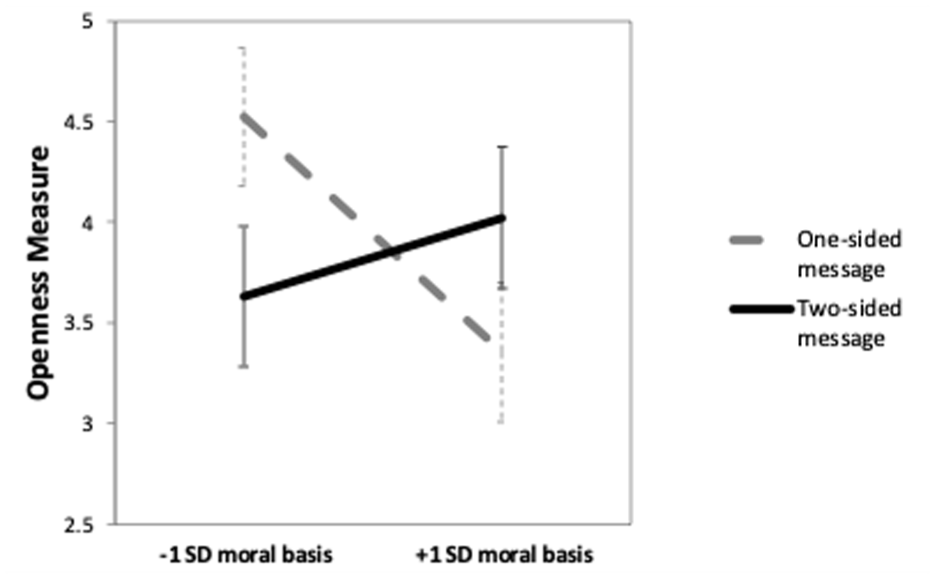
The interaction between an attitude’s moral basis & message sidedness on openness to change
We observed the same interaction between moral basis and message sidedness not only regarding topics with substantial support on both sides, like gun control, but also for topics having a clearly dominant view (e.g., forbidding Nazis from speaking in high schools). 36 It also extended to crucial health-related topics, such as face mask wearing during the COVID-19 pandemic. Furthermore, we obtained this effect with many different variations in the key concepts. Specifically, the effect held for alternative operationalizations of the attitude strength variable besides moral basis, including the certainty with which the attitude was held, the perceived importance of the attitude, and the extent to which the beliefs were tied to one’s identity, whether it be political affiliation or brand loyalty.37,40,41
For instance, we examined brand loyalty by assessing interest in switching between rival brands among iPhone users with positive attitudes toward their phones. 41 Participants received a one-sided or a two-sided sales pitch from an Android phone salesperson. The dependent variable of interest was participants’ willingness to switch to Android phones. Consistent with existing literature, 42 results in the one-sided condition showed that as brand loyalty increased, people expressed less willingness to switch. However, this effect reversed for those receiving the two-sided message: As their brand loyalty increased, they were more willing to consider a competitor brand. We replicated this effect with coffee brands and food delivery apps. 41 Lastly, our results held in all of these studies, regardless of whether we used self-reports or behavioral intention measures related to openness such as interest in reading counterattitudinal messages and purchasing intentions in a consumer context.
Our hypothesis that two-sided messages are particularly effective in fostering openness to the opposing side among individuals with strong beliefs stems from several processes that are more likely to operate among those with strong attitudes, including the norm of reciprocity, 43 the effectiveness of presenting one’s side with humility, 44 and the enhanced perception of source credibility. 45 For example, based on reciprocity, when someone does a favor for us, we feel compelled to return it. 46 Thus, if a speaker demonstrates openness to the recipient’s position, the recipient may feel compelled to reciprocate by being more open to the speaker’s viewpoint. Importantly, acknowledging a strongly held opinion is equivalent more similar to doing a larger favor than acknowledging a weak one. The greater the favor, the stronger the sense of indebtedness and the greater the need to reciprocate. Another mechanism is that recipients who have their view acknowledged rather than only disparaged are more likely to develop positive attitudes toward the source (e.g., fostering source credibility), which increases the likelihood of change. 45
Using Two-Sided Messages to Correct Misinformation
Although two-sided messages have long been examined in persuasion studies,47,48 researchers have only recently explored their potential for influencing entrenched viewpoints. Furthermore, to our knowledge, this strategy has never been examined in the context of misinformation correction. Rather, correction messages are invariably one-sided. We reasoned that when it comes to debunking misinformed beliefs, two-sided correction messages could become more effective as the strength of the belief in the misinformation increases, just as these messages become more effective with stronger attitudes in the persuasion domain. Furthermore, we hypothesized that this effect would be driven by the two factors just mentioned: recipients’ appreciation of the acknowledgment of their perspective (reciprocity), and enhanced source perceptions (i.e., credibility).
We conducted two studies to test whether the interaction between belief strength and message sidedness obtained in the attitude change domain would generalize to correcting misinformation. In one study, we recruited participants who held the incorrect belief that the 2020 U.S. Presidential election was rigged. 49 Belief strength (e.g., certainty, importance) was assessed before exposing the participants to either a one-sided or a two-sided correction message arguing that there was no evidence of systematic voter fraud. The message in the one-sided condition stated that scientists who explored the truth of this claim found no evidence for any widespread voter fraud. It also debunked the myth that the Dominion Voting System machines switched votes from Trump to Biden. The message in the two-sided condition first presented the same set of correction arguments and then also acknowledged that the message source completely understood why a reasonable percentage of the American public still believed that the election was stolen. Regardless of the condition, the same final conclusion was drawn, suggesting no evidence of systematic fraud.
After reading the respective message, participants responded to openness measures and provided their beliefs about the target misinformation (see also References 36 and 37, which reflect a similar approach). Next, participant appreciation of the message and source credibility were assessed. Results showed a significant two-way interaction between belief strength and message sidedness (see Figure 2). As was the case for the persuasion research reviewed earlier, for the one-sided message, as misinformation belief strength increased, the correction message became less effective in promoting openness. For the two-sided message, however, the opposite was the case. Furthermore, both perceived appreciation and source credibility mediated the interactive effect between belief strength and message sidedness on openness.
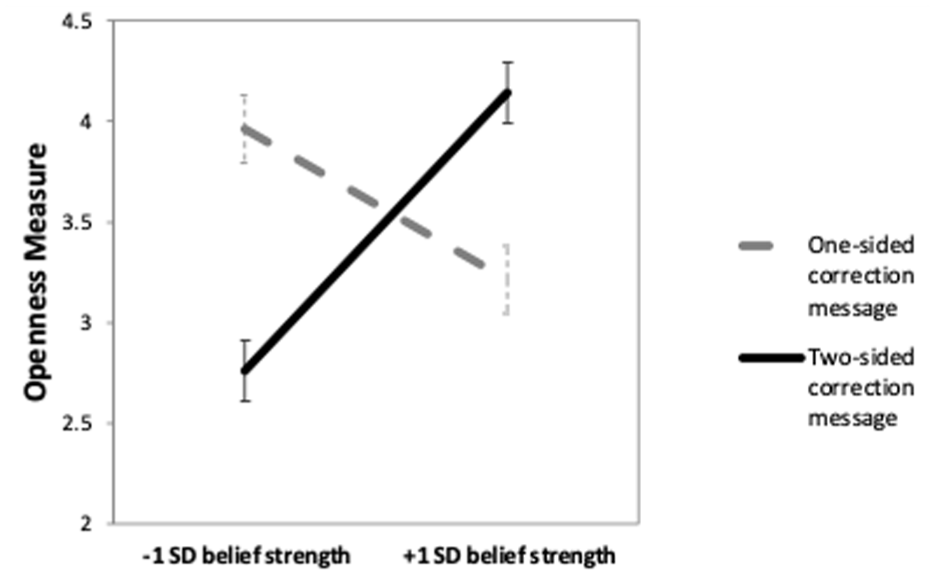
The interaction between belief strength & message sidedness on openness to change
To generalize these findings, we conceptually replicated this study using a different misinformed belief—that the FDA suppresses cancer cures—which pretesting confirmed was held similarly across U.S. political parties. 49 The procedure for this replication was identical to the stolen election study described above, except that participants were randomly assigned to read either a one-sided or two-sided message arguing that there was no evidence the FDA conspires with pharmaceutical companies to suppress cancer cures. Both messages presented the same arguments against this misinformation, but the two-sided communication briefly acknowledged that it was understandable why some Americans might hold this belief. Similar to the election fraud study, we found a significant interaction between prior belief strength and message sidedness, with the same pattern of mediation through reciprocity and source credibility.
General Discussion
In all of these studies, we examined the effectiveness of using two-sided messages as a strategy to encourage openness to change among individuals with deeply entrenched attitudes and misinformed beliefs. Over a series of experiments, we established that the strength of both attitudes and misinformed beliefs moderated peoples’ openness to counterattitudinal information when reading a two-sided versus a one-sided message. Specifically, as the strength of a person’s attitudes and misinformed beliefs increased, the relative benefit of using a two-sided message in promoting openness was enhanced.
Although the interaction between belief strength and message sidedness was consistent across each experiment, we conducted a meta-analysis to compare the effects across our entire set of studies, both published and unpublished. Overall, the interactive effect between attitude/belief strength and message sidedness on openness was significant, r = .17, SE = .02, z value = 9.48, p < .001, 95% CI [.13, .20] (see the left panel in Figure 3). The effect size varied somewhat across studies, but a test of heterogeneity was not significant (p = .22). This suggested that across the various strength indicators (e.g., moral basis, certainty, group identification) and the many topics (e.g., gun control, election fraud), there was a reliable and similar interaction between attitude/belief strength and message sidedness on openness to counterattitudinal advocacies across many study variations.
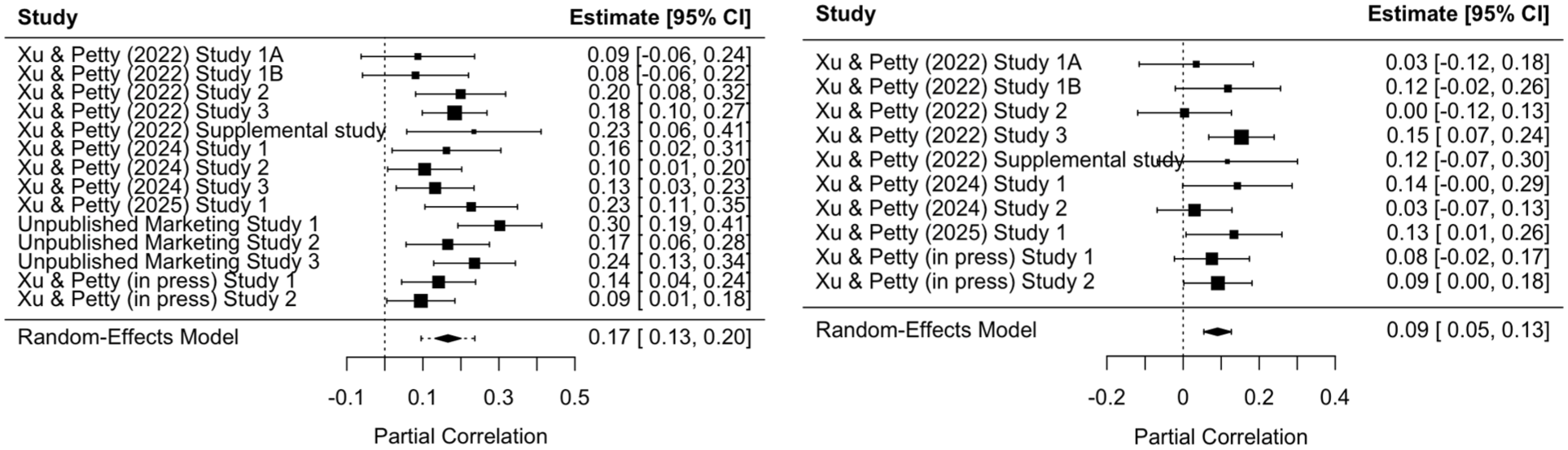
Forest plots of estimated partial correlation results
Furthermore, when replacing the openness dependent measure with postmessage attitudes or misinformation belief (depending on the study) the same meta-analysis showed that the interaction effect was significant, r = .09, SE = .02, z value = 4.92, p < .001, 95% CI [.05, .13] (see the right panel in Figure 3). In addition, even though the critical interaction effect varied in size and significance within each study, the test of heterogeneity was not significant (p = .61). While openness is viewed as a precursor to attitude change, we showed that two-sided messages can increase openness and also lead to attitude and belief change, particularly among individuals holding the strongest initial views.
Theoretical Implications
Our research demonstrated the utility of using two-sided messages to foster openness and belief change among individuals with deeply entrenched views. Although prior work on openness primarily has focused on individual traits such as intellectual humility and open-minded cognition,6,34 our research highlights how situational factors—in this case, using two-sided messages—can encourage openness, especially among those with strong beliefs. Leveraging the norm of reciprocity, two-sided messages acknowledge recipients’ perspectives, making them more open to counterattitudinal information. This approach complements existing strategies of misinformation correction 50 and extends the understanding of how to influence individuals with strong beliefs. Additionally, our work advances the literature on message sidedness by identifying perceived appreciation as a key mediator along with enhanced source credibility.
Practical Implications
Our findings offer several practical implications for combating misinformation and fostering constructive dialogue in polarized environments (see the Sidebar for key points). First, we introduced a new way of bridging the divide between people who hold opposing positions that can encourage communication on highly divisive political and social issues. Specifically, when debunking strongly held misinformation, communicators should consider using two-sided messages that acknowledge the reasons why people might believe the false information along with presenting factual corrections. For example, campaigns about climate change could acknowledge economic concerns related to green policies after presenting scientific evidence supporting the fact that climate change is happening.
Notably, our research also suggests that two-sided messages are especially effective for individuals with strong misbeliefs. Policymakers and educators can prioritize this approach when targeting deeply entrenched misinformation such as conspiracy theories. However, given that the results of one-sided versus two-sided messages reversed based on attitude strength in our studies, we recommend that policymakers test issues prior to deploying interventions and customize their misinformation correction efforts depending on the recipients’ degree of misinformation belief strength.
Second, educational initiatives could incorporate media literacy training that teaches individuals to critically evaluate sources and consider multiple perspectives. Initiatives like these can foster greater openness to factual information even when it challenges preexisting beliefs. Furthermore, policymakers could establish platforms for open dialogue on divisive issues, such as town halls or online forums, specifically targeting venues where individuals with the strongest beliefs are likely to gather. In these settings, two-sided messaging can be used to bridge divides and reduce polarization. Encouraging an open-minded mindset through two-sided messaging can help reduce conflict and promote understanding between opposing groups. For example, in political discourse, along with presenting evidence to support one’s position, acknowledging the valid concerns of both sides can facilitate more productive conversations.
Sidebar—Key Points for Policymakers
When debunking strongly held misinformation, communicators should consider using two-sided messages that acknowledge the reasons why people might believe the false information along with presenting factual corrections.
Given that the results of one-sided versus two-sided messages reverse based on attitude strength, it is recommended that policymakers test issues prior to deploying interventions and customize their misinformation correction efforts depending on the recipients’ degree of misinformation belief strength.
Educational programs should teach media literacy by training individuals to critically assess sources, consider multiple perspectives, and engage constructively with ideas that challenge their own.
Policymakers could establish platforms for open dialogue on divisive issues, such as town halls or online forums, where those with the strongest beliefs are likely to gather and where two-sided messaging strategies can be used to bridge divides and reduce polarization.
Although our work suggests a new approach for combating misinformation, there are many questions yet to be addressed and many opportunities for future research to examine the ways to construct and employ effective two-sided messages. For example, in our studies, the interactive effect between attitude strength indicators and message sidedness on postmessage beliefs varied somewhat in size, though the meta-analysis identified a significant direct effect overall. Furthermore, all of our studies revealed the existence of a significant indirect effect on postmessage attitudes/beliefs through openness, suggesting that openness is a precursor to attitude change. 51 Perhaps by opening people up to consider the truth with an initial two-sided correction message, a second message would prove effective in producing even stronger misinformed belief correction. Finally, it is important to specify exactly what to include in two-sided messages for maximum effectiveness.
Summary
We have examined how the strength of the acknowledgment in two-sided messages, 36 the need to substantiate the acknowledgement with actual arguments, 36 the placement of the acknowledgement, 40 and the refutation of the acknowledgement 41 influence the effectiveness of two-sided communications. We found that not all two-sided messages are equally effective. Specifically, we found that two-sided messages featuring strong rather than weak arguments in their acknowledgment of the other side was more successful in promoting openness to opposing views among individuals with strong attitudes. We also observed that two-sided messages containing only a general respectful acknowledgment of the opposing viewpoint (without specifying any arguments) were as effective as presenting strong arguments in the acknowledgement.
In our most recent research, 41 we examined the effectiveness of two-sided messages with or without refutation, which showed that refuting the other side’s arguments in a two-sided message was no more effective than a one-sided message. This suggests that the benefits of two-sided messaging likely depend on establishing respectful acknowledgment of the other side without subsequent refutation. Lastly, in another study, 40 we found that two-sided messages with the acknowledgement placed at the end (versus in the beginning) were more effective in promoting openness among individuals with deeply entrenched attitudes, likely because this order violates conversational norms and seems more sincere.
In sum, our research on two-sided counterattitudinal messages provides a practical framework for addressing misinformation, fostering open mindedness, and reducing polarization. By incorporating two-sided messaging into communication strategies, policymakers, educators, and leaders can bridge divides more effectively, promote evidence-based decision-making, and encourage meaningful dialogue on critical issues. These findings underscore the importance of balancing factual corrections with acknowledging reasons why people believe misinformation in the first place, offering a pathway to greater understanding and cooperation in an increasingly polarized and divided world.
Footnotes
Declaration of Conflicting Interests
The authors declared no potential conflicts of interest with respect to the research, authorship, and/or publication of this article.
Funding
The authors disclosed receipt of the following financial support for the research, authorship, and/or publication of this article: The National Natural Science Foundation of China (Grant #72302052) and the Templeton World Charity Foundation (Grant #TWCF 2023-32571).