



Abstract
Forming teams, developing relationships, and building trust can be challenging when dealing with increasingly socially anxious, disconnected, and diverse student cohorts. We describe an icebreaker that, through low-risk classroom interactions, allows students to socially identify with an in-group and compete with out-groups in a classroom environment. The activities provide abundant opportunities to relate in-class experiences to Social Identity Theory and other relevant management and OB theories.
Designed for use in an Organizational Behavior (OB) classroom, and grounded in Social Identity Theory (SIT), this series of activities demonstrates how existing identities can be subsumed by fresh ones and how new social identities can be elicited and constructed. This process strengthens group bonding, particularly with diverse student groups who sometimes struggle to gel.
Icebreakers are designed to encourage students to share personal information and build connections. However, prompts like “share one interesting thing about yourself” cause anxiety, increasing fears of negative evaluation (Dijkstra et al., 2008; Weeks & Howell, 2012). Students may worry about saying something too boring or standing out inappropriately, heightening feelings of vulnerability (Derlega et al., 1993). In contrast to exercises centering diversity and differences (e.g., Lo, 2023), this activity helps students find commonalities and shows how new social identities can, temporarily, become more salient than those students bring into the classroom. This icebreaker should be conducted early in the semester, when students are still getting to know each other. In this context, the activities serve as an engaging, non-threatening way to build group bonds while introducing and applying key management and OB theories.
Pedagogy and Theory
This icebreaker involves activities which utilize both experiential learning (D. A. Kolb, 1984, 2013; A. Y. Kolb & Kolb, 2005) and gamification. Gamification takes the enjoyable aspects of games (challenge, play, and competition) and applies them to work or education (Dale, 2014). Gamification requires problem-solving, collaboration, and communication (Dicheva et al., 2015). These activities employ game design principles, including competition, cooperation, prizes, and time limits.
While these activities primarily connect to SIT (Karasawa, 1991; Tajfel, 1982), they also provide abundant opportunities to discuss other concepts, including organizational socialization, cohesion, and team dynamics. Each is described below.
Social Identity Theory
Within SIT, one’s social identity is the element of one’s self-concept, “Who am I?,” which stems from membership in a salient group, “Who are we?” (Karasawa, 1991; Tajfel, 1982). Social identity is a perception of oneness with a group and occurs when perspective shifts from “you vs. me” to “us vs. them.”
People tend to favor in-group members, offering more support, effort, rewards, and resources (Cikara, 2021). Social identification drives behaviors aligned with that identity, such as in-group support, stereotypical self/other perceptions (e.g., competence or likability), and shifts in team dynamics, such as increased cohesion, competition, and cooperation (Ashforth & Mael, 1989; Ellemers & Haslam, 2012). In-group identification arises from factors that are relatively easy to influence, including self/other categorization, the distinctiveness and desirability of the in-group, and the salience of out-groups.
Research on “minimal groups” (Diehl, 1990) reveals that even random group assignments trigger social identity and ingroup–outgroup evaluations, a phenomenon called the “mere categorization effect.” Once they’ve identified with a group, people show in-group favoritism even when they know the assignment was simply arbitrary (Brewer, 1979; Otten & Moskowitz, 2000). Thus, the identity-eliciting activities in this icebreaker powerfully evoke social identification with students’ new in-groups.
Organizational Socialization
The transition from newcomer to organizational insider is profoundly influenced by social identification (Ashforth et al., 2018; Ibarra, 1999). Social identities are a significant component of workers’ organizational self-definitions and evolve over time, often triggered by cues such as organizational change, promotions, or disruptive events (Ashforth & Schinoff, 2016). Identification typically strengthens as employees gain experience and develop work-relevant skills (Ashforth et al., 2018).
Team Dynamics
Relationships within teams strengthen when members identify with one another. Strong social identification increases cohesion and motivation, especially when teams share a perceived out-group, and leads members to favor their own group members (Cikara, 2021; Evans et al., 2024; Haslam et al., 2000). Identifying strongly with one’s team also shapes intergroup dynamics (relationships between teams) by increasing competition, conflict, and negative evaluations of out-groups, often resulting in stereotyping and depersonalization (Ashforth & Mael, 1989; Van Knippenberg, 2000). SIT also explains how commitment to one’s team strengthens, as shared identities foster greater effort, cooperation, and reduced turnover.
Learning Objectives
This set of activities works simultaneously as an icebreaker and a demonstration of social identities and group dynamics. It is especially when applied to theory and workplace experiences. Media clips (Table B1) can reinforce the concepts, followed by discussion of social identity-related OB topics. After completing the exercise, students will be able to:
Recognize how social identity perceptions can be elicited and constructed (LO1).
Describe in-group / out-group effects on team dynamics (LO2).
Apply concepts from SIT to OB topics, including student diversity, organizational socialization, and group dynamics (LO3).
(Optional) Apply concepts from SIT to employee experiences using media clips (LO4).
Instructions for Running the Exercise
Students engage in a series of activities designed to break the ice, encourage connection and cohesion, elicit social identity evaluations and ingroup–outgroup perceptions. Competitive activities and the opportunity to win small prizes reinforce team dynamics within the class. The experiences are then related to several OB theories.
Logistics and Preparation
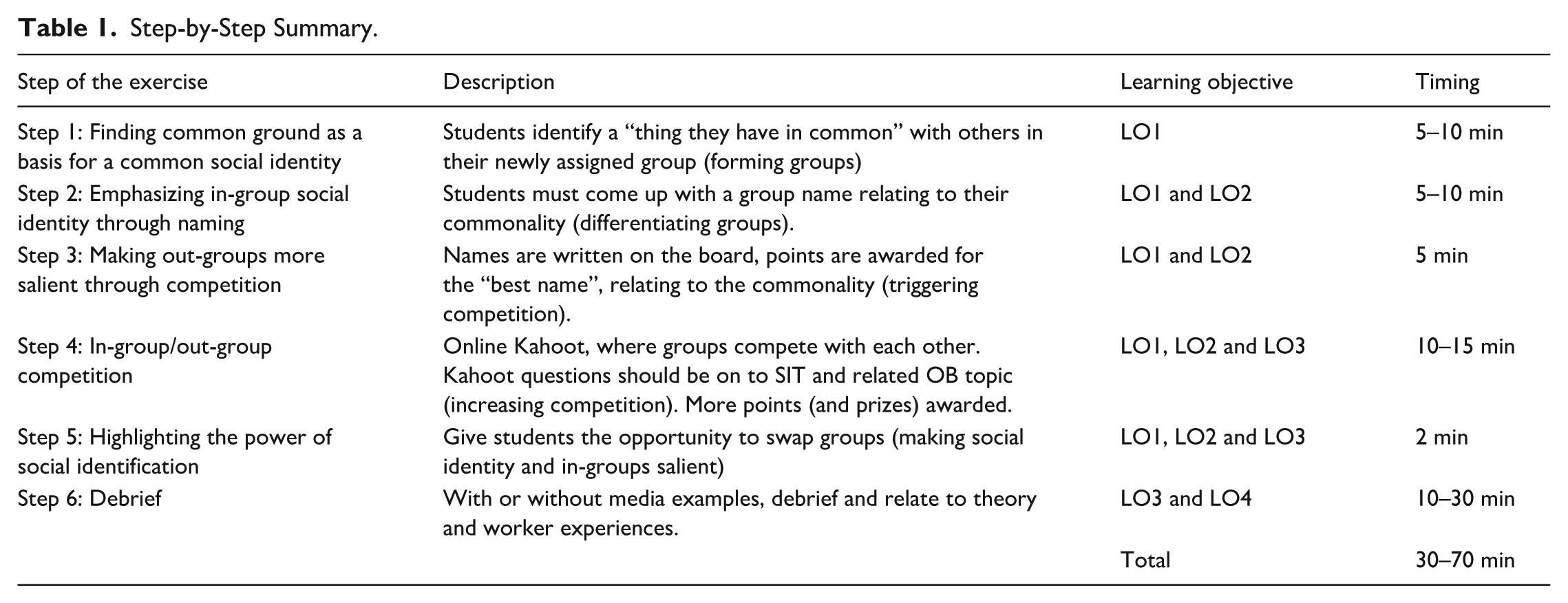
This activity can be done with anywhere from three to seven groups of three to six students. Students can be organized into groups based on where they happen to sit on arrival or some other, more coordinated, method (see Note 1). For the Kahoot, a computer and a projector are needed, and one internet-connected student device per table. Small prizes can be provided for the eventual winning team (see Note 2). Instructors can modify the time allocated to group bonding, debriefing, and applying theory. The session takes between 30 and 70 min (see Table 1), or up to 2 hr if media clips are utilized to further illustrate SIT.
Step-by-Step Summary.
Step-by-Step Instructions
Step 1—Finding Common Ground as a Basis for a Common Social Identity
Ask students to identify something they have in common with all others in their group. This request works well as an icebreaker because, to find what they have in common, students disclose low-risk information that they assume other students may share, such as owning pets or their favorite music genre. Students need only interact with their own tablemates (not with the whole class), further avoiding the discomfort many people feel when speaking to a large audience. Thus, social identities form through commonalities with peers rather than visible differences, such as ethnicity or gender. After each group finishes, either a group member or the facilitator should write each group’s common feature on the board.
Step 2—Emphasizing in-Group Social Identity Through Naming
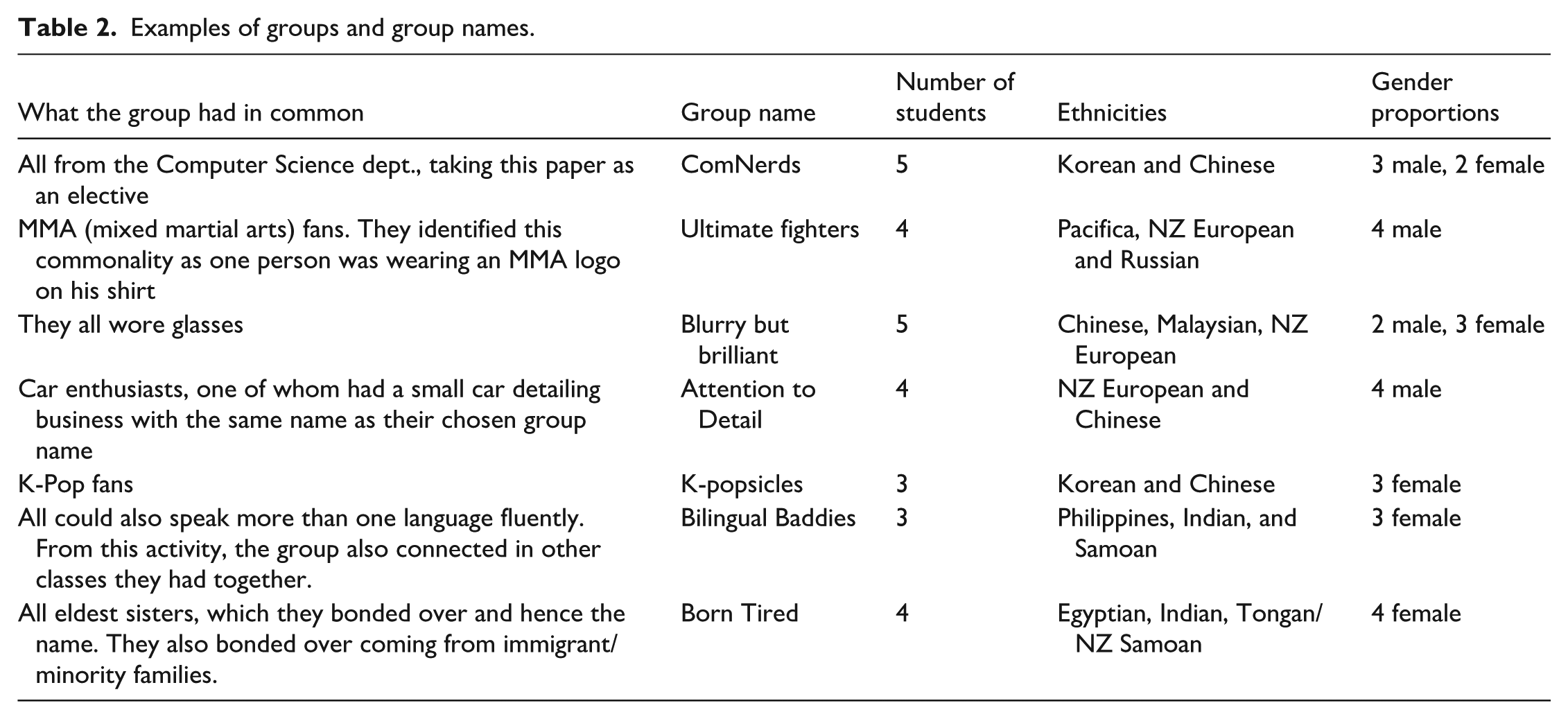
Building on the previous step, ask each group to come up with a humorous, accurate, or clever team name that specifically relates to their group’s common feature. This elicits social identification and in-group perceptions. For example, a group of MMA fans called themselves “Ultimate fighters” (see Table 2, Note 1 for more examples). The facilitator should make it clear that this is a competition in which the “best” name will win.
Examples of groups and group names.
Step 3—Making Out-Groups More Salient Through Competition
Inter-group competition reinforces social identification and strengthens team cohesion. Rank the group names in a light-hearted competition. Award points from one to the total number of groups (i.e., if four groups, give four points for the best name). As above, instructors can use a variety of criteria that best suit their teaching style and the student cohort; any or all of speed (how quickly groups agreed on a name), humor, linguistics (puns and rhymes), accuracy, etc. Experienced facilitators can more easily gauge which groups might enjoy some banter about their choice and elicit laughter from the class. Less experienced TAs may prefer to have more objective criteria, such as accuracy.
Step 4—In-Group/Out-Group Competition
A Kahoot! works well in this context. A Kahoot! competition is an interactive quiz game hosted on www.kahoot.com, where questions are presented, and participants join using a device shared by the group and a game PIN. Players answer questions as a team within a set time limit, earning points for correct and faster responses. Scores are updated after each question to create an ongoing leaderboard, and the competition concludes with a winner based on the highest total score (see Appendix A). Further points should be awarded to the top three teams. The students in the group with the most points then receive a small prize (see Note 2).
Step 5—Highlighting the Power of Social Identification
Ask if anyone in the room would like to swap groups. We have asked this question numerous times to student groups over several years, and have not yet had a student volunteer to switch (see Note 3). However, if a student does want to move, this scenario can also be related to other group processes (see Notes 4 and 5).
Step 6—Debrief
Appendix C provides specific discussion questions and conversation starters to promote reflection, critical thinking, and application of theory. Below, we outline opportunities to address various learning outcomes.
Eliciting Social Identification
Relating to LO1, students see how simply finding a shared trait (and naming their group after it) strongly evokes social identification (Karasawa, 1991; Tajfel, 1982). For diverse groups of relative strangers, this process, followed by intergroup competition, makes group membership more salient than individual characteristics, such as ethnicity, gender, or age. Facilitators can link this phenomenon to broader discussions on social and organizational roles, unconscious bias, and diversity (Ashforth & Schinoff, 2016).
In-Group Versus Out-Group Behavior
Relating to LOs 1 and 2, discuss how ingroup versus outgroup perceptions are experienced and magnified. Throughout the session, the facilitator should be noting competitive behaviors, such as outbursts of joy at winning or comments revealing frustration while losing the Kahoot. These examples can then be used to initiate in-class discussions of how people felt, behaved and interpreted others’ actions (Kuppens et al., 2013). This discussion can then be extended to examples of being competitive with other groups and encouraging fellow team members.
Members of a group become more cohesive and cooperative when the group share a “common enemy” (an out-group). People prefer in-group members and provide them with more resources (Voci, 2006). This links to motivation, work experiences and organizational norms around nepotism, equity, and fairness. Facilitators might also discuss the causes and effects of in-group biases in organizations, including negative stereotypes of out-groups (Evans et al., 2024).
Swapping Groups
Also relating to LO2, students being offered the chance to move groups, but preferring to remain, relates to social identification and the minimal group paradigm (Brewer, 1979; Diehl, 1990; Otten & Moskowitz, 2000). The facilitator can describe research showing that ingroup preferences can emerge even in randomly assigned, arbitrary groups, and even in the absence of similarity, conflict, competition, or meaningful distinction. Thus, it is almost inevitable that in-group evaluations and the desire to stay in one’s group will emerge after the class activities (see Note 3). It is also worth discussing the implications of wanting to switch groups, even if this doesn’t happen in the class (see Note 4).
Linking to Organizational Socialization
Relating to LO3, instructors can explore how social identities develop as employees become integrated into their organizations (He & Brown, 2013). Social identity forms a significant component of organizational self-definition and evolves as workers construct their identities as organizational insiders over time (Ashforth et al., 2018). Students benefit from discussing the positive outcomes when employees strongly identify with their organization or profession; “I’m on the McDonald’s team” versus “I flip burgers.”
Variations
Relating to LO4, facilitators can extend this activity by using selected media from Appendix B to relate SIT to employee experiences. Preliminary work might include asking students to view films or TV episodes that exemplify social identity, exclusion, role conflict, and organizational socialization.
Conclusion
In addition to breaking ice, when students participate in these activities, they experience a new, salient social identity. They can reflect on in-groups and out-groups and will be introduced to a range of key OB concepts, which can be expanded upon as the semester progresses. For courses that involve group discussions or group projects, this experience fosters functional and cohesive work groups, facilitating genuine friendships in the classroom.
Supplemental Material
sj-docx-1-mtr-10.1177_23792981261429910 – Supplemental material for You Are “My People”: A Gamified, Experiential Exercise Illustrating Social Identity Theory and Group Dynamics
Supplemental material, sj-docx-1-mtr-10.1177_23792981261429910 for You Are “My People”: A Gamified, Experiential Exercise Illustrating Social Identity Theory and Group Dynamics by Rachel L. Morrison and Helena D. Cooper Thomas in Management Teaching Review
Footnotes
Appendix A
Appendix B
Appendix C
Declaration of Conflicting Interests
The authors declared no potential conflicts of interest with respect to the research, authorship, and/or publication of this article.
Funding
The authors received no financial support for the research, authorship, and/or publication of this article.

References
Supplementary Material
Please find the following supplemental material available below.
For Open Access articles published under a Creative Commons License, all supplemental material carries the same license as the article it is associated with.
For non-Open Access articles published, all supplemental material carries a non-exclusive license, and permission requests for re-use of supplemental material or any part of supplemental material shall be sent directly to the copyright owner as specified in the copyright notice associated with the article.
