




Abstract
Whose UVP is it, Anyways? (WUVPA) introduces a brief, experiential classroom exercise designed to teach the concept of Unique Value Proposition (UVP) within entrepreneurship education. Drawing on experiential, constructivist, and situated learning theory, WUVPA engages students in creating UVPs for real-world companies and testing their clarity through peer-guessing. The exercise was delivered in five undergraduate lecture sections (N = 246) at a Canadian university, including both business and nonbusiness students. Postexercise survey data showed 90% or more students reporting positive perceptions of their learning experience across multiple dimensions. WUVPA is low-prep, scalable, and adaptable for entrepreneurship, strategy, and marketing contexts.
Keywords
Entrepreneurial thinking is widely recognized as a transdisciplinary competency that emphasizes creativity, opportunity recognition, problem-solving, and value creation, skills that are essential for students pursuing diverse and dynamic career paths (Neck et al., 2014; Peschl et al., 2021; Pittaway & Cope, 2007; World Economic Forum, 2020). Universities increasingly integrate entrepreneurial thinking into general education and co-curricular programming, recognizing its role in lifelong learning and adaptability (Rae, 2010).
With roots in marketing, and now a core concept in entrepreneurial thinking, Unique Value Proposition (UVP) is a concise articulation of the distinct benefits a product or service offers its intended customer (Ries, 2011). A clear, concise UVP helps entrepreneurs carve out their niche and stay focused on what differentiates their company. Prior research suggests that when entrepreneurship concepts are taught as static frameworks rather than situated, actionable practices, students struggle to internalize them (Fayolle, 2013; Neck & Greene, 2011). Yet, experiential and constructivist approaches have been shown to enhance learning outcomes by promoting deeper conceptual understanding and knowledge transfer (Kolb, 1984; Pittaway & Cope, 2007).
Whose UVP is it, Anyways? (WUVPA) is a short, experiential exercise that brings UVP to life through active, game-based learning. Students are introduced to the concept and provided with a simple template. In small groups, they are then given the name of an existing company and must craft a UVP
While marketing classes often focus on refining persuasive messaging for existing products, this exercise offers a significant twist in purpose and framing for entrepreneurial contexts. WUVPA engages students in interpreting and reconstructing the logic of value creation that underlies a firm’s opportunity. The UVP in this exercise, and in entrepreneurial contexts, is a testable statement of value to inform future iteration, not a finalized marketing output. By asking peers to infer an unknown firm based solely on a drafted UVP—not branding, logos, or other context clues—this activity adds a constraint that simulates the real-world communication challenge entrepreneurs face when pitching a new venture. The activity focuses on opportunity recognition, customer empathy, and strategic distinctiveness, illustrating the upstream processes that precede marketing communication. In this way, the exercise is a tool to teach a mindset and transferable skillset in addition to the concept.
To gather student feedback on WUVPA, a survey was administered across five lecture sections of two undergraduate courses at a Canadian university in the winter semester of 2025. The nine-question, 7-point-Likert-type-scale survey, yielded 246 student responses in which they rated the extent to which they perceived the exercise to enhance their understanding of UVPs, contribute to creative and critical thinking, and provide a valuable learning experience. While this feedback captures student perceptions rather than direct or validated learning outcomes, the positive responses suggest students found the exercise engaging (see Appendix A).
Theoretical Foundations
The UVP concept was first developed by consultants at McKinsey & Company during the 1980s (Ballantyne et al., 2011). There, Lanning and Michaels (1988) formulized the value proposition as a statement that articulates the benefits delivered to a specific customer segment relative to the price the customer is willing to pay. Nowadays, exercises like those developed by Dingus and Milovic (2019) guide students in crafting customer-focused statements within active learning settings, providing a structured approach to developing a UVP in marketing education.
WUVPA builds on this foundation by translating the concept into an experiential learning activity designed specifically for entrepreneurship education by having students evaluate the statement from the customer’s viewpoint when encountering a novel business. WUVPA draws on three complementary learning theories, namely, experiential learning (Kolb & Kolb, 2012), constructivism (Bada & Olusegun, 2015), and situated learning (Anderson et al., 1996; Lave & Wenger, 1991), which together support the creation of learning environments that mirror real-world entrepreneurial challenges (Kassean et al., 2015).
At its core, WUVPA reflects Kolb’s (1984) experiential learning cycle, shown in Figure 1.
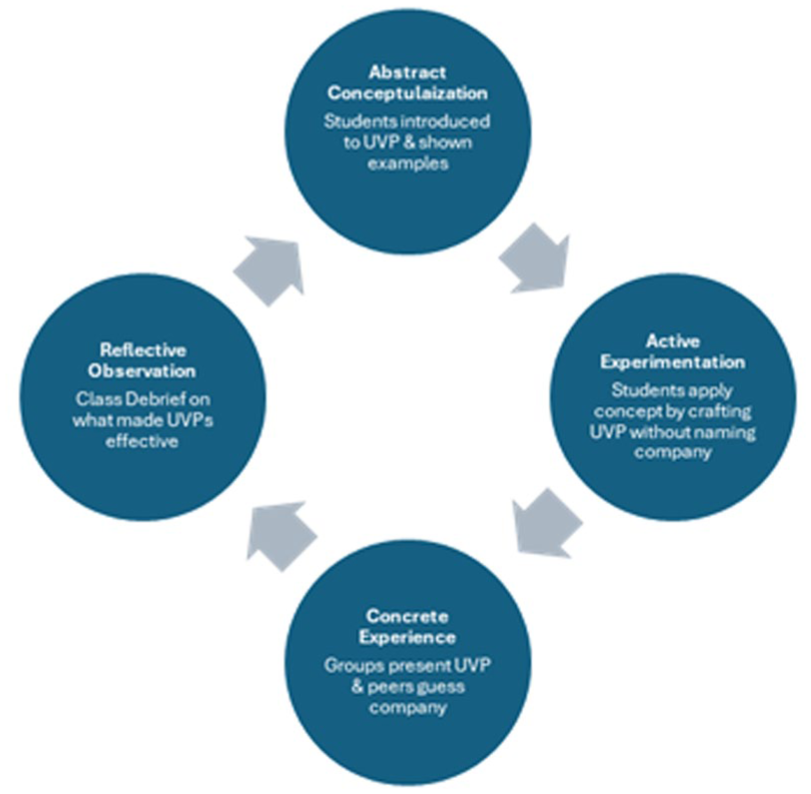
Kolb’s Experiential Learning Cycle.
The exercise begins with abstract conceptualization as students are introduced to UVP statements and provided with an explanation of specific relevance to entrepreneurs. Entrepreneurs must demonstrate the value of novel and unknown businesses—why will people buy from them instead of other available options? Then, students actively experiment by creating their own UVP in a fun, game-based environment. Students engage in concrete experience by presenting their UVP to their peers and receiving instant feedback based on the guesses. Then, through reflective observation and guided discussion, students are invited to consider why certain UVPs were easier to guess than others, and whether that differentiator brings value to the customers. Finally, students are invited to complete a survey to reflect on the value of the exercise (see Appendix A). Students then continue through the cycle, considering the importance of a UVP for a venture and then actively experimenting by creating a UVP for their own business ideas.
WUVPA is also constructivist in its design. Students bring prior knowledge of products, markets, and customer behavior into the exercise and must construct a UVP that communicates value from the customer’s point of view without mentioning the company. As they iteratively improve their language and framing, they develop a more nuanced understanding of what makes a UVP effective. This aligns with the growing emphasis in entrepreneurship education on active knowledge construction rather than the transmission of static frameworks (Löbler et al., 2021; Sioukas, 2023).
In addition, WUVPA functions as a form of situated learning (Lave & Wenger, 1991). Students are engaged in a task that mirrors the communication challenges entrepreneurs face. Crafting a UVP for an unknown company and being able to clearly articulate differences from competitors are not simply academic exercises; they are core entrepreneurial activities. The peer-guessing element introduces audience accountability, requiring students to think not only about what they want to say, but how it will be interpreted by others. This exercise mirrors the real-world demand for clear, compelling, and audience-relevant communication in entrepreneurial contexts (Anderson et al., 1996; Jones et al., 2021).
WUVPA can include many key elements of game-based learning: competition, rules, time constraints, and immediate feedback (Daniel et al., 2024). These design features support intrinsic motivation and deepen cognitive engagement (Patricio et al., 2022), without requiring complex technology or extended setup. Importantly, the “game” component reinforces rather than distracts from the learning objectives, making it an efficient tool for large, diverse classrooms.
Learning Objectives
After completing WUVPA, students will be able to:
Understand and apply the UVP concept, including: Define the components of an effective UVP and explain its role in entrepreneurial strategy. Distinguish between a product’s features and the value it delivers to customers. Practice clearly articulating value for unfamiliar or novel businesses.
Analyze and compare competitive positioning, including: Identify differentiators that distinguish a product or service from its com-petitors. Evaluate how effectively a UVP communicates customer-centric value and competitive advantage.
Instructions for Running the Exercise
Overview
WUVPA is a short, interactive activity where students practice creating an effective UVP through teamwork, audience-centered communication, and game-based learning. Students are placed into small groups and secretly assigned a real-world business. Each team then writes a UVP statement for their assigned business,
Exercise Logistics.
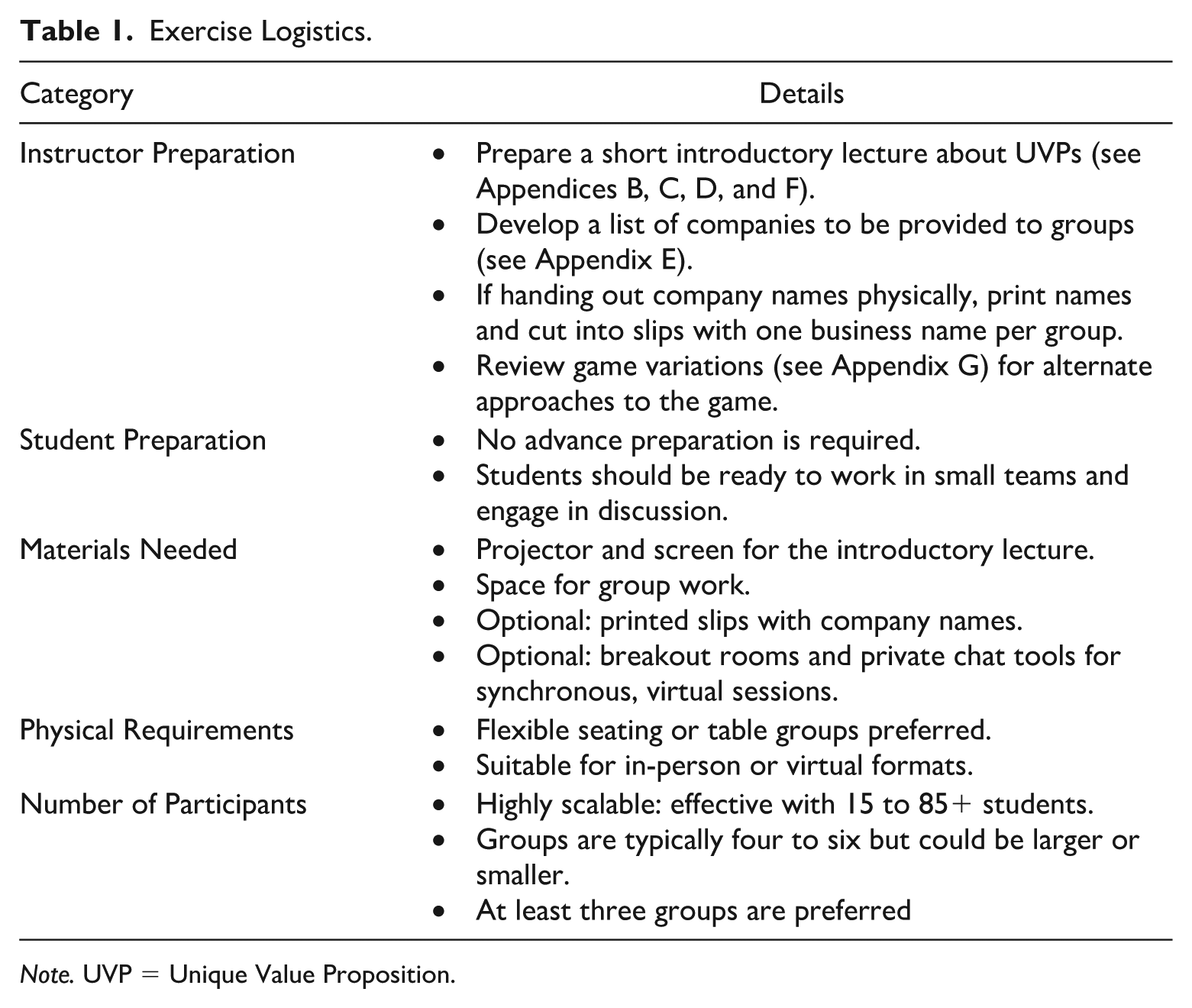
Note. UVP = Unique Value Proposition.
Suggested Timing for Activity and Debrief.
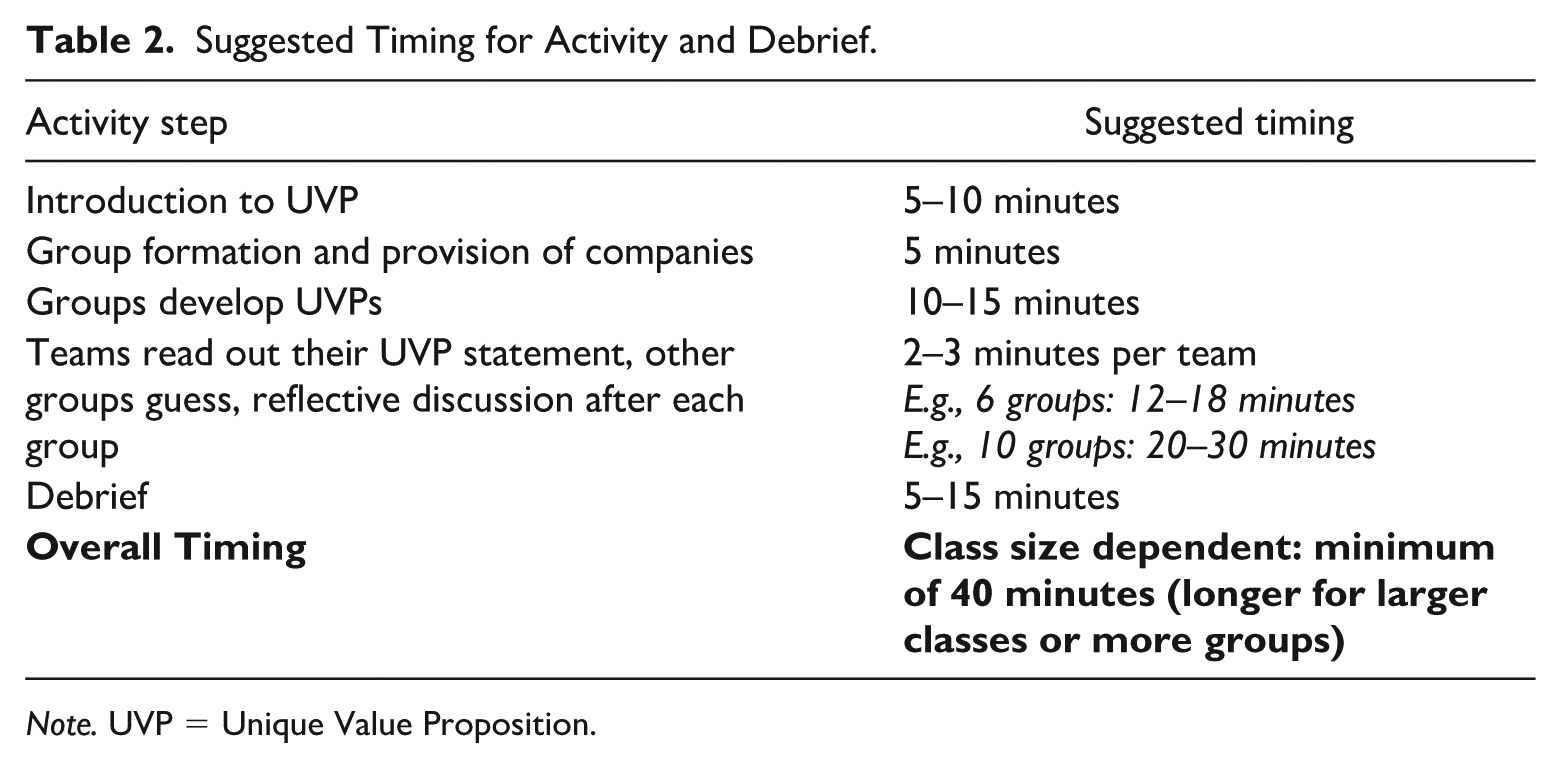
Note. UVP = Unique Value Proposition.
Step-by-Step Instructions
Instructor prepares a brief, introductory lecture on UVPs and their role in entrepreneurial strategy (see Appendix B for sample information).
In-class, students are given a template for creating UVPs and provided with a completed example (see Appendices C and D).
Students are placed into groups (four to six students are typical) and assigned a real-world business (see Appendix E) for which they will craft a UVP statement,
Groups are given 10 to 15 minutes to craft their UVP, without the use of external sources (internet or artificial intelligence [AI], etc.), and then each group will read their UVP to the class (see Appendix F).
The other groups will attempt to guess the business name based on how clear the UVP is and how well the groups differentiate their business’ offerings.
After each group reads their statement, students can either raise their hands or just shout out their guess. We usually encourage the presenting team NOT to indicate the correct answer right away, to give time for multiple students to guess before revealing the answer. Note that some businesses are harder to differentiate than others (e.g., BMW among German car manufacturers), and students may need more support.
After the business name has been guessed correctly, instructors lead a mini reflective discussion on why it was easy/hard to guess. For example, if the secret company was Coca-Cola: (a) If they guessed it correctly, point out aspects that made the statement particularly clear. If it was easy to guess because, for example, students focused on features (e.g., the red can), instead of something that brings value to the customer, how does this relate to entrepreneurship? It is critical for a new venture to add value for the customer, and is the red can something the customer truly wants? Or did we simply focus on a marketing ploy that differentiates the product? (b) When a company is hard to guess, we can ask why this was. Why don’t we know about Coca-Cola’s differentiation? Perhaps we are not the target customer? What does Coca-Cola think differentiates them? Does it matter? Is this more or less important for a new venture?
After all the groups have presented and all companies have been correctly identified, the class works through a more in-depth debrief (more details below).
Appendix G contains variations that can be made on the activity.
Students then apply this learning to develop a UVP for their idea.
Instructions for Debriefing
Once all groups have presented, we debrief the exercise. In the debrief, the instructor can reinforce the need for clarity, differentiation, and customer value while sparking discussion and reflection on how UVPs can communicate key information in a concise, compelling way. Below are a few common topics that are valuable to review:
Which company was the easiest to guess? Why? Was it a particularly obvious company to the generation of students? Does this demonstrate the value to the intended customer?
How many statements focused on particularly obvious features of the product, perhaps to the exclusion of the actual value?
Which company was hardest to guess? Why? Are the students less likely to be customers for that company?
When you think about your favorite brands, what stands out about their UVP? How does the company communicate its UVP?
What does this teach you about describing UVP for unknown or novel ideas?
Conclusion
WUVPA demonstrates how a theoretically informed, yet practically simple activity can meaningfully support student engagement with key entrepreneurial concepts. The positive student feedback indicates that learners perceived the activity as helpful for engaging with abstract concepts like opportunity recognition, value creation, and competitive positioning (Appendix A). By guiding students through the stages of Kolb’s (1984) experiential learning cycle and incorporating elements of game-based, audience-centered communication, and peer accountability, the activity supports both understanding and application of entrepreneurial concepts. It also addresses a common gap in entrepreneurship education by helping students transfer theoretical frameworks into actionable skills, building their confidence in a low-stakes environment. Its low cost, minimal setup, and flexibility across delivery formats make it a valuable tool for instructors. With small modifications, like peer voting or AI-supported iterations, the activity can be tailored to a wide range of course objectives while retaining its core pedagogical value.
Footnotes
Appendix A
Appendix B
Appendix C
Appendix D
Appendix E
Appendix F
Appendix G
Declaration of Conflicting Interests
The authors declared no potential conflicts of interest with respect to the research, authorship, and/or publication of this article.
Funding
The authors received no financial support for the research, authorship, and/or publication of this article.
