



Abstract
Engaging students in meaningful participation can be challenging, especially when they juggle work, family, and other responsibilities alongside their coursework. Carry the Class is an exercise designed to make participation more equitable, structured, and engaging by giving students ownership of class discussions. Rooted in social exchange theory and the psychological contract framework, this approach fosters accountability, reduces anxiety, and strengthens classroom dynamics by aligning participation expectations with students’ real-world constraints. Over a decade of implementation, it has shown its power to increase engagement, boost confidence, and develop essential leadership and communication skills. This paper provides a complete, ready-to-use framework for implementing Carry the Class in both face-to-face and online courses, making it easy to transform student participation into a tool for deeper learning, stronger connections, and a more inclusive academic experience.
Student engagement is central to effective learning and is often linked to higher academic achievement, increased retention rates, and improved personal development (Wong et al., 2024). Despite the implementation of diverse teaching strategies, many students remain disengaged, particularly those balancing academic, work, and family responsibilities (Benner & Curl, 2018). This disengagement can lead to suboptimal learning outcomes and decreased satisfaction with the educational experience (Cheng & McCarthy, 2013).
Whether and how students decide to contribute to classroom discussions, particularly when doing so occupies a portion of their grade, has seen mixed results. While some question the inclusion of participation in grading policies (Bean & Peterson, 1998), thoughtfully designed assessments can significantly encourage active learning (Dunn, 2023) and enhance intellectual growth and comprehension (Gioia, 1987). One way to achieve the benefits of assessment design is through recognizing and adapting to the complex academic, professional, and personal demands students often navigate.
After over a decade exploring interpersonal leadership and empirically testing social exchange theory (Blau, 1964), it seemed obvious the principles of these theories could easily transfer to the classroom. Accordingly, I designed a simple, yet effective, way to address the issue of student disengagement, by simply considering the diverse needs and responsibilities of students. Through this, Carry the Class was born.
Theoretical Foundations
Carry the Class rests on two interrelated frameworks known to be activated when valuable resources are exchanged between two parties: (a) social exchange theory (Blau, 1964) and (b) the psychological contract framework (Rousseau, 1989). Social exchange theory, as articulated by Blau (1964), emphasizes the role of reciprocal exchanges in building and sustaining relationships. He suggests relationships form from unspecified obligations or “favors creating future obligations” (p. 50). Within educational settings, meaningful student contributions, followed by instructor feedback, constitute reciprocal exchanges, reinforcing engagement value. Students managing part-time jobs, for example, might feel more invested when their contributions are acknowledged through meaningful feedback.
The psychological contract framework (Rousseau, 1989) complements this, by focusing on the implicit agreements between instructors and students. Psychological contracts are individual beliefs, shaped by the organization, regarding the terms of an exchange agreement between individuals and their organization (Rousseau, 1995). For example, students may expect instructors to be prepared, while instructors assume students are motivated to learn. In the context of Carry the Class, however, the terms of the psychological contract are made explicit. Students understand their responsibilities and what they can expect in return for their contributions. Clear expectations reduce role uncertainty—a key barrier to engagement—and foster trust and accountability in the classroom (Parzefall & Hakanen, 2010). When both parties meet their obligations, students feel less stressed, more productive, and more secure in their relationship with the instructor.
To understand how social exchange and psychological contract theories enhance student engagement, it is critical to note what might happen when expectations between students and instructors are not met. In other words, what are the consequences associated with a breach of the psychological contract? Psychological contract breach represents “cognitions that one’s organization has failed to meet one or more obligations within a psychological contract” (Morrison & Robinson, 1997, p. 230). In the context of Carry the Class, when students or instructors do not honor the explicit expectations established within their exchange relationship, a psychological contract breach will occur. This might happen when students are unprepared, or when instructors do not adhere to the promises made through Carry the Class. Breach of the psychological contract has a detrimental effect on trust (Deery et al., 2006; Grimmer & Oddy, 2007; Robinson, 1996). Accordingly, when a breach occurs, instructors must reestablish the terms of the psychological contract or, if unsuccessful, revert to more traditional and less desirable methods of assessing student engagement.
Carry the Class builds on the evidence-based principles of active learning, which significantly improve understanding and retention through analysis, synthesis, and evaluation of course content (Freeman et al., 2014). It strengthens these outcomes by explicitly accommodating the real-life responsibilities students bring into the classroom.
Learning Objectives
After completing the exercise, students will be better able to
lead and facilitate class discussions, with accountability and engagement.
apply social exchange and psychological contract theories to classroom participation.
evaluate structured participation strategies for engagement and learning outcomes.
Exercise Overview
Carry the Class is suitable for business courses requiring active participation at any level, especially those emphasizing critical reasoning, like organizational behavior, management, and leadership. It adapts readily to face-to-face, synchronous online, and asynchronous online formats with minor adjustments. This method aligns academic expectations with student desires for fairness, recognition, and participation (Sambell et al., 1997). Assigning students to lead discussions fosters ownership and accountability, while reducing the anxiety often triggered by cold calling in active learning settings (Felder & Brent, 2008; Rocca, 2010; Weimer, 2009).
Furthermore, Carry the Class includes a detailed rubric that sets clear expectations for participation, which has been shown to promote student engagement (Arter & McTighe, 2001; Stevens & Levi, 2005). By offering predictability and control, the structure supports deeper learning (Prince, 2004) and, when paired with the flexibility built into Carry the Class, fosters stronger relationships between students and instructors.
Running the Exercise
Implementing Carry the Class involves clear, structured steps that promote active engagement and reciprocal learning. Figure 1 offers a step-by-step checklist to help instructors efficiently adopt and adapt the exercise to their course context.
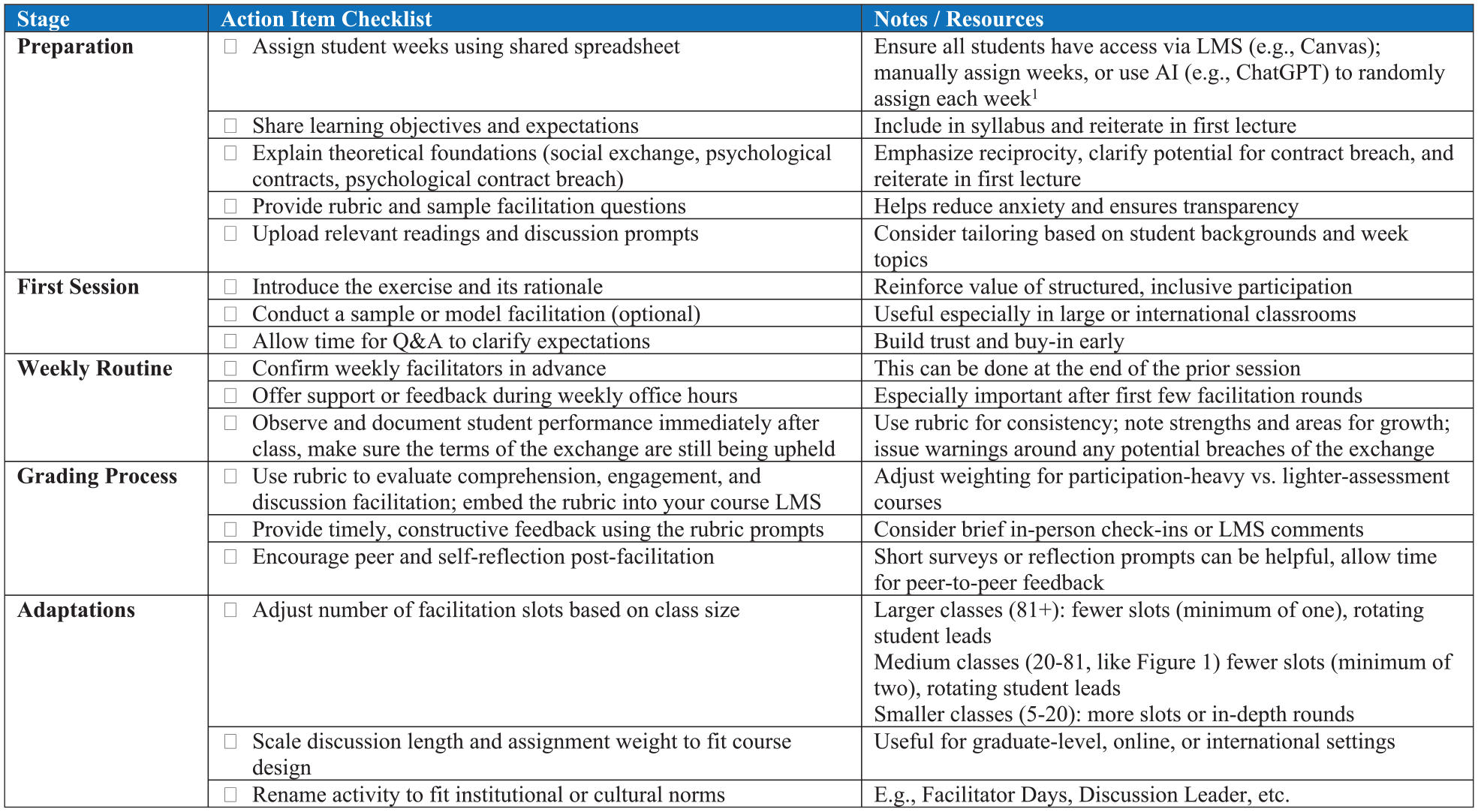
Implementation Checklist for Carry the Class.
Preparation and First Session
At the start of the term, provide students with both physical and electronic copies of the Carry the Class spreadsheet, clearly marking the specific weeks when each student will lead class discussions (see Figure 2). Ensure all students can access the spreadsheet through your learning management system (LMS). You may assign discussion weeks manually or use AI tools (e.g., ChatGPT) to randomly generate assignments. Alongside the Carry the Class spreadsheet, be sure to share the associating evaluation criteria (see Figure 3). Include this information prominently in your syllabus and throughout your LMS.
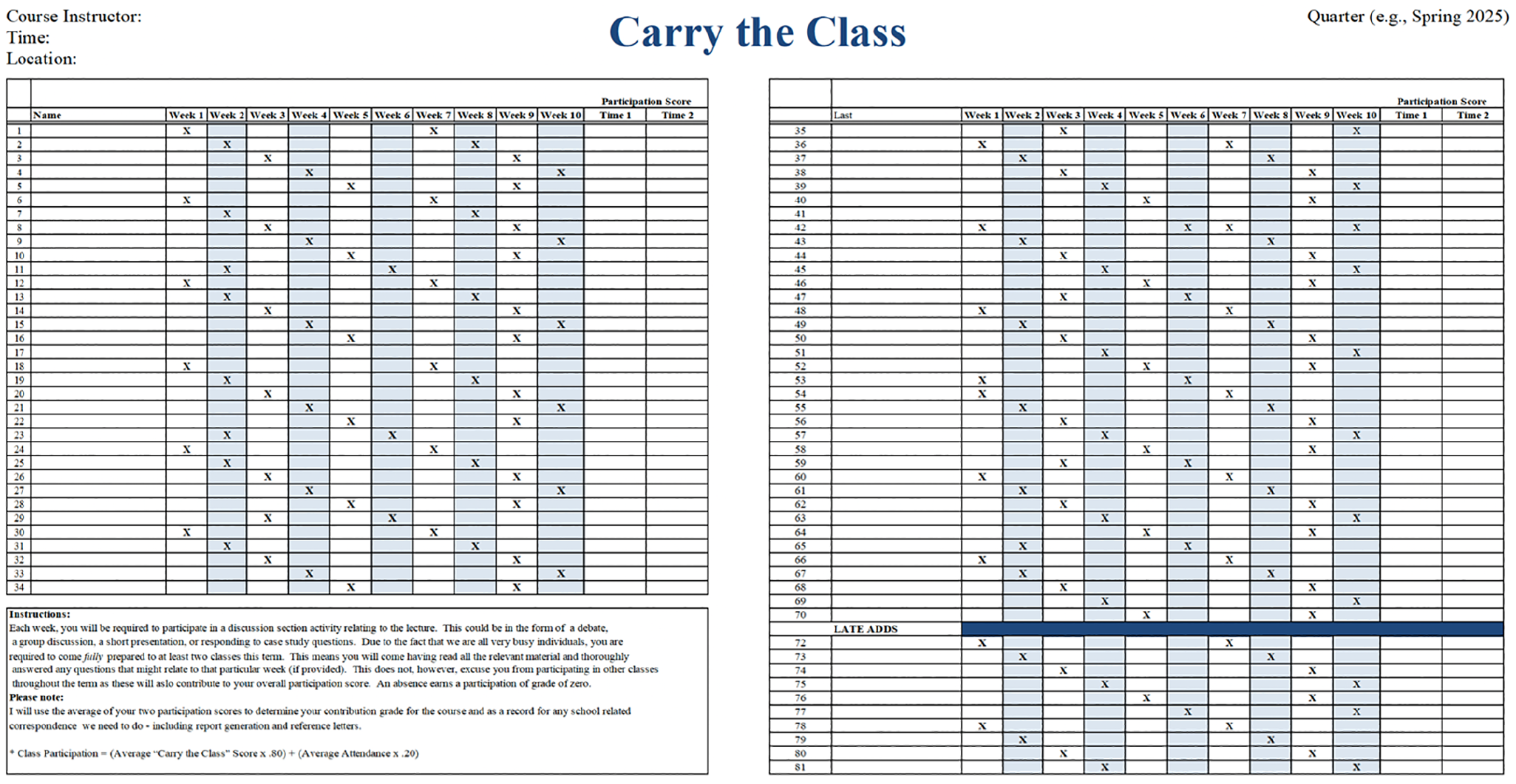
Example Carry the Class Spreadsheet.
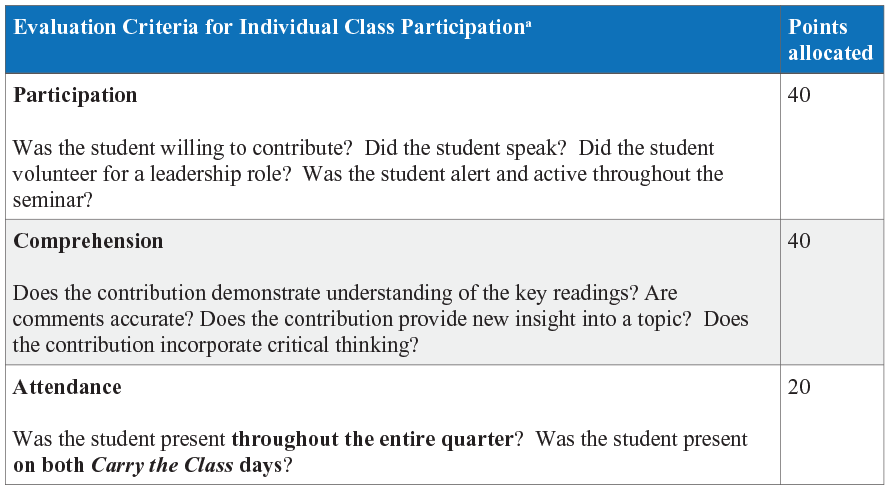
Carry the Class Rubric.
As you prepare students for their facilitation roles, provide access to essential resources, including assigned readings, structured discussion prompts, strategies for reviewing course materials, and examples of effective facilitation. Your guidance should encourage students to analyze assigned materials, identify central themes, and formulate discussion questions aimed at promoting critical thinking and meaningful peer engagement. While you should tailor the timing of student-led discussions to suit your class schedule, it is recommended that you allocate approximately 20–30 minutes to Carry the Class within an 80-minute session. Student-led facilitation typically follows your initial introduction of the week’s topic, either in-person or asynchronously for online formats, ensuring students are adequately prepared to lead effective discussions.
When taught synchronously online, Carry the Class follows the same structure as in-person implementation. Facilitation weeks are assigned at the start of the term and communicated in advance through the course LMS. For asynchronous courses, instructors might consider adapting the exercise by having students record short video blogs (Vlogs) that initiate discussion threads on the LMS, enabling peers to respond with written reflections and questions.
In the first lecture, explicitly discuss the theoretical foundations of Carry the Class, emphasizing its quid pro quo nature, grounded in social exchange theory and psychological contracts. Clarify the implications of breaching this psychological contract, to make organizational theory immediately relevant and applicable. In my courses, students frequently applaud after I describe Carry the Class—particularly once they recognize the reciprocal nature of the exchange.
Weekly Routine
Each week, confirm upcoming student facilitators in advance. Offer support during office hours, especially for students facilitating in the early weeks. After each session, observe and document student performance using the rubric (Figure 3) to maintain consistency and track engagement.
Regularly collect feedback from students about their experiences with this method and determine whether the approach is having the intended effect. This step is critical to maintaining the reciprocal nature of the exercise, and you should strive to create a classroom environment where students feel safe voicing concerns—especially if they perceive that you, as the instructor, are not upholding your end of the exchange. Typically, a soft warning in either direction reaffirms the inherent obligations of both parties. For example, in the event students are not coming to class prepared, caution a return to more traditional approaches to assessing engagement (i.e., cold calling, required preparation every week, etc.).
Grading Process
The evaluation phase mimics the guidance provided to students for preparation. Accordingly, determine engagement scores based on how well students comprehend the material, pose insightful questions, and facilitate discussion among peers. Use the evaluation rubric to promote transparency and ensure alignment with your course objectives. This practice supports research showing that structured, peer-led activities significantly enhance students’ understanding and retention of content (Crouch & Mazur, 2001).
In the final stages of evaluation, it is critical to provide mentorship, resources, and ongoing feedback. After students have performed their initial round of Carry the Class, offer one-on-one consultations during office hours, real-time feedback during class sessions, and constructive critiques after the discussions. Following their designated week, encourage students to review the feedback provided within the rubric. Embed the rubric directly into your course LMS, so students can clearly understand how they were assessed and identify specific ways to improve for future facilitation rounds. Consider assigning other students to evaluate and provide feedback regarding the performance of those facilitating. This reflection will assist students in evaluating their performance, spotting improvements, and setting future goals.
Please see Appendix A for the exact instructions provided to students enrolled in an upper division undergraduate course in organizational behavior.
Evidence of Effectiveness
Demonstrated through over a decade of use, Carry the Class increases student engagement, preparedness, and connection with instructors. By ensuring at least 20% of students are ready to lead each session, it eliminates awkward silences and creates a dynamic learning environment. This structure also seems to support a more inclusive classroom climate, which is known to encourage broader participation (Brookfield & Preskill, 1999).
Appendix B unveils student feedback over several iterations of Carry the Class and a number of positive themes. Notably, students report feeling valued, supported and recognized. They often credit the structured format of Carry the Class with helping them organize their thoughts and engage more critically with course material. Quieter students, in particular, report increased confidence and reduced anxiety, due to the opportunity to prepare in advance. While some note the format can feel repetitive or intimidating at first, these same students often acknowledge meaningful growth. Even so, instructors should be prepared to facilitate discussions in ways that minimize repetition, by actively building on student responses and guiding the conversation toward deeper, more critical analysis and debate.
Variations and Adaptations
Ultimately, the strength of Carry the Class lies in its adaptability. Instructors are encouraged to tailor its design to suit varying institutional, cultural, or curricular demands. In my graduate-level courses, for instance, the exercise is elevated by requiring students to draw, more intensely, from academic research. In international settings, where participation norms may differ, instructors may wish to emphasize anonymous or written components before verbal facilitation.
In addition, the number of assigned facilitation sessions can be adapted based on class size (i.e., allocating more time for in-depth discussion in smaller seminars, or streamlining contributions in large lectures). Instructors can also scale the weight of the assignment in the overall grade, to either encourage low-stakes experimentation or signify its importance within a participation-heavy curriculum. Finally, instructors may wish to rename the activity to better reflect their course focus or institutional culture. For example, a colleague at my university calls it Facilitator Days. These adaptations preserve the core principles of reciprocity, while enhancing accessibility and effectiveness across diverse teaching contexts.
Conclusion
Carry the Class offers a simple, structured approach to student engagement, grounded in social exchange theory and psychological contracts. Over more than a decade of use, it has consistently improved participation, strengthened instructor-student relationships, and created more inclusive classrooms. By adapting this strategy to their own contexts, educators can foster dynamic, engaging learning experiences for all students.
Supplemental Material
sj-docx-1-mtr-10.1177_23792981251349785 – Supplemental material for Carry the Class: A Strategic Approach to Designing Engagement Around Student Needs
Supplemental material, sj-docx-1-mtr-10.1177_23792981251349785 for Carry the Class: A Strategic Approach to Designing Engagement Around Student Needs by Kyle E. Ingram in Management Teaching Review
Supplemental Material
sj-docx-2-mtr-10.1177_23792981251349785 – Supplemental material for Carry the Class: A Strategic Approach to Designing Engagement Around Student Needs
Supplemental material, sj-docx-2-mtr-10.1177_23792981251349785 for Carry the Class: A Strategic Approach to Designing Engagement Around Student Needs by Kyle E. Ingram in Management Teaching Review
Footnotes
Appendix A
Appendix B
Evidence of Effectiveness for Carry the Class in Upper Division Organizational Behavior Course.
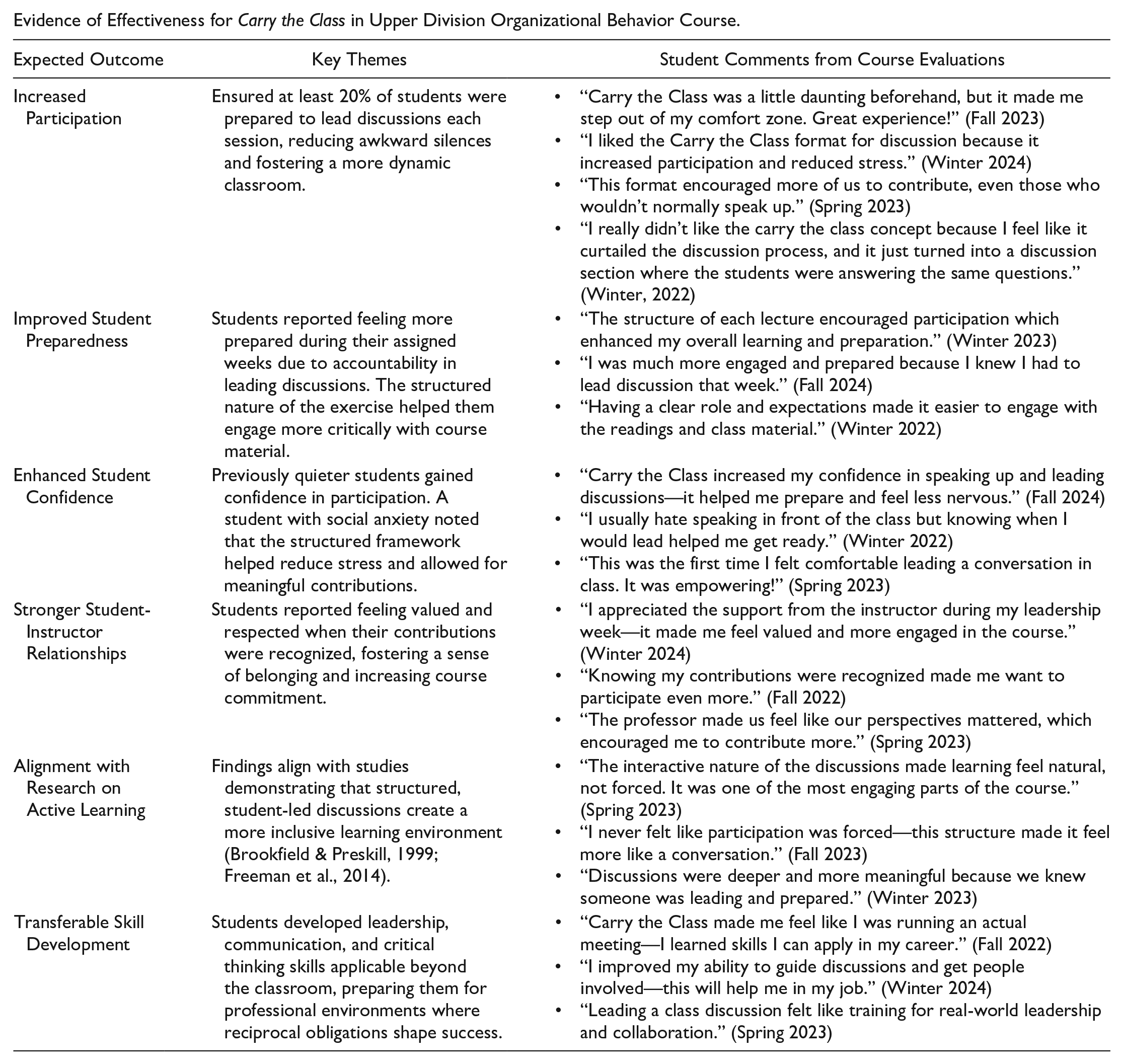
| Expected Outcome | Key Themes | Student Comments from Course Evaluations |
|---|---|---|
| Increased Participation | Ensured at least 20% of students were prepared to lead discussions each session, reducing awkward silences and fostering a more dynamic classroom. | • “Carry the Class was a little daunting beforehand, but it made me step out of my comfort zone. Great experience!” (Fall 2023) • “I liked the Carry the Class format for discussion because it increased participation and reduced stress.” (Winter 2024) • “This format encouraged more of us to contribute, even those who wouldn’t normally speak up.” (Spring 2023) • “I really didn’t like the carry the class concept because I feel like it curtailed the discussion process, and it just turned into a discussion section where the students were answering the same questions.” (Winter, 2022) |
| Improved Student Preparedness | Students reported feeling more prepared during their assigned weeks due to accountability in leading discussions. The structured nature of the exercise helped them engage more critically with course material. | • “The structure of each lecture encouraged participation which enhanced my overall learning and preparation.” (Winter 2023) • “I was much more engaged and prepared because I knew I had to lead discussion that week.” (Fall 2024) • “Having a clear role and expectations made it easier to engage with the readings and class material.” (Winter 2022) |
| Enhanced Student Confidence | Previously quieter students gained confidence in participation. A student with social anxiety noted that the structured framework helped reduce stress and allowed for meaningful contributions. | • “Carry the Class increased my confidence in speaking up and leading discussions—it helped me prepare and feel less nervous.” (Fall 2024) • “I usually hate speaking in front of the class but knowing when I would lead helped me get ready.” (Winter 2022) • “This was the first time I felt comfortable leading a conversation in class. It was empowering!” (Spring 2023) |
| Stronger Student-Instructor Relationships | Students reported feeling valued and respected when their contributions were recognized, fostering a sense of belonging and increasing course commitment. | • “I appreciated the support from the instructor during my leadership week—it made me feel valued and more engaged in the course.” (Winter 2024) • “Knowing my contributions were recognized made me want to participate even more.” (Fall 2022) • “The professor made us feel like our perspectives mattered, which encouraged me to contribute more.” (Spring 2023) |
| Alignment with Research on Active Learning | Findings align with studies demonstrating that structured, student-led discussions create a more inclusive learning environment (Brookfield & Preskill, 1999; Freeman et al., 2014). | • “The interactive nature of the discussions made learning feel natural, not forced. It was one of the most engaging parts of the course.” (Spring 2023) • “I never felt like participation was forced—this structure made it feel more like a conversation.” (Fall 2023) • “Discussions were deeper and more meaningful because we knew someone was leading and prepared.” (Winter 2023) |
| Transferable Skill Development | Students developed leadership, communication, and critical thinking skills applicable beyond the classroom, preparing them for professional environments where reciprocal obligations shape success. | • “Carry the Class made me feel like I was running an actual meeting—I learned skills I can apply in my career.” (Fall 2022) • “I improved my ability to guide discussions and get people involved—this will help me in my job.” (Winter 2024) • “Leading a class discussion felt like training for real-world leadership and collaboration.” (Spring 2023) |
Declaration of Conflicting Interests
The author declared no potential conflicts of interest with respect to the research, authorship, and/or publication of this article.
Funding
The author received no financial support for the research, authorship, and/or publication of this article.

References
Supplementary Material
Please find the following supplemental material available below.
For Open Access articles published under a Creative Commons License, all supplemental material carries the same license as the article it is associated with.
For non-Open Access articles published, all supplemental material carries a non-exclusive license, and permission requests for re-use of supplemental material or any part of supplemental material shall be sent directly to the copyright owner as specified in the copyright notice associated with the article.
