




Abstract
This article presents a LEGO®1-based experiential exercise where students learn about Tuckman team development and Belbin team role theories. The design allows real-time application of the theories through intense, time-constrained construction activity. Students act in teams of workers or watchers. Workers build the model without the instructions that come with the set. This and a few surprises designed into the task create pressure on the team. Or, students act as watchers, systematically observing the worker teams, using the theories to categorize or predict worker behavior. Directly experiencing the theories helps develop a critique of their utility in helping managers predict and influence team behavior. This activity is intended for synchronous classrooms, ideally with class sizes between 6 and 30. As presented here, the activity requires 2 hours, but can be modified to an hour for a smaller class. Scalability of the task depends on availability of LEGO sets, teaching assistants, and time.
This LEGO construction game enhances the teaching of team development theories, specifically Tuckman team development phases and Belbin team roles, immersing students in a situation where they experience and observe the content of these theories in real time. It was developed for organizational behavior classes, with undergraduates, older “post-experience” learners with work experience, and students who do not have English as a first language. It can also be used wherever teamworking and performance are considered, in project management, employability, or professional development classes.
A problem in teaching teamwork theories is that undergraduates often have minimal experience of working in teams or managing them (Bolinger & Burch, 2018) and therefore “little or no context for appreciating the value of the material” (Schmidt-Wilk, 2018). It can be difficult to maintain their interest in organizational behavior learning because of lack of context or imperative (Burke & Moore, 2003; Freeman, 2003). Post-experience learners tend to have work experience of teams, but the idea of theorizing it can seem strange. Both groups are rarely able to critically evaluate their experiences in teams until they grasp the application of theories of team role and life cycle. This activity addresses these problems. This learning matters, because in the workplace these theories are used to make decisions that affect workers’ lives and the performance of teams. The intended learning outcomes are:
Explain events and interactions in teamwork using team development and role performance theories
Discuss the difference between effective and ineffective teams
Critically evaluate teamworking and associated theories as management tools
Underpinning Literature
Belbin Team Role Theory grew from observations that teams of high performing individuals could be ineffective (Belbin, 1981). Individuals naturally take on specific roles in a team. If natural preference could be known in advance, teams could be designed to allow people to perform and interact to their strengths, which they would be aware of, in turn improving team effectiveness. Their role can be a source of strength for the team but can also come with “allowable weaknesses.” For example, a creative “free thinker” may miss details. Individuals discover their role preference through a self-perception inventory. This means that the output is also subject to individual’s self-awareness, or self-image. Belbin Team Role theory has been debated thoroughly (e.g., Furnham et al., 1993) and used globally in FT-100 companies, in 16 languages (Aritzeta et al., 2007) and features in academic research into teams (e.g., Blenkinsop & Maddison, 2007; Rahmani et al., 2022) and classroom teaching (Batenburg et al., 2013; Watkins & Gibson-Sweet, 1997).
Tuckman’s (1965) team performance life cycle of “form, storm, norm, perform, adjourn” is “the most predominantly referred to and most widely recognized [theory] in organizational literature” (Bonebright, 2010). As a framework for discussing and exploring team performance, it is used in research (e.g., Fulk et al., 2011; Parry et al., 2023) and teaching team concepts, notably in conjunction with games (e.g., Cresswell-Yeager, 2021; Wyland et al., 2023). In the case of learning both theories, reading and imagining the situations where the manifestations of role or change would become apparent are inferior compared to experiencing and directly observing how roles interact or the precedents and consequents of action. However, reality is never as neat as theories. People can have dual roles, stages can blur, making them challenging to observe in action.
My game integrates the intrinsic sense of fun and play brought by LEGO (Freeman, 2003), a mild spirit of competition and combination of kinesthetic, visual, and auditory stimulation. Use of LEGO to create interpersonal, work-like experiences is well established in management education literature since the study by Reddy and Byrnes (1972). Design is informed by the latest studies on gamification of learning such as Lameras et al. (2016), ensuring that learning outcomes are communicated by the game attributes. Also recognized are the potential problems caused by competition (Lund Dean & Wright, 2017).
Logistics
Identical small LEGO sets must be purchased, around £5 apiece, such as Figure 1. They should be about 50 pieces, where construction could be inferred from the box picture, as the build instructions will be initially unavailable. I perform some sub-assembly beforehand to speed up construction, leading to perhaps 20 sub-assemblies in each set, but this is optional. The sub-assemblies are packed into two transparent bags within the box.
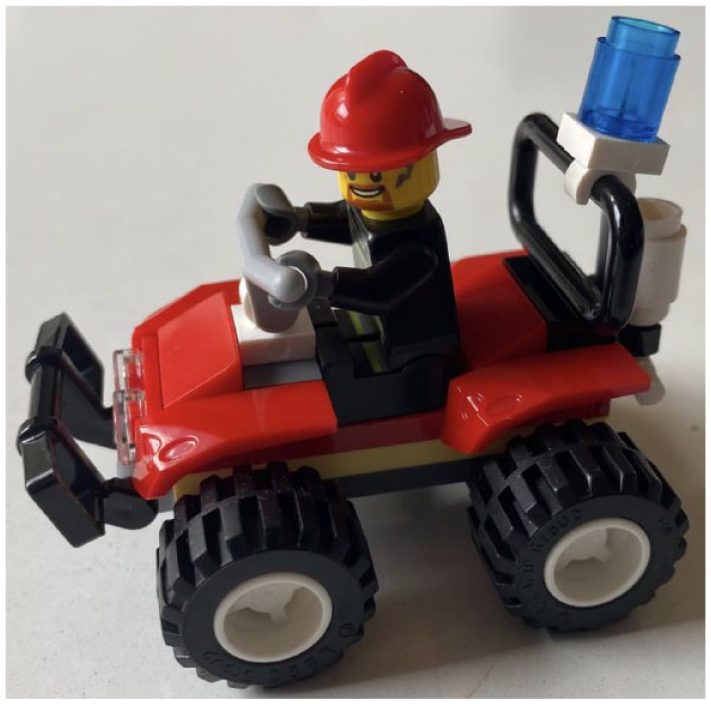
A Suitable LEGO® Model.
Each student must take a Belbin role inventory assessment before attending, keeping their outcome secret. There are many available online based on Belbin’s (1981) text. Students are divided into groups. I have found that groups of six to eight students work best as it dissuades social loafing. There can be as many student groups play as the teacher has identical LEGO sets. A flat room with as many tables as groups is needed. Groups are subdivided into teams of Workers and Watchers. Belbin himself says the ideal size for a team is four, therefore here, four workers and two to four watchers. The Workers and Watchers are briefly separated so that they cannot hear the briefing given to each other. They are given the activity instructions shown in Appendices A and B.
Game Operation
The flow of events in the game consists of giving out the written instructions, initial build time for reward, extended build time for declining reward, debrief activities, and reflective presentation of findings/experience. During build time, worker teams assemble the LEGO model, with only a picture of the finished model to guide them, under a time constraint and in competition with the other teams in the room. This is common in LEGO team games (e.g., Donovan & Fluegge-Woolf, 2015). The win condition is the model is completed, inspected by the teacher to confirm completion, then all parts are returned to their original bags. Worker instructions warn them to listen out for additional instruction. When worker teams are handed their instructions, the instruction to return the pieces to the original bags is given verbally only. This tests their listening ability, an important competence in teamwork. They are not told that a piece of their set has been removed and swapped for one from another team. If they finish within 20 minutes, the teacher will “pay” them £20,000. For every minute that they take past that time limit, the reward reduces by £1,000 to zero, at which point the game is ended. The sooner the team can finish, the more money they can win.
Watchers must be told to not interact with workers. Watchers sit opposite the workers and carry out a systematic observation of the worker team performance. Some watchers will focus on the time points where the team moves between the Tuckman phases. Others will focus on predicting the Belbin roles of the workers by directly observing their behavior. The instructions help them locate the right kinds of evidence. They are told the workers’ win conditions and given the two vital pieces of information that the worker teams do not have in writing—the instruction to return the pieces in the original bags and that one piece of each set has been removed and exchanged with another piece from another team’s set. They are advised to take special note of what time this is noticed and what happens.
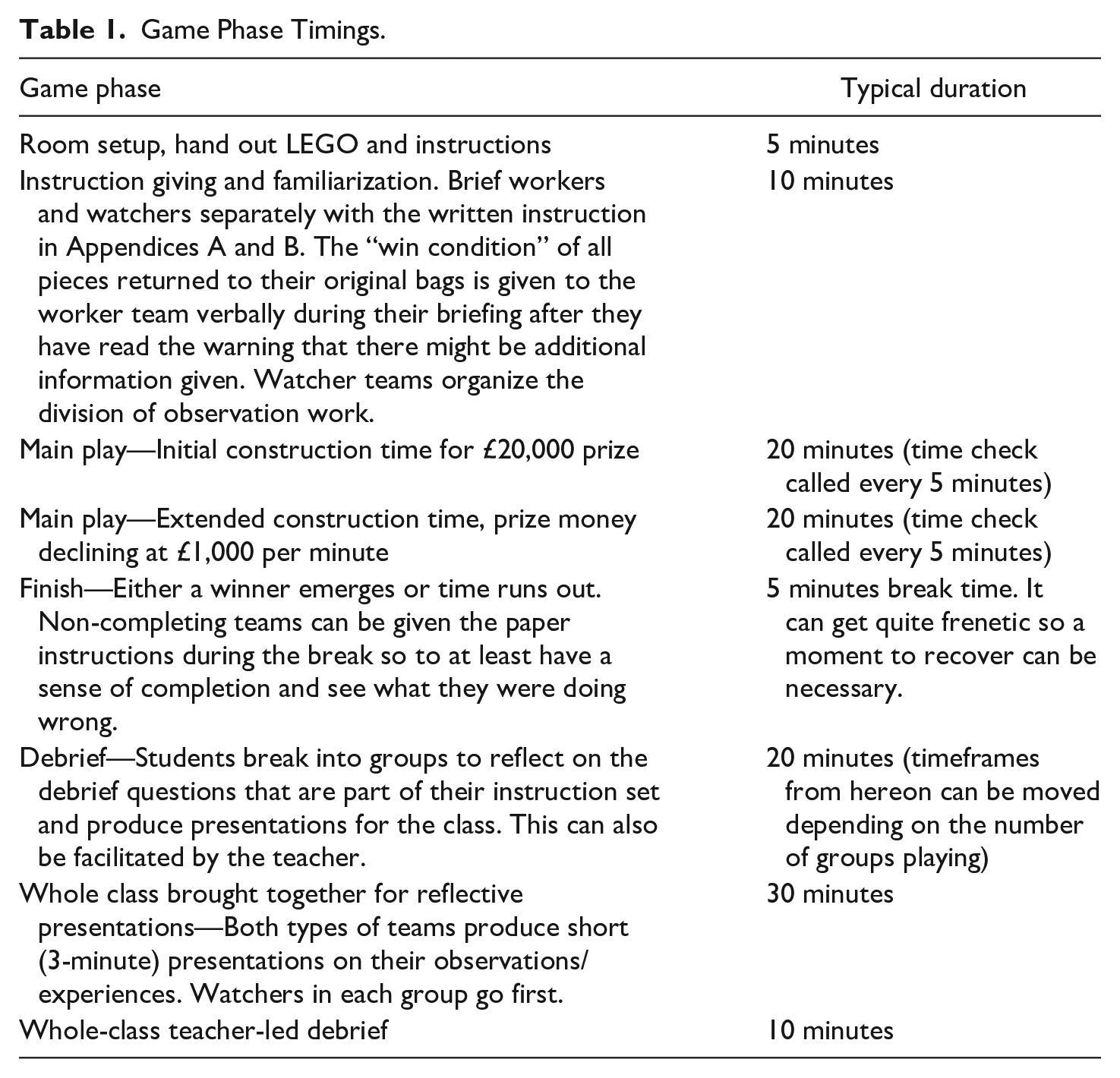
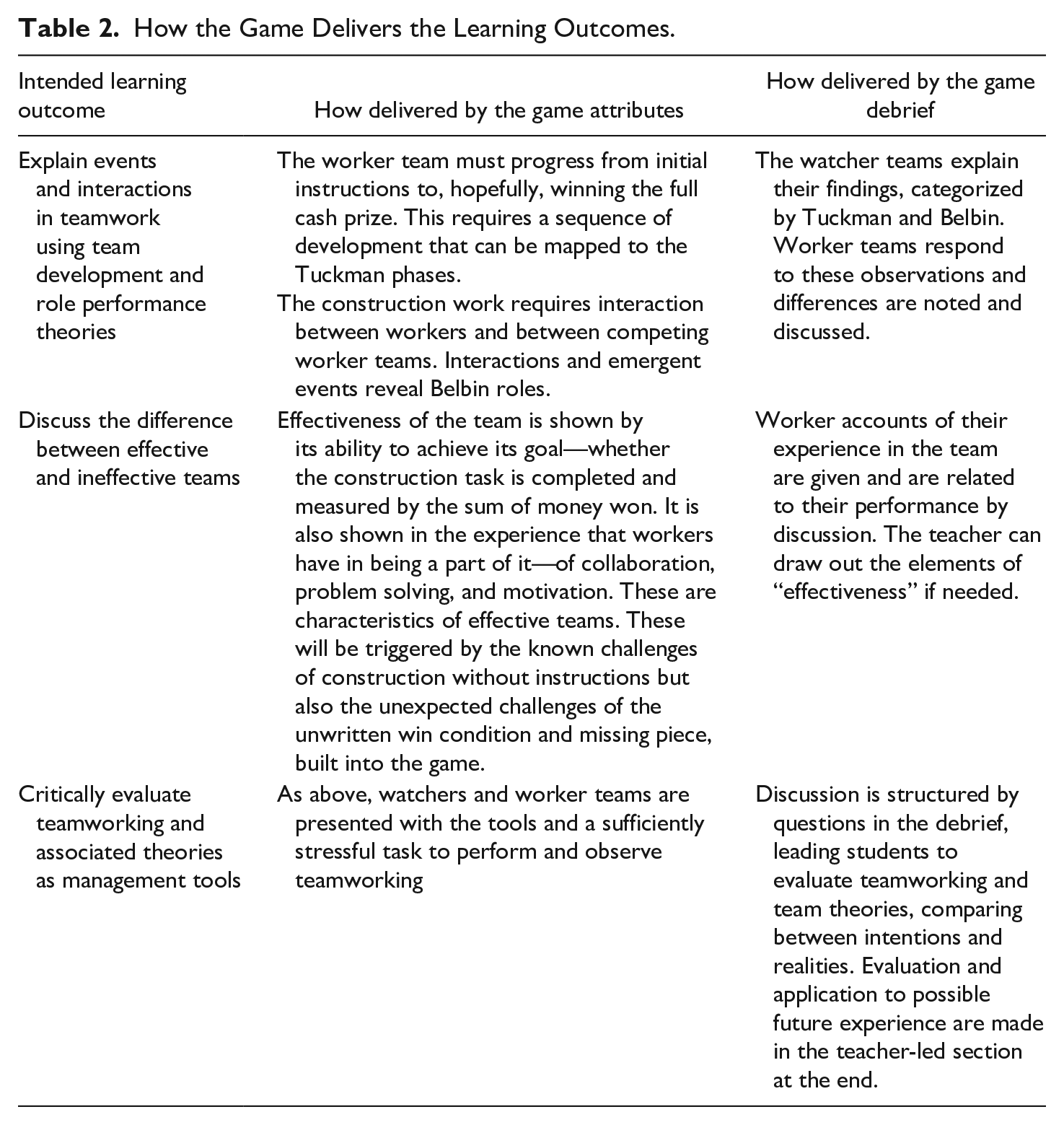
Game play progresses according to the instructions. Workers tend to discover the extra or missing parts after about 10 minutes and eventually, someone will conduct a search and negotiation for swapping. They are not told whether this is allowable. Leaders tend to emerge and then fall back if construction stalls. A few teams complete the task by the 20-minute mark and most complete the task before 40 minutes. In line with the observations of Erskine and Sablynski (2016), students under time pressure will often try to falsely claim that the model is complete. Most worker teams do not hear the oral instruction to return the pieces to the correct bags and are shocked when they are denied the winner’s reward just because they have completed the construction. By the end of the building phase, watcher teams usually have a complete set of observations of phase change timings and predictions of the apparent worker roles. Students then enter the debrief (Appendix C), where their reflections are guided by sets of questions specifically for workers or watchers. The “fun” conceals important and subtle learning experiences which the learner engages in almost subconsciously, hence the need for systematic reflection and debrief to complete the learning. The timings for the game phases are in Table 1, presuming a 2-hour session. Table 2 shows how the game attributes and the debrief activity deliver the learning outcomes.
Game Phase Timings.
How the Game Delivers the Learning Outcomes.
Some Typical Reactions
Assessments of the impact of serious games on teaching often confuse student liking for learning. In the following comments from students who have played this game, they have liked the game, but they are also reflecting on the nature of the learning, “It provided a unique learning experience, compared to classical lectures, more ‘serious’ in a way, but more ‘anxiogenic’ too.” Another student recognized gains in self-awareness, “It is axiomatic that those experiments aren’t quite the same as real life managing events, but they are useful in the teaching process and in understanding ourselves better.” Finally, a comment on Tuckman shows a kind of learning that would never have been possible through a lecture, which is the real strength of this activity, A lecture alone on Tuckman’s model could have led us to believe that team formation was much more linear and evident/systematic than what it actually is in reality. What I learned is that negative feedback and lack of agreement over instructions could keep the team in a sort of constant “storming” stage.
Burke and Moore (2003) emphasize the need for linking organizational behavior learning to student’s future lives. Therefore, the final question in the debrief activity discusses how the experience might parallel what students are expecting in the workplace or their existing teamwork experiences on their academic programs and to develop recommendations for effective teamworking in time-constrained conditions.
Limitations and Options
There are limitations and some human costs. Students rarely hear the instructions to put everything back in the right bag. They like to get their hands on the LEGO, not paying attention to what comes out of the bag. To help them, put simpler things to recall in one bag, like accessories, wheelsets, and the minifigure pieces. Some students are determined to make their extra piece fit even though the picture clearly shows that it does not belong. Students sometimes break apart the sub-assemblies of pieces that are supposed to make their work easier, they could be reminded of this (or not). The nature of competition between the teams can drive behaviors that are inconducive to learning (e.g., negative emotions triggered through frustration). This can take energy from the teacher in watching and dealing with questions and challenges. Schmidt-Wilk (2018) noted that experiential learning activities often take longer than anticipated. This can lead to crashing the debrief. In experiential education, the debrief is where the learning is, it must be protected.
The main limitation is that all students in the class cannot have the experience of both watching and working. After the first use of the game, they know what the game is and there are no surprises. This could just require new surprises to be developed. Variations can be made, depending on the time available. For example, drawing out the inter-team aspect of the missing/excess pieces, forcing personnel exchange between the teams, giving secret instructions to team members, construction of two models from one pile of parts simultaneously, or simply running the game again with workers and watchers changing position and seeing if the process is more efficient second time around, or in what ways it is different. Cutting the build phases to 10 minutes can reduce game time. If the class is smaller, setup time can be reduced. Removing the presentations can reduce debrief time, simply have the teams discuss their responses to the debrief questions with each other for 10 minutes then blend comparison with their watcher teams’ findings into the teacher-led part, for 20 minutes. Thus, the activity can be completed in an hour.
Conclusions
This game has been successfully deployed across a range of age and cultural groups to stimulate learning and critical evaluation of teamwork theories through real-time application. It was First Runner-Up in the “Non-Digital” category of the European Computer and Game Based Learning Conference 2023 Game Competition. The URL for the competition entry video is available in Appendix D, which will hopefully supplement this article for colleagues who wish to try this practice for themselves or compare it to their own work.
Footnotes
Appendix A
Appendix B
Appendix C
Appendix D
Declaration of Conflicting Interests
The author declared no potential conflicts of interest with respect to the research, authorship, and/or publication of this article.
Funding
The author received no financial support for the research, authorship, and/or publication of this article.
