




Abstract
Every year, professional basketball franchises convene for an entry draft to select the next generation of talent for their respective teams. This article describes an experiential exercise that places students in the role of team executives of a fictionalized professional basketball franchise. Students are tasked with evaluating a group of draft-eligible athletes and making the optimal selection for their team, considering a wide array of skills, abilities, and attributes. The Basketball Draft Night Exercise is informed by extensive research on sport entry drafts spanning several decades and sheds light on the systematic errors, fallacies, and decision-making biases that arise when making talent selections under uncertainty. Furthermore, this exercise illuminates the potential pitfalls and cognitive errors committed by experts when assessing and selecting talent under uncertainty.
Keywords
Developing proficiency in navigating the complexities of decision-making is a critical skill for emerging professionals and is an important aspect of business school education. This is especially true in circumstances of uncertainty, where decision-makers must make the right choice, often without enough information and with unpredictable results (Aldag, 2012; Simon, 1955). To address this challenge, the Basketball Draft Night Exercise was developed to offer students an immersive, engaging, and relatable experience. It encourages them to make decisions amid uncertainty firsthand, emphasizing that awareness of biases can mitigate their effects on organizations.
Based on recent calls to increase awareness of cognitive biases in management classrooms (e.g., Fiset & Byrne, 2021) and raise the overall competency of decision-makers at the professional level (e.g., Motomura et al., 2016), this experiential activity was developed to highlight systematic errors, fallacies, and decision-making biases that occur when selecting talent under uncertainty. Inspired by the National Basketball Association (NBA) entry draft, this activity fully engages students in the roles of front-office executives within a professional basketball franchise. It provides students with a realistic and engaging learning experience, enabling them to evaluate talent in a real-world environment characterized by limited information and amid conditions of uncertainty. With decision-making under uncertainty being a common element, this exercise holds significant relevance for personnel selection in organizations. Initially designed for use in an undergraduate human resource management course, the exercise is equally applicable to organizational behavior, sports management, and staffing and selection courses at both the undergraduate and graduate levels.
Since 1947, the NBA has annually conducted an entry draft to assign prospective athletes to professional basketball franchises (Soebbing & Mason, 2009). The purpose of the draft is to ensure competitive balance, granting low-performing teams the opportunity to select high-quality prospects. Drafts provide teams with the opportunity to negotiate with their selected players first, contribute substantial revenue to the league, and enhance fan engagement (Young, 2021). While drafts serve as an important means of assessing talent and ensuring competitive balance, the fact that team executives must make decisions under uncertainty does not always lead to optimal outcomes (Berger & Daumann, 2021a). Research indicates that decisions made in these environments are susceptible to systematic errors, fallacies, and decision-making biases (De Martino et al., 2006; Tversky & Kahneman, 1974). Consequently, given that draft-related decisions are related to team performance (e.g., Berger & Daumann, 2021a, 2021b), an entire industry has emerged aimed at identifying and selecting the best athletes and enhancing the quality of draft decision-making, albeit with limited success (e.g., sports analytics, Johnston et al., 2022; Lemire, 2020).
Professional sports serve as an ideal domain for this exercise given its high stakes, capacity to captivate students, and abundant opportunities for teaching decision-making and selection skills (e.g., Berger & Daumann, 2021a; Berri et al., 2011). Within this context, franchises meticulously evaluate athlete data—both qualitative and quantitative—to identify the most suitable prospects for their team based on their requirements and based on their pick in the draft. Nevertheless, human decision-makers are susceptible to cognitive biases and other errors, especially when operating in conditions of uncertainty (Johnston & Baker, 2020).
In the context of the NBA draft, several scholars cast doubt on the decision-making effectiveness of teams (e.g., Motomura, 2016) because of a mounting disparity in team competitiveness, a characteristic that entry drafts were intended to solve (Soebbing & Mason, 2009). Among the judgment and decision-making errors, and biases that have been explored in the context of the NBA draft, numerous studies have highlighted that decision-makers are biased by an athlete’s reputation out of high school (Berger & Daumann, 2021a), affiliation with a prestigious college (Burdekin & Van, 2019; Ichniowski & Preston, 2012), performance at the draft combine (an event where players undergo tests and evaluations before the draft, Berger & Daumann, 2021b; Teramoto et al., 2018), and being born outside the United States (e.g., Motomura, 2016), among others. As such, the overarching goal of this activity is to provide students with a hands-on learning opportunity to make talent decisions under uncertainty and support the below learning objectives.
Learning Objectives
At the end of this exercise, students should be able to:
Develop a persuasive rationale for decision-making in the context of talent selection.
Identify and describe various systematic errors, fallacies, and decision-making biases that are made under uncertainty.
Apply critical thinking skills to assess and mitigate potential biases in decision-making under uncertainty.
Evaluate methods for mitigating bias in decision-making under uncertainty.
Exercise Design and Instructions
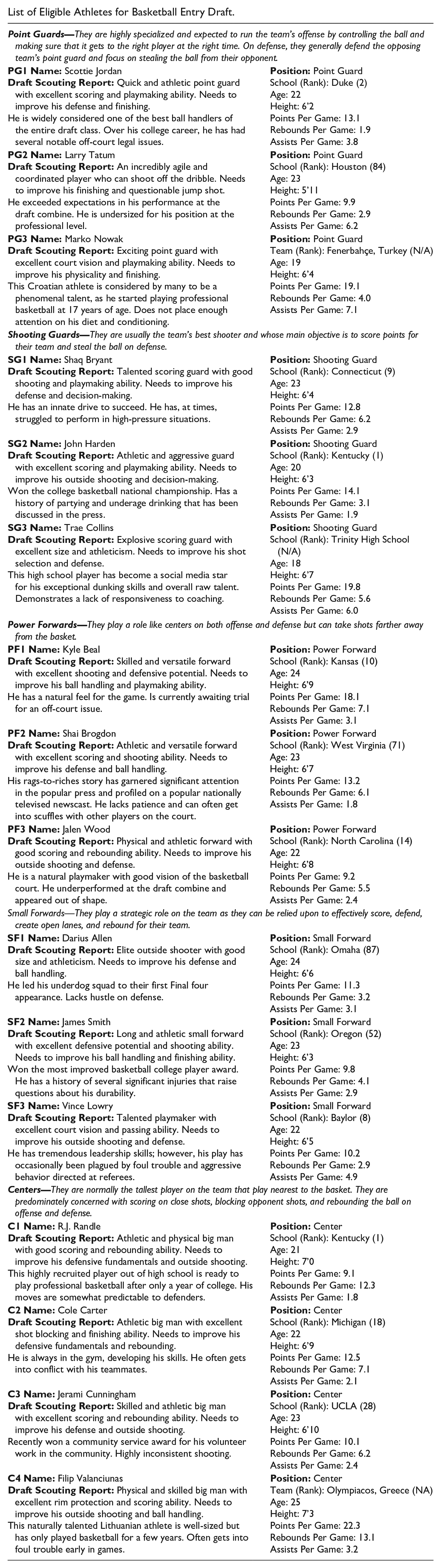
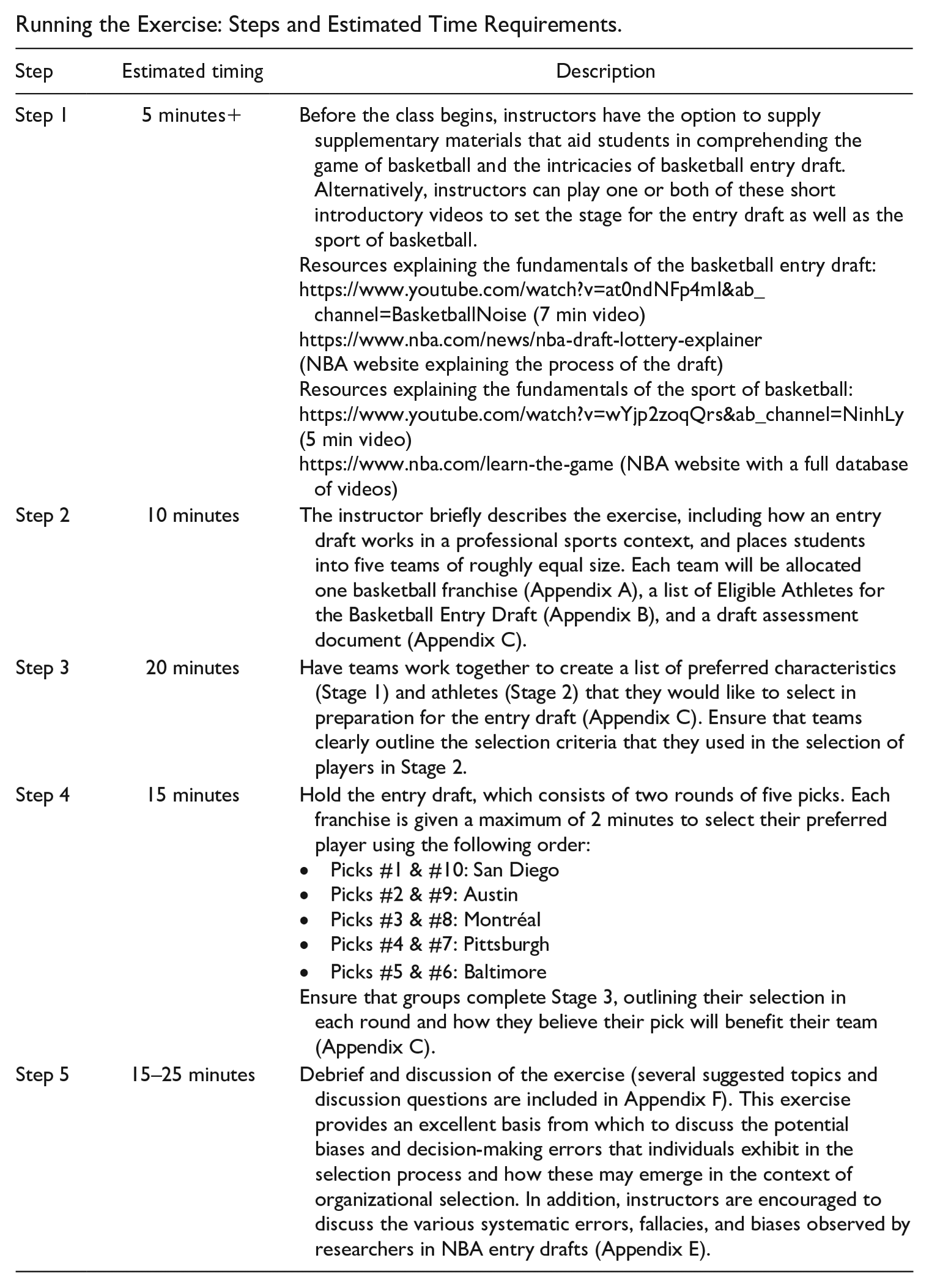
The current exercise closely mirrors the NBA entry draft. In the lead up to the exercise, instructors are advised to provide students with resources explaining the fundamentals of basketball and the basketball entry draft. This ensures that everyone is familiar with the context before the exercise begins (for more details on the draft process, see Appendix D, Step 1). Once the exercise begins, students are grouped into five franchises (group sizes can vary, but teams have performed well with up to eight students) and provided with information, including franchise talent criteria (Appendix A), a list of draft-eligible athletes, including their positions, demographic details, statistics, and scouting reports, along with a draft assessment document (see Appendix B and C). Instructors are provided with a step-by-step guide and estimated timeline (Appendix D), a take-home document outlining systematic errors, fallacies, and decision-making biases in basketball drafts (Appendix E), and a set of discussion questions to facilitate class debriefing (Appendix F). This exercise can be conducted in approximately 45–50 minutes with a short debrief (15 minutes) or can be expanded depending on available class time (see Appendix D for guide and estimated timeline).
The exercise begins with an introduction explaining the fundamentals of a basketball entry draft, its process, and operation (Appendix D, Step 1), where instructors have the option of providing the resources before class or playing one or more of the introductory videos prior to the beginning of the exercise. Following the introduction, the instructor clarifies that each group represents front office executives for a professional basketball franchise (e.g., General Manager, Director of Player Personnel, Head Coach, Director of Scouting Operations, and senior player scouts), where they are tasked with selecting players to help shape the future of their franchise. In line with a typical NBA entry draft, each franchise chooses two players, adheres to a predetermined draft order, and organizes team picks on a draft board. However, notable distinctions include the lack of a lottery system, a 2-minute selection time limit (as opposed to the traditional 5 minutes), and the absence of trade opportunities during the draft.
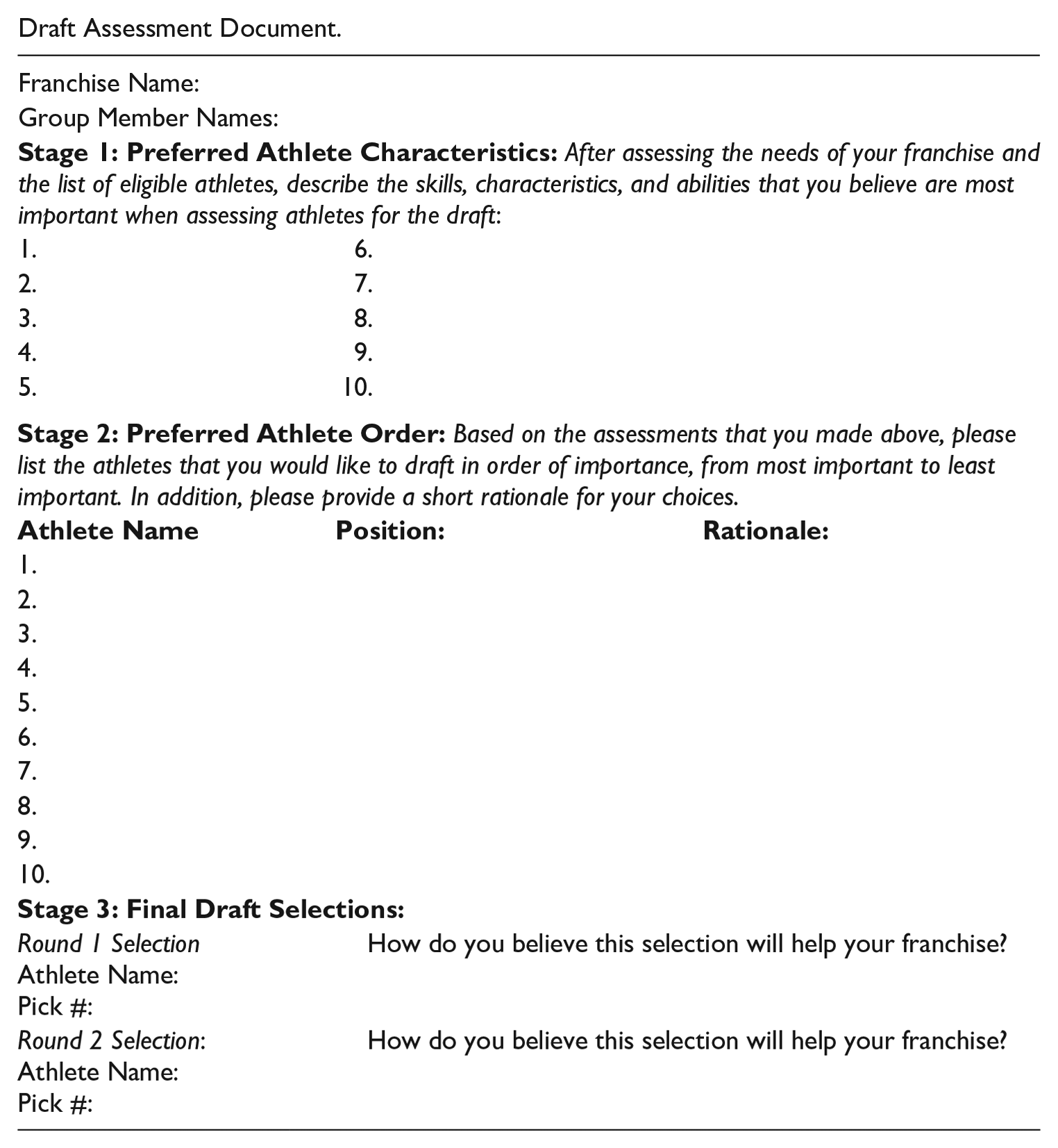
After explaining these similarities and differences, students proceed to complete Stage 1 and Stage 2 of the Draft Assessment Document (Appendix C). In doing so, students can evaluate the needs of their franchise (Appendix A) and list of draft eligible athletes (Appendix B) to develop a list of preferred skills, characteristics, and abilities, as well as their preferred order of eligible athletes of up to ten athletes that they would like to select in order of importance in preparation for the draft, as well as a rationale for choice (Appendix C). It is important to highlight that every athlete’s profile is designed to potentially trigger systematic errors, fallacies, and decision-making biases, as indicated by research. For instance, athlete C4 exemplifies the availability heuristic by being the top-scoring player in the draft. However, there are no ideal or superior picks among the athletes (Appendix E). The exercise primarily serves as an evaluation of students’ feelings about their selections. These decision-making fallacies often stem from fundamental psychological principles operating in complex and uncertain judgment environments (Tversky & Kahneman, 1974), forming the basis for post-draft exercise discussions (Appendix F).
Once the draft begins, follow the sequence outlined in Appendix A across two rounds. The draft begins by the first franchise making their selection, within two minutes of starting the draft process. Once selected, the selected athlete’s name is written on the board and the two-minute countdown begins for the next franchise to make their selection. This process continues until each franchise has selected one player, which ends the first round of the draft. Depending on time, the instructor can either move immediately to the second round, or students can take a short break and then resume the draft. Once finished the draft exercise, students can complete Stage 3 of the Draft Assessment Document (Appendix C), where they must outline how they believe their selection will help their franchise.
In running the draft, instructors are encouraged to make it as realistic as possible. Some suggestions to do so include designing logos for each franchise, appointing the instructor as the commissioner to announce each franchise’s selection, maintaining a visual depiction of the draft board to track picks throughout the two rounds using the computer or sticky notes (Robinson & Fiset, 2021), and using artificial crowd noise to create a more engaging life-like draft experience.
General Debrief of the Exercise
After the draft exercise is completed, the instructor facilitates class discussion regarding the entire draft process. First, instructors can probe into how students prepared for the draft and what aspects of their preparation they found helpful. Subsequently, the conversation shifts to discussions about how students evaluated their performance in the exercise in terms of identifying athletes with the desired skills and traits for their franchise. Next, the discussion delves into students’ confidence levels regarding their selections, considering factors such as the likelihood of their picks becoming successful professional players and how they justified any concerns outlined in each athlete’s profile (e.g., statistics and demographics). This phase offers an opportunity to discuss how even experts with years of experience can be influenced by various biases when selecting players in the draft. Throughout the discussion, instructors can engage students in exploring why drafts are ideal for examining decision-making biases, citing factors like uncertainty, franchise needs, sample size limitations, individual differences, and incomplete information.
At this point, instructors can distribute the list of systematic errors, fallacies, and decision-making biases observed in NBA entry drafts (Appendix E) and initiate a larger discussion of how these decision-making issues manifest when evaluating talent under uncertainty and how students could make better decisions under uncertainty in different contexts. In many cases, students describe the decision-making biases that they engaged in during the draft and provide examples. In cases where students may not feel comfortable disclosing their own biases, instructors can outline instances in the athlete profiles that may elicit a particular bias (e.g., favoring the player with the highest points per game). Regardless of the starting point for these discussions, they carry wide-ranging implications for other domains, particularly in the broader realm of personnel selection. This provides a chance to examine how organizations can reduce bias in personnel selection by improving processes, such as using data-driven analytics and integrating diverse evaluation perspectives.
Variations
Please see Appendix G for a discussion concerning the drawbacks of selecting an excess of exceptional talent. In this case, instructors are encouraged to explore Adam Grant’s WorkLife podcast episode “The Problem with All-Stars.” In addition, several other variations of the exercise are proposed, including incorporating a post-exercise reflection, adapting the exercise for various courses at both the undergraduate and graduate levels, such as sports management, staffing and selection, and organizational behavior, and suggestions on how the exercise could be adapted to an online classroom environment.
Conclusion
The Basketball Draft Night Exercise simulates an NBA entry draft, highlighting systematic errors, fallacies, and decision-making biases that may potentially lead to suboptimal player selection. Drawing from research on sports management and cognitive biases, the exercise reveals numerous issues faced by professional basketball executives predicting amateur player performance. This exercise effectively enhances students’ understanding of their susceptibility to bias and decision-making errors and sparks meaningful discussions about the complexities of talent evaluation and selection. As such, the present work emphasizes the importance of reducing decision-making errors to effectively minimize their impact within organizations (Johnston et al., 2022).
Footnotes
Appendix A
Appendix B
List of Eligible Athletes for Basketball Entry Draft.
|
|
|
He is widely considered one of the best ball handlers of the entire draft class. Over his college career, he has had several notable off-court legal issues. |
School (Rank): Duke (2) Age: 22 Height: 6’2 Points Per Game: 13.1 Rebounds Per Game: 1.9 Assists Per Game: 3.8 |
He exceeded expectations in his performance at the draft combine. He is undersized for his position at the professional level. |
School (Rank): Houston (84) Age: 23 Height: 5’11 Points Per Game: 9.9 Rebounds Per Game: 2.9 Assists Per Game: 6.2 |
This Croatian athlete is considered by many to be a phenomenal talent, as he started playing professional basketball at 17 years of age. Does not place enough attention on his diet and conditioning. |
Team (Rank): Fenerbahçe, Turkey (N/A) Age: 19 Height: 6’4 Points Per Game: 19.1 Rebounds Per Game: 4.0 Assists Per Game: 7.1 |
|
|
|
He has an innate drive to succeed. He has, at times, struggled to perform in high-pressure situations. |
School (Rank): Connecticut (9) Age: 23 Height: 6’4 Points Per Game: 12.8 Rebounds Per Game: 6.2 Assists Per Game: 2.9 |
Won the college basketball national championship. Has a history of partying and underage drinking that has been discussed in the press. |
School (Rank): Kentucky (1) Age: 20 Height: 6’3 Points Per Game: 14.1 Rebounds Per Game: 3.1 Assists Per Game: 1.9 |
This high school player has become a social media star for his exceptional dunking skills and overall raw talent. Demonstrates a lack of responsiveness to coaching. |
School (Rank): Trinity High School (N/A) Age: 18 Height: 6’7 Points Per Game: 19.8 Rebounds Per Game: 5.6 Assists Per Game: 6.0 |
|
|
|
He has a natural feel for the game. Is currently awaiting trial for an off-court issue. |
School (Rank): Kansas (10) Age: 24 Height: 6’9 Points Per Game: 18.1 Rebounds Per Game: 7.1 Assists Per Game: 3.1 |
His rags-to-riches story has garnered significant attention in the popular press and profiled on a popular nationally televised newscast. He lacks patience and can often get into scuffles with other players on the court. |
School (Rank): West Virginia (71) Age: 23 Height: 6’7 Points Per Game: 13.2 Rebounds Per Game: 6.1 Assists Per Game: 1.8 |
He is a natural playmaker with good vision of the basketball court. He underperformed at the draft combine and appeared out of shape. |
School (Rank): North Carolina (14) Age: 22 Height: 6’8 Points Per Game: 9.2 Rebounds Per Game: 5.5 Assists Per Game: 2.4 |
|
|
|
He led his underdog squad to their first Final four appearance. Lacks hustle on defense. |
School (Rank): Omaha (87) Age: 24 Height: 6’6 Points Per Game: 11.3 Rebounds Per Game: 3.2 Assists Per Game: 3.1 |
Won the most improved basketball college player award. He has a history of several significant injuries that raise questions about his durability. |
School (Rank): Oregon (52) Age: 23 Height: 6’3 Points Per Game: 9.8 Rebounds Per Game: 4.1 Assists Per Game: 2.9 |
He has tremendous leadership skills; however, his play has occasionally been plagued by foul trouble and aggressive behavior directed at referees. |
School (Rank): Baylor (8) Age: 22 Height: 6’5 Points Per Game: 10.2 Rebounds Per Game: 2.9 Assists Per Game: 4.9 |
|
|
|
This highly recruited player out of high school is ready to play professional basketball after only a year of college. His moves are somewhat predictable to defenders. |
School (Rank): Kentucky (1) Age: 21 Height: 7’0 Points Per Game: 9.1 Rebounds Per Game: 12.3 Assists Per Game: 1.8 |
He is always in the gym, developing his skills. He often gets into conflict with his teammates. |
School (Rank): Michigan (18) Age: 22 Height: 6’9 Points Per Game: 12.5 Rebounds Per Game: 7.1 Assists Per Game: 2.1 |
Recently won a community service award for his volunteer work in the community. Highly inconsistent shooting. |
School (Rank): UCLA (28) Age: 23 Height: 6’10 Points Per Game: 10.1 Rebounds Per Game: 6.2 Assists Per Game: 2.4 |
This naturally talented Lithuanian athlete is well-sized but has only played basketball for a few years. Often gets into foul trouble early in games. |
Team (Rank): Olympiacos, Greece (NA) Age: 25 Height: 7’3 Points Per Game: 22.3 Rebounds Per Game: 13.1 Assists Per Game: 3.2 |
Appendix C
Draft Assessment Document.
| Franchise Name: | ||
| Group Member Names: | ||
| 1. | 6. | |
| 2. | 7. | |
| 3. | 8. | |
| 4. | 9. | |
| 5. | 10. | |
|
|
||
|
|
|
|
| 1. | ||
| 2. | ||
| 3. | ||
| 4. | ||
| 5. | ||
| 6. | ||
| 7. | ||
| 8. | ||
| 9. | ||
| 10. | ||
|
|
||
| Round 1 Selection
|
How do you believe this selection will help your franchise? | |
| Round 2 Selection: |
How do you believe this selection will help your franchise? | |
Appendix D
Running the Exercise: Steps and Estimated Time Requirements.
| Step | Estimated timing | Description |
|---|---|---|
| Step 1 | 5 minutes+ | Before the class begins, instructors have the option to supply supplementary materials that aid students in comprehending the game of basketball and the intricacies of basketball entry draft. Alternatively, instructors can play one or both of these short introductory videos to set the stage for the entry draft as well as the sport of basketball. Resources explaining the fundamentals of the basketball entry draft: https://www.youtube.com/watch?v=at0ndNFp4mI&ab_channel=BasketballNoise (7 min video) https://www.nba.com/news/nba-draft-lottery-explainer (NBA website explaining the process of the draft) Resources explaining the fundamentals of the sport of basketball: https://www.youtube.com/watch?v=wYjp2zoqQrs&ab_channel=NinhLy (5 min video) https://www.nba.com/learn-the-game (NBA website with a full database of videos) |
| Step 2 | 10 minutes | The instructor briefly describes the exercise, including how an entry draft works in a professional sports context, and places students into five teams of roughly equal size. Each team will be allocated one basketball franchise (Appendix A), a list of Eligible Athletes for the Basketball Entry Draft (Appendix B), and a draft assessment document (Appendix C). |
| Step 3 | 20 minutes | Have teams work together to create a list of preferred characteristics (Stage 1) and athletes (Stage 2) that they would like to select in preparation for the entry draft (Appendix C). Ensure that teams clearly outline the selection criteria that they used in the selection of players in Stage 2. |
| Step 4 | 15 minutes | Hold the entry draft, which consists of two rounds of five picks. Each franchise is given a maximum of 2 minutes to select their preferred player using the following order: ● Picks #1 & #10: San Diego ● Picks #2 & #9: Austin ● Picks #3 & #8: Montréal ● Picks #4 & #7: Pittsburgh ● Picks #5 & #6: Baltimore Ensure that groups complete Stage 3, outlining their selection in each round and how they believe their pick will benefit their team (Appendix C). |
| Step 5 | 15–25 minutes | Debrief and discussion of the exercise (several suggested topics and discussion questions are included in Appendix F). This exercise provides an excellent basis from which to discuss the potential biases and decision-making errors that individuals exhibit in the selection process and how these may emerge in the context of organizational selection. In addition, instructors are encouraged to discuss the various systematic errors, fallacies, and biases observed by researchers in NBA entry drafts (Appendix E). |
Appendix E
Appendix F
Example Discussion Questions
Appendix G
Acknowledgements
I would like to thank Dr. Maria Carolina Saffie Robertson and Charlotte Genge for providing invaluable feedback on this manuscript.
Declaration of Conflicting Interests
The author declared no potential conflicts of interest with respect to the research, authorship, and/or publication of this article.
Funding
The author received no financial support for the research, authorship, and/or publication of this article.
