



Abstract
The Networking “Menu” is a customizable learning experience for online students to explore various ways to network virtually and to sharpen their networking skills. The “menu” offers four networking options for students to select from. Some networking options require that students network with their peers via virtual platforms (e.g., an online coffee break/happy hour and a shared activity), while other options (e.g., a network analysis and 5-minute favors) explore key networking concepts. The Networking “Menu” simulates the networking that occurs within the campus setting and challenges student perceptions that networking is “icky” by providing students with online networking opportunities that benefit others. This learning experience is applicable to online synchronous/asynchronous courses in organizational behavior (or other courses that cover networking concepts) at the undergraduate and graduate levels. A description of The Networking “Menu” options, supplemental materials for implementing the options, and questions for debriefing the exercise is provided.
Keywords
For campus-based students, peer networking occurs naturally through attending classes, working on class projects, participating in campus organizations, hanging out in dorms and dining halls, and attending on-campus events and seminars. For online students, these same naturally occurring, built-in peer networking opportunities either do not exist or do not operate in the same ways. Thus, online students may not have as many opportunities to develop a strong network of their peers or may need to make more intentional efforts to do so. Given that networking is a critical skill for building social capital, gaining access to information, and enhancing career success (de Janasz & Forret, 2008), networking is an integral part of the education experience that online students may be lacking, thereby illuminating the need for the integration of networking within online management courses.
Complicating the issue, students may have limited views of how to network professionally online. They may be unaware of ways to network virtually outside of social networking platforms, such as LinkedIn. In addition, students may have perceptions that online networking is intimidating or that networking is “icky” because their primary reason for networking is to benefit their career (Casciaro et al., 2016; Cullen-Lester et al., 2016; Ibarra, 2016). Online networking can combat these misconceptions because it can involve numerous approaches and be used to benefit others (Grant, 2013).
With the purposes of duplicating the networking experiences that campus students experience within the online environment, broadening students’ perceptions of networking, and providing students with various ways to network online, I developed the Networking “Menu,” which requires students to network with their peers (and others within their professional network) by selecting from a “menu” of four different networking-focused activities. I assign The Networking “Menu” in my graduate, online asynchronous organizational behavior course, although it can be utilized in online synchronous courses, at both the undergraduate and graduate levels. The Networking “Menu” is appropriate for any online management course that covers networking or influence within the course material or aims to foster networking among students.
Theoretical Foundations of The Networking “Menu”
Networking is defined as “individuals’ attempts to develop and maintain relationships with others who have the potential to assist them in their work or career” (Forret & Dougherty, 2001, p. 284). Previous research has well-documented the numerous benefits of networking, such as job search success (Wolff & Moser, 2009), promotional opportunities (Forret & Dougherty, 2004; Wolff & Moser, 2009), and career advancement (Burt & Ronchi, 2007). Due to its many benefits, networking is an essential skill to equip management students with to help them with their career success (de Janasz & Forret, 2008).
Networking is generally accomplished through natural face-to-face interactions or through spontaneous and serendipitous encounters that occur when individuals interact as part of the same social circle, have similar interests, or are part of the same organizational unit (Cullen-Lester et al., 2016). Examples of networking include going out for lunch or drinks with contacts, playing athletics with clients or coworkers, joining industry or professional associations, and participating in community, civic, and social organizations (Forret & Dougherty, 2001). For campus-based students, in addition to attending classes and interacting with their classmates, their networking may consist of having coffee with a peer at the campus coffee shop, playing intramural games with friends, and joining a variety of student clubs and organizations. These types of experiences provide on-campus students with opportunities to practice networking with their peers prior to networking professionally once they enter their first corporate job.
For online students, networking among their peers has less of the naturally occurring, spontaneity to it. Instead, interaction among online students may be limited to online discussion boards within the university learning management system, email exchanges, synchronous virtual discussions via WebEx, Microsoft Teams, or Zoom, messaging apps such as GroupMe or WhatsApp, or online social networking sites such as LinkedIn (e.g., Gerard’s 2012 exercises). These types of online interactions among students are clearly different than those that occur on-campus. Hence, online students do not have the same built-in opportunities as campus-based students to organically practice networking with their peers prior to launching their careers.
As management educators, we need to pay careful attention not only to online course delivery, but also to the experiences of online students and how they may or may not be analogous to the campus experience. Part of the benefit of attending an institution of higher education is meeting other students and developing connections with them. For online students, networking with their peers occurs differently due to the online modality, and this warrants recognition by management educators as well as efforts to provide online students with opportunities to network much like their campus-based peers do. While research has not yet investigated the differences in students’ networking experiences based upon course delivery modality, initial research into differences between offline and online networking among working persons suggests that online networking may result in similar benefits as offline networking does (Baumann & Utz, 2021). With this in mind, it is advantageous for management educators to make efforts to incorporate networking into their online courses to foster networking skill development among online students, especially since they may be missing out on the types of networking that campus students’ experience.
Furthermore, incorporating networking into online classes allows management educators to address common misconceptions that students have about networking. Students may view networking as inauthentic, self-serving, opportunistic, dirty, and even morally impure (Casciaro et al., 2014; Cullen-Lester et al., 2016; Gino et al., 2020). By educating online students about networking in a more authentic way (Gino, 2016) that can be used to benefit others (e.g., 5-minute favors), management educators can challenge students’ understandings of networking and expand their thinking of networking to include giving to others, thereby breaking down students’ negative and even dirty associations with networking. Offering creative opportunities for online students to network (e.g., 5-minute favors) also provides students with more and different ways to network than simply participating in online class-based educational activities or online social professional networking sites.
The Networking “Menu” experiential exercise is designed to address the concerns highlighted above regarding the lack of opportunities for online students to network with their peers in a more natural way, foster student learning about networking concepts, and promote a more positive view of networking. The Networking “Menu” exercise is based upon the principles of social learning theory (Bandura, 1977) and experiential learning theory (Kolb, 1984). Social learning theory suggests that individuals learn through observation and modeling behaviors, whereas experiential learning theory combines experience, cognition, and behavior. In the case of the Networking “Menu,” students not only learn about key networking concepts, they also observe networking concepts in action. They participate in virtual networking activities, thereby modeling networking behaviors to experience various approaches to networking.
The Networking “Menu” Description
Learning Objectives for the Exercise
The learning objectives for the varying options in The Networking “Menu” learning experience are offered as a collective whole. As a result of completing The Networking “Menu” experiential exercise, students will be able to:
Practice networking via virtual platforms with their peers;
Utilize a broad array of online networking options available to them;
Analyze their current network; and
Question the perception that networking is self-serving, opportunistic, and “icky” by networking in ways that benefit others.
Overview of the Exercise
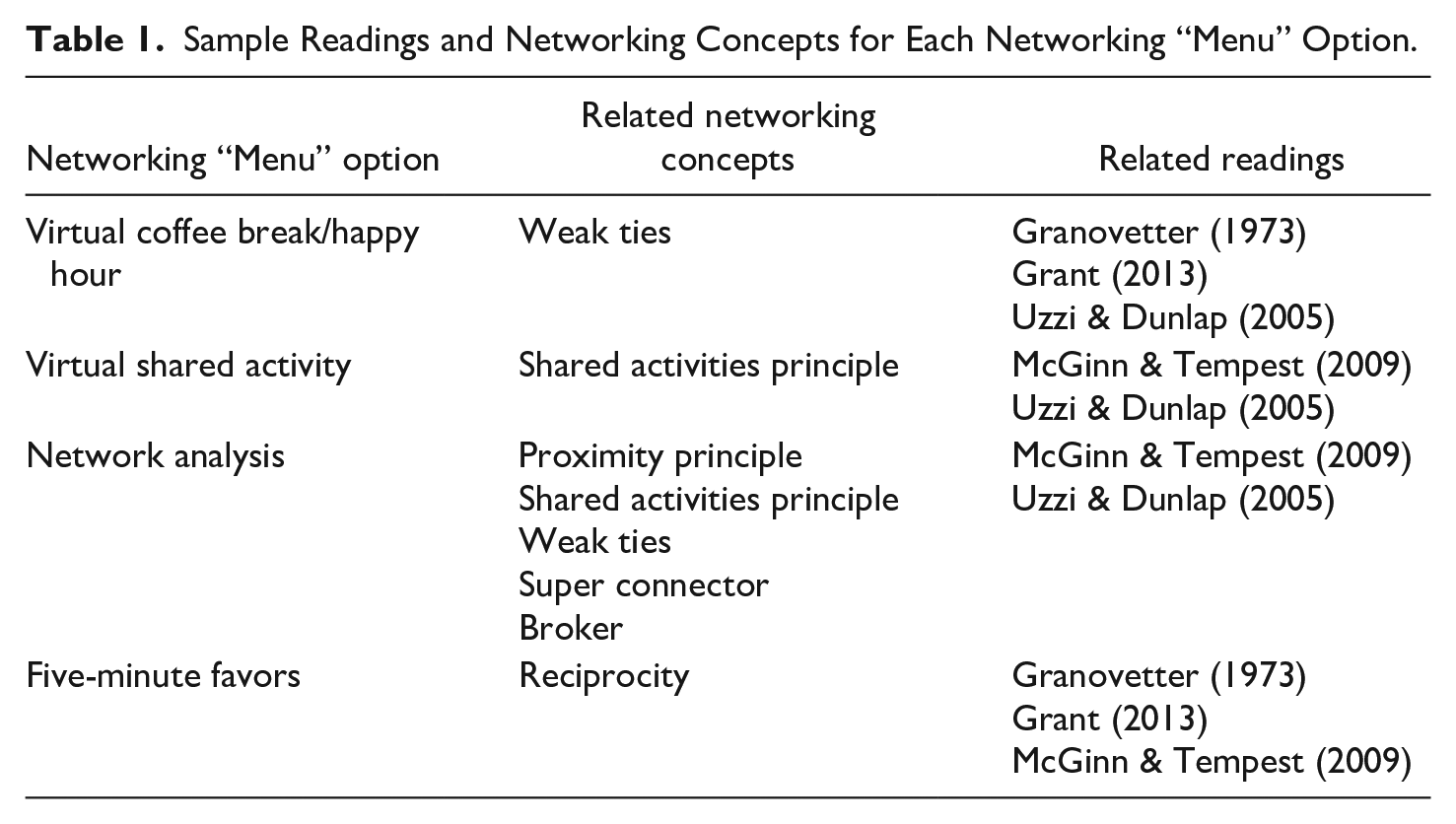
I provide a “menu” of networking opportunities that students can select from, thereby allowing students to customize their learning experience. For some options, students network with their professional contacts, and for other options, students network with their peers in the course. The Networking “Menu” options include participating in a virtual coffee break/happy hour with classmates, engaging in a virtual shared activity with peers, analyzing their network via a network mapping table (Uzzi & Dunlap, 2005), and doing 5-minute favors (Grant, 2013). The instructions for each of these options are in Appendix A, while Appendices B, C, and D offer ideas related to specific “menu” options. Appendix E includes variations for the exercise, and Table 1 details sample readings and networking concepts related to each Networking “Menu” option.
Sample Readings and Networking Concepts for Each Networking “Menu” Option.
I assign varying point values for the “menu” options based upon the effort required, with higher effort activities receiving more points and lower effort activities receiving fewer points. I allow students to select which activities they complete to earn the maximum allotted points for the exercise. I require that students complete at least one of the virtual networking options (e.g., the coffee break/happy hour or the shared activity) to foster interaction among students. I assign point values to the “menu” options so that it is advantageous for students to complete both of the virtual networking options, but students do not have to complete both virtual networking options to receive full credit for The Networking “Menu.” The reason why I include the other “menu” options (e.g., the network analysis table and 5-minute favors) is because asynchronous students may be in different time zones and may have trouble finding a mutually convenient time to network with their classmates; thus, The Networking “Menu” options can be offered without the requirement of completing the virtual networking options if necessary.
Debriefing The Networking “Menu” Exercise
As this exercise is designed for the online class environment, the debriefing can take place via an online discussion board or a reflection essay using the provided questions as prompts. The following questions can be used to debrief the exercise from a general perspective regardless of specific “menu” options that students select; sample student answers to these broad debrief questions are also included here. More specific debriefing instructions, debriefing questions related to each Networking “Menu” option, and sample student responses to these debriefing questions are in Appendix F.
General Debriefing Questions
What did you learn about networking from the exercise?
How has this exercise helped you further develop your networking skills and knowledge about networking within the online environment?
What were your perceptions of networking prior to completing the exercise?
How have your perceptions of networking changed as a result of the exercise?
Sample Student Answers to the General Debriefing Questions
Students mention that the exercise emphasized the importance of networking and prompted them to network more. Some students comment that networking in the online environment can be fun, whereas, other students discuss their broader understanding of ways to network within the virtual environment as a result of their exposure to the various networking options and concepts presented in the exercise. Students’ perceptions of networking prior to the exercise vary. Some view it as a necessary, but often neglected part of their professional life, whereas others enjoy networking and find that it comes naturally to them, giving them very positive perceptions of networking. Still, other students have more negative perceptions of networking because of the discomfort involved, but mention that it is something that they know they should do to further their careers. Students remark that they have more positive perceptions of networking after the exercise because networking can involve 5-minute favors (something they had not thought about prior to the exercise) and because the “menu” options helped them feel more comfortable and authentic networking in the online environment.
Conclusion
The Networking “Menu” experiential exercise allows students to practice networking with their peers within the online environment, learn about key networking concepts, experience various ways of networking virtually, and challenge their commonly held beliefs about networking being “icky,” “selfish,” or “inauthentic.” The “menu” format offers different options for students to select from, providing them with an individualized online learning experience about networking. Student feedback indicates that The Networking “Menu” makes learning about networking and practicing networking interesting and fosters a sense of connectedness among students.
Footnotes
Appendix A
Appendix B
Appendix C
Appendix D
Appendix E
Appendix F
Declaration of Conflicting Interests
The author declared no potential conflicts of interest with respect to the research, authorship, and/or publication of this article.
Funding
The author received no financial support for the research, authorship, and/or publication of this article.
