



Abstract
The Explainer Video Project was developed to familiarize management students with evaluating explainer videos for credibility and quality. In addition, it provides students with unique options for creating video content. Today’s workplace needs college graduates with entrepreneurial skills applicable to the gig economy enabled by online platforms. The demand for the perpetual creation of new video content generates a need for creators to develop explainer videos. Accordingly, consumers of such content require the necessary skills to evaluate them for credibility and quality. Through the phases of this project, students learn to evaluate explainer videos for quality and credibility and create credible, high-quality explainer videos using a visual communication platform.
Keywords
An explainer video is a concise, often animated video that effectively delivers a message to an audience. Explainer videos have taken the world of information sharing by storm. They are used for multiple purposes in business today, including education and marketing. For example, the following explainer video about Google Assistant™ explains a router technology for faster internet speeds, https://youtu.be/oZFFLoJ6eog. In this video by PadMapper®, viewers learn how to use the apartment hunting app, https://youtu.be/eN8nDVGfdZM. The market for explainer videos has skyrocketed with the expansion of social media and video streaming platforms. Therefore, learning how to evaluate them for quality and credibility has become an increasingly sought-after skill in the workplace.
Theoretical Foundations
The Use of Video in Management Education
Video clips have been used for supplemental instruction for decades. Previous research indicates that showing films or television clips increases students’ interest and enjoyment in the classroom (Krämer & Böhrs, 2017; Tyler et al., 2009). Explainer videos are relatively new to social media. According to Krämer and Böhrs (2017), explainer videos are a common method used to teach, learn, and inspire in Business-to-Business markets, Business-to-Consumer markets, and Consumer-to-Consumer markets. Krämer and Böhrs (2017) define an explainer video simply as “a format that conveys complex facts to a target group within a very short time” (p. 254). Explainer videos typically have one of two common structures: a process overview or a problem-and-solution format (Column Five Media, 2021).
While explainer videos are in abundance, not all were created equally. Krämer and Böhrs (2017) studied how explainer videos affect the knowledge of participants. They found that audio quality and visual quality heavily influence ratings of effectiveness, although the authors reported that American participants were interested in the accuracy of content over animation and sound effects. Furthermore, improved knowledge after watching varies across videos. It seems that participants have positive reactions to explainer videos when their content knowledge is deficient in a particular area. In addition, brief and concise videos tend to lead to higher viewer engagement (Krämer & Böhrs, 2017).
As instructors challenge students to develop content using this medium, it becomes critical to define parameters around effectiveness. Tu (2015) delineated five components present in an effective explainer video: (a) the video has a prepared script, (b) it is short in length (several sources suggest 60 to 120 seconds [Animation Explainers, 2019]), (c) the video has focus and simplicity, (d) the video tells a story, and (e) the video is visually captivating. Abedin et al. (2019) offer a framework for analyzing online reviews using systematic and heuristic information processing, which could be adapted for evaluating explainer videos.
Skills Needed for Gig Work
The number of gig, freelance, and contingent workers has continued to increase in numbers since the beginning of the Covid-19 pandemic. A Pew Research Center survey found that 16% of Americans had been paid to do gig work on an online gig platform at some point in time (Anderson et al., 2021). While gig work takes place in many industries and requires a vast range of roles and responsibilities for workers, entrepreneurial skills will help future gig workers navigate their careers. Skills such as social perception, impression management, self-promotion, social adaptability, and expressiveness (Baron & Tang, 2009) certainly pertain to today’s gig workers. More recently, Sutherland et al. (2020) uncovered critical work literacies for workers in the gig industries, which included building reputation, self-presentation, maintaining productivity, mitigating transaction risk, and building relationships. Each of these literacies or skills can be promoted through social media. As managers, consultants, and other gig professionals continue to promote themselves through the development of content on social media and video streaming platforms, they seek ways to distinguish themselves as purveyors of evidence-based content. The demand for the perpetual creation of new video content generates a need for creators to develop explainer videos. Accordingly, consumers of such content will require the necessary skills to evaluate them for credibility and quality.
In short, the literature suggests that incorporating video into course activities contributes positively to students’ learning experiences and better prepares them for professional opportunities in the growing gig economy.
These converging ideas led us to develop a course project, supported by exercises designed to guide students through locating explainer videos related to course content. Furthermore, this project teaches students to evaluate the credibility and quality of video content and provides them with an opportunity to create original, high-quality explainer videos.
Explainer Video Exercise Description
The project was designed with undergraduate human resource management (HRM) students in mind; however, the exercise could be used in any undergraduate business course or MBA course. While this project is framed from the perspective of a class that is being delivered in person or synchronously via video conference, ideas for adapting the project to an asynchronous online course are presented in Appendix A. Before beginning the exercise, students should become familiar with explainer videos and how they might be used in the field of management. To bring ideas forth, I encourage students to consider current workplace trends and apply a management concept or theory to address a specific problem. For example, in an HRM course, we might discuss how recruitment has changed during the Covid-19 pandemic (see Table A1 for additional examples). In a course on Organizational Behavior, students could envision a video on applying aspects of Herzberg’s two-factor theory to motivate employees to change behavior, such as wearing a facemask properly.
This exercise allows students to develop an enhanced understanding of any management topic through teaching the topic themselves (Cortese, 2005). Furthermore, students will develop skills in resourcefulness, evaluation of credible and reliable information, planning, and teamwork. On completion of the project, students will be able to:
Develop an enhanced understanding of one or more management concepts of their choice.
Identify the purpose and target audience of various explainer videos.
Evaluate the credibility of management information.
Work collaboratively within a small group.
Deliver a clear, concise, and credible presentation.
Develop creativity skills for remote presentation of ideas.
In brief, the five-phase project outlined in Table 1 prepares students with the requisite skill to evaluate video content for quality and credibility as well as create video content. Detailed instructions for each phase summarized below can be found in Appendix B. In Phase 1, Video Credibility, students evaluate the credibility and quality of videos using the prescribed rubric (see Table 2), which is adapted from Abedin et al.’s (2019) framework for conducting credibility analysis of online reviews. See Appendix C for more on assessing credibility using this framework.
Explainer Video Exercise Overview.
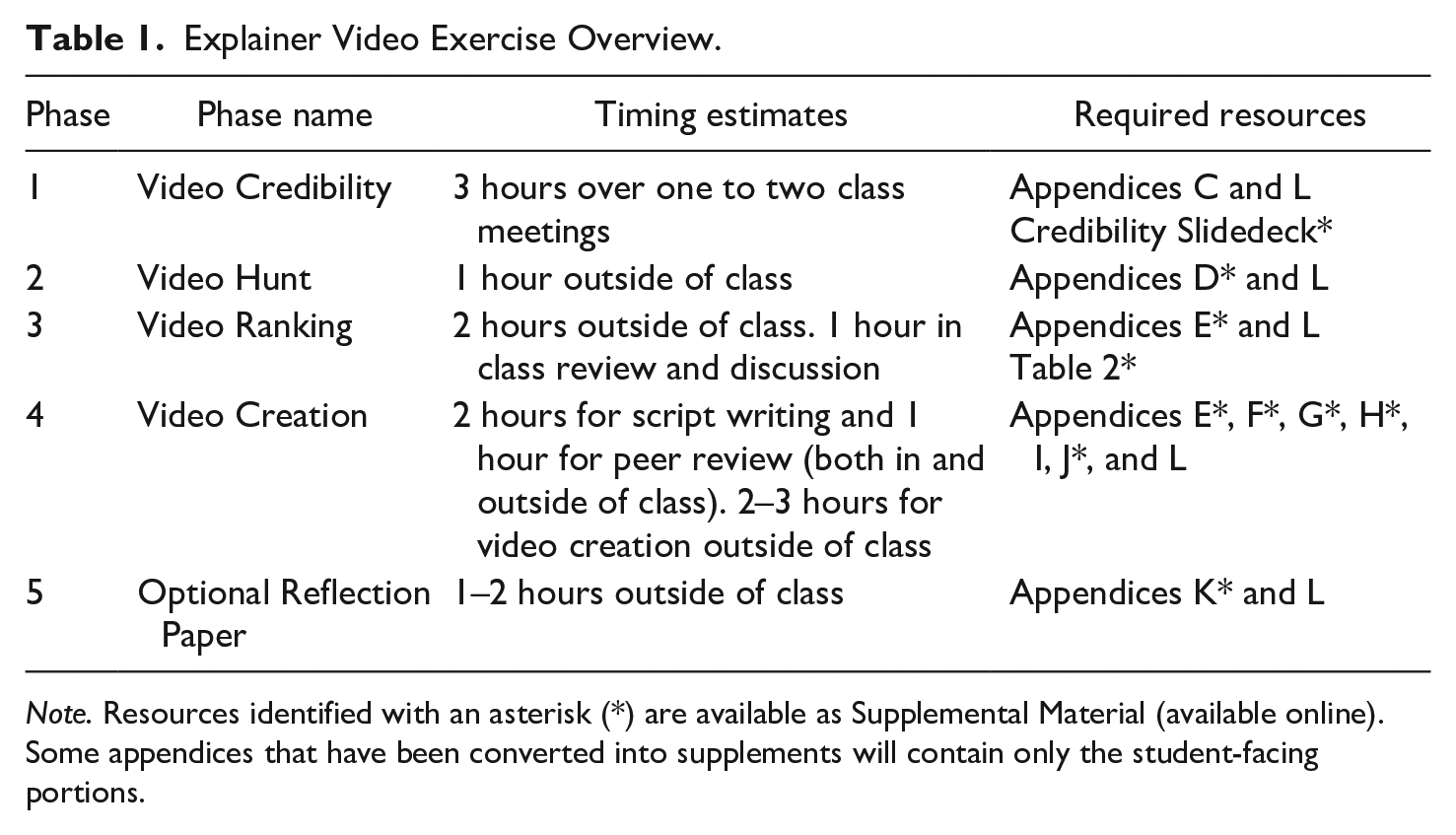
Note. Resources identified with an asterisk (*) are available as Supplemental Material (available online). Some appendices that have been converted into supplements will contain only the student-facing portions.
Explainer Video Evaluation Rubric.
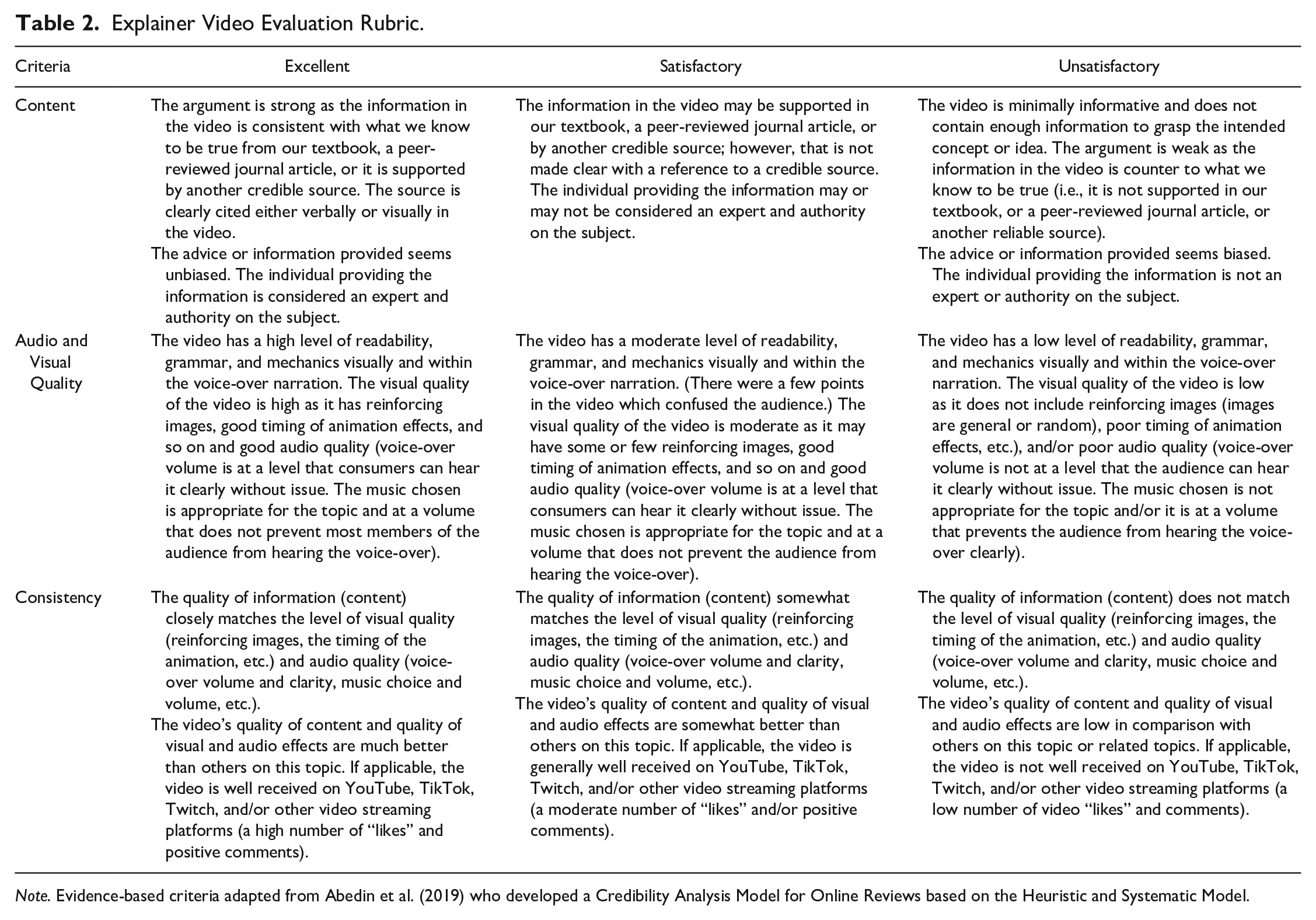
Note. Evidence-based criteria adapted from Abedin et al. (2019) who developed a Credibility Analysis Model for Online Reviews based on the Heuristic and Systematic Model.
In Phase 2, the Video Hunt, students simply locate explainer videos on the internet (see Appendix D) and encourage students to look for explainer videos on relevant topics that interest them. They should not be concerned with the quality or credibility of the video at this stage of the exercise.
In Phase 3, Video Ranking, the students discuss the videos they found in small groups, and together, they rank the videos for effectiveness. The ranking of videos serves two major purposes. First, it allows students to discuss the content of the videos and how they align with the concepts being presented in class. Second, it provides the opportunity to work collaboratively within peer groups with relatively low stakes. See Appendix E for the instructions.
In Phase 4, Video Creation, students create an explainer video for a management audience. At the start of this phase, instructors may provide the handout in Appendix F, Tips for Creating an Effective Explainer Video. The first step in creating an explainer video is to write a script. Students will write a script using the guidance provided in Appendix G. Once students have drafted a script, they will exchange scripts with a partner and conduct peer reviews. See Appendix H for the process overview and form needed to complete the peer review. Once all scripts have been peer-reviewed, students may make changes and submit them to the instructor for a final review. After scripts are completed, students begin creating explainer videos. We use Powtoon®, a visual communication platform with options for animated video creation; however, there are many platforms available on the internet. See Appendix I for a discussion of Powtoon and alternative platforms for consideration. Appendix J provides instructions for students for creating explainer videos using Powtoon.
In Phase 5, there is an optional reflection paper that students may write on their experience and lessons learned throughout the project. Appendix K contains instructions for the optional reflection paper.
Debriefing is a critical component of learning, and therefore, Appendix L contains guidance for debriefing students during each phase of the project.
Refer to Table 1 for an overview of the exercise, timing estimates, and corresponding appendices in each phase.
Conclusion
Initially, the Explainer Video Project was created to offer a unique and creative way for students to present their knowledge, particularly in online courses. However, it soon became apparent that while explainer videos were available on the internet in abundance, the quality of information within them was often lacking. This signaled a need to teach students how to distinguish between high-quality and low-quality explainer videos. In addition, we viewed this project as an opportunity for management students to develop a unique skill set that would serve them well in the workplace where entrepreneurial skills (e.g., Baron & Tang, 2009; Sutherland et al., 2020) are in high demand. Furthermore, students generally welcome the opportunity to learn such skills and appreciate the ability to showcase them in other courses.
Footnotes
Appendix A
Appendix B
Appendix C
Appendix D
Appendix E
Appendix F
Appendix G
Appendix H
Appendix I
Appendix J
Appendix K
Appendix L
Acknowledgements
We would like to thank Editor-in-Chief, Dr. Jane SchmidtWilk, and Associate Editor, Dr. Lisa Stickney, and the two anonymous reviewers for their constructive and developmental feedback.
Authors’ Note
All trademarks referenced in this article are the property of their respective owners, and the reference of these trademarks is solely for the purpose of commentary and does not imply any affiliation with, or endorsement by, the respective owners.
Declaration of Conflicting Interests
The authors declared no potential conflicts of interest with respect to the research, authorship, and/or publication of this article.
Funding
The authors received no financial support for the research, authorship, and/or publication of this article.

References
Supplementary Material
Please find the following supplemental material available below.
For Open Access articles published under a Creative Commons License, all supplemental material carries the same license as the article it is associated with.
For non-Open Access articles published, all supplemental material carries a non-exclusive license, and permission requests for re-use of supplemental material or any part of supplemental material shall be sent directly to the copyright owner as specified in the copyright notice associated with the article.
