



Abstract
Challenged by COVID-19, we sought ways to increase engagement in the virtual classroom, capitalizing on a popular multiplayer game to teach persuasion to undergraduate students. In the game Among Us
Forced to quickly pivot to online activities due to the COVID-19 pandemic in 2020, we initially had difficulty finding an existing experiential exercise that was (a) centered on persuasion tactics, (b) suitable for an interactive, virtual group, and (c) could be delivered within a single class period. Imagine our delight when we realized that the multiplayer online game Among Us
Theoretical Foundation
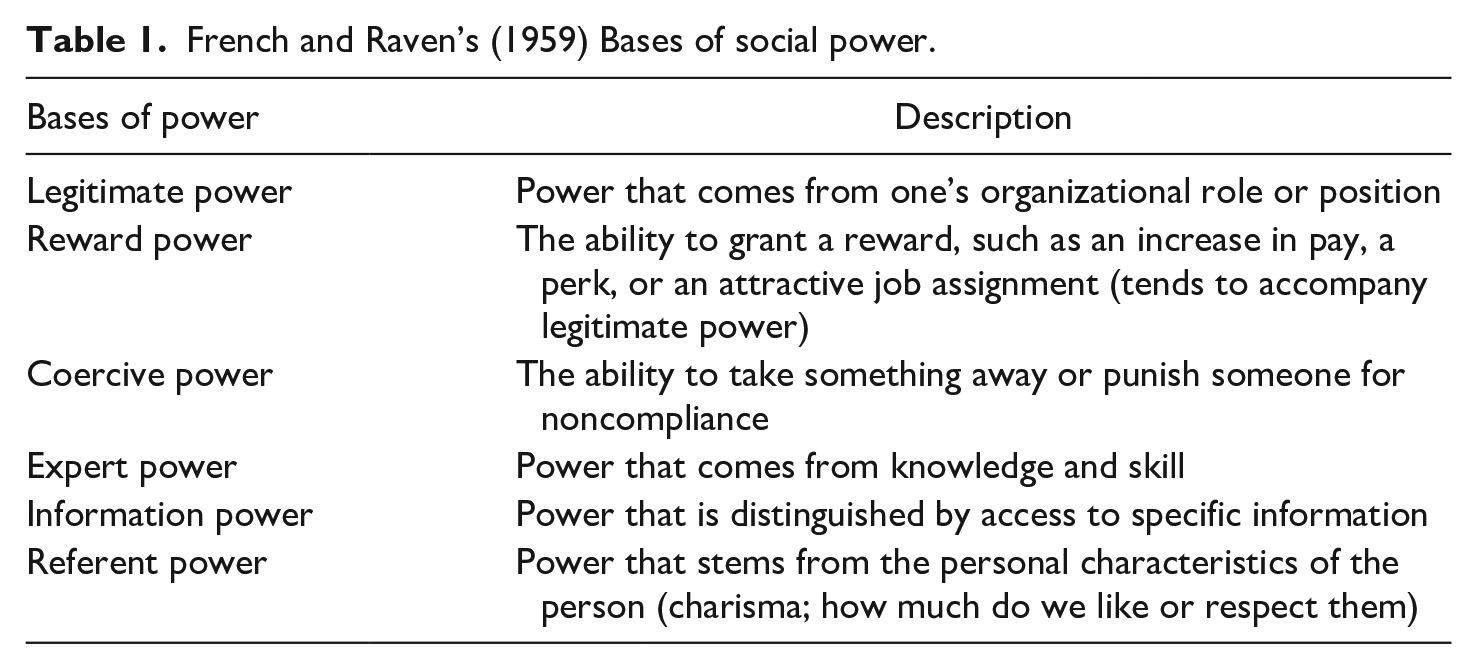
The topic of persuasion is firmly entrenched within the management curriculum, frequently covered in courses such as principles of management, organizational behavior, leadership, power and politics, and negotiation. A variety of frameworks are used to teach persuasion in the classroom; we focus on two of the more prominent: French and Raven’s (1959) Bases of Power and Yukl and Tracey’s (1992) Nine Influence Tactics. French and Raven’s framework outlines six distinct sources of power that people may have at their disposal as the result of situational and personal characteristics: legitimate power, reward power, coercive power, expert power, information power, and referent power (see Table 1). Yukl and Tracey’s framework is behavioral and outlines nine distinct tactics that people can use when attempting to influence others: rational persuasion, inspirational appeals, consultation, ingratiation, personal appeal, exchange, coalition tactics, pressure, and legitimating tactics (see Table 2).
French and Raven’s (1959) Bases of social power.
Yukl and Tracey’s (1992) Influence Tactics.
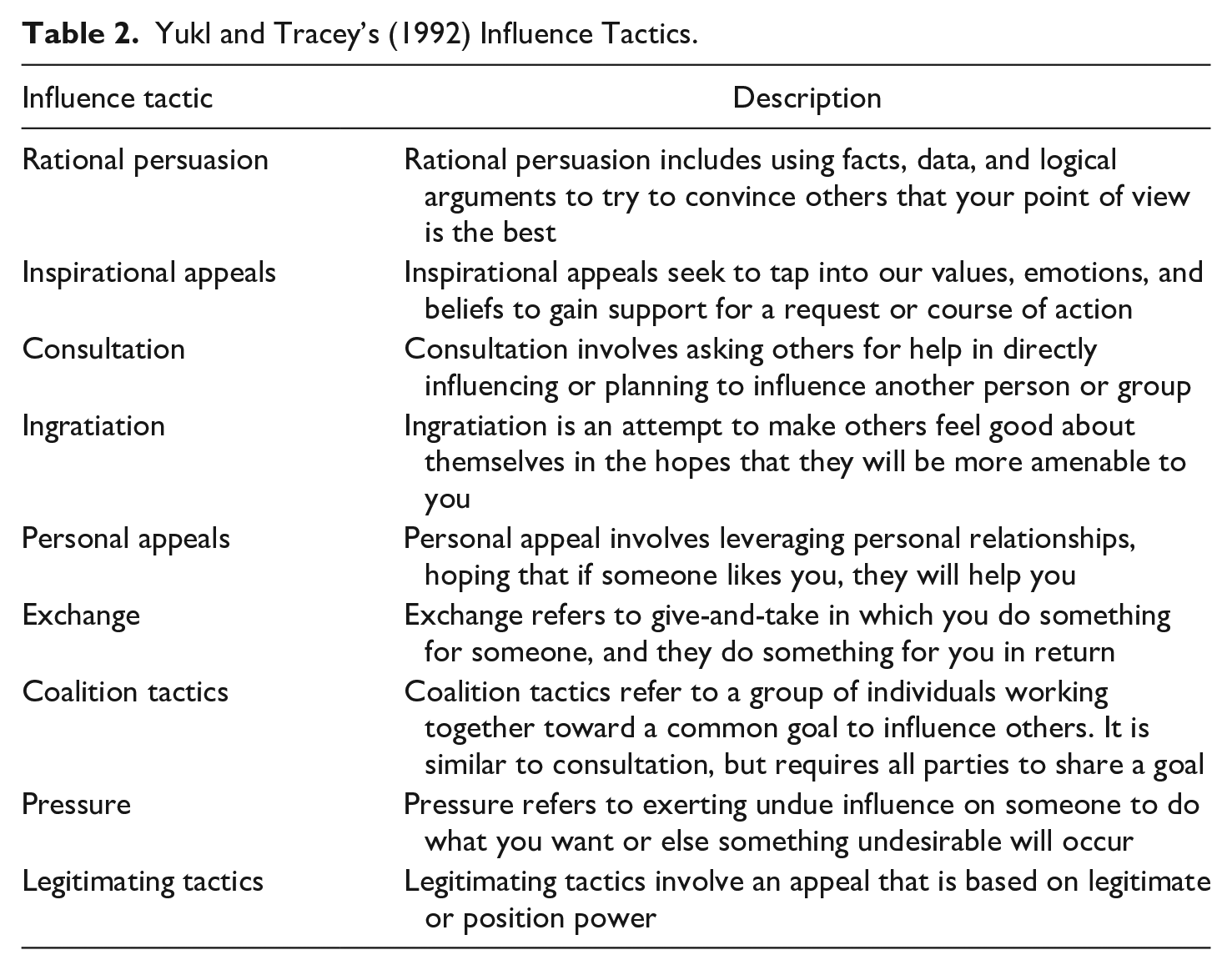
These two frameworks are inherently related, since power is defined as the potential to exert influence on others (French & Raven, 1959). Depending on the sources of power that a person has, particular influence tactics are going to be more appropriate or likely to work. For example, people who have information power (access to specific information) are likely to be able to use rational persuasion based on facts, whereas someone who does not have information power would have to rely on other tactics. Therefore, the ability to recognize one’s sources of power and identify the influence tactics that are most likely to be effective in a given context hinges on understanding the linkages between these two frameworks. See the slides posted as Supplemental Materials for more details on each framework.
Concepts come alive when lectures are accompanied by experiential activities such as games (D. A. Kolb, 2014; A. Y. Kolb & Kolb, 2005). Game-based learning has a positive impact on cognitive, behavioral, and affective learning outcomes (Vlachopoulos & Makri, 2017). Games have been shown to engage students, reinforce learning, and increase their motivation (Burguillo, 2010; A. Y. Kolb & Kolb, 2005; Plump & Meisel, 2020) and, as a side benefit, can increase a sense of connection and trust in virtually distributed teams (Depping et al., 2016). They also provide an opportunity for equal-status interactions among students, supporting the creation of an equitable learning environment (Cohen, 2000; Richard, 2017). Yet, compared with other topics like teamwork and leadership, experiential activities centered on persuasion are rare. In our review of the 109 Management Teaching Review articles covering experiential activities from its inception through January 2021, we found just four articles that had persuasion, influence, or power as keywords. In this article, we contribute a fun, interactive approach to developing students’ capacities to understand the linkages between power and influence using the game Among Us.
Learning Objectives
This activity is meant to be used in conjunction with readings and/or a lecture on the concepts and frameworks of power and persuasion. After participating in this exercise, students will be able to:
Identify the sources of power available in a particular context (focusing on French and Raven’s typology);
Assess, select, and implement influence tactics (focusing on Yukl and Tracy’s tactics) that are most likely to be effective given the available sources of power;
Evaluate the effectiveness of one’s own and others’ use of influence tactics; and
Connect the availability and effectiveness of particular influence tactics back to one’s sources of power.
Given the experiential nature of this activity, students get immediate feedback on their assessment, selection, and implementation of their influence tactics by how they perform in the game and by the commentary shared by their peers during the debrief. They also learn in real-time from observing the results of others’ choices.
Beyond its utility as an exercise to teach persuasion, Among Us can be used as a fun icebreaker to get students talking and build a shared experience. Games like this can help break down barriers and build trust and cohesion among students, particularly in a virtual environment (Depping et al., 2016).
Instructions for Running the Exercise
Among Us is an online, multiplayer competitive game by Innersloth LLC (2016) for four to 10 players, described as “a game of teamwork and deception.” The game is set on a spaceship, with players automatically assigned to roles of “Crewmate” or “Imposter.” It falls into the category of social deduction games, in which players try to determine other players’ hidden roles. The game iterates between gameplay and meetings. During gameplay, Crewmates complete sets of assigned tasks and Imposters attempt to sabotage the ship and kill the Crewmates. During meetings, players can accuse others of being Imposters, deliberate, and vote off suspected Imposters. (See Appendix A for game details.)
The meetings provide an opportunity for students to practice using and observing persuasion and influence tactics, which make this game an excellent experiential learning activity for this topic. In particular, players accused of being an Imposter (whether innocent or guilty) will try to persuade others of their innocence, and all players will similarly try to persuade others to indict suspects (Appendix A provides examples of what these exchanges might look like in practice).
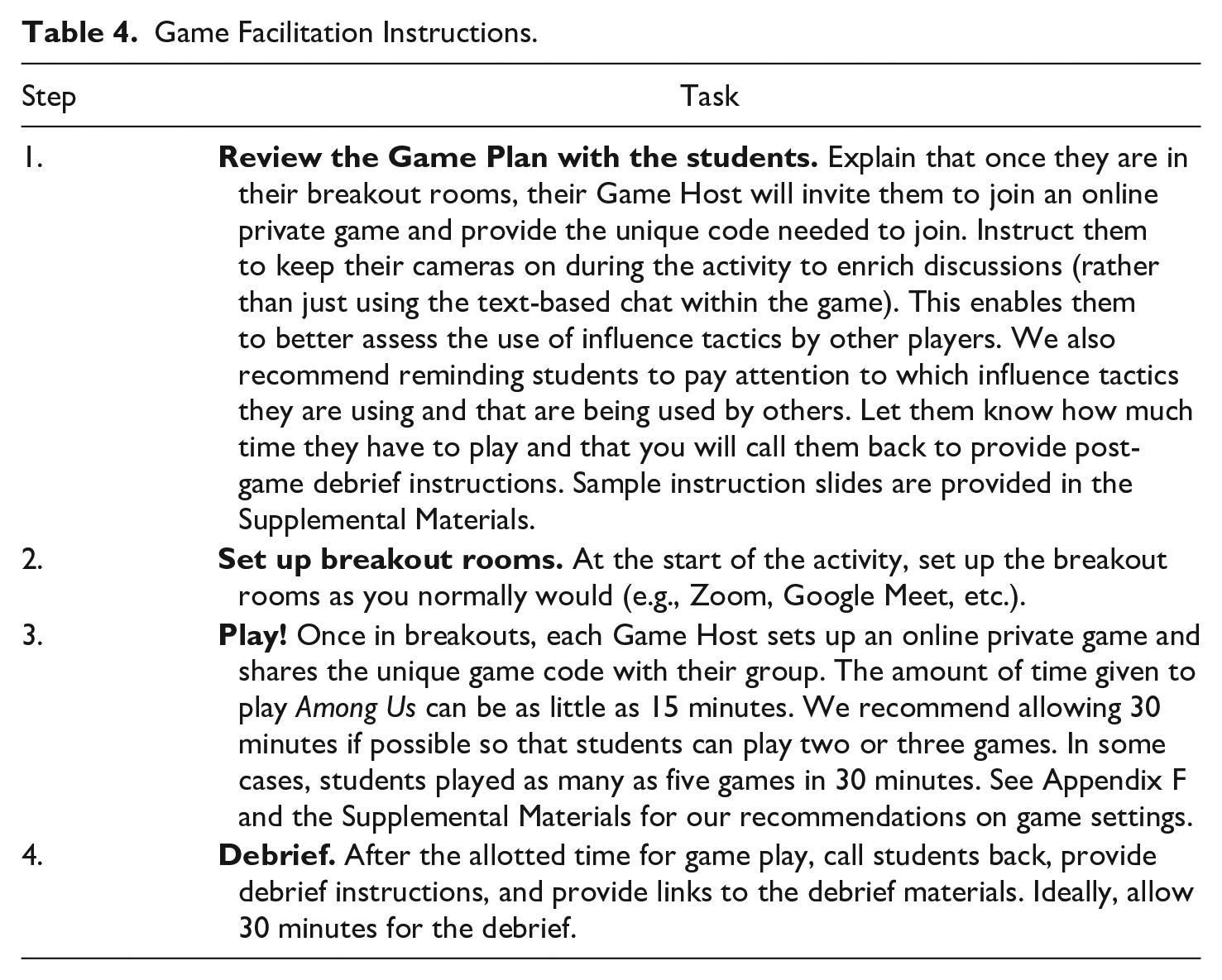
Tables 3 and 4 provide instructions for preparation and facilitation of this activity. We provide instructions for debriefing a synchronous virtual class below (and provide additional debrief details in Appendix B). Appendix C describes extensions to additional topics. Appendix D describes variations. Appendix E provides preparation instructions for students. Appendix F describes recommended game settings.
Game Preparation Instructions.
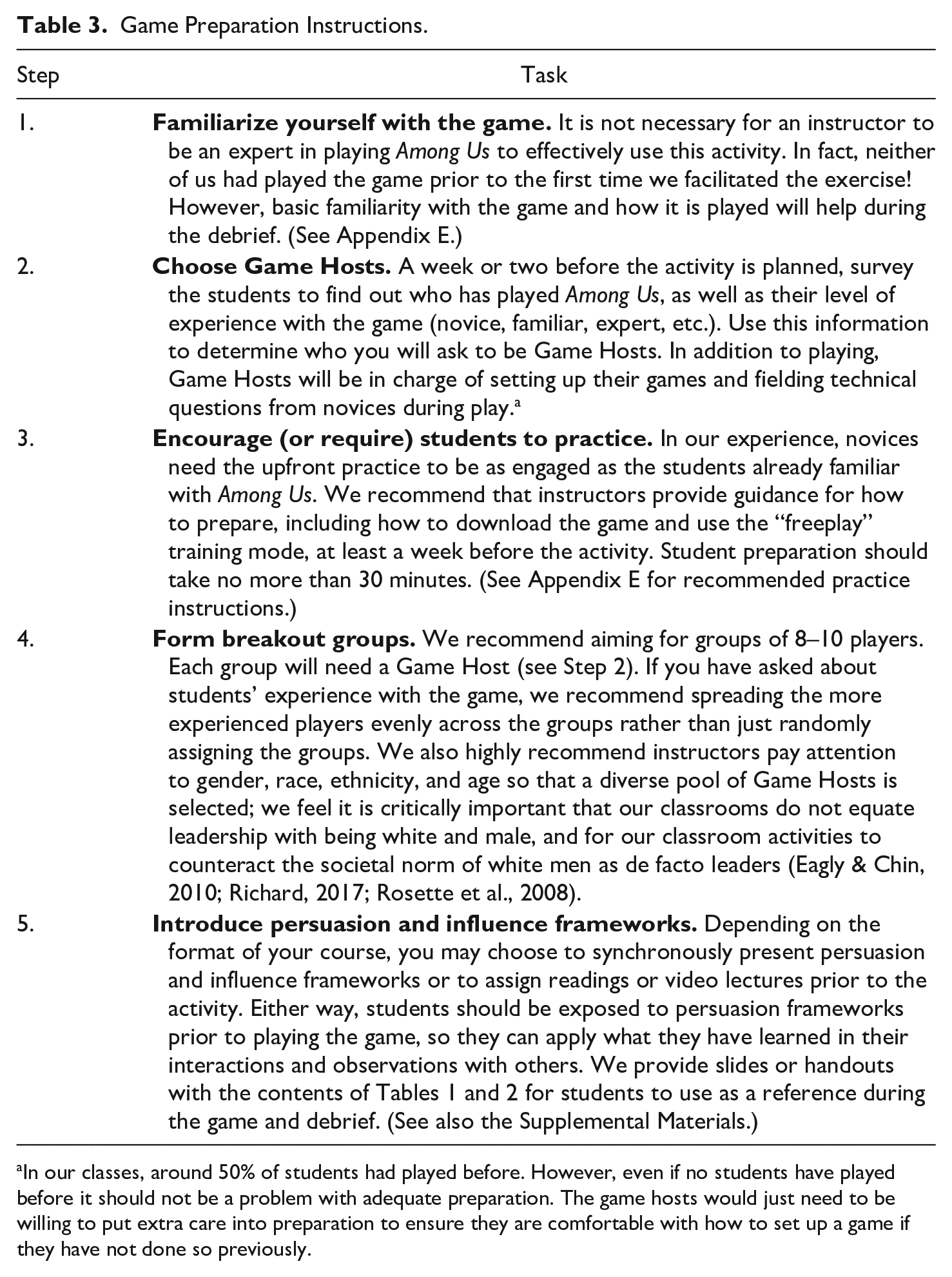
In our classes, around 50% of students had played before. However, even if no students have played before it should not be a problem with adequate preparation. The game hosts would just need to be willing to put extra care into preparation to ensure they are comfortable with how to set up a game if they have not done so previously.
Game Facilitation Instructions.
Instructions for Debriefing the Exercise
There is flexibility in terms of the debrief strategy, depending on a given instructor’s approach to teaching power, persuasion, and influence. In the virtual environment, we find that allowing the groups to debrief among themselves and then to return to a large group creates a higher level of engagement than an all-class debrief. Prior to the group debrief, we recommend giving students 2 minutes to individually write out their responses to the prompts below to give them time to think about their experiences before engaging with others. To create accountability, we set up a shared space using Google Slides (see the Supplemental Materials for a slide deck containing debrief instructions which could be used in a shared format of the instructor’s choice) where each team discusses and then documents their thoughts with respect to the following three questions:
1. What sources of power did you have during this activity? Which didn’t you have? Why?
2. Which influence tactics did you try or did you observe?
3. Which influence tactics were unlikely to work in this game and why?
Give groups 10 to 15 minutes to discuss and document their answers to these questions within the shared space. Since we are able to see their progress within the slides, we can join rooms that appear to be struggling, and adjust the time to match the students’ progress.
We recommend a 15-minute, full class wrap-up to recap and reinforce the takeaways. We use the three questions from the breakout rooms, which connect back to the Learning Objectives, as the structure for the final wrap-up.
We recommend including a discussion of how situations constrain behavior due to sources of power. Possible questions include: Was this realistic? What kinds of workplace situations have similar contexts to this game? How do the typical workplace opportunities for persuasion and influence differ from this experience?
Given that deception is a necessary component of Among Us, we recommend concluding the debrief with a discussion of the ethical considerations surrounding the use of deception and persuasion tactics. Both trust and transparency are by design undermined in Among Us; yet both are necessary conditions for successful, ethical relationships (see the Debriefing Guide in Appendix B).
Conclusion
While management educators cover persuasion and influence across a variety of courses, experiential activities on these topics are rare, particularly relative to other topics like teamwork, leadership, and negotiation. Among Us gave us a way to bring to life the various sources of power and persuasion tactics.
Among Us, like many other experiential activities, allowed us to reinforce the readings and make connections to other topics. But, importantly, it was truly a gift for our classroom communities. That the students had fun is something that we do not want to undervalue; in the middle of a pandemic and civil unrest, the students appreciated the opportunity to work together on something silly and fun, to laugh, and to connect in small groups. Student engagement during the activity and during the debriefs was high. A little “edutainment” went a long way.
Supplemental Material
sj-pptx-1-mtr-10.1177_23792981221104197 – Supplemental material for A Little “Edutainment” Goes a Long Way: Leveraging Among Us®, a Popular Multiplayer Game, to Teach Persuasion Virtually
Supplemental material, sj-pptx-1-mtr-10.1177_23792981221104197 for A Little “Edutainment” Goes a Long Way: Leveraging Among Us®, a Popular Multiplayer Game, to Teach Persuasion Virtually by Esther Sackett and Lisa M. Amoroso in Management Teaching Review
Footnotes
Appendix A
Appendix B
Appendix C
Appendix D
Appendix E
Appendix F
Acknowledgements
The authors acknowledge the Women of Organizational Behavior Facebook group, whose supportive community facilitated this collaboration.
Declaration of Conflicting Interests
The authors declared no potential conflicts of interest with respect to the research, authorship, and/or publication of this article.
Funding
The authors received no financial support for the research, authorship, and/or publication of this article.

Notes
References
Supplementary Material
Please find the following supplemental material available below.
For Open Access articles published under a Creative Commons License, all supplemental material carries the same license as the article it is associated with.
For non-Open Access articles published, all supplemental material carries a non-exclusive license, and permission requests for re-use of supplemental material or any part of supplemental material shall be sent directly to the copyright owner as specified in the copyright notice associated with the article.
