




Abstract
Although prior scholarship has highlighted the challenge that suburban ethnic communities pose to traditional theories of assimilation, less attention has been given to how many Asian residents these neighborhoods capture relative to traditional urban enclaves. Without understanding this demographic reach, it is difficult to assess whether suburban concentration represents a modest extension of enclave settlement or a more substantial reorganization of Asian residential patterns. This data visualization addresses that gap by examining trends from 1990 to 2020 in the distribution of Asian populations across urban and suburban ethnic neighborhoods in the 50 U.S. metropolitan areas with the largest Asian populations. Although urban ethnic neighborhood shares remain substantial, suburban shares have increased sharply. By 2020, nearly one in six Asians in these metropolitan areas resided in suburban ethnic neighborhoods, and in 16 of 50 metropolitan areas suburban shares exceeded their urban counterparts, compared with just 2 in 1990. These findings show that concentrated Asian settlement is no longer anchored primarily in the urban core but is increasingly distributed across both urban and suburban space, reflecting a broader reorganization of ethnic settlement across metropolitan areas.
Classic theories of immigrant incorporation have understood suburbanization as a defining stage of spatial assimilation (Massey 1985). By moving from dense urban ethnic enclaves into more integrated suburban neighborhoods, immigrant groups were expected to achieve upward mobility and greater exposure to majority-group populations, both vital to their assimilation (Alba and Nee 2003). However, early studies noted a number of divergent cases in which ethnic communities persisted in suburban settings (Alba, Logan, and Stults 2000; Logan, Zhang, and Alba 2002), and a growing body of scholarship on Asian “ethnoburbs” suggests that this pattern has endured—and may have strengthened—in recent decades (Kye 2023; Li 2009). Yet although this work clearly demonstrates that suburban ethnic communities are on the rise, it offers less clarity about how many Asian residents these communities capture. Without examining what share of the Asian population resides in such neighborhoods, and how that compares with traditional urban enclaves, it is difficult to assess whether suburban concentration represents a modest extension of enclave settlement or a more fundamental reorganization of Asian residential patterns.
This data visualization addresses this gap using a sample of the 50 U.S. metropolitan areas with the largest Asian populations in 2020, together accounting for approximately 85 percent of the Asian population nationwide. Because the sample is defined using 2020 population thresholds, the trends we document capture both changes within long-standing Asian destination metropolitan areas and the increasing prominence of areas that have more recently emerged as such. We examine trends in both the number of urban and suburban ethnic neighborhoods and the share of the Asian population residing within each, focusing directly on the distribution of Asian populations across metropolitan space. This approach complements prior work that has primarily examined ethnic neighborhoods in terms of their number or changing composition.
To define ethnic neighborhoods, we identify census tracts that are at least 25 percent Asian and classify them as urban or suburban according to tract location. Although any threshold used to define neighborhood types necessarily involves judgment, the 25 percent cutoff identifies neighborhoods that rank in the 91st percentile of Asian population share in our sample of 37,685 census tracts. Additional analyses demonstrate that the central patterns hold under alternative cutoffs ranging from 10 percent to 50 percent; further discussion of measurement choices and robustness checks is provided in the Supplementary Materials.
We track these measures from 1990 to 2020 to assess how Asian settlement patterns have evolved over time. Figure 1 presents the results in two stages: Figures 1A and 1B document aggregate trends across all 50 metropolitan areas, while Figures 1C and 1D examine urban and suburban patterns within individual metropolitan areas. Three core patterns emerge.
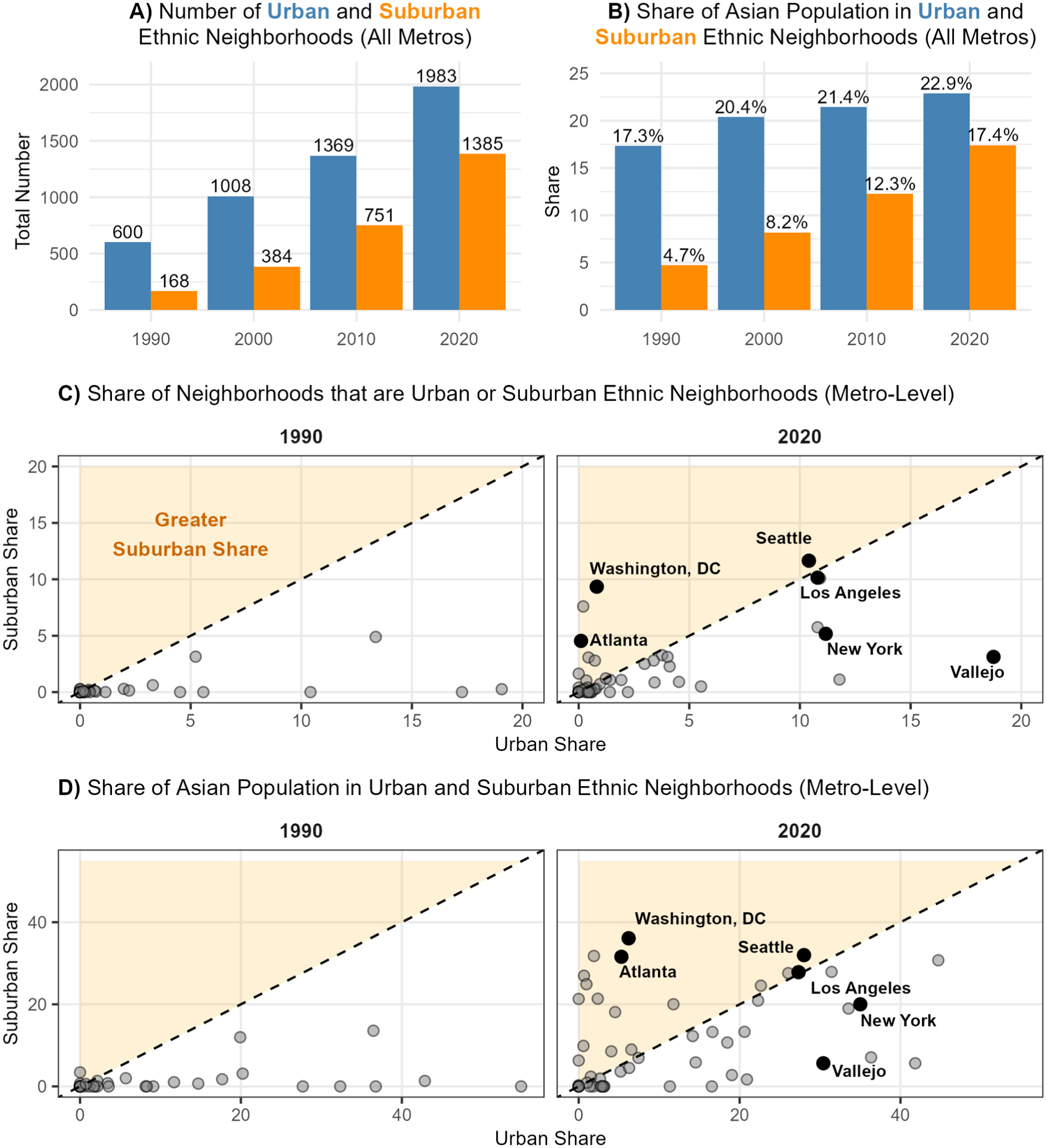
Trends in Asian ethnic neighborhoods by urbanicity and Asian population distribution across and within metropolitan areas, 1990–2020. (A) Number of urban and suburban ethnic neighborhoods (all metropolitans areas). (B) Share of Asian population in urban and suburban ethnic neighborhoods (all metropolitans areas). (C) Share of neighborhoods that are urban or suburban ethnic neighborhoods (metropolitan area level). (D) Share of Asian population in urban and suburban ethnic neighborhoods (metropolitan area level).
First, the number of Asian ethnic neighborhoods expanded dramatically (Figure 1A). Those in urban areas (e.g., enclaves) increased from 600 in 1990 to 1,983 in 2020, while their suburban counterparts (e.g., ethnoburbs) grew even more rapidly in proportional terms, rising from 168 to 1,385 over the same period. Although urban neighborhoods remain more numerous overall, growth in suburban ethnic neighborhoods accelerated sharply. Second, these structural changes correspond to meaningful shifts in where Asian residents live (Figure 1B). The share of the Asian population residing in urban ethnic neighborhoods increased modestly, from 17.3 percent to 22.9 percent, between 1990 and 2020. In contrast, the share residing in suburban ethnic neighborhoods more than tripled, rising from 4.7 percent to 17.4 percent; by 2020, nearly one in six Asians in these metropolitan areas lived in “ethnoburb”-type settings.
Third, metropolitan area–level comparisons show that this shift is not confined to a handful of gateway cities. Figure 1C compares the share of neighborhoods within each metropolitan area classified as urban and suburban ethnic neighborhoods, whereas Figure 1D compares the share of each metropolitan area’s Asian population residing in each neighborhood type. In 1990, most metropolitan areas exhibited relatively low levels of suburban representation, and urban shares generally exceeded suburban shares. In practical terms, the suburbs were a marginal site of concentrated Asian settlement. By 2020, however, many metropolitan areas display marked growth in both suburban ethnic neighborhood prevalence (Figure 1C) and population share (Figure 1D). The distribution of metropolitan outcomes in Figure 1D further suggests two distinct trajectories. On one hand, in many metropolitan areas where urban ethnic neighborhood population shares have remained low, suburban areas have emerged as a new locus of ethnic settlement (e.g., Washington, DC, Atlanta). On the other hand, in metropolitan areas with historically larger enclave shares, suburban ethnic neighborhoods now account for an increasing share of the Asian population alongside, and in some cases exceeding, that of their urban counterparts (e.g., Seattle, Los Angeles). This pattern stands in contrast to metropolitan areas where the urban ethnic neighborhood infrastructure remains dominant (e.g., New York, Vallejo). All told, the suburban ethnic neighborhood population share exceeds that of urban ethnic neighborhoods in 16 of the 50 metropolitan areas (excluding 1 edge case driven by extremely small population counts; see the Supplementary Materials for details).
Taken together, these findings reveal a broader reorganization of ethnic settlement across metropolitan space. Although suburban ethnic communities have long been recognized, our analyses show that they now account for a substantial, and in some metropolitan areas majority, share of the Asian population residing in ethnic neighborhoods. In some metropolitan areas, they constitute the new ethnic neighborhood infrastructure, while in others they complement, or in some cases supplant, established enclave systems. Concentrated settlement is therefore no longer anchored primarily in the urban core but is increasingly distributed across both urban and suburban contexts. As a result, the geography of Asian incorporation may be less characterized by dispersion than by the emergence of a dual system of ethnic neighborhoods spanning city and suburb.
By establishing the scale and redistribution of Asian populations across urban and suburban ethnic neighborhoods, our analysis provides a basis for future work to reassess the role of the “suburban” stage in immigrant incorporation. One possibility is that suburban residence has shifted toward the beginning, rather than the end, of the assimilation process, reflecting broader changes in patterns of immigrant settlement. Alternatively, these patterns may reflect more class-selective forms of suburbanization, reshaping the consequences of an otherwise intact spatial assimilation process in an era of rising inequality. The processes driving these urban and suburban settlement patterns, and the extent of redistribution itself, are also likely to vary across subgroups within the broad “Asian” category. Ultimately, a more detailed account of suburban ethnic neighborhoods may shape new understandings of how ethnic settlement unfolds across metropolitan space and shapes broader patterns of immigrant incorporation.
Supplemental Material
sj-pdf-1-srd-10.1177_23780231261442407 – Supplemental material for The Changing Distribution of U.S. Asian Populations across Urban and Suburban Ethnic Neighborhoods
Supplemental material, sj-pdf-1-srd-10.1177_23780231261442407 for The Changing Distribution of U.S. Asian Populations across Urban and Suburban Ethnic Neighborhoods by Samuel H. Kye and Zhongze Wei in Socius
Footnotes

Funding
The authors received no financial support for the research, authorship, and/or publication of this article.
Declaration of Conflicting Interests
The authors declared no potential conflicts of interest with respect to the research, authorship, and/or publication of this article.
Supplemental Material
Supplemental material for this article is available online.
Author Biographies
References
Supplementary Material
Please find the following supplemental material available below.
For Open Access articles published under a Creative Commons License, all supplemental material carries the same license as the article it is associated with.
For non-Open Access articles published, all supplemental material carries a non-exclusive license, and permission requests for re-use of supplemental material or any part of supplemental material shall be sent directly to the copyright owner as specified in the copyright notice associated with the article.
