




Abstract
In his classic Who is Black? One Nation’s Definition, James Davis examined the construction of Blackness from the country’s roots through the close of the twentieth century. In this article the author extends Davis’s project by drawing on original survey data that examines present-day Black Americans’ own understandings of Black identity. The author also examines how self-classification as Black alone, Black-White, and Black-other relates to these measures, to open-ended descriptive self-identification, and to classifying oneself as “multiracial.” Black-alone and Black-in-combination respondents largely concur in how they assess the relevance of one’s self-identification and factors related to biological race conceptions when thinking about whether someone is Black. However, the groups diverge on what importance they give to others’ appraisals and cultural and experiential factors when assessing Black identity; they also differ in their own open-ended racial identifications. In contrast to concerns raised in some prior work, Black-alone respondents do not see multiraciality as disqualifying of Blackness. That the identity difference along which views of Black identity split is unrelated to the topics of the split is striking. The author argues that this Black-multiracial identity paradox may help illuminate how intragroup cohesion is possible alongside growing within-group diversity.
By the early 1900s, uncertainty about the placement of people of mixed African and other ancestries in the U.S. racial hierarchy had given way to widespread national adoption of the infamous “one-drop rule” regulating Blackness on the basis of hypodescent (Davis 2001; Monk 2022; Yancey 2003). The rule, at first developed as a tool for White elites to streamline oppression, imposed significant harms upon all those with known African ancestry. Yet it soon revealed itself as a double-edged sword, as Black Americans coopted the rule as a mechanism for building group size and cohesion. In the context of a racial system governed by a severe White/Black binary hierarchy, questions about within-group distinctions and divisions, while never entirely absent, took a back seat to a shared struggle against White racism through most of the twentieth century (Davis 2001; Du Bois [1899] 1996; Frazier 1955; Hochschild and Weaver 2007).
In the twentieth century’s closing decades, once-suppressed within-group differences began to emerge more prominently. Interracial marriage and multiraciality became more common and more recognized (Brunsma and Rockquemore 2002; Roth 2005; Williams 2006). Several million Black immigrants whose families did not experience slavery or formal segregation arrived in the United States (Hamilton 2020). The aftermath of the civil rights movement yielded greater class variation among Black Americans, and Hispanic and Asian American immigration transformed the U.S. racial system from binary to nuanced (Harris and Khanna 2010; Iverson et al. 2022; Pilgrim 2021; Rabe and Jensen 2023; Wilson 2012). And important changes continue in the new century: the past two decades have seen the election of America’s first Black president, followed by its most openly racist president in a century; the coming of age of a generation whose closest family memories of formal segregation come from grandparents rather than parents; and surges in both movement and countermovement mobilization related to civil rights and Black Americans’ standing. Numerous scholars have asked whether shared Black collective identity remains cohesive or has begun to fracture on the basis of self-identification, skin tone, socioeconomic class, and other factors (Albuja et al. 2023; Franco et al. 2019; Hochschild and Weaver 2007; Monk 2015). For these reasons, reexamination of Black Americans’ understandings of Black identity is warranted.
This study therefore draws on closed and open-ended survey data from 163 Black Americans to consider two related sets of questions. First, I ask how self-classification as Black maps onto other forms of racial identity. For instance, how does self-classification as Black alone, or as Black in combination with some other race, relate to open-ended expressions of race? How do Black people who classify themselves as “multiracial” think about their and other Black Americans’ racial identities? Second, what factors do Black Americans consider especially important in Black identity broadly, and how do these patterns vary by mono- or multiraciality, education, age, gender, and related factors? These two components address complementary aspects of how group boundaries are constructed: the identity logics that respondents apply to themselves, and the criteria they apply to others. Together, they illuminate how Black Americans construct and appraise Blackness for themselves and others in twenty-first century America.
Analyses reveal an intriguing pattern. Respondents who checked “Black or African American” alongside at least one other race option differ significantly from Black-alone respondents in how they describe their racial identity on a separate, open-ended question. Furthermore, numerous differences in views of Black identity emerge between these two groups. By contrast, other factors that might have divided respondents, such as educational attainment (Lacy 2007), gender (Collins 2022), and political ideology (Dawson 1994; Fields 2016), have limited to no effects on views of Black identity. However, the key differences that emerge do not concern Black-alone respondents doubting the group belonging of Black-in-combination respondents. Instead, the groups diverge on what importance they give to cultural and experiential factors (including socioeconomic background, ancestors’ experiences of slavery and segregation, and time spent with same-race others) and external appraisals (by Americans broadly, by Black people, and by peers and others during childhood) as crucial elements of Black identity. By contrast, Black-alone and Black-in-combination respondents agree on the roles of self-identification and traditional biological understandings of race in Black identity.
I argue that the fact that the identity difference along which views of Black identity split is unrelated to the topics of the split is striking, given that academics have long asked whether mono- versus multiracial identity might split the Black community but rarely if ever considered whether these groups’ divergences might centrally concern factors other than multiraciality. I term the pattern that emerges the Black-multiracial identity paradox and argue that this concept enhances our understanding of Black American identity in the modern U.S. racial system.
Literature Review
For nearly three centuries after the arrival of enslaved people in North America, norms for ascribing membership in racial categories such as White, “Negro,” “Mulatto,” and various fractional groups to people of mixed ancestry were subject to inconsistency, contestation, and local variation (Biewen 2017; Gross 2008; Haney López 1996; Kendi 2016; Williamson 1995). But following the rollback of Reconstruction in the late 1800s, the “one-drop rule,” previously one among several different categorization regimes, attained dominance. Though developed and used by White supremacists to significant effect, the rule simultaneously of heightened shared identity among all those marked as Black (Davis 2001; Monk 2022).
Notable shifts began to occur in the last third of the twentieth century. The U.S. civil rights movement unleashed policy changes that enhanced class mobility for some, resulting in greater within-group class differentiation (Andrews 2004; Landry and Marsh 2011; Wilson 2012). The prevalence and recognition of interracial marriage and multiracial ancestry grew, culminating in a “mark all that apply” identification policy from the U.S. Census Bureau in 2000 and raising questions about weakening of the one-drop rule (Brunsma and Rockquemore 2002; DaCosta 2007; Iverson et al. 2022; Roth 2005; Williams 2006; see also Schachter, Flores, and Maghbouleh 2021 and Feliciano 2016). New waves of Black immigrants whose families did not experience slavery or formal segregation arrived in the United States, troubling the assumed link between these family experiences and Black identity for about a tenth of Black Americans (Hamilton 2020). And growing numbers of new Americans of Hispanic and Latine, Asian, and Middle Eastern ancestry transformed the U.S. racial system from binary to nuanced (Iverson et al. 2022; Rabe and Jensen 2023).
Scholars of the early twenty-first century have argued that continuing strong Black cohesion should not be taken for granted. These scholars have pointed especially to multiraciality and other aspects of racial identity, class variation, and skin tone variation as potential axes along which intragroup cohesion might break down. In terms of racial identity and multiraciality, some studies find that White/Black multiracial individuals tend to both be classified by others and to feel accepted as Black, in part because legacies of the one-drop rule fostered a broad sense of shared identity (Ho et al. 2011; Parker et al. 2015). However, psychologist Marisa Franco and her colleagues have argued that some Black nationalists reject multiracial Blacks as “inauthentically Black” (Franco et al. 2019), that many people of mixed White and Black ancestry experience some rejection at the hands of both White and Black relatives for crossing racial lines (Franco et al. 2020), and that feeling rejected by Black people is highly damaging to Black multiracial people’s emotional well-being when it occurs (Franco and Franco 2015; Franco and Holmes 2017; see also Campion 2019 and Waring 2023). In a recent addition to this set of studies, Albuja et al. (2023) found that individuals who consider themselves Black-alone identify as much with mixed-ancestry White-Black individuals who identify as biracial as they do with those who identify as Black but feel less empathy toward those who identify as White. Related, one study showed that many White-Black multiracial individuals deliberately sometimes “pass” as monoracially Black in part to avoid rejection and be perceived as fully part of a Black collective (Khanna and Johnson 2010; see also Pilgrim 2021).
Other studies hint at the possibility of division around class variation, either on its own or in connection to color-based stratification. Harris and Khanna (2010) asked whether Black identity might fracture along a monoracial/multiracial identity split but instead found that growing socioeconomic differentiation might pose a greater risk to collective identity than multiraciality. Another array of studies has revealed significant stratification by skin tone in Black Americans’ health, wealth, and longevity (Monk 2015). This line of research sometimes examines connections between within-group color stratification and collective identity; for example, Hochschild and Weaver (2007) noted significant within-race inequality by skin tone and argued that this poses a latent challenge to group unity should darker skinned Blacks raise it as a political issue, as within-race color stratification rivals traditional White/Black racial stratification in its severity. However, they argued that the traditional White/Black binary is sufficiently entrenched, and a sense of shared fate among Black Americans deeply enough embedded, to suppress consideration of color stratification, a phenomenon they termed “the skin color paradox” (Hochschild 2006; Hochschild and Weaver 2007; see also Monk 2015).
Despite their study’s strengths, much of Hochschild and Weaver’s (2007) data drew from the late twentieth century. This raises the question of whether a sense of shared fate still overrides possible divisions in a new century that has seen significant anti-racist mobilization and backlash, continued diversification, and explosive growth in multiracial recognition. This study therefore examines how Black Americans in the twenty-first century conceive of Blackness (i.e., what elements or factors they see as crucial when considering whether someone is Black) as well as the relationships between their own racial identities, self-classifications, and self-understandings as monoracial or multiracial.
Methods
Data for this study come from a larger survey conducted in 2019. I contracted with Lucid, a major national sample provider, to gauge Americans’ views on a range of race-related topics. The original sample was constructed to be representative of English-speaking 1 American adults by race, gender, age, and region, and included more than 1,100 respondents. The survey included mostly closed-ended questions, with a few open-ended questions. The survey was approved by my university’s institutional review board.
All analyses here include only respondents who checked “Black or African American,” either by itself or in combination with other choice(s), in response to a closed-ended race question (details to follow). The final sample used in these analyses included 163 Black respondents. The Appendix presents more information on the survey design, process, and respondents. One set of analyses in this article draws on all 163 respondents, while another set draws on a subsample of 85 who received a question about the importance of various cues in deciding if another person is Black (the other 78 were randomized to an alternative treatment and received a question about White identity; see Table A1 in the Appendix for information about all respondents). Although the sample size imposes some limitations on statistical power and inference, I argue that findings are nonetheless intriguing and meaningful; I address this point fully in the discussion.
The first set of variables concerns cues used in assessing whether a person is Black. The question read,
Imagine you are trying to decide whether someone in the US is black/African American or not, and you have access to a large amount of information about them. Please identify how much each of the following factors matters in you deciding whether they are black/African American or not.
This stem was followed by 13 specific factors; respondents rated the factors on a five-point scale ranging from “irrelevant” to “essential” in deciding race. I drew these factors from sociological literature on racial appraisals and attribution (e.g., Morning 2018; Roth 2016, 2018; Schachter et al. 2021; Vargas and Kingsbury 2016) as well as by examining online discussions among laypeople (e.g., discussion pages from Quora, Reddit, and similar sites on whether race is “real,” what constitutes race, whether people of certain descriptions would qualify as part of a given race, and similar topics). Ultimately, this process yielded more options examined for assigning race than those in prior studies. This variety added complexity but allows more nuance, which may be useful, as prior research (e.g., Schachter et al. 2021) has shown that the weight given to culture and experience varies according to which specific cues are involved.
The order of factors was randomized. The factors were as follows:
That they consider themself black/African American
That their parents or family considered them black/African American
That people around them but outside their family (peers, teachers, neighbors, etc.) when they were growing up considered them black/African American
That most black/African American people would consider them black/African American
That most Americans in general would consider them black/African American
That they had a socioeconomic background like most black/African American people
That they or their ancestors experienced slavery or segregation
That they had a cultural upbringing like most black/African American people
That they spend significant amounts of time around people who are black/African American, or as a member of a black/African American community
That they have definite or probable African ancestry
That their genetics are more similar to typically African/black than to other groups
That they physically appear black/African American
That they are not also part of another racial group
In interpreting results, these factors conceptually cluster loosely into four dimensions. The first prompt above, “That they consider themself black/African American,” is the one factor related to self-identification as a basis for Black identity. The next four items (parents’ or family’s views, others’ views in childhood, most Black people’s appraisals, and most Americans’ appraisals) gauge what importance respondent give to other people’s appraisals. The following four items (socioeconomic background, family experiences of slavery or segregation, 2 cultural upbringing, and time spent with Black people) together gauge the importance of culture and experiences as part of Black identity. A final four items (ancestry, genetics, physical appearance, and not being part of another racial group) examine the prevalence of traditional biological conceptions of race. 3 Following Ghoshal (2025a), I do not argue for a single correct way to group these items, but rather that these clusters conceptually cohere reasonably well and therefore serve as a useful interpretive tool.
A second set of key variables involves respondents’ race. In line with evidence on distinctions between self-categorization and self-identification, especially among people of mixed ancestry (e.g., Brunsma, Delgado, and Rockquemore 2013), I asked about respondents’ race in three different ways. The first came at the start of the survey and asked simply, “What is your race?” Participants responded in an open-ended manner; this corresponds to what Roth (2016) called racial identification. Then near the end of the survey, another question asked, “Are you multiracial? That is, are you part of two or more racial groups?” and offered checkboxes for the mutually exclusive options “Yes, I am multiracial,” “No, I’m not multiracial,” and “I’m not sure.” The multiraciality question was followed by one more race question: “Just to make sure we understand your self-identification fully, please mark which racial group or groups below you belong to. You can check multiple options if needed.” Options were “White,” “Hispanic or Latina/o,” “Black or African American,” “Asian,” “American Indian/Native American (Cherokee, etc.),” and “Other.” This corresponds to self-classification (Brunsma et al. 2013) and was the filter, as all respondents who did not check the “Black or African American” box were removed from analyses.
I also included measures of education, skin tone, age, gender, region, and political ideology. Education is measured on a 5-point scale, while skin tone is measured on a 10-point scale based on the item
Imagine you’re placing yourself on a scale that sorts all people in the United States by skin color, with number 0 representing the lightest skin and number 10 representing the darkest skin. Where would you place yourself on the scale?
Age is a simple numeric variable. Only 2 of more than 1,100 respondents in the larger project indicated a nontraditional gender, so gender uses a binary classification of women contrasted to all others. Region is a nominal variable with four possible values that I dichotomize into South versus non-South, and ideology is self-assessed on a five-point scale ranging from “very conservative” (1) to “very liberal” (5), with “none of the above” and “I don’t know” responses coded alongside “moderate or centrist” as 3.
All analyses were conducted in Stata. I began with t tests comparing Black-alone and Black-in-combination respondents’ views of the bases of Black identity. I then ran regression analyses bringing in education, skin tone, age, gender, region, and political ideology, and also ran models that compare Black-alone, Black-White, and Black-other respondents. As the key outcomes were evaluated on five-point scales, I tested both ordinary least squares (OLS) and ordered logistic regressions to examine all patterns. These methods produced very similar results with the exception that the ordered logit versions yielded more statistically significant predictors than the OLS version. To be cautious, I present the OLS version.
Findings
Descriptive Results
Responses to the open-ended race question cohered into several categories. The great majority of respondents simply wrote in “Black,” “African American,” or a variant such as “Afro-American”; these responses formed the first category (n = 129). The second group wrote in a single racial identity other than Black or its close derivatives, for example, “White” (n = 14). A third group listed two or more different races (n = 9), while the fourth group included responses such as “multiracial” without specifying identities (n = 9). Two responses fell outside all these patterns. For the closed-ended racial group question, responses clustered into three groups: Black or African American alone (n = 113), Black-White (including those who also chose additional identities, n = 24), and Black-other but not White (n = 26).
Part 1: Appraisals of Black Identity
Figure 1 and Table 1 present the importance of various factors when deciding whether someone is Black, as rated by Black respondents. Items are ordered by overall importance across the subsample. Black Americans consider African ancestry, a family history of experiencing slavery or segregation, racial attribution by parents or family members, self-identification, and physical appearance as the most important factors overall. Conversely, few respondents see not being part of another racial group (a reverse one-drop rule), having a socioeconomic background like that of most Black or African American people, or spending time with Black or African American people as essential elements of Black identity (see also Ghoshal 2025a).
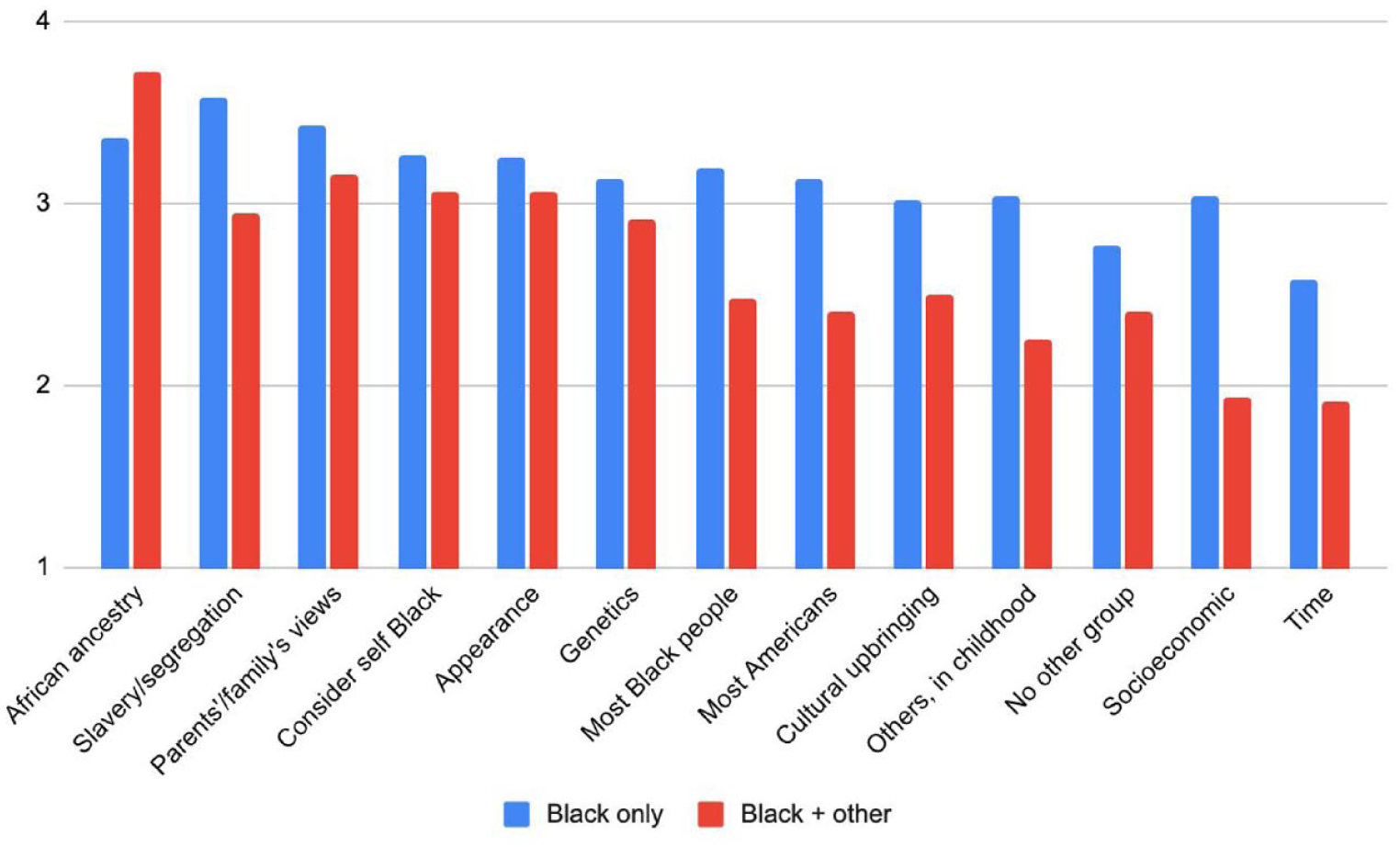
Factors in Black Americans’ appraisals of Black identity.
Importance of Various Factors to Black Identity (Subsample n = 85).

Note: See the “Methods” section for full item wordings. Items are ordered within each cluster by overall mean importance, on a scale ranging from 1 (“irrelevant”) to 5 (“essential”). Significant differences (at p ≤ .05) are in boldface type for readability.
p < .10. *p < .05. **p < .01. ***p < .001.
Black-only and Black-in-combination respondents share some commonalities, but also differ in some notable ways, when evaluating Black identity. Specifically, both groups regard whether someone has African ancestry, their parents’ or family’s views of their race, their physical appearance, and their self-identification as of above-average importance, their genetic characteristics as moderately important, and their cultural upbringing and not being part of another racial group as of low importance compared to other factors. However, Black-alone respondents rate six factors as more important in determining whether someone is Black. The gap is largest for having a socioeconomic background like most Black people (3.04 for Black-alone respondents vs. 1.94 for Black-in-combination respondents on the five-point scale, p < .001). It is also large and statistically significant for assessments during childhood by non–family members (3.04 vs. 2.25, p < .01), assessments by most Black people (3.19 vs. 2.47, p < .05) and by most Americans (3.13 vs. 2.41, p < .05), spending time with other Black people (3.58 vs. 2.94, p < .05), and family experiences of slavery and segregation (3.58 vs. 2.94, p < .05). Ancestry is the only factor mixed-race Black respondents rate as more important, though this difference does not reach significance.
Table 1 and Figure 1 establish some intriguing bivariate differences. However, given that researchers have flagged various demographic factors as potential flashpoints for division (e.g., Harris and Khanna 2010), I consider the possibility that the differences are driven by other underlying factors. Table 2 presents OLS models that simultaneously consider respondents’ age, educational attainment, political ideology, skin tone, gender, and region (South vs. non-South), alongside Black-only versus Black-in-combination self-classification, as potential influences on what factors are seen as important to Black identity. Model set 1 reveals a pattern largely consistent with the bivariate analyses: mixed- versus single-race membership remains significant in five of the original outcomes, while family experiences of slavery or segregation falls just below significance. Ancestry continues to run opposite to the other factors, albeit nonsignificantly so. Gender matters for two of the outcomes and region for one. Overall, evidence for the Black-alone and Black-in-combination effect remains strong, while all other factors show much smaller or no impact.
Factors Shaping Views of Determinants of Black Identity, 1-to-5 Scale (Subsample, n = 85).

Note: Significant differences (at p ≤ .05) are in boldface type for readability. Regressions of importance of each factor, scale ranging from 1 (“irrelevant”) to 5 (“essential”). See text for full item wordings and predictor descriptions. For model set 1, the first row includes respondents who chose only “Black or African American”; the reference group is those who chose at least one other option (in addition to “Black or African American”). For model set 2, the first row denotes respondents who chose Black in combination with choice(s) other than “White” (e.g., those who chose “White” are excluded from this group), and the second denotes those who chose Black along with White, while the reference group is Black-only respondents. To conserve space, regressions for the four factors on which no differences were significant in either model (self-identification, genetics, appearance, and parents’ or family’s views) are not shown.
p < .10. *p < .05. **p < .01. ***p < .001.
Model set 2 presents the same regressions, but with mixed-race Black respondents separated into those who also selected “White” (with Black alone or with Black and other races) and those who selected another race, but not White. The reference category here is Black-alone respondents. This set of models is consistent with model set 1 but also builds beyond it. The Black-other and Black-alone groups differ across only two factors: socioeconomic background (1.28-point difference, p < .01) and nonfamily treatment during childhood (0.83-point difference, p < .05). However, the Black-White and Black-alone respondents diverge significantly on the importance of six factors: family experiences of slavery or segregation, socioeconomic background, the views of most Americans, the views of most Black people, cultural upbringing, and childhood treatment by non–family members. 4 The sizes of these gaps remain striking. For instance, socioeconomic factors, slavery and segregation experiences, and the reflected appraisals of most Americans are more than 1 point more important to Black-alone respondents than to one or both other groups. In most cases, Black-other respondents place midway between the other two groups. One exception is slavery and segregation experiences, the only item that significantly varies between Black-other and Black-White respondents (this set of contrasts not shown; 1.25-point difference, p = .01); it does not vary between Black-alone and Black-other respondents.
In summary so far, (1) there are some convergences but also significant differences in the factors that Black-only and Black-in-combination individuals consider most important when deciding if someone is Black; (2) this pattern of differences is driven mainly by the contrast between Black-alone and Black-White respondents; and (3) by contrast, there is weak to no evidence that factors such as education, skin tone, political ideology, age, or gender shape Black Americans’ views of Blackness. I next turn to a set of questions asked to the full sample to examine how respondents’ own self-categorizations, open-ended racial identities, and self-ascribed multiraciality interrelate.
Part 2: Self-Identification Patterns
The remaining analyses consider the full sample of 163 respondents and their views of their own identities. Table 3 maps the relationship between respondents’ self-classifications of “which racial group or groups you belong to,” which allowed multiple responses, and their open-ended racial identification, written out. The first column shows that among the 113 respondents who checked only the “Black or African American” box, 109 (96.5 percent) also gave an open-ended response that suggests monoracial Black identification, such as “Black” or “black” (n = 69), “African American” or “Afro-American” (n = 36), or slight variants such as “Black American” (n = 4). However, open-ended identifications were more varied among those who checked two or more boxes. Examining all Black-in-combination respondents together (i.e., combining columns 2 and 3) reveals that only 40 percent (20 of 50) wrote out open-ended racial identities suggesting monoracial Black or African American identity, a significant difference (p < .001) from the Black-only fixed-choice group. Specifically, for respondents who checked Black alongside another non-White option(s) (column 2), Black-alone open-ended identifications remained most common (17 of 26 [65.4 percent]), but more than a third (9 of 26 [34.6 percent]) gave open-ended responses indicating a mixed-race or non-Black monoracial identification. And for those who checked both the Black and White boxes (column 3), the departure is dramatic: only three of these 24 individuals indicated Black or a variant as their open-ended racial identity (12.5 percent). Writing out a single identifier other than Black (e.g., White or Mexican) was the most common open-ended response for this group (n = 8 [33.3 percent]), followed by terms such as mixed or multiracial (n = 7 [29.2 percent]) and indicating the exact combination(s) (n = 5 [20.8 percent]). In fact, in stark contradiction of the “one-drop rule,” solely White identification was more common than solely Black identification on the open-ended question, among this group (6 vs. 3 cases). 5
Open-Ended Race Responses by Self-Classification (n = 163).
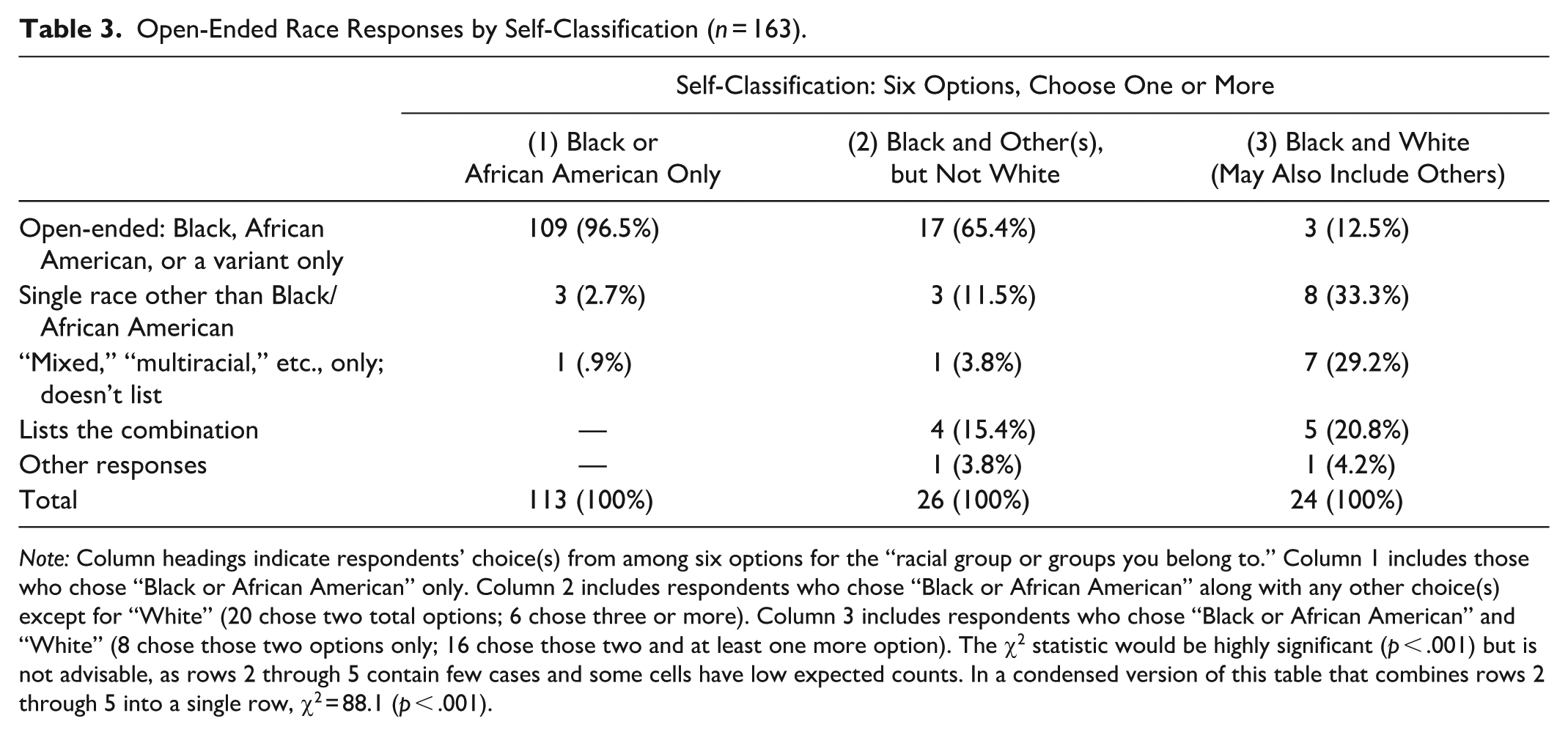
Note: Column headings indicate respondents’ choice(s) from among six options for the “racial group or groups you belong to.” Column 1 includes those who chose “Black or African American” only. Column 2 includes respondents who chose “Black or African American” along with any other choice(s) except for “White” (20 chose two total options; 6 chose three or more). Column 3 includes respondents who chose “Black or African American” and “White” (8 chose those two options only; 16 chose those two and at least one more option). The χ2 statistic would be highly significant (p < .001) but is not advisable, as rows 2 through 5 contain few cases and some cells have low expected counts. In a condensed version of this table that combines rows 2 through 5 into a single row, χ2 = 88.1 (p < .001).
The finding that self-categorized Black-other respondents identify simply as Black or African American (on the open-ended question) far more often than (self-categorized) Black-White respondents do is intriguing. This pattern raises the question of whether these Black-other individuals reject self-labeling as multiracial (even if they recognize multiple races in response to a forced-choice question), or rather accept the “multiracial” label just as much as Black-White respondents, but do not find complex descriptions as valid or useful as “Black” or “African American” when describing their identity.
Tables 4 and 5 help adjudicate these possibilities: they show that Black-other respondents are not more rejecting of the idea that they are multiracial writ large. Rather, they are simply less likely to see it as part of their (open-ended) racial identity. Specifically, Table 4 shows that 22 of 24 Black-White and 22 of 26 Black-other (non-White) respondents respond “Yes, I am multiracial” when directly asked, an insignificant difference. (Although the χ2 test is significant, the significant difference is only between Black-only respondents and the other groups.) Table 5 confirms that respondents who elected “No, I’m not multiracial” or “I’m not sure” are highly likely to have written out a monoracial Black identity (95.3 percent and 87.5 percent, respectively), while those who self-identify as multiracial are only slightly better than even odds to have done so (54.8 percent). In combination with the earlier results, this pattern shows that self-classified Black-White and Black-other respondents are about equally likely to consider themselves multiracial, but that this multiracial self-classification carries over to open-ended racial identity far more for the Black-White group than for the Black-other group, who largely opt to note solely Black identity.
Multiracial Self-Identification by Self-Classification (n = 163).
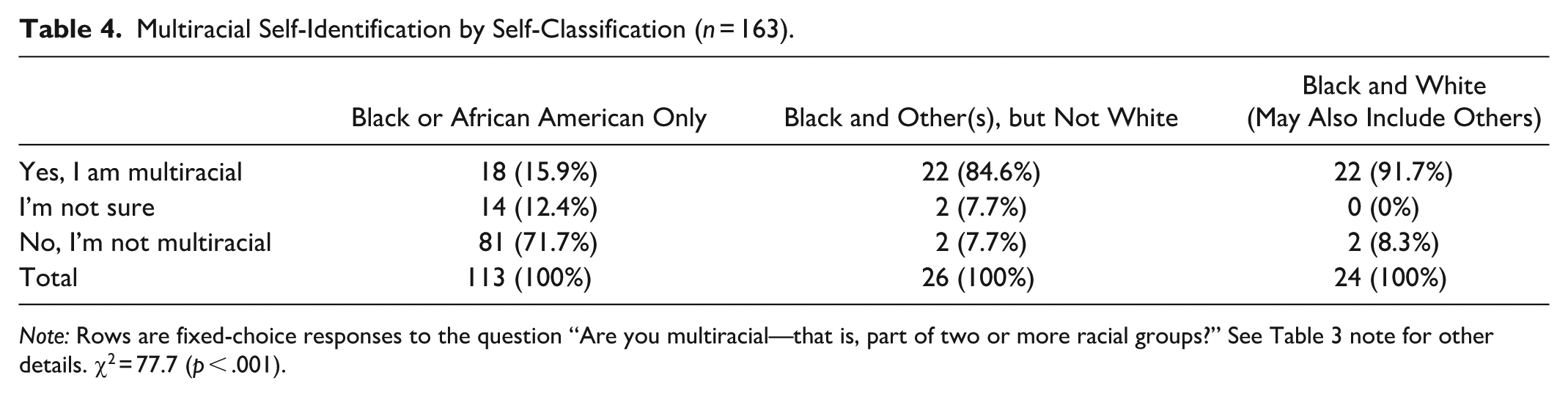
Note: Rows are fixed-choice responses to the question “Are you multiracial—that is, part of two or more racial groups?” See Table 3 note for other details. χ2 = 77.7 (p < .001).
Open-Ended Identifications by Multiracial Responses (n = 163).

Note: The χ2 statistic is not used here, as rows 2 through 5 contain few cases and some cells have low expected counts, but would be significant at p < .001 if used. In a version of this table that condenses rows 2 through 5, χ2 = 38.78 (p < .001).
Discussion
In this study, I inquired into whether Black Americans are divided in how they conceive of Black identity, and if so, on what grounds. In part 1, I examined the criteria respondents use when assessing whether others are Black, that is, how they draw boundaries of Black identity. In part 2, I then considered how those same individuals locate themselves with regard to identity boundaries through their own self-identification and open-ended racial descriptions. Examining the two parts together shows how various facets of mono- versus multiracial identity organize variation both in how respondents evaluate others and in how they represent themselves. Although the part 2 measures are not direct mirrors of the appraisal items in part 1, they tap the same underlying processes of self-location within, or alongside, Blackness. Taken together, the two sets of findings reveal that the key factor along which views of Black identity diverge, mono versus multiracial identity, is not the dimension individuals cite as most relevant when evaluating Blackness. The full dynamics of this disjunction become visible through consideration of both boundary appraisals (part 1) and self-identification practices (part 2).
The results of part 1 show many points of agreement but also some important differences. Most demographic splits—educational attainment, skin tone, gender, age, region, and ideology—yield very few or no differences in understandings of Blackness. And Black-alone and Black-in-combination respondents regard six factors (whether someone has African ancestry, their parents’ or family’s views of their race, their physical appearance, their self-identification, their genetic characteristics, their cultural upbringing, and not being part of another racial group) similarly. However, Black-only respondents diverge from Black-in-combination respondents in how heavily they weigh seven other factors when thinking about whether someone is Black. Most of this divergence is driven by the Black-alone vs. Black-White contrast, with Black-other (non-White) respondents in between. The results of part 2 show that although self-classified Black-alone individuals overwhelmingly also self-identify on an open-ended question as Black, self-classified Black-other respondents are less likely, and self-classified Black-White respondents dramatically less likely, to do so. However, Black-White respondents are not more rejecting than Black-other respondents of multiracial self-classification. They are simply less likely to opt into multiraciality as an identity (see also Brunsma et al. 2013).
In considering implications, several points merit elaboration. First, the factors that Black-alone individuals weigh more when appraising Blackness all concern culture and experiences and other people’s appraisals. In fact, Black-alone respondents differed from either all others (Table 2, model set 1) or at least one of the other two groups (Table 2, model set 2) on all four culture and experiences factors (slavery and segregation histories, cultural upbringing, socioeconomic background, and time spent with Black people) and on three of the four external appraisals items (appraisals by Americans generally, by Black people, and by one’s peers and others during childhood, but not by parents or family). By contrast, Black-alone self-classification did not boost the perceived relevance of the self-identification dimension, nor any of the four items related to biological conceptions of race. In fact, ancestry emerged as the only item that Black-in-combination respondents placed greater emphasis on, albeit insignificantly so.
This pattern might arise if being appraised as Black more often and believing one’s experiences are more typically of Black people fuel adoption of a Black-alone identity, as some prior research hints (e.g., Khanna 2010). By contrast, being less often appraised as Black or believing that one’s culture and experiences are less typical might lead some to ground their Blackness more in ancestry, a claim that cannot be invalidated by others’ interpretations, and to an increased likelihood of developing a Black-in-combination identity. That said, it is also possible that adoption of a Black-alone or Black-in-combination identity itself shape beliefs about the centrality of various factors. Future research should delve deeper into causality here.
Second, there are intriguing possible relationships between several of the variables considered in this article. Multiracial Black people may be externally appraised as Black less often than monoracial Black people; they may also experience less “typically Black” cultural upbringings or socioeconomic backgrounds. For these reasons, Black Americans who are part of multiple racial groups might nonetheless face greater within-community questioning of their belonging than others, even if their multiraciality is only indirectly implicated. Researchers should continue to build on existing work addressing relationships between these factors (Harris and Khanna 2010; Waring 2023).
Third, the finding that mono- and multiracial Black people’s views of Black identity diverge, but do so on topics orthogonal to mono- and multiraciality, raises the question of whether similar patterns characterize other racial groups. Some scholarship has suggested that U.S. versus foreign nativity (e.g., whether one grew up in the United States or not) and Spanish language ability may be among the key demographic divides for Asian American and Hispanic American populations, respectively (Lee and Kye 2016; Mora and López 2023). Scholars might consider whether individuals on different sides of these splits see these splits themselves, or instead other factors (e.g., country of origin, cultural knowledge, or other factors), as crucial in determining “authentic” Asian or Hispanic identity. Given that strong White identity is typically associated with very conservative racial politics but sometimes arises in very progressive ones (Hughey 2020), inquiry as to Whites’ understandings of the meanings of “White authenticity” and divisions in Whiteness might also be worthwhile.
Fourth, the study has several limitations. First, the sample size is small. The main impact is to make significant differences that might exist less likely to be found, as significance tests are designed not to overinterpret possible sample noise. That numerous significant patterns nonetheless emerged is striking and suggestive of intriguing group differences. However, all findings here should be interpreted somewhat cautiously given the possibility of sample noise. Expanding the sample would yield greater confidence in the patterns uncovered.
Second, although the closed-ended racial group membership question achieves its intended aim of capturing self-classification, future work might include a question on whether respondents have known ancestry from any group that they do not consider themselves part of. This could yield insights into the relationship between known ancestry, self-classification, and multiracial identities.
Third, this study establishes intra-Black differences in appraisals of Blackness, but not whether these differences yield splits in policy views. Should intra-Black divergences in political ideology, for example, grow, such divisions might disrupt group unity even without affecting conceptions of Blackness. Future work might address this question.
One further intriguing question is whether patterns might have shifted during the national surge in attention to racial inequality following the 2020 murder of George Floyd and a related Black Lives Matter protest wave. However, it is likely that the 2020–2022 wave had limited, if any, effects on the patterns considered here. The early 2020s “racial reckoning” focused on racial inequality, rather than complications in Black racial identity. Indeed, the mixed racial ancestry of prominent Black victims of police shootings both before and after the 2020 protest wave (e.g., Tony Robinson in 2015, Daunte Wright in 2021) received almost no mention in media coverage and seemed to neither impede nor aid Black-led protests around their deaths (New York Times 2022; Schneider 2015; WTAQ 2015). Organizational statements in the wake of the 2020 protests highlighted anti-Black racism broadly (Wang et al. 2022), rather than differences in Black experiences by skin tone or multiraciality. Given that Black Americans have always seen race as highly salient, heightened attention to race affected Whites’ racial views more than Blacks’ (al-Gharbi 2024). Furthermore, views on many topics related to the “reckoning” reverted to pre-2020 levels by 2025 or earlier, both among Americans broadly and among Black Americans (Horowitz, Cox, and Hurst 2025). That said, only new data collection could address this question definitively.
Conclusion
Scholars have long wondered whether several different factors, including multiraciality, educational/class variation, and skin tone, might split the Black community’s views of “authentic” Blackness, but typically assumed that the content of this split would mirror its demographic basis (e.g., Campion 2019; Franco et al. 2019; Hochschild and Weaver 2007). 6 The most intriguing findings of the study should be read in that context. Many of the potential axes of difference considered here do not produce divergent understandings of Blackness. Instead, the findings of part 1 reveal that multiracial self-classification emerges as the only frequently significant predictor of varying views of Blackness, and the findings of part 2 show that open-ended racial identities differ significantly for self-classified Black-alone, Black-White, and Black-other respondents. That Black-alone and Black-in-combination respondents do not just see their own racial identities differently, but also think about the grounds for Black identity differently, might seem to support concerns about fracture along this difference. However, findings reveal that the identity difference around which views of Black identity split is different than the substantive topics of that split. That is, though the views of Black-alone Americans and Black-in-combination respondents diverge when assessing Black identity, the divergence concerns external appraisals and cultural experiences, not whether being “also part of another racial group” (monoracial vs. multiracial identity) is disqualifying of Blackness. Neither group sees Black-only identification as essential.
Following Hochschild and Weaver’s (2007) deployment of the “skin tone paradox” concept to explain how color stratification significantly affects Black Americans’ lives yet often does not yield self-conscious political division between light- and dark-skinned Black people, I term this mismatch between ideological differences and the identity split that produces those differences the Black-multiracial identity paradox. Individuals who identify as Black-alone see Black identity somewhat differently than those who consider themselves also part of other racial groups. Were they to see authentic Black identity as necessarily involving rejection of other racial identities, this divergence might grow in significance along an us/them divide, bringing to the fore some of the most worrisome possibilities addressed by Franco et al. (2019) and Albuja et al. (2023) and potentially yielding enduring splits. That the identity characteristic along which views of Black identity split (mono- vs. multiracial identity) does not mirror what the split is about (experiential and cultural factors and external appraisals) is fortuitous, as it may well lessen the potential for these divergent views to fracture the community. Future research should explore this possibility. The Black-multiracial identity paradox may help explain why intracommunity division about identity and a broad shared understanding of Blackness so often coexist simultaneously, but the broad understanding most often carries the day.
Footnotes
Appendix: Survey Methods and Sample
Data are drawn from a survey I ran through an online survey provider, Lucid, in 2019. The company is the largest survey sample provider in the United States, and its samples have been used in dozens of academic studies (e.g., Coppock and McClellan 2019; Haeder, Sylvester, and Callaghan 2021; Lunz Trujillo et al. 2021; Sylvester 2021). Lucid provides a sample designed to be representative of English-speaking American adults in terms of race, gender, age, and region. It aggregates multiple panels and publishers and routes preprofiled panelists to studies through application programming interfaces, and uses respondents’ stored demographics (e.g., age, sex, race/ethnicity, region) to fill eligibility and quota targets. Because recruitment occurs across many upstream sources (rather than a single sampling frame) and surveys were accepted only for those who answered all questions, a conventional AAPOR response rate is not defined (Cint 2023). Coppock and McClellan (2019) found that “demographic and experimental findings on Lucid track well with US national benchmarks” (1) and that its sample representativeness is superior to alternatives such as Amazon Mechanical Turk (4), a finding echoed by Stagnaro et al. (2024) (9 and 10).
The survey, which addressed respondents’ views on race, included mostly closed-ended questions along with a few open-ended questions (see Ghoshal 2025a for further details). The median respondent took slightly longer than 15 minutes. The initial full completed sample (including people of all races) consisted of more than 1,100 respondents, but exclusion of those who did not select “Black or African American” narrowed the sample size to 163. The first two columns of Table A1 show demographic information on the final sample used here. The education categories included less than high school, high school only, associate degree or some college, college degree, and postgraduate degree. The five-point ideology scale ranged from “very conservative” (1) to “very liberal” (5), with “moderate or centrist,” “none,” and “don’t know” scored as 3. For comparison with the national Black population, the two right columns present national demographic benchmarks for Black adults drawn from IPUMS’s census data (Ruggles et al. 2025) plus a national political ideology benchmark drawn from Gallup (Saad 2022; see table note).
The sample nearly perfectly matches national benchmarks for Black adults on education and ideology, and shows small to modest composition differences by region, gender, and age. Differences are large for the share of Black respondents who report being part of multiple racial groups. 7 It is likely that the survey’s focus on racial identity encouraged Black respondents to report additional information that often goes unreported in census responses. The finding that more than 30 percent of Black respondents reported being part of at least one other racial group is quite plausible given evidence that a large majority of Black Americans have at least some non-Black ancestry and that racial identity and multiraciality are fluid across contexts and prompts (Brunsma et al. 2013; Bryc et al. 2015; Citrin, Levy, and Houweling 2014; Davenport 2020). Should Black-in-combination respondents nonetheless be overrepresented, this study’s central focus on comparing these groups and the inclusion of the Black-alone versus Black-in-combination terms in regressions mitigates the impact of possible differences (just as a study that oversampled Black respondents generally could nonetheless compare Black and White respondents’ characteristics).
1
The survey was offered only in English. Most Black Americans (96.2 percent) speak English only or speak English “very well” in addition to another language (author’s calculation using American Community Survey data described in the  ; Ruggles et al. 2025; see also Martinez and Passel 2023). Although research incorporating non-English-speakers would be valuable, developing multiple versions of the survey in different languages was not logistically feasible. See the Appendix for more information.
2
The intent of the slavery and segregation item was to examine whether Black Americans draw a strong identity boundary between those whose families were present during slavery and segregation, and later arrivals. For a striking example of difference claims, see Dickerson (2007), who argued that Barack Obama “isn’t black. ‘Black,’ in our political and social reality, means those descended from West African slaves. Voluntary immigrants of African descent (even those descended from West Indian slaves) are just that, voluntary immigrants of African descent with markedly different outlooks on the role of race in their lives and in politics.” See also on recent controversies around calls for reparations to descendants of enslaved people (“foundational Black Americans”) but not to other Black Americans. Future research might also consider views on whether experiencing discrimination in interpersonal or organizational contexts is a core element of Black identity.
3
Biological conceptions of race as a set of genetically determined discrete groups are unsound but nonetheless widespread, and investigation of the patterning of these conceptions is worthwhile. See Morning (2011) and Roth, Van Stee, and Regla-Vargas (2023) for elaboration.
4
These patterns were identical in regressions that used solely the Black-alone, Black-White, and Black-other terms with no controls (not shown).
5
In addition to the Black-alone versus all others contrast, all three intergroup contrasts here are significant at p < .001. This analysis makes no assumptions about whether self-classification is best seen as a cause or an effect of open-ended racial identity, but using open-ended identifications as the denominators shows the same patterns. Of the 129 people whose open-ended responses suggested monoracial Black identification, 109 (84.4 percent) chose only Black in the closed-ended question, while 20 (15.5 percent) chose two or more groups. On the imperfect overlap between individuals who check multiple race boxes and those who self-describe as multiracial, see .
6
7
The absolute standardized mean difference for gender is .10 and for region is .20, while that for age is .30 and for Black-alone/Black-in-combination is .61. Differences of .20 and lower are typically considered small, .30 is considered small to moderate, and .61 is considered large. See, for example, .