



Abstract
Research examining racial disparities in the labor market has recognized Black-White gaps in earnings and various career outcomes. However, relatively little attention has been given to the potential discrepancy in employment stability across races. Prior studies also lacked proper controls for individual productivity and occupational classification, leaving the observed differences between races open to question. Leveraging the National Basketball Association’s comprehensive individual performance records and team data, the author examines whether Black players experience less stable employment experience compared with their White counterparts. The findings reveal that Black players tend to sign shorter non-entry-level contracts and have lower probabilities of signing new contracts with their current teams, even when individual productivity is held constant. Additional analyses suggest that these disparities in contract length and renewal rates are unlikely to be a consequence of strategic choices made by players. Employment stability is a crucial but often overlooked aspect of workplace inequality. By highlighting these disparities, this study underscores the need to consider stability alongside more traditional markers of inequality such as earnings and reflects the broader systemic inequalities that can shape career outcomes.
Research on racial inequality in the labor market has long identified gaps in incomes and multiple career attainments between Black and White employees (e.g., Grodsky and Pager 2001; Huffman and Cohen 2004; Kalev, Dobbin, and Kelly 2006; Mandel and Semyonov 2016; Manduca 2018; McBrier and Wilson 2004; Zhang 2022). However, the existing literature has paid less attention to the potential racial difference in employment stability and thus may not have captured the total extent of racial gap in the workplace. Often denoting a stable relationship between an employer and an employee, employment stability plays an essential role in job quality and as a cause of broader inequalities (Bidwell 2013; Hollister 2011). For example, prior work has shown that involuntary job loss and precarious job can lead to reduced opportunities for career advancement, lower income levels, and adverse health outcomes (Brand 2015; Gangl 2006; Kalleberg 2000, 2009; Pedulla 2016; Weisshaar 2018; Young 2012).
So far, the literature on employment stability has focused on the changing trend of job stability over time and possible gaps among different groups defined by gender, education level, and sector differences (Diebold, Neumark, and Polsky 1997; Farber 2008, 2010; Hollister and Smith 2014; Swinnerton et al. 1995; see Hollister 2011 for a review). There has been little literature regarding the variation in employment stability between Whites and those from racial minority backgrounds in the workforce, especially in recent years. Furthermore, early studies on racial difference in employment stability were limited by lacking close control of individual productivity or fine-grained occupational classification scheme (e.g., Boisjoly, Duncan, and Smeeding 1998; Diebold, Neumark, and Polsky 1997; Marcotte 1998). Therefore, it cannot be ruled out that any differences identified among races are consequences of those confounded variables.
The field of professional sports, such as professional basketball, provides an unusually rich empirical setting in which to study racial disparities in employment stability. The National Basketball Association (NBA) offers detailed, time-sensitive, and objective measures of both individual and team performances, allowing researchers to better isolate whether employment outcomes differ by race even when players perform at comparable levels (Norris and Moss-Pech 2022; see also Fonti, Ross, and Aversa 2023). Moreover, the league offers sufficient examples of players’ entering and completing multiple contracts over their careers, enabling a systematic examination of employment continuity and turnover across time.
Although the NBA is unique, the dynamics that shape employment stability, including both employer evaluations and employee responses, are not confined to professional sports. On the employer side, contract and retention decisions may still be affected by racial stereotypes and subjective judgments. On the employee side, cross-racial relationships between players and decision-makers can influence work satisfaction and career continuity. In the NBA, although Black athletes are numerically dominant, team owners and managers remain predominantly White, making such dynamics especially relevant. If racial disparities in employment stability emerge even in a setting where Black athletes are highly visible and sometimes viewed through relatively positive stereotypes, similar disparities may plausibly exist in other, less transparent and more exclusionary labor markets as well. In this sense, the NBA serves as a strategic case that helps illuminate how racial gap in employment stability can persist even in meritocratic, performance-based environments.
Rather than aiming to assess whether there is an overall racial disparity in employment stability in the U.S. labor market, in this study I use the NBA as a case to reveal such gaps, when players’ individual productivities are measured to the fullest extent and without being confounded by occupational differences. The purpose is not to empirically identify the specific mechanisms that generate these disparities but to provide evidence that such racial gaps in employment stability exist and warrant further investigation in broader and more representative labor market settings. Given the unique characteristics of the NBA setting, I selected two variables to measure the employment stability of the players, which differ from the measures used in previous research, the duration of a player’s contract and the likelihood that he can renew his contract with the current team (see the following discussion for further rationale for choosing these two measures). With data on players, teams, and their contracts all merged into a relational dataset, I found that compared with their White counterparts, Black players have non-entry-level contracts of shorter durations. Black players also face reduced opportunities to sign new contracts with their current teams, net of other factors. The shorter contract durations and lower renewal rates suggest on average a less stable career trajectory for Black players, if not indicate explicit career disadvantages for them. I also conducted a few supplemental analyses to further investigate whether such disparities are likely to be the consequences of players’ strategic choices.
This research sheds light on a crucial yet often overlooked aspect of racial difference in the American workplace. Although income and career advancement are integral to one’s professional trajectory, the stability of the work environment and protection from job loss are equally significant. Finally, I discuss the implication of this study and the generalizability of its findings to a broader scope of job settings in the U.S. labor market.
Race in the Workplace and Employment Stability
Scholars of racial gap in the U.S. workplace have identified persistent gaps in various labor market attainments between Whites and racial minorities, especially Black people. Black employees consistently receive lower wages than White counterparts (Cancio, Evans, and Maume 1996; Chetty et al. 2019; Grodsky and Pager 2001; Huffman and Cohen 2004; Mandel and Semyonov 2016; Manduca 2018). Black employees also face fewer opportunities in attaining jobs (Bertrand and Mullainathan 2004; Gaddis 2015; Neckerman and Kirschenman 1991; Pager, Western, and Bonikowski 2009; Tomaskovic-Devey, Thomas, and Johnson 2005), achieving leadership (Kalev et al. 2006; Merluzzi and Sterling 2017; Wilson and Maume 2013; Zhang 2022), and getting promoted (Castilla 2008; Wingfield 2009) but a higher likelihood of suffering from injuries (Berdahl and McQuillan 2008). Prior literature also shows that Blacks are more likely to experience downward mobility from white-collar jobs to blue-collar ones (McBrier and Wilson 2004; Wilson 2009). However, less clear is the potential racial and ethnic gap in career stability (Hollister 2011).
Since the 1990s, there has been growing concern over the weakening of long-standing commitments between employers and employees in the United States, resulting in a notable shift from stable, long-term employment toward a more flexible and precarious labor market, embodied by shorter job duration, higher involuntary job losses, and the rise of nonstandard work (Hollister 2011; Kalleberg 2009). Nonetheless, empirical research has produced mixed findings in this regard. Prior scholarly attention has focused on verifying the existence of this declining trend and assessing its variation across different social groups defined by genders, ages, education levels, and sector differences (e.g., Farber 1995, 2008, 2010; Gottschalk and Moffitt 2000; Hollister 2012; Hollister and Smith 2014; Kambourov and Manovskii 2008).
Less attention has been given to potential racial disparities in employment stability. Early studies indicated that Black employees experienced some decline in job stability from the 1970s to the 1990s, especially facing shorter job durations or higher likelihood of job loss (Diebold, Neumark, and Polsky 1997; Marcotte 1995, 1998; Swinnerton et al. 1995). However, there are a few limitations of these extant studies. First, these studies focused on the changing trend of Black employees’ employment stability over time rather than the potential gap in job stability across races. In fact, some studies revealed no significant racial difference in the stability of single employment in the 1980s (Marcotte 1995; Swinnerton et al. 1995). Moreover, previous studies relied primarily on general social surveys, which often fail to adequately consider factors such as time-sensitive individual performance (e.g., Boisjoly et al. 1998; Diebold et al. 1997; Marcotte 1998). Without precise accounting for individual productivity, it is challenging to dismiss the possibility of any association between unequal employment stability and individual performance.
Another potential drawback of the previous studies is that they lacked fine-grained occupational classification schemes. For example, in the study of Boisjoly et al. (1998), only five occupational categories were specified. Therefore, it is not clear whether the difference in employment stability between different races is a consequence related to race or some occupational features.
The NBA as a Case
Although the NBA is often seen as a unique social setting, this league provides a strategic case for the research of employment and workplace inequality, and it has been frequently used by related previous studies (Biegert, Kühhirt, and Van Lancker 2023; Ertug and Castellucci 2013; Norris and Moss-Pech 2022; Staw and Hoang 1995; Zhang 2017, 2019). One advantage of using the NBA as a case is its wide availability of information about players and teams. For example, third parties such as basketball-reference.com and realgm.com provide detailed records of players’ individual performance every season and information about their contracts and their paths of playing for different teams over time. This data availability makes it possible for researchers of labor market outcomes to effectively observe and measure the individual productivity or human capital of employees, which is not usually feasible in most settings or cases.
As one of the four major professional sports leagues in the North America, the NBA is currently made up of 30 teams from United States and Canada, which are divided into two conferences (East and West) and six geographical divisions (Atlantic, Central, Northwest, Pacific, Southeast, and Southwest). An NBA season consists of a regular season and a playoff season. In the regular season, every team plays against every other team at least twice. The top 8 teams in each conference then attend the playoff games to compete for the final championship.
Every year, the league sees many cases of players’ joining and leaving teams for work. There are two ways for a player to join or leave a team. First, as a free agent, a player can sign a new contract with a team, mostly during the offseason period. The tenure of a contract is in most cases already determined at the time the contract is signed. 1 Second, a player can also be traded from one team to another. In this case, the current contract is still effective and is fulfilled by the new team until it ends, though a player’s contract can also be terminated under certain circumstances. 2
Potential Racial Gap in Employment Stability in the NBA
Previous studies about the racial gap in labor market outcomes focused on wage gaps and yielded mixed results (Hoang and Rascher 1999; Kahn 2009; Kahn and Shah 2005). Meanwhile, scholars also found a higher likelihood of exiting the field (i.e., shorter career lengths) for Black players than their White counterparts, which partly explains the racial gap in players’ overall career earnings (Hoang and Rascher 1999; Norris and Moss-Pech 2022). Nevertheless, it is still not clear what contributes to this gap in career length between Black and White players. It could be because it is more difficult for a Black player to get a job with a team, a phenomenon that is well studied (Bertrand and Mullainathan 2004; Gaddis 2015; Neckerman and Kirschenman 1991; Pager et al. 2009; Tomaskovic-Devey et al. 2005). It is also possible that Black players face shorter duration and more uncertain experiences of a single employment than White players, a phenomenon that has rarely been explored.
One of the factors that can potentially shape unequal stability between Black and White employees is stereotypes held by employers. Previous studies have shown that racial stereotypes can affect labor market outcomes, especially hiring outcomes (Bertrand and Mullainathan 2004; Gaddis 2015; Pager et al. 2009; Turner, Fix, and Struyk 1991; and see Pager 2007 and Pager and Shepherd 2008 for further review). However, the impact of stereotypes is likely to persist, even after employees enter an organizations. For example, employers are found to disfavor employees linked with stereotypes associated with lower social status, holding all else constant, when assessing employee performances, allocating rewards, and making promotion decisions (e.g., Biernat and Kobrynowicz 1997; Castilla 2008; Gorman 2006; McKay and McDaniel 2006). Literature on double-standard theory and results of laboratory experiments also suggest that individuals from groups associated with negative stereotypes face heightened rigorous scrutiny when they achieve high-quality performance, contradicting their perceived productivity (Foschi 1996, 2000).
Prior literature has shown that in the workplace, Black employees are associated with general negative stereotypes. Previous interviews and surveys have shown that employers hold general negative stereotypes about Black workers, regardless of their actual experiences of interacting with their own Black employees. These stereotypes are mostly associated with the reliability and productivity of Black employees, especially young Black men, such as lacking work ethic, having an inappropriate attitude and self-presentation, and being low in dependability (Moss and Tilly 2000; Neckerman and Kirschenman 1991; Pager and Karafin 2009).
These broader racial stereotypes are reflected, to some extent, in perceptions of Black and White players in the NBA. Although Black players constitute the majority of athletes in the league, and many have achieved notable athletic and financial success, this visibility does not mean that negative racial stereotypes are absent. White players are also subject to particular stereotypes, such as the trope that “White men can’t jump” (Stone, Perry, and Darley 1997), but it would be overly simplistic to conclude that anti-Black bias or racial discrimination is irrelevant within the NBA. Research by Boyd and Shropshire (2001), for example, suggests that race remains a salient lens through which fans perceive and interpret NBA games. Commentaries and fan surveys have shown that Black players or those with darker skin tones are often portrayed as naturally athletic and physically gifted, whereas White players or those with lighter skin tones are more frequently described as intelligent, hardworking, mentally disciplined, and team oriented (Bruce 2004; Foy and Ray 2019; Rada and Wulfemeyer 2005; Stone, Perry, and Darley 1997). Moreover, White players’ good performance and achievements are more likely to be recognized compared with Black players, net of all else (Foy and Ray 2019).
Second, the league’s ownership and upper-level management remain overwhelmingly White, and some high-ranking decision-makers have been found to hold or express disparaging views of Black players. These portrayals often frame highly paid Black athletes as undisciplined, prone to misconduct, or in need of professionalization (Griffin and Calafell 2011). Although Black players are frequently praised for their athleticism and competitiveness, they are simultaneously burdened with negative stereotypes related to professionalism, work ethic, and perceived fit within team culture, echoing broader narratives that have historically shaped perceptions of Black workers in the labor market.
These stereotypes can shape managerial perceptions of their long-term value as employees, particularly in decisions involving contract renewals or continued investment in their development. In this way, racialized assumptions about character and employability may undermine Black players’ employment stability, despite strong athletic performance. Even in the absence of personal bias, managers may act in ways that correspond with the expectations of fans or the broader public. As a result, there is likely to be a significant difference in employment stability between comparable Black and White players. In contrast, the positive attributes ascribed to White players, such as being intelligent, disciplined, and team oriented, align more closely with managerial ideals of long-term employability. These favorable perceptions may bolster White players’ employment stability by reinforcing their perceived reliability and compatibility with team dynamics. As a result, comparable Black and White players may experience significantly different employment outcomes over time.
Meanwhile, it is also possible that choices on the player side may also lead to a less stable employment. Although Black players hold numerical dominance in the NBA, most of the managerial and decision-making positions of the league office and NBA teams are still held by Whites (see, e.g., Lapchick 2022; Statistia 2025). Black players may be more likely than their White counterparts to have negative experience with their current work environment or the decision-makers of their current teams. Previous studies in other occupational fields report that Black workers are more likely than Whites to feel unsatisfied about their jobs (Banerjee and Perrucci 2010; Doede 2017; Hersch and Xiao 2016; Mukerjee 2014). The same situation may happen in the field of professional sports as well. Therefore, Black players may be more inclined to finish their employment, net of all else, which leads to overall a higher employment instability than White players.
Another possibility exists: that players, especially those with high qualities, may prefer more flexible employment at some points in their careers, to seek better outcomes in the future. For example, a high-performing player may strategically choose to sacrifice to some extent the stability aligning with his quality in order to join a strong team, by signing a shorter contract, with the expectation that he can achieve great team performance with other high-performing teammates. Strong team performance and collaborating with other stars are likely to further boost his prestige, so that he can sign a more lucrative contract after the current one. Although the same phenomenon may happen in some specific professional fields, such as acting (Rossman, Esparza, and Bonacich 2010), it is not clear how pervasive such strategic moves are in the NBA. I conducted a few supplemental analyses to further investigate how likely any racial gaps in employment stability are to be the consequence of such intentional choice.
Construction of the Dataset
With players’ contracts as its unit of analysis, this study requires merging three sets of data: (1) data on individual players, (2) data on teams, and (3) data on the contracts signed by NBA players during their careers, which connect players and teams. Data about individuals and teams were collected from the Web site basketball-reference.com, which publishes NBA-related data and had been used in previous sociological studies (Norris and Moss-Pech 2022; Zhang 2017, 2019). The Web site provides profiles for all players in the history of NBA, which contain season-specific performance statistics such as total minutes played, scores, and rebounds. Its records on players’ seasonal salaries and the team that pays the salary in each season begin with the 1984–1985 season. However, these records are comprehensive only from 1990–1991 onward. As players’ salaries need to be considered in this study, I use data only from 1990–1991 onward. Given the sheer number of players and their career lengths, I used Python packages to scrape related data from basketball-reference.com and then collated the data before converting them into a spreadsheet, namely, the individual dataset, which contains 19,576 observations (player-season pairs). 3
Data on the 30 teams were collected and collated manually from basketball-reference.com, including their regional divisions, all their game results, and each team’s winning percentage of regular seasons from 1984–1985 to 2021–2022. These data were used to construct the team dataset. Throughout these years, some teams changed their locations and/or names, such as the Seattle SuperSonics’ becoming the Oklahoma City Thunder. These were treated as one team.
Data on events of contracts signing were collected from realgm.com, a Web site that contains very detailed career records of NBA players. Research assistants and I manually collected information on the contracts whose assigned salaries can be found in the individual dataset and that were signed by players who had more than one contract in their careers, including players’ names, the starting and ending seasons of their contracts, the teams with which these players signed contracts and the most recent teams for which they played, and years for which these players stayed in the league when their contracts were signed (see the section “Measures and Variables”). If a player played for more than one team in the prior season, the team for which he played the most minutes was selected as his most recent team. As the experiences of marginal and temporary players in the league can differ from those of regular players, this study did not include data on contracts that lasted significantly shorter than a whole season, such as two-way and 10-day contracts, two types of non-full-time contracts. 4
In most cases, contracts become effective immediately after they are signed. However, contracts such as veteran and rookie extension contracts are often signed one or several seasons before they become effective. 5 I recorded the seasons in which these contracts went into effects, in addition to the time of signing, on the basis of information found in Google searches. There are about 20 veteran extension contracts whose years of taking effect could not be confirmed. Their years of taking effect are recorded as one year after they were signed.
As Figure 1 illustrates, to construct the final dataset, I merged the contract dataset with the individual player dataset by player name, linking each contract with the player’s season-level performance and salary data. This merging allowed me to calculate the average salaries and other season-specific indicators during the effective period of each contract. 6 I then merged the contract dataset with the team-level dataset by team name, connecting each contract with the corresponding team’s performance statistics. In the final dataset, player and team characteristics are matched from the season immediately preceding the contract decision. Specifically, when analyzing contract durations, performance and team characteristics are taken from the season before a new contract is signed, whereas in the analysis of contract renewals, they correspond to the final season of the expiring contract. The resulting dataset of this study contains 4,540 contracts signed by 1,831 free-agent players of the NBA and NBA teams from 1990–1991 to August 2022.
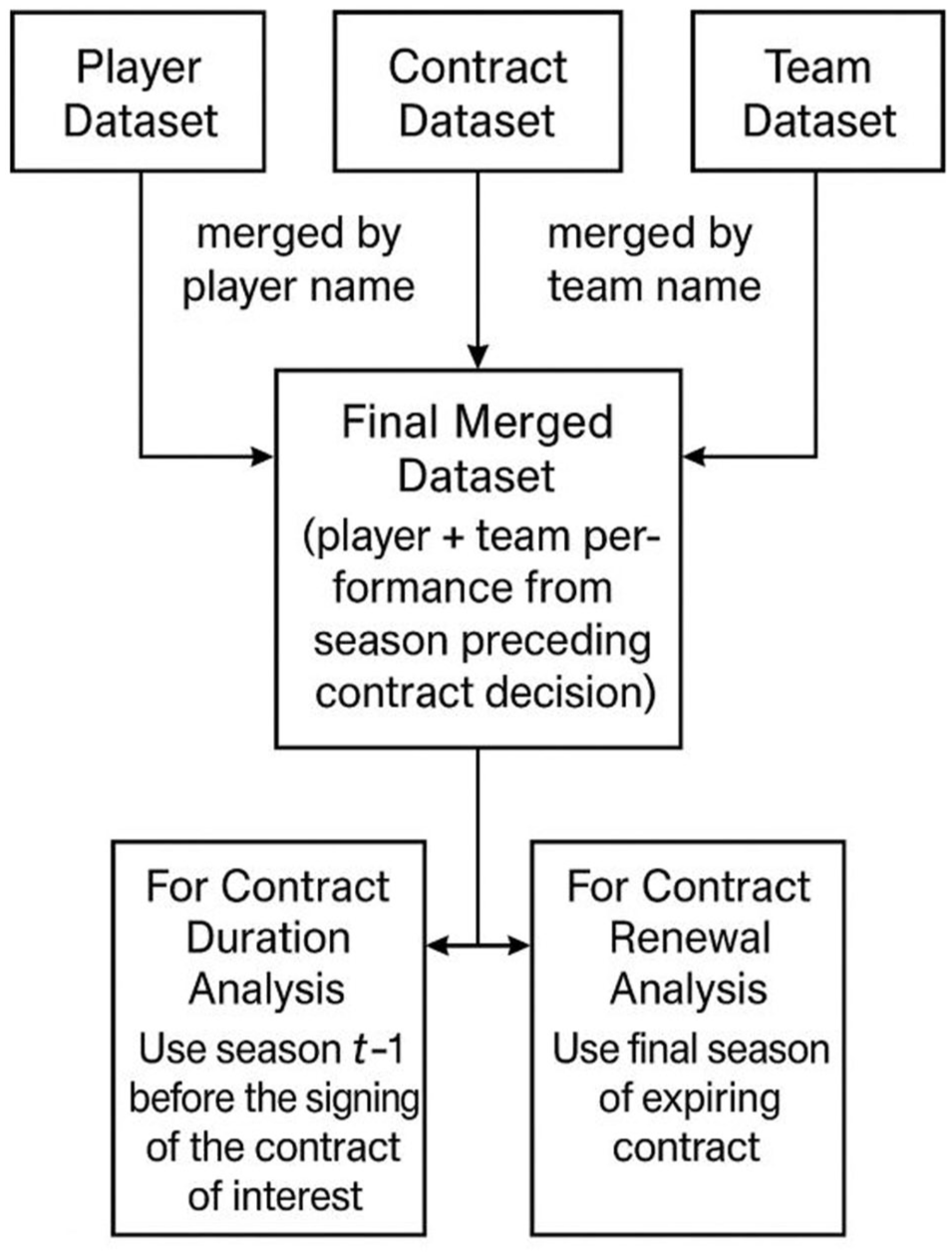
Illustration of the data-merging process.
Measures and Variables
To measure the employment stability of NBA players, this study has two major dependent variables. The first calculates the duration of players’ contracts. Conventionally, previous studies measured employment stability with the tenure, or a form of its variation, of an employment (e.g., Gottschalk and Moffitt 2000; Jaeger and Stevens 2000). However, as noted previously, in the NBA, although players always play for the teams that signed contracts with them at the beginning of the contracts, many are also traded to different teams later for reasons that can be irrelevant to employer-employee relations, 7 with their current contracts and most other original plans still effective and fulfilled. Thus, the duration of a player’s contract is a better proxy of his employment stability in the specific setting of the NBA. The measure of contract duration was constructed as the number of seasons covered by a player’s contract. Given that contract data were recorded at the seasonal level rather than by exact calendar dates, contract durations were rounded to the nearest full season. For example, contracts that were slightly shorter or longer than one full season were both coded as lasting one season. As Figure A1 in Appendix A shows, the distribution of players’ contract durations is heavily right skewed, with one-year contracts accounting for the largest share and the proportion of contracts decreasing progressively as their duration increases. Thus, I used the logged years of contract duration to correct for right skewness and heteroskedasticity. As Table C1 in Appendix C shows, estimating the models with the original durations yielded substantively similar results.
The second measure is the likelihood a player renewing his current contract with his current employer after his current contract ends, corresponding to the event of job loss, another measure that has been frequently used in previous studies (e.g., Farber 2010). A potential problem with using this measure is that a player may refuse to renew his contract because he has a more lucrative contract to sign with another team. Therefore, to measure involuntary job loss, I also include the likelihood of signing contracts with any team in the league, after the current contract ends, as an alternative measure.
The independent variable of this study, the racial background of each player, was collected and coded manually on the basis of online photos and information from the Internet, as basketball-reference.com does not directly report players’ racial backgrounds. Although this approach allows consistent and replicable coding, it inevitably relies on publicly available images and representations, which may not perfectly capture how players are perceived in all contexts. Conceptually, however, race is treated here as a socially perceived identity, particularly as perceived by employers making contract decisions. Following previous studies (Biegert et al. 2023; Zhang 2017), two coders independently coded players as White (the reference category, coded 0) or Black (coded 1), reaching agreement for more than 98 percent of all players. 8 With Black players as the reference category, White players are coded 1.
The control variables of this study include control variables related to contracts, players, and teams. Contract-related control variables include the seasons during which they were signed and started, 9 seasonal average salary of the periods of these contracts (already accounted for inflation). Control variables for players include height, birthplace (U.S. vs. foreign born), age and age squared, and position on the team (center, power forward, small forward, point guard, or shooting guard). To account for players’ experience in the league, their tenures up to the point contract signing or renewal were included in the model.
To adjust for individual player productivity in a given season, several common measures were used, including total minutes played, per-minute scores, rebounds, and assists. To analyze contract duration, these statistics from the regular season preceding the contract signing were incorporated into the model, as employers were likely to consider recent individual performance before signing contracts. In examining contract renewal, statistics from the final effective regular season of the contracts were used.
Regarding NBA team controls, factors such as regional divisions and team performance in a given season were considered. Team performance was assessed on the basis of playoff qualifications for that season. In investigating contract duration, the prior-season performance of both the signing teams and players’ previous teams were included, if they happened to be different teams. To assess the likelihood of extending current employment in the posthiring stage, team performance from the players’ current teams during the final effective season of the contracts was incorporated into the analysis. For the robustness check, I added team fixed effects to the main models and found no substantive changes in the results.
Analytic Strategies
With the contract duration as the dependent variable, I conducted an ordinary least squares regression analysis with season fixed effects, with clustering robust standard errors at the player level, using data on unterminated contracts in the NBA spanning from the 1990–1991 season to August 2022. I also excluded players of other races, as this study focuses on the Black-White comparison. A significant and positive coefficient suggests that White players, compared with their Black counterparts, have longer contract durations. Furthermore, I restricted the regression analysis to non-entry-level contracts for two main reasons. First, the length of entry-level contracts is heavily influenced by NBA policies. Second, employers’ assessments of rookie players and their entry-level contracts may differ from those of most players in the league with non-entry-level contracts. For instance, rookie players lack prior individual productivity in the NBA for employers to evaluate.
One potential concern about excluding entry-level contracts is that the likelihood of obtaining a non-entry-level contract may differ between Black and White players. If underperforming Black players are more likely than comparable White players to receive a second contract, these Black players might subsequently hold shorter contracts in later stages of their careers compared with White players who remain in the league. To assess this possibility, I conducted logistic regression analyses to examine whether Black players are more likely than White players to obtain a second contract. The results, shown in Table C2 in Appendix C, report no statistically significant racial difference in the probability of receiving a second contract after controlling for other factors. In fact, the odds ratio for Black players is below that for comparable White players, suggesting that, if anything, Black players are somewhat less likely to secure a second contract.
With the likelihood of contract renewal as the dependent variable, I conducted logit regressions with time (season) fixed effects, while clustering robust standard errors at the player level. Subsequently, I compared the predicted probability of White players’ signing new contracts with their current teams relative to Black players (i.e., the marginal effect), because directly comparing log ratios or coefficients from logit regressions could be influenced by unobserved heterogeneity (Long and Mustillo 2021; Mood 2010). A significant difference between the probabilities of two racial groups would reflect employers’ varying inclination to retain players of various racial backgrounds.
As this study focuses on the Black-White gap in employment stability, I dropped players who were identified as other racial and ethnic groups (e.g., Latinos, Asians).
One potential weakness of this research is that this analytical strategy does not directly observe players’ and teams’ actual decision-making processes. Therefore, although the major goal of this study is to compare employment stability between Black and White players, it does not identify the specific mechanisms that explain racial difference observed in expected job duration and/or opportunity in extending current employment. However, I conducted a few supplemental analyses to assess the possibility of Black players’ intentional choice of a less stable employment experience (see below for details).
Descriptive Statistics
Table 1 presents the counts and descriptive statistics for all NBA contracts signed by Black and White players, the unit of analysis of this study, from the 1990–1991 season to August 2022. As indicated in the table, the frequency of contract signings increased over the decades. Among the 3,508 contracts held by Black players from 1990–1991 to 2021–2022, 28.42 percent resulted in contract renewals, signifying agreements signed between the players and their current teams. Conversely, the proportion of contract renewals was slightly higher for White players, with 31.43 percent of the 948 contracts’ being renewed. The average seasonal salary of a contract stood at $3,525,309, although there was considerable variation due to inflation. Additionally, the average duration of contracts was 2.461 seasons, with Black players averaging 2.451 seasons and White players averaging 2.504 seasons.
Counts and Summary Statistics for All National Basketball Association Contracts Signed by Black and White Players between the 1990–1991 Season and August 2022.

Table 2 presents counts and summary statistics for variables regarding players. Out of the 1,856 players included in this period, approximately 41 percent had only one contract during their NBA tenures, highlighting the competitiveness of the league. About 46 percent of players had between two and four contracts throughout their careers, while the remaining 13 percent had five or more contracts. The NBA league was composed predominantly of Black players, accounting for 76 percent of the total player population, while White players and those from other racial backgrounds comprised 22 percent and 2 percent respectively.
Counts and Summary Statistics of Players.

On average, players logged approximately 1,131 minutes per regular season, scored 12.936 points, provided 2.892 assists, and grabbed 6.402 rebounds per 36 minutes of play. Additionally, the average height of players was approximately 200 cm (about 6 ft 7 in).
Regression Results
Table 3 presents the results of the ordinary least squares models with logged contract lengths as the dependent variable, with season fixed effects. In model 1, encompassing all non-entry-level contracts, the significant coefficient for the binary race variable indicates an association between racial background and contract duration in the NBA. Specifically, being Black versus White is associated with a decrease by a factor of 6.9 percent (e−0.072 − 1) in contract durations, after accounting for individual productivity and other covariates. Model 2 includes all the unterminated non-entry-level contracts. As the lengths of unterminated contracts are already determined at the time of signing, they are reflective of the expected duration of employment assigned at the hiring stage. With these contracts considered, I still find that being White relative to Black is expected to result in a decrease by a factor of 5.4 percent (e−0.056 − 1) in contract duration, net of all else. Although a factor of 6.9 percent or 5.4 percent may not seem substantial, it does mean that Black players can expect to have a shorter period to perform.
Estimates of Logged Contract Length as the Dependent Variable, with Time Fixed Effects.

p < .05, **p < .01, and ***p < .001 (two-tailed tests).
In addition, model 1 reveals several other noteworthy findings. Notably, the performance of players’ prior teams in the previous season, regardless of the specific teams they belonged to, positively correlates with players’ contract durations. This suggests that not only individual productivity but also organizational productivity may influence employers’ evaluations of players. Furthermore, contracts that are renewed by players and their current teams exhibit significantly longer durations.
Table 4 presents the results of the logit models of contract renewal incorporating season fixed effects. Model 1 uses the binary variable of contract renewals or not after the current contracts end as the dependent variable. The significant coefficient for race is positive and significant, suggesting that the odds of Black players’ signing contracts with their current teams are about 28 percent smaller than those of comparable White players. The marginal effect of being Black versus White is also significant, as this difference is associated with a decrease of 5.9 percentage points in the predicted probability of signing contracts with the current team.
Odds Ratio Estimates for Contract Renewals and League Exits after Current Contracts, with Time Fixed Effects.

p < .05, **p < .01, and ***p < .001 (two-tailed testes).
An alternative explanation for these racial disparities in expected employment duration and opportunities for extending current employment is that they may be consequences of players’ strategic choices. Given this possibility, supplemental analyses were conducted to mitigate this concern. Model 2 presents the results of the logit model of league exit, in other words, having no contract to sign at all after the current contract ends, as it is not likely that NBA players strategically choose to leave the league. The coefficient for racial background is still significant: being White as opposed to Black is associated with a 5.1 percentage point decrease in the predicted probability of leaving the league. Such results provide stronger evidence to fewer opportunities and less stable careers for Black NBA players.
Another potential concern of this analysis is that minutes played, average points, rebounds, and assists during regular seasons, although strong indicators of players’ productivity, may not capture performance comprehensively. I addressed this issue in three ways.
First, I replaced these variables with players’ player efficiency ratings (PERs) for regular seasons in the main models. Developed by ESPN columnist John Hollinger, PER provides an overall evaluation of a player’s on-court contributions by summing positive actions and subtracting negative ones. Second, I incorporated players’ average steals and blocks per 36 minutes into the models to account for additional dimensions of performance. Third, I collected players’ playoff statistics and substituted regular-season performance with playoff performance whenever they participated in the playoffs that season.
Although none of these measures perfectly captures all observable or unobservable aspects of productivity, together they represent the most comprehensive strategy available given current data. As shown in Tables C3 and C4 in Appendix C, the results of the main models remain substantively unchanged.
How Likely Are Black Players’ Strategic Choices a Cause of the Racial Gap?
To further address the possibility that the findings in racial differences in expected contract duration and opportunities for contract renewal result from Black players’ deliberate choice, two additional analyses are conducted. First, Table 5 presents the estimates of the model with logged seasonal average salary as the dependent variable time, and player fixed effects, and non-entry-level contracts and clustered robust standard errors at the player level. The results indicate that signing renewed contracts with current teams is associated with approximately a 10 percent increase in average salary per season and a 32 percent increase in average salary per season with one additional season signed. These associations remain significant even when considering only Black players (model 2). Thus, holding all else constant, offers from current teams and longer contracts are, on average, significantly more lucrative than shorter contracts or those from other teams. Although it is possible that players may prefer the latter, such occurrences should not be prevalent.
Estimates of the Logged Seasonal Average Salary of Non-entry-level Contracts.

Note: ICC = intraclass correlation coefficient.
p < .01 and ***p < .001 (two-tailed tests).
In a second approach, I replicated the models in Tables 3 and 4, with players whose PERs ranked no greater than the 50th percentile of all players in their last season before their prior contracts ended. The rationale behind this was that players who are relatively underperforming would likely have fewer opportunities to attract and receive more lucrative offers from other teams or less power over the negotiation table to decide contract duration. Shown in Table 6, the original results still hold. In fact, the results of model 1 suggest the racial disparities seem to be more salient when only underperforming players are considered, especially for expected contract duration. Specifically, being White versus Black is associated with an increase by a factor of 9.64 percent (e0.092 − 1) in contract durations, after accounting for individual productivity and other covariates. As shown by the results of model 3, the marginal effect of being White versus Black is also significant, as this difference is associated with an increase by 6.6 percentage points in the predicted probability of signing contracts from the current teams.
Estimates of the Model with Contract Renewals and League Exits after Current Contracts End as the Dependent Variables, with Season Fixed Effects, and with Players Whose PERs Ranked No Greater Than the 50th Percentile of All Players in Their Last Season before Contract Signing or Renewal.

p < .05, **p < .01, and ***p < .001 (two-tailed tests).
Meanwhile, results with players whose PERs ranked above the 50th percentile of all the players are mixed. With these players considered, the racial difference in contract duration is no longer significant. As for contract renewal opportunities, the racial gap remains significant, as being White relative to Black is associated with an increase of 5.4 percentage points. Although these results do not technically indicate that individual performance moderates the racial gaps in either contract duration or contract renewal opportunities, they suggest that racial gaps still exist for underperforming players, who are not likely to actively pursue a flexible and less stable career. Therefore, at least for a considerable number of NBA players, their racial gap in employment stability is not likely to be a consequence of players’ intentional and strategic choices. However, these supplemental analyses fall short of further identifying the mechanisms behind these racial differences. Follow-up studies are needed to further address this issue.
Conclusion and Discussion
Research examining racial disparities in the labor market has long recognized the Black-White gaps in terms of earnings and various career outcomes, such as job acquisition. However, relatively less scholarly attention has been given to the potential discrepancy in employment stability across races. Early studies were limited by a lack of proper controls for individual productivity and/or a fine-grained occupational classification scheme and thus could not clearly identify the racial gap in employment stability.
The setting of the NBA offers well-recorded individual performance metrics and team performance and sufficient cases of players entering and finishing multiple employments in their careers. Leveraging this advantage, in this study I explore whether such a gap exists when players’ individual productivities are measured to the fullest extent and without being confounded by occupational differences. With data on players, teams, and their contracts all merged into a relational dataset, I found that compared with their White counterparts, Black players have non-entry-level contracts of shorter durations. Black players also face reduced opportunities to sign new contracts with their current teams, net of other factors. The shorter contract durations and lower renewal rates suggest on average a less stable career trajectory for Black players, if not indicate explicit career disadvantages for them.
My additional analyses explore the possibility that these disparities originate from teams’ racial stereotypes. They show that Black players not only have lower opportunities to renew their contracts but also face higher likelihood to exit the field, net of all else. Furthermore, I discovered that players who signed longer contracts or renewed contracts with the same team tended to receive higher salaries on average. Thus, players should have relative less intention to make alternative choices with the intention of maximizing their incomes. Additionally, the findings about shorter contracts and lower renewal opportunities also hold when I consider only players who relatively underperformed and should have less power on the negotiation table or fewer opportunities to receive lucrative offers from other teams. All these results suggest that shorter expected employment duration and the lower renewal rate are unlikely to be the consequences of strategic choices made by Black players but rather outcomes influenced by racial stereotypes on the side of teams.
Several limitations in this study pave the way for future investigations. First and foremost, this study comes short of eliminating the possibility of players choosing shorter contracts or rejecting renewal offers from their current teams. Professional sports present a unique setting compared with many other occupational domains. For instance, the transparency of players’ productivity and earnings is uncommon in other sectors. Moreover, the NBA operates within a highly competitive yet relatively small-scale industry, characterized by a limited number of employers and employees. It is plausible that employers may exhibit different evaluation patterns in alternative settings. Nonetheless, the transparency of data and the high level of competitiveness within the NBA should theoretically reduce the scope for unfair decision-making compared with other contexts. Hence, the findings of this study may be even more relevant and impactful elsewhere.
Another drawback related to the research setting is that this study does not account for the impact of different types of NBA contracts and provisions related to them (e.g., designated veteran player contracts), as well as off-the-court factors (e.g., locker room dynamics) on employers’ decisions regarding contract duration and renewals. Finally, although this study examines the likelihood of obtaining a non-entry-level contract among comparable Black and White players, it cannot assess whether the initial likelihood of entering the league differs between the two groups. Consequently, the potential issue of sample selectivity cannot be fully addressed. Future research endeavors addressing these aspects would provide a more comprehensive understanding of the complexities influencing employment stability in professional sports.
The findings of this study contribute significantly to the body of research on racial inequality in the workplace. Like other labor market attainments or outcomes, employment stability is a crucial aspect of one’s professional trajectory. This study does not purport to offer a comprehensive report about racial inequality in employment stability but instead to be set as stepping stone for further studies about this subject. Employment stability means more than the job duration or involuntary loss of jobs. It is associated with bias, discrimination, and inequalities in other labor market attainment. It can exert influences on employees’ motivation and well-being and perhaps shape the atmosphere of the working environment in the organization (Zhang 2023). Future research endeavors are essential to shed further light on this critical issue.
Footnotes
Appendix A
Appendix B: Data Collection and Web-Scraping Procedures
The terms of use at basketball-reference.com specify that scraping is not permitted if it adversely impacts site performance or access. To prevent this, I incorporated a time.sleep() function in my Python script so that each player’s webpage was accessed only once every several seconds. This ensured that the scraping process did not place undue burden on the site. During the process, I did not receive any warnings, nor was access interrupted. The Web site maintains an index page of all players, sorted alphabetically by last name (https://www.basketball-reference.com/players/). From this index page, I generated a full list of players with records on the site, along with their standardized URLs (e.g., basketball-reference.com/players/[first letter of surname]/[surname][first two letters of first name]01.html). Using a loop, I accessed each player’s page with Python and extracted the relevant information.
Appendix C: Supplementary Analyses
Regression Estimates Predicting Contract Renewal (Odds Ratios Reported), with Alternative Measures of Player Performance.

| Model 1 | Model 2 | Model 3 | |
|---|---|---|---|
| With PER Added | With Blocks and Steals Added | With Playoff Statistics Added | |
| Black race | −.360*** | −.408*** | −.308*** |
| (.106) | (.108) | (.102) | |
| Contract length | .056* | .056* | .135*** |
| (.030) | (.030) | (.027) | |
| Average seasonal salary | −.000*** | −.000** | .000 |
| (.000) | (.000) | (.000) | |
| Height | .001 | −.003 | −.005 |
| (.009) | (.010) | (.009) | |
| Foreign born | −.011 | −.025 | .030 |
| (.127) | (.125) | (.122) | |
| Age | −.767*** | −.739*** | −.674*** |
| (.096) | (.096) | (.095) | |
| Age squared | .012*** | .012*** | .010*** |
| (.002) | (.002) | (.002) | |
| Minutes played (prior season) | .001*** | .001*** | .000* |
| (.000) | (.000) | (.000) | |
| Average rebounds per 36 minutes (prior season) | −.016 | .017 | |
| (.023) | (.014) | ||
| Average assists per 36 minutes (prior season) | .043 | .020 | |
| (.033) | (.023) | ||
| Average points per 36 minutes (prior season) | .040*** | .029*** | |
| (.010) | (.007) | ||
| Average steals per 36 minutes (prior season) | .125* | .123** | |
| (.074) | (.051) | ||
| Average blocks per 36 minutes (prior season) | .277*** | .046 | |
| (.076) | (.032) | ||
| Pers (prior season) | .071*** | ||
| (.012) | |||
| Signing team’s playoff presence in the prior season | .442*** | .451*** | .766*** |
| (.080) | (.080) | (.089) | |
| Player’s position | Yes | Yes | Yes |
| Season fixed effect | Yes | Yes | Yes |
| Intercept | 9.294*** | 9.552*** | 9.594*** |
| (2.533) | (2.585) | (2.510) | |
| n | 4,346 | 4,346 | 4,346 |
| Pseudo-R2 | 15.21% | 14.89% | 9.75% |
| Marginal effect of race | −.063** | −.072*** | −.058** |
Note: PER = player efficiency rating.
p < .05, **p < .01, ***p < .001 (two-tailed tests).
Acknowledgements
A substantial portion of this research was conducted during my Ph.D. training at the University of Virginia. I gratefully acknowledge the intellectual support and research environment provided there.
Author’s Note
Di Shao is now affiliated to Sun Yat-Sen University, Shenzhen, Guangdong, China.

1
Some contracts may grant a player and/or a team power to extend employment for one more season or to end employment in advance of one season. However, they are not mandatory provisions and should not substantively affect the observation of assigned contract duration.
2
A player’s contract is terminated by his team in mostly two ways: waiving and buying out. In the first situation, when a team decides that a player cannot contribute to the team and wants someone else to fill his spot on the roster, the team may one-sidedly release the player before the contract is completed, while continuing to pay his salary, unless another team takes over the contract. In a buyout, when a player and a team agree that it is better for both parties to part ways, the player can leave the team after some negotiations.
3
4
A two-way contract is a contract offered to undrafted young players, who are guaranteed positions on teams not in the NBA but its official minor league. Therefore, players with two-way contracts often play more games in minor leagues than in the NBA. A 10-day contract is a contract that lasts for only 10 days or three games. Players with these contracts are usually seen as temporary players in the league.
5
Both rookie and veteran extensions are designed for early contract renewals. Young players picked in the first round of the NBA draft in each season can choose to extend their entry-level (rookie) contracts with the teams they are working for, usually one year before the end of their rookie contracts. Players who have signed at least one contract in the league are seen as veterans. A veteran player can extend his contract a few years before his current contract ends.
6
There are about 250 cases in which players have more than one team that pay their salaries within one year because of some technical reason. For example, a player may still receive payments from his prior team under certain circumstances. I manually matched each salary with the correct contracts.
7
For example, a player can be traded to another team because his current team cannot pay his salary without breaking the salary cap in a certain season.
8
To minimize bias, two coders of different racial backgrounds independently classified players’ race using photos primarily from basketball-reference.com . When photos were unavailable, multiple verified images from reputable sources (e.g., ESPN, nba.com) were used. Cases of disagreement or ambiguous racial background (e.g., limited photos or unclear biographical information) were reviewed collaboratively, and unresolved cases were excluded from the analytic sample.
9
In the NBA, most contracts are completed and signed during the offseason (June to September). If a contract is signed during or after June in a certain year, the season that starts after this offseason is counted as the season in which the contract starts. For example, if a player signs a contract with a team on July 1, 2020, this contract is coded as starting in the 2020–2021 season.