




Abstract
Research on young people’s transition to independent living has focused primarily on the stay/leave dichotomy, an approach increasingly inadequate for capturing the prolonged, reversible, and complex nature of contemporary transitions. This is particularly salient in East Asia, where intergenerational coresidence is a long-standing norm that is now being reshaped by shifting socioeconomic pressures and evolving youth aspirations. Existing research on East Asian societies has often examined the living arrangements of married couples, thereby offering limited insight into the diverse experiences of young individuals. To address these gaps, the authors use nationally representative longitudinal data and sequence analysis to examine distinct home-leaving trajectories, capturing variations in pace and pathways, among both single and married young individuals in China. The results show that difficulties in school-to-work transition and entry into parenthood are positively associated with extended coresidence with parents or returning to parental homes after initial leaving. The findings suggest a “feathered net” effect, whereby the parental home acts as a safety net. These findings underscore how residential trajectories are intertwined with other key life-course transitions and reveal how intergenerational living arrangements adapt to constrained socioeconomic opportunities within the Asian context, in which family is vital in welfare provision.
Keywords
Leaving the parental home is an important milestone for young people in their transition to adulthood (Kiernan 1991; see Buchmann and Kriesi 2011 for a review). However, recent research highlighted the growing challenges faced by young people in achieving independent living and the notable increase in the prevalence of parent–adult child coresidence in Western societies (e.g., Esteve and Reher 2021; Fry 2022). The failure of young adults to depart from their parental homes and establish independent residence is viewed as a developmental concern in Western societies (Gillespie 2020; South and Lei 2015).
Conversely, in East Asian societies, living with their parents for an extended period and forming a stem family are common for adult children. Intergenerational coresidence between aging parents and adult children is typically influenced by traditional Confucian values. Historically, coresidence generally involves adult children providing physical care and support to their elderly parents, which is rooted in the traditional values of filial piety (Chan and Tan 2004) and limited social welfare for the elderly (Logan, Bian, and Bian 1998; Ting and Chiu 2002). However, East Asia’s rapid economic growth and modernization in recent decades have reshaped traditional norms and contributed to a growing emphasis on privacy and autonomy (Yasuda et al. 2011). As a result, the preference for independent living among young individuals may increase.
Young people’s residential independence in East Asia may be influenced more by the challenges than by changes in cultural values. The emergence of prolonged coresidence between unmarried and lower-educated adult children and their parents in the Chinese Mainland, Japan, Korea, and Taiwan reflects a significant change in the traditional pattern of intergenerational support (Lin and Yi 2013). Factors such as the high cost of living and limited affordability can contribute to financial constraints and lead to extended stays with parents, in which young adults typically rely on their parents for financial support (Chang 2023; Park and Sanderfur 2005). In this context, intergenerational coresidence serves as a means for parents to provide support to their adult children as they navigate developmental challenges, extending beyond the preservation of traditional cultural norms related to care from adult children to their parents.
Despite the evolving cultural values and changing challenges of youth development, knowledge about the recent transition to independent living among young people in East Asia is limited. Previous studies have focused predominantly on examining the living arrangements of married couples and their parents (e.g., Chen 2005; Logan and Bian 1999; Takagi and Silverstein 2011; Yasuda et al. 2011) or older parents and adult children (e.g., Frankenberg, Chan, and Ofstedal 2002; Ma and Wen 2016; Yuan and Whyte 2003; Zimmer and Korinek 2010), which have undoubtedly provided valuable insights. However, focusing on either married couples’ residential patterns or older parents’ coresidence is inadequate for gaining a comprehensive understanding of the situation faced by young people.
Notably, the transition to independent living of unpartnered young individuals in East Asia has received limited research attention. One possible reason is that leaving the parental home for residential independence is strongly associated with marriage. Young people in East Asia typically live with their parents until marriage, leaving the parental home only after getting married (Fukuda 2009; Park and Sandefur 2005; Raymo and Ono 2007). However, the rates of delayed marriages and young adults remaining unmarried have risen considerably in recent years (Raymo et al. 2015), with one-person households emerging as a significant demographic trend (Yeung and Cheung 2015). Although several exceptional studies have examined the home-leaving patterns of young people in Japan (e.g., Fukuda 2009) or compared Western and East Asian contexts (e.g., Nauck and Ren 2018; Zeng et al. 1994), these rely on data that are now at least a decade old. Thus, there remains a gap in contemporary research analyzing home-leaving trajectories among East Asian youth, particularly during this era of profound socioeconomic changes and shifting family norms.
In addition, young people’s home-leaving behavior after marriage should be considered. On one hand, married young individuals may return to their parental home after a period of independent living because of life circumstances, such as union dissolution or parenthood (Stone, Berrington, and Falkingham 2014). On the other hand, they may leave their parental home for residential independence after a period of intergenerational coresidence. Therefore, young people may leave and return to their parental home at various time points before and after marriage, and societal and cultural norms, as well as external constraints, may differ between young adults leaving home to live with a partner and young adults leaving home to live independently (Billari and Liefbroer 2007; Zorlu and Mulder 2011).
Furthermore, focusing solely on the stay/leave dichotomy among young people may restrict our understanding of the complex process of transitioning to independent living. The existing studies on transition to independent living typically employ a binary framework of home leaving versus remaining at home (e.g., Avery, Goldscheider, and Speare 1992; Chen and Chen 2016; Emery, Dykstra, and Djundeva 2019; Whittington and Peters 1996; Zeng et al. 1994; Zorlu and Mulder 2011), with some considering the phenomenon of returning home (e.g., Gillespie 2020; Olofsson et al. 2020; Sandberg-Thoma, Snyder, and Jang 2015; South and Lei 2015). Transition to independent living is not a simple dichotomy but rather, a prolonged, reversible, and intricate process (e.g., South and Lei 2015; Stone et al. 2014). The factors associated with young people’s initial departure from their parental home may differ from those that relate to subsequent returns, and the complex residential pathways between these transitions remain insufficiently understood.
To deepen our understanding of the home-leaving process among young people, it is crucial to move beyond the notion of a conventional dichotomous transition. Therefore, we examine the home-leaving trajectories of young individuals and consider the factors that are associated with the processes of staying, leaving, and returning to their parental home. Moreover, investigations into the home-leaving trajectories of young people should encompass single and married individuals, as well as their living arrangements before and after marriage.
China provides a compelling context for examining the complexities of the transition to independent living of young people. It is an Asian society in which traditional Confucian values of filial piety coexist with modernization and rapid economic development. This intersection creates distinct challenges for young adults, particularly as higher education expansion has intensified employment competition (Knight, Deng, and Li 2017). By using nationally representative longitudinal data from China, we address the following research questions: (1) What are the distinct home-leaving trajectories among Chinese young people? and (2) How are cultural values and youth development challenges associated with these trajectories? By analyzing youth transition trajectories, rather than taking a static snapshot of transitional status, we aim to offer a comprehensive understanding of the dynamics underlying the processes of staying, leaving, and returning to the parental home. It also sheds light on the evolving factors that shape these transitions.
Literature Review and Research Hypotheses
The home-leaving behavior of young people can be primarily understood through two key theoretical lenses: the modernization perspective, which emphasizes value-driven independence, and the feathered net perspective, which highlights developmental needs and available support systems.
The modernization perspective posits that the transition of young people to independent living in East Asia reflects the shifts in cultural values amid societal changes. Traditional Confucian values, including strong family obligations, filial piety, and patrilineal kinship systems, have historically sustained prolonged intergenerational coresidence (Whyte 2003). Culturally, independent living before marriage is discouraged, with unmarried children typically remaining in the parental home (Whyte 2004). Filial piety, a cornerstone of East Asian societies (Zeng et al. 1994), emphasizes that adult children, particularly married sons, reside with and care for their aging parents (Chan and Tan 2004; Raymo et al. 2015).
Patrilineal kindship systems also serve to reinforce the home-leaving patterns. Nauck, Gröpler, and Yi (2017) compared the United States, Germany, Taiwan, and the Chinese Mainland and found that Chinese societies with patrilineal kinship systems exhibit lower rates of home leaving. In Taiwan and the Chinese Mainland, male offspring often continue residing with their parents even after marriage, whereas women typically reside with their in-laws. This practice contrasts sharply with bilinear Western systems, where family formation, through marriage or cohabitation, generally leads to residential independence.
However, rapid economic development and modernization have reshaped social values and practices in East Asia, thereby weakening long-standing familial traditions (Raymo et al. 2015; Yasuda et al. 2011). The modernization perspective interprets these shifts as a move toward individualism and nuclear family structures (Yasuda et al. 2011). Contemporary research highlights a rising trend of nuclear families in China (Hu and Peng 2015; Li, Fan, and Song 2020), aligning with Goode’s (1963) classic argument that modernization encourages young people to prioritize autonomy over extended family ties. Consequently, the growing preference for independent living among East Asian youth may reflect broad attitudinal changes driven by socioeconomic transformations. These shifts parallel the second demographic transition observed in Western societies, which is characterized by declining marriage rates and rising alternative living arrangements (for a review, see Raymo et al. 2015). Notably, there has been a rapid increase in one-person households (Yeung and Cheung 2015) and a growing acceptance of premarital cohabitation among younger Chinese cohorts (Yu and Xie 2022). Collectively, these developments signal significant departures from traditional family systems in the region.
Although the modernization perspective frames home leaving as the value-driven pursuit of independence, the feathered net perspective highlights the parental home as a safety net that can respond to young people’s developmental needs. This perspective builds on theories of emerging adulthood (Arnett 2000, 2004; Arnett and Taber 1994), which identify the period between late teens and twenties as a distinct developmental stage characterized by a prolonged and varied pathway to adulthood. During this extended transition, young people may face increasingly complex developmental challenges.
The feather net perspective is rooted in the interplay between structural constraints in the transition to adulthood and culturally embedded family practices distinctive to East Asia, particularly China. On one hand, contemporary socioeconomic conditions and institutional changes further complicate youth transitions and disrupt normative life course trajectories. For instance, the widespread expansion of higher education has intensified labor market competition and increased youth unemployment (Delaney et al. 2020; Hannum et al. 2019; Mok and Jiang 2018). While education, employment, and marriage constitute key transitional milestones, home leaving typically occurs alongside these life events (Fukuda 2009).
On the other hand, this perspective highlights familial adaptations steeped in social and cultural traditions that sustain intergenerational support. Unlike prevailing attitudes in Western societies, many East Asian parents continue to provide substantial support to their adult children, including financial assistance, childcare during the transition to parenthood, and temporary housing throughout education or job-seeking periods (Chang 2015; Nauck et al. 2017; Zeng et al. 1994). Consequently, young people in Chinese societies often live with their parents or extended family (Chang 2015; Nauck et al. 2017), delaying home leaving (Zeng et al. 1994). This practice contrasts with Western patterns, such as in the United States, where early marriage and early childbirth are associated with early home leaving (Tang 1997).
Together, these structural and cultural dimensions explain why parental homes function as dynamic safety nets. The feathered net perspective highlights how the challenges and difficulties of transitioning to adulthood, such as school-to-work transition (SWT), transition to parenthood, or partnership dissolution, can activate the protective role of the parental home. Parental assistance is important in supporting young people’s transitions to adulthood (e.g., Swartz et al. 2011). Parents’ resources, particularly parental home, serve as a critical protective factor during key transitions, providing financial, social, and emotional support (e.g., Berngruber 2015; Sandberg-Thoma et al. 2015). Intergenerational support is evident in the “boomerang” behavior, in which young individuals return to their parental home after a life-course disruption, such as education discontinuation, job loss, or partnership dissolution (e.g., Olofsson et al. 2020; Stone et al. 2014).
Although the feathered net perspective recognizes the impact of cultural tradition on family solidarity and parental support, it emphasizes that the parental home functions as a safety net primarily in response to the challenges young adults face during transitional life stages. This needs-triggered view distinguishes it from earlier research on the “feathered nest,” which frames the parental home as a comfortable environment that delays departure (e.g., Avery et al. 1992; Chen and Chen 2016; Whittington and Peters 1996). Affluent parents prolong coresidence by covering living expenses (Maroto 2017) or by providing spacious, comfortable living conditions (Mulder 2013; Smits, Van Gaalen, and Mulder 2010). By contrast, the feathered net perspective highlights how parental support is activated in response to young adults confronting socioeconomic or developmental pressures, rather than serving as an extension of familial comfort.
Guided by the modernization (value-driven independence) and feathered net (needs-triggered adaptation) perspectives, our study examines the home-leaving trajectories of young adults and analyzes how sociodemographic factors and challenges during critical youth transitions, such as SWT and transition to parenthood, shape these distinct pathways. The following subsections outline the testable hypotheses derived from each perspective.
Home-Leaving Patterns
The modernization perspective posits that young people in increasingly modernized East Asian societies demonstrate a growing preference for independent households and nuclear families over traditional intergenerational coresidence (Raymo et al. 2015). The shift reflects broad sociocultural transformations, in which the notion of autonomy, privacy, and personal freedom can motivate young people’s departure from their parental home and establishment of independent living arrangements (Yasuda et al. 2011). Similarly, China’s rapid economic development and modernization have fostered such attitudinal changes, with young people embracing independent-living preferences (Logan et al. 1998; Yasuda et al. 2011). This attitudinal change underpins our first hypothesis, which reflects the individualistic values and weakened norms of intergenerational coresidence:
Hypothesis 1a: Young people’s residential trajectories converge toward independent living as the dominant pathway.
By contrast, the feathered net perspective conceptualizes the parental home as an adaptive resource that responds to young people’s developmental needs amid socioeconomic constraints and prolonged transition to adulthood. Although some individuals achieve stable independence, others encounter obstacles, such as unemployment or partnership dissolution, which may lead to prolonged coresidence or “boomerang” returns to their parental home (e.g., South and Lei 2015; Stone et al. 2014). Such patterns are further evidenced by the global resurgence of intergenerational coresidence (Esteve and Reher 2021), which demonstrates the role of the parental home in buffering socioeconomic instability. These observations inform the following competing hypothesis that emphasizes the parental home as a dynamic safety net:
Hypothesis 1b: Young people’s residential trajectories diverge into multiple prevalent pathways, including prolonged coresidence and returning after leaving, alongside independent living.
Role of Sociodemographic Factors and Youth Transitions
The modernization perspective frames home leaving as the value-driven pursuit of independence, shaped by individuals’ exposure to modern values that vary by sociodemographic characteristics. Higher educational attainment and urban residence, as key conduits of modern values, can considerably predict independent-living preferences (Logan et al. 1998; Yasuda et al. 2011). In East Asia, highly educated young adults in Japan (e.g., Wakabayashi and Horioka 2009) and South Korea (e.g., De Vos and Lee 1993) show significantly low rates of intergenerational coresidence, and rural Chinese young people exhibit higher coresidence rates than their urban peers (e.g., Yasuda et al. 2011; Zeng and Wang 2003). Furthermore, young people with high socioeconomic status (SES) may leverage economic resources to “buy” their autonomy, such as by compensating their parents or subsidizing their less well-off siblings to live with their parents (Lee, Parish, and Willis 1994). The observations lead to the following hypothesis:
Hypothesis 2a: Higher education and urban hukou are associated with the transition of young people to independent living.
Contrasting with the modernization perspective, the feathered net perspective conceptualizes the parental home as an adaptive response to youth’s developmental needs during youth transitions. SWT represents a crucial milestone in young people’s path toward financial independence from their parents. Berngruber (2015) found that successful SWT can facilitate independent living, while Fukada (2009) observed that employed Japanese youth exhibit a low level of intergenerational coresidence, suggesting that economic empowerment fosters residential independence among young people.
However, the global higher education expansion has intensified labor market competition and created substantial employment challenges across societies, such as European (Delaney et al. 2020; Teichler 2002) and East Asian societies (Hannum et al. 2019; Mok and Jiang 2018). Such labor market pressures can lead to precarious employment or unemployment that prolongs intergenerational coresidence (Olofsson et al. 2020) or increase the likelihood of boomerang returns (Stone et al. 2014). Within this context, multiple economic barriers further constrain residential independence. Rising student debts (Houle and Warner 2017), increasing housing prices (Fu, Zhu, and Ren 2015), and high rents (Arundel and Ronald 2016) increase young individuals’ financial dependence on their parents (Kahn, Goldscheider, and García-Manglano 2013).
Furthermore, familial support becomes crucial during critical events in young people’s lives. The feathered net perspective posits that this support is needs-driven, with parental home acting as a safety net during difficulties. Empirical studies are consistent with this view, showing that partnership dissolution is associated with higher return rates to the parental home (e.g., Sandberg-Thoma et al. 2015; South and Lei 2015). Furthermore, the transition to parenthood often coincides with intergenerational coresidence, particularly in societies with limited institutional support, where parents typically provide household assistance (Xian and Forrest 2020). Guided by this perspective, we hypothesize that the observed patterns of association in our analysis will be consistent with this proposed needs-driven mechanism:
Hypothesis 2b: SWT challenges and parenthood are positively associated with extended coresidence with parents or a return to parental homes after initial leaving.
Research Methods
Data
Data for this study were extracted from the China Family Panel Studies (CFPS), 1 a nationally representative longitudinal social survey conducted biennially since its baseline survey in 2010. The CFPS provides comprehensive information on respondents’ sociodemographic background, family dynamics, and economic activities on a biennial basis, thereby making it suitable for addressing the research questions.
Our analysis focused on data from 2010 to 2018, 2 covering five waves of the biennial survey (2010, 2012, 2014, 2016, and 2018). The 2010 baseline survey involved respondents aged 16 to 22 years, which corresponds to significant transitions to adulthood, including the transitions from school to work, independent living, marriage, and parenthood. In China, age 16 is the minimum legal working age, while age 22 marks extended emerging adulthood because of the educational expansion. At age 22, young people typically graduate from higher education and undergo the SWT. By the second wave of the survey in 2012, all respondents were at least 18 years old, the conventional age marking the beginning of adulthood.
Our analysis of home-leaving trajectories focused on 2,667 respondents (51.5 percent of the age group) aged 16 to 22 years who were living with their parents in 2010. 3 This baseline coresident sample was traced through four subsequent waves of the biennial longitudinal surveys for 8 years. Restricting the sample to baseline coresidents enabled clearer identification of transition patterns for three key reasons. First, individuals already living apart at the baseline lacked complete trajectory data. 4 Second, they had lower personal interview response rates in baseline and subsequent waves, which introduces potential bias. Third, early home leavers differed systematically from coresidents. The former was disproportionately composed of individuals with lower educational attainment, from rural hukou backgrounds, females, and those who were unemployed or out of the labor force (see Table A1 in the Appendix). Typically, this group consisted of young women from rural areas who had not completed secondary education and married at an early age. They were not the principal focus of our study.
Measures
In this study, the dependent variable was the trajectory of leaving the parental home. This variable was constructed on the basis of the information obtained from respondents’ reports on the residential arrangement of their family members in each wave of the CFPS. In the analysis sample, we observed four primary residential statuses: (1) living with their parents(s) and not married or cohabiting (labeled P), (2) living alone (O), (3) living with a spouse or partner (S), and (4) living with parents and/or parents-in-law after marriage or cohabitation (I). The four statuses encompassed young people’s typical family structure as defined by marriage and intergenerational coresidence. The changes in these residential statuses among these young people were documented over eight years, spanning five waves of biennial longitudinal surveys conducted by the CFPS.
The modernization perspective suggests that individuals with high-level education and an urban origin are likely to prefer independent residence because of their exposure to modern values and economic resources (De Vos and Lee 1993; Zhang 2004). Therefore, we used the young people’s higher education attainment and hukou registration status at age 12 as proxies for their exposure to modern values.
SWT and transition to parenthood are key variables of the feathered net perspective in this study. To examine SWT, we categorized the respondents’ employment status as studying, employed, and neither studying nor employed. We constructed the sequences of SWT spanning five waves and applied cluster analysis of sequence data to identify six distinct clusters that represented different school-to-work trajectories: (1) remaining employed; (2) not in education, employment, or training (NEET); (3) NEET to employed; (4) unsmooth SWT; (5) smooth SWT; and (6) prolonged SWT. Figure A1 provides the sequence index plots illustrating these school-to-work trajectories. In addition, we coded the transition to parenthood as having at least one child between 2010 and 2018 (coded 1) or not having any children (coded 0).
In this study, we controlled for one-child status and parental education, which may influence the residential arrangements of young people. The only child in a family, benefiting from undivided family resources, may follow distinct residential pathways compared with a child with siblings. Parental education (measured by years of education attained by the more educated parent) served as a measure of SES, which can reflect material resources and modern values. Although we did not include parental wages owing to potential measurement instability across the survey waves, education remains a robust SES indicator in China, where it strongly correlates with income (Yang and Qiu 2016; see Buchmann and Hannum 2001 for a review). The additional control variables were gender, the baseline age groups (16–17 and 18–22 years), and the older parent’s age.
Analytic Strategy
To answer the first research question, this study conducted sequence analysis to classify the clusters of the common home-leaving trajectories. This analytic approach assesses the sequence, duration, timing, and number of transitions in various stages of one’s life, such as employment status, marital status, and residential status (for a review, see Aisenbrey and Fasang 2010). Sequence analysis has been increasingly applied in social science research (see Liao et al. 2022, for a review) as it can group variations in life course sequences. The typologies derived from cluster analysis also serve as a basis for investigating the characteristics associated with the probability of adhering to a particular trajectory represented by these clusters (Raab and Struffolino 2023). We use sequence analysis to capture the young people’s residential trajectories comprehensively and move beyond the conventional stay/leave dichotomy to reveal nuanced patterns in their transition to independent living.
Using longitudinal data from five waves of the panel survey, we constructed residential trajectories and classified each observation into one of four mutually exclusive statuses based on respondents’ partnership status and coresidence with parents. A total of 1,024 sequences of five equal lengths were identified for analysis. To compare entire sequences, we employed a dynamic Hamming distance matrix, an advancement of traditional optimal matching techniques designed to address prior criticisms (Raab and Struffolino 2023; also see Studer and Ritschard 2016 for a review of sequence dissimilarity measures). This approach is particularly suitable for analyzing fixed-length sequences and investigating synchronous changes of interest. 5
For cluster formation, we applied hierarchical clustering with Ward’s linkage criterion, a widely adopted method in sequence analysis (Raab and Struffolino 2023). An initial solution of 22 clusters was identified on the basis of widely used cluster quality indicators, including the average silhouette width, point biserial correlation, and Hubert’s gamma. Our analysis revealed that the 22-cluster solution yielded average silhouette width scores above 0.51, indicating a reasonable structure. The point biserial correlation values stabilized across solutions containing 8 to 25 clusters, indicating reliable partition reproducibility within this range. Similarly, improvements in Hubert’s gamma began to plateau around the 22-cluster solution. On the basis of these observations, the 22-cluster solution was selected as an appropriate initial clustering outcome (Table A2). Notably, several clusters displayed similar transition patterns, including boomerang trajectories such as PPOPO and PPOPP, differing primarily in the precise timing of the transitions. Considering that the qualitative nature of transitions and episodes may hold greater theoretical significance than their exact timing, we merged certain clusters to enhance theoretical coherence and increase cluster sample sizes. Our refinement of the clustering strategy prioritizes both the destination of home-leaving transitions and the sequence of states leading to that destination. Additionally, we keep some distinct subcategories that carry greater theoretical significance. For example, in rural Chinese families, it is common for young couples to initially live with the husband’s parents in the early years of marriage and gradually achieve residential independence after the birth of their first child (Yan 2003). Trajectories such as PIISS and PPISS thus represent a distinct type—transitioning through a stem family phase—and should not be grouped with trajectories reflecting direct transitions to nuclear family living (e.g., PPSSS, POOSS). Similarly, in urban Chinese families, many young couples form nuclear households initially but later coreside with parents for childcare support after having children (Shen 2019). Sequences such as PPSII should therefore be treated as a separate category rather than obscured within broader groupings. This refinement yielded an eight-cluster typology of home-leaving trajectories (Table A2). Further methodological details are provided in the Supplementary Material (“Cluster Formation of Home-Leaving Trajectories”).
To answer the second research question, after identifying the home-leaving trajectories of young people, we used multinomial logistic regression models to examine how SWT, transition to parenthood, and modernization-related factors were associated with the trajectories.
Results
Diverse Home-Leaving Trajectories
The study was focused on young people’s home-leaving trajectories by analyzing a sample of individuals aged 16 to 22 years who were living with their parents in 2010. Figure 1 displays the index plots of the eight clusters identified through sequence analysis. These clusters systematically varied along three underlying dimensions: (1) residential status, which distinguished between parental coresidence and independent living; (2) transition pace, which captured the speed of home leaving, from rapid to gradual; and (3) partnership context, which differentiated between a solo transition and a transition that occurred alongside partner formation. These dimensions revealed the complex interplay between residential independence, family structure, and life-course timing.

Sequence index plots of eight home-leaving pathway clusters of young people in China.
Description of Eight Home-Leaving Pathway Clusters (n = 2,667).

Source: China Family Panel Studies (2010–2018).
Note: I = living with parent(s) or parent(s)-in-law after marriage or cohabitation; O = living alone; P = living with parent(s) and remaining single; S = living with a spouse or partner.
Table 1 describes each cluster, specifically, the labels assigned to the clusters, the average duration at each residential status, and the typical transition trajectory. Approximately 15 percent of the individuals were classified as “continuous coresidents” (cluster 1), who remained single and lived with their parents throughout the observation period. Clusters 2 and 3 represented rapid and gradual transitions to independent living, respectively, accounting for approximately 23 percent of the sample.
Cluster 4 showed the “boomeranging” trajectory of the young people (16 percent) who returned to their parental home after leaving. Clusters 5 and 6 (25 percent of the sample) represented the individuals’ gradual and rapid transitions to a nuclear family, respectively. Specifically, cluster 5 involved a direct transition, without intergenerational living, whereas cluster 6 involved intergenerational living before the formation of a nuclear family.
The last two clusters represented individuals in a partnership who resided either in their parental home or with their parents-in-law. The clusters reflected intergenerational nesters or married or cohabiting adult children in stem families, which constituted more than 20 percent of the sample. The individuals in cluster 7 experienced a rapid transition to intergenerational living after marriage/cohabitation, whereas those in cluster 8 underwent a gradual transition to a nuclear family before transitioning to intergenerational living.
In summary, the analysis of home-leaving trajectories offers a comprehensive understanding of how young people’s residential statuses evolved by considering the sequence and duration of various residential statuses. These findings support the hypothesis of the feathered net perspective regarding diversified trajectories (hypothesis 1b) but not that of the modernization perspective about early home-leaving patterns (hypothesis 1a).
Table 2 provides the descriptive characteristics of the analysis sample for each cluster. Notably, about 60 percent of the continuous coresidents were between the ages of 26 and 30 years (aged 18–22 years at the baseline), which indicated a prolonged stay in their parental home while remaining single. More than 70 percent of the gradual solo independents received tertiary education, thereby suggesting a prolonged stay in their parental home because of educational pursuits. Among unpartnered individuals, the proportions of experiencing NEET and unsmooth SWT were higher for the continuous coresidents and boomerangers than for solo independents. Meanwhile, 82 percent of the gradual partnered intergenerational coresidents, and 79 percent of the gradual partnered independents experienced a transition to parenthood, which indicated potential parental support for child-rearing while coresiding in the parental home. The descriptive statistics show that young people’s transition to independent living may be accompanied by SWT or transition to marriage or parenthood.
Descriptive Statistics by Home-Leaving Trajectories (n = 2,667).

Note: I = living with parent(s) or parent(s)-in-law after marriage or cohabitation; NEET = not in education, employment, or training; O = living alone; P = living with parent(s) and remaining single; S = living with a spouse or partner; SWT = school-to-work transition.
Covariates of Partnership Transitions in Residential Trajectories
Partnership status and residential arrangement are important components in clustering the eight home-leaving trajectories. The circumstances behind and factors contributing to unpartnered residential independence may differ from those for partnered residential independence. Figure 2 provides an overview of the home-leaving trajectories and the flow of our data analyses, given that all the respondents stayed in their parental home in the first wave of the survey.

Home-leaving trajectories of young people in China.
We analyzed three groups of home-leaving trajectories: individuals who remained unpartnered and stayed in their parental home (continuous coresidents), those who remained unpartnered and left home and thus experienced the transition to independent living, and those who obtained a partner and thus experienced the transition to partnered living. The home-leaving trajectories of these three groups are examined in Tables 3 to 5. Table 3 presents analyses of the transition patterns across these distinct residential trajectory groups. Tables 4 and 5 focus respectively on the trajectories of unpartnered and partnered young individuals, providing detailed comparisons within each group.
Multinomial Logistic Regression Model for Trajectory Cluster Membership (n = 2,667).

Source: China Family Panel Studies (2010–2018).
Note: Values in parentheses are standard errors. Likelihood ratio χ2(24) = 675.78; log likelihood = −2,347.4793. I = living with parent(s) or parent(s)-in-law after marriage or cohabitation; NEET = not in education, employment, or training; O = living alone; P = living with parent(s) and remaining single; S = living with a spouse or partner; SWT = school-to-work transition.
p < 0.05. **p < 0.01.
Multinomial Logistic Regression Model for Trajectory Cluster Membership: Unpartnered Individuals (n = 1,430).

Source: China Family Panel Studies (2010–2018).
Note: Values in parentheses are standard errors. Likelihood ratio χ2(36) = 198.45; log likelihood = −1,864.8025. I = living with parent(s) or parent(s)-in-law after marriage or cohabitation; NEET = not in education, employment, or training; O = living alone; P = living with parent(s) and remaining single; S = living with a spouse or partner; SWT = school-to-work transition.
p < .05. **p < 0.01.
Multinomial Logistic Regression Model for Trajectory Cluster Membership: Partnered Individuals (n = 1,237).
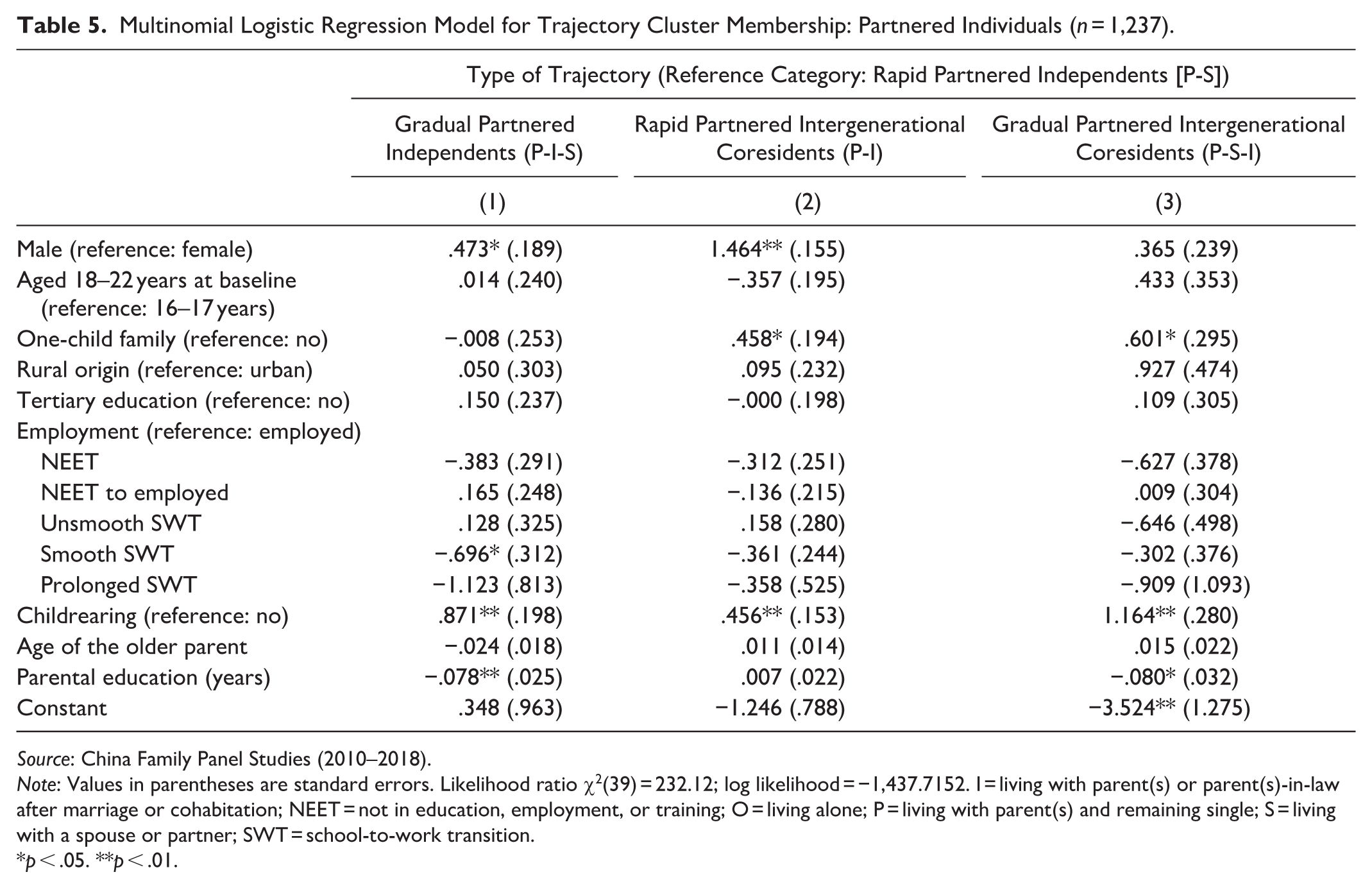
Source: China Family Panel Studies (2010–2018).
Note: Values in parentheses are standard errors. Likelihood ratio χ2(39) = 232.12; log likelihood = −1,437.7152. I = living with parent(s) or parent(s)-in-law after marriage or cohabitation; NEET = not in education, employment, or training; O = living alone; P = living with parent(s) and remaining single; S = living with a spouse or partner; SWT = school-to-work transition.
p < .05. **p < .01.
Table 3 presents multinomial logistic regression results comparing the residential trajectory clusters of unpartnered independent living and partnered living arrangements against the reference category of continuous coresidents. The results reveal that the young individuals with an urban hukou were likely to remain unpartnered and stay in their parental home, thus presenting inconsistent evidence with hypothesis 2a of the modernization perspective. The effects of hukou registration and tertiary education are discussed in the next section, focusing on the detailed analysis of the trajectories of the unpartnered youth.
Labor market experience is significantly associated with the departure of young individuals from their parental home, as demonstrated in Table 3. Individuals who were NEET were less likely to leave their parental home than those with stable employment (columns 1 and 2). Moreover, the young adults who experienced a challenging or prolonged SWT were less likely to transition from their parental home to a nuclear or stem family (column 2). These results suggested that young individuals’ difficulties in SWT coincided with extended stays in their parental home, a pattern consistent with the protective mechanism theorized by the feather net perspective and providing support for hypothesis 2b.
Home-Leaving Trajectories among Unpartnered Young People: Key Correlates
We further investigated the factors associated with the home-leaving trajectories of unpartnered young individuals (Figure 2, left) in Table 4, using the rapid solo independents as the reference group. The effect of hukou was consistent with that in Table 3. Specifically, the young people with rural hukou were more likely to leave their parental home quickly and live independently than those with urban hukou. This finding contradicts the modernization perspective, which suggests that having urban hukou is associated with the transition of young people to independent living (hypothesis 2a). This seemingly contradictory result can be attributed to the urban-rural divide in terms of economic development and migration in China. Rural youth often migrate to cities in pursuit of improved employment prospects and better livelihoods (Nauck and Ren 2018), reflecting stronger structural incentives for early home leaving in less developed rural regions (Nauck et al. 2017).
In addition, higher education attainment significantly increased the likelihood of young people transitioning gradually to independent living (column 2). This outcome suggests that extended education may prolong the length of time that young people stay in their parental home before moving out. The finding is inconsistent with the prediction of the modernization perspective (hypothesis 2a) on the positive role of higher education in facilitating home leaving.
To examine the evidence for the feathered net perspective, we considered the role of labor market experience in shaping unpartnered individuals’ home-leaving trajectories. The results in Table 4 show that those who were NEET were more likely to remain in their parental home than those with stable employment (column 1). The former individuals may also require a long time to transition to independent living (column 2). However, the individuals who experienced unemployment during their SWT (i.e., unsmooth transition) demonstrated a significantly high likelihood of moving back to their parental home after a period of independence (i.e., boomerangers; column 3). Thus, the home-leaving trajectories of unpartnered individuals appeared to be associated with their SWT experience. Difficulties encountered in this transition may hinder young people’s ability to move toward independent living at a rapid pace and result in an extended stay in their parental home, a gradual transition to independent living, or a return to their parental home after a period of independent living. The findings support hypothesis 2b of the feathered net perspective.
Home-Leaving Trajectories among Partnered Young People: Key Covariates
Our analysis of partnered individuals’ residential trajectories reveals that transitions to parenthood are significantly associated with home-leaving patterns. Table 5 presents the analysis of residential trajectories among partnered individuals, with rapid partnered independents serving as the reference category. The results indicate that young couples with children were substantially less likely to follow the rapid home-leaving trajectory. Instead, they were likely to exhibit the trajectory of gradual home leaving (column 1) or become rapid partnered intergenerational coresidents (column 2) or gradual partnered intergenerational coresidents (column 3).
These results reveal that becoming parents serves as a critical life-course transition that can alter young individuals’ residential arrangements. The childcare needs associated with parenthood seem to motivate young couples to either postpone their departure from their parental home or return to intergenerational coresidence. This pattern can be understood in China’s institutional context, where the scarcity of formal childcare services leads families to rely heavily on extended family support (Chen, Liu, and Mair 2011; Goh 2009). The observed residential trajectories of maintaining or reestablishing living arrangements with parents provided robust empirical evidence for hypothesis 2b from the feathered net perspective. These findings underscore how familial support is adapted to childcare demands through dynamic residential trajectories that balance independence and intergenerational support.
Notably, young individuals with highly educated parents showed a greater likelihood of rapid home leaving than gradual departure or return (columns 1 and 3). This result suggests that high-SES families facilitate independent living among young couples, contrasting with prior research emphasizing parental homes as comfortable environments that delay departure (e.g., Avery et al. 1992; Chen and Chen 2016; Whittington and Peters 1996). Although affluent parents could theoretically support prolonged coresidence by covering additional expenses of coresidence (Maroto 2017) and providing spacious and comfortable living conditions (Mulder 2013; Smits et al. 2010), our findings align with the modernization perspective. Highly educated parents may promote early independence through the transmission of modern values and the provision of financial resources to ease the transition. These results extend Iacovou’s (2010) European findings by demonstrating a parallel value-resource dynamic in China. Iacovou (2010) found that parental resources interact with cultural preferences (independence vs. family closeness) to shape home-leaving patterns, while our study reveals that in China, where individualistic values are emerging, higher parental SES accelerates home leaving.
The reference categories in Tables 4 and 5 were rapid solo independent and rapid partnered independent, which represented a typical pattern of a smooth transition to independent living for the unpartnered individuals and the partnered couples, respectively. The results demonstrate the significant effect of SWT and transition to parenthood on the trajectory from the parental home to independent living. The findings support the feathered net perspective and the importance of parental support.
In summary, the key results indicate that the feathered net effect is associated with interrupted or unsmooth SWTs and the transition to parenthood. The parental home serves as a safety net that shields young people from economic vulnerability and provides familial support for child-rearing. These results align with the “linked lives” principle from the life course perspective (Bengtson, Elder, and Putney 2012), underscoring how young people’s lives are deeply intertwined with their parents. The feathered net effect of the parental home, which serves as a buffer against the challenges associated with other youth transitions, remained significant when we controlled for parental background. The findings align with those of previous studies on intergenerational solidarity in East Asian families (Raymo et al. 2015).
Meanwhile, this study offers partial evidence for the modernization perspective. Although it presents contradictory findings regarding the predicted early home-leaving trajectories and the positive effect of urban hukou and higher education on independent living, the effect of rural–urban migration reflects a modernization process that affects home-leaving patterns. Consistent with previous research (Nauck et al. 2017), rural-to-urban migrants often relocate from less developed rural regions to urban centers in pursuit of employment opportunities. This geographical relocation is often associated with an accelerated departure from the parental home. In addition, highly educated parents appear to facilitate rapid independent living among young couples through the transmission of modern values and the provision of financial resources to ease the transition.
Conclusions and Discussion
This study examines the residential trajectories of young people in China by analyzing the patterns of home-leaving trajectories and the factors associated with remaining in, departing from, or returning to parental homes. We use two theoretical lenses, namely, the modernization perspective, which frames home leaving as the value-driven pursuit of independence, and the feathered net perspective, which conceptualizes the parental home as a safety net that adapts to young people’s needs during life-course transitions. Using nationally representative longitudinal data, we track the home-leaving trajectories of single and married individuals and analyze their living arrangement transitions before and after family formation.
This study uncovers that the home-leaving patterns among young people in China do not align with the early departure predicted by the modernization perspective, nor do they strictly adhere to the traditional societal depiction of late departure owing primarily to marriage (e.g., Park and Sanderfur 2005). Moving beyond the conventional stay/leave dichotomy, this study reveals a complex and reversible home-leaving process that encompasses various paces and pathways.
This study identifies various home-leaving trajectories among unpartnered young people. Some choose to stay in their parental home (continuous coresidents), whereas others opt for a swift transition (rapid solo independents) or a gradual transition (gradual solo independents) to independent living. In addition, some of the young people leave but later return to their parental home (boomerangers). The distinct home-leaving trajectories provide valuable insights into the intricate transition to independent living of unpartnered young people, particularly in East Asian societies, where the number of unmarried individuals and the prevalence of delayed marriage among young people are increasing (Raymo et al. 2015).
Among partnered young individuals, this study reveals that approximately one-fifth of the sample follows the trajectory of gradual or rapid partnered intergenerational coresidents. This observation signifies that, after marriage, young people transition to living with their parents or parents-in-law at either a gradual or a rapid pace. The patterns of married young couples highlight the significance of intergenerational family connections, which differ from the primary focus on the husband-wife relationship commonly observed in Western societies. Moreover, these findings, together with the home-leaving trajectories of the unpartnered young individuals and those who experience a rapid or gradual transition to a nuclear family, broaden the scope of existing studies on living arrangements in East Asian societies, with a specific focus on married couples (e.g., Chen 2005; Logan and Bian 1999; Takagi and Silverstein 2011; Yasuda et al. 2011).
More important, this study advances the feathered net perspective by demonstrating how parental homes function as dynamic safety nets during challenges in youth transitions. Our findings reveal that difficult SWT and parenthood shape distinct residential trajectories. SWT challenges are typically associated with a boomerang-like trajectory, while NEET status correlates with prolonged intergenerational coresidence. However, the directionality of this relationship remains unclear and warrants further investigation. Notably, parenthood slows the transition to independent living after marriage. By distinguishing different home-leaving trajectories, we reveal that the factors associated with home leaving differ fundamentally from those associated with independent living and prompt returns to the parental home. This finding likewise highlights the interconnection between residential trajectories and other youth transitions. Thus, the parental home serves as a critical buffer against economic and social vulnerability, complementing (and sometimes substituting for) labor market opportunities and government support systems.
Conventional perspectives on transitions to independent living often frame intergenerational coresidence as a failure to achieve independence. By contrast, we reconceptualize remaining in (or returning to) parental homes as an adaptive strategy for young Chinese individuals navigating developmental challenges. Our findings reveal this arrangement to be a distinct form of parental support that diverges from traditional filial piety norms emphasizing children’s obligations to their aging parents (Chan and Tan 2004; Hu and Scott 2016). Unlike Western societies, in which family support typically diminishes in young adulthood (Nauck and Ren 2018; Zeng et al. 1994), Chinese parents actively buffer their adult children against socioeconomic challenges, including labor market instability and limited institutional childcare support, during critical transitions to employment and parenthood.
Additionally, we reveal how these living arrangements reflect strategic adaptations to constrained socioeconomic opportunities within China’s welfare and labor market context. These findings offer valuable insights for other East Asian societies where strong family traditions similarly compensate for limited state support (Izuhara and Forrest 2013). Young people worldwide face potential economic uncertainty and limited development opportunities (Green 2017; Yeung and Yang 2020). Our study provides valuable insights into the interconnectedness between the life trajectories of young individuals and their intergenerational ties in East Asia’s distinctive welfare regime, where family and market are vital in welfare provision (Aspalter 2006).
The key findings of our study have important implications for future research and policies. First, the second demographic transition theory highlights fundamental shifts in family demographic behaviors, including the decoupling of marriage and parenthood, delayed family formation, and the emergence of alternative living arrangements (for a review, see Zaidi and Morgan 2017). However, East Asia exhibits a more selective and uneven adoption of these trends (Raymo et al. 2015). For instance, Japan maintains a high rate of premarital intergenerational coresidence (Fukuda 2009; Raymo and Ono 2007), while China has witnessed a recent rise in one-person households (Cheung and Yeung 2015) and premarital cohabitation among younger Chinese cohorts (Yu and Xie 2022). Our findings suggest that although residential arrangements among young adults in China are becoming more diverse, these are shaped by distinct structural constraints and cultural norms. Future research could investigate how these residential trajectories interact with broader family demographic behaviors, such as premarital childbearing and union stability, to assess whether China or other East Asian societies are developing a distinct pathway of family transformation.
Second, while McLanahan (2004) highlighted the diverging destinies of children resulting from a widening gap in parental resources, this study emphasizes the role of parental home in supporting the youth development, which may exacerbate intergenerational inequality during their transition to adulthood. Future research could investigate how varied home-leaving trajectories intersect with family SES to shape life outcomes, potentially generating new pathways for the reproduction of inequality. Third, though existing studies linked coresidence with delayed marriage (Yu and Kuo 2016) and altered fertility patterns (Yoda 2022), it is worth further investigating how specific residential trajectories mediate or moderate such outcomes.
From a policy perspective, our findings suggest holistic approaches to facilitate young adults’ transition to adulthood, addressing the potential difficulties of multiple domains of transition rather than focusing solely on one transition. Furthermore, rather than viewing prolonged coresidence as problematic, policymakers should recognize its adaptive value while working to mitigate the potential negative consequences, such as reinforced inequalities or delayed family formation. This holistic approach is crucial in East Asian contexts, where family remains central to welfare provision but faces growing strain from demographic and economic pressures.
Our study has several limitations that should be considered in future research. First, given the data constraints, our analyses may not have captured the complete transition processes of all the young people, which may extend beyond the eight-year longitudinal period. This study also excluded individuals not residing with their parents at baseline. Although focusing on baseline coresidents allows a clearer identification of normative transition trajectories, future research should investigate more complex early home-leaving patterns. In addition, the home-leaving transition and SWT between the five waves of surveys may be underrepresented if the participants experienced multiple transitions between the surveys. Conducting a large-scale longitudinal survey with detailed information on youth transitions over an extended period would be necessary to capture the complex trajectories of interlinked transitions fully.
Second, it is important to acknowledge that our data do not permit causal inference. The observed associations may be shaped by unobserved factors, such as broader family resources, which may influence both the educational attainment and residential transitions of individuals. Furthermore, the SWT, as a time-varying predictor, may introduce anticipatory effects. For instance, the expectation of returning home may influence labor market behavior (e.g., reduced job search effort). Additionally, our dataset lacks information on housing tenure and ownership arrangements, such as whether adult children reside in housing they or their parents own or rent, which may influence living arrangements.
We recommend that future research use experimental methods or longitudinal designs that capture the precise timing of key life events (e.g., home leaving and SWT) to rigorously identify causal effects. Additionally, directly measuring individuals’ expectations and intentions regarding living arrangements and SWT in longitudinal surveys, or adopting a mixed-method approach that combines surveys with in-depth interviews, could better identify and mitigate anticipatory effects. Such studies should also incorporate a more comprehensive set of family-related variables to account for potential confounders and provide deeper insights into intergenerational support dynamics.
Third, we measure the modernization perspective only indirectly, as suggested by previous studies (e.g., De Vos and Lee 1993; Zeng and Wang 2003; Zhang 2004). Future studies may benefit from using direct measures of modern values. Furthermore, we do not obtain information on the parents’ health status. Serious illness in a parent may influence the delayed departure of young people from their parental home. However, this study partially addresses this issue by controlling the age of the respondents’ parents, which can account for age-related illness. Notably, the parents in our sample are relatively young, because we focus on young people aged 16 to 22 years in the baseline year. Moreover, the information self-reported by the parents about the young people who left home may be outdated or inaccurate. Nonetheless, we assume that most parents have maintained contact with their adult children, especially those who were living together during the baseline year.
Supplemental Material
sj-docx-1-srd-10.1177_23780231251395464 – Supplemental material for Parental Homes as Feathered Nets: Home-Leaving Trajectories of Young People in China
Supplemental material, sj-docx-1-srd-10.1177_23780231251395464 for Parental Homes as Feathered Nets: Home-Leaving Trajectories of Young People in China by Jin Jiang and Chunni Zhang in Socius
Footnotes
Appendix
Recoding the 22-Cluster Solution to an 8-Cluster Solution.

| Clusters | Medoid Sequence of Initial Clusters | Revised Cluster Assignments |
|---|---|---|
| 1 | PPPPP | PPPPP |
| 2 | POOOO | P-OOO |
| 3 | PPOOO | P-OOO |
| 4 | PPPOO | PPP-O |
| 5 | PPPPO | PPP-O |
| 6 | PPOPP | P-O-P |
| 7 | POPOO | P-O-P |
| 8 | PPOPO | P-O-P |
| 9 | PPSSS | P-S |
| 10 | PPPSS | P-S |
| 11 | PPPPS | P-S |
| 12 | POOSS | P-S |
| 13 | PPPSO | P-S |
| 14 | PSSOO | P-S |
| 15 | PIISS | P-I-S |
| 16 | PPISS | P-I-S |
| 17 | PSIIS | P-I-S |
| 18 | PPPPI | P-I |
| 19 | PPPII | P-I |
| 20 | PPIII | P-I |
| 21 | PIIII | P-I |
| 22 | PPSII | P-S-I |
Note: I = living with parent(s) or parent(s)-in-law after marriage or cohabitation; O = living alone; P = living with parent(s) and remaining single; S = living with a spouse or partner.
Acknowledgements
We sincerely thank the editor, Professor Tim Liao, and the three anonymous reviewers for their insightful comments and constructive suggestions, which greatly improved this article. Earlier versions of this article were presented at the 20th International Sociological Association World Congress of Sociology (2023) and the RC28 Spring Meeting (2024). We are grateful to the participants for their valuable feedback. We also extend our deep appreciation to Professor Arthur Sakamoto and Professor Hon-Kwong Lui for their thoughtful advice. Finally, we acknowledge the valuable research assistance provided by Phoebe Chung and Zhenzhen Xie.
Funding
The authors disclosed receipt of the following financial support for the research, authorship, and/or publication of this article: The work described in this article was supported by a grant from the Research Grants Council of the Hong Kong Special Administrative Region, China (HKBU 23603520).
Supplemental Material
Supplemental material for this article is available online.
2
As the dataset only covers the period from 2010 to 2018, it avoids the potential confounding effects of the coronavirus disease 2019 pandemic, which may have significantly disrupted living arrangements and data collection methodologies.
3
The CFPS maintained more than 80 percent follow-up rates at the individual level from 2012 to 2018 (Wu et al. 2018; Wu et al. 2021;  ). Within our sample, although 18 percent (n = 479) missed one or more waves, the majority were successfully recontacted in subsequent waves. The complete attrition rate across all four waves was low (2.4 percent [n = 64]). Given this limited attrition and the rigorous tracking procedures of the CFPS, we expect any potential bias from attrition to be minimal.
4
This is because the CFPS, as a household-based survey, does not interview individuals who had left their parental home and established independent residences prior to baseline. Furthermore, it collects no retrospective data on prebaseline residence, making these trajectories structurally absent from the data.
5
Author Biographies
References
Supplementary Material
Please find the following supplemental material available below.
For Open Access articles published under a Creative Commons License, all supplemental material carries the same license as the article it is associated with.
For non-Open Access articles published, all supplemental material carries a non-exclusive license, and permission requests for re-use of supplemental material or any part of supplemental material shall be sent directly to the copyright owner as specified in the copyright notice associated with the article.
