




Abstract
Youth employment has long been posited to have a detrimental impact on educational outcomes and to potentially contribute to the intergenerational association of educational outcomes. The early 1980s in the United States constituted a time when high school employment was especially common, and the routes to gainful employment without a college education were especially more accessible than they are today. Leveraging rich educational data on a nationally representative cohort of 10th graders in 1980, the authors apply recently developed double machine learning–based causal decomposition methods to examine how working while in high school causally links parental educational attainment to children’s educational attainment. The results indicate that working in high school plays little to no role in explaining the intergenerational transmission of educational attainment. Although the authors consistently find evidence that working in 10th grade, particularly working long hours, has a robust negative impact on educational outcomes, there is little variation in the prevalence of working. The authors do find significant heterogeneity in the effect of working on dropout rates for the children of dropouts compared with children whose parents completed high school, indicating that about 10 percent of the gap in dropout rates between these groups can be attributed to differences in the effect of working.
A substantial body of sociological research highlights the increasing significance of educational attainment in shaping life opportunities in the United States. Since the 1970s, income inequality has been on the rise, with the most pronounced disparities appearing in the returns to education (Autor 2014; Song, Lachanski, and Coleman 2021). Today, the United States stands out globally for offering some of the highest returns to cognitive skills (Hanushek et al. 2015). Furthermore, widening educational gaps are evident in various other outcomes, such as mortality rates and family structures (McLanahan and Percheski 2008; Miech et al. 2011).
The United States also has some of the lowest levels of intergenerational mobility in the developed world (DiPrete 2020). Disproportionately in the United States, children born to the most educated and highest income parents will grow up to be well educated and have high incomes, while children born to the least educated and lowest income parents will grow up to be the least educated and have low incomes. Educational attainment is a key intermediate variable linking social origins and social destinations (Blau and Duncan 1967; Hout 1988; Torche 2011). A long line of sociological research has framed equalizing educational attainment as central to improving intergenerational mobility in the United States.
Both individual and structural factors play roles in shaping occupational attainment, with cognitive and noncognitive skills being key to explaining the unequal distribution of educational outcomes. Higher paying occupations are often linked to higher skill levels, creating a feedback loop that perpetuates inequality across generations (Hughes et al. 2024). The connection between personality traits and occupational choices suggests a bidirectional causal relationship. As a result, disparities in skills limit access to resources, reinforcing social stratification and hindering intergenerational mobility. In recent decades, the job market has also become more polarized, with middle-class jobs declining and wage inequality increasing (Mouw and Kalleberg 2010; Wright and Dwyer 2003). This context makes educational attainment an increasingly critical factor for occupational success and upward mobility in the U.S.
Given these disparities, it is crucial for scholars to explore the underlying causes of variations in educational attainment. One potential factor examined in previous research is high school employment. Traditional theoretical perspectives suggest that working part-time while in high school might disengage students from academic commitments. As Warren and Lee (2003) noted, “An hour spent at work is seen as an hour not spent doing homework, studying, or resting for school, and commitment to the workplace is seen as antithetical to commitment to school.”
Past empirical studies have sought to assess the relationship between employment during high school and long-term educational attainment. A key variable relevant to the short- and long-term effects of adolescent employment is work intensity, or the number of hours worked per week. Warren and Lee (2003) found that students working more than 20 hours per week were 40 percent more likely to drop out of high school compared with their peers. Warren and Cataldi (2006) found a negative association between intense adolescent employment and educational attainment, specifically dropping out of high school. Other studies have also linked part-time work to lower academic performance across various measures. For example, Lillydahl (1990) observed that students who worked more than 15 to 20 hours per week had higher absenteeism, spent less time on homework, and had lower grade point averages.
However, less intense work may provide a positive effect on educational attainment (Hwang and Domina 2017; Mortimer 2010). Some studies argue that high school employment has minimal to no impact on academic performance (Lee and Orazem 2010), though they note that working longer hours may affect future outcomes such as college attendance. Keister and Hall’s (2010) review of past research indicates that 20 hours of work per week serves as a rough threshold, beyond which negative effects, such as reduced academic focus and increased stress, begin to outweigh the benefits, such as greater responsibility and independence. Regardless, the effects of work intensity on educational attainment can vary by group. McLoyd and Hallman (2020) found that Black students who worked more intensely had higher expectations for college enrollment, whereas white students had a negative relationship between college expectations and work intensity. These results suggest that some groups may associate working intensely during high school with high mobility, including educational attainment. Similarly, Hwang and Domina (2017) found that low-intensity work was associated with positive college outcomes. Additionally, the authors also observed that the negative relationship between high-intensity work and postsecondary outcomes was limited to white students.
Preexisting orientations toward work and school are associated with early transition into work in high school (Warren 2002), which may induce a spurious association between working behaviors and educational attainment. This means that some students may seek out intense hours as they prefer working to school, and some may work intense hours due to necessity. In a study of adolescents aged 12 to 18 years in 1992, Meeks (1998) found that 20 percent of adolescents were expected to contribute to family expenses, 25 percent were expected to save at least half their income, and almost 50 percent could spend their income as they chose. A descriptive association between adolescent employment and educational attainment could be attributed to their preexisting financial situation. In a study to differentiate students who wanted intense work from those who wanted moderate or no work, Staff, Schulenberg, and Bachman (2010) found that the preference for intense work was linked to lower academic success and confirmed that working long hours was strongly linked with negative academic outcomes. These results suggest that preference and dispositional differences toward work and education among adolescents, rather than the effect of work itself, could help explain potential educational attainment outcomes.
Consequently, some research finds no effect of working in high school on academic achievement once accounting for preexisting attributes (Schoenhals, Tienda, and Schneider 1998; Warren et al. 2000). Along with work intensity, the type of work occupied by high school students may have positive or negative effects on their eventual educational attainment (McNeal 1997). Within their sample, Hirschman and Voloshin (2007) identified a hierarchical structure for the types of jobs held by adolescents. The bulk of their sample worked in “stereotypical” teenage jobs such as fast food and retail. These jobs were characterized by low pay and long hours, while some adolescents held higher status jobs such as coaches, tutors, and secretaries, which offered fewer hours but higher pay. Surprisingly, some adolescents within their sample worked blue-collar jobs characterized by higher pay and longer hours. Overall, the effects of adolescent employment depend on the background and motivations of the adolescent (Staff and Schulenberg 2010). For instance, adolescents from disadvantaged backgrounds may get more benefits from lower status jobs than adolescents from more advantaged backgrounds. Of course, the effects of working during high school are not all negative. Adolescent employment experiences can help shape identity and commitment to future goals (Thouin, Dupéré, and Denault 2023) and can also increase self-efficacy, optimism, and problem-solving skills (Purtell and McLoyd 2013). However, these benefits may not translate directly into marketable job skills (Ormiston 2016).
There is still much speculation on the impact of high school employment on educational attainment, yet determining the causal effect of this relationship is challenging because of selection bias between those who work and those who do not (Buscha et al. 2012; Carr, Wright, and Brody 1996; Parent 2006; Singh 1998). Working in high school has been considered an important life course transition for youth from working-class backgrounds (Staff and Mortimer 2007). For students who do not have the resources to pursue higher education, investment in employment while still in high school may present as a more promising route for eventual success in the labor market. Earlier and more intensive employment may serve as a more viable means for acquiring human capital among those from more disadvantaged backgrounds (Entwisle et al. 2000; Staff and Mortimer 2007). If earlier and more intensive working reduces educational attainment, this transition may be an important variable bifurcating educational outcomes between students from different social origin groups.
Understanding the causal effect of working during high school may be crucial for addressing persistent inequalities in educational attainment, which are disproportionately rooted in social origins. Causal decomposition offers a powerful tool for disentangling the various mechanisms through which high school employment might causally explain the intergenerational persistence of educational attainment. By breaking down the overall disparity into components, specifically baseline disparities, differences in treatment prevalence, differences in treatment effects, and differences in selection into treatment, one can better understand how high school work amplifies or mitigates existing inequalities. These components all map to specific interventions and can plausibly inform approaches for promoting educational equity. Additionally, if existing disparities amount entirely to baseline disparities, the causal decomposition would suggest interventions should be targeted at factors other than high school employment.
There are three key ways in which working in high school may contribute to differences in eventual educational attainment: prevalence of high school employment, the effects of high school employment, and selection into high school employment. First, youth from more or less advantaged social backgrounds may differ in the prevalence with which they work during high school. If working during high school has a negative causal effect on educational attainment and is more prevalent among disadvantaged children, this could widen the gap between social origin groups in terms of educational outcomes. Evidence supporting this hypothesis would suggest that reducing the prevalence of high school work among disadvantaged groups could serve as an intervention to reduce the overall gap in educational attainment.
Second, the educational effects of high school employment may vary across social origin groups. The extent to which different groups benefit, or are harmed, by working during high school is crucial for understanding whether reducing high school employment could equalize educational outcomes. For instance, students from disadvantaged backgrounds may experience a greater negative impact on their educational trajectories because of work compared with students from advantaged backgrounds. Some studies suggest that early employment can interfere with school performance, particularly for students who already face academic challenges (Lillydahl 1990; Marsh 1991). If the negative effects of high school employment are more pronounced for disadvantaged students, reducing the negative impact of work could help narrow the educational gap between groups.
Our third component is a relatively novel source of inequality in the social stratification literature (Yu and Elwert 2025). Referred to as the selection component, this mechanism considers whether students who are most at risk of experiencing negative effects from working during high school are the ones most likely to do so, and specifically whether that covariance varies between groups. If the degree to which individual effects of working are correlated with working varies substantially between groups, an intervention to randomly assign high school employment within groups, without changing group-specific prevalence, could substantially alter educational disparities between groups. In other words, if the disadvantaged students who are more likely to work during high school are especially more likely to be harmed by work, this selection into treatment may exacerbate existing educational inequalities. In addition to the prevalence and effect components, the selection mechanism may contribute to inequality between groups even when rates of working in high school are equal between the groups and the average treatment effect of working is equivalent between the two groups.
The early 1980s offer a uniquely valuable context for assessing the relationship between high school work and educational attainment, as teen labor force participation peaked in 1979 at 57.9 percent (Morisi 2017). Demographically, the general population of young people decreased from 37 million to 34.1 million between 1979 and 1986 (Nardone 1987), which in turn reshaped labor markets. The High School and Beyond (HSB) dataset uniquely captures students navigating this period, when working while in high school was a widespread phenomenon. In contrast, today’s high school students are far less likely to work, with teenage employment rates declining sharply over the past several decades. As of 2023, only about 22.5 percent of U.S. high schoolers are employed. This dramatic downward shift in the prevalence of high school employment suggests that the early 1980s are a potentially insightful analytical period for understanding how early labor market participation shapes educational inequality.
In addition to its widespread prevalence, the nature and implications of high school work have changed substantially over the last few decades. In this early 1980s, the economy was relatively less bifurcated compared with today. It was much more feasible for a student to get a well-paying job out of high school, or even while still in high school. This is the case, for example, for the manufacturing industry of the early 1980s, which historically provided a reliable and consistent source of employment. However, by 1986, the percentage of out-of-school young men working in manufacturing significantly declined. Between 1979 and 1986, the percentage of young men out of school aged 16 or 17 years working in manufacturing decreased from 15.1 percent to 6.7 percent (Nardone 1987). Many high school jobs in the early 1980s provided meaningful opportunities for skill development and career exploration, with less emphasis on the competing demands of college preparation.
The historical context of the early 1980s also provides a clearer lens to examine the mechanisms underlying educational inequality, unencumbered by some of the confounding dynamics present today. Since the 1980s, there has been greater student and parental emphasis on attending college in combination with increased college tuition costs, making college more inaccessible. Both of these factors modify the trade-offs between working and education attainment. By focusing on a point when high school work was at its peak, we aim to capture a crucial analytical time period in the relationship between early labor market participation and educational outcomes, offering insights for understanding how working in high school might reproduce educational inequality.
Data and Measures
For this analysis, we use data from the HSB longitudinal study. The HSB study follows a nationally representative cohort of students who were high school sophomores or seniors in the spring of 1980, providing a rich source of information on their early life conditions and educational trajectories. Our analysis specifically focuses on the sophomore cohort, leveraging their unique position in the dataset to examine important educational outcomes, specifically dropping out of high school between 10th and 12th grade and attending college by 1984 (when the cohort was approximately 20 years of age).
The HSB sample was constructed through a two-stage stratified probability sampling process. Schools were selected with probability proportional to enrollment size, and within each school, 36 sophomores were randomly selected for participation. This design resulted in an initial sophomore sample of 30,030 students, which has been followed longitudinally, with repeated surveys in 1982, 1984, 1986, 1992, and 2014. Our study uses data from the 1980 baseline wave to establish baseline characteristics and draws on the 1982 wave and 1984 wave to measure educational attainment.
Baseline data collection in 1980 included student questionnaires, achievement tests, and surveys from parents, teachers, and school administrators. These instruments capture a comprehensive range of variables, including academic performance, cognitive and noncognitive skills, family background, and students’ aspirations. By examining data from 1980 and linking it to educational attainment measured in 1982 and 1984, we aim to isolate the causal effect of working in 10th grade. We focus on 10th grade because it marks a pivotal point before significant dropout and labor market participation intensifies, allowing us to isolate the effect of early employment at a more meaningful life course stage. Our sample corresponds to the entire pool of 10th graders that can be linked to the 1982 and 1984 follow-up waves, including both children from single-parent and two-parent households.
We draw on a very rich assortment of baseline covariates to isolate the causal effect of work. These covariates include sex, race, high school grades, standardized test scores, parental education, family structure, educational expectations, parental educational expectations, completed coursework, extracurricular activities, school attributes, and peer characteristics, such as the proportion of peers planning to attend college, skipping classes, or engaging in risky behaviors. A wide array of variables are selected to account for a comprehensive array of factors that potentially influence educational attainment, helping isolate the causal effect of high school work experience. In total, we draw on more than 150 variables from the baseline HSB survey as controls. Our sample for studying dropping out of high school consists of all 27,118 sophomores from the original base year sample, while our sample for studying postsecondary attendance consists of all 13,749 sophomores from the original base year sample who were part of the second follow-up wave of the survey. To address missing variables in the survey data, we use 10 iterations of predictive mean matching multiple imputations in combination with Rubin’s rules to ensure that the results are robust to the imputation of missing variables.
Methods
We use Yu and Elwert’s (2025) unconditional causal decomposition method to estimate the causal effect of working in 10th grade on educational attainment, focusing on decomposing the overall effect into interpretable components. The causal decomposition framework is designed to break down the overall disparity in an outcome variable (in this case, educational attainment) between two groups (parental educational attainment groupings) into components unrelated and related to a specific treatment (working during 10th grade). Specifically, the decomposition separates the overall disparity between two groups into four components: baseline, prevalence, effect, and selection. These components provide insight into how much of the overall disparity in educational attainment is driven by differences in exposure to the treatment, the effectiveness of the treatment, and selection into treatment.
The Four Components of Causal Decomposition
Baseline component: This represents the portion of the disparity in educational attainment that would persist even if no students worked in 10th grade.
Prevalence component: This captures the extent to which differences in the likelihood of working in high school contribute to disparities in educational attainment. If one group is more likely to work in 10th grade than another, the prevalence component will reflect how much of the overall educational disparity would change if treatment prevalence was equalized between the groups.
Effect component: This component measures how differences in the impact of working in high school contribute to educational disparities. It captures variation in how much individuals benefit or are harmed by employment during 10th grade. For instance, working may have a stronger effect on one group than another, contributing to disparities in educational outcomes.
Selection component: This reflects the extent to which disparities arise because the individuals who are more likely to work are systematically different from those who do not. For example, if the subset of less advantaged students who work are disproportionately more likely to be harmed by working, this within-group selection may contribute to overall between-group disparities.
We consider the decomposition in terms of a binary treatment (working vs. not working) as well as in terms of two multicategory treatments (number of hours of work per week vs. not working, type of work vs. not working). Our binary estimands can be written in the following form:


and

where Y represents our outcome measure of educational attainment; groups a and b correspond to the advantaged and disadvantaged groups, respectively; D represents working in high school, where D = 0 corresponds to not working in high school and D = 1 corresponds to working in high school; Y0 represents the potential outcome if a student were externally assigned to not work in high school, Y1 represents the potential outcome if a student were externally assigned to work in high school, and τ denotes the individual-level treatment effect, Y1 − Y0.
Our multicategory estimands can be represented similarly but with the key distinction being that D is not a binary variable but is a multicategory treatment variable, where D = 0 still corresponds to not working in high school, but D = 1, 2, 3 . . . corresponds to engaging in different types of work or work intensities. Analogously, Yj for j > 0 represents the potential outcome if a student were externally assigned to work type or intensity j in high school, and τj denotes a specific individual-level treatment effect, Yj − Y0.



and

Implementation of Decomposition
To implement the decomposition, we first estimate the causal effect of working during 10th grade on educational attainment using double machine learning methods. These models use doubly robust estimation and include a rich set of covariates to isolate the effect of working in high school from other factors that may influence educational outcomes. We then apply the decomposition framework to break down the overall disparity between groups into the baseline, prevalence, effect, and selection components.
Our estimation approach accounts for a potentially heterogeneous, nonlinear relationship between working and educational outcomes. We employ random forests from the R package ranger, leveraging cross-validation for hyperparameter tuning to avoid overfitting and ensure robust model performance. These techniques allow flexible modeling of the relationships between high school employment, our control variables, and educational attainment, ensuring that the decomposition accurately captures complex associations and interactions.
Standard errors are estimated exactly following Yu and Elwert’s (2025) procedure. Efficient Influence Functions correspond to each component of the decomposition and are used to develop one-step estimators. Standard errors are then estimated by calculating the variance for each Efficient Influence Function. These standard errors are then directly applied to calculate Wald-type confidence intervals. We use Rubin’s rule to combine 10 rounds of multiply imputed datasets into a single set of estimates. Our estimates are ultimately √n consistent, asymptotically normal, and semiparametrically efficient.
There are four key assumptions involved in Yu and Elwert’s unconditional decomposition. First is the usual stable unit treatment value assumption, which states that there is no interference between units and that the treatment is well defined. Second is the conditional ignorability assumption, which states that the assignment of the treatment (working in this case) is random conditional on observed confounders. Given the rich set of covariates we include in both our outcome and treatment model, we believe this is a reasonable assumption, but these results must be interpreted causally bearing this assumption in mind. Third is the overlap assumption, which states that all individuals must have a nonzero probability of receiving each of the possible treatment values. Fourth is the no misspecification assumption, which states that consistent estimation of the nuisance function is required.
Interpretation of Results
The results of the decomposition can be interpreted causally and plausibly inform various interventions. A large baseline component would indicate that much of the educational disparity is independent of high school employment, suggesting that a policy to eliminate working in high school would make little difference in reducing the gap between groups. A large prevalence component would point to the need for interventions that equalize the likelihood of working during school independent of social origins. A significant effect component would highlight the importance of effect heterogeneity in contributing to overall disparities. Finally, a substantial selection component would underscore the importance of addressing the factors that lead certain students to work in high school.
Results
Intergenerational Persistence of Dropping Out of High School
The first analysis looks at the intergenerational persistence of dropping out of high school. We specifically compare children who reported having at least one parent drop out of high school (35.6 percent of the sample) with children who did not (64.4 percent of the sample). We measure whether they reported working at the time of the base year survey (in 10th grade) and measure the outcome dichotomously as whether they had dropped out two years later, in what would have been the spring of their 12th grade year.
Table 1 presents a combination of descriptive statistics and causal estimands, while Table 2 presents causal decomposition estimands. Table 1 indicates a strong rate of intergenerational persistence in dropping out of high school. While children who had both parents complete high school have only a 5.8 percent dropout rate, children who had at least one parent not complete high school have a 13.2 percent dropout rate, more than double the former rate. In terms of the rate of work in 10th grade, we see an opposite pattern: 42.5 percent of children who had both parents complete high school work, slightly higher than children where at least one parent did not (38.6 percent).
Intergenerational Persistence of Dropping Out of High School: Descriptive Statistics and Causal Estimands.

Note: ATE = average treatment effect; HS = high school; ITE = individual treatment effect.
Causal Decomposition of the Intergenerational Persistence of Dropping Out of High School.

The bottom half of Table 1 presents causal estimands. To reiterate the methods, these causal estimands were estimated using random forest models fine-tuned using 10-folds of cross-validation and cross-fitted 10-folds. These estimates were combined using Rubin’s rule over 10 multiply imputed datasets with independent cross-fitting on each dataset. These results indicate that for both groups, working in 10th grade increases the probability of dropping out. Notably, however, this effect is significantly heterogeneous. For children whose parents complete high school, working in 10th grade on average increases the probability of dropping out of high school by 1.13 percentage points, from 5.34 percent to 6.47 percent. Distinctly, for children who had at least one parent not complete high school, working in 10th grade on average increases the probability of dropping out of high school by 2.78 percentage points, from 12.18 percent to 14.96 percent. The bottom of Table 1 indicates that for neither group working in 10th grade is significantly correlated with an individual’s specific treatment effect, suggesting those who are more likely to be affected by working are not more likely to work.
Table 2 presents the results of the causal decomposition. The results indicate the gap between the two groups to be 7.39 percent. The baseline component of the gap represents the gap that would persist in the absence of anyone receiving the treatment; in this case, if no one worked in 10th grade. This component represents 6.83 percent, equivalent to 92.5 percent of the gap. The prevalence component of the gap represents the share of the gap that is attributable to differences in how common the treatment is between the two groups. This component is only 0.11 percent and, notably, in the opposite direction of the existing gap, but it is statistically significant. This indicates that an intervention to equalize the prevalence of working between the two groups would actually increase the overall size of the gap. This makes sense given the descriptive finding that working in 10th grade is more common for the advantaged group (coupled with the fact that working has a negative average treatment effect for both groups).
The effect component indicates the share of the gap between the two groups, which can be attributed to differences in the average treatment effect between the two groups. This is the difference in the size of the gap that would remain if the treatment was assigned at random with equal prevalence between the two groups, as opposed to if no one was treated. This component is 0.70 percent and is statistically significant. This equates to slightly less than 10 percent of the entire gap. The selection gap indicates the share of the gap between the two groups that can be attributed to differential rates of selection into the treatment (working in 10th grade) between the two groups. This measures the extent to which the gap would change if prevalence was kept the same for each group but was assigned at random, conditional on group membership. This component is 0.04 percent and is not statistically significant.
To further scrutinize these results, we explore heterogeneity in the effect of working in terms of the attributes of the work. First, we consider working longer hours. Past research indicates more intensive employment is strongly associated with worse academic outcomes (Warren, LePore, and Mare 2000). Supplemental Tables S1 and S2 present the results of an analogous analysis where working is defined dichotomously as working at least 15 hours a week. The results reveal a similar overall pattern of findings, though with some key differences. First, the difference in prevalences between the two groups is insignificant for this definition of working. Additionally, although this form of work still significantly increases the probability of dropping out for both groups and the effect difference remains significant, the effect size and difference is noticeably larger. These results indicate that for children whose parents complete high school, working at least 15 hours a week in 10th grade on average increases the probability of dropping out of high school by 2.52 percentage points, from 5.34 percent to 7.86 percent. Distinctly, for children who had at least one parent not complete high school, working in 10th grade on average increases the probability of dropping out of high school by 5.47 percentage points, from 12.29 percent to 17.76 percent.
Supplemental Tables S3 and S4 consider an even more strict definition of working in 10th grade: working at least 22 hours per week. 1 The results are again generally similar, with a few key differences. Importantly, although the average treatment effect remains quite large (the point estimate is even larger), the difference in average treatment effects between the two groups becomes insignificant as the standard errors are larger. Notably, however, the difference in rates of working is significant—with children who had at least one parent not complete high school being more likely to engage in this form of work. Consequently, although Supplemental Table S2 indicates that effect heterogeneity insignificantly contributes to the overall gap, Supplemental Table S4 indicates prevalence differences significantly do, albeit at a very small scale.
We additionally perform a more comprehensive analysis of how different degrees of work intensities can contribute to the gap in dropping out. Although prior models treated work as a dichotomous treatment where individuals have only two potential outcomes—not working or working—this model treats working as a multicategory treatment where individuals can have five potential outcomes—not working, working 1 to 4 hours per week, working 5 to 14 hours per week, working 15 to 21 hours per week, and working 22 or more hours per week. We treat not working in 10th grade as the reference (not treated) category. Supplemental Table S5 presents descriptive statistics on the prevalence of these different intensities of work across groups. Less intense work (1–4 and 5–14 hours) is significantly more common among students with more educated parents, whereas more intense work (>22 hours) is significantly more common among students with less educated parents.
Supplemental Table S6 presents estimated average treatment effects for each intensity of work by group. The results indicate that only one type of work has a significant beneficial effect for either group: working 1 to 4 hours per week reduces the probability of dropping out for students with better educated parents. Notably, across all four different intensities of work, there is no significant difference in effect between the two groups. Both working 15 to 21 hours per week and working >22 hours per week have significant effects on the dropout rate for both groups. Figure 1 presents another view of these results. For the average 10th grade student who has one or more parents who did not complete high school, working 22 hours or more per week increases the probability of dropping out from 11.96 percent to 27.45 percent. For the average 10th grade student for whom both parents completed high school, working 22 hours or more per week increases the probability of dropping out from 5.16 percent to 16.15 percent.
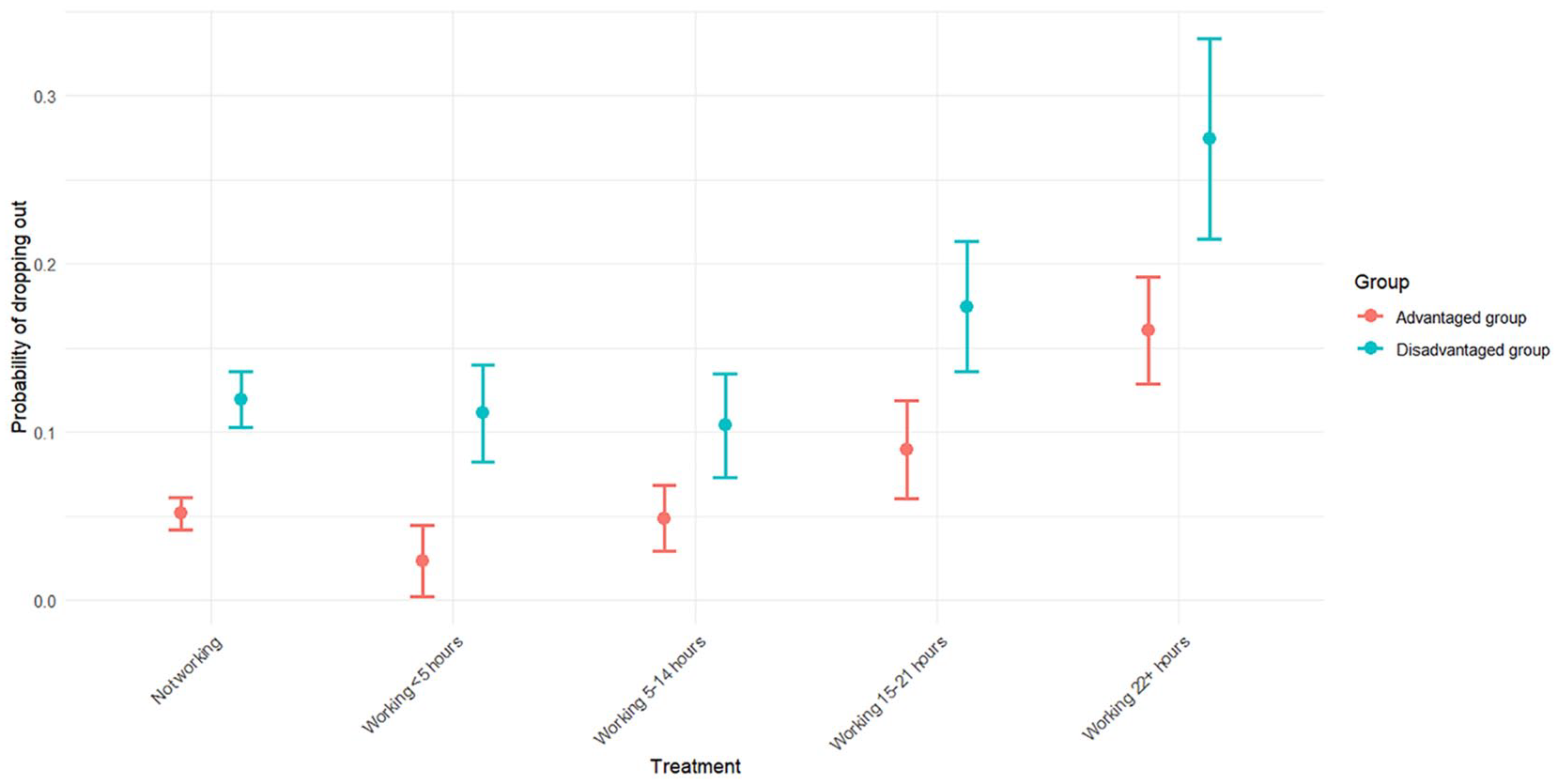
Causal estimands of the probability of dropping out of high school under different working intensities.
Supplemental Table S7 presents the result of the causal decomposition drawn from this multicategory treatment model. Notably, no component of the model (except the baseline) is statistically significant. It is worth noting that the standard errors are much larger than prior models, which is attributable to the fractionalized treatments increasing the uncertainty around estimates of each treatment effect.
We additionally consider the role that types of work may play in contributing to the gap in rates of dropping out. Supplemental Table S8 presents descriptive statistics on how types of work vary between the two groups. Significant differences in prevalence are observable across several types of work. Lawn work and odd jobs, babysitting, and manual labor are all more common among children with higher educated parents. Supplemental Table S9 presents estimates of average treatment effects for each type of work. We treat not working in 10th grade as the reference (not treated) category. The results indicate that only one type of work has a significant beneficial effect—babysitting reduces the probability of dropping out for students from both groups. Two types of work appear to have detrimental effects: both waiting tables and “other” jobs increase the probability of dropping out for both groups. It is important to note that the standard errors around each estimate are high, likely attributable to the highly fractional treatments, which increase the uncertainty around estimates of each treatment effect. Subsequently, the causal decomposition, presented in Supplemental Table S10, indicates no component of the decomposition except for the baseline is significant. Notably, the point estimate for the prevalence component is extremely close to zero, indicating that differences in the prevalence of certain types of work between groups do not seem to meaningfully contribute to differences in rates of dropping out.
Intergenerational Persistence of Higher Education Attainment
Tables 3 and 4 present an analogous analysis for college attendance. College attendance is operationalized as having attended or begun to attend a bachelor’s degree–granting institution by 1984 when the cohort was approximately 20 years of age. To study intergenerational persistence, we operationalize our groups as children who had at least one parent attain a bachelor’s degree or higher (40.1 percent of the sample) and those who did not (59.9 percent of the sample).
Intergenerational Persistence of Attending College (Bachelor’s Degree): Descriptive Statistics and Causal Estimands.

Note: ATE = average treatment effect; ITE = individual treatment effect.
Causal Decomposition of the Intergenerational Persistence of Attending College (Bachelor’s Degree).

Similar to Table 1, Table 3 presents descriptive statistics and causal estimands. We observe a large gap in college attendance between the two groups. Nearly half (48.78 percent) of children in the advantaged group began to attend college by 20 years of age, compared with less than a third (32.85 percent) of the disadvantaged group. Rates of working in 10th grade are statistically indistinguishable between the two groups: both just over 40 percent.
The bottom half of Table 3 presents causal estimands. The results indicate that working in high school has a negative, statistically significant effect for those in the advantaged group and a negative, insignificant effect for those in the disadvantaged group. Notably, the two effect sizes are statistically different, however. The point estimates indicate that working in 10th grade for a child with at least one parent who attended college, on average, reduces the probability of college attendance by 3.03 percentage points, from 49.99 percent to 46.96 percent. For a child who had neither parent attend college, working in 10th grade reduces the probability of college attendance by 1.26 percentage points, from 33.33 percent to 32.07 percent. We find no evidence that working in 10th grade for either group is associated with the individual effect of working.
Table 4 presents the results of the causal decomposition. Given an overall existing gap of 15.93 percent, no component of the decomposition (except the baseline) is statistically significant. Notably, the point estimate for the baseline is larger than the existing gap, indicating that in the absence of any student working at all, the gap would be expected to be larger, although the difference is not statistically significant.
Tables 5 and 6 present the results of a similar analysis. Instead of operationalizing college attendance as attending an institution that grants bachelor’s degrees, we operationalize it as any form of postsecondary education, which also includes junior colleges, trade schools, and other types of schools. These results are generally quite similar to the prior analysis, and we find no component to be significant. We do, however, observe an opposite pattern in terms of the treatment effect of working. Although in terms of bachelor’s degree attendance, working is significantly detrimental for advantaged group members, but not for disadvantaged group members, for any postsecondary attendance, working is significantly detrimental for disadvantaged group members, but not for advantaged group members. This potentially suggests that advantaged group members who end up not attending baccalaureate colleges because of working, may pursue other postsecondary options, whereas disadvantaged group members will tend to not end up pursuing postsecondary education at all.
Intergenerational Persistence of Attending College (Any Postsecondary): Descriptive Statistics and Causal Estimands.

Note: ATE = average treatment effect; ITE = individual treatment effect.
Causal Decomposition of the Intergenerational Persistence of attending college (Any postsecondary).

We additionally consider the role that work intensity may play in these results. Similar to the high school dropout models, we consider a multicategory treatment approach to the decomposition, dividing up types of work in terms of intensity. Supplemental Table S11 presents descriptive statistics on the distribution of different intensities of work between the two groups. The patterns are generally the same as in Supplemental Table S5, but are not identical because our group categorization and sample wave (1984) are different. The same pattern holds, however, in terms of working fewer hours (1–4 hours) being significantly more common in the group with higher educated parents, whereas working longer hours (>22 hours) is significantly more common in the group with lower educated parents.
Supplemental Table S12 presents estimates of the average treatment effect of specific intensities of work in having enrolled in a bachelor’s degree–granting institution by 1984. No form of work across either group has a significant positive impact on attending college. Furthermore, no form of work has a significantly different effect between the two groups. For both groups, however, working longer hours (15–21 and >22 hours) has a significant negative impact on the probability of attending college. Figure 2 presents another view of these results. For the average 10th grade student who had one or more parents attain a bachelor’s degree, working 22 hours or more per week decreases their probability of attending college from 52.00 percent to 22.54 percent. For the average 10th grade student for whom neither parent attained a bachelor’s degree, working 22 hours or more per week decreases their probability of attending college from 34.77 percent to 15.25 percent. Supplemental Table S13 presents the results of the decomposition, which indicates that no component, except for the baseline, is significant.

Causal estimands of the probability of attending college (bachelor’s degree) under different working intensities.
Supplemental Table S14 presents estimates of the average treatment effect of specific intensities of work in having enrolled in any postsecondary institution by 1984. The results indicate that working a small number of hours per week (1–4 hours) significantly increases the probability of attending college, but only for students who had a parent who went to college. The difference in effects is significant. Working 5 to 14 hours per week, 15 to 21 hours per week, and >22 hours per week all have significantly negative impacts on the probability of attending college for students whose parents did not attend college; only the latter two have significant effects for students who had a parent who attended college. Figure 3 presents another view of these results. For the average 10th grade student who had one or more parents attain a bachelor’s degree, working 22 hours or more per week decreases their probability of attending college from 73.96 percent to 43.49 percent. For the average 10th grade student for whom neither parent attained a bachelor’s degree, working 22 hours or more per week decreases their probability of attending college from 58.80 percent to 28.48 percent.

Causal estimands of the probability of attending college (any postsecondary) under different working intensities.
Supplemental Table S15 presents the results of the decomposition. Besides the baseline component, the prevalence component is positive and significant. This indicates that differences in the prevalences of work intensity significantly contribute to the observed gap between these groups. Notably, although this component is statistically significant, it is quite small, equal to only about 3.7 percent of the entire disparity. This suggests that an intervention to equally distribute the distribution of work intensities between the two groups would reduce the gap in college attendance, but only by a very small amount. The point estimate for the effect component is notably much larger but is insignificant.
We next consider the potential role that different types of work may play in contributing to the gap in attending college. Supplemental Table S16 presents the descriptive prevalence of each type of work by group. These numbers are generally similar to Supplemental Table S8 but are based on a different parental education grouping, and a different sample wave (1984). Supplemental Table S17 presents estimates of the average treatment effect of different types of work in having enrolled in a bachelor’s degree–granting institution by 1984. For students who had at least one parent attend college, waiting tables, skilled trade, and “other” work all have a significantly negative effect on attending college, whereas babysitting has a significantly positive effect. No type of work has a significant effect on those for whom neither parent attended college. Notably, the difference between groups in effect size for babysitting is statistically significant. Supplemental Table S18 presents the results of the decomposition, which indicates that no component, except for the baseline, is significant.
Supplemental Table S19 presents estimates of the average treatment effect of specific types of work on having enrolled in any postsecondary institution by 1984. For students who had at least one parent attend college, waiter/waitressing and “other” work both have a significantly negative effect on attending college, while babysitting has a significant positive effect. For those for whom neither parent attended college, lawn work and odd jobs, waiting tables, and “other” types of work all have a significant negative impact. Supplemental Table S20 presents the results of the decomposition, which indicates that no component, except for the baseline, is significant.
Discussion
This study examines the intergenerational persistence of educational attainment, estimating the role working in 10th grade plays on high school dropout rates and college attendance. Consistent with prior research, we observe a stark intergenerational persistence of both dropping out of high school and college attendance. Combining a rich dataset with flexible, doubly robust machine learning methods, we find evidence of a clear effect of working in 10th grade, particularly working longer hours, on dropping out of high school and not attending postsecondary school.
Our causal decomposition reveals that children of less educated parents are not only more likely to drop out of high school but also experience a greater increase in dropout risk when working in 10th grade compared with their peers with more educated parents. Although effect heterogeneity is present when examining work dichotomously, it is absent when considering more fine-grained variation in work intensities—which we attribute to our finding that working longer hours (e.g., ≥22 hours per week) substantially increases the probability of dropping out, and is more common among children of less educated parents. Overall, we find limited evidence that working contributes to the intergenerational persistence of dropping out of high school, though some evidence indicates that heterogeneous effects of work slightly contribute.
In terms of college attendance, the results show that working in 10th grade has a negative impact on both advantaged and disadvantaged groups. We find little evidence to suggest that working in high school plays a significant role in contributing to the intergenerational persistence of college attendance. Ultimately, these findings dispute the theory that entrance into the labor force early in secondary school contributes to educational social stratification.
Further analysis reveals that the type and intensity of work play significant roles in shaping educational outcomes. Low-intensity work (e.g., 1–4 hours per week) appears to have a protective or even beneficial effect for students from more advantaged backgrounds. Conversely, high-intensity work has consistently detrimental effects, particularly for students from disadvantaged backgrounds. Similarly, the type of work appears to influence outcomes, with babysitting showing positive effects and waiting tables or “other” jobs exhibiting negative effects across groups. These findings suggest that interventions targeting work intensity and promoting more educationally supportive types of work may yield positive results, though they are unlikely to substantially alter the intergenerational persistence of educational attainment.
In line with a variety of other social stratification research, our findings highlight a high degree of intergenerational persistence in terms of educational attainment. Our main results, however, suggest that these disparities have little to do with high school employment. Although tailored interventions to mitigate the intergenerational persistence of educational attainment is an important policy goal, these findings suggest shifting attention away from labor force participation toward other inputs that actually shape disparities. In terms of improving educational outcomes for everyone, labor force participation may still be an important lever on which to intervene. Our main results suggest that although high school employment does not meaningfully contribute to disparities, it still appears to have a universal negative impact, particularly long working hours.
This study has several limitations to bear in mind when interpreting these results. First, despite the rich dataset these analyses drew on, unmeasured confounding factors may still bias the results. Additionally, although the decomposition analysis provides valuable insights, large standard errors indicate substantial uncertainty in our causal estimates. Applying these same methods to even larger samples may yield clearer findings.
Caution should also be exercised when applying these findings to countries other than the United States, as educational systems, labor market conditions, and stratification factors vary globally. Even within the United States, patterns around high school employment and educational attainment have shifted from 1980 to today, potentially suggesting our findings may not hold in today’s cohort of high school students. Given the decreasing prevalence of work in 10th grade from 1980 to today, our results suggest that if work played little to no role in the intergenerational persistence of educational attainment in 1980, it seems even less likely to do so today. Future research should examine the generalizability of these results across a wider array of populations, geographical contexts, and time periods. Although the sample of this dataset makes subgroup-specific analyses challenging, such analyses may yield especially informative results related to our overarching research questions and are an important direction for future research to head.
Ultimately, this research has several implications for both scholarship and policy. First and foremost, further research should investigate the precise mechanisms that mediate the negative causal effect of high school work on educational attainment. Our findings align with past research that suggests that certain forms of high school work are not associated with worse educational attainment (Neyt et al. 2019). Some forms of work may even enrich adolescents’ cognitive and noncognitive skills and may be important to long-term outcomes. Analyses on larger samples may yield more informative results on this heterogeneity.
Ultimately, the results of this paper suggest that substantial levels of student work may have adverse impacts on educational outcomes. Although we find limited evidence to suggest that work contributes to the persistence of educational inequalities, policies designed to discourage, prohibit, or limit students from working a high number of hours during high school may still have a positive effect on educational attainment in certain cases. It is important for policies to be carefully designed, however, as certain types of work or limited amounts of work may actually have a positive effect on academic outcomes (Keister and Hall 2010; McNeal 1997; Mortimer 2010). Ultimately, as the consequences of unequal educational attainment become increasingly relevant for life outcomes (Autor 2014), it is imperative scholars work to better understand the mechanisms that foster inequitable educational outcomes.
Supplemental Material
sj-docx-1-srd-10.1177_23780231251362947 – Supplemental material for High School Employment and Intergenerational Mobility in Education: A Causal Decomposition Approach in a Period of Widespread Teenage Work
Supplemental material, sj-docx-1-srd-10.1177_23780231251362947 for High School Employment and Intergenerational Mobility in Education: A Causal Decomposition Approach in a Period of Widespread Teenage Work by Karl Vachuska and Stephen Rodriguez-Elliott in Socius
Footnotes
Funding
The authors disclosed receipt of the following financial support for the research, authorship, and/or publication of this article: This research was carried out using the facilities of the Center for Demography and Ecology at the University of Wisconsin–Madison, which is supported by Eunice Kennedy Shriver National Institute of Child Health and Human Development grant P2C HD047873, and was supported in part by training grant T32 HD007014. The content is solely the responsibility of the authors and does not necessarily represent the official views of the National Institutes of Health.

Supplemental Material
Supplemental material for this article is available online.
1
This odd cutoff was a result of the HSB survey question answer categories and was not selected by the authors.
Author Biographies
References
Supplementary Material
Please find the following supplemental material available below.
For Open Access articles published under a Creative Commons License, all supplemental material carries the same license as the article it is associated with.
For non-Open Access articles published, all supplemental material carries a non-exclusive license, and permission requests for re-use of supplemental material or any part of supplemental material shall be sent directly to the copyright owner as specified in the copyright notice associated with the article.
