




Abstract
The author examines racial fluidity, defined as ambiguity around racial boundaries and shifting national identification patterns over time, in Jamaica. Using data from the 2010 to 2023 AmericasBarometer in Jamaica, the author explores how skin color and socioeconomic status (SES) influence Black or mixed self-identification and whether racial schemas have evolved. The results show that both skin color and SES are associated with racial identification. Over time, skin color ratings between Black and mixed-race individuals converged, suggesting increased fluidity between skin color and racial identity. Additionally, the relationship between SES and racial identification changed significantly across survey years. These findings (1) expand the study of racial fluidity to a majority African-descended society shaped by ideologies of racial mixing; (2) reframe the role of SES in racial identity through mestizoization or creolization rather than whitening; and (3) highlight intra-Black fluidity, whereby racial identity may diverge from skin color. Overall, the study illustrates how national racial formations shape the malleability of race.
Jamaica has long embraced national ideologies of racial mixing that contribute to blurred racial boundaries and reclassification on the basis of skin color, ancestry, and class (Henke 2001; Livesay 2018; Newman 2018; Sio 1976). This legacy of racial fluidity persists through a localized emphasis on phenotype and wealth that may contrast with dominant U.S. understandings of race (Kelly 2024). Further complicating this landscape is a tension between the Jamaican state’s promotion of racial mixing and physical hybridity (i.e., creolization; Thame 2017) and an emergent “modern Blackness” that departs from the official discourse of mixedness (Thomas 2004, 2005). These competing nationalist frameworks, combined with the interplay between skin color and socioeconomic status (SES) in shaping racial classification, likely influence patterns of racial self-identification and contribute to broader racial fluidity.
This context is crucial, as scholars often theorize that “money whitens”: lighter skin and/or higher SES can facilitate upward mobility in racial classification not fully supported by phenotype (Roth, Solís, and Sue 2022; Schwartzman 2007). Research indicates that the degree of racial malleability, whether racial classification is fluid or binary, depends on a country’s racial schema, or “the bundle of racial categories and the set of rules for what they mean, how they are ordered, and how they apply . . . to oneself and others” (Roth 2012:12; see also McNamee 2020; Telles and Bailey 2013). This malleability is particularly evident in the flexibility of whiteness, Blackness, and intermediary categories (Telles and Flores 2013; Telles and Paschel 2014). Additionally, national histories, racial divisions, and ideologies help structure racial schemas. Prior scholarship has found more categorical ambiguity between Black and mixed-race classifications than among other racial categories (Bailey and Telles 2006; Carvalho, Wood, and Andrade 2004). However, few studies have investigated racial fluidity in majority African-descended countries in the Americas that also promote ideologies of racial mixing. Despite notable parallels with Latin American contexts and existing research suggesting a similarly nuanced racial terrain, empirical studies on racial fluidity in Jamaica remain limited.
This study focuses on Jamaica to investigate racial fluidity: the notion that race is socially malleable rather than fixed (Davenport 2020; Saperstein 2025; Telles and Paschel 2014). Scholars have identified four dimensions of fluidity: temporal (changes over time), contextual (variations across settings), referential (inconsistencies in how others perceive someone’s race), and categorical (blurred boundaries between categories). This study adopts a broader definition, viewing racial fluidity as both the ambiguity surrounding racial categories and national-level shifts in racial identification over time. Particular emphasis is given to the temporal component, as research across the Americas shows that racial identification can shift in response to social, economic, and political factors (Agadjanian and Lacy 2021; Antman and Duncan 2015; Saperstein and Penner 2012). Racial mixing ideologies prominent in the twentieth century have arguably been challenged or supplemented by new racial projects (Telles and Bailey 2013). As race-conscious policies gain traction, national patterns of racial identification may continue to evolve (Freeman, Telles, and Goldberg 2025). In Jamaica, the competing narratives of mixedness and modern Blackness may similarly wax or wane over time. Examining changes in self-identification at the national level thus offers insight into the salience and persistence of racial ambiguity in Jamaica. Although broad in scope, the study is grounded in and contributes to existing research on racial fluidity.
Using nationally representative data from the 2010 to 2023 waves of the AmericasBarometer on Jamaica, I investigate (1) the extent to which skin color maps onto racial identification, (2) how SES is associated with racial identification, and (3) how these relationships shift over time. Results indicate that the connection between skin color and racial self-identification is fluid. The average skin color of those identifying as Black and those identifying as mixed converge across survey years. In 2010, higher SES was associated with a more “mestizoized” 1 —or, more accurately, “creolized”—racial identification. In 2012, SES was associated with “darkening” 2 identification, had no significant effect from 2014 to 2019, and returned to a pattern of “creolization” in 2023. These patterns suggest meaningful shifts in how racial identity is expressed over time.
The study makes three key contributions. First, it broadens the scope of racial fluidity research by centering Jamaica, a majority African-descended society where racial mixing continues to shape social and political identity (Altink 2019; Kelly 2024). Second, it moves beyond traditional “whitening” frameworks to explore how SES contributes to “mestizoized” or “creolized” racial identification as a form of racial privilege. Third, it underscores the fluidity within and around Blackness in Jamaica, where darker skin does not automatically equate to Black identification, and Black identity is not exclusive to darker skin color. In doing so, the study highlights the importance of national racial formations in shaping racial fluidity and contributes to a more nuanced understanding of racial malleability in African-descended populations.
Previous Research on Racial Fluidity
In Latin America, racial classification is widely regarded as more fluid than in other regions, making it a preferred context for many studies on racial fluidity. However, the degree of fluidity varies across countries in the region. Telles and Flores (2013) explored how national context, sociodemographic factors, and skin color affect white racial self-identification across 17 Latin American countries. Their findings showed that although skin color constrained white identification in all the countries, national context, education, and age also played significant roles. White identification thus differed across countries and was shaped by both historical and social dynamics.
Telles and Paschel (2014) investigated racial fluidity in Brazil, Colombia, the Dominican Republic, and Panama using nationally representative data based on self-rated SES and interviewer-rated skin color. They examined variations in categorical ambiguity, focusing on color elasticity—“the extent to which skin color maps directly onto racial identification” (p. 870)—and the social value of higher SES. Skin color significantly predicted racial self-identification across all four countries, although with varying degrees of elasticity. Color elasticity was high in Panama, low in the Dominican Republic, but intermediate in Brazil and Colombia. SES also strongly influenced racial identification in three of the four countries. However, rather than a uniform “money whitening” pattern, they found varying trends: “polarization” 3 in Brazil, “mestizoization” in Colombia, “darkening” in the Dominican Republic, and no SES effect in Panama. These divergent outcomes underscore the role of national context and ideology in shaping racial schemas.
Despite extensive research on racial fluidity in the Americas, the phenomenon remains understudied in the Anglophone Caribbean and majority Black populations, and findings are often inconsistent. For example, Golash-Boza (2010), in a qualitative study of racial fluidity and racialized mobility in an African-descended Peruvian community, found no evidence that SES led to social or cultural whitening among the interviewees.
More recently, McNamee (2020) examined variations in racial identification and schemas across the Americas, testing the explanatory power of colonial legacies versus national ideologies while controlling for skin color. The author theorized that in societies historically dominated by European settlers, where whiteness became the dominant racial ideology, higher SES would lead to racial whitening. Conversely, in societies with fewer European settlers and ideologies that valorized racial mixture, higher SES would promote mestizoization. Using data from 27 countries and 25 Brazilian states, McNamee found that higher education, a proxy for SES, was associated with racial whitening in countries with significant European colonial presence, while it led to more mixed-race identification in countries with ideologies of racial mixing.
McNamee’s (2020) analysis included majority African-descended countries such as the Bahamas, Barbados, Haiti, and Jamaica (Central Intelligence Agency 2024). Among these Anglophone Caribbean and majority-Black countries, only Jamaica stood out. Despite ideologies of racial mixing, Jamaica exhibited a racial binary that included Blackness: higher levels of education correlated with darkened racial identification. McNamee attributed this to local and transnational Black activism, which may have disrupted the state-supported racial project of creole multiracialism.
Although McNamee’s (2020) study offered valuable insights, it relied solely on education to define SES, despite noting similar findings when using income. In developing contexts such as Jamaica, expense-based indicators more accurately reflect socioeconomic conditions (Cordova 2009; see also Kelly 2020; Paredes 2018; Telles and Paschel 2014). A broader view of SES may yield more accurate insights into how it shapes racial identification. Building on McNamee’s suggestion that racial identification may be shifting in Jamaica, in this study I investigate national trends in self-identification over time.
Together, these studies highlight the complexity of racial formations and their influence on racial self-identification. Specifically, they illustrate how national ideologies and individual agency intersect to shape how and to what extent SES affects racial identity. Jamaica offers a nuanced case for understanding racial formations, their effects on racial schemas, and racial fluidity in a predominant Black society with a political and cultural legacy of racial mixture akin to Latin America.
Background
Class, Color, and Racial Identification in Jamaica
Historically, Jamaica’s racial structure, like that of other societies in the Americas, placed whites at the top, Blacks at the bottom, and people of mixed race in the middle, reflecting the belief that any European ancestry conferred superiority. Before the 1730s, finer gradations were used. Sio (1976:8) described a “rank order” of racial categories in Jamaica:
Negro (child of negro and negro)
Sambo (child of mulatto and negro)
Mulatto (child of white and negro)
Quadroon (child of white and mulatto)
Mustee (child of white and quadroon)
Mustifino (child of white and mustee)
Quintroon (child of white and mustifino)
Octoroon (child of white and quintroon)
These classifications were legislatively enforced, with skin color and birth status often determining racial category. Skin color also influenced citizenship rights, especially from the 1730s until the abolition of slavery in the 1830s:
After 1733, those lighter than mustee [i.e., mustifino, quintroon, and octoroon] were legally defined as white on the principle of generation and received the full rights of citizenship. Those darker than mustifino were defined in the law as mulatto. Legally then . . . free colored in Jamaica applied to those in the category of mulatto. The free colored group was also divided into free browns (mustee, quadroon, mulatto) and free blacks (sambo, Negro). (Sio 1976:8)
However, laws restricting “free coloreds” from access and ownership could be bypassed by wealth. Between 1733 and 1826, some elite free colored Jamaicans petitioned to be legally recognized as white. These petitions, while rarely successful in granting full legal whiteness, often emphasized wealth, social standing, and kinship ties to white men on the island (Livesay 2018). Through high SES, some individuals were able to whiten their racial classification in practice, if not in law. In this sense, SES functioned as an “escalator” (Roth et al. 2022), making whiteness, at least in terms of treatment and rights, attainable despite phenotype. These petitions were unique to Jamaica among Anglophone Caribbean countries, although they mirror legal racial fluidity found in parts of Latin America (Livesay 2018).
This conflation of race, color, and class also persists in Jamaican discourse. Austin-Broos (1994) observed that references to any of the three often carry implicit assumptions about the other. Additionally, categorical ambiguity remains, as numerous informal race/color descriptors are still commonly used (see Hall 1997; Henke 2001).
Dominant Racial Projects in Jamaica
Two major racial projects shaped Jamaican national identity in the twentieth century: creole multiracialism and Black nationalism (Levi 1992). Racial projects “connect what race means in a particular discursive practice and the ways in which both social structures and everyday experiences are racially organized, based upon that meaning” (Omi and Winant 2014:125). In Jamaica, these projects sought to reconcile the nation’s colonial past with its aspirations for global “civility” and a distinct cultural identity separate from Britain (Thame 2017). They were rooted in two coexisting ideals: “one that envisioned a Jamaica in which white Jamaicans and African Jamaicans had the same opportunities and another that imagined an island run by locally born Jamaicans of a certain class and color” (Altink 2009:2).
Creole Multiracialism
As the name suggests, this racial project was grounded in the concepts of creolization, defined as the blending of several “original elements” from the Old World into the New World (Bolland 1998). In Jamaica, the main elements were European (white) and West African (Black), as the indigenous population was nearly eradicated during Spanish conquest which began in the fifteenth century. Thus, to be creolized largely meant being of Black and white “extraction,” with light skin serving as the physical marker of this racial hybridity (Sio 1976). Creole multiracialism equated being of mixed race or “brown” with indigeneity, shifting the basis of national belonging away from whiteness (Thame 2017).
Although this Black-white dichotomy might appear reductive, it reflects the quotidian reality of creole multiracialism in Jamaican society. The nationalist framework aimed to establish a “homogeneously mixed race nation” (McNamee 2020:347; see also Kelly and Bailey 2018), where “Blacks could themselves be named mixed (not pure, not African, even if dark-skinned), or they could work toward the facticity of mixedness” (Thame 2017:121).
Evidence of this institutionalized mixedness persists. As recently as the 1960 census, classifications such as “Afro-European, Afro-East Indian, Afro-Chinese, and other mixtures” were officially recognized (Jamaica Department of Statistics 1960). Although no longer the standard, these terms still appear in some official records (e.g., World Population Review 2023). The national motto, “Out of many, one people,” encapsulates cultural and racial hybridity as the norm (Cooper 2012; Nettleford 1970; Thame 2017). This ideology is also reinforced through an Afro-Saxon model of mobility: a “creole multiracial citizenry” 4 cultivated for respectability (Thomas 2004, 2007).
Although creole multiracialism shares many features with Latin American ideologies of mestizaje, the two differ in important ways. Scholars note that Latin American mestizaje promoted whitening through further mixture and excluded Indigenous and Black cultures and identities from nationalist narratives (De la Fuente 2001; Gudmundson 1984; Telles and Bailey 2013; Wade 1993). In contrast, although certain aspects of Black culture in Jamaica may have been constrained (Nettleford 1970; Thomas 2007), Black identity was never excluded from the formation of Jamaican nationalism (Gray 1991). Furthermore, because of high levels of absenteeism among European colonizers and settlers, the status of “native” in Jamaica was claimed by mixed-race (or creolized) individuals. This contrasts with Latin America, where this status was typically claimed by whites or “criollos” (Alleyne 2002).
Black Nationalism
The entire Jamaican population did not readily accept the creolization of national identity. Numerous scholars have noted competing, more explicitly racialized frameworks of belonging that sought greater inclusion of the Black working-class population. These oppositions manifested in various social movements that rejected the political and cultural ideals of creole nationalism (Barrett 1977; Levi 1992; Meeks 2000). Key examples include the Morant Bay Rebellion of 1865, the founding of the Universal Negro Improvement Association in 1914, the emergence of the Rastafari movement in the 1930s, the Claudius Henry Rebellion, and rise of the Universal Negro Improvement Association and the “rude boy” phenomenon in the 1960s.
Although state elites often dismissed Black nationalist movements and ideologies that empowered Blackness as divisive (Meeks 2000; Nettleford 1965, 1970), this resistance underpins what Thomas (2004) called modern Blackness: “a subaltern aesthetic and politics; a bracketed Blackness that continually deconstructs [the power relations] that are often erased within the [country’s] Creole [nationalist] formulation” (p. 13). In her ethnographic investigation of Jamaican nationalist identities, Thomas (2004) observed that working-class Blacks were alienated from the “folk Blackness” promoted by creole multiracialism. Modern Blackness among her informants emerged from efforts of place-making within the racial project of creole multiracialism and primarily challenges Black subordination, although Thomas noted that certain “aspects . . . can . . . reproduce timeworn tropes about black vernacular culture” (p. 231).
The Jamaican Context: 2010 to 2023
Economic Turmoil and Attending Racial Tensions
Jamaica has experienced significant economic turmoil since the 1990s, exacerbated by the 2008 global financial crisis. By 2013, public debt had reached 147 percent of gross domestic product. To alleviate the country’s debt and safeguard additional International Monetary Fund–supported programs (IMF 2019), the Jamaican Economic Program Oversight Committee was established as an accountability structure for the government’s “reform commitments and fiscal discipline.” These measures helped reduce public debt from 150 percent of gross domestic product to 100 percent in 2018 and 75.5 percent by 2023 (Eichengreen, Henry, and Arslanalp 2024; World Bank Group 2024). Despite this progress, poverty remains a persistent issue. Between 2010 and 2023, the highest reported poverty rate was 24.6 percent in 2013, and the lowest was 11 percent in 2019 (Statistical Institute of Jamaica 2024). As of 2023, 12.3 percent of the Jamaican population lived below the international poverty line of U.S. $6.85 per day (World Bank in Jamaica 2024)
Leaders from both of Jamaica’s major political parties have hailed Chinese investment in the island as a promising source of economic development. As in many developing nations, the People’s Republic of China has invested heavily in infrastructure development (Campbell and Valette 2014; Lumsden 2015). The Chinese Harbor Engineering Company claims that its Jamaica Development Infrastructure Program has brought thousands of jobs to the country. However, Jamaican labor unions have staged multiple strikes in response to allegations of poor labor conditions, wage cuts, mass layoffs, and the increased use of imported Chinese labor (Laville 2015; Lumsden 2015). Local contractors and political commentators often describe Chinese labor as “industrious” and “affordable,” implicitly contrasting it with Black labor (Frater 2016; McIntosh 2014). In this context, Chinese migrant workers are frequently perceived as a threat to Jamaican livelihoods. These dynamics, combined with broader global economic shifts, exacerbate racial disparities and likely influence the fluidity of racial identification over time and across categories.
The Sociopolitical Context
During the study period, Jamaica saw its first Black female prime minister, Portia Simpson-Miller, who served from 2012 to 2016. Her embodiment of modern Blackness made her popular with working-class voters, but she received less support from middle- and upper-class voters. Although she had been a member of parliament since 1989, critics called her unqualified on the basis of her “modest education, undistinguished performance in Parliament, Creole speech [i.e., Patios], populism and refusal to face the press” (Patterson 2007). Simpson-Miller herself attributed these criticisms to being of the “wrong color, address, and social class” (Johnson-Myers 2021:198–99; see also Virtue 2016).
The treatment of the mixed-race male prime ministers who preceded and followed Simpson-Miller—Bruce Golding (2007–2011) and Andrew Holness (2011–2012, 2016–present)—further illustrates the role of racism and colorism. For example, both Golding and Holness occasionally used Patois in public, but they were never criticized for doing so, unlike Simpson-Miller. These differing perceptions reflect how race, color, and class of political leaders invoke specific racial projects and affect racial identification (Agadjanian and Lacy 2021; Egan 2020), especially when we consider related assumptions about competency and legitimacy (Cooper 2022; Golding 2020; Wilson 2019).
These tensions became especially salient during the racial reckoning of 2020, sparked by incidents of police brutality and extrajudicial killings, mirroring similar protests in the United States (Altink 2020). A protest held on June 6, 2020, outside the U.S. Embassy in Kingston was catalyzed by the killing of Susan Bogle—a poor, intellectually disabled woman—during a police and military operation. Protesters carried placards with the names of many other victims of police brutality, including Mario Deane, who died in police custody in 2014. These events reflected a diasporic form of racialized Black consciousness that likely shapes racial self-identification in Jamaica today.
The Present Study
This study builds on Telles and Paschel’s (2014) claim that racial schemas across the Americas vary primarily based on the intersection of SES and skin color. This is especially relevant in Jamaica, where skin color, SES, and race are often conflated (Altink 2019; Austin-Broos 1994). Using data from the 2010 to 2023 waves of the AmericasBarometer, the correlation among these dimensions was investigated through three central questions: (1) How does skin color correspond to racial category? (2) How does higher SES affect self-identification? and (3) Have national racial identification patterns shifted significantly over time? These questions were addressed using interviewer-rated skin color and two SES indicators, education and expense-based household assets (hereafter “household amenities”; see Kelly 2020, 2022, 2024).
Contrasting racial projects—creole multiracialism and modern Blackness—may shape racial formations and identity. Creole multiracialism, and by extension mixedness, has historically connoted colonial respectability, while modern Blackness, which gained prominence after independence, emerged as vital to national identity and challenges the values and institutional legacies of creole multiracialism. These competing frameworks remain in constant tension, reflecting broader value debates central to conceptualizations of race and racial identity (Thomas 2004; see also Saperstein and Penner 2012 on the perceived link between Black racial identification and lower social status). Factors such as racial justice mobilizations (Omi and Winant 2014) and national policy shifts (Francis and Tannuri-Pianto 2013; Telles 2004) can influence the salience of these projects and the racial schemas they produce. Given the sociopolitical and economic instability Jamaica experienced from 2010 to 2023, the persistence and extent of racial fluidity during this period remain unclear.
Accordingly, the aim of this study was to investigate whether temporal shifts in national racial identification patterns have occurred in Jamaica and whether these shifts are associated with skin color and SES. Although I did not explicitly test the effects of racial projects on racial identification, the meanings ascribed to mixedness and Blackness—by creole multiracialism and modern Blackness, respectively—suggest that Black and mixed-race self-identification may align with these competing nationalist frameworks. The terms creolized and creolization are used in this study rather than mestizoized and mestizoization to more accurately reflect Jamaica’s specific historical and cultural context of racial mixing. The study contributes to the literature beyond Latin America by focusing on a majority African-descended population shaped by ideologies of racial mixing. It also reframes the role of SES in racial identity beyond whitening, focusing instead on patterns of Black and mixed-race identification. Finally, it highlights the fluidity within Blackness itself, underscoring the malleability of race.
Data and Methods
Data
The data for this study were obtained from the Jamaican waves of the AmericasBarometer, collected between 2010 and 2023 by the Latin American Public Opinion Project (LAPOP) at Vanderbilt University. LAPOP (2010–2023) has conducted biannual surveys in Jamaica since 2004, but only the 2010, 2012, 2014, 2016–2017, 2018–2019, and 2023 waves included interviewer-assessed skin color (using the Project on Ethnicity and Race in Latin America [PERLA] color palette) along with self-identified race. Surveys were conducted in English with voting-age adults using a national probability sampling design stratified by region (Kingston Metropolitan Region, Surrey, Middlesex, and Cornwall) and by urban or rural location. The sample sizes for each wave ranged from 1,500 to 1,521. After listwise deletion of missing responses and excluding individuals who did not identify as Black or mixed, the final pooled sample totaled 7,046 respondents.
Measures
The sole outcome variable was self-identified race. Respondents were asked the following question: “Do you consider yourself Black, Indian, white, Chinese, mixed, or of another race?” In the unweighted pooled sample, 87.53 percent identified as Black, 9.95 percent as mixed, 0.29 percent as white, 1.44 percent as Indian, 0.09 percent as Chinese, and 0.70 percent as “other.” For analysis, respondents who identified as white, Indian, Chinese, or “other” were excluded. A binary outcome variable was created to measure the likelihood of respondents self-identifying as mixed race: 1 = mixed-race identification and 0 = Black identification.
The main predictors were skin color and SES. Skin color was assessed by interviewers using the PERLA palette at the end of the interview without the respondents’ knowledge. The scale ranged from 1 (very light) to 11 (very dark). SES was measured using two variables: educational attainment and household amenities.
For the 2010 to 2019 LAPOP data, education was captured using a continuous variable ranging from 0 to 17 years of completed schooling, but for the LAPOP 2023 data, it was captured using a seven-category variable. To ensure consistency across survey years, education was recoded into three categories: 1 = primary-level education or less (0–6 years of schooling), 2 = high school–level education (7–11 years of schooling), and 3 = tertiary-level education (12 or more years of schooling).
Household amenities were measured using a relative wealth index developed by LAPOP (Cordova 2009), on the basis of ownership of eight expense-based items: refrigerator, cell phone, washing machine, microwave, drinking water or indoor plumbing, computer, Internet service, and flat-panel TV. Each item was dummy coded (1 = yes, 0 = no), and a principal-component analysis was conducted. Two components had eigenvalues greater than 1, but only the first (eigenvalue ~ 3) was retained, as it accounted for the largest share of variance and gave significant weight to all items except cell phone (Kaiser-Meyer-Olkin measure = 0.798).
In addition to these measures of skin color and SES, the statistical models included controls for sociodemographic factors that may influence racial identification. These included the respondent’s sex (1 = female), age, and urban residency. Because interviewers’ and respondents’ skin color may be correlated, the former’s skin color was also controlled to assess potential interviewer effects (Hill 2002; Paredes 2018). Interviewers rated their own skin color using the same PERLA color palette.
Methods
Summary statistics for the merged sample are presented in Table 1, while Figures 1 and 2 illustrate the distribution of self-identified race and skin color. Logistic regressions were conducted to predict mixed versus Black racial identification across several models. Models 1, 2, and 3 evaluated the effects of skin color and SES on identification, individually and jointly, in the pooled sample. Models 4 and 5 included sociodemographic controls. Model 4 excluded and model 5 included survey year dummies. Model 6, a saturated model, incorporated all covariates along with interaction terms for survey year and the three main predictors (skin color, education, and household amenities). This approach identified temporal variation in racial identification and the effects of each key variable over time. 5
Unweighted Summary Statistics (n = 7,046).

Source: AmericasBarometer social survey for Jamaica, 2010 to 2023.
Note: Means and standard errors are rounded to three decimal places.
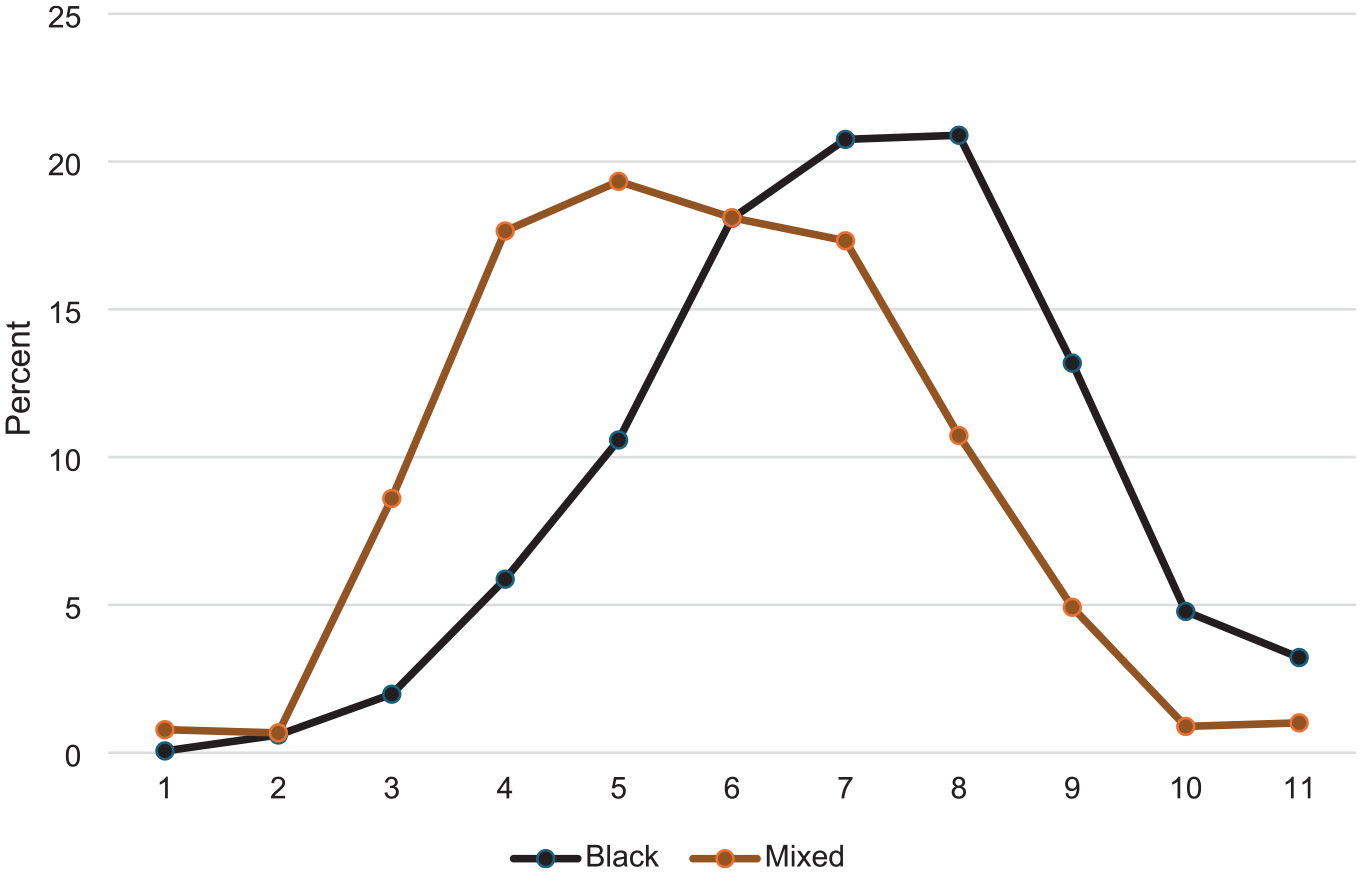
Percentage distribution of Black and mixed self-identification by skin color in Jamaica, Latin American Public Opinion Project, 2010 to 2023.
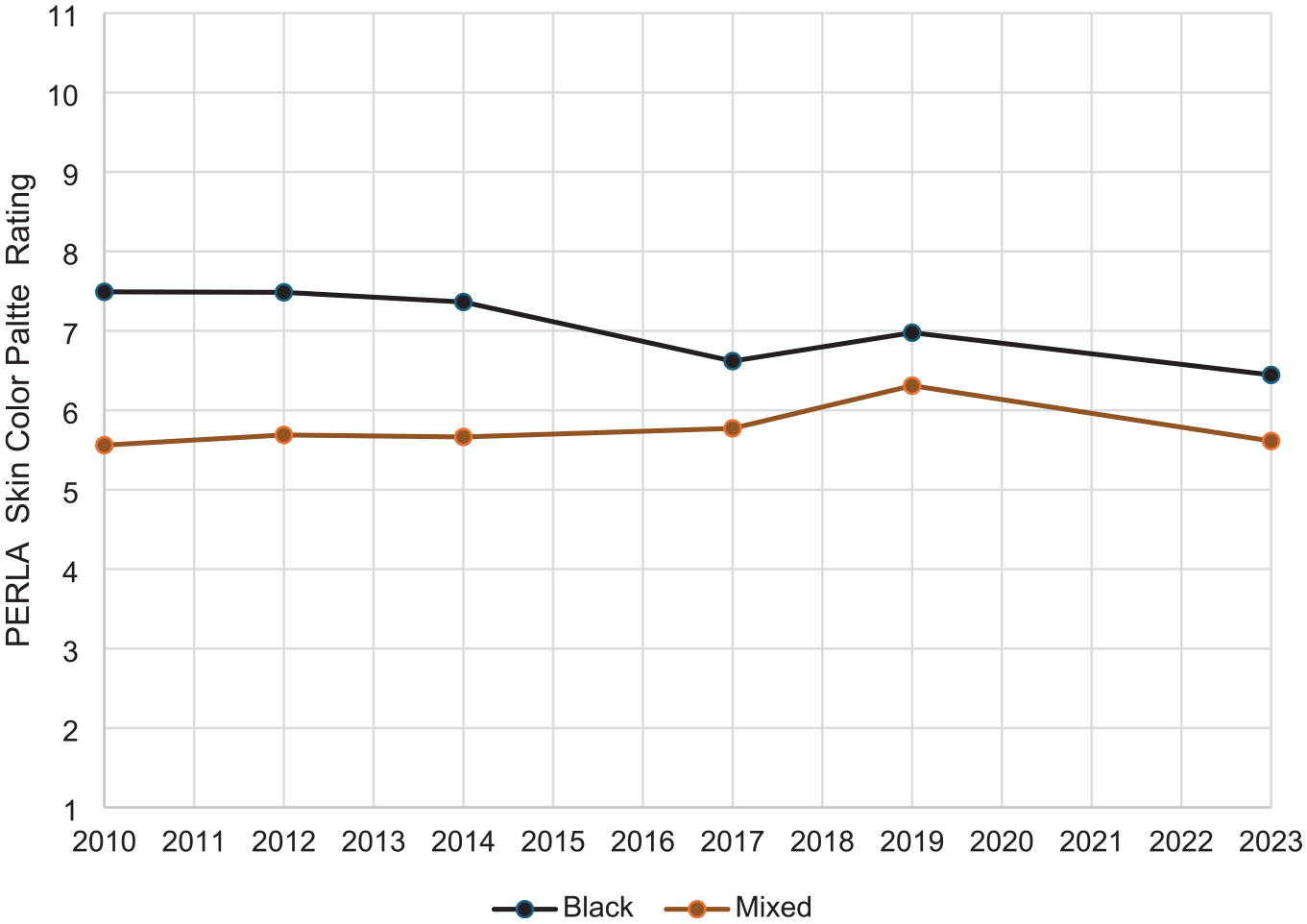
Mean skin color distribution by racial identification across survey years, Latin American Public Opinion Project, 2010 to 2023.
As a robustness check, joint significance tests were performed to determine whether differences in mixed versus Black identification across survey waves were statistically significant (Table A2). All six models are shown in Table A1, but only model 6 is discussed in the main results (see Table 2).
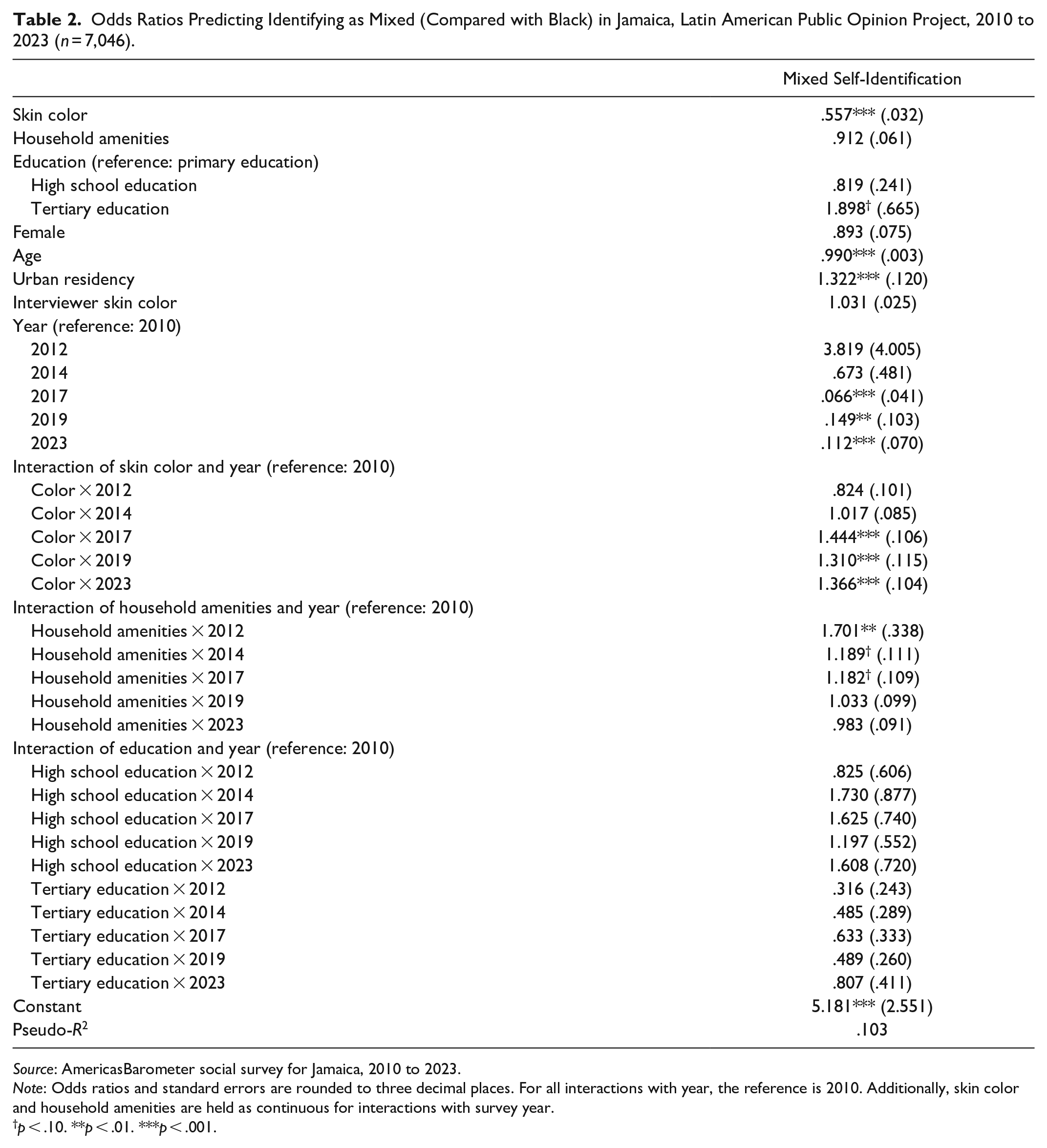
Odds Ratios Predicting Identifying as Mixed (Compared with Black) in Jamaica, Latin American Public Opinion Project, 2010 to 2023 (n = 7,046).
Source: AmericasBarometer social survey for Jamaica, 2010 to 2023.
Note: Odds ratios and standard errors are rounded to three decimal places. For all interactions with year, the reference is 2010. Additionally, skin color and household amenities are held as continuous for interactions with survey year.
p < .10. **p < .01. ***p < .001.
To further explore SES effects over time, following Telles and Paschel (2014), predicted probabilities of racial self-identification were estimated across the six survey waves. These probabilities were calculated for respondents with a skin color rating of 6, where Black and mixed-race respondents were equally represented (~18 percent; see Figure 1). High SES was defined as having tertiary education and a household amenities score one standard deviation above the mean. Low SES was defined as having primary education and a household amenities score one standard deviation below the mean. All other covariates were held at their respective means (Figure 3; see also Table A3).

Predicted probabilities for self-identification as mixed (compared with Black) by socioeconomic status in Jamaica, 2010 to 2023.
Results
Descriptive Findings
Table 1 presents summary statistics for the pooled 2010 to 2023 AmericasBarometer sample. The unweighted sample had an average age of 40 years and was equally split between men and women, with 60 percent living in urban areas. Educational attainment was as follows: 13.2 percent had primary education, 64.4 percent had secondary education, and 22.4 percent had tertiary education. The mean household amenities score was −0.020, and the average skin color rating was 6.891. Overall, 89.9 percent of respondents self-identified as Black and 10.1 percent as mixed race. Among Black respondents, 14.77 percent had primary education, 65.99 percent had secondary education, and 19.25 percent had tertiary education, with a mean household amenities score of −0.038. In contrast, of mixed-race respondents, 9.38 percent had primary education, 64 percent had secondary education, and 26.62 percent had tertiary education, with a mean household amenities score of 0.294 (not shown).
Figure 1 shows the skin color distribution for Black and mixed-race respondents within the pooled sample. Although both groups spanned the full range of skin colors, mixed-race respondents tended to be marginally lighter. Darker skin colors (ratings of 8–11) were more common among Black respondents (42.07 percent) than among mixed-race respondents (17.55 percent). Importantly both identifications were found in every skin color category, indicating fluidity in racial classification.
Figure 2 illustrates mean skin color ratings by year. The mean skin color rating for Black self-identified respondents generally decreased over time, while it increased slightly for mixed respondents as the gap between groups narrowed from two units to less than one. More specifically, beginning in 2017, the difference in mean skin color between the two groups dropped to less than one unit, a trend that remained consistent in 2019 and 2023. These minimal differences suggest a declining correlation between skin color and racial identification in Jamaica over time.
Logistic Regression
Table 2 presents odds ratios from model 6, predicting mixed versus Black self-identification by SES and skin color.
Skin Color and Racial Identification
Skin color was significantly associated with racial identification. Each unit increase in darkness of skin color reduced the odds of identifying as mixed by a factor of 0.557 (p < .001), holding all other variables constant. In other words, darker skin increased the likelihood of identifying as Black by approximately 44 percent.
However, this association varied by survey year. Interaction terms of skin color and survey year showed that compared with 2010, the odds of mixed identification increased by 44.2 percent, 30.5 percent, and 36.6 percent per unit increase in skin color in 2017, 2019, and 2023, respectively (p < .001). A Wald test confirmed that the impact of skin color on mixed-race identification in following survey years differed significantly from the 2010 reference (χ2 = 52.68, p < .001; see Table A2). These results suggest that, by 2017 to 2023, mixed-race respondents were more likely to have darker skin than in 2010. Thus, lighter skin is no longer a clear indicator of mixed-race identification over time in Jamaica, a finding supported by the descriptive trends illustrated in Figures 1 and 2.
SES and Racial Identification
Although the main effect of household amenities was not significant, its predictive power for mixed self-identification increased over time. Compared with 2010, individuals with more household amenities were 1.701 times more likely to identify as mixed than Black in 2012 (p < .01), 1.189 times more likely in 2014 (p < .10), and 1.182 times more likely in 2017 (p < .10). Joint significance tests (Table A2) confirmed that the odds ratios for the interaction terms for survey year and household amenities differed significantly from those in 2010 (χ2 = 18.36, p < .05). Education was also positively and significantly associated with racial self-identification. Respondents with tertiary-level education were 1.898 times more likely to self-identify as mixed than Black (p < .10). This suggests that tertiary education marginally creolized racial identification among Jamaican respondents. No significant variations were observed across survey years in the association between education and self-identification.
To further explore the effect of SES on mixed self-identification, predicted probabilities of high ([tertiary education] + [mean household amenities score + 1 SD]) and low ([primary education] + [mean household amenities score − 1 SD]) SES were estimated for persons with a skin color rating of 6 on the PERLA palette. Figure 3 illustrates that in 2010, high SES was associated with creolization, as the probability of identifying as mixed was 11.8 percent for low SES and 22.7 percent for high SES. In 2012, however, high SES was associated with a darkening of racial self-identification, with a 12.7 percent decrease in mixed self-identification. In 2014, 2017, and 2019, SES had minimal impact on mixed identification, with increases ranging from 0.5 to 2.6 percent. In 2023, SES again creolized racial identification, as mixed self-identification rose from 9.7 percent in 2019 to 14.5 percent among those with higher SES.
Changes in National Patterns of Racial Identification
Survey year dummy variables revealed shifts in national racial identification patterns. Mixed identification declined significantly in 2017, 2019, and 2023 relative to 2010. Joint hypothesis tests (Table A2) confirmed significant year-to-year variation in mixed identification, independent of skin color and SES. Over time, skin color ratings among those identifying as Black and mixed exhibited increasing convergence, while SES-related effects shifted from creolization in 2010, to darkening in 2012, to no effect in 2017 to 2019, and back to creolization in 2023. These results highlight both persistent categorical ambiguity and evolving national identification patterns in Jamaica.
Discussion
This study investigated patterns of self-identification by skin color and SES in Jamaica between 2010 and 2023. Like most Anglophone Caribbean nations, Jamaica historically lacked a numerically significant white population because of landowner absenteeism (Alleyne 2002; see also McNamee 2020). Although white economic power and British colonial influence remain prominent in the island nation, identification with whiteness has largely been supplanted by mixed status. Indeed, only 0.29 percent of respondents self-identified as white. Thus, Jamaica provides an ideal context for examining racial fluidity beyond whitening, focusing instead on creolization or mestizoization as a marker of racialized privilege. This context enables a better understanding of how national factors shape the relationship among skin color, SES, and racial identification. Using data from the 2010 to 2023 AmericasBarometer social survey, I examined (1) the correlation between skin color and racial category, (2) the impact of SES on racial identification, and (3) changes in national self-identification patterns over time by skin color and SES.
Regarding the first research aim, skin color was significantly correlated with racial category, as lighter skinned individuals were more likely to identify as mixed rather than Black. This aligns with prior research showing a link between skin color and racial identification in Latin America (Francis and Tannuri-Pianto 2013; Freeman et al. 2025; Roth et al. 2022; Telles and Flores 2013; Telles and Paschel 2014). However, in Jamaica, darker skin did not uniformly lead to Black identification. In contrast to most studies—in which few, if any, self-identified Blacks fell into the lightest skin categories (with Roth et al. 2022 as a notable exception)—this study revealed that 8.5 percent of self-identified Blacks were categorized in the lightest skin colors (1–4 on the PERLA palette). For example, Telles and Paschel (2014) found that in Colombia, the Dominican Republic, and Panama, mixed (mulatto) identification spanned all skin colors, but no self-identified Blacks fell within the lightest skin color categories. In Jamaica, however, this internal variability suggests that lighter skin is not inherently inconsistent with Black identity. It should be noted that these findings are based on six combined waves of LAPOP data.
Findings related to the second research aim show that SES, measured as education and household amenities, was significantly associated with racial identification, although the effects varied by year. In 2012, 2014, and 2017, individuals with more household amenities were more likely to identify as mixed rather than Black compared with 2010. In 2010, those with tertiary education also had a higher likelihood of identifying as mixed. These variables may represent distinct “socioeconomic escalators” (Roth et al. 2022) that elevate respondents into lighter classifications within Jamaica’s racial hierarchy. However, the influence of these escalators fluctuated over time. These results differ somewhat from those of McNamee (2020), who found that higher SES (i.e., education) increased Black identification. Even in pooled sample analysis in this study (models 1–3, Table A1), higher SES was generally associated with more frequent mixed identification. It is important to recognize that McNamee’s primary focus was on how colonial legacies and national ideologies shaped racial identification, with his examination of status driven racial identification done in tandem with colonial demographics and individual educational attainment. In contrast, this study employed a broader operationalization of SES, including household amenities, thus providing a more nuanced, context-sensitive view of its effects on racial identification. Although McNamee used only 2010 to 2014 LAPOP data and did not perform year-specific analyses, this study finds that SES was linked to darkening only in 2012, further suggesting that analytical focus and variable selection may explain discrepancies. Nonetheless, the findings support McNamee’s broader conclusion that self-identification trends in Jamaica have shifted over time.
Regarding the third research aim, the study found evidence of racial fluidity over time, as the average skin color ratings of Black and mixed groups increasingly converged over time, beginning in 2017. Both groups displayed categorical ambiguity, with individuals identifying as Black or mixed appearing across all skin color categories. Although darker skinned respondents were less likely to identify as mixed, the average skin color of mixed-identity individuals grew darker over time, while Black-identified individuals appeared lighter (see Figure 2). The logistic regression results presented in Table 2 support this trend. As shown in the table, from 2017 onward, darker skinned individuals were significantly more likely to identify as mixed than in 2010. Although the data do not track the same individuals over time, this convergence in skin color ratings across groups suggests temporal fluidity in Jamaica’s national patterns of racial identification.
This finding supports those of Telles and Paschel (2014), who found an association between skin color and racial identification, although the results of this study more closely align with patterns observed in the Dominican Republic. In Jamaica, color elasticity was high, as individuals with darker skin were not necessarily identified as Black. Furthermore, findings concerning the categorical ambiguity of skin color in predicting mixed self-identification align with Thame’s (2017) assertion that because of the conception of Jamaicanness as mixedness—rooted in creole nationalism—even darker skinned individuals may claim a mixed identity.
There were also notable shifts in racial schema trajectories by SES over time. Specifically, predicted probabilities for individuals with a skin color rating of 6 illustrate shifting national identification patterns. In 2010, higher SES was linked to creolized identification. In 2012, it was associated with a darkening of racial self-identification, while from 2017 to 2019, SES had minimal impact. In 2023, a reemergence of creolized identification occurred. These findings partially align with recent research suggesting that individuals of higher SES are less inclined to adopt white or intermediate racial identities, especially in nations experiencing strong shifts in racial politics and nationalist narratives (Marteleto 2012; McNamee 2020; Telles and Paschel 2014). Furthermore, they build on Telles and Paschel’s (2014) challenge of the notion of a singular Latin American model of race relations by demonstrating that such variation can also occur within a single national context over time.
Limitations
This study has limitations, largely due to the nature of the data used. The ideal method for assessing changes over time, or temporal fluidity, involves the use of longitudinal data. However, the pooled cross-sectional sample used here does not track whether the same person changed their racial identification over time; instead, it estimates national trends. Additionally, the measure of skin color, assigned by interviewers after the interviews, could reflect perceptions shaped by respondents’ SES (Roth et al. 2022). Nonetheless, observed differences in self-identification were significant despite accounting for interviewer characteristics.
The study did not examine other phenotypic features (e.g., hair type, facial features) that they may work in conjunction with skin color to influence racial self-identification. This is significant, as such features can shape how Blackness or mixedness is externally judged and internally understood (Feliciano 2016). Moreover, the study did not control for the interviewers’ race, which has been shown to influence survey responses (Adida et al. 2016; Wamble et al. 2022), as this information was not available in the dataset. However, interviewer skin color was included as a control variable in all regression models to account for potential biases. Although not a perfect proxy, controlling for skin color helps mitigate effects related to interviewer-respondent dynamics, and the main findings remain robust even after accounting for this limitation.
Another limitation is the absence of parental race data and the limited availability of parental social class data, which was collected only in the 2012, 2014, and 2017 waves and then only through mother’s education level. Restricting the analysis to just these waves would have undermined the study’s goals, so mother’s education was excluded. Controlling for both parental race and social class would have clarified whether generational shifts in racial identification exist and how wealth transference might relate to identity transmission (see Francis and Tannuri-Pianto 2013).
Conclusion
Despite these limitations, this study strengthens and complicates our understanding of racial fluidity and formations. In a society like Jamaica, where the majority of the population is of African descent, racial self-identification and its relationship to skin color may be more dynamic than commonly assumed. The study also deepens inquiry into how SES interacts with racial self-identification. By focusing on mestizoization—or, more accurately, creolization—as a marker of racialized privilege rather than whitening, it highlights the specific forms racialized privileging takes in Jamaica. These findings underscore how national racial projects can shape racial schemas within countries (McNamee 2020; Telles and Paschel 2014).
Previous research has shown that racial self-identification can shift over time for various reasons (Agadjanian and Lacy 2021; Antman and Duncan 2015; Saperstein and Penner 2012). Although not directly tested here, the results suggest that divergent racial projects and their evolving salience may influence patterns of racial identification. Although some scholars critique Jamaica’s ongoing “creole political and sociocultural hegemony” (Thomas 2004; see also Cooper 2012; Thame 2017), and public discourse continues to invoke ideals of creole multiracialism (Altink 2020), its impact on racial identification appears inconsistent. The weakening of elite advocacy and institutional support for creole nationalism from 2012 to 2019 may signal a waning influence of this racial project.
For instance, as noted earlier, Portia Simpson-Miller was elected prime minister of Jamaica in late 2011 and delivered her inaugural address in January 2012 (Johnson-Myers 2021). The 2012 wave of LAPOP data was collected from late February through the end of May, and the observed darkening of racial identification by SES during this period may reflect a response to her election. Notably, Simpson-Miller was only the third person identified as Black to hold this office since Jamaica’s independence in 1962. Her immediate predecessor, P. J. Patterson, left office in 2006. 6 As Simpson-Miller embodied the cultural essence of modern Blackness, her strong alignment with this racial project may have influenced racial identification during her early tenure as head of state (for related research, see Agadjanian and Lacy 2021; Egan 2020).
Other racialized movements across the Americas, such as Black Lives Matter, may also affect racial identification. In our globalized world, racial ideologies migrate and intersect. Prior research has shown how racial ideologies can cross national boundaries and influence other societies (Roth 2012). Given the influence of U.S. (Black) culture on Jamaican identity (Thomas 2007) and the countries’ geographical and political proximity, changes in the U.S. political landscape may challenge Jamaican racial projects and affect self-identification.
Although some regional dynamics may encourage Black identification, they may also reinforce the association between creolization and higher SES, even in the absence of skin color differences between Black and mixed-race respondents. With reemergence of overt racist policing and policy in the U.S., there may be more incentives for individuals to distance themselves from Blackness, which could help explain stronger links between higher SES and creolized/mestizoized racial self-identification. This is particularly important as Jamaica’s net migration rates continue to decline (United Nations – World Population Prospects 2022).
In sum, this study expands the field of racial fluidity research by examining a majority African-descended society shaped by ideologies of racial mixing. It reframes the relationship between SES and racial identity through the lens of creolization rather than the more widely studied whitening trajectory. It also highlights the internal fluidity of Blackness; wherein racial identification does not always neatly align with skin color. Together, these insights show how national racial formations structure the malleability of race and provide a deeper understanding of changing racial schemas.
Footnotes
Appendix
Predicted Probabilities for Mixed Racial Self-Identification (Compared with Black Self-Identification) for High and Low Socioeconomic Status.

| Year | Socioeconomic Status | Mixed Racial Identification |
|---|---|---|
| 2010 | Low | .118*** (.033) |
| High | .227*** (.037) | |
| 2012 | Low | .139 (.086) |
| High | .100** (.039) | |
| 2014 | Low | .090** (.035) |
| High | .095*** (.023) | |
| 2017 | Low | .073*** (.025) |
| High | .099*** (.021) | |
| 2019 | Low | .091*** (.030) |
| High | .097*** (.021) | |
| 2023 | Low | .088*** (.028) |
| High | .145*** (.028) |
Note: Predicted coefficients are rounded to three decimal places; values in parentheses are standard errors. Coefficients are reflective of respondents with a skin color rating of 6, with all other covariates held at their respective means.
p < .01. ***p < .001.
Acknowledgements
I thank the LAPOP Lab, its director Mitchell Seligson, and its major supporters for making the data available. I am grateful to Sabrina Strings, Carla Pfeffer, Cleothia Frazier, Adam Roth, Isabel Valdivia, and Philip Pettis for their feedback on varying iterations of this article. I also thank the editor and reviewers for their helpful comments.
1
Mestizoization refers to the selection of a lighter, mixed-race, or “mestizo” racial self-identification by individuals. See Roth et al. (2022) and  for similar findings in Mexico and Peru, respectively.
2
Darkening refers to higher status individuals’ self-identifying in darker racial categories.
3
4
5
The saturated logistic regression model was tested for curvilinearity; the likelihood ratio test was not significant.