




Abstract
Given substantially higher substance use rates among justice-involved people and that employers are largely protected from disqualifying people who use drugs, the U.S. Department of Labor called for incorporation of substance use recovery into the “second chance” hiring framework for individuals with criminal records. Despite this call and a sizable literature on applicants navigating the market with a criminal record, the labor market experiences among the subset who use substances has not been directly studied. The authors address this research gap using 43 in-depth interviews with people with criminal records in central Ohio who use substances. With substance use taking primacy over possessing a record, two thematic approaches emerged. First, participants remained in the formal labor market by restricting applications to employers not conducting drug screens, along with avoiding triggering jobs and using evasion techniques. Second, participants described disconnecting from the labor market while using, either generating illegal income or describing addiction as too all encompassing to work. These results demonstrate that the restrictive labor market for people with criminal records is further limited among those who use substances and how substance use can prohibit labor market attachment. The authors describe implications for employment policy and the punitive nature of substance use control.
In the job acquisition process, applicant substance use is a hidden but discoverable stigmatized characteristic, as many employers subject applicants to drug screening. Given the much higher rates of substance use among justice-involved populations (Fazel, Bains, and Doll 2006), there have been federal-level calls to incorporate substance use recovery into the “second chance” framework for hiring individuals with criminal records by providing avenues for treatment and job retention for those who test positive for substance use (U.S. Department of Labor 2024). To add empirical evidence to these nascent calls, however, necessitates understanding the labor market experiences of people possessing both characteristics. Despite substance use being identified as making criminal justice reentry especially difficult (Mitchell 2022; Western 2018) and a considerable literature on job acquisition among individuals with criminal records, the labor market experiences specifically among those who use or have used substances remains understudied. That is, the combination of having a criminal record and substance use may enhance difficulties in the ability and desire to seek, obtain, and maintain employment.
Using 43 in-depth interviews with people with criminal records recently released from prison in central Ohio who also identified using substances, we consider the intersection of employment, criminal records, and substance use by examining how the combination of criminal records and substance use shapes job-searching behavior and labor market attachment among individuals possessing both characteristics. Such an examination is timely, as employment law and policy currently provide employers with broad leeway in how they approach applicants who use drugs. Moreover, although employment policies that attempt to strengthen opportunities to obtain jobs for those with criminal records, such as Ban-the-Box, are important, they do not contend with the considerable number of reentering people who have histories of substance use or are currently using substances. Understanding the experiences in the labor market of those with criminal records who use drugs is likely also informative for the work experiences of those who use drugs but have yet to have criminal justice contact, as increasing opportunities for work may ultimately prevent such contact given work’s potential protective effects against criminal behavior. We begin by reviewing how employers might consider substance use in their hiring decision and how this dovetails with criminal records and identities such as race and gender, which provides important context for expectations of applicant behavior that then follow.
Background
Employer Considerations of Applicants with Histories of Substance Use
Substance use is a common consideration in the employment acquisition process. According to the 2021 Bureau of Labor Statistics (2022) Business Response Survey, 41.1 percent of employment positions are subject to testing for drugs or alcohol. Often, job applications contain a warning that a drug test will be conducted, as well as questions obtaining consent to drug test. Employers may be seeking to reduce risk, as drug use is associated with higher absenteeism and risk for job-related injury (Verstraete 2011). Beyond risk reduction, researchers have argued that drug testing is a relatively easy way of “distinguishing the reputable from the disreputable” (Tunnell 2004:99) and provides employers with an image of control and legitimacy (Cavanaugh and Prasad 1994).
Although a protected status, evidence shows that disability negatively affects employment acquisition and results in precarious employment situations (Bjørnshagen and Ugreninov 2021; Brown and Ciciurkaite 2023). Employer differential treatment of people who use drugs, however, rarely qualifies as discrimination because of legal interpretations of substance use disorder (SUD) as a disability. As reviewed by Aoun and Appelbaum (2019), the Americans with Disabilities Act (ADA) 2008 amendment defined those with SUDs as having limited protections. As this categorization implies that such individuals can be held to the same standards as other employees, it creates a catch-22 for applicants because proving the required criterion of “major life activities limitations” related to a SUD demonstrates their lack of qualifications for the job, invalidating their claim. Although drug use at work is not protected, those “currently engaging in the illegal use of drugs,” arguably when accommodations are most needed, are also not protected. Moreover, the ADA does not provide a definition of “current,” which has been interpreted expansively by courts (Aoun and Appelbaum 2019). The ADA also permits drug testing as part of preemployment screenings and to prove that a current employee who has been through drug rehabilitation is drug free. Thus, the only individuals defined to qualify for protection are those who have successfully completed or are participating in “supervised drug rehabilitation” and are no longer engaging in illegal drug use, essentially eliminating protections in the instance of relapse for current employees and providing no protection for applicants. 1 Courts have almost exclusively ruled in favor of employers when an employee arguing protection because of a SUD has sued under the ADA (Aoun and Appelbaum 2019). A patchwork of laws at the state level also largely results in employer protection (Hickox 2017). The law in practice often permits a foregone conclusion: applicants who fail drug screenings typically are not hired and some may even be prevented from applying again (Tunnell 2004).
Given experimental evidence consistently demonstrating that those with criminal records, and especially people of color, fare worse in the application stage of employment relative to those with no record (Decker et al. 2015; Galgano 2009; Leasure and Kaminski 2021; Pager 2003; Pager, Bonikowski, and Western 2009; Uggen et al. 2014) together with massive disproportionalities in criminal records by race (Shannon et al. 2017), there has been a push for hiring managers to not use criminal records as a fully disqualifying characteristic. Building on this momentum, according to the U.S. Department of Labor (2024), “recovery-ready workplaces” can be encouraged by explicitly understanding the connection to criminal records and “second chance hiring.” They state,
Given the high rates of criminal justice system involvement among people with substance use disorder—especially those whose disorder involves illegal use of prescription drugs or use of illicit drugs—recovery-ready workplaces apply “second chance” frameworks broadly, taking into account both any history of criminal justice system involvement and any history of substance use disorder or positive toxicology tests among prospective or current employees.
As an example, they cite Indiana House Bill 1007 as an avenue toward this aim, which provides protections against civil liability for negligent hiring stemming from harmful or negligent actions by the employee to businesses agreeing to adopt recovery-ready workplace policies that allow both applicants and current employees to enter treatment and start or return, respectively, to work.
Building on this overlap in second chance hiring, a small body of experimental criminology research relying on “signals” of substance use provides some insight into employer behavior regarding employing those who have a history of substance use. Interestingly, many field experiments testing employer callbacks for job applicants with criminal records use a drug crime as their conviction (Decker et al. 2015; Leasure and Kaminski 2021; Pager 2003; Pager et al. 2009). Although much of the observed effects are likely due to the criminal record (as studies using other crimes also found effects), the degree to which employers may have disregarded applicants because of drug use cannot be separated. Indeed, one experiment even used a past SUD to justify the crime committed if asked to explain the conviction on an application (Leasure and Kaminski 2021). Using a survey experiment of those who make hiring decisions, Sugie, Zatz, and Augustine (2020) presented robust evidence that those signaling both substance use and a criminal record are especially stigmatized in the labor market. Although experimental conditions of applicants signaling drug use alone and in combination with a criminal record were both associated with a lower rating of hireability than a control applicant, the combination condition was also significantly lower on this likelihood than applicants signaling drug use only. Regarding likely behavior at work, those signaling both characteristics were rated significantly higher on possessing negative attributes (use of drugs or alcohol at work, late or absent, stealing, inappropriate language, fighting) and lower on positive attributes (ability to work with customers, respecting authority) relative to signaling drug use alone. Additional employer survey experiments show that employers are more likely to believe that Black men would both commit crime at work and fail preemployment drug tests compared with White men (Wozniak 2011). Clearly, the employment literature has emphasized the connection between substance use and criminal records, which, as we explain next, is well justified.
Why Use a Justice-Involved Sample to Study Substance Use and Employment?
Building on the prior quotation from the Department of Labor, there are strong reasons to consider the intersection of substance use and criminal records and how they affect reentry outcomes such as employment: policy approaches to drug use in the U.S. have historically taken a punitive approach (Tonry 2009), the rise of which occurred simultaneously with changing structural conditions. Although many participate in low-wage work, economic conditions in neighborhoods depleted of resources, and that were largely communities of color, made the drug trade an attractive option for income generation (Anderson 1999; Contreras 2013; Newman 2009; Wilson 1996). Together with drug policy that differentially targets the drug-using behavior of Black and Brown people relative to White people, the advent of mandatory minimum sentencing, and hypersurveillance in minority neighborhoods, the drug war contributed to a rise in mass incarceration that disproportionately affected the lives of racial minorities and those in poverty (Alexander 2012; Lynch 2012; Mitchell and Caudy 2015; Rosino and Hughey 2018; Tonry 2009; Wacquant 2009).
These trends have created an inextricable link between substance use and incarceration. Among state prisoners nationwide, 21 percent stated they committed offenses to obtain money for drugs, including 39 percent, 30 percent, and 15 percent of property, drug, and violent crime offenders, respectively (Bronson et al. 2017). Among all prisoners in the most recent 2016 Survey of Prison Inmates, 38 percent reported using drugs and 30 percent reported using alcohol at the time of their offense (Maruschak, Bronson, and Alper 2021). Additionally, nearly half (49 percent) met the criteria for a past-year SUD and 40 percent for alcohol use disorder at admission, among whom 33 percent of state prisoners had received drug or alcohol treatment since admission (Maruschak et al. 2021). Thus, regardless of offense type, 2 there is undoubtedly a connection to substance use whether in the motivation for the crime, use at the time of the crime, or a recent history of SUD.
However, punitive approaches do little to address the root causes of substance use. As a review in JAMA concluded, “Punishment alone is a futile and ineffective response to drug abuse, failing as a public safety intervention for offenders whose criminal behavior is directly related to drug use” (Chandler, Fletcher, and Volkow 2009:189). By placing the bulk of treatment for those in poverty in the criminal justice system, it creates a “strong-arm sobriety” that is “limited, stigmatizing, punitive, and unable to address the forces that made adults’ lives so precarious” (Gowan and Whetstone 2012; Piehowski and Phelps 2023:22). Even drug courts, which meta-analyses have shown reduced recidivism and substance use (e.g., Jensen, Parsons, and Mosher 2007; Logan and Link 2019; Mitchell et al. 2012; Sevigny, Fuleihan, and Ferdik 2013; Shaffer 2011), have been identified as contributing to net widening (Lilley 2017; Lilley, Stewart, and Tucker-Gail 2020; Walsh 2011); that is, individuals whose cases would have been dismissed remain in the system, potentially creating the consequences of a criminal record and perpetuating a punitive focus by attaching the threat of further criminal legal sanctions to treatment outcomes (Phelps et al. 2022).
This punitive focus is particularly consequential when considering race, class, and gender. The medicalization of addiction amplifies systems of judgement, which maintains a punitive approach to drug treatment (Gowan and Whetstone 2012). This medicalization creates a diagnostic-led approach that appears neutral, ironically eliminating consideration of systemic causes of criminal justice outcomes by race, class, and gender while simultaneously reifying individual-level stereotypes that affect how treatment is managed across these intersectional identities (Gowan and Whetstone 2012; Horowitz and Gowan 2023; Whetstone 2023). For example, prison-based programs can reproduce racial disparities in substance abuse recovery by making it easier for White participants to embrace the addict label relative to Black participants’ rejection of those labels, which permits White participants to receive reintegrative support (Kerrison 2018).
After release, compulsory treatment constitutes a “perverse benefit” for the formerly incarcerated, relegating a largely poor Black population to a form of second-class citizenship subject to coercive governmental oversight (Miller and Stuart 2017). This court-mandated treatment often blames individuals’ “lifestyles” and thus reinforces the criminalization of addictions among poor Black people (Gurusami 2017; Whetstone 2023). In doing so, struggles in other domains such as mothering for Black women and the labor market for Black men are misattributed to cultural deficiencies (Gunn, Sacks, and Jemal 2018; Gurusami 2017; Horowitz and Gowan 2023). Thus, stigma related to substance use and criminality can magnify gender- and race-based stigma in ways that make reentry success extremely difficult and result in suffering more consequences from substance use (Beatty 2003; Van Olphen et al. 2009). Beyond those with justice contact, using criminal justice approaches as an avenue to address substance use among those in poverty and people of color can detract from the need to establish addiction services within affected communities (Walsh 2011). Such structural determinants instead act to create considerable treatment access issues, particularly for Black people with SUDs (Cody et al. 2023; Jegede, Bellamy, and Jordan 2024), while those in court-ordered treatment must succeed in a context mostly devoid of state aid for redressing these structural barriers (Phelps et al. 2022).
When examining criminal justice’s intersection with substance use, considering rurality also becomes important as it pertains to poor White people (Ostrach and Carroll 2024). As Hansen, Netherland, and Herzberg (2023) described, racial capitalism favoring Whiteness made White people particularly vulnerable to the harm of the first wave of prescription opioid overdoses, as they have higher rates of health care access and insurance relative to people of color and with medical professionals more willing to address their pain needs. In rural areas such as Appalachia (a region within the state of our study), criminal enforcement became a common strategy to attempt to address the overdose crisis, with one study of North Carolina demonstrating that White Appalachian people who use drugs received significantly worse treatment by law enforcement relative to all other drug-using populations (Morrissey et al. 2022). The fear of law enforcement responses subsequently prevents use of harm reduction services and willingness to administer naloxone (Davis et al. 2019; Garcia et al. 2023). For Appalachian women, health care and criminal-legal systems essentially merge, with the latter controlling treatment access (Buer 2020). By reviewing these studies, we do not intend to minimize the impact of substance use on racial/ethnic minorities; yet the effects of rurality, class, Whiteness, and the opioid crisis also could result in similar labor market experiences for poor White people who use drugs.
Altogether, although with potentially noble intentions, placing treatment within the auspices of criminal justice extends supervision over more people, stigmatizes them in the process of treatment, and does not address the fundamental needs of individuals and their communities. Given that 63 percent of jurisdictions require drug testing during parole (Travis and Stacey 2010), conditions are ripe for reincarceration, as regular drug testing as a condition of parole or probation does not deter illicit drug use, except possibly for cannabis (Western and Simes 2019). Under such conditions, successful employment outcomes are likely even more difficult among those with criminal records who also use drugs, as they potentially lack the community resources to reduce or cease their substance use and possess two undesirable characteristics for employers (Sugie et al. 2020). With this context in mind, we next consider how potential applicants might navigate the labor market with these characteristics.
Understanding Job Applicant Behavior
For those exiting incarceration with a history of substance use, the period immediately after is one of high risk (for a review, see Mitchell 2022). Such individuals return to an environment with ubiquitous exposure to drugs, poor social support, inadequate economic resources, and personal medical comorbidities (Binswanger et al. 2012). This scenario makes relapse very likely, with the risk for overdose extraordinarily high both accidentally because of decreased tolerance and intentionally because of inability to cope with stressors (Binswanger et al. 2012; Mitchell 2022). Beyond risky use, evidence shows that prevalence of illicit and licit substances is high during the immediate period after incarceration, with illicit drug use increasing across the postrelease year (Western and Simes 2019). Such use is consequential for recidivism, with one study finding substance use to be the strongest predictor of recidivism during the reentry period (Western 2018). Thus, there may be considerable difficulties in navigating the labor market as a person with a criminal record who also uses drugs.
Several studies demonstrate that people with criminal records can attempt to negate the stigmatizing signal of the record. In the hiring process, they can engage in stigma management strategies, deciding what information about their criminal history they will reveal to employers and potentially using their personal story to their advantage by considering crime something that they overcame and describing themselves as a changed person (Augustine 2019; Goodman 2020; Halushka 2016; Harding 2003; Lindsay 2022; Maruna 2001). The availability of and effectiveness of particular strategies to neutralize the criminal record vary by race (Winnick and Bodkin 2009) and gender (Grace 2022).
Unlike “felon-friendly” employers, however, the analogue known as “recovery-ready” workplaces, where certain industries or individual employers have reputations for hiring those with a history of substance use, has experienced limited adoption (U.S. Department of Labor 2024) and has not been a site of study. Perhaps applicants can use similar stigma management strategies as they would for their criminal record, selectively disclosing substance use behavior and possibly creating a redemptive arc of recovery. However, unless the recovery arc is used as part of the broader strategy explaining presence of a criminal record, this strategy seems unlikely. For criminal records, these strategies would be an attempt to counteract the information from a criminal background check or application question and suggest that crime is not a “current” behavior. Furthermore, if an employer does not drug test or the applicant is confident that they will test negative, there would be little reason to selectively disclose substance use, as applicants with former SUDs, despite the protection noted earlier, are still treated differently by employers (Baldwin, Marcus, and DeSimone 2010). If a drug test came back positive, however, such stigma management toward substance use would be for naught, as current use would become apparent and disqualify the applicant (Tunnell 2004) under laws affording the employer protection. Thus, potential applicants are in a scenario where concealment is probably best. For those who anticipate failing a test, as with criminal record questions and background check warnings (Vuolo, Schneider, and LaPlant 2022), statements on applications noting drug testing may affect self-selection strategies in terms of seeking employment.
Of course, this assumes that individuals remain attached to the labor market. Many individuals with records rely on “bad” jobs, temp agencies, or under-the-table work, or they resort back to crime to obtain needed income (Augustine 2019). Not all reentering individuals persist in their search for legitimate employment, with many quickly turning to unstable survival work or altogether dropping out of the labor market (Apel and Sweeten 2010; Sugie 2018). The subset who uses drugs might especially experience these outcomes, as relative to other offenders, those exiting incarceration who use drugs have a more difficult reentry period (Mitchell 2022). Substance use creates a strong earnings imperative that low-wage work cannot satisfy, leading to increased reliance on illicitly generated income during periods of use (Uggen and Thompson 2003) and with legitimate work failing to reduce substance use even though it reduces crime (Uggen and Shannon 2014). For those attempting sobriety, they may even participate in, potentially exploitative, free labor as part of rehabilitative therapy (Hatton 2024).
Furthermore, substance use may interfere with the ability to perform the tasks required at a job (Verstraete 2011), making employment tenuous. Indeed, such problems at work and inability to meet work obligations (along with school and home) represent two of the eleven criteria for SUD in the Diagnostic and Statistical Manual of Mental Disorders (5th edition) that should come under the auspices of the ADA. Beyond interference, some individuals may find substance use overrides all other responsibilities. The sociology of addiction demonstrates that those at the height of addiction characterize their substance use by a complete loss of self-control that takes over their life, removing any sense of agency and pushing aside other obligations (Weinberg 1997, 2011). Under such a scenario, employment may be an afterthought, further creating the potential for failure for those with records as nearly all jurisdictions require employment as a condition of parole (Travis and Stacey 2010).
These conditions lead to our main line of inquiry: Within a sample of people with criminal records, what role does substance use play in job acquisition strategies and labor market attachment? We view the use of a sample of people with criminal records who were recently incarcerated as an advantage, as it permits reflection on the possession of two interdependent stigmatized characteristics within the process of obtaining employment and falls under the Department of Labor’s expanded definition of second chance hiring. To be clear, we do not conduct a direct comparison in this article with the strategies among those who only have a criminal record, but rather rely on a literature that is replete with evidence of the stigma management strategies of such individuals as reviewed earlier (e.g., Augustine 2019; Goodman 2020; Grace 2022; Halushka 2016; Harding 2003; Lindsay 2022; Maruna 2001) as well as our own research with this same sample (Vuolo et al. 2022) to make relevant comparisons. Strategies used by the subset of individuals with criminal records who use substances specifically for job searching and attachment to the labor market, to our knowledge, have not been explored. Our in-depth interviews aim to fill this gap, while also addressing substance use in labor market navigation more generally.
Methods
Our study draws on a sample of adults in central Ohio with criminal records, which for our purposes was largely those recently released from prison for a felony conviction. Although 140 individuals participated, for this article, we use the subset of 43 participants who discussed substance use, which as described later was queried through several relevant questions in our interview guide. Our substantial qualitative sample size allowed us to achieve a sample size for the subset that is typical of interview studies. Participants were recruited from local reentry organizations, transitional living programs, and a local parole board office from October 2018 to September 2019. These sites were selected to add variation in participant experiences. In addition to purposive site sampling, we used methods for random selection of participants at sites, which should assuage concerns of the full sample being a mere convenience sample. The subset of people who use substances should thus also be an accurate probabilistic reflection of the occurrence of this subset at the sites. Specifically, sampling by prison release order (“consecutive sampling”) is a common prison research strategy (Fazel et al. 2006). For the parole board and transitional living, participants had recently cycled from prison, fitting this strategy. Many participants from community organizations also recently exited prison, but we nonetheless randomly selected participants from class rosters to induce additional randomness. At the site level, we intentionally oversampled reentry organization classes and transitional living facilities for women to provide the ability to make comparisons across gender. 3
Each participant undertook an in-depth interview and short survey to collect demographic, socioeconomic, and criminal justice data. Several characteristics of our overall sample and the subset for this article are shown in Table 1. The subset is very similar, save for race, a point to which we return later. We had a 100 percent participation rate in the subset. All data were collected in a private room at each partner organization with a single participant at a time.
Descriptive Statistics.
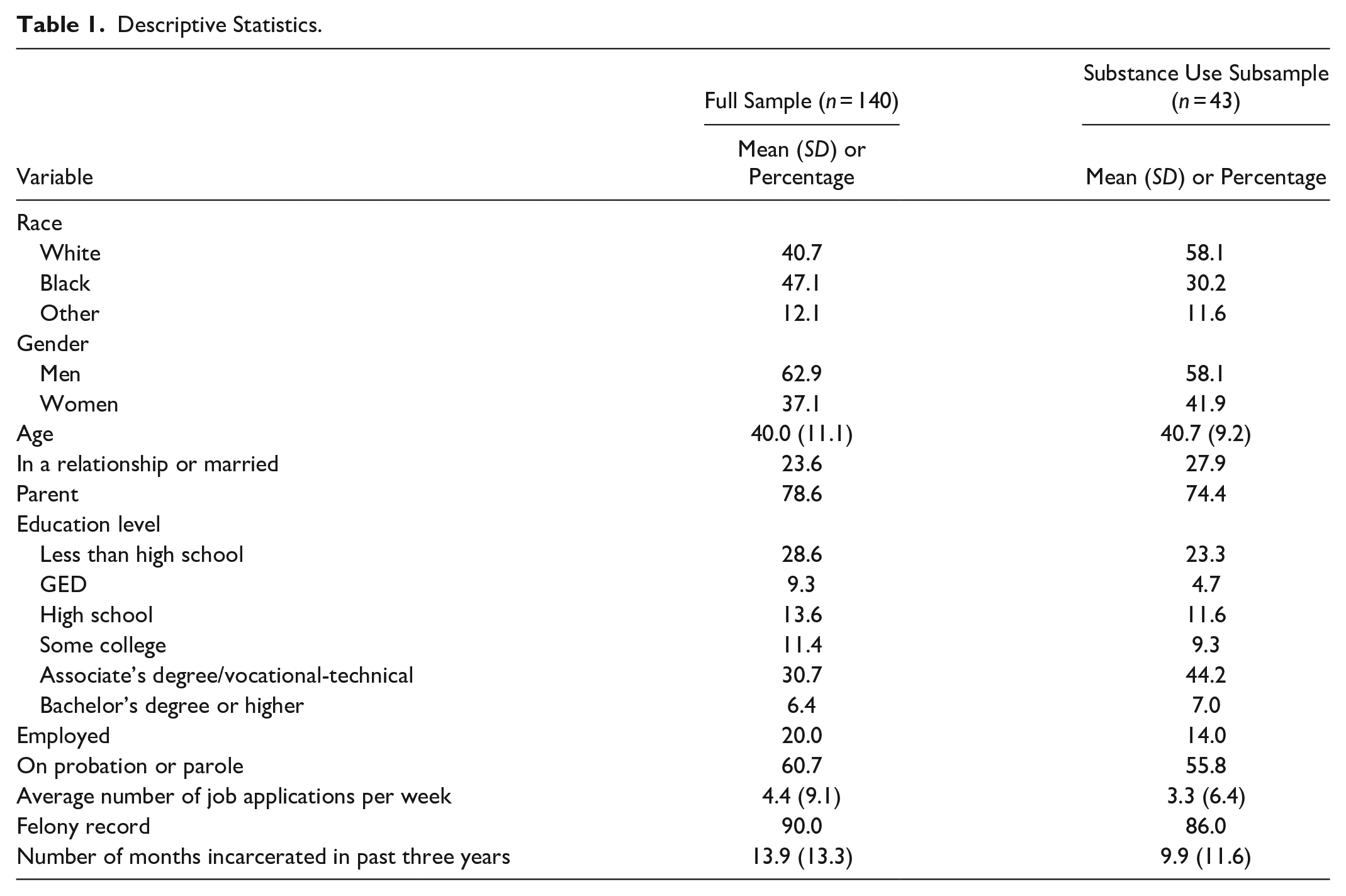
Our main research question was understanding selection into job applications for those with criminal records. That is, we sought to understand how people with criminal records navigate decisions regarding which job applications to complete during their search for employment after incarceration. Although the labor market was our main topic, our interviews were far-reaching and explored obstacles to reintegration across numerous domains, including employment, financial wellbeing, relationships, programming, and, relevant here, substance use. 4 Two interviewers were present for each interview, one man and one woman. Scholarship shows that interviewer/interviewee gendered dynamics influence all combinations of interviewer and interviewee genders, but that these dynamic interactions do not necessarily produce invalid or incorrect information. Thus, having one man and one woman involved in each interview was advantageous because interviewees provided responses via a variety of gendered frames that may otherwise have been less likely with one interviewer (see Williams and Heikes 1993).
Our interview guide conformed to Esterberg’s (2002) model for semistructured interviewing and relied upon a set of core questions but also allowed additional probing questions. This method enabled nuance and complexity in answers, encouraged participants to provide detailed responses, and permitted probing. Although substance use arose in the context of many interview questions and probes, several are particularly pertinent to this article. For example, three questions (and probe examples) for which substance use typically arose were (1) what have been the biggest obstacles to getting a job or keeping a job (probes: for example, transportation, family and kids, substance use; what about substance use made it such an obstacle for work), (2) have there been times in your life when you’ve stopped looking for work or dropped out of the labor market (probe: what were some factors that led to this and why), and (3) have you ever chosen not to fill out a job application because you’d have to do a drug test (probe: why or why not; you mentioned substance use earlier, was that a factor in applying). Although participants were free to interpret these questions in any way, responses almost always revolved around illicit substances and misuse of pharmaceutical drugs. However, alcohol was also mentioned, although exclusively in combination with other drugs. As such, we use substance to refer to both licit and illicit drugs. Moreover, we did not ask participants what substances they used, but this information was typically divulged voluntarily. Anyone mentioning substance use was included in our analysis, whether use was current or retrospective. As such, the thematic approaches were not mutually exclusive, with participants describing varying periods of labor market attachment and substance use. Table 2 provides a list of the terminology encountered by interviewees split by theme, to which we return in the “Results” section.
Terminology Related to Substance Use by Theme.

Data were analyzed using NVivo 12. We iteratively approached the data through multiple readings, coding and assessing emerging concepts and themes relevant to our research questions (Rubin and Rubin 2012). Interviews were coded using a combination of inductive and deductive perspectives (Strauss and Corbin 2015) by a single researcher. This process began by considering the ways participants discussed their substance use within the context of employment. When considering active periods of substance use, thematic analysis quickly revealed two approaches of attempting to stay in the labor market or dropping out. Inductively, the multiple readings of the data allowed the discovery of emerging subthemes (described later), permitting contrasting experiences within and across the two approaches. After completing the first round of coding, each transcript was reviewed, looking for common themes and coding similar categories of data together, with conceptual labels placed on reported events, experiences, and feelings, resulting in a set of axial codes. A goal of thematic analysis is to identify general sentiments across the sample while leaving outlying assertions aside (Strauss and Corbin 2015). As such, we ensure that excerpts accurately reflect the interview sample.
Results
Two main thematic approaches emerged in the analysis of job acquisition strategies described by people with criminal records who also use substances. First, 65 percent of participants described strategies to remain in the formal labor market by limiting applications to employers who do not drug test, avoiding triggering jobs, or evasion techniques. We find that such participants faced an especially limited pool of jobs for which they applied, and when they did apply, they described job acquisition experiences heretofore unrevealed in prior scholarship considering only criminal records. Second, 70 percent of participants described periods of disconnecting from the labor market, either generating income illegally or describing addiction as too risky or all encompassing to consider employment, trends which reflect prior scholarship examining the relationship between criminal records and employment but with additional overlap with the sociology of addiction. As the percentages reveal, the two themes are not mutually exclusive, with 35 percent of participants appearing in both. Such participants thus experienced churning between periods in and out of the labor market. We highlight such participants when applicable, particularly given that Table 2 reveals substance use described in much more problematic terms among this group.
To further set the stage for our results, Table 3 shows the distribution across themes and subthemes by race and gender. It demonstrates that representation across themes is relatively similar to the marginal distribution by race and gender. Although similar numerically across themes, we nonetheless highlight differences in qualitative experiences within theme by race and gender where relevant. Ultimately, we argue that people with criminal records who also use substances are an important subset to consider, as they face a particularly limited pool of jobs and additional barriers to maintaining labor market connection.
Thematic Analysis Categories by Race and Gender.

One man identifying as multiracial Black and Native American, one man identifying as multiracial Black and White, and one man self-identifying as “other” on the survey but Black in the interview.
One Latina woman and one identifying as multiracial unspecified.
Approaches to Staying in the Labor Market
Avoiding Jobs That Drug Test
Among participants who attempted to stay in the labor market while actively using substances, the most commonly stated strategy for doing so was to avoid job applications that mention drug testing, with 53 percent of our subsample reporting such an approach. That is, they self-selected out of applying for a job to which they otherwise would apply. In response to whether seeing a drug test warning on an application kept her from applying, Magdalena, a 36-year-old Latina woman stated, “Yeah, a lot.” Angela, a 26-year-old White woman, said, “Oh, yeah. That’s when I walk out the door.” Similarly, Paul, a 34-year-old White man, said, “At the time, I’ll just go onto the next one. . . . Because I wouldn’t waste my time. I wouldn’t waste theirs. You know what I mean? As far as the drug tests, there’s no way around that.” In finding an employer that did not screen, Paul said that he has “been lucky in a couple of situations,” and felt that this unknown made the entire process seem as though a product of chance. Willie, a 49-year-old man who identified as mixed race Black and Native American, described how these continual experiences of not getting work in industries who drug test and do background checks, specifically calling out retail, eventually led to not applying to such positions. He said,
The jobs I’ve been applying for like [lists retail establishments] or something like that. I tried to get a job at some of them places but they take background checks. So I never really tried to go in there. I asked, ’cause they tell you ahead of time, drug tests or background checks.
Scott, a 34-year-old White man, concurred: “I didn’t want to go anywhere that they’re going to drug test me. . . . It kind of limited my options.”
Each quotation demonstrates that participants put in the time and resources to go and apply, but do not go through with it once seeing that there is drug screening. When considering the already limited pool of jobs open to people with criminal records alone, this self-selection out of jobs that drug test indicates that people who have both criminal records and use substances likely face a doubly limited market wherein they must avoid both employers who do not hire those with records and those who drug test. Furthermore, applicants expend time and resources applying, only to later find that a drug test is required and ultimately not apply. Prior work examining labor market behavior among those with criminal records has found that the energy spent on unsuccessful applications can contribute to burnout and disconnection from the formal labor market (Apel and Sweeten 2010; Sugie 2018; Vuolo et al. 2022). As such, people with criminal records who also use substances may be especially likely to experience burnout relative to those with criminal records or substance use alone, as they have two sets of disqualifying characteristics and therefore face greater odds of an application asking about at least one of them.
As with the aforementioned participants, Matthew, a 32-year-old White man, ultimately selected out of jobs that require drug testing but did so in the context of a temp agency. He explains:
At temp services, they’re called tickets, instead of job. . . . There are certain tickets I’ve not been able to get because I would not submit to a drug screening. Because they would say, if you can’t pass a drug screening, you can’t work for this company anymore. . . . So you can stay working here, but just don’t apply for this when you get on it.
Even though Matthew was seeking employment via a temp agency, a common job acquisition strategy among those with criminal records (Augustine 2019), his options were nonetheless restricted to temp employers who did not drug test. Thus, individuals with criminal records and substance use who seek employment through temp agencies are nonetheless still doubly restricted even in this context, underscoring the need to consider substance use in combination with criminal records.
Some participants even described drug tests as the impetus for completely dropping out of the formal labor market. Both Amy (a 62-year-old White woman) and James (a 39-year-old White man) responded affirmatively when asked if they chose not to fill out applications that mentioned drug testing. Amy said the drug tests made her “a little afraid” when her substance use “was really bad.” She went on to say this fear resulted in her not “apply[ing] for them [jobs] for a while.” In a similar follow-up to the drug testing question, James confessed to not applying because of drug testing questions, responding, “Yeah. I never applied for a job while I was doing drugs, put it that way.” Thus, applications with drug tests were enough to push these participants out of the labor market, a theme that we return to later, including more on James’s experience with such churning.
Perhaps most tellingly, participants described instances in which they would have applied despite their criminal record but selected out because of drug testing. Warren, a 31-year-old Black man, exemplifies this scenario, stating,
I was trying to get a job [at automotive chain]. And on their application, they asked about the record, which, I was a little backyard mechanical. . . . I got the experiences. I’m overly confident, right? Regardless of my record, let me tell you what my skills are. So, but nevertheless it also said you have to submit to a urine test. [I was smoking] weed real heavy at the time and had dreads. . . . But so, I didn’t do it [fill out application]. [The employer and I] had a good rapport coming through the door, always talking. I was shooting my skills even before I even have application in my hand. . . . Then when I seen that part [drug testing], I said, you know what, I’m going to be back [and left to not return]. I would [go] smoke; I had a joint in my pocket.
Warren described feeling confident that he could use his skills to his advantage, using stigma management strategies to not allow the divulgence of his criminal record to stop him from applying, aligning with prior work examining the labor market experience of people with criminal records (Augustine 2019; Goodman 2020; Halushka 2016; Harding 2003; Lindsay 2022; Maruna 2001). Warren described being prepared to implement such stigma management strategies, emphasizing his relevant skills and work experiences, and he was confident that he would be successful. Despite his confidence, he still decided not to apply, knowing he would fail a drug test. Unlike the stigma of a criminal record, Warren did not identify any strategies that would have overcome a failed drug test. He also perceived likely stigmatization that would emerge from the positive test result because of associations between his appearance as a Black man with dreadlocks and cannabis use, despite this appearance not hindering his applying prior to seeing the drug test warning. As such, his experience as a person with both a criminal record and substance use appears distinct from a person with only a criminal record, with him needing two separate sets of strategies for each characteristic but only having one, and with his appearance factoring into his decision.
Deborah, a 48-year-old White woman, described a similar instance in which an employer even offered her a job knowing her criminal record, only to revoke the offer after failing a drug test because of cannabis use. In response to a question asking if an employer ever directly asked her about her criminal record, she responded,
It was [a] warehouse, and they asked me, but they didn’t have a problem with that. She wrote it all down, felony for whatever, wrote all that down on my application. But I had smoked some weed when I got out of jail, and I failed the drug [test] . . . they was going to start me that evening. And it was $12 an hour, and I thought, “Wow. This is amazing.”
Notably, solely because of cannabis use, Warren selected out from a job he otherwise felt he had a good chance of obtaining, while Deborah had an offer revoked. Reginald, a 53-year-old Black man, similarly noted avoiding places that drug tested “because of smoking weed.” As displayed in Table 2, for those that only appeared within this theme of staying in the labor market, the terminology they used was typically more benign. Notably, the reason for self-selection can be solely cannabis, which employers can still legally use to screen employees, even in states with legal cannabis, because the ADA is based on the federal schedule of substances (Aoun and Appelbaum 2019).
Bobby, a 48-year-old Black man, described a complex interaction of criminal record, drugs, and race that affected his job searching. While replying that he has not filled out job applications because of the need to pass a drug test, he noted additionally avoiding criminal record questions because his conviction was drug-related, which he assumed revealed his own drug use. He said,
Like even in some of the applications . . . they don’t give you a chance to explain yourself. So I was intimidated by filling out applications because of that. I know that a lot of employers, and I’ve been told this, [are not] hiring me because of any type of drug conviction.
He described even further limiting his search because of perceived racism, saying of construction,
I hate to say it like this, but a lot of people don’t want to hire Blacks in this field. There’s trust issue. You know, we have to work on jobs where there’s a lot of materials. They’re very expensive materials.
Thus, even though we find similar distributions by race and gender across themes (Table 3), there are important within-theme differences in experiences across these identities where race together with criminal record and substance use can determine what applications people are willing to complete.
As is made clear, remaining in the labor market during periods of substance use is not without struggle. Participants felt little choice but to avoid applications that mention drug tests, significantly reducing the jobs for which they are eligible. Importantly, these are individuals who are ready and willing to enter the formal labor market, and in some instances were even selected for employment despite their criminal record, but faced further restrictions because of their substance use.
Other Strategies to Stay in the Labor Market
Avoiding triggering jobs
Although less common than outright avoiding jobs that drug test, we believe two additional strategies are nonetheless worth noting. First, as another form of avoidance, a strategy noted by four participants was avoiding triggering jobs. For these individuals, they sought to stay in the formal labor market but pursued jobs that would not expose them to triggers that could result in relapsing or increasing substance use. For the participants noting this strategy, they all pointed to the presence of alcohol. For example, Sharon, a 37-year-old White woman, said, “No bartending for sure. Bartending, I’ve thought about going and serving, but it would be like at a breakfast place, where it would only stop at three o’clock and stuff like that.” Magdalena echoed the sentiment about the time of day, stating about jobs she would be willing to take:
Except for late night. Late night would be good, but I can’t do late night because of the bus and because of the triggers. . . . I don’t know what it is about darkness and loud music, but it’s like, “Ooh, let’s get drunk or high.” You know? But at seven o’clock in the morning and the birds are chirping and the cars are driving, I don’t think that. I don’t know what it is in my brain. Something just snaps when it’s night and I’m like, “Ooh.”
Margaret, a 29-year-old White woman, actually quit her bartending job about three weeks before our interview, stating, “I have struggled with addiction, so it’s just not a good environment.” Similarly, Dwayne, a 32-year-old Black man, had restaurant experience prior to incarceration. But when asked whether in his current postincarceration job search he would pursue restaurants, he said, “No, that’s a trigger for me. I don’t want to mess up again.” For these participants, even if it meant forgoing an industry in which they had experience, they described feeling that it was necessary to restrict their job search to minimize the chances of succumbing to substance use.
Again, this strategy illustrates considerations among those with criminal records who also use substances when searching for employment and underscores the added restrictions posed by the combination of criminal records and substance use. That is, although certain industries have reputations for being “felon friendly” (see, e.g., Rucks-Ahidiana, Harding, and Harris 2021; Visher, Debus-Sherrill, and Yahner 2010), some of those same industries (e.g., bars and restaurants) may be more likely to trigger individuals with a history of substance use. Thus, for people with criminal records with a history of substance use, the job pool is again particularly restricted, as they are limited to those that are both “felon friendly” and nontriggering.
Evading drug tests
In another strategy better characterized as evasion rather than avoidance, five participants described using another person’s urine or detoxification to attempt to pass a drug test. In fact, for Brian, a 27-year-old White man, drug tests did not present a problem at all. When asked if he had ever chosen not to fill out a job application because of drug testing, he explained, “I just used the temp service and I’d bring in fake pee and drop the one time and then I’d be good, so no.” Unlike Matthew who avoided temp agency tickets that required testing, Brian described using another’s urine once to permit taking any ticket. Notably, however, Brian was the only participant in the sample who described using substances but did not see drug tests as a barrier to employment, underscoring the inconsistency with which job acquisition strategies can be successfully implemented. Indeed, even for those who attempted to navigate drug tests by getting drug-free urine, it was not always easy. For Sharon, this strategy sometimes was not feasible. When asked if she avoided anything that mentioned a drug test, she replied, “No, I was always trying to think of ways to sneak my pee in, and then if I couldn’t get nobody’s pee, am like fuck it.” Sharon’s answer illustrates the difficulty in which some strategies can be deployed – even if participants identified methods of avoiding drug testing, they still sometimes found themselves selecting out of an application because of this barrier. As an alternative way to avoid detection, Willie tried commercial detoxification products, but said, “I don’t think none of it worked. I tried that and I still failed it.” Similar to others’ quotations, Willie only used cannabis and was attempting to avoid its detection. For others, however, they described substance use as affecting them to such a degree that they completely selected out of the labor market, an approach to which we now turn.
Disconnecting from the Formal Labor Market
Generating Income Outside Being Formally Employed
The employment options for justice-involved individuals are already limited, often leaving them no choice but to take jobs that do not pay a living wage or are otherwise undesirable or to turn to under-the-table work (Augustine 2019), a period which has been likened to “foraging” for work (Sugie 2018). In the immediate reentry period, quantitative evidence shows a reliance on criminally generated income is more likely (Apel and Sweeten 2010). Quantitative studies further demonstrate that this reliance is especially true for those in active periods of substance use, given the earnings imperative use creates (Uggen and Thompson 2003), a finding qualitatively supported by our participants’ experiences.
Criminally generated income, especially from selling drugs, was perceived as a better source to stay afloat during active periods of use. As Stephanie, a 29-year-old White woman, described,
When I’m heavy in addiction and when I’m selling and I’m doing that, it consumes my whole life. I tried to juggle both for a while and go to work for $8 an hour or run across town and make 300. And then those priorities start to fall. Screw Uncle Sam and his taxes. I’m going to go put this money on my electric bill. It’s Christmas. I got kids. That money starts to trump.
Stephanie’s reference to her children may be an important point in terms of distinguishing which participants expressed which themes. Table 4 shows participant responses to several questions in the survey accompanying the interview. Although we caution that these are characteristics at the time of the interview, we believe they are informative nonetheless. Relative to the other themes, those relying on informal income generation are more likely to have children (91 percent), cohering with Stephanie’s sentiment. Those within this theme were also less likely to have a post–high school degree, have car access, receive food or housing assistance, or state that they had family or friends that could help with financial support.
Thematic Analysis by Characteristics at Time of Interview.

Note: We do not include the subthemes for “other strategies to stay in the labor market” due to small numbers. SNAP = Supplemental Nutrition Assistance Program.
Among those for which childcare is applicable.
The idea that selling drugs represents quick, easy money that is superior to legal work was a common refrain. James, who mentioned dropping out of the labor market because of drug tests, said,
Why do I want to go to a job making [trails off]. I can make one trip . . . back to my hometown, and make 400 bucks. Why do I want to do that [legal work]? Or want to go sit and flip burgers for nine bucks an hour? You make great money selling dope.
Kenneth, a 35-year-old White man, similarly said,
I mean, I waited [to hear back about job applications]. I found another way to make money. Quick money. I really didn’t even look back on that, selling drugs is what my other option was. It was quick money. Dollars every day.
As we noted earlier, Willie did not use illicit drugs other than cannabis. But he still replied affirmatively to having dropped out of the labor market, relying on selling and other forms of criminal activity for generating income. He said,
I either sell drugs or just do any kind of hustle or something. . . . I used to drink a lot and smoke weed. That’s how I was. That was my means of supplying myself, by selling it and then using it.
Several women in our sample also noted relying on sex work, although they often used indirect language to express this experience. For example, Hattie, a 55-year-old Black woman when asked about how she supported herself when she dropped out of the labor market and “was in the streets,” said, “How did I not starve? Because I’m a woman. If you understand that or not, if y’all really want some real stuff.” Lillie, a 49-year-old Black woman, whose experiences we quote again later, also indirectly mentioned sex work as well as other forms of crime. She said,
But I didn’t take off to real, real hardcore addiction until I ran into the hard drugs like cocaine and heroin. But it was always mounting up. Progression got worse over the years. So, with using drugs and sometimes even if you’re not doing drugs, if you have a criminal element. And so, when I grew up, I seen all of my aunts and uncles. They was all pimps and hoes and gangsters. They were criminals. So, I thought that that was what you do. I just thought that was the norm. That was all I’ve ever seen.
Magdalena was more direct when asked about whether there were periods where she stopped working, saying, “These past two years, I just kind of gave up. . . . I started working on the streets, unfortunately. Prostitution and drug dealing. And I did that for the past two years.” Only women mentioned sex work, and in the case of our data, all women of color. By contrast, 67 percent of those who described selling drugs were men. This discrepancy supports prior work characterizing the drug economy as a gender-stratified labor market, in which women take on more marginalized roles (Maher and Hudson 2007).
Surprisingly, only two people in our substance use subset mentioned informal noncriminal income-generating activities, such as under-the-table work or begging. 5 Brian, who mentioned relying on temp jobs with another’s urine at times, contrasted those periods with times he exited the formal labor market. He said, “It was a mess. I left [a job] and started getting high and just stopped working, just kept getting high. It lasted for about two years, just getting high, not working. I’d do side jobs and stuff.” Matthew expressed similar sentiments, but also noted panhandling as another strategy: “During my addiction, it was easier for me to find an under the table . . . you know what I mean? To get high, instead of actual career opportunity.” During a seven-month period of homelessness, he said, “It was standing . . . holding up a sign, will work for food, hungry, whatever, bumming money and stuff because of the addiction. . . . I was like this is the quicker, easier way to get money.” Similar to those selling drugs, and despite the likely income difference, Matthew used the same justification of it being “easier” to panhandle than finding and maintaining legal work. Notably, both Brian and Matthew were also quoted in the prior section, reflecting churning through periods of labor market attachment.
Exiting the Labor Market Altogether
The prior participants described dropping out of the labor market because criminally generated income, and less often under-the-table work, was a better option than legal work during periods of high use. Not every participant who described selecting out of the formal labor force had such an alternative source of income, however. Although, relative to those relying on informally generated income, Table 4 reveals that those who drop out altogether more often answered that they received food assistance and had family or friends to help with financial support or food, but lower rates of help with childcare. Each of these may factor into whether dropping out altogether is feasible.
For some, they explained that addiction made working so difficult that they stopped seeking any job at all, regardless of formality or legality, an important consideration given typical parole employment requirements. Often, this difficulty stemmed from a fear of working while high. Michael, a 48-year-old White man, expressed this fear; while recalling if there were times he stopped looking for work, he said, “When I was doing drugs real bad and alcohol, yes. Because I wasn’t . . . I didn’t want to go to work . . . on the influence of some alcohol and some drugs, and get hurt or hurt somebody else.” Angela similarly expressed concerns about job performance while describing occasions in her life when she dropped out of the labor market. She explained,
I just didn’t feel comfortable, and I was getting high. . . . What I believe, if you’re working a job, you need to do your best. So, if I wasn’t where my mind was right and stuff, I felt like I couldn’t do the task.
These statements illustrate that, for some, working while high was not an option.
Moreover, some respondents described instances in which they secured employment but were unable to perform the work due to substance use and subsequently lost the job. Joseph, a 39-year-old White man, for example, described his biggest barrier in finding employment:
Just me personally, mine has been more substance abuse. Like I’ve just screwed up jobs, been unreliable. And you know, like I said lost jobs, quit jobs. . . . The guy that I was talking about I work for. I call him right now and then when you look, you go like this with his phone and it’ll say flight risk. . . . I’ll be there and be like Houdini.
Further showing the interplay between substance use and criminal records, Lillie recalled a time in which she was able to obtain a job despite her criminal record, but ultimately lost it because of substance use:
I actually got a job. I put an application in at the hospital for housekeeping, and I actually got an interview and I [told] them about my background and stuff, and he said, “Well, I’m not going to worry about what you did then. I’m concerned with what you’re willing to do now, so I’m going to give you a shot.” So, he did. . . . And I loved that job. I was doing great. Everyone loved me. But I ended up getting high . . . I nodded out for a few minutes. Period. I’m not justifying it. I nodded out. Someone saw that. They called my boss. And when I woke up, which was maybe six to eight minutes, my boss was right there in my face and he sent me home. . . . At that point when I left, I just went out there and just started getting high, turned my phone off and said, “Fuck it.” But they was trying to call me to tell me to come back to work. But I just gave up because low self-worth and whatever. So, I messed that job up.
Both Joseph and Lillie describe instances in which they were able to secure employment despite the stigma of a criminal record. Yet their substance use interfered with their ability to perform the job tasks to such a degree that they were unable to maintain this employment. Moreover, Lillie’s story reflects the churning described by many participants wherein they potentially get a job despite their criminal record, only to succumb to drugs or alcohol for a period out of the labor market.
For others, however, dropping out of the labor market did not stem from a fear of or inability to work. Instead, these participants described periods of active addiction as so all encompassing that they were not able to search for employment at all. Participants frequently described the extent to which substance use took over their lives during periods of use. When describing the period during which he stopped searching for employment, Thomas, a 42-year-old White man, said, “Just the substance took priority over things that are responsibilities and what I needed to do.” In a nearly identical answer, Kathleen, a 36-year-old White woman, described the time during which she left the labor market, explaining, “My drug addiction started about that time too, so that kind of takes. . . . It took over your responsibility.” Velma, a 49-year-old Black woman, likewise described her experience during addiction: “I was just worried about getting my next fix.” When asked what his biggest barrier to getting and maintaining employment, Winston, a 43-year-old Black man, explained,
I’ve battled with drugs and alcohol addiction for about the past 30 years. And so it’s just anytime that I’ve chosen to take a drink, smoke a joint or anything like that, it’s cost me jobs, it’s cost me time with my family, it’s cost me a piece of me. And so my biggest obstacle, my biggest barrier has been my use of drugs and alcohol. Again, once I make a decision to do that, then all else kind of goes by the wayside.
Winston’s description of substance use reflects the findings of prior scholarship in the sociology of addiction showing that periods of active addiction are characterized by a loss of self-control that takes precedence over all other obligations (Weinberg 1997, 2011).
With this all-encompassing nature of substance use in mind, coupled with the unique difficulty it poses to successful reentry, participants frequently identified substance use as their biggest barrier to employment. Indeed, many interviewees gave a rapid, straightforward response when asked about the biggest obstacle for getting or keeping a job, with responses such as “Drugs and alcohol” (Scott), “My addiction” (Sharon), “My drug problem” (Angela), and, “Drugs, drugs, definitely drugs” (Magdalena). Dwayne described this obstacle as lifelong, stating,
My biggest obstacles have been drug and alcohol use. That’s always gotten in my way. That stopped me from a lot, you know what I mean? Since I was, since I’ve been in college. I’m just now getting that together. So, I’ve been clean for six months now.
The frequency with which participants identified substance use as the single greatest barrier to obtaining or keeping a job demonstrates the degree to which such concerns surpassed their criminal record.
We return to Lillie to demonstrate the degree to which substance use trumps the criminal record in the labor market from the participants’ perspective. As noted earlier, an employer was willing to consider her record as something in the past, a common stigma management tactic where the present self is considered an applicant’s true self, while their record is part of a past self that was not the “real them” (Halushka 2016; Harding 2003; Maruna 2001). But Lillie described subsequently losing that job because of the all-encompassing nature of her substance use. At the time of her interview, she had been searching for work for a year without success. When asked what she thought employers perceived when she tried to obtain employment, she replied, “incorrigible, poor, Black, addicted.” We believe it is telling that among the stigmatized labels that Lillie felt prevented her from getting a job, “criminal” was not listed, especially given that she attributed her lengthy criminal record explicitly to her substance use and that criminal records and employment were a central focus of our interviewing. Rather, her experience was defined by her status as a poor Black woman suffering from addiction. Lillie’s story coheres with literature showing that although White and Black women have equal rates of substance use and problematic use, Black women suffer more consequences of their use because of systemic racism and sexism (Beatty 2003).
Simply put, participants saw the stigma of addiction, coupled with other identities related to race and gender, as incredibly difficult to overcome, even when one might overcome a criminal record. Thus, even after one might disconnect from the criminal label, the strong-arm sobriety approach of the criminal-legal system (Gowan and Whetstone 2012; Piehowski and Phelps 2023) continues to linger in its stigmatizing nature of addiction, such that it may also be considered not just a strong-arm sobriety, but a long-arm sobriety.
Discussion
Following considerable evidence that individuals with criminal records receive fewer employer callbacks than equally qualified applicants (Decker et al. 2015; Galgano 2009; Leasure and Kaminski 2021; Pager 2003; Pager et al. 2009; Uggen et al. 2014) together with massive disproportionalities in criminal records by race (Shannon et al. 2017), policies to reduce this difference, such as Ban-the-Box, have become part of a national conversation about how to make the reentry period more successful by providing “second chances.” The Department of Labor (2024) has explicitly called for substance use recovery to be incorporated into the second-chance framework, given the high rates of justice system involvement among people with SUDs. Yet we know little about the experiences of such justice-involved people with SUDs in applying for and maintaining employment. This omission led us to ask how possessing both a criminal record and history of substance use shapes job-search strategies and labor market attachment in ways that might be missed by only focusing on criminal record. Most who had substance use issues described it as the single biggest obstacle to finding employment, trumping their criminal record, which is notable within interviews that were clearly about criminal records.
In a context in which the ADA and state law offer virtually no protection to applicants (Aoun and Appelbaum 2019; Hickox 2017) and thus challenges the very definition of a SUD as a disability, those who use drugs must create their own strategies for obtaining income. For those who remain in the labor market, they necessarily restrict the jobs to which they apply to a much smaller pool of employers, even beyond those employers that would otherwise hire someone with a criminal record. For others, their substance use is enough of a hindrance that they do not remain connected to the formal labor market, which typically means relying on criminally obtained income or simply not working. For both thematic approaches, the difficulty of obtaining employment likely contributes to reentry success and findings showing that substance use is among the strongest predictors of recidivism (Western and Simes 2019). As described here, our findings contribute to an overlooked intersection of sociological theories of addiction, work, and law and criminology.
The decision to go through with applications or stay in the labor market for people with records who use substances deserves specific focus relative to those with criminal records more generally. For criminal records alone, individuals might know that they can attempt stigma management strategies to overcome their record in the application process. Stigma management strategies can involve selective disclosure (Goodman 2020), alternative signals of productivity (Lindsay 2022), working their story to their advantage (Harding 2003), and the creation of redemptive arcs (Maruna 2001). Indeed, the teaching of such strategies, whether beneficial or not, is an integral part of reentry programs (Halushka 2016). For criminal records then, the decision to go through with an application querying records or warning of a criminal background check is based on an assumed probability of obtaining employment that may or may not be zero. For those who also actively use substances, however, this probability is almost certainly zero if the application notes that a drug test is required. No participant described trying to overcome the forthcoming label as a user of drugs. Theoretically, our findings require a reassessment of the stigma associated with a criminal record in the labor market and ability to overcome it when individuals also use substances. In addition to theories related to identity and stigma, the choice to apply or stay in the labor market appears to be an agentic decision regarding the ability to pass or deceive a drug screen, presence of easier forms of income, inability to perform the work, and fears of causing an accident at work. Similar to stigma management of a criminal record across race and gender (Grace 2022; Winnick and Bodkin 2009), we found instances in which application decisions for Black men who use substances were partially determined by their assumption of how they would be perceived by employers; thus, additional stigma related to race and gender are also important to consider.
For others, addiction results in a perceived loss of agency and self-control (Weinberg 1997, 2011) whereby drug use surpasses all other obligations. For marginalized people and their communities, the criminal justice system has become a primary point of entry into treatment (Piehowski and Phelps 2023). However, use of the criminal justice system to address addiction merely maintains the punitive and judgmental attitude toward people who use drugs, especially among those in poverty (Gowan and Whetstone 2012; Piehowski and Phelps 2023; Walsh 2011). These points collide with work in criminal justice reentry that emphasizes how reconnecting to institutions such as the labor market may lead to desistance. This assumption results in maintaining employment as a very common condition of probation and parole (Travis and Stacey 2010). For our participants who felt they have no control over their substance use, the idea of obtaining employment was simply out of the realm of possibility. Furthermore, the reentry period is filled with considerable risk factors for those who use drugs that make obtaining control over their substance use or sobriety very tenuous, with such use as a strong predictor of recidivism (Binswanger et al. 2012; Western and Simes 2019; Mitchell 2022; Western 2018). Without a recognition that some people undergo periods where employment is not possible because of their substance use, the likelihood of rearrest or violations of conditions of release related to maintaining employment or sobriety are high, which further embeds individuals within the criminal justice system.
Regarding race and gender, we found relatively similar distributions across themes. In one sense, these similarities may reflect the effects of class, substance use, and criminal justice involvement. Many of the same mechanisms regarding criminal justice avoidance, community treatment access, and the reliance on criminal justice for drug treatment have been described for both Black and (especially rural) White people in poverty (Buer 2020; Cody et al. 2023; Davis et al. 2019; Garcia et al. 2023; Jegede et al. 2024; Miller and Stuart 2017; Morrissey et al. 2022; Walsh 2011). Our location in a state that includes a region with a largely poor rural White population affected by the opioid crisis might be driving some of our observed similarities. Yet the representation among White participants is still likely partially a product of societal-level race advantages, as poor White people were particularly vulnerable to the first wave of the opioid crisis that involved prescription drugs because of wider health care access and providers more willing to prescribe to White patients relative to racial/ethnic minorities (Hansen et al. 2023).
Furthermore, race and gender differences can still exist both within themes and in the implications of our findings. Even though no White participant invoked their race, this does not imply that they did not experience advantages, as the move toward color-blind language implies that White people do not overtly invoke Whiteness as a privilege (Bonilla-Silva 2006). By contrast, Black participants did invoke their race, acutely aware that there was further stigma levied at them for their race. Several Black men described how their race restricted their application choices. Disproportionalities in criminal justice for Black men (Shannon et al. 2017) mean that even when expressing themes at similar rates, they are differentially affected in the population. Cohering with literature showing Black women suffer worse consequences than White women from substance use despite equal rates of use (Beatty 2003), some of the most harrowing narratives came from Black women as well as the one Latina woman in our sample. Subsequently, criminal justice drug treatment programs that permit White people to succeed easier reinforce criminality and cultural stereotypes for Black people (Gunn et al. 2018; Gurusami 2017; Horowitz and Gowan 2023).
Overall, though, stigma does not appear to be the sole consideration for labor market attachment, as individuals actively seek to avoid needing to disclose substance use or disconnect from the formal market. However, this does not imply that substance use is not highly stigmatized in the labor market; rather, the outcome is so clear cut that the stigmatized characteristic cannot even be used in the hiring process because applicants do not apply. Indeed, none of the strategies described can be painted positively. Each implies that an individual must either limit the pool of jobs to which they apply, commit deceit or crime, or disconnect from the formal labor market. Like criminal record questions or background check statements on applications (Vuolo et al. 2022), often the applicant does not know that a drug screening is necessary until they have put in the time and resources to apply. Some participants even described being ready to overcome the criminal record question, only to see the drug screen warning and choose not to apply. Thus, time and resources are spent, which could contribute to eventual burnout and exiting the formal labor market. This trend is consistent with those with criminal records more broadly (Apel and Sweeten 2010; Sugie 2018; Vuolo et al. 2022), but our findings also bring attention to employment churning that periods of addiction can cause. Thus, the process likely creates a cycle that is difficult to escape and that can often lead back to crime. Indeed, those who described such churning categorized their substance use in particularly problematic ways (Table 2). For individuals who have yet to have criminal justice contact, these results also highlight how addiction can lead to such contact.
The type of substances being used and intensity of use is likely related to classification across our two themes and among those who appeared in both. For those who only appeared in the theme of staying in the labor market, participants rarely described use as taking over their life. Indeed, some individuals remaining in the labor market were afraid of failing drug tests solely because of cannabis use. During periods of addiction when participants avoided the formal labor market and especially among those who churned through both periods in and out of the labor market, they described higher intensity substance use, a progression of “harder” substances, and polysubstance use, illustrating addiction as all-encompassing whereby they felt compelled to rely on illegal income or feared the ability to perform a job. By design, we oversampled women relative to their representation in the local criminal justice population to examine thematic differences in our results. Some of the unique experiences for women point to the need for gender-sensitive approaches to drug treatment among those with criminal justice contact. This need is especially important given past studies showing how punitive treatment policy through the criminal justice system can reify stereotypes of people who use drugs across identities, including gender and race (Gowan and Whetstone 2012; Horowitz and Gowan 2023; Whetstone 2023).
Limitations
We note limitations to our study. First, although the 31 percent of our overall sample who described substance use during the interview is reasonably close to some of the descriptive statistics presented at the outset for substance use among correctional populations, we recognize that interviewees could have potentially withheld their substance use. Nonetheless, through standard techniques for building and maintaining rapport as well as probing (Rubin and Rubin 2012), most participants were quite forthcoming.
Second, although similar on most characteristics to the full sample, the subset is noticeably composed of more White people and fewer Black people. Related to the first limitation, Black participants may have been more reluctant to share their stories of addiction. However, we are largely confident that this was not the case, as participants of all demographics described intimate details of their lives otherwise, as reflected both here and in our other work (Vuolo et al. 2022), and the difference may be related to the oversample of women. 6
Third, our sample consisted of individuals with records in central Ohio. We recognize that this group is not necessarily reflective of the entire restored citizen population, although within our sites, we used methods to induce randomness described earlier. Our sample largely consists of White and Black individuals, given central Ohio’s small Latinx population.
Finally, although not necessarily a limitation given our research question, we did focus specifically on people who use substances who have a criminal record. We imagine that those with no record might take similar approaches to obtaining employment or avoiding the labor market. However, given the difficulties substance use poses during reentry and scholarly focus on employment during this period, we believe understanding the behavior of those with both stigmatizing characteristics in navigating the labor market is important. Still, we fully support similar research for those with no justice system contact and believe that some of our findings, as well as the implications that follow, are applicable to those who have not had justice system contact.
Policy Implications
If academics, practitioners, and policymakers are serious about reducing disparities and difficulties in employment acquisition for people with criminal records, then addressing substance use must be part of the equation. On the employer side, attention should be paid to how substance use is used as a screening mechanism by employers. Given the relationship between substance use and crime, drug screening could be used as an alternative gatekeeping mechanism for those with criminal records that is currently overlooked given the focus on application criminal record questions and background checks and especially as such questions appear on fewer applications. On the other hand, the employer may view their decision as entirely rational, as they need to consider extending offers to those who use substances given a known association between employee substance use and higher absenteeism, accident exposure, and financial losses (Verstraete 2011). Much like criminal records (McElhattan 2022), disqualification based on drug use may have become a method by employers to avoid negligent hiring, particularly given that they are largely protected in the case of drug use under the ADA and state law (Aoun and Appelbaum 2019; Hickox 2017). Yet the Department of Labor’s (2024) highlighting of Indiana House Bill 1007 represents a potential path forward, where employers adopting a recovery-ready workplace are protected from negligent hiring civil liability. We encourage research on how employers use drug screens specifically at the application stage where they are most legally protected.
Although we are cognizant of our qualitative approach and sample size, we propose four additional recommendations that we believe our results suggest would help (re)connect those who use substances to the labor market. First, we recommend removing drug screening warnings and consent processes from the initial application, given that they prevented more than half of our participants from going through with applications. Rather, tests can be conducted after a conditional offer is made, as with criminal records under ban the box.
Second, states can create policies, and the ADA amended, such that if a contingent offer is made with the final step being a drug test, the applicant has a chance to enter a drug treatment program, a potentially strong motivation knowing that a job is waiting on the other side of sobriety. This pathway is explicitly provided for within Indiana House Bill 1007, including for a failed preemployment drug screening. Upon a failure for potential or current employees, a qualified addiction professional determines the exact treatment approach. Once completed and a “return-to-duty” drug screening is passed, the employee can start or continue work. To be clear, we are not suggesting that employers’ concerns regarding employee substance use are invalid. However, the two foregoing recommendations would allow employers to not miss out on employees that they would otherwise hire and to maintain employees, while simultaneously providing a bridge to treatment for potential and current employees. With the relapse noted among our participants, particularly those that experienced labor market churning, such programs recognize that abstinence is difficult and backsliding can occur, but that disconnecting from employment could only amplify difficulties including recidivism (National Academies of Sciences, Engineering, and Medicine 2022). Given the protective role employment can play in preventing illegal activity, these approaches could also benefit those who have yet to become entangled with the criminal-legal system but may struggle with employment because of substance use.
Third, given the move toward cannabis legalization and that cannabis represented the sole reason some participants self-selected out of applying for jobs, failed drug tests, or relied on selling cannabis, states could encourage employers to exclude this substance as grounds for not hiring, treating it much the same way alcohol is addressed in the workplace. Furthermore, as the ADA covers all federally scheduled substances and thus employers in all states can choose to use cannabis to disqualify applicants, we believe our findings provide further support for descheduling cannabis at the federal level.
Fourth, during reentry, we must continue to attempt and evaluate programs that assist individuals with substance use issues within criminal justice and communities most in need, both in terms of treatment and employment opportunities and with approaches sensitive to experiences that differ by race and gender. We must also consider how to move both social services generally and for drug treatment specifically outside the criminal justice system and with threats of punishment for failure removed (Phelps et al. 2022). Although no small feat given the considerable coordination required (Kemp et al. 2004) and the need to avoid stigmatizing and punitive “strong-arm sobriety” (Gowan and Whetstone 2012; Piehowski and Phelps 2023), some level of reform is needed to address the common roots of crime, substance use, and unemployment.
Footnotes
Acknowledgements
We are grateful to Eric LaPlant for his integral role in design and data collection.
Funding
The author(s) disclosed receipt of the following financial support for the research, authorship, and/or publication of this article: This study was supported by grants from the National Science Foundation (Law and Sciences Program, grant SES-1823316, principal investigator Mike Vuolo) and The Ohio State University Criminal Justice Research Center.

1
In terms of entering drug rehabilitation, the Family and Medical Leave Act of 1993 states that under the conditions that there are at least 50 employees and that the employee has worked for a year and at least 1,250 hours, the employer must permit an employee to take up to 12 weeks of unpaid, job-protected leave to seek treatment of drug or alcohol addiction or related illnesses and cannot retaliate against those making this request.
2
The breakdown of crime type among state prisoners is 56.2 percent violent, 15.4 percent property, 15.0 percent drug, and 13.4 percent other. Among violent, property, and drug crimes, respectively, 35 percent, 49 percent, and 55 percent of prisoners were using a drug at the time of arrest; 34 percent, 24 percent, and 22 percent were using alcohol at the time of arrest; 42 percent, 59 percent, and 56 percent met criteria for a past-year SUD at admission; and 43 percent, 28 percent, and 24 percent met criteria for an alcohol use disorder at admission.
3
Participants were compensated with $25 in gift cards for participating in the in-depth interview. The study received institutional review board approval. All names are pseudonyms.
4
We arrived at our final interview guide after a pilot period with 50 participants; these participants are not included in the following analysis but rather only the subset of 43 from the 140 postpilot interviews.
5
We do not intend to imply that under-the-table work is legal but rather are making a distinction about whether the actual work itself is criminal.
6
Whereas the male prison population of Ohio is about evenly split by Black (47 percent in 2020) and White (50 percent), White women (74 percent) represent a larger proportion of the female prison population than Black women (24 percent). Combined with the fact that Ohio women (27 percent) are more likely to be incarcerated for drug offenses than men (14 percent) and meta-analyses show higher rates of SUDs for incarcerated women than men (Fazel, Yoon, and Hayes 2017), these numbers lend some support that the race difference in the subsample is an accurate reflection of those with criminal records with substance use issues.