




Abstract
Interracial parents face unique challenges in racially socializing their mixed-race children, but this socialization is imperative to their overall well-being and self-esteem. Using critical multiracial theory, the author argues that the interracial parents included in this study overwhelmingly understand the harm of promoting a monoracial paradigm of race when raising their children. They demonstrate this by implementing racial humility in their socialization practices to support and encourage the formation of a positive racial identity in their children. Drawing upon in-depth, semistructured interviews with 19 sets of interracial parents in the United States, the author identifies four themes related to how parents practice racial humility: (1) allowing their children to explore their mixed-race backgrounds by not forcing them to “pick a side,” (2) using specific language to identify children’s unique racial background, (3) encouraging ethnic and cultural engagement through bilingualism, and (4) exposing children to toys and media that feature mixed-race characters and a spectrum of skin tones. This study contributes to literature examining racial socialization practices of multiracial families and expands the concept of “racial humility” to sociology.
Keywords
Multiracial families and people are now more common than ever in the twenty-first century amid a diversifying U.S. population (Hughes et al. 2006; Parker and Barroso 2021; Ventura and Flores 2025). Despite their growing numbers, multiracial families navigate unique experiences in their daily lives simply because they represent multiple races and a range of skin tones (Cardwell 2021; Johnson 2024a, 2024b; Lengyell, Weststrate, and Moodley 2023; Waring and Bordoloi 2018). One such experience is interracial parenting. How do parents of two different races socialize their multiracial child about their racial identity? Their decision, and resulting racial socialization practices, will affect their children from a young age and possibly throughout their lives (Atkin, Yoo, et al. 2022; Lengyell et al. 2023; Seshadri and Gutierrez 2024; Umaña-Taylor and Hill 2020). Recognizing this, more parents are implementing socialization practices that align with racial humility, in which parents assume “an other-oriented interpersonal stance to respect and display a lack of supremacy over their child’s racial background and experiences” (Green and Bryant 2023, 33). This practice allows children the space to explore and make sense of their mixed-race identity without the pressure to self-identify one way or another (Atkin, Yoo, et al. 2022; Franco and McElroy-Heltzel 2019; Green and Bryant 2023; Stokes, Charity-Parker, and Hope 2021).
Using critical multiracial theory (MultiCrit), I argue that the interracial parents included in my study overwhelmingly understand the harm of promoting a monoracial paradigm of race when raising their children (Ashlee and Combs 2022; Cardwell 2021; Harris 2016; Johnson 2024a). They demonstrate this by implementing racial humility in their socialization practices to support and encourage the formation of a positive racial identity in their children. Namely, these practices of racial humility include (1) allowing their children to explore their mixed-race backgrounds by not forcing them to “pick a side,” (2) using specific language to identify children’s unique racial background, (3) encouraging ethnic and cultural engagement through bilingualism, and (4) exposing children to toys and media that feature mixed-race characters and a spectrum of skin tones.
My research contributes to literature examining racial socialization practices of multiracial families, specifically their use of racial humility in raising mixed-race children (Atkin, Jackson, et al. 2022; Ashlee and Combs 2022; Johnson 2024c; Lengyell et al. 2023; Osuji 2019; Stokes et al. 2021). It also expands the application of racial and cultural humility from other fields, such as psychology (Green and Bryant 2023; Stokes et al. 2021) and health care (Husbands et al. 2022; Khan et al. 2022; Massaquoi 2023), to sociology and the institution of the family. Many studies examine the importance of racial and cultural humility in realms outside of the family, such as in practicing medicine, counseling, education, and social work (Anderson, Simpson, and Sánchez 2024; Mason et al. 2024; Massaquoi 2023; Powell and Linger 2023). Furthermore, because this literature largely focuses on racial and cultural humility practices outside of the family, it contributes to the erasure of experiences of multiracial families (Johnson 2024a). By suggesting that these tools are most needed when providing a service to others, we fail to account for the importance of racial humility as a practice for those we are closest to, such as children, spouses and partners, family, and friends of other racial backgrounds. I situate my study with the following research questions:
How do interracial parents make sense of the racial identity choices for their children?
How, if at all, do the parents racially socialize a multiracial identity?
Racial Socialization
The institution of the family is the prime site for socialization, where children are first taught social norms, morals, and beliefs (Nomaguchi and Milkie 2019). How parents socialize their children is influenced by myriad demographic and social markers, such as socioeconomic status, gender, and race (Hughes et al. 2006; Nomaguchi and Milkie 2019; Umaña-Taylor and Hill 2020). As such, whether parents are cognizant of it or not, children learn about race, racism, and race relations within their family unit (Brown et al. 2007; Hughes et al. 2006; Umaña-Taylor and Hill 2020). Researchers have identified common racial socialization practices such as cultural socialization, preparation for bias, promotion of mistrust, egalitarianism, and not discussing race at all (Hughes et al. 2006). Of these practices, cultural socialization likely involves the most positive messaging from parents to their child regarding their racial/ethnic identities (Umaña-Taylor and Hill 2020). Cultural socialization is meant to instill pride and build a child’s self-esteem, and includes celebrating cultural holidays, speaking the family’s native language, continuing traditions, and teaching children about their heritage and history (Brown et al. 2007; Faragó 2024; Hughes et al. 2006).
Families of color often prioritize racial socialization of their children as a means of instilling pride around their racial/ethnic identity, but also as a means of preparing their children for discrimination they will likely encounter (Atkin and Yoo 2021; Brown et al. 2007; Hughes et al. 2006; Juang et al. 2018; Malone Gonzalez 2019; Turner 2020; Umaña-Taylor and Hill 2020). White families, however, may not actively engage in racial socialization of their children, particularly if they do not associate Whiteness with a racialized set of experiences (Brown et al. 2007; Hagerman 2014; Hughes et al. 2006; Perry, Skinner, and Abaied 2019; Vittrup 2018). Recent studies suggest that more White parents are actively engaging in conversations about race and racism with their children though (Hagerman 2014; Kincaid and Underhill 2024; Underhill 2019; Underhill and Simms 2022; Vittrup 2018). Although monoracial families must negotiate if and how they racially socialize their children, multiracial families must also navigate these conversations while considering their diverse makeup, which may include an array of races, ethnicities, and skin tones.
Challenges Surrounding Racial Socialization in Multiracial Families
Interracial parents face numerous challenges related to the racial socialization of their children. First, interracial parents themselves represent at least two different racial backgrounds. These different racial backgrounds result in different sets of racialized experiences, which affect an individual’s development and understanding of race and racism. This was aptly summarized by Lengyell et al. (2023), who stated, “Racialized partners entered their parenting journeys with intimate understandings of race and racism. White partners were exposed to the complexities of race and racism in new and more personalized ways” (p. 403). This statement highlights how many sets of interracial parents do not have shared experiences with one another, or likely with their child, who will have their own unique set of experiences as someone of a mixed-race background (Castillo 2022; Gonlin 2022; Johnson 2024c; Lengyell et al. 2023; Nadal et al. 2013; Seshadri and Gutierrez 2024; Seto, Becker, and Lau 2021; Waring and Bordoloi 2018). Interracial partners must also navigate external stressors from their own family of origin and friends when starting and growing their families, including disapproval, concern, microaggressions, and overt racism (Kil, Robichaud, and Mageau 2022; Lengyell et al. 2023; Seshadri and Gutierrez 2024). Furthermore, even parents of mixed-race children are capable of perpetuating racism, specifically anti-Blackness (Loblack 2024).
Relatedly, parents must determine if or how they will discuss race and racism and how they will identify their children. Some parents, typically mothers and/or parents of color, might be more enthusiastic or engaged when it comes to the racial socialization of their children (Atkin and Jackson 2021; Faragó 2024; Kincaid and Underhill 2024; Rollins and Hunter 2013; Stone and Dolbin-MacNab 2017; Vittrup 2018). White parents can choose to take a color-blind or color-conscious approach, both of which affect their children’s understanding of race, racism, and their own identities (Faragó 2024). When White parents fail to engage in conversations about race and racism or exhibit White fragility, or even hostility, in conversations about race and racism, their parent-child relationships may suffer (Atkin and Jackson 2021; Durrant and Gillum 2025; Loblack 2024; Robinson-Wood et al. 2021; Umaña-Taylor and Hill 2020).
Last, children of mixed-race backgrounds may experience more family instability, especially if their parents are not married at the time of their birth (Choi and Goldberg 2021). Furthermore, when they do marry, interracial couples are more likely to divorce than monoracial couples (Bratter and King 2008; Craft, Rowley, and Perry-Jenkins 2022; Grether and Jones 2021). This could lead to single-parent households and racial socialization via the perspective of one parent, usually White mothers (Rockquemore 2002; Stone and Dolbin-MacNab 2017).
The Importance of Racial Humility in Parenting Mixed-Race Children
Racial socialization in general is critical for building self-esteem and a positive sense of self for children. When children have a positive racial/ethnic identity and understand how to navigate racist encounters, researchers have found they are more likely to have increased racial/ethnic group knowledge, perform well in school, have fewer behavioral problems, and better overall well-being, for example (Hughes et al. 2006; Umaña-Taylor and Hill 2020). Specifically, for children of mixed-race backgrounds, racial humility is imperative in forming a positive sense of self. When parents give their children the freedom to understand their multiple racial backgrounds, self-identify as they want, and potentially change that self-identification over time, children have better mental health outcomes, such as fewer depressive symptoms, and stronger relationships with their parents (Atkin and Jackson 2021; Cardwell 2021, 2024; Csizmadia, Rollins, and Kaneakua 2014; Franco and McElroy-Heltzel 2019; Green and Bryant 2023; Seto et al. 2021; Stokes et al. 2021).
Theoretical Framework
I use MultiCrit to assess the racial socialization practices of interracial parents. MultiCrit expounds upon the original tenets of critical race theory and is a framework that provides understanding for how people of a mixed-race background experience race and racism in ways that are similar and different from their monoracial counterparts (Cardwell 2021; Harris 2016). Tenets of MultiCrit include a nuanced understanding of racism, monoracism, and colorism; a monoracial paradigm of race; differential micro-racialization; and intersections of multiple racial identities (Harris 2016). Two of these tenets, a nuanced understanding of racism, monoracism, and colorism and a monoracial paradigm of race, will primarily be used to analyze how parents talk about racially socializing their mixed-race children.
MultiCrit helps us explain how people of a mixed-race background can simultaneously experience racism, monoracism, and colorism on the basis of how they are racialized, including their skin color (Harris 2016; Johnson 2024a). Monoracism is the belief that individuals fit into singular racial categories only, and as a result, those who self-identify with more than one category may experience discrimination and oppression at various levels within society (Ashlee and Combs 2022; Cardwell 2021, 2024; Harris 2016; Johnson 2024a). For many multiracial people, it is common to internalize monoracism and experience discrimination within their daily lives at the interpersonal level (Cardwell 2020, 2024; Gay, Farinu, and Issano Jackson 2022; Harris 2016; Johnson 2024a). Monoracism also supports the understanding of a monoracial paradigm of race, which is a concept that “focuses on the way that race is constructed in neat, fixed categories, disallowing for the recognition of a multiracial reality” (Harris 2016:800).
Parental awareness of monoracism and the monoracial paradigm of race in particular shape how they talk about race with their children and attempt to assert the validity of a multiracial identity (Ashlee and Combs 2022). Furthermore, critical race theory and MultiCrit both emphasize the importance of challenging dominant ideologies (Harris 2016). The racial socialization practices discussed in the findings section challenge dominant racial ideologies, such as the White racial frame and monoracial paradigm of race, while affirming other ways of knowing and being (Atkin, Yoo, et al. 2022; Feagin 2013; Harris 2016). These affirmations demonstrate the parents’ commitment to racially humble parenting (Ashlee and Combs 2022; Franco and McElroy-Heltzel 2019; Green and Bryant 2023; Stokes et al. 2021).
Data and Methods
Data Collection and Analysis
The data in this study are based on in-depth, semistructured interviews with interracial parents living in the United States. I received institutional review board approval for the study in July 2021. I recruited participants through social media, primarily Facebook groups for multiracial families and interracial couples, and also through snowball sampling. I posted recruitment flyers with eligibility information, contact information, and institutional review board approval number. I was specifically looking for the following racial dyads to participate: Black and White, Asian and White, and Black and Asian. I selected these dyads for a few reasons: (1) to make comparisons between multiracial families with and without a White parent; (2) to gain a greater understanding of Asian and White families; which make up an increasing number of interracial marriages and multiracial identification; and (3) to gain a greater understanding of the experiences of Black and Asian families, as there has been greater attention recently to influential individuals who self-identify as Black and Asian (e.g., Kamala Harris, Naomi Osaka, Kyler Murray).
I required the participation of both biological parents in my study, but marriage was not an eligibility requirement. Regardless, almost all of the parents in my study are married, with the exception of one set of parents who are divorced and coparenting. This methodological choice resulted in insights to how the parents, as individuals and a unit, navigated and negotiated racial socialization practices. I wanted to account for the perspectives of both parents, as existing racial socialization studies, specifically studies on multiracial families, often rely on the perspective of one parent, which is usually a White mother (Rockquemore 2002; Stone and Dolbin-MacNab 2017). Including both biological parents also ensured that I would hear the perspectives of White fathers and both mothers and fathers of color, allowing an intersectional examination of race and gender.
Interviews were conducted between August 2021 and June 2022 with eight sets of Black and White parents, seven sets of Asian and White parents, and four sets of Black and Asian parents. In total, there were 38 participants. The sample represents multiple regions of the United States and is overall highly educated, with many families having a middle- to upper-middle-class background. The median annual household income was more than $173,000, with a minimum of $60,000 and maximum of $400,000. Almost all of the participants had bachelor’s degrees, but 22 also completed graduate and/or professional programs, such as PhDs and JDs. All participants were asked to select their own pseudonyms, or pseudonyms were assigned to them and their children.
Interviews were conducted via Zoom and lasted between one and two hours. All of the parents were interviewed together, except for the one set of divorced parents. Interview topics covered if and how the parents talked about their children’s racial identities prior to birth; how they identify their children’s race on various forms and why; how the parents, children, and/or family experienced racism; and how the family talked about race, racial identities, and racism with one another and their children. The U.S. sociopolitical climate also influenced topics of discussion, such as the coronavirus pandemic and anti-Asian hate crimes, the impact of the Trump administration and immigration and race-related policies, and the Black Lives Matter movement and resulting protests following the police murder of George Floyd (Waring 2025). I interviewed parents until I reached saturation, meaning that I heard similar narratives and found few surprises in newly gathered data (Small 2009).
Interviews were transcribed by the author or an undergraduate research assistant. The author coded transcripts line by line in NVivo. I took a thematic analysis approach in analyzing the data to generate codes and themes (Clarke and Braun 2017). Initial codes were descriptive in nature and directly related to the content being coded as stated by the participant (Hsieh and Shannon 2005), for example, “hair,” “skin color,” and “fetishization.” I was able to identify themes by organizing and grouping related codes, such as those related to physical appearance (Clarke and Braun 2017; Hsieh and Shannon 2005). This grouping provided understanding of how children’s physical appearance affects things like how they self-identify and how they are treated by others on the basis of how they present.
Positionality
Many participants asked about my personal interest or connection to the research. I shared with them that I self-identify as a multiracial White and Asian woman, growing up with a White mother and multiracial White and Asian father in a working-class household. Reflecting on my childhood, I found it fascinating that outside of broad statements that “we’re Japanese,” we had few to no discussions of race, ethnicity, and culture. As a (mostly) White-presenting multiracial person, I believe that my father and I present very differently, and he is likely read as a monoracial Asian man. At the same time, I have also experienced monoracism in its common forms. I have experienced the intrusive questions (people asking, “What are you?”) and racial dissection, such as people stating they could tell I was “something” or “see the Asian” in my eyes (Curington 2021). So how do I present and how do others see me? I think it varies from person to person.
I shared with my participants that growing up my parents rarely talked about race or multiraciality, which led to my specific interest in how parents have these conversations, if at all, with one another and their children. I also shared my personal struggles in understanding the validity of my multiracial identity. As such, my personal background helped in recruiting some participants and helping them feel at ease as someone who perhaps had more of an understanding of their family dynamic, particularly White and Asian families. Other potential participants questioned my intentions and felt as if I was infiltrating private spaces for multiracial families, which I think was influenced by my physical appearance.
Findings
Several themes related to racially humble parenting emerged during data analysis. These themes include: (1) allowing their children to explore their mixed-race backgrounds by not forcing them to “pick a side,” (2) using specific language to identify children’s unique racial background, (3) encouraging ethnic and cultural engagement through bilingualism, and (4) exposing children to toys and media that feature mixed-race characters and a spectrum of skin tones. Last, I identify and discuss a few outlier cases in which parents expressed struggles with practicing racial humility.
“There Is No Dilution of the Struggle of the Ancestors”: Allowing Children to Explore Their Mixed-Race Identity
Theme 1 highlights how parents talk to their children about their multiple racial identities by avoiding harmful practices, such as making their children “pick a side,” and emphasizing that they are a whole person, not half. Black mothers in particular stressed that they would not force their children to pick sides when it came to their racial backgrounds. Angela, a 34-year-old Black mother of two Black and White children, said, We always said that we were going to raise our kids to know that they were not Black or White, they were Black and White, and making sure they knew both of their heritages and both of their cultures. We would never make them choose one over the other.
Samantha, 41, a Black mother of two Black and Asian (Filipino) children, echoed Angela’s sentiment. Samantha stressed that she wanted her children to identify as both Black and Asian. She said, It’s really important to me that they’re not seen as “other.” I don’t want them living separately from Black people or separately from Asian people . . . they are both. It’s an “and” and not an “other,” so that’s sort of where we are right now.
Noor, a 37-year-old Black woman, said her 8-year-old daughter identifies as Blindian (Black and Indian). She encouraged this kind of identification from a young age because she did not want her daughter to feel as if she was only part Black or part Indian. “I will say that even before she was born . . . I had decided how she would be identified, and like, you are 100% Black and 100% Indian. There is no dilution of the struggle of the ancestors.”
Rochelle is a 38-year-old Black woman coparenting two Black and Asian (Vietnamese) sons with her ex-husband, Vinh. She personally understands the complexity surrounding mixed-race identities, as she has a White father and Black mother and self-identifies as Black. Throughout the interview, Rochelle described why she self-identifies as Black, which she largely attributed to the influence of her mother. She understands the importance of giving her sons the freedom to choose how they will identify. Rochelle said, I was trying to think, okay, what do they need in order to feel like they have access to all their identities? Knowing that how they end up publicly identifying is going to be completely up to them and shaped by a variety of things that I’m not gonna have any control over, regardless of what I expose them to or not. I just want them to be able to feel that they have a choice, that they’re not forced to pick one or another. Although they might end up picking one over another and that’s fine. . . . Our intention I would say, because we both do it, is to make sure that we reinforce the idea that it is theirs to have.
Rochelle stressed that her and coparent Vinh placed importance on their children’s having “access to all their identities.” This socialization practice, exhibited by all parents discussed thus far, is central to racially humble parenting of mixed-race children, as they must contend with both racism and monoracism while trying to make sense of their place in a society that largely adheres to a Black-White binary (Franco and McElroy-Heltzel 2019; Green and Bryant 2023; Harris 2016; Stokes et al. 2021). As someone who has parents of two different races, Rochelle understands that not everyone of a mixed-race background will self-identify as multiracial (Gonlin 2022). She recognizes that how her sons self-identify will be “shaped by a variety of things that I’m not gonna have any control over.” This self-identification will likely be influenced by how the boys present physically, such as how they are racialized and their skin color, as well as their gender (Davenport 2016; Gonlin 2022; Johnson 2024c).
The Importance of Language: Deliberate Decisions Surrounding Racial Labels, Names, and Bilingualism
I discuss both themes 2 and 3 in this section, as they both emphasize the importance of language in allowing children to explore their racial, ethnic, and cultural backgrounds. First, I introduce how parents use specific language to identify children’s unique racial background. Next, I present how they encourage ethnic and cultural engagement through bilingualism.
As introduced earlier with the use of “Blindian,” several parents used specific language to racially label or identify their children. In turn, the children embraced these labels and used them to self-identify their racial backgrounds. Noor elaborated on the use of “Blindian,” and stated that her daughter, 8, has self-identified this way since she was five or six. Noor said, “She’s like, ‘I’m Blindian. I’m not Black. I’m not Indian.’ I’m like that’s okay. . . . When Kamala Harris got elected, I was like, ‘Baby, she’s Blindian just like you!’ Very hype.
Other parents with Black and Indian children, Issa and Dev, also described using the term “Blindian” with their children. Another couple, Samantha, Black, and James, Filipino, had discussions about how their children might self-identify prior to their birth. They described coming across the term “Blasian” when they were dating and holding onto that as a way of helping their children understand their mixed-race backgrounds.
In addition to the language families used to describe a mixed-race identity, several parents also placed importance on giving their children meaningful names and teaching them to be multilingual as a way of exploring and connecting to their racial, ethnic, and cultural backgrounds. Vinh, 41, is a Vietnamese father of two Black and Asian (Vietnamese) boys. He coparents with his ex-wife, Rochelle. Vinh and Rochelle both prioritize racial socialization to help their sons develop positive racial identities, starting with their names. Their actual names, and pseudonyms used in the study, Hai and Lien, reflect this. Vinh said, Those are very traditional, very nice names, and so, for us, that was a deliberate decision . . . so the name is one thing. Also, their education is pretty important. We send them to a Vietnamese dual language preschool and a Vietnamese dual language elementary school.
Jason, White, and Melody, Filipina, are raising two White and Asian (Filipina) daughters in California and live near Melody’s parents. The couple said they want their daughters to be able to communicate with their grandparents in their native language. Jason, 33, said, I have a personal interest in learning Tagalog. . . . I’m also trying to set that groundwork to get to a point where it’s like Melody and I can just be conversational in Tagalog and really create that dynamic where . . . for certain times of the day, if you want to communicate to me, you’re gonna have to kind of figure this out a little bit.
Jason said that he is trying to model the importance of learning Tagalog to his daughters. As the White parent in the family, his efforts demonstrate a willingness to not only have a stronger connection with his in-laws, but to encourage his daughters to explore their racial/ethnic background and connect more with Filipino culture. Research indicates that when White parents practice racial humility, they are more likely to have close relationships with their children (Green and Bryant 2023). Furthermore, research has found that White fathers experience challenges when raising their Black and White sons (Durrant and Gillum 2025). Even though Jason is raising White and Asian daughters, he is educating himself and attempting to eliminate White ignorance, which will best serve his daughters and their relationship (Durrant and Gillum 2025).
David, 46, a Filipino father, also wants his White and Asian (Filipina) daughter, Tamsen, 3, to learn Tagalog. He lamented about his limited language skills since he was “Americanized” by his immigrant parents and described his understanding of Tagalog to be around a third grade level. David said, We would love her to. We throw in a lot of Tagalog words and we encourage my dad to say different things in Tagalog. Right now, every time she goes to sleep, Lolo will say to her . . . Well, first of all, she calls him Lolo, which is grandfather in Tagalog, and he goes by Lolo. As far as she is concerned, that’s Lolo, not grandpa. And going to bed, they will say to each other “I love you” in Tagalog, in German, and in Spanish. But I definitely would love the culture to be passed down. We’re also trying to do it with German and Polish as well.
Because Tamsen’s Lolo lives with the family, David and Tara are seeking intergenerational support in ensuring that Tamsen feels connected to her Filipino background. Even though David described being “Americanized” in his childhood, Lolo is willing to share language, food, and traditions with his granddaughter to keep the culture alive.
The family is also making attempts to include Tara’s ethnic background by incorporating German and Polish, which they hope will provide Tamsen a well-rounded sense of her racial/ethnic backgrounds. However, the parents did not elaborate on how else they incorporate Tara’s German and Polish backgrounds. Tara’s grandparents were both immigrants from Germany and Poland, but she described the family as “100% Anglo . . . we’re just all very White.”
Only one couple expressed different views on their children learning another language. Interestingly, Tad, 47, who retains his Japanese citizenship, did not think it was important for his children to learn Japanese. His wife, Kathy, a 43-year-old White woman, really wants her children to learn Japanese, not only so they can communicate with their grandparents in Japan but so that they feel more connected to Japanese culture and part of their racial/ethnic background. Kathy said: The one thing that I care about more than he does is I would like them to be fluent in the language, both verbal and written. . . . He doesn’t view it as that important. It’s the only thing that we don’t agree on.
When asked why it was not important to him for his children to learn Japanese, Tad essentially discussed the lack of practicality of the language. He discussed the struggling Japanese economy and said, “It’s pretty much in the toilet right now. . . . I don’t expect Japan to go back to where it was. So I just don’t really see a benefit of knowing the language.” Interestingly, Tad also expressed concerns that his children would be taken advantage of or overworked by future employers if they were multilingual, because this was his experience.
However, Kathy and Tad did both agree on giving their children names that were easily pronounced in both English and Japanese. Kathy said, We were cognizant of picking names that would work in both the U.S. and in Japan. So we purposely avoided certain letters that would be hard for the Japanese folks to pronounce. . . . We’ve come up with good and meaningful Kanji for those and they worked on, you know, both sides.
Here, Kathy described the importance of ease of pronunciation, for Americans and Japanese, and knowledge of the Japanese language as important factors when naming their children. By taking these intentional and “meaningful” actions, parents such as Tad and Kathy demonstrate their attempts at racial and cultural humility in raising their mixed-race children.
Exposure to Toys and Media with Characters of Color, Mixed-Race Characters, and Multiracial Families
This final theme related to racial humility explores how parents intentionally expose their children to characters of color and multiracial people and families as a way to normalize and affirm their family structure. Issa, a 43-year-old Black mother, described how toys can reinforce traditional beauty standards that are rooted in Whiteness, such as lighter skin and straight hair (Thompson and Keith 2001). Issa does not want her children to internalize anti-Blackness. Instead, she wants their toys to have “melanin” and better reflect their Black and Asian (Indian) background. She said, We have action figures and dolls that we have given our kids . . . we want them to have melanin. It’s constantly like, “oh it’s just a doll, oh it’s just this.” No, it’s not. It’s more than that . . . it’s the little ways that kids pick up on, “oh this must be better because there’s so many of them” or “oh this doll is neater and nicer and prettier” compared to, you know, those that are dark skinned.
Issa is hopeful that this practice will affirm her children’s identity as people of color and instill self-love. Melody, a 30-year-old Filipina mother, can also attest to how toys like dolls influence what her daughters view as beautiful. She described one of her daughters choosing an American Girl doll for her birthday. Both she and her husband encouraged their daughter to pick a doll that looked more like her, such as one with dark, curly hair, but she wanted a White doll with blonde hair and blue eyes.
In addition to toys, parents prioritize exposing their children to characters of diverse racial backgrounds in books, shows, and movies. Fiona, a 42-year-old White mother of two Black and White daughters, described how media, like books, are often “skewed a certain way.” She said, We want to make a conscious effort to bring in more diverse books. Just curating the types of things that we buy and put in front of them, knowing that everything out there is going to be skewed a certain way. . . . Some of the books that we have, one is called Mixed Me and others that have interracial couples in it.
Brittany, a 32-year-old Black mother, also described purchasing books for her Black and White son that featured multiracial characters and discussions of skin complexion. She talked about the importance of this representation and trying to “normalize many different races represented instead of just one or the other.”
Furthermore, some parents discussed the importance of exposing their children to media featuring characters of color that were not necessarily from their own racial background. They explained that “White” culture and storylines will always dominate in settings like daycare or school. Christine, a 38-year-old White mother of a White and Asian (Vietnamese) daughter, said that she is intentionally trying to “counterbalance” that representation. “I’ve seen the stack of books at school and it’s all animals or White kids, so we do like over-emphasizing,” she said of the books they purchase for daughter, Kit. Christine continued, She’s just getting out of workbooks and into like the early picture books. . . . If there are any authors that are Vietnamese American or Vietnamese, and they have a child’s book that a young child can understand, and I know it exists in the world, I probably bought it. . . . And then I have not done this in the last year, but the first couple years I also made a point to really focus on the Asian American authors and Black authors for books so she actually has a really diverse set of images and pictures and stories that we read about.
Tara, a 45-year-old White mother, echoed this sentiment. Her and her husband take “intentional” actions to expose their daughter, Tamsen, to not only characters of different skin tones, but different genders too. Tara said, I think we are very intentional in terms of introducing characters, or you know, things in books or TV that show a variety of skin tones and gender. As part of our parenting style, we just want her to grow up with an acceptance of, you know . . . outside of the traditional . . . separation of gender and sex, and I guess, again, kind of be very different, intentionally different from the parenting styles we grew up with.
Tara and David attribute their parenting styles to the “rigidity” they experienced growing up. Like a few parents in this study described, they are attempting to challenge both dominant race and gender ideologies when socializing their children. Just as they hope their children will experience acceptance of their mixed-race identity, they hope their children will grow up to be accepting of those who experience marginalization in other ways, such as by gender or sexual orientation.
Struggles with Practicing Racial Humility
Despite many participants’ understandings of how imposing a racial identity on their children can be harmful, some also admitted to struggles in practicing racial humility with their mixed-race children. In an interview with one set of Black and White parents, Dee, 36, said she hoped that her daughter Jade, 3, would identify as a Black woman when she is older. Dee described her own insecurities surrounding her racial identity growing up. As a light-skinned Black woman with Cape Verdean ancestry, people frequently assumed she was biracial and family members consistently commented on her skin tone, even calling her White. As a result, Dee expressed concerns for how her daughter would be perceived in the future and hesitancy she might experience in self-identifying as Black. She described a situation in which her nephew said Jade was White.
It hurt my heart. It’s not my nephew being mean, he doesn’t understand. . . . I remember how hard it was for me. Because she presents as White . . .
Definitely, she’ll have to decide for herself.
I know I have to let it go, but there’s so few people on my side and in my court on an everyday basis that it would be nice to have somebody else, especially in the family. . . . I want someone on my team, because everyone in the whole entire family is White. . . . It would be so nice if my teenage daughter were to get it. I feel alone.
Mark subtly interjected to remind Dee that how Jade self-identifies when she is older will be her own choice. Dee ultimately agreed but described feeling alone when with Mark’s family because they are all White. The couple spends more time with Mark’s family because of proximity, and Dee was imagining a future when she could bond with her teenage daughter over a shared racial identity (Ashlee and Combs 2022; Gonlin 2022; Ho, Kteily, and Chen 2017). Similarly to race though, Dee emphasized the importance of humility in letting her daughter figure out her gender and sexual orientation on her own, while providing support and education from a young age.
Another couple, Laura, a White woman, and Josh, a Black man, described differences in how they identify their eight-year-old son Jalen’s race. Laura said she typically uses “biracial” to describe him, but Josh identifies his son as Black. When asked why, Josh said that society “views [him] as a Black boy or as a Black man, so he needs to kind of get used to what that entails and what that means to the world and to him and know how to react.” As such, Josh’s racial labeling decision and racial socialization practices for his son revolve around his emphasizing his personal safety (Johnson 2024c). Josh said the family lives in a predominately White town in Michigan, where “the average person driving down the street or walking down the street will see a Black kid, so he needs to be more aware of his surroundings than the White kids.” Because he personally understands the toll of controlling images on Black men at the intersection of race and gender, Josh wants to protect his son by sharing this understanding (Johnson 2024c).
Similarly, Earl, a Black man from Jamaica, and Sun, a White woman, understand that their daughters are racialized as Black. When they have the option to select two or more races on forms, they will identify their children as biracial. Otherwise, they select Black or African American. Sun said, “Earl’s brother told me my kids are Black, no matter what. . . . I just basically took it that my kids are always going to be identified as being Black because that’s just their physical look in society.”
Unlike Josh though, Earl was raised in Jamaica and had different understandings of race growing up. It was not until he came to the United States in his 20s that Earl experienced what he described as segregation and an understanding that “people keep to themselves.” Because Earl is from Jamaica and a man, he might have more difficulty in understanding how his daughters experience gendered racism and how to prepare them for these experiences (Essed 1991).
Conclusion
The narratives of my participants demonstrate that they are committed to racial and cultural humility in raising their mixed-race children. I argue that parents engage in these racial socialization practices because they overwhelmingly understand the harm of promoting a monoracial paradigm of race when raising their children (Ashlee and Combs 2022; Cardwell 2021; Franco and McElroy-Heltzel 2019; Green and Bryant 2023; Harris 2016; Johnson 2024a; Seto et al. 2021). This understanding is informed by their class and educational backgrounds, but also their personal experiences in which they recall how people of a mixed-race background were treated growing up and even how people talked to them about multiracial beauty stereotypes before their children’s birth (Johnson 2024c). Even though the parents may not know what it is like to be of a mixed-race background, they socialize their children to understand that they can claim all of their racial backgrounds, if they wish. Throughout my findings, I described these socialization practices under four themes: (1) not forcing children to “pick a side” when it comes to their racial identities, (2) using specific language to identify children’s unique racial background, (3) encouraging ethnic and cultural engagement through bilingualism, and (4) exposing children to toys and media that feature mixed-race characters and a spectrum of skin tones.
Importantly, these findings indicate that parents are attempting to challenge notions of the “one-drop rule” through their racial socialization practices (Curington 2016; Khanna 2010; Spencer 2004). The one-drop rule was historically used to categorize anyone with Black ancestry as Black, even if they were of a mixed-race background. During U.S. enslavement, this classification was used to delineate who was a citizen, who was free, and property rights (Curington 2016). Today, however, mixed-race people have more agency in how they self-identify. With changes to the 2000 census and an increasing number of people self-identifying with more than one racial category, it seems that interracial parents are supporting this movement through their racial socialization practices (DaCosta 2020; Ventura and Flores 2025). These structural changes and racial socialization practices of parents at the micro-level may have future potential to restructure racial hierarchies and understandings of race, specifically, what it means to be multiracial.
These findings contribute to the multiracialities and racial socialization literature. My findings expand the application of racial and cultural humility from other fields, such as psychology (Green and Bryant 2023; Stokes et al. 2021) and health care (Husbands et al. 2022; Khan et al. 2022; Massaquoi 2023), to sociology and the institution of the family. Furthermore, my study highlights how a MultiCrit framework can be applied to understanding the experiences and practices of interracial parents and multiracial families (Harris 2016; Johnson 2024a). Generally, the practices described here could be applicable for all interracial parents or professionals working with multiracial families. Several studies have shown the importance of racial/ethnic socialization in child development (Atkin and Jackson 2021; Cardwell 2021, 2024; Csizmadia et al. 2014; Franco and McElroy-Heltzel 2019; Green and Bryant 2023; Seto et al. 2021; Stokes et al. 2021), and these findings advance our understanding of how interracial parents specifically can enhance their children’s well-being and confidence and help them feel secure claiming and understanding their multiracial identities from an early age (Table 1).
Participant Overview.
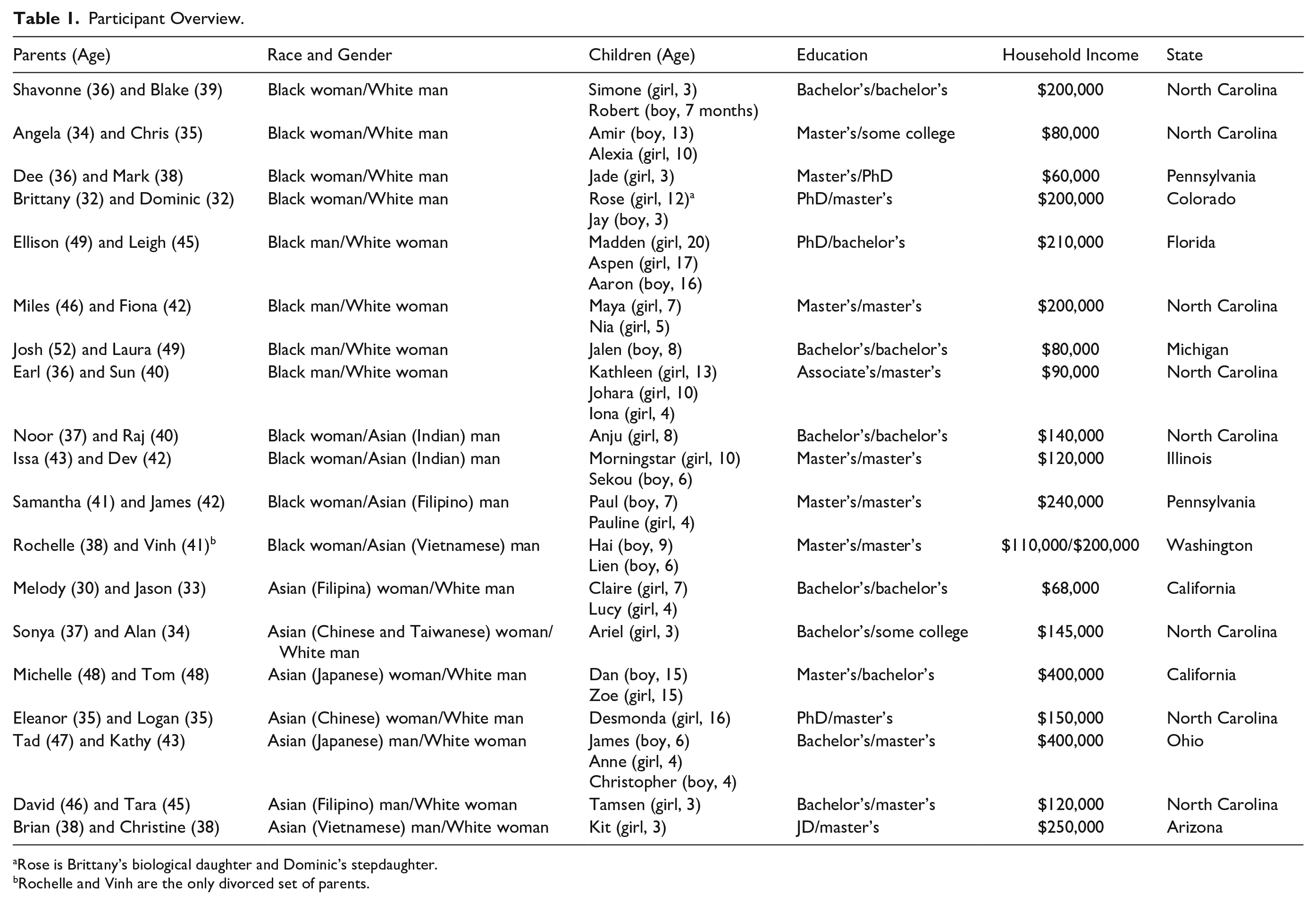
Rose is Brittany’s biological daughter and Dominic’s stepdaughter.
Rochelle and Vinh are the only divorced set of parents.
Despite the contributions of the study, there are limitations that can be addressed in future research on multiracial families and their racial socialization practices. First, the sample was highly educated and participants overwhelmingly represented middle- to upper-middle-class backgrounds. Previous research has found that parents who are highly educated and middle class more frequently engage in racial socialization compared with parents of lower socioeconomic backgrounds (Brown et al. 2007). Furthermore, highly educated and middle-class families likely have access to more resources when racially socializing their children, such as dual language schools, a range of extracurricular activities, and attempts at selecting more diverse neighborhoods, daycares, and schools. Although families may share similar concerns for their children regardless of social class, low-income parents “are unable to assert their class status to avoid racism and discrimination” (Turner 2020:243). For example, Black mothers share concerns about their children’s safety, but low-income, single mothers “do not have access to the same ‘toolkit’ as middle-class mothers to help them protect their children from racism” (Turner 2020:252).
Second, I was unable to recruit Asian mothers who have children with Black fathers. I changed my recruitment flyer to specifically target these dyads and even offered a gift card incentive for participation. My original intent was to have equal representation among the racial dyads. For example, three sets of Black mothers and White fathers and three sets of Black fathers and White mothers. However, I could not accomplish this with the Black and Asian dyads and therefore could not generate intersectional comparisons with the experiences of Black mothers and Asian fathers that I interviewed. I think part of this failure was due to my positionality as a White and Asian woman, as many potential participants described negative experiences with White and Asian couples, namely, anti-Black racism.
As discussed in my data and methods section, I wanted to interview the parents together. This was a purposeful decision for this study, yet dyadic interviews may result in limitations. Mothers seemed to be most enthusiastic about participating in my study, often reaching out to me for information and getting their spouses’ or coparent’s consent to participate in an interview. This affected some interviews, particularly when the mothers were more engaged or talkative. When I noticed this, I made attempts to draw in the father and elicit responses from him, asking, “What do you think about that?” or “How have you experienced this?” Future studies related to racial socialization practices of parents might consider the use of individual and dyadic interviews to allow parents equal “air time” and the opportunity to perhaps respond more honestly and freely.
