



Abstract
Although quantitative social scientists have examined how self-perceptions of masculinity and femininity vary by sociodemographic axes, gender polarization has rarely been studied. This concept captures gender subjectivities in ways that reflect how many individuals understand themselves as having a mixture of masculine and feminine characteristics, helping align survey measures with how gender theorists and qualitative scholars have examined gender. It is measured as the absolute value of the difference between self-rated masculinity and femininity. For example, if someone rated themselves as a 4 of 7 on masculinity and a 7 of 7 on femininity, their gender polarization value would be 3. In contrast, if someone rated themselves as a 1 of 7 on masculinity (the lowest value) and a 7 of 7 on femininity, their value would be 6. The authors examine this metric in a probability sample of Canadians. Gender polarization differed by political ideology, sexual identity, and age cohort for both women and men. For men only, race/ethnicity, educational attainment, and rural or urban location were related to gender polarization. These results highlight how social and structural contexts both shape and constrain how individuals perceive themselves in gendered ways.
Few large-scale representative surveys have examined how individuals understand themselves in terms of masculinity or femininity. Even fewer measure these characteristics relative to one another. Gender polarization refers to the absolute value of the difference between self-rated masculinity and femininity (Magliozzi, Saperstein, and Westbrook 2016). Measuring gender polarization on surveys helps better capture gendered subjectivities, which for many people involve a mixture of masculine and feminine characteristics.
Analyzing how gender polarization varies underscores how culture, social norms, and structural factors shape understandings of gender. This metric is of sociological importance, as it highlights the social contexts and demographic axes associated with more rigid or flexible gender norms. Higher gender polarization values indicate the internalization of more rigid gender norms. In contrast, lower values indicate contexts or axes in which individuals are more likely to see themselves as a combination of masculinity and femininity and are thus less constrained by strict gender norms. More broadly, this metric highlights how something that feels deeply personal—gender subjectivity—is systematically shaped by social factors.
To that end, we recently fielded a telephone survey of Canadian adults that included two separate scales for femininity and masculinity, from which we calculated gender polarization (see also Silva, Hamdon, and Huddart 2025). Respondents of all gender identities answered these questions. Respondents were selected through probability sampling. This study is among the first to provide representative results about gender polarization by multiple sociodemographic axes, and the first to do so in Canada. Ethical approval for this project was obtained from the University of British Columbia, approval number H24-00972, and informed consent was obtained from all participants.
Findings
Among both women and men, gender polarization varied by political ideology, age, and sexual identity (Figure 1). Immigration status was the only axis not related to gender polarization among either women or men. The political left was less gender polarized than the political right (women, −0.53; men, −0.65; p < .001 for both). People in emerging adulthood (19–29 years of age) were less polarized than people in middle age (45–64 years of age) or older adulthood (≥65 years of age). The difference between the youngest and oldest cohort was large: −0.88 for women and −0.69 for men (p < .001 for both). People who identified as exclusively straight were substantially more gender polarized than people of other identities. LGB people challenge gender norms as part of the LGB identity construction process (e.g., the importance of heterosexuality to men’s masculinity) and are therefore more likely to incorporate both masculine and feminine characteristics (Kahn and Halpern 2019).
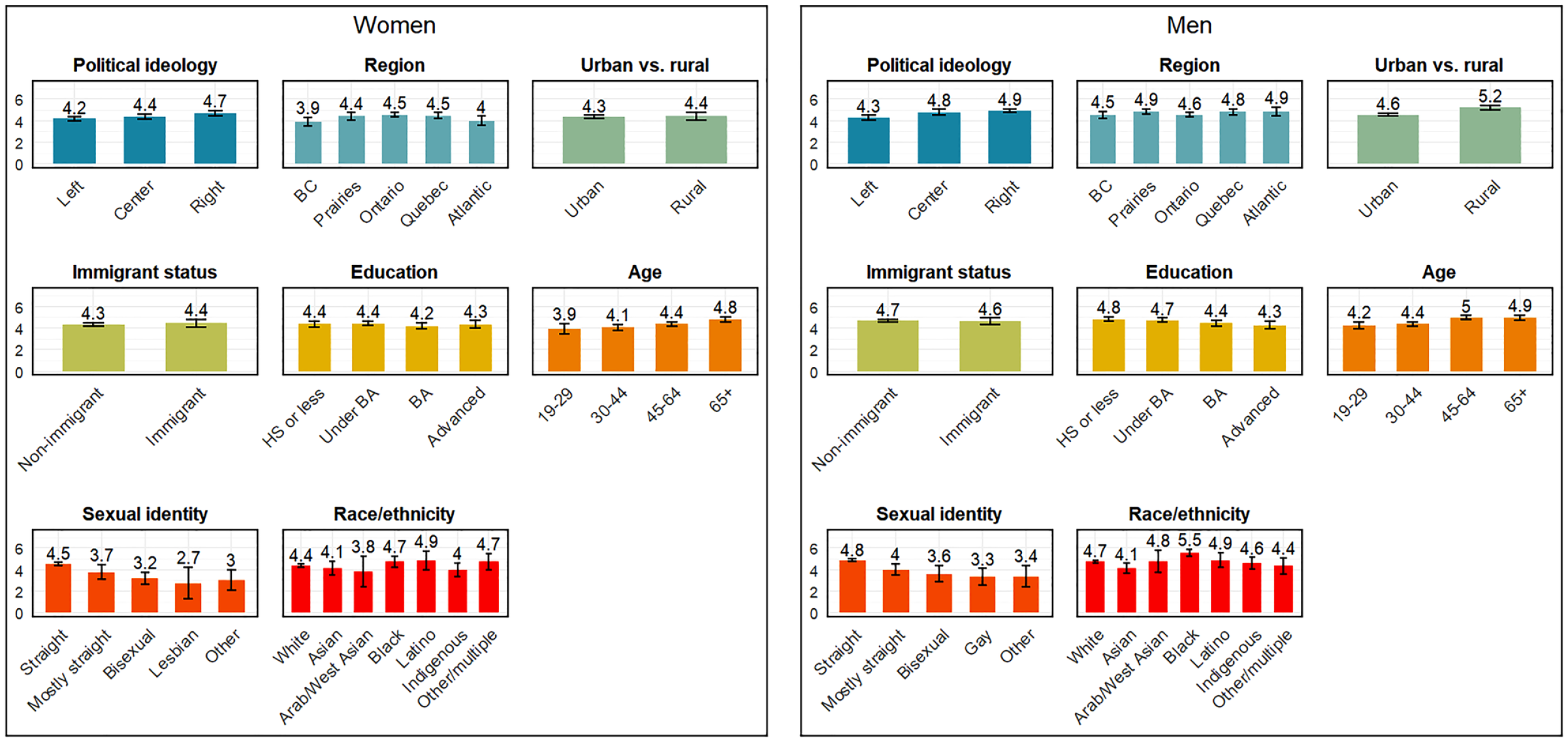
Gender polarization by sociodemographic axis for Canadian women and men.
Among women only, region was related to gender polarization. Women in British Columbia were less gender polarized than women in Ontario or Quebec (−0.64 [p < .01] and −0.57 [p < .05], respectively). This finding may reflect a politically progressive social climate in southwestern British Columbia, where most of the population lives; strong feminist and queer activist histories; institutional encouragement of gender diversity, such as through early adoption of comprehensive sexual orientation and gender identity curriculum in British Columbia schools; and how wilderness activities—which are conventionally associated with masculinity—are important to many British Columbians of all genders (Statistics Canada 2023).
Whereas race/ethnicity, educational attainment, and rural/urban residence were substantively unassociated with gender polarization among women, they were among men, reflecting how masculinity is more narrowly defined than femininity and shaped strongly by context. Asian men were the least gender polarized, and Black men were the most. The differences between Asian Canadians and Black and white Canadians were −1.43 (p < .001) and −0.63 (p < .01), respectively, whereas the differences between Black Canadians and white and Indigenous Canadians were 0.81 (p < .001) and 0.96 (p < .01), respectively. These findings indicate how different forms of gendered racialization and subcultural community norms shape men’s gendered subjectivities in systematic ways (Kyler-Yano and Mankowski 2020). Higher levels of education were associated with lower gender polarization. For example, men with bachelor’s degrees were less polarized than men with high school degrees or less (−0.38, p < .05). Many men view educational achievement as incompatible with masculinity (Morris 2008), which manifests in a selection effect in which gender polarized men are less likely to earn higher educational degrees. Additionally, urban men were less gender polarized than rural men (−0.65, p < .001), reflecting how gender norms are stricter for rural men (Silva 2022). Overall, gender polarization varied more among men than women. There is extensive variation in men’s gendered subjectivities according to social context and demographic axes, reflecting social constraints that affect men’s ability to enact less rigid configurations of masculinity.
Supplemental Material
sj-docx-1-srd-10.1177_23780231251355660 – Supplemental material for Gender Polarization and Sociodemographic Axes in Canada
Supplemental material, sj-docx-1-srd-10.1177_23780231251355660 for Gender Polarization and Sociodemographic Axes in Canada by Tony Silva, Sophia Dimitrakopoulos and Emily Huddart in Socius
Supplemental Material
sj-docx-2-srd-10.1177_23780231251355660 – Supplemental material for Gender Polarization and Sociodemographic Axes in Canada
Supplemental material, sj-docx-2-srd-10.1177_23780231251355660 for Gender Polarization and Sociodemographic Axes in Canada by Tony Silva, Sophia Dimitrakopoulos and Emily Huddart in Socius
Supplemental Material
sj-docx-3-srd-10.1177_23780231251355660 – Supplemental material for Gender Polarization and Sociodemographic Axes in Canada
Supplemental material, sj-docx-3-srd-10.1177_23780231251355660 for Gender Polarization and Sociodemographic Axes in Canada by Tony Silva, Sophia Dimitrakopoulos and Emily Huddart in Socius
Footnotes
Funding
The author(s) disclosed receipt of the following financial support for the research, authorship, and/or publication of this article: This research project was funded by the Social Sciences and Humanities Research Council of Canada (Insight Grant F23-04313).
Availability of Data and Code
R script for the figure visualization and Stata code for the numerical estimates are included as supplementary materials. A master coding file and dataset from this project will be made publicly available through a data repository (all files are also available upon request directly from the corresponding author).

Supplemental Material
Supplemental material for this article is available online.
Author Biographies
References
Supplementary Material
Please find the following supplemental material available below.
For Open Access articles published under a Creative Commons License, all supplemental material carries the same license as the article it is associated with.
For non-Open Access articles published, all supplemental material carries a non-exclusive license, and permission requests for re-use of supplemental material or any part of supplemental material shall be sent directly to the copyright owner as specified in the copyright notice associated with the article.
