



Abstract
School shooting scholars call for a comprehensive approach that can integrate idiosyncratic studies, solve definition dilemmas, and foster programmatic clarity. The authors argue that Newman and colleagues’ approach to rampage school shootings can be adapted to any subset of shootings. Using an original dataset, the authors assess constellation theory (CT)—Newman and colleagues’ comprehensive framework—and show how refined CT factors help define and explain rampage attacks amid broad shifts in gun appropriations, social media engagement, punitive school security, and adolescent mental health decline. The findings suggest that (1) duration, lethality, and shooter fatality distinguish rampage attacks as a subset; (2) shooter life histories display a majority of indicators across all CT factors, and the mean proportion of factor indicators is positively and significantly correlated with lethality; and (3) psychosocial support infrastructures represent inflection points in surveillance system failures that create time for other CT factors to gain salience in shooters’ biographical trajectories. This study provides insight into the mechanisms driving rampage shootings and develops Newman and colleagues’ approach as a generative analytic strategy for school shooting research.
In the more than 25 years since 2 students left 13 dead and 23 wounded at Columbine High School, research has advanced our understanding of school shootings, their processes and causes (Muschert 2019). We have learned, for example, that masculinity threat moderates the salience of gun access (Bridges and Tober 2019), the media content shooters create, rather than consume, conveys their motives (Larkin 2018), and attacks pose “the only way out” for shooters with or without mental illness (Nassauer 2022:240). And although public discourse routinely cites guns, violent media, or mental illness as the cause, the literature indicates that interactions between multiple factors across theoretical levels help explain school shootings (Graham, Jonson, and Lee 2022; Harding, Fox, and Mehta 2002; Schildkraut et al. 2021).
Critics within this multidisciplinary field point to programmatic discord and the need for a comprehensive approach that coheres “idiosyncratic” studies of school shootings into a unified research program (Muschert 2007:73; Schildkraut and Muschert 2019). Some call for a uniform definition of school shooting (Freilich et al. 2022; Rocque and Duwe 2018), but others warn that rigid criteria exclude cases on trivial grounds and minimize key differences between those included (Borum et al. 2010; Henry 2009). Affirming this risk, mass shooting criteria require indiscriminate targeting, four or more fatalities, and a single location and shooter but disqualify clear-cut cases (e.g., Columbine) and foment media invisibility and data scarcity for most excluded cases (Brazzell, Tober, and Bridges 2023). Although a comprehensive approach could help resolve definition dilemmas and integrate studies that focus on a single case, cause, or theoretical level, school shooting scholars have yet to flesh out the components and application of the proposed approach. We read this proposition as a matter of adapting Newman et al.’s (2004) approach to defining and explaining rampage school shootings.
Newman et al. (2004) leveraged two case studies to generate the criteria they used to define 25 rampage school shootings (1) the location represents a public stage on school property, (2) shooters are current or former students, and (3) some victims are targeted indiscriminately. The authors derived these criteria iteratively from within-case and cross-case analysis, and only after they devised a theory of the factors that are copresent and salient in all rampage school shootings (Harding et al. 2002). Newman et al.’s constellation theory (CT) posits five necessary but insufficient factors for rampage attacks: (1) social marginalization, (2) psychosocial issues, (3) under the radar, (4) gun access, and (5) cultural scripts. Indicators denote each factor’s presence, but its salience is inseparable from interactions with other factors. A case becomes explicable as factor interactions reveal sequential actions by which the shooter situates the attack’s meaning within their biography and social milieu (Harding et al. 2002). Case definition and explanation proceed iteratively, in tandem and through precisely the kind of analyses of “solitary factors” invoked to critique the school shooting literature (Rocque 2012:310). The comprehensive logic of this approach lies in applying CT as a framework to analyze factors across theoretical levels (Harding et al. 2002). The approach fosters programmatic clarity in prescribing empirically accurate case definitions and explanations, rather than strict adherence to inclusion criteria and CT factor indicators (Harding et al. 2002). In this article, we adopt Newman et al.’s approach to assess the applicability of CT and in the process, demonstrate how the approach can be adapted to any subset of shootings.
CT factors have helped explain rampage school shootings in the United States from 1974 to 2008 (Newman and Fox 2009; Newman et al. 2004). Since 2008, however, school shootings have become more frequent and lethal amid significant shifts in the social landscape (Bridges and Tober 2019; Riedman 2023). Specifically, White men and boys have reappropriated guns as a solution to socioeconomic precarity (Pfaffendorf, Davis, and Kinney 2021; Warner et al. 2022), social media proliferation has afforded new vehicles for inhabiting desired personas online (Katz 2016; Stuart 2020), and growing demand for adolescent psychosocial support has been met with punitive security enhancement in schools (Madfis 2014; Muschert 2019). These macrostructural developments carry implications for the conceptualization of CT factors, providing a theoretical rationale for assessing CT’s applicability to rampage attacks since 2008.
Drawing on open-source data and the K–12 School Shooting Database, we examined the cases of school-related gun violence recorded between 2009 and 2022. We defined 30 cases as rampage shootings, created a report for each one, and reconstructed the life histories of the 31 shooters involved. To account for patterns in our data that complicated Newman et al.’s (2004) conceptualization of CT, we refined factors and indicators and assessed their applicability to 30 rampage school shootings (2009–2022).
Our findings suggest that duration, lethality, and shooter fatality distinguish rampage attacks from other school shootings. Most CT factor indicators are highly visible in shooter life histories, and the mean proportion of indicators, both across all factors and our original operationalization of cultural scripts, is positively and significantly correlated with lethality. Although explaining any particular case is beyond the scope of this article, CT factor interactions reveal psychosocial support infrastructures as key inflection points for surveillance system failures that create time for social marginalization, psychosocial issues, gun access and socialization, and cultural scripts to become increasingly salient in shooter trajectories toward rampage school shootings.
This article makes three primary contributions. First, our assessment offers empirical evidence on the warrants of defining rampage shootings as a distinct subset. Second, our account of factor interactions provides analytic leverage on the mechanisms driving rampage shootings. Finally, our refinement of CT factors and indicators shows that Newman et al.’s (2004) comprehensive approach affords a generative analytic strategy that can incorporate and complement insights from studies of school shootings. We start with an overview of Newman et al.’s approach and gun violence research that draws out CT factors and interactions. After discussing our methods and data, we turn to the quantitative portion of our assessment. We then draw on shooter life histories to illustrate CT factor interactions that help explain rampage school shootings against the backdrop of macrostructural transformations. To conclude, we discuss the implications of our findings and avenues for future research.
A Comprehensive Approach to Rampage School Shootings
Newman et al. (2004) analyzed each shooting as a process, tracing sequential actions and their meaning within each case and comparing them across cases (Harding et al. 2002). For example, interpersonal disputes drive revenge attacks but cannot account for indiscriminate targeting, one criterion for rampage attacks. Unlike avengers, rampage shooters regularly traverse the site of the attack and expect to die in its execution (Katz 2016). In explaining why rampage shooters aim at destroying their personification by others, Katz (2016) implicates the relevance of the location and student criteria for rampage attacks. For instance, terrorists indiscriminately target victims in sites of degradation, including schools, but the location (i.e., school property) has biographical meaning only for the rampage shooter (i.e., current or former student). To capture how the sociocultural landscape orients the shooter’s biographical trajectory toward the attack, Newman et al. applied CT as a framework for analyzing factors across the individual, community, and structural levels. The following sections show how CT can incorporate insights from school and mass shooting research that, in turn, draw out refined CT factors and indicators, along with factor interactions that help explain rampage school shootings.
Social Marginalization
Schools foment frustration and even aggression by imposing rules to which students must conform but feel powerless to change (Donoghue and Pascoe 2023). When students’ agency is further constrained by academic struggle, peer exclusion, and family problems, they are more likely to act out at school (Bonanno and Levenson 2014; Hagan and Foster 2001; Mateu-Gelabert and Lune 2003). And boys who are ostracized, teased, and bullied may see violence as the only way to escape victimization and protect their masculinity simultaneously (Donoghue and Pascoe 2023; Larkin 2018; Warner et al. 2022).
Most rampage shooters are straight White young men or boys who perceive romantic rejection as a masculinity threat (Farr 2019; Leary et al. 2003; Schildkraut, Cowan, and Mosher 2024). They also belong to the larger population of White men and boys experiencing an amplified sense of precarity and status threat amid economic decline and increasing inclusion of women, people of color, and LGBTQ groups (Drakulich and Craig 2022; Pfaffendorf et al. 2021). This shifting social landscape has rearticulated White men and boys’ appropriation of guns as a masculinity resource that enables access to gender and racial status (Bridges and Tober 2019; Carlson 2015a, 2015b).
Masculinity threat draws attention to how shooters situate the attack’s meaning within their biography and sociocultural context, as an agentic irreversible enactment of gender efficacy (Katz 2016). But gender threats are not confined to cis men and boys. Although women are more likely to endorse masculine ideals of protective gun use than react to femininity threats (Warner et al. 2022), one cis girl, a trans boy, and a trans man (former student) have executed rampage school shootings since 2019. School bullying policies and gender policing deny girls agency in forcing them to repress anger or face punishment for violating school rules, not merely gender norms (Chesney-Lind and Irwin 2008). And trans students, who report more life stressors and worse mental health than cis peers, face greater risk of bullying victimization, which can pose gender and sexual identity threats and, for trans boys, position help seeking as a source of masculine discrepancy stress (Anzani, Decaro, and Prunas 2023; Reidy et al. 2018).
Psychosocial Issues
Most shooters endure stressful life events (e.g., traumatic loss) and family problems that catalyze insecure attachment, academic struggle, impulsivity, and aggression (Noonan and Pilkington 2020; Schneider 2020). The copresence of mental illness, stressful life events, and family problems increases risk for violent offending (Perez, Jennings, and Baglivio 2018), but mental illness alone increases risk for violent victimization and is a low specificity predictor of enacting violence (Rozel and Mulvey 2017; Whiting, Lichtenstein, and Fazel 2021). For example, people with chronic mental illness (e.g., conduct disorder) are at slightly greater risk for enacting violence relative to those without mental illness (Glied and Frank 2014; Peterson et al. 2022), and severe mental illness increases this risk only at specific stages in illness and treatment (e.g., first-episode psychosis and involuntary commitment) (Swanson et al. 2015).
Sociologists find that mental illness is among multiple sources of powerlessness and problems for which shooters seek institutionalized solutions that fail (Goodrum et al. 2022; Nassauer 2022). When psychosis is linked to rampage attacks, shooters endure inadequate or no treatment and problems across social arenas, until attacks present “the only way out” (Nassauer 2022:240). These findings complement psychological studies suggesting that adolescent suicidality, particularly in boys, and untreated depression are associated with greater risk for future violence (Van Dulmen et al. 2013; Yu et al. 2017). Sociological research on mass shootings and rampage school shootings shows that psychosocial issues become salient through interactions with social marginalization, especially masculinity threat (Bridges and Tober 2019; Kalish and Kimmel 2010; Newman et al. 2004). Providing a telling example, Schildkraut et al. (2024) detailed the sequence in which a shooter, who was diagnosed with childhood mental illness, experienced romantic rejection shortly before attempting suicide and endured successive stressful life events punctuated by romantic rejection days before his rampage attack, which, the authors argued, presented possibilities for prevention.
Under the Radar
Shooters issue threats, express violent ideations, and disclose plots in person, in diaries, and in online venues (Schildkraut et al. 2024; Silva and Greene-Colozzi 2023). Despite prioritizing school securitization (e.g., armed guards, metal detectors, cameras, punitive policies), surveillance systems routinely miss warning signs and allow shooters to fly under the radar (Muschert 2019; Newman et al. 2004). In tracing averted attacks to school cultures that help students feel comfortable reporting shooting plots, Madfis (2014) showed that prevention hinges on information, communication, and trust. As a key domain of preventive surveillance, psychosocial support infrastructures have absorbed a two-decade decline in adolescent mental health (Centers for Disease Control and remain ill equipped to serve people deterred from seeking help for stigmatized issues, including but not limited to mental illness (Goodrum et al. 2022; Graham et al. 2022). As Fox and DeLateur (2014:135) noted, shooters externalize blame and “desire fair treatment, not psychological treatment.” When psychosocial support infrastructures fail to help rampage shooters make sense of their grievances, these mostly White young men and boys turn to alternative vehicles for expression (Bridges and Tober 2019; Katz 2016; Newman et al. 2004).
Gun Access
In the wake of high-profile shootings, public discourse fixates on gun type, quantity, and control (Collins 2014; Newman et al. 2004). Shootings that involve semiautomatic rifles and multiple guns typically inflict more casualties (Greene-Colozzi and Silva 2022; Livingston, Rossheim, and Hall 2019). Although bill proposals and public opinion favoring gun control increase after lethal attacks, most American adults can still buy semiautomatic rifles and high-capacity magazines legally (Olzak 2023). Gun-disqualifying mental health record reporting has increased in recent years, but such records have yet to be submitted to federal databases or created for a large share of the population deemed as disqualified (Swanson et al. 2015). Age disqualifies most school shooters from buying guns but hardly stymies access (Schildkraut and Hernandez 2014). The Columbine shooters, for example, obtained guns from an adult who sidestepped background checks through private firearm transfers (Schildkraut and Geller 2022; Schildkraut and Muschert 2019).
However, gun access cannot fully explain the frequency of school and mass shootings in the United States (Bridges and Tober 2019). Sociologists link White men’s and boys’ heightened sense of precarity and status threat with shifts in gun culture, whereby protective gun use has supplanted recreational use (Carlson 2015b; Warner et al. 2022; Yamane 2024). There is reason to believe that rampage school shooters are socialized into protective gun use, given that most access guns at home, hunt, and shoot targets (Leary et al. 2003; Newman et al. 2004). To capture how shooters situate the meaning of gun use within their biographies and sociocultural context, we refine this factor as gun access and socialization. In doing so, we come to understand how shooters’ rituals of gathering guns build up both their commitment to and the meaning of their attack, as an agentic irreversible enactment of masculine efficacy (Collins 2014; Katz 2016; Warner et al. 2022).
Cultural Scripts
In the preparation phase, shooters draw on narrative resources (i.e., scripts) that make the attack seem possible (Kiilakoski and Oksanen 2011; Newman et al. 2004). Some fit their attacks to the narrative structure of video games (Denham, Hirschler, and Spokes 2021), and most consult media about prior shootings as resources for anticipating others’ responses (Katz 2016). For example, the Finnish Jokela High School shooter obsessed over Columbine and tried on an enraged antihero identity on YouTube (Kiilakoski and Oksanen 2011). The proliferation of social media has enabled mass consumption of live-streamed videos of rampage school shootings that remain posted for hours before removal (Peterson et al. 2023). Rampage shooting fandoms exploit the affordances of social media for unimpeded circulation of videos, music, art, and texts that constitute touchstones within global subcultures (Mizrahi-Werner et al. 2022; Paton and Figeac 2015; Raitanen and Oksanen 2018). Self-described “Columbiners,” for instance, idolize the two shooters as martyrs of the marginalized, and aspirant shooters bluster about exceeding the death toll, making a statement, and gaining fame (Larkin 2009; Raitanen and Oksanen 2018). Most shooters create social media content and use online venues as a vehicle for expressing sadness and suicidality, exploring violent fantasies, and inhabiting their desired public persona (Katz 2016; Peterson et al. 2023).
Cultural scripts lend insight into the meaning of the attack for the shooter, but this factor raises challenges for operationalization (Kiilakoski and Oksanen 2011; Newman et al. 2004). Newman et al. (2004) conceptualized cultural scripts in terms of sending a message, seeking fame, and masculine exit, and Kiilakoski and Oksanen (2011) described cultural scripts as a combination of blueprints, media attention, and masculinity. Bridging Katz’s (2016) theory of intimate massacres with Bridges and Tober’s (2019) two-part social psychological and cultural theory of mass shootings, we conceptualize cultural scripts to capture the narrative resources shooters use to fit attacks to their biographical trajectory and social milieu. Attending to the scripts that each shooter uses to tether their expressed grievances to their executed attack and expected death reveals a pursuit not of fame, but rather a solution to powerlessness that entails passing a biographical point of no return and sacrificing—not creating—a future self through an agentic, irreversible enactment of gender efficacy (Bridges and Tober 2019; Katz 2016; Kimmel and Mahler 2003; Newman et al. 2004). We refine sending a message as “explaining the attack as a solution to problems,” and seeking fame and media attention as “destroying one’s personification by others.” Our analysis highlights these indicators in shooter life history data and is the first to our knowledge to operationalize cultural scripts for rampage school shootings.
Methods and Data
The K–12 School Shooting Database contains nearly 2,400 cases from 1966 to the present (Riedman 2025). Unlike other databases that use restrictive criteria (cf. Brazzell et al. 2023), the K–12 School Shooting Database includes every case in which a gun is fired, brandished, or a bullet hits on school property, irrespective of motive, casualties, day, or time. It also records shooting duration (minutes), number of victims killed and wounded, and shooter fatality. The 1,214 cases recorded between 2009 and 2022 constitute our sampling frame.
Guided by methodological advances in open-source data collection for school shooting research (Chermak et al. 2025; Freilich et al. 2022), we gathered public documents on each case, using search engines—Nexis Uni, Google, Yahoo, and Bing—and the following search terms: shooting date, school name and location, and shooter name. We gathered documents on each case until we excluded it or reached saturation (i.e., the search yielded no new sources or insights) (Chermak et al. 2025). We excluded cases in which shooters (1) targeted only known disputants, (2) lacked explicit plans for attacking the school, (3) halted the attack before shooting others, or (4) lacked school affiliation as a current or former student. We included 30 cases, created a report for each one, and reconstructed the life histories of the 31 shooters involved. Our life history dataset (see Table 1) consisted of a total of 539 documents across 31 shooters (M = 18.0 documents per shooter, SD = 5.9) and seven document types: news media reports (83.7 percent), court records (5.9 percent), government and school administration reports (3.5 percent), social media content (2.6 percent), police records (1.5 percent), academic research (1.5 percent), and Web site content (1.3 percent). The median time from attack to document publication was 41 days.
Open-Source Data for Rampage School Shooter Life Histories.

Following Newman et al. (2004), we analyzed each case as a process and, using focused coding (Timmermans and Tavory 2022), moved between rampage shooting criteria and CT factor indicators. This recursive approach revealed five cases in our sample that warranted exclusion, including one later in our analysis, which clarified that the shooter targeted only known disputants (Italy High School, 2018). The approach also provided a generative analytical strategy that helped tease out CT factor interactions and led us to refine factors and indicators (see Table 2). For example, we refined gun access (Newman et al. 2004) to account for patterns in gun socialization, whereby shooters’ experience with guns enhanced their agency, not merely capacity, for executing attacks and, in turn, sharpened our analysis of sequential actions (e.g., responses to masculinity threat, family abuse, counseling) and meaning-making processes through which agentic, irreversible enactments of gender efficacy were made manifest (Katz 2016). Finally, case reports and shooter life histories allowed us to incorporate characteristics of the 30 rampage attacks and 31 shooters, along with a binary matrix of CT factor indicators into our dataset.
Operationalization of Constellation Theory Factors and Indicators.

We used descriptive statistics to summarize characteristics of shooting settings (e.g., population density) and the shooters (e.g., gender, age, race). Using t tests and chi-squared tests, we compared these characteristics with those of other school shootings and assessed the warrants of defining rampage shootings as a distinct subset (Henry 2009). We measured the relative prevalence of each CT factor by summing the number of indicators observed and dividing that sum by the total number of factor indicators. We also estimated the mean proportion of indicators observed across all CT factors. Finally, we examined correlations between the mean proportion of indicators observed, both for each CT factor and across all factors, and shooting duration and lethality.
Results
Characteristics of Rampage School Shootings and Shooters
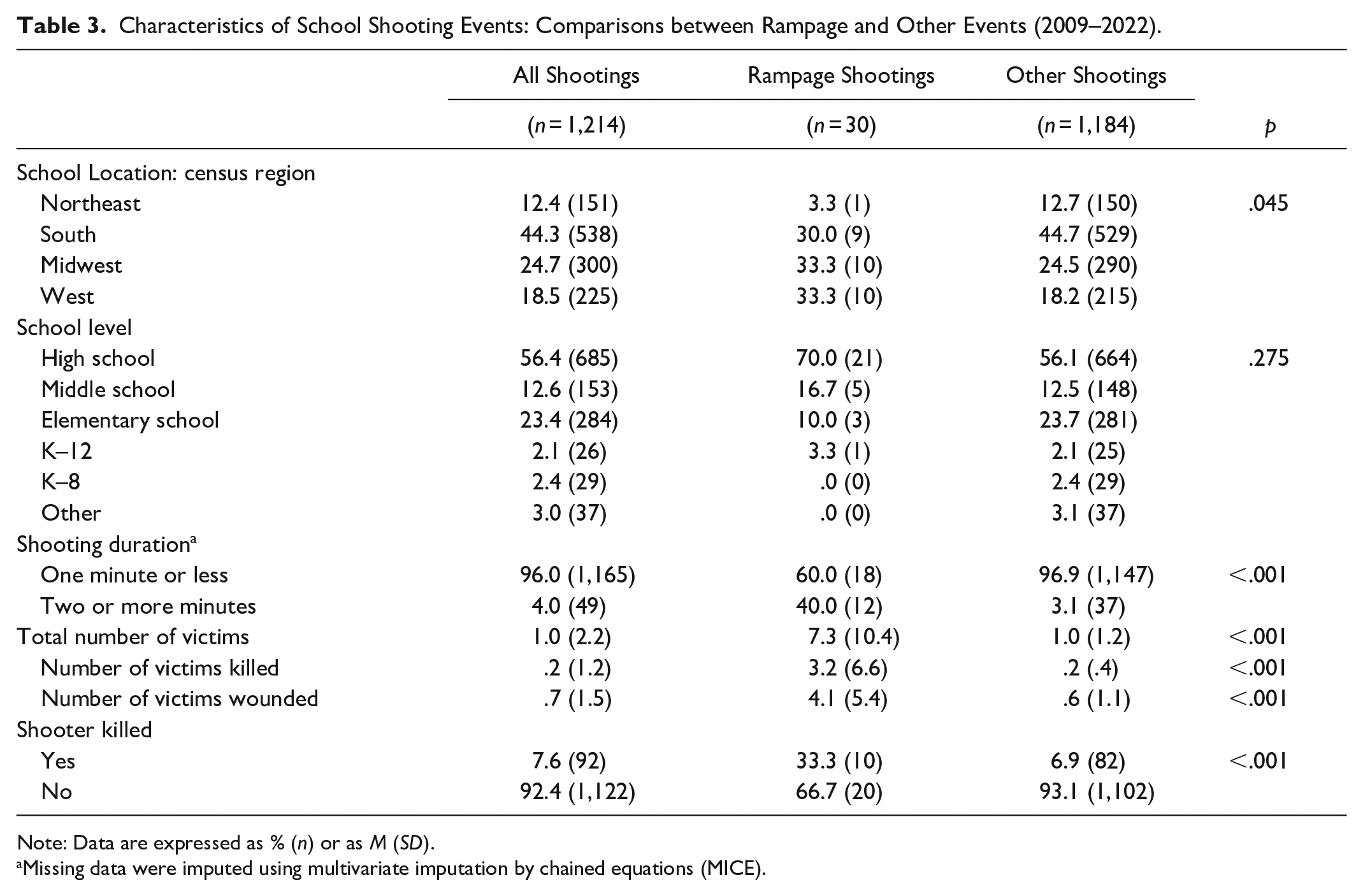
Echoing Newman et al. (2004), no U.S. region is immune to rampage school shootings (see Table 3). Compared with other school shootings (2009–2022), higher percentages of rampage shootings occur in the Midwest (33.3 percent vs. 24.5 percent) and West (33.3 percent vs. 18.2 percent). Rampage school shootings inflict a greater number of total victims (rampage shootings: M = 7.3, SD = 10.4; other shootings: M = 1.0, SD = 1.2), fatalities (rampage shootings: M = 3.2, SD = 6.6; other shootings: M = 0.2, SD = 0.4), and wounded (rampage shootings: M = 4.1, SD = 5.4; other: M = 0.6, SD = 1.1). A greater share of rampage shootings unfold over a duration of two or more minutes (40 percent vs. 3.1 percent) and result in shooter fatality (rampage shootings, 33.3 % other shootings, 6.9 percent).
Characteristics of School Shooting Events: Comparisons between Rampage and Other Events (2009–2022).
Note: Data are expressed as % (n) or as M (SD).
Missing data were imputed using multivariate imputation by chained equations (MICE).
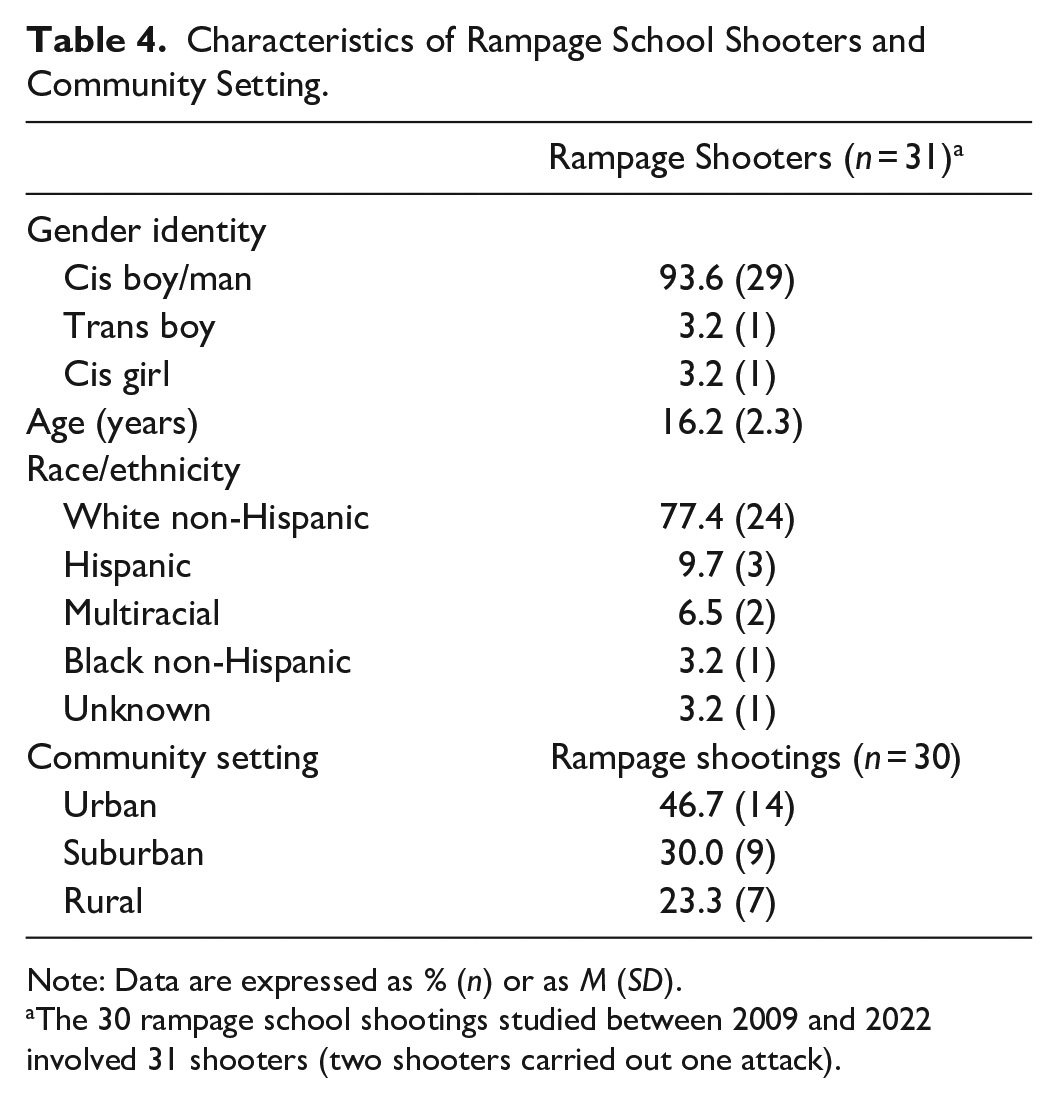
Descriptive statistics provide insights into the characteristics of the shooters in our sample (2009–2022) and the settings in which they resided and executed their attacks (see Table 4). Of 31 shooters, 29 identified as cis boys or men (93.6 percent), one as a trans boy (3.2 percent), and another as a cis girl (3.2 percent). Compared with Newman et al.’s (2004; Newman and Fox 2009) sample of all cis boy and man shooters (1974–2008), the slight gender variation in our sample led us to refine the masculinity threat indicator (social marginalization), adding gender and sexual identity threat. In our sample, shooters’ average age was 16 years and ranged from 12 to 21 years (SD = 2.3 years). More than three quarters identified as White non-Hispanic (77.4 percent), and smaller percentages identified as Hispanic (9.7 percent), multiracial (6.5 percent), or Black non-Hispanic (3.2 percent). Most rampage school shootings occurred in urban areas (46.7 percent), followed by suburban areas (30 percent), and rural areas (23.3 percent). This incidence of urban and rural shootings departs from Newman et al.’s (2004) sample, in which 60 percent of shootings occurred in rural areas (15 of 25), 32 percent in suburban areas (8 of 25), and 8 percent in urban areas (2 of 25).
Characteristics of Rampage School Shooters and Community Setting.
Note: Data are expressed as % (n) or as M (SD).
The 30 rampage school shootings studied between 2009 and 2022 involved 31 shooters (two shooters carried out one attack).
Applicability of CT
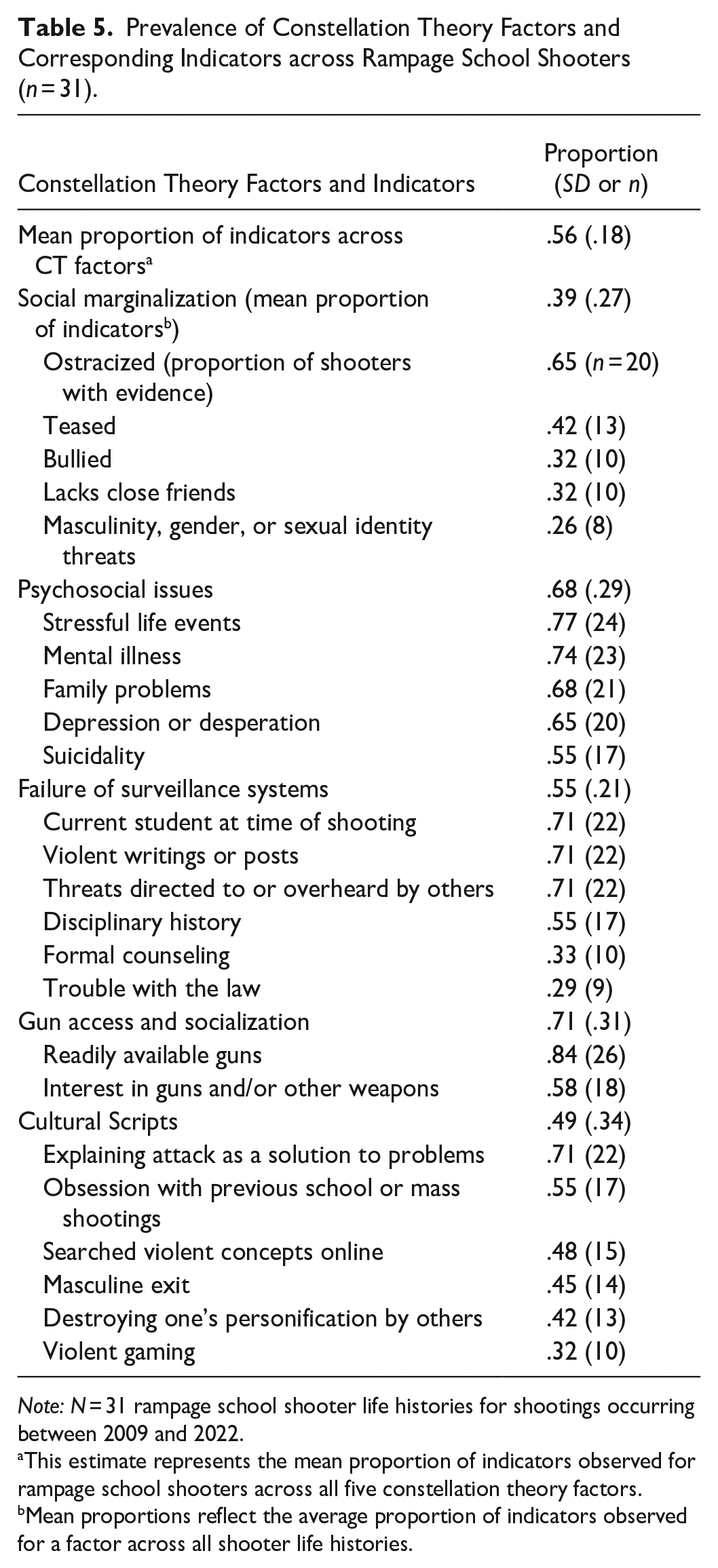
To assess CT’s applicability, we examined factor indicators observed in shooter life histories (see Table 5). Shooters displayed a majority of indicators across all five factors (mean proportion = 0.56), and we identified links between the proportion of indicators and attack lethality (see Figure 1). The mean proportion of indicators observed across all CT factors was significantly and positively correlated with the number of victims killed (r = .38, p < .05) and total number killed or wounded (r = .42, p < .05). Our analysis of individual CT factors showed that the mean proportion of indicators of cultural scripts was positively and significantly correlated with the number of victims wounded (r = .41, p < .05), total number killed or wounded (r = .43, p < .05), and shooting duration (r = .40, p < .05). Additionally, the mean proportion of gun access and socialization was positively and significantly correlated with the total number killed or wounded (r = .37, p < .05). In examining individual indicators of CT factors, we found that masculinity, gender, or sexual identity threat (social marginalization) was positively and significantly correlated with the number of victims killed (r = .36, p < .05), the number wounded (r = .42, p < .05), the total number killed or wounded (r = .45, p < .05), and shooting duration (r = .40, p < .05). Notably, shooter affiliation as a current student at the time of shooting (surveillance system failures) was negatively and significantly correlated with the total number of victims killed (r = −.49, p < .05) and total number killed or wounded (r = −.40, p < .05). Both interest in guns and weapons (gun access and socialization) and violent gaming (cultural scripts) were positively and significantly correlated with the total number of victims killed (r = .41 and r = .40, respectively, p < .05) and the total number killed or wounded (r = .43 and r = .45, respectively, p < .05).
Prevalence of Constellation Theory Factors and Corresponding Indicators across Rampage School Shooters (n = 31).
Note: N = 31 rampage school shooter life histories for shootings occurring between 2009 and 2022.
This estimate represents the mean proportion of indicators observed for rampage school shooters across all five constellation theory factors.
Mean proportions reflect the average proportion of indicators observed for a factor across all shooter life histories.
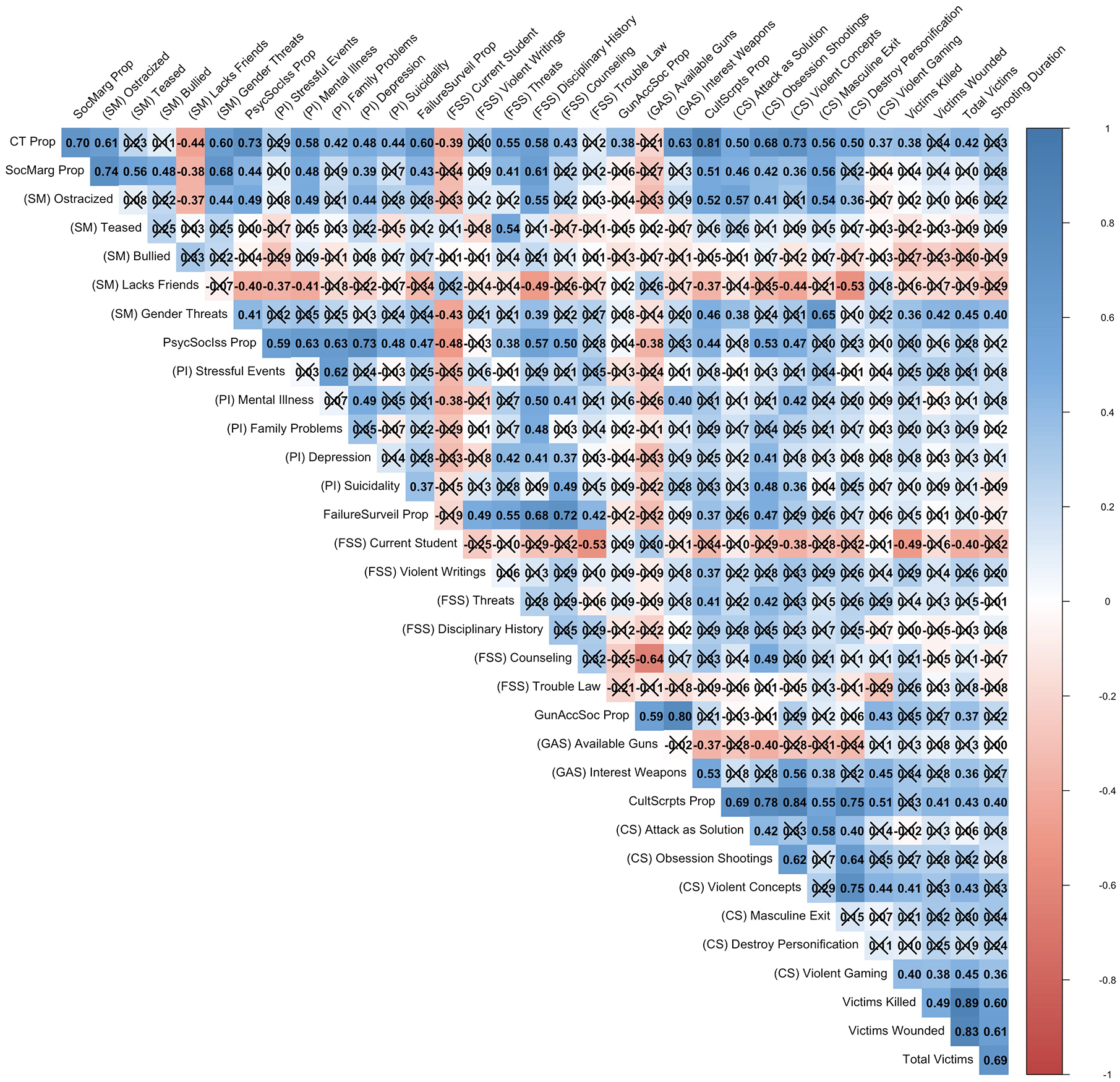
Correlation matrix of study variables.
These correlations provide preliminary evidence suggesting that refined CT factors and specific indicators are consequential for attack lethality. However, to understand the salience of any particular factor or its indicators, we must trace its interactions with other CT factors. We take up this task in the subsequent illustration of each CT factor’s indicators observed in shooter life histories, drawing attention to especially poignant cases. Verbatim statements appear in quotations. Shooter initials denote each case after first mention, which includes school name and year of attack.
Social Marginalization
An overwhelming sense of powerlessness emerged in shooter life histories, which displayed more than one third of the indicators of social marginalization (mean proportion = 0.39). Sixty-five percent of shooters felt ostracized (20 of 31), and 32 percent lacked close friends (10 of 31). In a deposition, A.H. (Madison High School 2016) recounted moving in with his father and stepmother after his parents separated, stating, “I’m not wanted by anyone” (BieryGolick 2018). A.L.’s (Sandy Hook Elementary School, 2012) housebound status in middle school curtailed his opportunities to join peer groups, and his psychiatrist described him as increasingly reclusive (Office of the Child Advocate, State of Connecticut 2014). In LiveJournal posts, W.A. (Aztec High School, 2017) stated that he was ignored by his brother and parents after their divorce and that the family’s move to New Mexico’s Four Corners region ruined his friendships and forced him to attend Aztec, where he was “singled out” for his disinterest in sports and religion (Lonich and Langman 2020).
In line with Pfaffendorf et al. (2021), shooters were less vocal about being teased (13 of 31 [42 percent]) and bullied (10 of 31 [32 percent]). In a note found in his backpack, J.R. (Sparks Middle School, 2013) detailed unjust treatment at school, and according to his psychotherapist, J.R. spent his session three days before the attack recounting classmates ridiculing his physique (Associated Press 2014). In notes found in her bedroom, the unnamed sixth grade girl shooter (Rigby Middle School, 2021) described her attack as the only way to end the bullying she faced at school (Associated Press 2014; Sunderland 2022). For some shooters, teasing and bullying fomented a sense of powerlessness that festered over time. Eighteen-year-old S.R. (Robb Elementary School, 2022), for instance, attacked his fourth grade classroom, where years prior, according to his cousin’s (classmate) testimony, he had been physically bullied and teased about his stutter and appearance (Burrows and Eva 2022). Nicknamed “Little Jessie,” J.O. (Townville Elementary School, 2016) described being physically bullied at his middle school, but he attacked his former elementary school (Osborne 2016).
The life histories of some shooters revealed severe gender anxiety, and 26 percent experienced masculinity, gender, or sexual identity threats (8 of 31), both inside and out of school. For example, J.O.’s paternal grandfather recalled J.O.’s father expressing disappointment about not having: “the athletic, competitive son he had hoped for” (Sheets 2019). Romantic rejection typically incited shame and a sense of failure among shooters such as A.H., who described feeling humiliated by his girlfriend’s infidelity when interviewed (BieryGolick 2018). Externalizing blame, N.C. (Marjory Stoneman Douglas High School, 2018) lamented “fail[ing] high school” and was embarrassed that his girlfriend, whom he verbally and physically abused, broke up with him (Montgomery 2022; Schildkraut et al. 2024). D.P.’s (Santa Fe High School, 2018) crush, according to her mother, rejected him in front of classmates one week prior to his attack (BBC 2018; Perez, Morris, and Ellis 2018). And a close friend of the girl who rejected T.L. (Chardon High School, 2012) claimed that T.L. “felt forgotten” after her new boyfriend teased and threatened T.L. (BieryGolick 2018; Lieberman and Ng 2012). Only two shooters in our sample, N.C. and W.A., exhibited gendered racism in response to masculinity threats (Warner et al. 2022). W.A.’s post online, for instance, referenced women as subservient to men and Whites as a “master race” that should be segregated from “Negros, Fags, Leftists, SJWs [social justice warriors], Nonwhites etc” (Lonich and Langman 2020).
Psychosocial Issues
Shooters endured feedback loops between social marginalization and psychosocial issues, displaying two thirds of the indicators in their life histories (mean proportion = 0.68). Observed most frequently, stressful life events (24 of 31 [77 percent]) were often punctuated by gender threats. As Schildkraut et al. (2024) made clear, N.C.’s childhood trauma extended into adolescence, wherein romantic rejection bookended his adoptive mother’s death, school expulsion, and armed services disqualification, fueling his depression and homicidal thoughts leading up to his attack. As with N.C., 68 percent of shooters endured family problems (21 of 31). W.A. moved to Aztec after his father physically abused his mother (Lonich and Langman 2020). T.L., whose parents’ alcohol abuse, violent disputes, and custody battle began when he was one year old, claimed that he carried out his attack to avoid returning home (Sarah Ann Nolan v. Thomas M. Lane, Jr. 1995). S.R. (Robb Elementary School, 2022) was repeatedly ignored when trying to convince his mother, who struggled with addiction, that her ex-boyfriend had sexually assaulted him as a young child (Burrows and Eva 2022; Reidy et al. 2018).
Lifetime prevalence estimates of mental disorders with severe impairment among adolescents are 22 percent (Merikangas et al. 2010). Yet 74 percent of shooters in our sample (23 of 31) were diagnosed with mental illness prior to their attacks (e.g., anxiety disorder, obsessive compulsive disorder, schizotypal personality disorder), 65 percent exhibited depression or desperation (20 of 31), and 55 percent presented suicidality (17 of 31). A.M. (STEM School Highlands Ranch, 2019), the only trans boy shooter in our sample, experienced considerable childhood trauma—domestic abuse, kidnapping, parent incarceration and deportation—followed by recurrent depression, suicidal ideation, and psychiatric hospitalizations, along with transphobic bullying at school (The People of the State of Colorado v. Maya Elizabeth McKinney a/k/a Alec McKinney 2019). A psychologist testified that C.S. (Freeman High School, 2017) executed his attack after spending months housebound, depressed, and obsessively watching Columbine videos (Epperly 2022). Echoing Nassauer (2022), mental illness was one of multiple sources of powerlessness that built up the meaning that attacks held for shooters. The role of mental illness in contributing to such meaning-making is perhaps best illustrated by S.B. (Forest High School, 2018), who had no diagnosable mental illness but was involuntarily committed at 14 years of age, which shattered his dream of a career in the Marines because of the Baker Act (Bouche 2018).
Surveillance System Failures
The costs of prioritizing punitive security over psychosocial support are placed into sharp relief by N.C., C.S., and S.B. Shooter life histories displayed most indicators of surveillance system failures (mean proportion = 0.55), with 71 percent producing notes and social media content about their plans (22 of 31). For example, while W.A. posted online about his attack hours before it began, he also regularly posted about other shootings, and law enforcement saw one of these posts (Lonich and Langman 2020). J.O. detailed his plans in Project Rainbow, a school shooting fandom Instagram group, where aspirant shooters glean narrative resources for executing and justifying lethal attacks (e.g., police response time and bullying prevention) (Monasterio 2016). However, 71 percent of shooters also issued threats within earshot of peers, teachers, and counselors (22 of 31). N.C. made death threats to peers and their families, community residents, and his own mother (Schildkraut et al. 2024). Teachers witnessed E.C. (Oxford High School, 2021) researching ammunition online and drawing pictures of his planned attack (Burrows and Eva 2022; Daily Mail Reporter 2011; Shapiro 2022b). Schools and law enforcement were aware of some shooters’ behavioral problems, as 55 percent had extensive school discipline records (17 of 31), and 29 percent had legal troubles (9 of 31). For instance, T.L. was arrested for assaulting his uncle two years before his attack (Geauga County Sheriff’s Office 2009).
Although shooter life histories indicate that punitive surveillance is a poor prevention strategy, they also make clear that psychosocial support infrastructures cannot be reduced to mental health treatment (Nassauer 2022). Thirty-three percent of shooters received formal counseling prior to their attacks (10 of 31). O.H.’s (Central Visual and Performing Arts High School, 2022) parents sought treatment for his mental illness and suicidality and supervised his medication regimen (Vidal 2022). After C.S. sent two peers threatening notes, the school suspended him, required a mental health evaluation, but allowed him to return and execute his attack days later (Clouse 2019). J.R. was visibly distressed after describing the homophobic bullying he faced at school to his psychiatrist, who referred J.R. to group therapy three days before his attack (Sparks Police Department 2013). Mental health treatment failed to help shooters make sense of their grievances and instead pushed them to find alternative vehicles for rectifying their privately held sense of powerlessness.
Gun Access and Socialization
All of the shooters accessed guns; most were socialized into gun use. Their life histories exhibited most indicators of gun access and socialization (mean proportion = 0.71), with 84 percent accessing guns at home or relatives’ homes (26 of 31). Four shooters obtained guns through private transfers, and A.M.’s co-conspirator, D.E. (STEM School Highlands Ranch, 2019), accessed guns at his home. Fifty-eight percent of shooters displayed significant interest in guns and regularly hunted or shot targets (18 of 31). On Instagram, E.C. and his mother documented their trip to a gun range days before his attack, posting pictures of targets riddled with bullets from E.C.’s new semiautomatic pistol, captioned: “Mom and son day, testing out his new X-mas present,” which he used to kill four and wound seven (State of Michigan Court of Appeals 2023). Shortly before his attack, J.P. (Reynolds High School, 2014) received a rifle for his birthday and, according to peers, regularly discussed owning and shooting guns (Davidson 2014; Multnomah County in the State of Oregon 2014; Wozniacka 2014). In his confessional interview, J.O. described shooting guns as a vehicle for relieving stress and earning the approval of his father, who physically abused and emasculated J.O. and whom J.O. killed right before driving to his former elementary school and executing his attack (Osborne 2016).
Cultural Scripts
The narrative structure surrounding most shootings became visible in shooter life histories, which displayed nearly half of the indicators of cultural scripts (mean proportion = 0.49). Seventy-one percent of shooters explained attacks as a solution to problems (22 of 31). In his diary, J.P., a devout Mormon, described intentions to kill the sinners who persecuted him at school, and, according to his teacher, classmates criticized J.P.’s presentation on the Holocaust for comparing himself with Jews one week before his attack (Jung 2014). The notes J.R. left behind stated that mistreatment at school “ruined his life” and his attack was “a last stand” (Sparks Police Department 2013).
It is plausible that shooters played shooting video games (10 of 31 [32 percent]) to rehearse their attacks, but most had experience using guns. J.P., for instance, avidly played shooting games at home and used guns with the Junior Reserve Officer Training Corp (Gunderson 2014). While C.S. played shooting games and posted role-play videos on social media, he regularly shot his father’s guns (Lapin 2017). Shooters who played shooting video games but lacked experience using guns consulted media content about prior shootings. J.R., who played sniper video games but had few opportunities to fire real guns, became obsessed with Columbine, and 10 days before his attack, J.R.’s class watched a video dramatization wherein a student used a gun to confront bullies at school (McAndrews 2014). N.C. played School Shooting, a video game, but also obsessively studied prior rampage attacks and watched simulated school shooting response videos (Sedensky 2013).
J.R. and N.C. were among the shooters whose life histories conveyed obsessions with prior rampage school shootings (17 of 31 [55 percent]) and who searched violent concepts online (15 of 31 [48 percent]). Similarly, A.L. devoted extensive time to studying previous shootings, recording details in a spreadsheet (Salam 2017), and O.H.’s list of shooters’ names and shooting fatalities was found in his car (Kilander 2022). W.A. used prior shooters’ names for his social media usernames and drew a timeline of Columbine on a classroom whiteboard (Dilanian and Douglas 2022; Lonich and Langman 2020). S.R. actively engaged across social media platforms, using them to search and post increasingly violent content (e.g., sexual violence, gore, animal cruelty) (Burgess and Taylor 2022; Burrows and Eva 2022).
Shooters’ gender grievances crystallized through increasingly violent social media posts leading up to their attacks, with 45 percent positioning their rampage as a masculine exit (14 of 31). After stating “everyone in the world deserves to get raped” in a Yubo live audio chatroom, S.R. sent women digital pictures of recently purchased guns and, on the day of his attack, text messages claiming that he shot his grandmother and planned on attacking an elementary school (Burgess and Taylor 2022; Burrows and Eva 2022). N.C., who carved swastikas into the boots and magazine of the gun used in his attack, expressed gendered racism through increasingly violent statements about his hatred of and desire to kill racial and sexual minorities and White women in interracial relationships (Associated Press 2022; Montgomery 2022; Murphy 2018). When interviewed, A.H. recounted his anger mounting because of his father’s disapproval, his girlfriend’s infidelity, and his academic ineligibility for school athletics, but he justified his attack as a way to flaunt a stolen pistol and ensure the impossibility of returning to his parents’ home (BieryGolick 2018). In text messages exchanged the night before their attack, A.M., a trans boy, and co-conspirator D.E., a cis boy, agreed that D.E. would kill A.M. to quell false rumors about their sexual intimacy, depict D.E. as a hero, and end A.M.’s suffering from transphobic bullying (Douglas County Sheriff 2019). D.P. killed his teacher, classmates, and crush in the same art classroom where she had rejected him one week prior (BBC 2018). Before killing his ex-girlfriend’s new boyfriend, two other students, and wounding another three, T.L. posted a poem verse online: “He longed for only one thing, the world to bow at his feet” (Langman 2016; Lieberman and Ng 2012). The night before his attack, E.C.’s Twitter post displayed the Bhagavad Gita quotation from the video game Fallout 4: “Now I become Death, the destroyer of worlds. See you tomorrow Oxford” (McClellan 2022). These shooters drew on narrative resources that presented their attacks as agentic irreversible, public enactments of masculine efficacy.
For some shooters, attacks offered resolution to their sense of powerlessness, with 42 percent indicating that they sought to destroy their personification by others (13 of 31). S.R. spoke openly about his school shooting fascination, telling peers that he would be “all over the news” (Burrows and Eva 2022). In a video about his intent to kill at least 20 people, N.C. stated, “When you see me on the news you’ll know who I am” (James 2018; Shapiro 2022a). The fact that S.R. and N.C., like most shooters, anticipated dying poses a problem for interpreting such statements as evidence of fame seeking. N.B. (Saugus High School, 2019) attacked his school and shot himself on his own birthday. K.P. (Arapahoe High School, 2013) executed his attack on Friday the 13th, with the Latin phrase alea iacta est, meaning “the die has been cast,” written on his left forearm, conveying that he had passed a biographical point of no return (Katz 2016; Walcher and McCauley 2016). In executing their attack, shooters sacrificed a future self, ensuring that the future would not repeat the past (Katz 2016). Shooters’ destruction of their personification by others is perhaps best exemplified by J.O., who killed his father, drove to his former elementary school, shot a teacher and two first graders (one died) before his gun jammed, and after being detained, declared, “Now, I have a life.”
Discussion and Conclusion
CT was last evaluated in 2008 (Newman and Fox 2009) and the intervening years have witnessed significant shifts in the empirical reality and material conditions within which rampage attacks occur. Guns have emerged as a solution to the masculinity challenges faced by White men and boys (Bridges and Tober 2019), ever present social media has enabled identity validation online (Stuart 2020), and enhanced school security has left adolescent mental health decline unchecked (Muschert 2019). Against this backdrop, we have shown that refined CT factors can help explain 30 rampage school shootings between 2009 and 2022. Thirty-one shooters’ life histories display a majority of factor indicators, and the mean proportion of indicators across all factors is positively and significantly correlated with lethality. However, rampage school shootings are rare, and CT factors provide a heuristic for problems commonly reported by adolescents: disconnection (41 percent), racism (36 percent), and bullying (15 percent) at school, and emotional or physical abuse (55 percent) at home (Jones et al. 2022; Krause et al. 2022; Mpofu et al. 2022). To understand the salience of CT factors in rampage school shootings and attack lethality, we must focus on factor interactions (Harding et al. 2002).
Most shooters were ostracized at school and home, identity-conferring places for adolescents (Donoghue and Pascoe 2023). Most endured stressful life events, mental illness, and family problems. Feedback between social marginalization and psychosocial issues fomented a sense of powerlessness that nearly three fourths of shooters sought to resolve through their attack. Nearly half of the shooters exhibited a sense of powerlessness rooted in masculine ideals that have become unattainable for most White men and boys in the United States (Warner et al. 2022). All shooters turned to guns as a vehicle for redressing their grievances (Pfaffendorf et al. 2021), and most accessed and were socialized into using guns at home. Gun use afforded a sense of agency, allowing shooters to inhabit a desired persona that countered their personification by others (Katz 2016; Leary et al. 2003). J.O., for example, initially saw gun use as a vehicle for relieving stress and earning his abusive father’s approval; it became a vehicle for killing his father, attacking his former school, and ensuring that the future would not repeat the past (Katz 2016). The meanings gun use had for J.O. developed over time (Katz 2016).
Our findings suggest that time was a crucial mechanism by which factor interactions drove rampage attacks and their lethality. After killing one and wounding two in one of the less lethal attacks in our sample, J.O. stated that he would have killed more had his gun not jammed (i.e., if he had more time). The salience of time became visible in interactions between surveillance system failures and other CT factors. Twenty-two shooters (71 percent) were current students who made threats and revealed plots in notes, diaries, and online venues. The plans of 12 shooters (39 percent) (e.g., J.P., J.R.) surfaced after their attacks, but 10 shooters (32 percent) exposed their plans online before their attacks. Although police had contact with nearly one third of shooters, we do not argue that law enforcement was solely responsible for, much less capable of foiling, attacks (Graham et al. 2022). Indeed, school discipline officials suspended one third of shooters. We located key inflection points for surveillance system failures in the nonpunitive domain of psychosocial support infrastructures. Most shooters endured mental illness, and one third had formal counseling that cemented the attack as their only escape (Nassauer 2022). Yet surveillance system failures were much more than missed opportunities for prevention; they created time for other factors to gain salience in shooters’ biographical trajectories. Left undetected by school security tactics and without psychosocial support for solving their problems, shooters had additional time to endure social marginalization and psychosocial issues, gain gun access and socialization, and enact cultural scripts to situate their attack’s meaning biographically and within the sociocultural landscape (Collins 2014; Newman et al. 2004).
Nearly three fourths of shooters explained attacks as a solution to problems, and more than half consulted prior attacks, especially Columbine, as narrative resources for anticipating others’ response to their own (cf. Bridges and Tober 2019; Katz 2016; Newman et al. 2004). Forty-five percent designed a masculine exit, in which a final act of public domination would negate narratives about masculinity failure often rooted in romantic rejection. Gender scripts for masculine efficacy (e.g., physical and sexual) were foregrounded in some shooters’ attacks, such as A.M. (a trans boy) and D.P. For others, like A.H. and J.O., masculine efficacy meant executing an irreversible narrative, wherein the attack, not their father, had the final word (cf. Katz 2016).
The cis girl and trans boy shooters in our sample (2 of 31) pushed us to evaluate the concept of masculine exit. We identified attacks that tried to irreversibly transform narratives fomented by identity threats that were not clearly experienced as masculinity threats. For example, the cis girl shooter saw her attack as a way to end the constant bullying she faced as an awkward preteen in a new school. And J.R.’s note described his attack as a “last stand” to end school mistreatment that “ruined his life.” Forty-two percent of shooters adopted these scripts, conveying a shared logic of sacrificing a future self to destroy their personification by others (Katz 2016). Bridging masculine exit with the destruction of one’s personification by others, we account for the distinct meanings the same script can have for different shooters. Research has shown that cis girls may enact scripts for gun violence in response to sexual identity and gender dignity threats (cf. Anzani et al. 2023), and feminist discourse has intermittently invoked masculinity scripts for protective gun use as a means of redressing gender grievances and social alienation (Gould and Olivares 2017; McCaughey 1997; Yamane 2024).
The proportion of indicators of cultural scripts was significantly and positively correlated with attack duration and lethality. These correlations may capture shooter commitment to destroying their personification in the school and achieving an irreversible narrative by inflicting maximum damage within the time allotted. Notably, our analyses that excluded exceptionally lethal attacks—S.R., N.C., and A.L.—reduced the strength and significance of these correlations. This suggests that our results may be sensitive to particular characteristics of lethal attacks, especially duration. It is also tragically plausible that the attacks of S.R., N.C., and A.L. simply went as planned. Gun malfunction, witness intervention, and swift police responses require shooters to improvise, if not shorten their performance (Collins 2014; Kiilakoski and Oksanen 2011). However, abridged attacks that temper lethality, say little about shooters’ intentions of following scripts (cf. Katz 2016). In other words, less lethal attacks may reflect the time that shooters have to inflict casualties, rather than their abandonment of the script. Nevertheless, we would welcome analysts to revisit our operationalization of cultural scripts in future research.
Although lacking the predictive power of a theory of necessary and sufficient factors, it is reasonable to believe that in the absence of one of CT’s necessary but insufficient factors, the likelihood that an attack will be executed decreases significantly. In this sense, one of the most useful aspects of CT is that it lends insight into an urgent public demand: strategies for preventing rampage school shootings. Below, we discuss the limitations of our study and suggest avenues for future research that can advance our understanding of prevention strategies.
Limitations of our study design carry implications for our results. First, public information varies across cases (Brazzell et al. 2023). Thus, we recognize that the ostensible absence of indicators of a given factor might not reflect the absence of that factor in a given case (Harding et al. 2002). Second, our assessment of the salience of refined CT factors cannot account for patterned situations that catalyze shooters’ violent ideations into action. Third, our analysis of the process by which rampage attacks are executed excludes near misses (i.e., averted attacks). As Madfis (2014) noted, averted attacks share characteristics with executed attacks, offering a fruitful avenue for future research, in which comparison can generate more precise understanding of how each CT factor, especially surveillance system failures, drives executed attacks.
The millions of adolescents who exhibit indicators of social marginalization and psychosocial issues but who do not carry out rampage school shootings present a large sample of “negative cases” that analysts can leverage to examine how CT factors interact (Harding et al. 2002). Research on social connectedness across the life course, including correlates of marginalization (e.g., loneliness, lack of social support) has focused on midlife and older cohorts (Umberson and Donnelly 2023). Analysis of social isolation among “failed joiners” of adolescent peer groups promises to expand this literature. Few studies examine contextual factors surrounding mental health challenges faced by rampage shooters (Nassauer 2022), a line of inquiry that can provide insight into their emergence and interactions with CT factors. Future research might also examine shooters’ networks, given that their social media posts may elicit less engagement from people who might report them. The fact that most rampage school shooters are White young men and boys who remain undetected by school security tactics stands in contrast to racialized hyperpolicing of Black youth on social media (Stuart 2020) and punitive surveillance of non-White boys in marginalized urban schools (Rios 2009). Comparisons of surveillance system failures across school settings promise to uncover (1) interconnections among subsets of shootings, (2) racialized logics of school securitization, and (3) the costs of punitive policies increasingly adopted by schools since Columbine (Muschert 2019). Finally, future research is needed to assess the applicability of CT to rampage shootings in community settings such as workplaces and recreational spaces.
Newman et al.’s (2004) comprehensive approach is well suited for establishing programmatic clarity in the school shooting literature. The definitional criteria and CT represent different components of a generative analytic strategy that begins with flexible conceptions of the explanandum (e.g., rampage school shootings) and explanans (e.g., CT factors) (Katz 2016). To explain school shootings, analysts must identify indicators of multiple factors that interact across theoretical levels. And by comparing factor indicators within and across cases, analysts gain leverage on defining cases and the subset to which they belong. Explanation and definition, in this sense, are complementary projects that respond to CT factor indicators (Newman and Fox 2009). In comparing, explaining, and defining cases, analysts become familiar with those that can be separated out and compared, explained, and defined as distinct subsets (Harding et al. 2002; Newman et al. 2004).
Our study demonstrates how beginning with flexible conceptions of the explanandum and explanans is a starting point for expanding the universe of cases to be defined and comprehensively analyzed. In particular, proceeding toward definition and explanation simultaneously can help mass shooting researchers address the limitations of defining this subset on the basis of quantified criteria (e.g., fatality threshold, numbers of shooters and casualties) and indiscriminate targeting (cf. Brazzell et al. 2023). For example, 15 shooters in our sample inflicted fewer than three casualties or attacked their schools after they had shot family members at home. One shooting was jointly planned and executed by two shooters. Our sample also included three cases in which shooters indiscriminately fired multiple rounds into crowded spaces on school property but inflicted no injuries. What mattered was that the location (i.e., school) was biographically meaningful for the shooter and that some parties were targeted indiscriminately because of their affiliation with the location (Katz 2016). However, privately held meanings of the location for the shooter became visible only after we identified CT factor indicators.
It has become clear that armed guards, metal detectors, cameras, and zero-tolerance policies fail to prevent lethal school shootings (Elsass et al. 2021; Tanner-Smith et al. 2018). Yet to suggest that better mental health treatment or gun control can resolve the masculinity challenges faced by young White men and boys would be naive (Brazzell et al. 2023). There is near consensus among social scientists that multiple, interacting factors drive school shootings, and scholars have yet to oppose the repeated call for a comprehensive approach that advances programmatic clarity in the field (Henry 2009; Muschert 2007; Timmermans and Prickett 2023). Our assessment of refined CT factors has exemplified the utility of adopting and adapting Newman et al.’s (2004) approach, thus answering that call.
