




Abstract
Since the end of World War II, a worldwide educational revolution has led to the development of what David Baker has termed schooled societies. In such societies, school-based education has become a central and authoritative institution, transforming individuals, groups and society at large. Up to this point, research on schooled society has focused mainly on its global similarities. Yet as within this global trend there exist important national differences, the theory of schooled society needs an indicator that can be used in empirical comparative research. Therefore, the authors develop a multidimensional index that maps cross-national differences in the centrality of schooling. The authors collected 12 indicators from internationally comparable country-level data to construct a unique and publicly available dataset containing 192 countries. Indicator reduction analyses indicated that two subdimensions could be identified: the “institutionalization of schooling” and “school-based allocation.” As these subscales were strongly related, the authors constructed a composite scale, namely, the Schooled Society Index. This index added value compared with classically used indicators of schooling. Finally, the authors study the relationships between the Schooled Society Index and a range of commonly used demographic, economic and political country-level variables.
Schooling has become a central and ubiquitous institution across the globe. Since World War II, in every region of the world each generation went more and longer to school than their parents did. Today, basic schooling has become virtually universally compulsory (Schofer and Meyer 2005). Moreover, the hope of the modern world seems to rest on schooling, as nation-states and international organizations see it as the solution to a wide range of societal problems and advocate that it will cause greater development (Amadio et al. 2005; Bromley et al. 2023; Fiala and Lanford 1987; Labaree 1997; McNeely 1995). Simultaneously, the school system takes on a central and legitimizing role in the stratification processes of contemporary societies (Meyer 1977; van Noord et al. 2019, 2023).
This tremendous “educational revolution” has led to what Baker (2014) termed the schooled society, a global trend in which schooling has become a central institution, authoritatively defining and transforming individuals, groups, and society at large (see also Baker and LeTendre 2005; Kavadias, Spruyt, and Kuppens 2024; Meyer 1977; Schofer, Ramirez, and Meyer 2021). Rather than being a “secondary” institution merely functional on economic or technological tendencies, schooling is a “primary” institution that has shaped contemporary societies as much as other, well-acknowledged trends (e.g., democratic governance; Baker 2014; Schofer et al. 2021).
Up to this point, empirical research regarding schooled society has focused strongly on its global similarities, treating it as a “world-level” variable (e.g., Fiala and Lanford 1987; Schofer and Meyer 2005). Nevertheless, important national differences exist with regard to the global institutionalization of schooled society (cf. Baker and LeTendre 2005; see also Anderson-Levitt 2003). We argue that empirically mapping these differences will enable us to extensively evaluate its working, associates, and impact. It is by comparing societies in which schooling has become a central institution with societies in which it has not, that we can fully grasp its “institutional effects” (cf. Meyer 1977; see also Jakobi 2007).
To accomplish such a comparison, the theory of schooled society needs an indicator that maps cross-national variation in the centrality of schooling and that covers its different theoretical dimensions (Kavadias et al. 2024). Up to this point, most cross-national research on the differences in the institutionalization of schooled society has worked with proxies (i.e., the share of the higher educated) that focus on but one dimension (i.e., demographic educational expansion). Collecting and analyzing indicators that reflect other relevant aspects of this major and global trend will add to our understanding of the position and role of schooling in contemporary societies.
In this study, we therefore aim to map and examine national variations within the global similarities of the growth of schooled societies (see Baker and LeTendre 2005). To this end, building on previous work (Kavadias et al. 2024), we collect internationally comparable country-level data on schooling from supranational organizations and scientific databases to construct a unique comparative and publicly available dataset containing 192 countries (freely accessible at https://osf.io/49xy5/?view_only=245f01e35fe94f3c91036c984f98001f). Subsequently, we examine the multiple aspects of schooling and their mutual relationships and empirically identify multiple “subdimensions” of the growth of schooled society. Finally, we construct the Schooled Society Index (version 1.3) and two subscales, namely, “institutionalization of schooling” and “school-based allocation” and analyze their associations with other country-level indicators. In the conclusion, we elaborate on how the endeavor we started here can be further developed.
Background: The Global Schooled Society
The Schooled Society Thesis
The thesis of schooled society rests on three general propositions.
First, schooling has become a central and primary institution in the modern world, exerting an authoritative influence on the way people think, feel, behave, and organize (Baker 2014; Kavadias et al. 2024; Meyer 1977; van Noord et al. 2019). For example, historically, the institutionalization of mass schooling has been shown to install novel ideas about personhood and citizenship (e.g., Meyer 1977), transform world views and what is considered as being legitimate knowledge on which action can be based (i.e., the diffusion of science and a decrease in religious thinking; e.g., Baker 2014; Kavadias et al. 2024), and both the increased dominance of educational credentialism and the delegitimization of other bases of social and economic inclusion and exclusion. Providing a common cultural frame revolving around principles of universalism and equality, schooling not only socializes individuals, but also constructs societal positions and allocates the former to the latter in a legitimate way (Meyer 1977).
Second, and crucially for the present study, the rise of schooled society is a multidimensional phenomenon (Baker 2014; Kavadias et al. 2024). The well-known (1) expansion of schooling is reciprocally intertwined with cultural and structural dimensions. Culturally, an inherently transnational (2) ideology of schooling (see Fiala 2007; Fiala and Lanford 1987; Labaree 1997; Lerch 2023) embeds a belief in schooling as a fundamental right to every individual (i.e., regardless of social background) and as a key driver of development and societal salvation. Moreover, the institutionalization of schooling comes with new types of legitimate knowledge (e.g., university-based scientific knowledge; “psychology”), positions (e.g., expert elites; the psychologist), and competence (e.g., analytical thinking; psychological [authoritative] thinking and practice; cf. Meyer 1977:68). Finally, structurally, (3) school-based allocation has acquired an authoritative position in societal stratification processes (Bourdieu and Passeron 1990; Collins 1979; Meyer 1977; van Noord et al. 2019). Credentials not only act as an important gatekeeper on the labor market. As schools are believed to offer equal opportunities to all, education-based allocation is seen as legitimate given that the social structure it (re)produces is seen as reflecting the distribution of valued and “deserved” properties.
Third, the growth of schooled societies is a global tendency (Baker 2014; Baker and LeTendre 2005; Inkeles and Sirowy 1983; Schofer and Meyer 2005), heavily promoted by nation-states and international organizations (Bromley et al. 2023; McNeely 1995). It is exceptional how universally accepted mass schooling as the main form of education has become (Meyer 1977). This is partly because mass schooling is an inherently transnational project: it is so widely adopted by countries across the world precisely because it stems from and engenders a common “world culture” (Meyer, Ramirez, and Soysal 1992; Schofer et al. 2021). The global similarities in schooling (in terms of expansion, curriculum, structure, aims, qualifications, etc.) are so striking because school-based education forms the fundament of a societal model institutionalized at the “world level” (cf. Schofer and Meyer 2005).
Measuring the Schooled Society: National Differences within Global Similarities
Although there has been quite some research on the rise of schooled societies, three important gaps remain. First, studies that analyzed schooling from a global perspective have focused mainly on a single aspect of it. An examination of the (inter)relationships between the multiple dimensions of schooled society remains limited. We argue that the consideration of the multidimensionality of these processes may reveal overlooked tendencies. Second, previous research often focused on schooling as a “world-level variable.” Yet it would be interesting to analyze the cross-national differences within this global evolution (cf. Baker and LeTendre 2005) to compare societies in which schooling is most extensively institutionalized with those in which other institutions remain more central. This would allow us to fully assess the effects of the previously described process. Third, the studies that did analyze cross-national differences in the development of schooled society (e.g., van Noord et al. 2019, 2023) focused mainly on European countries. However, as the rise of schooled society is a worldwide phenomenon, it is necessary to assess how countries differ in the centrality of schooling on a global scale (Baker and LeTendre 2005; Jakobi 2007; Kavadias et al. 2024).
There is thus a pressing need for an indicator that (1) encompasses the multiple theoretical dimensions of schooled society, (2) takes into account its cross-national variation, and (3) does so on a global level. To that end, we construct the Schooled Society Index: a measure of the centrality of schooling in a country. In this article, we present this index and its subdimensions and provide the underlying data. We consider this index and database as an “ongoing” project: they can be used freely by other researchers and also further elaborated, supplemented and improved. Providing an empirical tool for the schooled society theory will also stimulate scholars to include schooling as an institution in comparative (survey) research, in the same way that indicators for the economic context such as gross domestic product (GDP) per capita and the Gini coefficient are used, and along this way help the theory break out of its niche.
Data and Methods
The Schooled Society Dataset
Data and Sources
To empirically map cross-national differences in the development of global schooled society, we gathered internationally comparable country-level data from both supranational organizations and scientific databases and supplemented these with information gathered from the statistical bodies of national governments, scientific studies, and official Web sites. All used data were publicly available. By collecting, combining and calculating such indicators, we constructed a unique dataset on the centrality of schooling containing 192 countries: the Schooled Society Dataset. This dataset is publicly available on the Open Science Framework (OSF) (https://osf.io/49xy5/?view_only=245f01e35fe94f3c91036c984f98001f).
Our main source was the UNESCO Institute for Statistics, which is the official statistical agency of UNESCO. Data are collected mainly from administrative sources (e.g., from educational ministries), household surveys, and financial, expenditure, and population data (UNESCO 2023). We also relied on information provided by United Nations Development Program – Human Development Research, and the International Bureau of Education’s sixth (2006–2007) and seventh (2010–2011) editions of the World Data on Education reports. Information on international testing was gathered via its Web sites, found through the Organisation for Economic Co-operation and Development and the International Education Association. We also relied on additional information from the World Bank, the European Commission, Eurydice, the International Monetary Fund, as well as the online platform Our World in Data, most often to complete missing data. Finally, we integrated data generated and collected by researchers, such as the educational enrollment data provided by Lee and Lee (2016) and Bosch and Charest (2008). A full list of the used sources per indicator is presented in Table 1. More extensive information on the indicators and sources can be found on OSF (https://osf.io/49xy5/?view_only=245f01e35fe94f3c91036c984f98001f).
Indicators of the Schooled Society Index.

Note: GDP = gross domestic product; IBE = International Bureau of Education; IHS = international household survey; ILSA = international large-scale assessment; IMF = intramuscular fat; OWD = Our World in Data; UIS = UNESCO Institute for Statistics; UNDP – HDR = United Nations Development Program – Human Development Research; WDE = World Data on Education.
Country-Level Indicators
From the previously described sources, we selected a range of country-level indicators on the basis of (1) theoretical considerations, (2) their global availability and comparability, and (3) their reliability. On the theoretical level, we make an analytical distinction between the multiple subdimensions of schooled society, that is, the expansion of schooling, the ideology of schooling, and school-based allocation. Yet when collecting empirical indicators, it became apparent that (1) they should be considered proxies that reflect the theoretical ideal type imperfectly, and (2) they often cover two or more of the theoretical subdimensions. In the following, we list these proxies and describe their coverage. Table 1 provides an overview of the descriptive statistics, as well as a list of their sources and the subdimensions they cover.
Expansion of schooling
Mean years of schooling: Estimated by deriving the length of schooling from calculating the “average” level of the International Standard Classification of Education of the adult (25 years and older) population in a country, this indicator reflects the extent to which access to the educational system has expanded. The indicator takes into account both the number of people having attained a certain level of schooling, as well as the length of their schooling (i.e., the number of years of socializing influence).
Out-of-school ratio for children of primary school age (reversed): We included this measure to consider more strongly the possible variance in access to schooling. People who do not attend “fundamental” schooling are not ritually integrated into the schooled society model (Ramirez and Boli 1987), and other institutions likely have more control over socialization and societal allocation in such countries.
Expansion of schooling and ideology of schooling
Literacy rate: The extent to which a country’s population (15 years and older) can read and write indicates the ubiquity of mass basic schooling and its “effectiveness” in instilling a symbolic structure (i.e., a national “official” language) in people, to which historically often only small groups had access (Anderson 2006).
Gross enrollment ratio in preprimary education: The ratio of the number of enrollments in preprimary schools to the total population of preprimary school age measures the expansion of the “lowest” stratum of the school system and the immersion of schooling into the earliest stages of children’s lives. This not only reflects the extent of school-based childhood socialization but also a belief in the necessity of early schooling in the formation of individuals and their personalities (Wotipka et al. 2017).
Difference from gender parity in primary and secondary education (reversed): Gender parity in the enrollment ratios of basic schooling reflects the inclusion of women into the school system and the idea that every child, regardless of their innate and social characteristics (i.e., gender), should receive “educational opportunities.”
Pupil-to-teacher ratio in primary education (reversed): The number of pupils per teacher reflects the extent of expansion of the teacher staff (and their role as an educator and, very often, state personnel; see De Keere and Spruyt 2019). Moreover, it also reflects the possibility of and commitment to individualized instruction (Ramirez and Boli 1987:14).
Government expenditure on education (percentage GDP): The national expenditure on the school system gauges the states’ involvement in financing mass schooling and reflects the belief in schooling as development and a universal solution to social problems (Inkeles and Sirowy 1983; Ramirez and Boli 1987). We used a relative indicator of the level of investments in schooling to measure this independently of a country’s GDP.
Expansion of schooling and school-based allocation
Gross enrollment ratio in tertiary education: The ratio of the number of enrollments in tertiary education on the total population of tertiary school age measures the inclusion of universities and “higher education” in the larger school system and, importantly, the access thereto, thus playing an important role in the institutionalization of stratification on the basis of “merit” (van Noord et al. 2019, 2023).
Ideology of schooling and school-based allocation
Participation in international large-scale assessments (ILSAs) and international household surveys. The quantity (and historical length) of international assessments refers to the testing, ranking and comparing of students’ achievements, using a common global framework to assess educational outcomes (Ramirez, Schofer, and Meyer 2018; Smith 2016; Spruyt, Van Droogenbroeck, and Kavadias 2023). Participation in ILSAs such as the Organisation for Economic Co-operation and Development’s Programme for International Student Assessment tests or the International Education Association’s Trends in International Mathematics and Science Study provides an indication of the extent to which nation-states apply a standardized framework of assessing school-based knowledge and skills that are believed to have a universal and thus comparable character (Frank and Meyer 2020), as such endorsing and reinforcing the belief in the equality of educational opportunities and school-based allocation.
Expansion of schooling, ideology of schooling, and school-based allocation
Mean number of years of legally guaranteed compulsory and fee-free education: The legal framework of the education system measures the commitment of nation-states to the instalment of universal schooling and the length of “basic” schooling. Therefore, it also reflects the belief in (1) “schooling for all” and (2) school systems as “neutral” allocators (formally, the possibility of schooling should not be based on economic capital or other social characteristics).
Share of students in secondary education enrolled in vocational programs: The expansion of vocational programs reflects the inclusion of ever more societal domains into the school system (Baker 2014) and the differentiation within the system (Archer 1979), as well as its capacity to select and categorize pupils (Bol et al. 2014).
Number of ratified UNESCO conventions on education: The number of times a country ratified a convention on education (e.g., the Convention against Discrimination in Education) of UNESCO reflects its ideological commitment to mass schooling and internationally recognized and standardized qualifications. It also offers an indication of the extent to which countries adopt the recommendations and views of supranational and global organizations (see Bromley et al. 2023; Lerch 2023).
Method
To construct an indicator that captures cross-national variation in the development of schooled society, we first used indicator reduction analyses (i.e., factor analyses) to assess the associations between and the common variance in the country-level variables (see Figures A1–A3 and Tables A1–A3, A13, and A14 in the Supplementary Materials for a more extensive presentation of and additional analyses thereon). Next, we investigated the correlational relationships of the Schooled Society Index with other relevant country-level indicators.
Results
The Subdimensions of Schooled Society
All country-level variables correlated positively (0.11 < Pearson’s r < 0.82; Supplementary Materials, Figure A1). Typically, the indicators that correlated weakest with all other variables were those that can be seen as strongly ideological aspects of schooling (i.e., less due to historical accumulation than to countries’ policies), such as governments’ expenditures on education. Yet as we mainly found strong and significant positive correlations, we subsequently conducted factor analyses. First, we conducted a factor analysis with oblique rotation and the pairwise deletion of missing values (for the full table, see Supplementary Materials, Table A1). Table 2 displays the factor loadings. Although we identified three theoretical subdimensions, we already noted that most indicators seem to tap at least two of these dimensions at the same time. It is therefore not surprising that the factor analysis only identified two main dimensions (Pearson’s r = 0.40). The first reflected the historical “institutionalization of schooling” (eigenvalue = 5.57, percentage of variance = 46.4) and consisted of proxies that gauged the expansion of schooling (e.g., enrollment ratios) and a combination of the first with ideological elements (e.g., gender parity, legally guaranteed compulsory and fee-free education). The second grasped the crystallization of “school-based allocation” (eigenvalue = 1.32, percentage of variance = 11.0), measuring the possibility of “schooling for all” (e.g., number of ratified UNESCO conventions) and therefore school-based selection (e.g., vocational enrollments) and (the belief in) internationally standardized assessments and qualifications (e.g., ILSA participation). Thus, this dimension strongly grasps the institutionalization of the allocation of people based on “school certified merit.”
Factor Analysis with Oblique Rotation and Pairwise Deletion (n = 192), Structure Matrix.
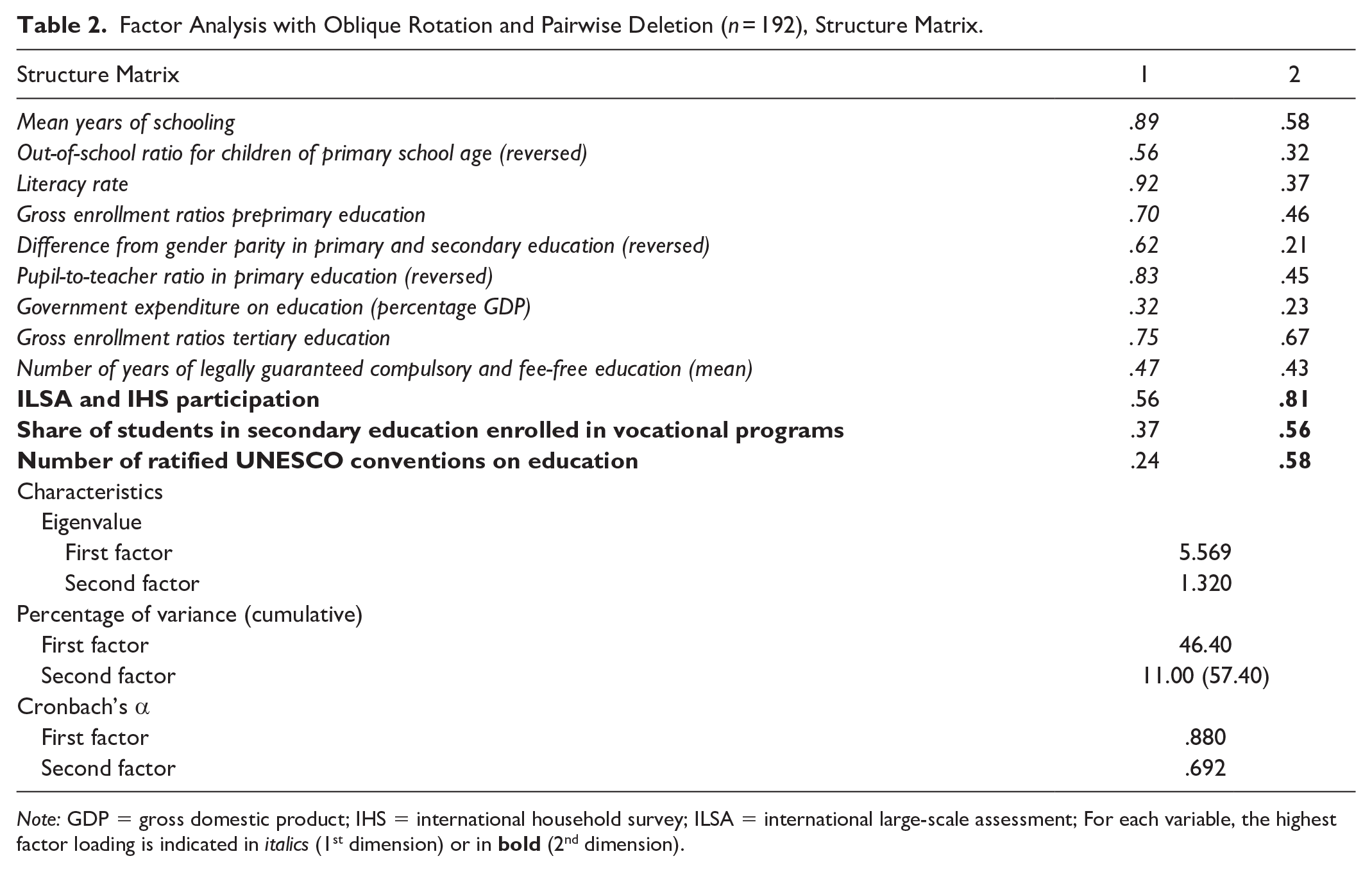
Note: GDP = gross domestic product; IHS = international household survey; ILSA = international large-scale assessment; For each variable, the highest factor loading is indicated in italics (1st dimension) or in
Next, as both dimensions are theoretically relevant, we constructed two scales, namely, the “institutionalization of schooling” and “school-based allocation” indices, by calculating factor scores for both subdimensions (see Tables A2 and A3 in the Supplementary Materials). Because we wanted to provide two scales that measure clearly distinct aspects of schooling, we excluded those indicators that had high cross-loadings (i.e., a difference in factor loadings of less than 0.10 in the structure matrix, which was the case for the enrollment ratios in tertiary education, government expenditures on education, and the number of years of legally guaranteed compulsory and fee-free education for the first dimension) from the construction of the indices. Figure 1 displays their linear (left) and quadratic (right) relationship. A regression analysis showed a strong positive and significant linear (β = 0.89, p < .001) and quadratic (β = 0.50, p < .001) association, in which the relationship between both dimensions became stronger as their scores increased. This suggests that the historical institutionalization of schooling goes hand in hand with school-based allocation, but that especially in countries that have fewer characteristics of a schooled society, both dimensions are more loosely related.

Association between the “institutionalization of schooling” and “school-based allocation” (r = .530, p < .001, n = 188).
When plotting this relationship by region in Figure 2, we found differences in the extent to which both dimensions were associated. The positive association was strongest in regions such as East Asia and Southeast Asia, Oceania, and Europe and North America. The weakest association was found in Latin America and the Caribbean and sub-Saharan Africa. It is unclear whether these regional differences are due to their historical context or because of the average regional scores on both dimensions (reflected by the quadratic nature of the relationship).

Linear association between the “institutionalization of schooling” and “school-based allocation” (n = 188) by United Nations regional classification.
To analyze the relationship between the two dimensions in more detail, we divided both scales in deciles and plotted them on a global map in Figure 3. Predominantly Western European countries scored high on both scales (e.g., the Netherlands, Norway, but also Australia). Several countries scored highly on the “institutionalization of schooling” dimension but belonged to the median or lower categories regarding school-based allocation (e.g., Belarus, Georgia, Iceland, Singapore). 1 Finally, some (mainly sub-Saharan African) countries scored higher on the school-based allocation index than on the institutionalization of schooling (e.g., Senegal, South Africa, but also, for instance, Bolivia, Indonesia, and Turkey).

Global maps of the indicators of the “institutionalization of schooling” (top) and “school-based allocation” (down).
The Schooled Society Index
Subsequently, as all indicators loaded positively on the first dimension in the previous factor analysis, the eigenvalue of this first factor was almost four times higher than that of the second, and we wanted to capture variation in the extent to which countries’ empirical reality corresponds with the “ideal type” of the global schooled society model (in which all country-level indicators should score highly), we reestimated the factor analysis but constrained the number of factors to one. Given that the number of ratified UNESCO conventions on education had a factor loading of less than 0.30 (see Tabachnick and Fidell 2007) on the first dimension (see Table 2), we excluded it from the factor analysis. 2
Table 3 displays the results. The indicators that strongly reflected “school-based allocation” loaded somewhat less strongly on this single dimension, except for ILSA participation, while indicators measuring the historical “institutionalization of schooling” displayed high factor loadings. As we still wanted to grant each indicator a similar weight (to construct an empirical measure for the theoretical model), and Cronbach’s α (0.88) showed high internal consistency, we finally constructed a summation scale that reflects cross-national variation in the centrality of schooling: the Schooled Society Index version 1.3 (score range = 0–100, n = 185, M = 59.80, SD = 23.41).
Factor Analysis, Number of Factors Held to One (n = 192).

Figure 4 displays the global distribution of the schooled society index, distributed across deciles. Unsurprisingly, countries in (North-)Western Europe belong to the highest category of the Schooled Society Index, as the origins of mass schooling are situated in this region. Especially in states such as the European Nordic countries (M = 95.68), the Netherlands (M = 100.00), and the United Kingdom (M = 93.42), the schooled society model is strongly institutionalized. At the same time, schooling is also central in several previously communist nation-states, such as Poland (M = 88.71) and Slovenia (M = 95.38). Other countries belonging to the highest categories of the Schooled Society Index are the United States (M = 88.85), Australia (M = 93.43) and New Zealand (M = 89.47), as well as South American countries Bolivia (M = 87.80) and Chile (M = 85.61). Countries placed in somewhat lower categories are found in almost each world region, such as Romania (M = 78.41) and Albania (M = 64.59) in Europe, Tunisia (M = 60.74) in North Africa, South Africa (M = 61.55) in sub-Saharan Africa, Mongolia (M = 73.61) in Central Asia, Indonesia (M = 67.51) in Southeast Asia, and Argentina (M = 78.55) in Latin America. Finally, countries where schooling holds less of a central position are mostly found in northern Africa and western Asia (e.g., Algeria, M = 45.66; Yemen, M = 28.18), sub-Saharan Africa (e.g., Mali, M = 15.01; Zimbabwe, M = 39.76; Niger, M = 0.00), as well as the southern parts of Asia (e.g., Pakistan, M = 34.94; Myanmar, M = 37.09). Finally, we stress that even when analyzing cross-national differences in the extent to which schooling has become institutionalized, global similarities were striking. Most countries adopted compulsory and tuition-free education laws within their legal framework, and then differed in the number of years they provide. Government expenditures on education (percentage GDP) were only in four countries below 1 percent, the rest of the world’s nation-states substantively financing their education system. Moreover, only 10 percent of the countries did not adopt a vocational education track. Our results therefore confirm that nation-states worldwide tend to adopt a global model of schooling (as a fundamental institution). In the next section, we investigate the associations of the schooled society with other country-level characteristics.

Global map of the Schooled Society Index.
The Schooled Society Correlates
In the final step of the analysis, we assess how other contextual indicators are associated with the institutionalization of schooling, school-based allocation, and the Schooled Society Index. First, the upper part of Table 4 displays the correlations between our indicators for the schooled society and the classic proxy for the institutionalization of schooling, namely, the share of higher educated per country. Globally, we found a strong positive correlation between the two indicators, although this was less high than expected (r = 0.70, p < .001). The position of countries on these indicators (see OSF for a full list) reveals (1) a set of countries that scores very high on the share of higher educated indicator but belongs to a somewhat lower category of the Schooled Society Index. Several ex-Soviet countries, such as Kazakhstan (73.0 percent higher educated against a score of 73.9 on the Schooled Society Index) and Armenia (43.3 percent against 61.94), as well as countries such as Singapore (48.1 percent against 68.40) and the United Arab Emirates (52.5 percent against 74.87) belong to this category. Moreover, (2) countries that belong to the highest category of the Schooled Society Index do not always contain the highest shares of higher educated (e.g., Germany, 25.7 percent against 93.20). 3 Figure 5 displays the relation between the Schooled Society Index and the share of higher educated by region. The strength of the relationship varies across regions. In three regions, the correlation is notably weaker: sub-Saharan Africa (r = 0.20), Latin America and the Caribbean (r = 0.30), and Europe and North America (r = 0.25). Especially in these regions, it might therefore be fruitful to distinguish between the composite measure of schooled society and the massification of tertiary schooling as such. Finally, we found a similar relationship between the institutionalization of schooling and the share of higher educated (r = 0.68), and a somewhat lower association with school-based allocation (r = 0.56).
Country-Level Correlations with the Schooled Society Index.
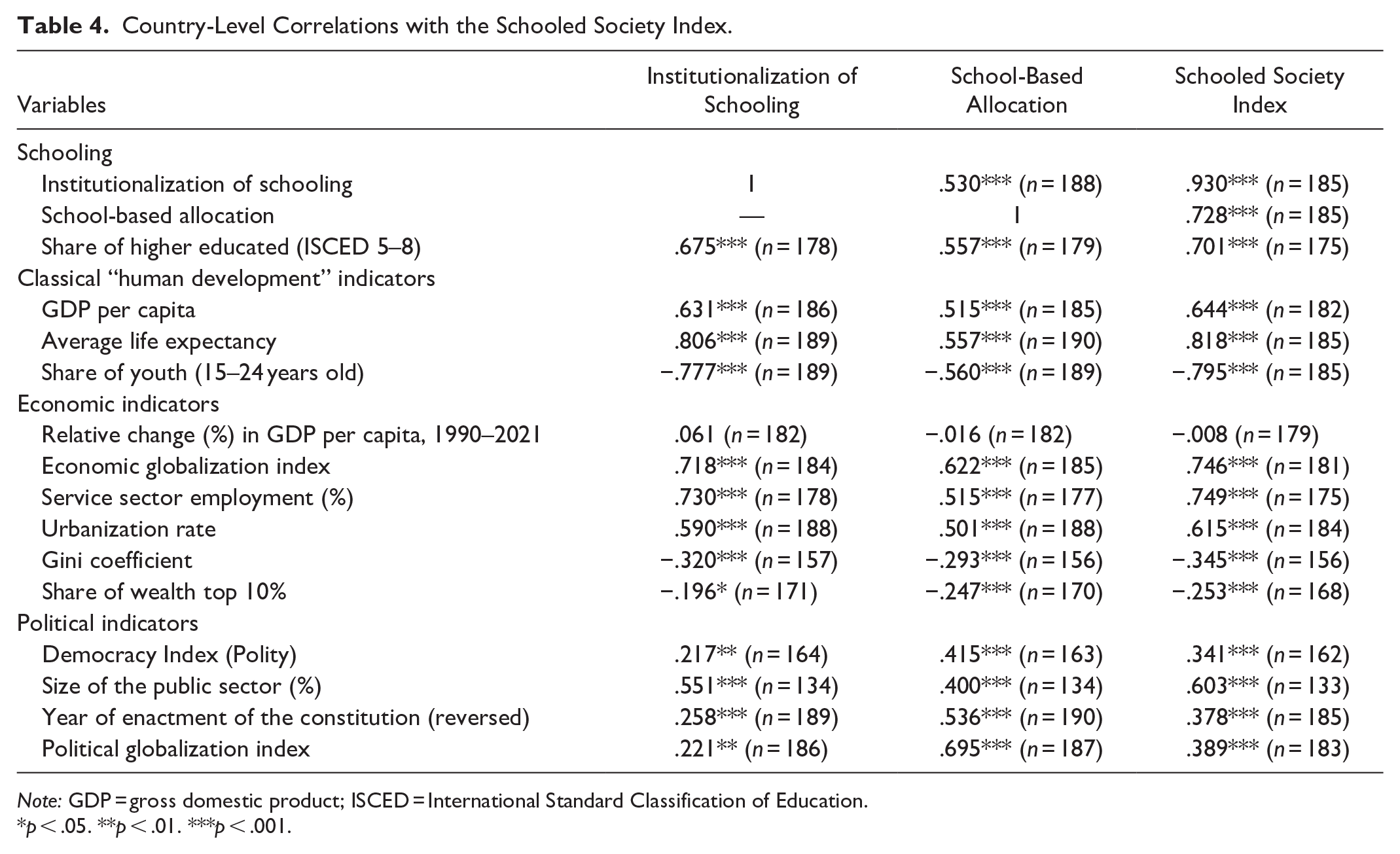
Note: GDP = gross domestic product; ISCED = International Standard Classification of Education.
p < .05. **p < .01. ***p < .001.
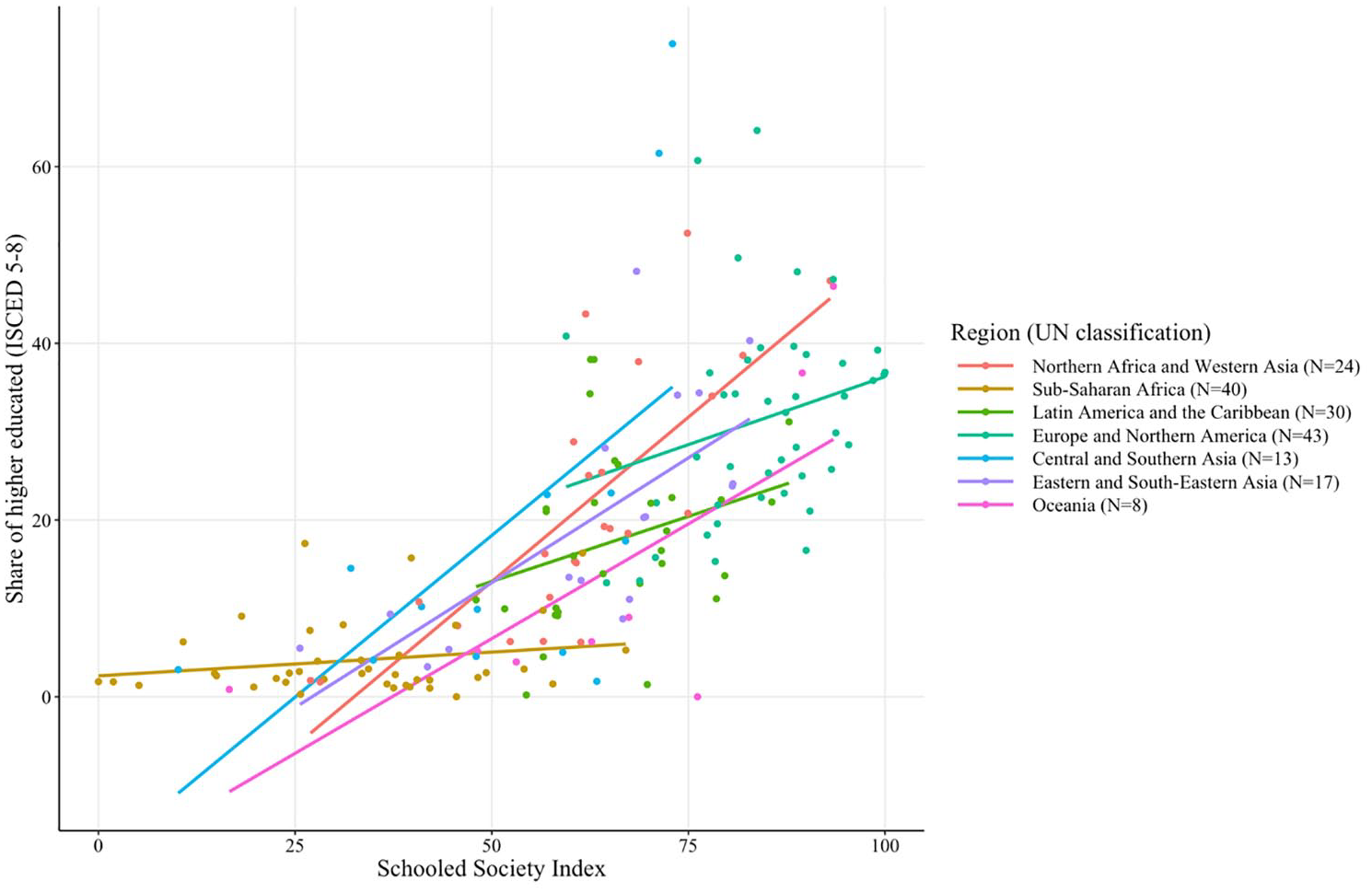
Linear association between the Schooled Society Index and the share of higher educated (International Standard Classification of Education [ISCED] 5–8) per country, by United Nations regional classification.
Second, how are country-level variables that are often linked to the “general development” of a country related to the development of schooled society and its subdimensions, as well as other institutional factors? This is important, as (1) the institutionalization of schooled societies does not take place in a vacuum, unrelated to other trends and (2) it has been difficult to construct composite indicators (e.g., the human development index) that capture and provide insight into something other than countries’ economic capital (measured in terms of GDP or gross national product; cf. McGillivray 1991). Therefore, we calculated the correlations between the Schooled Society Index and classic development indicators such as GDP per capita, the average life expectancy and the share of youth (15- to 24-year-olds) in a country, and other relevant indicators that capture the economic (e.g., Gini coefficient, share of service sector employment), and political configuration in a country (e.g., age of the nation-state, 4 political globalization, political regime). A full description of these indicators can be found in Table A4 in the Supplementary Materials. Table 4 provides an overview of the correlations (see Tables A5a and A5b in the Supplementary Materials for the full correlation table). The global correlations between the Schooled Society Index and the other variables outline that the schooled society model is associated with a higher national economic capital (r = .64) and average life expectancy (r = .82) and a less youthful population (r = −.80). Given that country-level correlations tend to be quite high, we feel that the association between the Schooled Society Index and GDP per capita is not so strong that we can argue that they essentially measure a common trend, especially as the Schooled Society Index is not associated with the relative change in a country’s GDP per capita between 1990 and 2021 (r = −.01), and this correlation is quite low in both Latin America and the Caribbean (r = .15) and Europe and North America (r = .19; see Table A9 in the Supplementary Materials). These results also confirm that the institutionalization of schooled society is very strongly associated with a demographic transition from societies with a high birth and mortality rates to societies with lower birth and mortality rates.
Regarding the economic indicators, we found that schooled societies are more urbanized (r = .62) and economically globalized (r = .75), that the structure of their labor markets is dominated by the service sector (r = .75), and that they know somewhat less economic inequality (although this is true only for the regions Europe and North America and Oceania: see Tables A6–A12 in the Supplementary Materials). We also found moderate positive associations between the Schooled Society Index and the age of the nation-state (r = 0.38), the Polity Democracy Index (r = .34) and the degree of political globalization of a country (r = .39), and a strong relationship with the expansion of the public sector (r = .60). These factors also vary by region, with associations being quite stronger in Europe and North America (see Tables A6–A12). 5
Regarding the two subscales of the schooled society, we found that, on the one hand, the institutionalization of schooling scale largely followed the same patterns as the Schooled Society Index, although it was less strongly associated with political indicators such as the year of enactment of the constitution and political globalization index. On the other hand, the school-based allocation scale was more strongly associated with democratization (r = .42), age of the nation-state (r = .54) and political globalization (r = .70). This shows that although both trends are clearly subdimensions of a common global phenomenon, they constitute markedly different aspects of it that are likely to produce effects in their own right. Indeed, the (historical) institutionalization of the school system and its ideological aspects is more strongly related to cross-national variation in economic indicators such as economic wealth, economic globalization and the expansion of the service sector, while the extent to which a country adopts an inherently global framework reflecting the belief in schooling as a basis for societal stratification is more closely linked to political indicators.
Conclusion and Discussion
In this article, we presented the construction and examination of the Schooled Society Index, an indicator that maps cross-national variation in the centrality of schooling in the contemporary world. Building on previous work (Kavadias et al. 2024), we first constructed a comparative dataset on the basis of cross-national administrative and expert indicators. Next, we conducted factor analyses in order to empirically identify the associations between these variables. We identified two “subdimensions” of schooled society, namely, (1) the “institutionalization of schooling,” which tapped into a combination of the historical expansion and cultural belief in schooling, and (2) “school-based allocation,” which reflected the legalization of the selection of people on the basis of an (internationally) standardized framework of school credentials. We found that these scales measure distinctive subdimensions of the institutionalization of schooling and can be employed as such. Finally, as the relationships between the indicators strongly pointed toward the existence of a globally homogeneous model of schooling as an institution, we combined our indicators into a single scale, namely, the Schooled Society Index, and analyzed its relationship with other country-level indicators. Importantly, this comprehensive scale not only captured the massification of (tertiary) schooling (e.g., the share of higher educated), offering a multidimensional measure for the centrality of schooling in a country (by including measures of its cultural and structural aspects as well) and illustrating empirically “that educational expansion was but the tip of the iceberg” (Ramirez 2003:242). We also found that the Schooled Society Index correlated positively with a series of classical economic (e.g., GDP per capita), demographic (e.g., average life expectancy) and political indicators (e.g., democratization).
The construction of the Schooled Society Index engages with and contributes to the literature in two main ways. First and foremost, by creating a composite index that quantifies cross-national variation in the centrality of schooling as a global institution, we offer an empirical tool to assess its primacy and influence in societies in the contemporary world. As such, and just as the development of other and often studied country-level indicators (such as GDP per capita, the Gini coefficient, democracy indices) have done, this index creates an incentive to consider schooling in cross-national survey research more often as an institution that significantly affects societies in its own right, rather than seeing its role as being functional on other institutions (e.g., the market economy, democratization) or as resulting from the attributes of individuals (e.g., the interpretation of the effect of educational attainment as the result of individual characteristics). As (1) research into general (and global) sociological trends should systematically consider the primary and formative role of schooling and (2) the strength of the association between the Schooled Society Index and other central country-level characteristics (e.g., economic wealth and inequality, the level of democratization) shows that they reflect empirically distinguishable forces, a series of concrete research questions can be addressed on the basis of the availability of an empirical measure of schooled society. For instance, how are cross-national differences in the development of schooled society associated with cultural (e.g., beliefs about individual agency, citizenship, legitimacy), structural (e.g., education-based differences in economic capital, political behavior and attitudes, social status) and institutional (e.g., the societal position and legitimacy of institutions such as religion, the nation-state, the labor market) differences?
Second, this index should give rise to a systematic empirical identification of the multiple aspects of schooled society and an examination of their interrelations. To what extent are these aspects universally diffused, institutionalized in different world regions, or adopted by specific nation-states? Do countries differ in the way they engage with them (see Anderson-Levitt 2003; Baker and LeTendre 2005)? Although our results largely confirmed the proposition of schooling as being an inherently global and worldwide homogeneous institution (e.g., Meyer et al. 1992; Schofer and Meyer 2005), we also found regional differences in the extent to which its subdimensions were related. This indicates that the aspects of schooled society “fit” more tightly in some (groups of) countries than in others. Moreover, we found that indicators closely related to the ideological commitment of nation-states to schooling (e.g., government expenditures, compulsory and tuition-free schooling laws) seemed globally diffused, while other indicators varied to a greater extent across nations, typically variables closely related to the historical length of development of schooling, such as the mean years of schooling. Such findings should be integrated in a larger theory of schooling (see Baker 2014).
Providing an open-source dataset and index helps develop a research agenda through which our cross-national dataset and indicators on schooling will be systematically complemented and improved, and in which additional indices can be constructed. More data and variables can be integrated, the Schooled Society Index updated, and specific aspects regarding the centrality of schooling and its impact on social phenomena operationalized and analyzed. For example, what are the differences between the “institutionalization of schooling” and “school-based allocation” subdimensions regarding their impact on other societal institutions? For instance, in this regard, we found that the institutionalization of schooling is more strongly associated with differences in economic globalization, while the centrality of school-based allocational rules is more tightly connected to political globalization.
In light of such a research agenda, this study contains several limitations that provide the starting point for future studies. First, in this study we worked with available indicators. Working with these also showed that to further improve the Schooled Society Index, new indicators should be developed. For example, for certain indicators, more than one source had to be used to complete missing data. Although comparable to a great extent, there is room for improvement here, certainly as missing values are systematically related to the centrality of schooling in a country. 6 Moreover, even if supranational organizations such as UNESCO provide highly standardized and thoroughly collected statistics, a margin of error likely remains in terms of their comparability, for instance, because of differences in the classifications made by national statistical offices or ministries of education (e.g., the International Standard Classification of Education five level is employed by some countries, whereas it exists only marginally in others). Thus, our country-level indicators can be sharpened by systematic analyses.
Second, additional variables should be added to the Schooled Society Index. Although our index gauges the centrality of schooling in a nation-state and reflects a hegemonic acceptance of the necessity and functionality of the institution, it tells us little about the substance of this latter belief. Although variables such as the gender parity in enrollment ratios and the instalment of a legal framework on universal basic schooling certainly form indicators of, for instance, the belief in schooling for all, they remain proxies. More direct indicators could reflect the belief in schooling as a fundamental right (and even duty), a solution to an increasing range of societal problems and driver of development, or even as a country’s investment in “society” itself or in individuals (as a basis of human capital; see Labaree 1997). Such data might also indicate national differences or temporal changes in the aims and methods of and curriculum in schooling (Amadio et al. 2005; Benavot et al. 1991; De Keere and Spruyt 2019; Fiala 2007; Fiala and Lanford 1987; Labaree 1997; Lerch 2023). Furthermore, other indicators could be constructed that are more closely related to the specific structure of the school system (e.g., tracking).
Third, the Schooled Society Index is a cross-sectional indicator that does not provide long-term information. Although it is a multidimensional index that can be used to thoroughly assess national differences in the centrality of a global institution (cf. Baker and LeTendre 2005), thus lending itself to cross-national research in which more strongly schooled societies can be compared with less schooled societies (see Kavadias et al. 2024), in its current form it does not reflect developments therein and therefore cannot be used in comparative longitudinal research. As we argue that schooling has a direct and primary impact on society, future endeavors should be made to construct a longitudinal indicator of the schooled society (our analyses indicate that indicators such as the mean years of schooling might be good starting points for developing such an indicator). This way, we can empirically measure the development of schooled society over time and assess its impact on other institutions, (the relations between) social groups, and individuals over time. Theoretically, this would also imply that the worldwide increase in the centrality of schooling should not be considered deterministic, linear or irreversible (see Anderson-Levitt 2003; Bromley et al. 2023; Schofer, Lerch, and Meyer 2022), leaving room for inconsistency, conflicts over models of schooling, and change. Thus, continuously and systematically improving and supplementing the Schooled Society Index will advance our empirical and theoretical understanding of schooling in the contemporary world, an invisible yet ubiquitous, central and global institution.
Supplemental Material
sj-docx-1-srd-10.1177_23780231251338676 – Supplemental material for The Schooled Society Index: Measuring the Centrality of Schooling in the Twenty-First Century from a Global Perspective
Supplemental material, sj-docx-1-srd-10.1177_23780231251338676 for The Schooled Society Index: Measuring the Centrality of Schooling in the Twenty-First Century from a Global Perspective by Leandros Kavadias, Bram Spruyt and Toon Kuppens in Socius
Footnotes
Funding
The author(s) disclosed receipt of the following financial support for the research, authorship, and/or publication of this article: Funding from the Research Foundation – Flanders (FWO). Grant number: 11H8922N.

Supplemental Material
Supplemental material for this article is available online.
Notes
Author Biographies
References
Supplementary Material
Please find the following supplemental material available below.
For Open Access articles published under a Creative Commons License, all supplemental material carries the same license as the article it is associated with.
For non-Open Access articles published, all supplemental material carries a non-exclusive license, and permission requests for re-use of supplemental material or any part of supplemental material shall be sent directly to the copyright owner as specified in the copyright notice associated with the article.
