




Abstract
This data visualization illustrates trends in income inequality within and across different contexts in Germany from 2010 to 2022. The authors examine four key contexts in which income inequalities predominantly arise: (1) the national level, (2) the industry level, (3) the occupational level, and (4) the firm level. Using large-scale official data on employee incomes in Germany, the authors compute contextual income inequalities and assess the impact of part-time work by calculating inequalities on the basis of both gross monthly and gross hourly incomes. The findings reveal considerable variation in income inequality across these contexts, with inequality consistently highest at the national level and progressively lower at the industry, occupation, and firm levels. Despite these differences, overall inequality trends remained relatively stable across contexts and income measures. These results have implications for the broader sociological framework on inequality, as they suggest that in Germany, within-firm inequality is not the primary driver of macro-level income inequality. Consequently, efforts to reduce overall income inequality should extend beyond the firm level and also address income disparities at the occupational and industry levels.
Many scholars argue that the rise in income inequality in recent decades is due to shifts in wage setting in specific institutional contexts. In Germany, minimum wages are set at the national level (Dütsch, Ohlert, and Baumann 2025), while many collective agreements are negotiated at the industry level (Jäger, Noy, and Schoefer 2022). Occupational structures shape income distributions through different closure potentials (Giesecke, Groß, and Stuth 2020), and firms increasingly set wages through individualized negotiations (Sauer et al. 2021). Consequently, employees experience income inequality at multiple contextual levels (Tomaskovic-Devey and Avent-Holt 2019). Beyond that, about one third of all employees in Germany work part-time, which is another important driver of income inequality (Biewen, Fitzenberger, and de Lazzer 2018). Nevertheless, income inequality is usually reported only for monthly incomes and only at the national level.
To address this, we used representative data from the German Structure of Earnings Survey (2010, 2014, and 2018) and its successor, the Earnings Survey (2022), which each cover more than 1 million employees in about 800 industries, 1,000 occupations, and 30,000 firms. 1 We calculated income inequality for each industry, occupation, and firm for each year and plotted the averages in Figure 1 to investigate how contextual income inequalities evolved and compared with macro-level inequality. To examine the role of part-time employment in shaping income inequality, we computed inequalities separately for gross monthly incomes (Figure 1A) and gross hourly incomes (Figure 1B). The lower panels (Figures A2 and B2) show the percentage changes in average income inequalities compared with the previous period, making differences in the rate of change between levels more explicit.
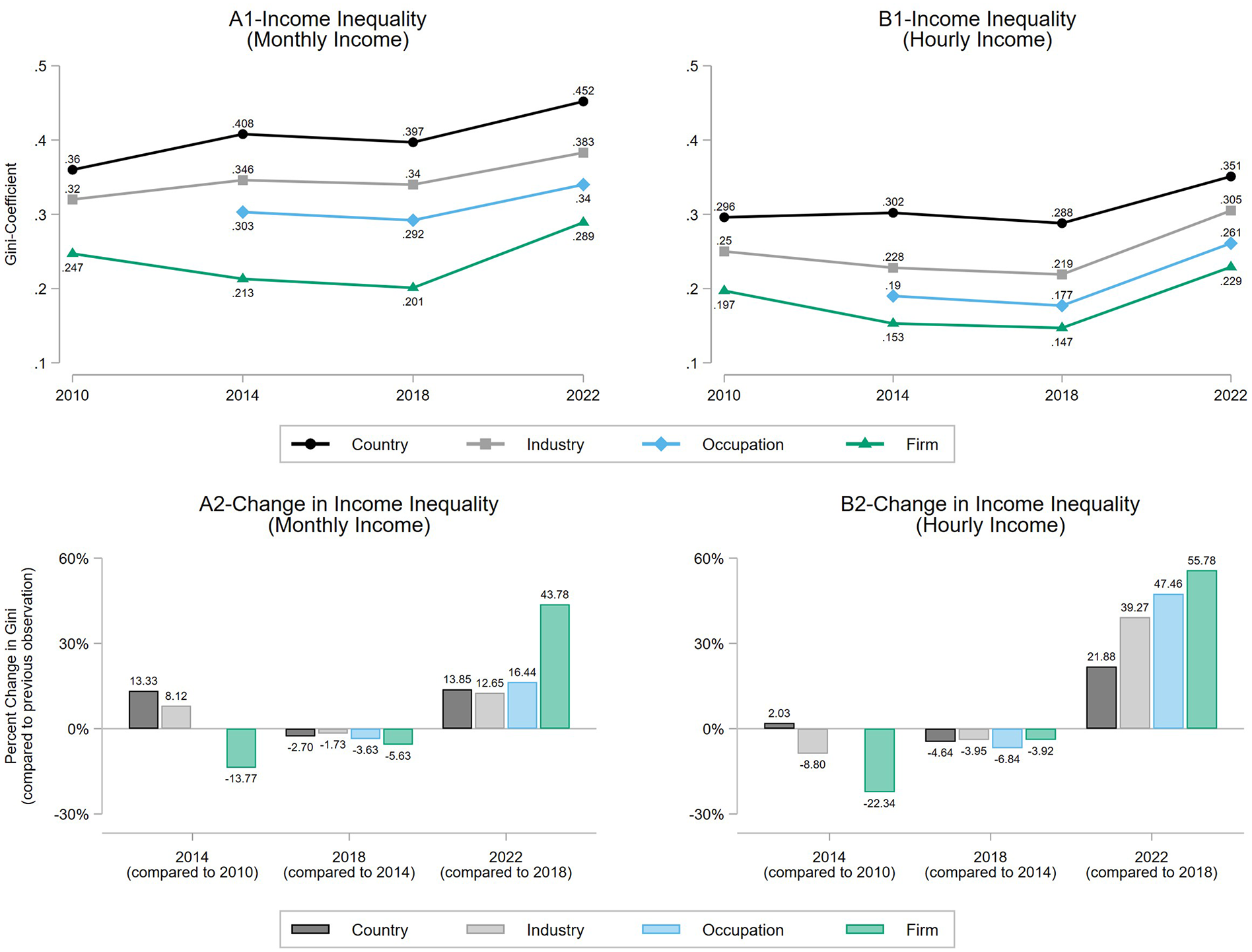
Contextual income inequality dynamics in Germany from 2010 to 2022.
Figure 1 reveals three main findings. First, average income inequality is consistently highest at the national level and progressively lower at the industry, occupation, and firm levels. This suggests that as the unit of analysis narrows, income distributions become increasingly homogeneous.
Second, income inequality is significantly higher when calculated using gross monthly incomes than when using gross hourly incomes. This indicates that variations in working hours and employment contracts (e.g., full-time vs. part-time or marginal employment) contribute substantially to overall income inequality. However, the overall trends in Figures A1 and B1 remain largely similar across all four contexts and time periods, suggesting that labor market participation rates did not significantly alter the broader inequality trajectory.
Third, income inequality remained relatively stable between 2010 and 2018. Although the trend between 2010 and 2014 lacks a clear pattern, inequality declined in all contexts between 2014 and 2018. The introduction of a federal minimum wage in 2015 may have played a role in this decline. However, despite a minimum wage increase in 2019, income inequality surged dramatically across all contexts between 2018 and 2022. This increase was particularly pronounced at the firm level, where average hourly income inequality rose by about 55 percent (from 0.147 to 0.229). Although the exact timing of this increase is unclear, we speculate that it reflects a substantial coronavirus disease 2019 (COVID-19) effect, likely due to workforce segments’ experiencing employment restrictions during the peak of the pandemic.
Looking ahead, future releases of the Earnings Survey will enable us to determine whether the sharp increase in income inequality in 2022 was a temporary COVID-19-induced disruption or the beginning of a more persistent trend in contextual income inequalities. Moreover, our results on variations in income inequality across different levels have important implications for broader sociological frameworks on inequality and stratification. In particular, our findings suggest that in Germany within-firm inequality is not the primary driver of macro-level income inequality. Therefore, efforts to reduce overall income inequality should extend beyond the firm level and also address income disparities at the occupational and industry levels. Although this study has shown that income inequality varies across different contexts, it remains unclear whether individuals perceive these differences. Future research should therefore explore whether and how different forms of contextual income inequality influence individual attitudes and behaviors.
Supplemental Material
sj-docx-1-srd-10.1177_23780231251331402 – Supplemental material for Tracing Income Inequality Trends in Germany from 2010 to 2022: Dynamics across Industries, Occupations, and Firms
Supplemental material, sj-docx-1-srd-10.1177_23780231251331402 for Tracing Income Inequality Trends in Germany from 2010 to 2022: Dynamics across Industries, Occupations, and Firms by Peter Valet, Patricia Böger and Jonas Lübker in Socius
Footnotes
Funding
The author(s) disclosed receipt of the following financial support for the research, authorship, and/or publication of this article: This research is part of the project Contextual Income Inequality and Life Satisfaction: Mechanisms and Moderators, funded by the German Research Foundation (grant 533150713).

Supplemental Material
Supplemental material for this article is available online.
Notes
Author Biographies
References
Supplementary Material
Please find the following supplemental material available below.
For Open Access articles published under a Creative Commons License, all supplemental material carries the same license as the article it is associated with.
For non-Open Access articles published, all supplemental material carries a non-exclusive license, and permission requests for re-use of supplemental material or any part of supplemental material shall be sent directly to the copyright owner as specified in the copyright notice associated with the article.
