




Abstract
The United States is undergoing a remarkable religious transformation: in just a few decades, the proportion of religious “nones” surged from 1 in 20 to more than 1 in 4. Through four waves of National Study of Youth and Religion surveys and in-depth interviews (2003–2013) linked with administrative data, this study follows a cohort of adolescents coming of age during the rapid rise of the “nones” and shifting social values, including growing support for same-sex marriage. When young people perceive religious institutions as stifling self-actualization, marginalizing sexual minorities, constraining women, or demonstrating hypocrisy, they experience conflict between their religious commitments and deeply held values related to concern for others and the sacredness of the individual. Many manage this conflict by disengaging from religious institutions while reimagining spirituality on their own terms. The findings reveal individuals breaking free from modernity’s iron cage of bureaucratization and rationalization, seeking self-actualization and a more authentic connection to others and to the sacred. The authors propose that these trends represent the individualization of American religion, a transformation that illuminates how personal quests for authenticity can fundamentally reshape the religious landscape.
Every day people are straying away from the church and going back to God.
If the concept of God has any validity or any use, it can only be to make us larger, freer, and more loving. If God cannot do this, then it is time we got rid of Him.
Americans are losing their religion. The proportion of religious “nones” has risen from 1 in 20 to more than 1 in 4 in just a few decades. This transformation coincides with broader societal shifts, including rapidly changing views toward same-sex marriage and other issues related to personal autonomy (Hout and Fischer 2014; Schnabel and Sevell 2017). We argue that these parallel changes, and the politicization of religion in response to rising support for personal autonomy and deinstitutionalization of society (Hout 2017a; Hout and Fischer 2002; Putnam 2000), provide a context for considering religious change in relation to broader social change.
In this study we examine how young adults navigate tensions between institutional religion and personal authenticity among a cohort coming of age during the rise of the “nones.” We follow individuals born in the late 1980s from adolescence through early adulthood using longitudinal surveys (4,566 observations from 1,348 individuals), in-depth interviews (183 interviews with 54 respondents), and administrative records. 1 This mixed-methods approach reveals patterns of institutional disengagement alongside the meaning-making processes underlying them.
Our analysis shows how young people are responding to the bureaucratization and rationalization that Weber predicted would create an “iron cage” in modern institutions, developing new forms of religious and spiritual expression outside formal institutions. Scholars have traced religious transformation through various theoretical frameworks, for example, “popularization,” “privatization,” “believing without belonging,” and the “spiritual turn” (Davie 2015; Heelas and Woodhead 2005; Knoblauch 2008; Watts 2022b). Building on these perspectives and theories of individualism, religious privatization, and political backlash (Bellah et al. 1985; Hout and Fischer 2014; Roof 1993), we develop a theoretical framework that synthesizes these approaches and links religious change to broader social change.
Drawing on Roof’s (1993) concept of a “spiritual marketplace” and Yang’s (2012) analysis of religious innovation under constraint in China, we identify a theoretical parallel: institutional religion’s rigidity and politicization in the United States generates dynamics of spiritual innovation that in some ways parallel state suppression of religion in Communist China. In both contexts, institutional constraints, whether imposed by state power or religious organizations themselves, prompt individuals to develop alternative spiritual practices outside formal structures. The key distinction lies in the source of constraint: state suppression in China versus institutional choices amid cultural change in America. Research has frequently conceptualized religious markets in terms of competition between formal organizations (e.g., denominations), but we suggest the contemporary religious, and spiritual, marketplace includes options beyond formal organizations. We propose individualization, a term more often applied to broader social change than to religious change (e.g., Beck and Beck-Gernsheim 2002), as a unifying perspective that explains both institutional disaffiliation and spiritual innovation.
Although our evidence comes from a specific cohort navigating religious choices during one historical moment, we use these findings to develop broader theoretical insights about religious change. The discussion builds on these empirical patterns to set forth a dialectical framework that suggests the current turn toward personal, syncretic forms of faith reflects responses to the rationalization (Nongbri 2013; Smith 1963) and politicization (Braunstein 2022; Hout and Fischer 2014) of institutional religion. By using empirical findings as a foundation for theory building, we connect contemporary patterns to broader cycles of religious and social change. The patterns we uncover challenge conventional assumptions about religious change: rather than only becoming secular or treating faith less seriously, many young adults are developing new ways of engaging with the sacred outside formal institutions. This transformation echoes historical cycles of religious change, where periods of institutional dominance give way to more personalized and experiential approaches to faith.
Breaking Free of the Iron Cage: Individuals over Institutions
In their classic article, DiMaggio and Powell (1983) drew on Weber’s ([1905] 1930) Protestant Ethic to make an argument about how rationalization, bureaucratization, and institutionalization can act as an “iron cage.” According to Weber, the rationalist spirit had achieved a momentum of its own under capitalism, creating a bureaucratic order that could imprison humanity indefinitely absent revolution against it. Although Weber predicted that this rationalism would contribute to religious decline through disenchantment, religion instead adapted, developing its own forms of systematization and rationalization.
We bring the iron cage argument back to religion, making the case that rising individualization and autonomy reflected in the 1960s countercultural movement set the stage for a revolution against the bureaucratization and politicization of religion. Building on Bellah et al.’s (1985) insights about American individualism and Roof’s (1993) analysis of spiritual seeking, we examine how this process unfolds as young adults find their place in the world. The religious marketplace has expanded beyond competing denominations to include options outside formal institutions altogether, from personalized spirituality to individually crafted approaches to faith and meaning. People are breaking free not with bolt cutters but with deeply personal acts of spiritual rebellion, rejecting the rationalized, systematized, and institutionalized religious constructs of modernity in favor of more dynamic, diverse, and syncretic expressions (Asad 1993; Masuzawa 2005; Smith 1963).
The Sacredness of the Individual
In Democracy in America, de Tocqueville ([1835] 2000) described key features of American life, terming some aspects of it “individualism,” highlighting the tension between individual liberty and community engagement—and suggesting individualism could lead to the decline of institutions. We argue that changes in religion reflect a broader shift in the social fabric, rooted in the sense of the sacredness of the individual arising in response to bureaucratization and the fragmentation, polarization, and decline of some traditional institutions including religion. Like Hirschman’s (1982) observation that societies swing between public and private spheres as each reveals its limitations, we find disillusionment with bureaucratized religion propelling a shift toward individualized faith. We suggest that politicization and fragmentation accelerated deinstitutionalization, especially in the realm of religion, as the sacredness of the individual took precedence over loyalty to institutions.
The rise of individual autonomy as a central value has deep roots in the historically Christian West, illustrated in the Protestant Reformation, the Enlightenment, and the American, French, and industrial revolutions (Watts 2022b). As modern institutions took shape, Weber predicted the rise of a rational and scientific bureaucracy and Durkheim the rise of a systematic and scientific cult of the individual. Following the supposed “disenchantment” of the world, both expected the end of religion as it was known within a few generations. Yet neither fully anticipated how individuals might craft new relationships with the sacred. Whereas Weber thought an iron cage of bureaucracy would arise, Durkheim believed that as societies grew more complex and industrialized, traditional forms of social solidarity, such as religion and community, would be replaced by individualism. Nevertheless, Durkheim held that the sacred dimensions of life are perennial, and predicted a “cult of the individual” would emerge and replace traditional forms of religion (Carls 2019). Although he envisioned this taking a rational and systematic form, we propose something different: the rise of a more enchanted cult of the self-expressive individual.
With the benefit of hindsight, we can see a move toward rationalizing bureaucratization occurred first, followed by an individualizing response to bureaucratization. Trends of bureaucratization, systematization, and rationalization in the United States seemed unstoppable in the 1950s, with a strong national establishment and flourishing institutions. Instead of fading into irrelevance, religion itself systematized and bureaucratized, with institutionalized high-church Christianity predominating (O’Dea and Yinger 1961; Smith 1963). The postwar period arguably saw American religion reach peak bureaucratization, with flourishing institutions and a strong religious establishment.
The tension between individual liberty and institutional authority that de Tocqueville identified intensified. An ethos of expressive individualization emerged, emphasizing self-actualization and civil rights, as the conformist climate of the post–World War II era gave way to greater personal freedoms (Watts 2022b). Many traditional institutions weakened and voluntary membership organizations declined while the rights of individuals took center stage, with civil society undergoing profound transformation (Putnam 2000). Religion was not exempt from broader deinstitutionalization, but not all of the initial shifts were away from participation in religion writ large. Instead, they signaled a move away from participation in more bureaucratic religion (e.g., mainline Protestantism), although some less formalized yet tightly knit and intense religious groups experienced an uptick and proved more resilient amid overall declines (Roof and McKinney 1987; Schnabel and Bock 2017).
As individualization gained momentum, some religious institutions doubled down on institutional authority, viewing personal autonomy, especially around gender and sexuality, as threatening to traditional order (Bock 2021; Hout 2021). Ironically, this reaction was perhaps strongest among evangelicals and Pentecostals, who had embraced aspects of deinstitutionalization even as they rejected the ethos of self-actualization. Religious factions (primarily “low-church” sectarians) that had previously steered clear of politics became focused on political advocacy against rising gender and sexual liberation (Braunstein 2022; Braunstein and Taylor 2017). The emergent Christian Right risked alienating proponents of self-actualization who prioritized the sacredness of the individual, sparking a counter-reaction and spurring a mass exodus from organized religion among new generations, who increasingly saw these institutions as impediments to, rather than vehicles for, authentic spiritual expression.
2
Writing on the cusp of the rise of the nones, Bellah et al. (1985) aptly encapsulated the sense of the “sacredness of the individual” in Habits of the Heart: [Americans] believe in the dignity, indeed the sacredness of the individual. Anything that would violate our right to think for ourselves, judge for ourselves, make our own decisions, live our lives as we see fit, is not only morally wrong but sacrilegious. Our highest and noblest aspirations, not only for ourselves, but for those we care about, for our society and for the world, are closely linked to our individualism. (p. 142)
The cohort captured in our data was born into a world where sanctification of the individual had, in several respects, been realized at the same time that much organized religion sought to counter it. They came of age during a period of institutional upheaval, from the 2008 financial crisis that shook faith in traditional structures, to technological changes that transformed how people formed communities and identities, to cultural shifts reflected in Obama’s historic election. Social change accelerated: marriage and family norms shifted toward personal fulfillment, women’s rights, and the fostering of autonomy and personal development in childrearing (Cherlin 2004; Hout 2021). Support for same-sex marriage increased, eventually leading to constitutional recognition, while the number of religious nones simultaneously exploded (Hout 2017a).
Mainline Protestant denominations, despite their comparatively liberal social stances, declined dramatically, in part because of lower fertility rates and also because their bureaucratic structures and less emotive approach seemed at odds with authentic individual expression even as their leaders embraced more, though only somewhat more, progressive values (Schnabel 2024). Mainline Protestantism’s very attempt to modernize while maintaining bureaucratic structures highlighted the contradictions that younger generations increasingly rejected. The earlier decline of mainline denominations, despite ideologies that allowed more political flexibility (see Hollinger 2022), highlights how institutional structures themselves, not just conservative politics, can conflict with rising individualization.
Alongside the formality, stultification, and hierarchy of bureaucratization that can make religions feel more like an iron cage than a place to celebrate the individual, the perceived judgmentalism, inauthenticity, and hypocrisy of religious institutions created a cultural mismatch with emerging generations. Fraud in televangelism (Smith 1992), abuse of sexual minorities forced into conversion therapy (Lawson 1998), and institutional cover-up of sexual abuse (Böhm et al. 2014) contradicted the values of a generation raised on principles of mutual love and tolerance. This dissonance between personal morality and ethical failings of institutions created conditions for institutional exodus, particularly among young progressives who see religious organizations as incompatible with their deeply held values.
We argue that Americans are choosing individuals over institutions and people over politicization, prompting an exodus from organized religion. For many, personal experimentation and spiritualism supersede rational institutional authority (DiMaggio et al. 2023). This transformation creates both possibilities and perils. As Edin et al. (2019) demonstrated, the weakening of traditional institutional attachments can leave individuals without crucial support structures as they pursue authentic self-expression. The challenge becomes not just breaking free of institutional constraints, but crafting new forms of meaning and community that provide both autonomy and connection.
Individualization and the Life Course
Is what we are seeing in American society Durkheim’s predicted cult of the individual or something related but distinct? Distinguishing between individualism and individualization, we highlight the difference between Durkheim’s predicted cult of the individual and the more self-expressive version that emerged. In contrast to individualism, which can fragment society into isolated egos pursuing their own interests, individualization represents a journey toward authentic selfhood that paradoxically leads to deeper connection with others. Jung (1959) characterized individuation, which parallels individualization, as a spiritual transformation that transcends artificial divisions between self and other, where one discovers their unique place within the larger human experience. For Jung, true individuation dissolves rather than reinforces group boundaries and identities, enabling people to recognize their distinctiveness while embracing their fundamental interconnection. He related this integrative process to insights about unity and wholeness found at the core of many traditions, including Buddhism, Hinduism, Taoism, and Christianity.
This vision of discovering one’s authentic self through expanding rather than contracting circles of moral concern reflects the “golden rule”—valuing oneself and others, a principle central to many religious traditions (Armstrong 1993)—and Christianity’s concept of “the Kingdom of heaven within you” (Jung 1966:373). What emerged from the 1960s was not Durkheim’s rationalized cult of the individual, but an ethos of self-expressive autonomy and collective self-actualization that saw individual authenticity and universal connection as mutually reinforcing, one that questioned inherited divisions and the institutions that reinforce them to access deeper forms of human solidarity (see Watts 2018).
The emergence of individualization points to the importance of the life course when considering religious change, especially in relation to the ways people navigate institutions during the transition to adulthood as young people differentiate from their families and forge independent identities (Pearce and Denton 2011; Schwadel 2016). In the past, institutions structured life from cradle to grave, presenting fewer choices and often dictating uniform, stable experiences (Putnam 2000). People married young, worked the family farm or joined large employers they might stay with for life, and continued on in their parents’ religion. But with the rise of expressive individualization—alongside the Internet, proliferation of information, and globalization of identities—contemporary young people face the freeing but daunting task of authoring their own stories, rather than inheriting institutional scripts for adulthood. Where previous generations followed established paths through marriage, career, and faith, adolescents are now asked to “find themselves” on a journey of self-discovery, even as rising inequality and weakening institutional supports leave them vulnerable in the process (Cech 2021; Edin et al. 2019).
Education is an institution that has not declined and now shapes more lives for longer, perhaps replacing the role of other institutions and leading to assumptions that education is a primary cause of religious disaffiliation. However, Schwadel (2011, 2016) shows education is not uniformly linked with religious decline. In fact, greater involvement in educational institutions can predict more involvement in religious institutions. Regardless of whether they attend college, young people today during and beyond the college years, as a result of individualization, spend considerable time picking (or not) their life partners, “finding their passion,” and exploring what to believe. The paradoxical association between participation in one institution and another, education and religion, highlights how religion’s decline as an institution should be situated in relation to broader social change and institutional decline.
Our argument about individualization aligns with but also differs from previous work by scholars such as Denton and Flory (2020), who suggested that young adults often treat religion as a personal utility, carried “in the back pocket” like a phone app used at one’s convenience. But this metaphor, although evocative, misses something essential about contemporary religious transformation. What we are witnessing is not just casual spiritual consumption but a fundamental rethinking of how individuals engage with the sacred. Although past research highlights privatization and personalization of religion, we situate such processes within a larger scale framework of societal transformation. Our multilevel perspective considers how macro-level forces, particularly bureaucratization and politicization of religion, provide the context for individual-level processes of religious change. Young people who leave organized religion are not simply taking a less serious approach to life’s big questions; rather, many are making a principled moral and ethical stand against what they perceive as inconsistencies between their deeply held values, such as concern for marginalized groups like the LGBTQ community, and the stances of many religious institutions. We argue that this moral and ethical stand is one key factor accelerating the previously gradual deinstitutionalization and individualization of religion, helping explain the rapid disaffiliation from organized religion, particularly among liberals and younger generations who prioritize the sacredness of the individual. This principled rebellion against institutional religion marks a distinctive turn, one in which individual conscience increasingly trumps institutional authority, yet without necessarily abandoning the sacred dimension of life that Durkheim considered perennial.
Expectations
Drawing together insights about religious transformation, political backlash, and the sacredness of the individual (Bellah et al. 1985; Hout and Fischer 2002, 2014), we have three expectations about religious change in adolescence among emerging generations. First, we expect that as they become independent, autonomous adults, young people become less involved in and committed to institutional religion. Second, we expect this change is not a monolithic secularization, but a move toward more individualized forms of religious practice, with many young people gravitating toward personalized and syncretic faith and spirituality as they move away from institutional religion. Third, we expect this change—rather than merely the product of an onward march of rationalization but instead the dynamic result of individualization, the sacredness of the individual, and values—to be politicized such that movement away from institutional religion is most pronounced among liberals and those who support autonomy and individual rights, especially in the realm of gender and sexuality (as measured by support for same-sex marriage and abortion rights).
We are witnessing a transformation in how people engage with the sacred—one that neither Weber nor Durkheim fully anticipated. The period we examine (2003–2013) captures a crucial moment in this process, as social and economic upheaval, technological change, and shifting cultural values converged to reshape how a new generation related to traditional institutions. In the theory-building section following the results, we will draw on religious studies and religious history to place the patterns found in this study within the context of broader societal trends for not only the last few decades but the last few centuries. We suspect that recent religious change is part of a longer ranging process of institutionalization and then deinstitutionalization of religion that coincides with broader societal trends: a pendulum swinging back and forth between systematized institutions and individualized faith.
Data and Quantitative Methods
The National Study of Youth and Religion (NSYR) is a four-wave study that uses both longitudinal survey and longitudinal in-depth interview data to investigate religious change among adolescents transitioning into adulthood. The NSYR was first conducted in 2003, with a nationally representative telephone survey of 3,290 adolescents (ages 13–17 years) and one of their parents or caregivers (conducted separately), and then a follow-up, in-person, semistructured interview with a subset of them (n = 267). The NSYR followed the adolescents into adulthood with three additional survey waves and semistructured interviews in 2005, 2008, and 2013. The data gathered include a range of measures on aspects of religious expression and practice well suited to this study (Hill and Den Dulk 2013; Lim and Wiertz 2024; Smith and Denton 2004).
This study’s quantitative portion focuses on three pairs of dependent variables capturing institutional/outward and individual/inward indicators of religion and spirituality: (1) attending religious services versus praying alone, (2) religious affiliation versus believing in God, and (3) converting other people versus meditating. For the first pair, the NSYR records respondents’ answers using seven-point scales, which we treat as continuous. For the second and third pairs, we first transform the NSYR recording of religious affiliations (which used different categories in each wave) into a binary of any affiliation or no affiliation. Then for the other variables, we use binary measures of certain belief in God (“yes” and “no” or “unsure”), whether “it is okay for religious people to convert other people” (vs. “everyone should leave everyone else alone”), and whether respondents “practiced any religious or spiritual meditation technique, not including prayer.” 3
We control for an array of time-invariant variables, including average age of respondents throughout the survey; gender; race/ethnicity; socioeconomic status (combining factors including parents’ income and occupational prestige); an urbanicity index; attendance at religious services with parents; and whether respondents’ parents (1) attended religious services frequently, (2) viewed religion as extremely important, (3) identified with any religious affiliation, and (4) had higher educational experience. Several were measured only at wave 4: political ideology, attitudes toward same-sex marriage and abortion, and whether they had obtained a bachelor’s degree or had children of their own. Additional analyses presented in the Online Appendix and discussed in the results consider demographic factors including (but not limited to) gender, race, and education (not just as controls but as intersecting factors by which the general patterns may vary). The Online Appendix includes additional details on the data, sample, measurement, and methodology.
We also control for a battery of time-varying factors at each wave, including respondents’ religious affiliations (recoded into five categories: conservative Protestant, mainline Protestant, Catholic, other, and none), 4 whether currently in college, completion of college-level education, whether living with parent(s), whether married or cohabiting, and region of residence. In 2016, three years after the final wave, we linked the NSYR data to the National Student Clearinghouse to better track educational experiences. 5 This integration provided a more comprehensive view of educational trajectories, enhancing the covariates used in our primary analyses and facilitating additional analyses (as shown in the Online Appendix).
This study uses growth curve modeling (GCM) to estimate individuals’ trajectories for the three pairs of dependent variables. GCM is a tool for studying individual change over time that can effectively capture between-unit differences in within-unit trajectories and allow for disaggregation of two different types of variation (i.e., longitudinal and cross-sectional) in panel data (Meulemann, Davidov, and Billiet 2018). Relative to other approaches (e.g., random effects, fixed effects, lagged models), GCM estimates growth parameters as a function of time by modeling growth paths and identifying different sources of variability in those trajectories (Hox and Stoel 2014; Willett and Sayer 1994). It provides estimates of individual growth trajectories that can be examined and explained by both time-invariant and time-varying factors (Bollen and Curran 2006; Fairbrother 2014; Rey and Duncan 2004). GCM is well suited to this study’s focus on within-individual change and potential variations in these trajectories.
To address estimation issues due to unbalanced attrition patterns, we confine our quantitative analyses to respondents present in all four waves of the study. In light of potential concerns about attrition in any panel study, we compare demographic characteristics of our analytical sample (those present across waves) to the full NSYR sample and conduct sensitivity analyses to assess the robustness of our findings across various demographic groups (see the Online Appendix). To make intermodal comparison possible, we focus on cases with complete information. Our analytical sample includes 4,566 individual observations nested in 1,348 individuals over four waves spanning a decade.
Quantitative Results
The quantitative data are effective for examining broad patterns and how they generalize across the population, while the processes, mechanisms, and explanations underlying these general patterns (including elements related to the proposed processes of individualization and deinstitutionalization) are explored in the qualitative data. Table 1 presents descriptive change in the means or percentages of dependent variables from wave 1 (2003) to wave 4 (2013). Except for the percentage reporting meditation practice, which increases from ≈12 percent to ≈21 percent, there is a decline across measures, with the most pronounced involving institutional involvement. Overall, as Table 1 indicates, measures of institutional aspects of religion are declining faster than those of individual faith and spirituality. 6
Average Change in Dependent Variables during the Survey Period from Wave 1 (2003) to Wave 4 (2013).

Source: National Study of Youth and Religion (2003–2013).
Note: The sample is limited to individuals present in all four waves. Number of observations = 6,928. Number of individuals = 1,732. W = wave.
Although Table 1 shows descriptive declines across most measures of religiosity, growth curve models allow us to analyze these patterns within individuals accounting for other factors with quadratic terms that help us explore nonlinearities and thus variations in the pace of change that linear models would miss. We now use GCM to estimate unique trajectories for individuals conditioned on both time-invariant and time-varying variables. 7 To present our results in a concrete way, we calculate the average trajectory of growth for each dependent variable when all time-invariant independent variables carry their actual values in the sample. This allows us to compare in a meaningful way trajectories of institutional versus individual aspects of religion. We focus on visualization of the patterns here and provide full tables in the Online Appendix.
Figure 1 presents trajectories for attendance and prayer frequency. Despite similar starting points, the predicted trajectory of attending religious services declines faster than praying alone. Although attendance indicates constant decline, prayer starts to decrease at a slower rate and then plateaus. This creates a widening gap over time between these two key practices of institutional and individual religion.
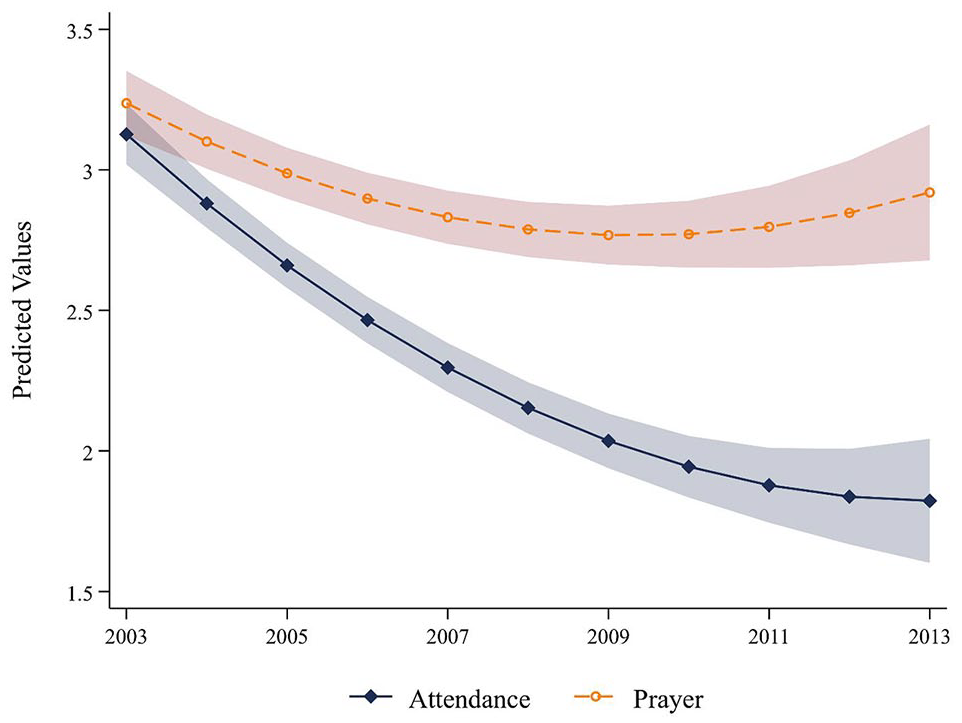
Estimated trajectories of attendance and prayer (2003–2013).
Figure 2 shows the trajectories of the predicted probabilities for religious affiliation and believing in God. At the beginning of the panel, the predicted probability of affiliation is actually greater than belief in God, but by the end of the panel we see a flip. As with the first pair of variables, affiliation reveals constant overall declines, while belief in God plateaus.

Estimated trajectories of religious affiliation and belief in God (2003–2013).
Figure 3 presents average trajectories of predicted probabilities for the last pair of institutional/outward and individual/inward religion measures: proselytization and meditation. Although the predicted probability of supporting proselytization decreases overall from the initial starting point, the predicted probability of practicing spiritual meditation techniques reveals steady increases.
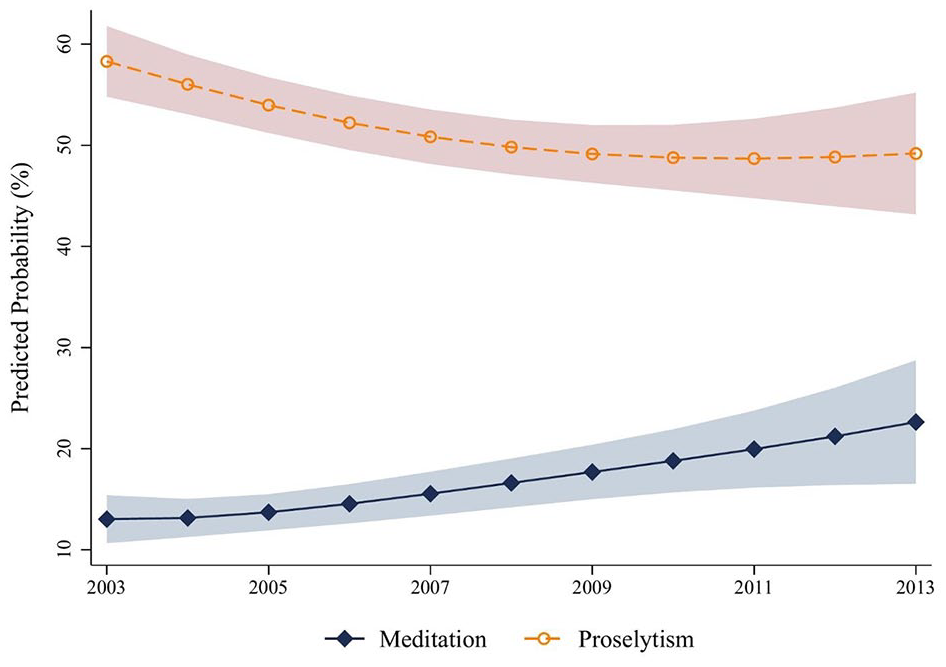
Estimated trajectories of meditation and proselytism (2003–2013).
These figures reveal differential patterns of change: institutional measures like attendance and affiliation show steeper, more consistent declines, whereas individual measures like prayer and belief demonstrate more varied trajectories, including periods of relative stability (or, in the case of meditation, increase). On average, adolescents in this cohort are moving away from institutional religion in a way that differs from the patterns for individual faith and spirituality.
To further investigate the decline in institutional religion, Figures 4 to 6 focus on two measures of institutional religion, attendance and affiliation, to determine whether and how these trajectories vary across theoretically relevant covariates. Figure 4 shows estimated trajectories of religious attendance and affiliation disaggregated by political ideology. Political ideology, like views on same-sex marriage and abortion, is only measured in wave 4 and is treated as a time-invariant variable. These trajectories should thus be interpreted as the average individual-level changes for those who report particular wave 4 characteristics, acknowledging the limitation that we cannot observe how these views may have changed over time or shaped religious trajectories. Figure 4 shows that individuals who end up identifying as liberal at the end of the survey demonstrate greater declines in attendance and affiliation compared with both moderates and conservatives. Note that both moderates and conservatives also decline, suggesting broad change across this cohort. 8
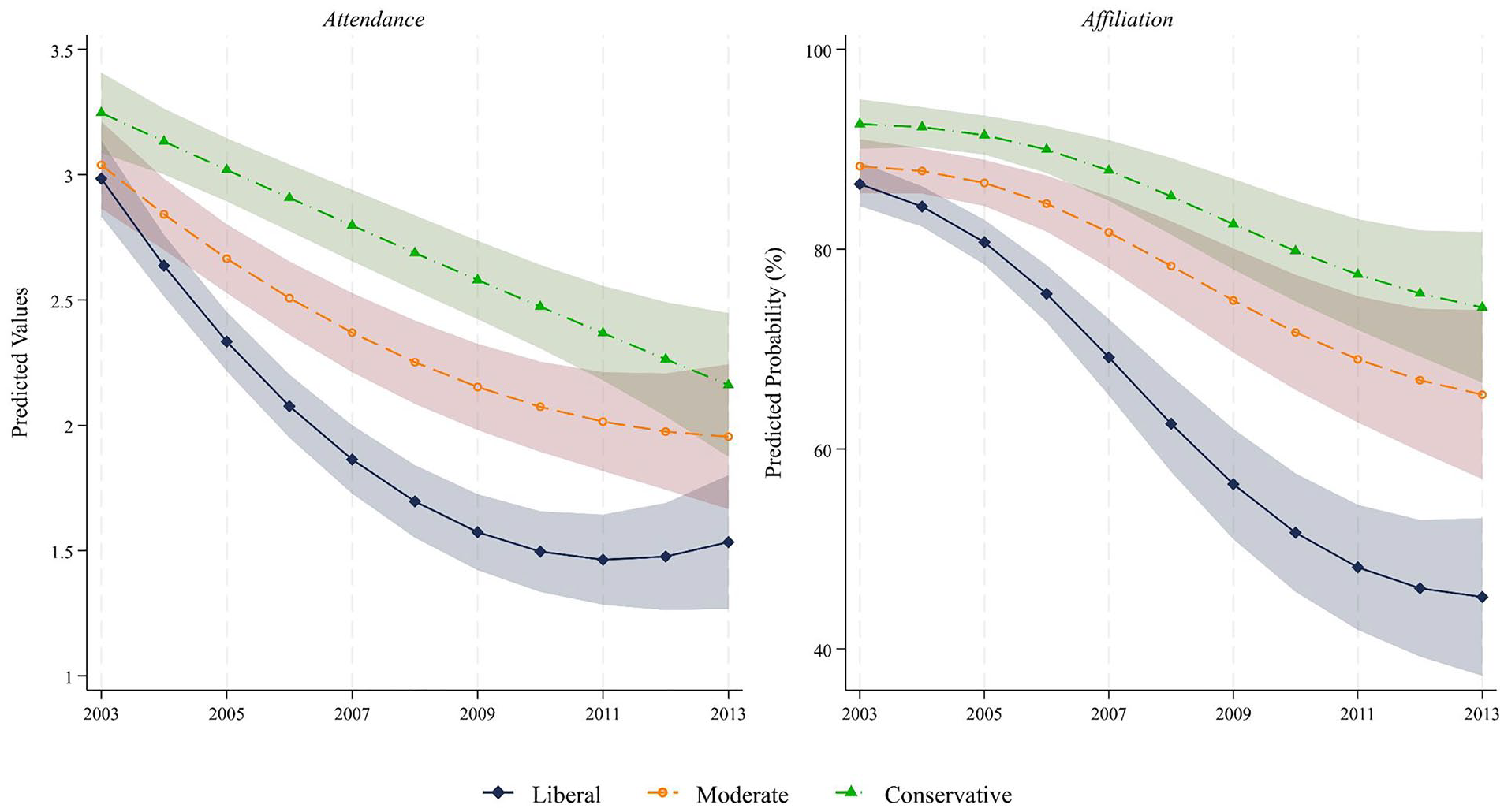
Estimated trajectories of religious attendance and affiliation by political ideology (2003–2013).
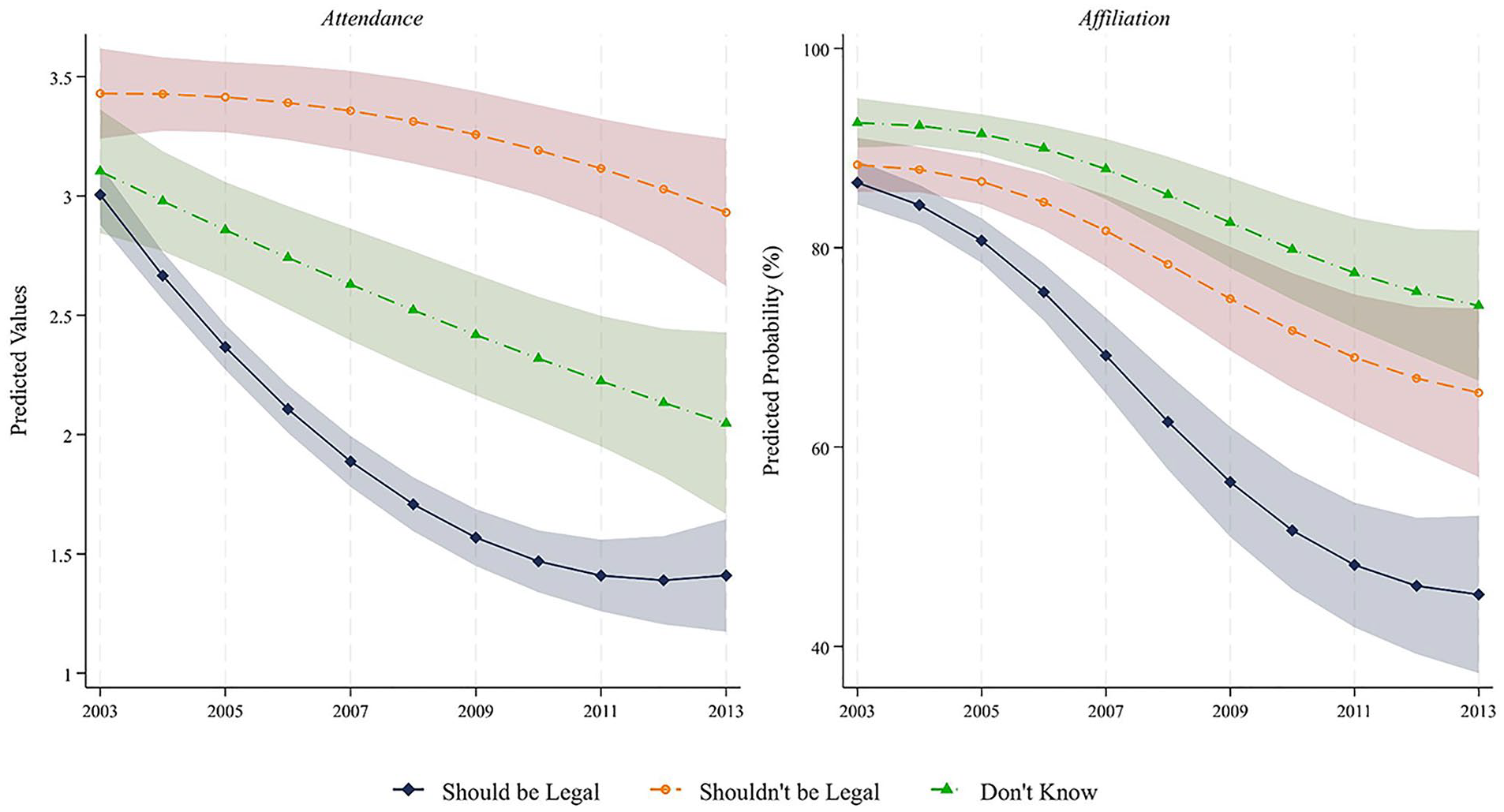
Estimated trajectories of religious attendance and affiliation by views on same-sex marriage (2003–2013).
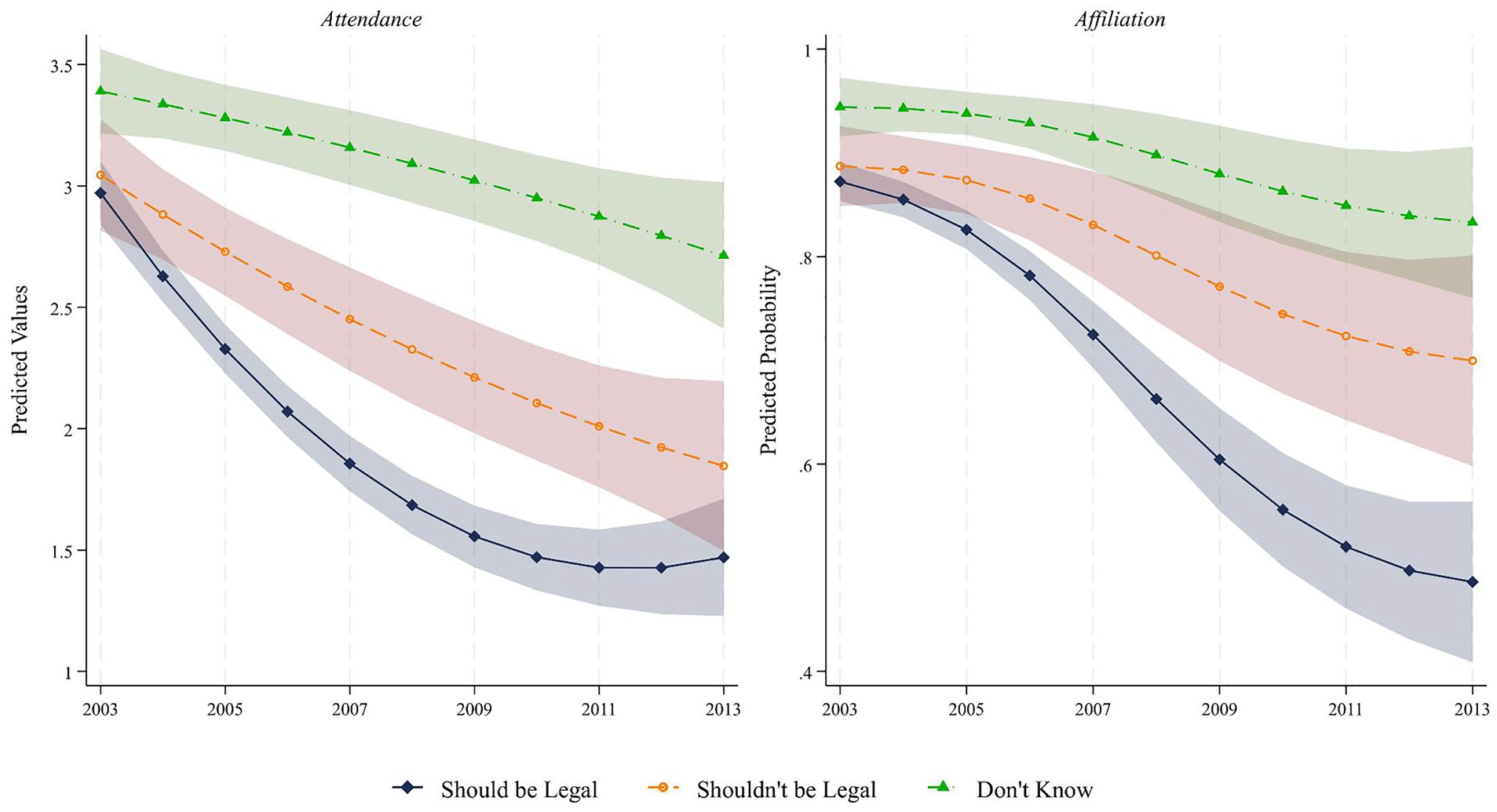
Estimated trajectories of religious attendance and affiliation by views on abortion (2003–2013).
Figure 5 disaggregates the attendance and affiliation trajectories on the basis of attitudes toward same-sex marriage using a similar strategy as described earlier. Like political ideology, views on same-sex marriage are only measured in wave 4. Figure 5 shows that although all of these groups decline on these measures of institutionalized religion, those who support same-sex marriage in 2013, a key indicator of autonomy and expressive individualization, demonstrate more decline in attendance and affiliation compared with respondents who were against or indecisive about the legality of same-sex marriage.
Figure 6 presents parallel patterns by views on abortion. Those who believed abortion should be legal at the end of the panel also demonstrate more overall decline in both attendance and affiliation compared with those who were unsure or thought it should be illegal. Overall, Figures 4 to 6 indicate politics and concern for autonomy in the realm of gender and sexuality are key factors to consider in relation to the decline of institutional religion.
Additional analyses presented in the Online Appendix illustrate that although social and political values help explain the move away from institutional decline, other explanations from the often cross-sectional literature on adolescent religious change (education and failure of religious socialization) do not help explain religious decline. The move away from institutional religion does take place during the college years, but occurs similarly among both those who attend and do not attend, suggesting that becoming an adult and distinguishing oneself from one’s parents is more pertinent than going to college. We also find decline happens just as quickly (if not more so) among those raised by more religious parents. Whereas Figure 4 shows that those with different political ideologies started closer together with respect to attendance and affiliation and then diverged over time, children with different levels of religious socialization (both in terms of how religious parents are and in terms of their religious affiliation) start further apart but become more similar over time. It may be that some people react against strict religious parenting, or just that starting out more religious offers more room to decline.
As shown in the Online Appendix, when considering whether overall change patterns vary or are similar across various sociodemographic groups by gender, race, class, and sexual orientation, trends tend to be generally similar across most groups. Certainly, some groups demonstrate higher levels overall, but the trends all tend to move in the same direction at generally similar rates. Although rates of disengagement from organized religion appear similar across sociodemographic groups, structurally disadvantaged populations demonstrate particularly persistent levels of individual spirituality. 9
Qualitative Methods
The qualitative analysis provided the foundational insights for our study, identifying central themes we later tested quantitatively. By combining the strengths of both methods, we were able to uncover not only the general trends but also the lived experiences and meaning-making processes behind these trends. Although the qualitative analysis was conducted first, we present these results second to align with the convention of moving from broader patterns in quantitative data to qualitative analysis that helps explain those patterns.
The quantitative data show young people moving away from institutional religion while retaining individual faith and spirituality. Politics, especially politics related to autonomy in the realm of gender and sexuality, help explain this move. Although the quantitative data provide a general overview, the qualitative data provide a depth of narrative detail on life course processes and the complexities of causes in individual lives. For example, we expected that conflict between deeply held values and religious institutions should help explain movement away from institutional religion. Seeing that liberals and people who support same-sex marriage and abortion are moving away from institutional religion in greater numbers is suggestive of this possibility, and qualitative data can elucidate this change.
We now turn to an examination of data from 183 semistructured interviews with 54 respondents whose attendance declined substantially from adolescence into young adulthood to consider the life narratives of those moving away from participation in organized religion. 10 We determined our qualitative sample by identifying people who met the following criteria: (1) at least two waves of interview data, (2) attended religious services regularly at wave 1 (at least a couple of times a month), and (3) declined at least two steps on the attendance frequency measure from wave 1 to the latest wave available (typically wave 4). For example, someone who attended weekly as a teen and declined to a few times per year in their 20s would qualify, as would someone who attended two to three times per month as a teen to less than once or twice a year in their 20s. We also considered some potentially disconfirming cases who ended up attending infrequently but with different change patterns (e.g., initially attending infrequently, starting to attend more, and then declining again) or where less change occurred because attendance started low, from which we discuss some examples in the results. These potentially disconfirming cases ended up being exceptions that proved the rule, exhibiting similar conflict with organized religion as the focal sample.
Retrospective narratives reflect both actual decision processes and meaning making when people reflect on and interpret their lives (Small and Cook 2023). Although retrospective sense making is inevitable, the longitudinal design of our study enables us to track how participants’ religious beliefs and practices evolved over time, offering insights into not only the reasons participants articulate at the end of the study but also how those reasons developed alongside life course changes. Although participants’ narratives may not fully capture the complexity of their decisions, they provide valuable insights into how young adults understand and navigate their religious identities, reflecting broader cultural and social trends in their life course.
Table 2 presents demographic information for the 54 respondents interviewed an average of 3.4 times over 10 years for 183 total interviews in our analytic sample. We employed a team-based approach to code the data, as it has proven effective in evaluating the reliability and validity of the codes (Namey et al. 2007). Key themes were identified through an iterative process of initial readings, memo writing, inductive code development, and collaborative codebook refinement. The final set of key codes, categorized under “reasons for decline in religious participation,” included influences such as friends, life-altering events, struggles finding a suitable church, feelings of guilt, alienation from broader institutions, lack of time, shifting away from family influences, negative interactions with church, and realization of conflicting values. These codes led to the identification of three primary themes discussed below.
Qualitative Sample Demographics.

Note: The qualitative sample includes respondents who declined at least two points on religious service attendance measure. LDS = Church of Jesus Christ of Latter-Day Saints; SES = socioeconomic status.
The refined codebook facilitated systematic tagging of interview transcripts, enabling a more objective evaluation of the data. Interrater reliability was robust, exceeding 0.80. For our thematic analysis, we used Dedoose.com and implemented a two-tiered approach, examining individual cases and making cross-case comparisons (Ivankova, Creswell, and Stick 2006). The qualitative data were anonymized and pseudonyms used.
Qualitative Results
The qualitative data provide the foundation for our theorizing about the reasons people leave institutional religion and why many, though certainly not all, of them maintain (or even reinvigorate) individualized and syncretic faith and spirituality. The following three key themes emerged from the data:
Autonomy, values, and identity formation: As adolescents develop an autonomous self, have new experiences, and meet new people, the move away from organized religion is an active choice in line with deeply held values and identities related to issues such as LGBTQ rights. 11
Conflict with institutional religion: The intentional shift away from religion is driven by both attitudinal and personal conflict with institutional religion and its agents, which are experienced as antithetical to moral values of authenticity, self-actualization, and the sacredness of the individual.
Retention and transformation of spirituality: Although young people are moving away from institutional religion, that does not necessarily equate to abandoning individualized faith and spirituality; in fact, for some it takes losing religion to find themselves spiritually.
Autonomous Identities, Active Choice, and “Finding Yourself”
For many, moving away from institutional religion aligns their actions and identities with deeply held values and principles. As young people grow up and venture out into the world, they often experience cognitive dissonance between their values and institutional religion. Encountering new people and perspectives, particularly related to politically charged topics such as LGBTQ rights and abortion, contributes to growing commitments to self-worth, self-actualization, and the freedom for all to pursue these ideals.
Chris’s experience illustrates this shift, highlighting how personal and political values evolve alongside religious commitments. Raised in a small rural town in Pennsylvania by working-class farmers, he was deeply rooted in Catholicism during his adolescence. At 16, Chris viewed God as an omnipresent force shaping his life: “There’s not a day that goes by when I don’t think of God or thank him . . . you’ve got to make decisions about what God would like you to be.” The Bible was central to his moral compass, and he dismissed alternative explanations for existence: “I believe in God for sure. How else would we be here? That big bang theory, screw that” (wave 1).
As he left his small town to attend college, exposure to new perspectives began to challenge his worldview. By wave 3, Chris found the Church’s teachings on homosexuality increasingly difficult to reconcile with his values of acceptance and care for others: I don’t necessarily agree with the view on homosexuality and that it’s a sin, that it’s wrong. That’s a narrow-minded view. We should be accepting. If you’re in love with another guy or a girl or whatever and you know you’re a homosexual, that’s fine, you know I’m accepting to that. The Catholic [Church] isn’t very accepting to that. (wave 3)
Despite these conflicts, Chris continued to attend religious services weekly, actively participating in youth ministry, reading the Bible more than he used to, and maintaining a strong connection to his faith. His political and social views began to shift as he described himself as politically “middle of the road” and “accepting, not narrow-minded” (wave 3). By wave 4, however, Chris’s alignment with Catholicism had unraveled. He distanced himself from the Church, citing frustration with its politicization and treatment of sexual minorities: I used to go to church [and] Mass all the time. I was born and raised Catholic. . . . I think growing up changed it—having different perspectives. . . . I was tired of going to church and hearing about politics. And I was tired of going to Mass and hearing about how we can’t let the gays get married. . . . I said [to the padre], “For a church that says they’re accepting, we pride ourselves on being holier than thou, you guys are pretty discriminatory. And I don’t appreciate it . . . I used to love coming to church, [but] I don’t anymore. It’s because every time I come here, you tell me who I should be and who can do this and who can do that.” (wave 4)
Chris’s decision to leave the church was not passive or incidental. It reflected a deliberate alignment of his values with his actions, shaped by his exposure to broader perspectives and his commitment to individual autonomy: “I mean, living in the same town for their entire life [my parents] sort of have a narrow-minded view just on the world as a whole. . . . I’ve been exposed to so many different things that have opened my eyes” (wave 4).
Although Chris no longer identified as Catholic, he retained a sense of spirituality, rejecting the Church’s politics while holding onto a belief in something greater: The politics of the church have really turned me off of it. Not so much what it stands for, but I mean it’s just corrupt. . . . The politics and the scandals. . . . People ask me to identify [and] I say “born and raised Catholic. But not now.” [But] I believe that there is something, whether you want to call it God or not. (wave 4)
Chris’s narrative exemplifies the active, value-driven process of moving away from institutional religion. His story also reveals how exposure to new experiences, coupled with shifts in political identity, can create cognitive dissonance that motivates religious change. As his personal and political values developed, Chris chose to prioritize autonomy and inclusivity over institutional loyalty. His journey underscores that movement away from religion is often rooted in deeply held convictions and a desire for personal alignment, not apathy or weak socialization.
Daniela, a professional-class white mainline Protestant from Beaverton, Oregon, offers another example of how young adults navigate tensions between inherited religious traditions and emerging values. At 13, Daniela regularly attended church with her parents and expressed a strong belief in Jesus. At age 15, she says that the “most important things in life” are “God, family, helping others, and health” (in that order). By 23, however, she considered herself agnostic and spiritual and no longer attended religious services, emphasizing values of individual autonomy and social justice.
Signs of Daniela’s eventual cognitive dissonance and departure from institutional religion were evident by age 15, when her involvement in the Gay Straight Alliance drew confusion from her peers: When someone found out I was in the [Gay Straight Alliance], they were like, “But you go to church.” And I’m like, “I’m a Christian who thinks it’s okay [to be gay] . . . I don’t see a contradiction. I don’t see an issue.” (wave 2)
This early commitment to LGBTQ rights signaled a growing divergence between Daniela’s personal beliefs and her church’s teachings. By wave 3, she explicitly articulated her discomfort with the church’s moral authority, describing the dangers of intertwining religion and politics. When asked about “the most important influences” on her religion, faith, and belief in recent years, Daniela described her internal struggle: The most important influence was probably all the debate about church and state. . . . I had to think about how I really felt about that, being someone who supports the secular government and someone who is religious. Like how do I resolve that with myself? I decided that the secular government is good because then you don’t have the danger of the fundamentalist crazy people for any religion imposing their rules. . . . People in government can still be religious, but they shouldn’t do things solely to help people of their church. (wave 3)
Over time, Daniela’s beliefs shifted to emphasize individual rights and freedoms. She actively engaged in political and social movements, attending gay pride parades and expressing strong support for civil liberties: “I especially care about the major ones: gay marriage, abortion, [and] mostly civil liberties” (wave 3). Although Daniela valued Christianity’s emphasis on love and concern for others, she saw its institutional form as judgmental and rigid.
By wave 4, Daniela had fully embraced an agnostic and spiritual identity. Reflecting on her high school years, she noted the tension between her moral commitments and the views of her religious peers: Everyone was friends until it came to November (election season) and the Mormons were like I love you but I just don’t think you should have voting rights. . . . I told my youth pastor one time my issue with getting more involved in church and what not is that for me I can’t grapple with the idea that you can be the best person on the planet, you can be Mother freaking Teresa, or Ghandi or whatever, be awesome, live your life for others, but if you are attracted to people of the same sex you burn in hell forever? That doesn’t make sense to me. (wave 4)
Daniela’s story exemplifies how exposure to diverse perspectives, combined with growing political awareness, can create tensions with inherited religious frameworks. Her departure from institutional religion was not a passive process but an active negotiation of her identity, as she sought alignment between her values and beliefs. Like Chris, Daniela prioritized autonomy and authenticity, reshaping her spiritual identity to reflect her evolving principles. Her experience highlights the broader cultural shifts that encourage young adults to move away from rigid religious institutions while reimagining spirituality on their own terms.
As we noted above, we also considered some potentially disconfirming cases with different change patterns than our focal sample that challenge simple narratives of more unidirectional religious change. For example, Rafa, a young Hispanic man who grew up poor in southern California, provides an example of a trajectory distinct from Chris and Daniela. Unlike them, Rafa’s initial engagement with religion was an intentional choice made during adolescence, rather than a result of childhood socialization. Raised by a mother who had no interest in religion, Rafa discovered Christianity through a high school Christian club. This exposure led him to actively embrace religious participation, attending services weekly, a significant shift from his previously nonreligious upbringing.
At first, Rafa found aspects of religious teachings appealing, particularly in areas where they aligned with his intellectual curiosity, such as debates about evolution: “The evolution debate [doesn’t bother me].” However, as Rafa became more involved, tensions emerged when organized religion focused on social and political issues he found troubling, particularly the condemnation of sexual minorities. He recalled the conflicting messages he encountered: But [I can’t get over] the gay and religious debate—some Christians totally hate gay people. And then I go to the youth group [and] one of the leaders says, “The Bible says you’re supposed to love everybody.” You can’t just say, “Oh, these people, they are gay. I don’t like them.” You’re supposed to love everyone. (wave 3)
This dissonance marked the beginning of Rafa’s questioning of organized religion. Over time, he struggled to reconcile his evolving personal values with the rigid moral expectations of Christianity, describing the religion as “a pretty strict religion.” By wave 4, his skepticism had deepened, encompassing not only specific doctrines but the concept of religious dogma altogether. Rafa reflected on his process of questioning and exploration: I was sort of trying to rationalize everything . . . reading blogs, reading parts of certain books influenced me. . . . I think I got through half of The God Delusion’ and then I was like, “I’m not going to read anymore of this.” And then I tried reading some Christian rebuttals [and] their arguments didn’t seem sane. (wave 4)
Ultimately, Rafa set aside the pursuit of rational certainty and focused on people. He identified as liberal, aligning with values that prioritized social programs to help the poor and personal freedoms like gay marriage over allegiance to religious institutions. He resolved the tension between his personal values and organized religion by adopting an agnostic identity: I think the definition of agnostic is you can’t prove whether or not God exists, which I believe is the truth. We could all be living in the Matrix and God did create the universe, we don’t know. . . . If I want to go to church occasionally and ya know believe in the fairy tales once in a while, I’m okay with that. (wave 4)
Rafa’s journey underscores the importance of agency and exploration in shaping religious trajectories. Unlike passive disaffiliation, Rafa’s path illustrates the active negotiation of beliefs and values, often driven by encounters with conflicting messages within religious institutions. His experience highlights how exposure to new ideas and persistent cognitive dissonance can lead to a departure from organized religion, even for those who intentionally chose religion for themselves earlier in life. At the same time, his agnosticism reflects a reimagining of spirituality on his own terms, aligned with his commitment to inclusivity and personal authenticity.
Moral Individuals, Immoral Institutions
Alongside the cognitive dissonance that emerges between religious institutions and convictions about the sacredness of the individual as people become autonomous adults, some emerging adults experience more direct, personal conflict with religious organizations and their representatives. Both the ideological and especially the personal conflicts individuals experience with religious institutions echo Niebuhr’s (1932) thesis in Moral Man and Immoral Society. Niebuhr posits a fundamental paradox: although individuals often exhibit moral and selfless behavior, when organized into religious institutions, these same individuals can collectively act in selfish, judgmental, and power-driven ways. Such actions can lead to negative personal experiences that can sour people’s relationships with religious institutions.
Tom’s story illustrates how personal and attitudinal conflict with institutional religion can drive intentional religious change. Raised as a professional-class white Catholic in southeastern Washington, Tom began his religious journey with a strong belief in God and a clear delineation of his religious values. From the start, however, his introspective nature and intellectual curiosity set him on a path toward questioning religious authority. In wave 1, Tom describes himself as faithful yet independent in his beliefs, suggesting that his relationship with religion was already influenced by his strong sense of agency and critical thinking: “I’m pretty strong in my faith but I’m also pretty independent in what I think about. Like if I don’t agree with something, I’ll be vocal about it.” This early independence evolved into doubt by wave 2, where Tom says he is “wavering” in his identity as a Catholic. He begins to question the coherence of Catholic doctrine and struggles with what he perceives as contradictions in religion: The contradictions in all religions, there’s just too many contradictions and like, there’s kind of like no physical proof, to me it just sounds like a bunch of mumbo jumbo right now. It’s like an invention for people to feel better . . . to believe in God, you have to take everything or nothing. And, I have problems with some things . . . [one] has to drag everything into question. (wave 2)
His internal doubts are compounded by his experiences in Catholic school, where he perceives the religious education system as rigid and overbearing. In his words: “They just cram it down your throat so much, you just get fed up with it. I think if they were smart, they would [only] have religion class once a week and give us time away from it.” Tom’s frustrations extend to the teachers at his Catholic school, whom he describes as politically dogmatic and overzealous: “I have a problem with a few of them, cause they’re stark raving lunatics, in their political views, and they try to push them on me, and I’m like no!”
This external conflict with religious representatives amplifies Tom’s internal struggle, creating a tipping point that ultimately leads him to abandon Catholic identity entirely. By wave 4, Tom identifies as an atheist and directly attributes his departure from religion to the system of religious education in which he was raised: It was all pretty much entirely due to Catholic school . . . ultimately, there’s a lot of questions you can’t answer. One is the classical, if God is omnipotent or can He create a circumstance that he can’t lift. Or, why is there human suffering? Just a lot of things like that.
Tom’s journey illustrates the dual sources of religious conflict: internal doubts rooted in his intellectual development and external conflicts with religious institutions. The rigidity and perceived judgmental nature of the Catholic school system played a decisive role in Tom’s eventual shift to atheism, underscoring how institutional religion can sometimes alienate those who value authenticity, self-actualization, and intellectual exploration. For Tom, resolving his conflict with religion meant moving away from Catholicism entirely.
Claude, a white middle-class man from South Carolina, illustrates how personal and ideological conflicts with institutional religion can propel an individual toward agnosticism. Raised Catholic, Claude converted to Methodism with his mother and brother around age 16. Claude initially engaged with religion in a casual, dutiful manner. He prayed at mealtimes and attended church about two times per week, and thought “if you’re without some kind of spirituality, you’re alone. . . . If you didn’t have some kind of faith or some kind of God . . . you don’t have anybody to talk to.”
By wave 2, we can see signs of Claude’s dissatisfaction with institutional religion, particularly as he began to question the societal pressure to adhere to a specific belief system: “Just being forced to believe one thing and not feeling like you have the right to believe what you wanna believe or being pushed into stuff you don’t wanna do.” For Claude, the perceived inflexibility of religious doctrine clashed with his desire to explore his beliefs independently. He articulated doubts about the Bible’s authority, finding parts of its narrative “far fetched.” His skepticism was compounded by broader existential questions about suffering and injustice: “If God was there, how could that really have happened? How can you just let stuff like that happen?”
The most profound source of conflict for Claude, however, stemmed from his identity as a gay man. The church’s condemnation of homosexuality stood in direct opposition to his lived experience, causing significant cognitive dissonance. Claude’s rejection of the church’s teachings on sexuality was evident: “The Bible says that being gay is wrong, but I don’t personally believe that. You’re born how you are.”
This tension deepened after a personal tragedy when a close friend was murdered in an antigay hate crime. Claude’s involvement in protests following the incident exposed him to the pervasive nature of discrimination and hate: “I really realized the impact of it and how common it is. . . . I’ve been walking to [campus] and been called a faggot just for being with somebody else.”
The loss of his friend and the broader societal hostility toward sexual minorities exacerbated Claude’s disillusionment with religious institutions. The church, which he had once viewed as a moral compass, now appeared antithetical to the values of acceptance and equality he held dear.
By wave 4, Claude had resolved these conflicts by identifying as agnostic, a shift that allowed him to maintain a belief in the possibility of a higher power without the constraints of institutional dogma. He described his agnosticism as a response to both personal experiences and his observations of global suffering: Just watching the news and seeing stuff that happens in the world. . . . I kinda feel like, if God is supposed to just watch over you like they say, a lot of the stuff that happens in the world shouldn’t happen.
Claude’s narrative illuminates the interplay among personal identity, moral values, and institutional authority. His shift away from religion was not a rejection of spirituality but a deliberate effort to reconcile his sense of self with a world that often seemed incompatible with the teachings of his church. The church’s condemnation of homosexuality contradicted his belief in the sacredness of individuals and the moral imperative of love and acceptance.
Eva, a poor, Hispanic Catholic from Detroit, exemplifies how attitudinal and personal conflicts with institutional religion can drive a shift away from faith. Raised by a devout Catholic mother, Eva attended Catholic school and church weekly, but even in her early years, her religious participation was more out of obligation than personal conviction. Eva saw God as loving and forgiving but remained detached from the social aspects of her church community.
As Eva grew older, she increasingly questioned institutional religion, catalyzed by her exposure to diverse perspectives and involvement in activist circles. Her activism and exposure to various belief systems broadened her understanding of spirituality, making her increasingly skeptical of a rigid, dogmatic faith. Eva found Catholicism’s exclusivity and prescriptive approach difficult to reconcile with her belief in individuality and diversity. This questioning included the church’s stance on homosexuality, which she viewed as a fundamental moral conflict: “I think [homosexuality] just happens. I don’t think it’s a choice. I don’t think it’s immoral or anything like that. It just happens. People being honest with themselves.”
Eva’s growing exposure to diverse beliefs and her activism amplified her willingness to question Catholicism. By wave 4, Eva no longer identified as Catholic. Her departure was driven not only by ideological disagreements but also by personal experiences that highlighted the hypocrisy she perceived in religious institutions. Reflecting on her time in Catholic school, Eva described her negative interactions with nuns as a turning point: “How can you be this supposedly holy person but act how you act?”
This growing disillusionment with religious institutions was further amplified by Eva’s increasing awareness of systemic injustices in the world, which challenged her belief in an all-powerful, benevolent God. Nevertheless, she did not reject the concept of a higher power entirely, embracing instead a more nuanced, individualized spirituality and a belief in “something bigger.”
Eva’s shift away from institutional religion was tied to her core values of autonomy, individuality, and independent thinking. She viewed institutionalized religion as a threat to these ideals: “I’m not a supporter of institutionalized religion. I think that what would be lost is individuality and freedom and independent thinking. . . . For me, that means a loss of integrity.”
Losing Institutional Religion but Finding Individualized Faith
The journey away from religious institutions often means not simply losing faith but transforming it. Like Jung’s concept of individuation as a path toward both self-discovery and universal connection, many who leave organized religion find themselves on a quest that deepens their sacred commitments while freeing them from institutional constraints. This transformation unfolds gradually as people encounter repeated conflicts between institutional demands and personal values, through experiences of bureaucratic rigidity, moral judgmentalism, or institutional abuse. They craft personally authentic relationships with the sacred—whether experienced as God, a higher power, or profound wonder at existence—that better align with their evolving sense of moral truth and identity. Some discover this authenticity by finding new congregations that respect individual spiritual growth, while others forge entirely personal paths outside formal institutions.
Brittany, a professional-class Baptist living in a Seattle suburb, was deeply committed to her Christian faith as an adolescent: “It’s [religion] part of my basic personality at this point.” For Brittany, feeling close to God means “living the way that He would want me to” and her life purpose was to “serve Him and show Him to others.” Religion pervaded her life and shaped her actions: I can’t really believe in God and His truths without having that affect how I act and how I live. I think it helps me to love people . . . [we live] in a fallen world and I’m a part of that. It’s like, wow, since God loves us then I should probably love others. (wave 1)
By wave 2, Brittany’s engagement with organized religion began to wane. She attended church less frequently and struggled to feel a sense of belonging in her local congregation. When asked in wave 2 if she had become more or less religious, she reflected, I think I’ve become a little less religious in the sense of going to church, like I don’t go as much as I used to. And thinking things are simple. . . . I used to think things were real straight, but it’s just that I’ve grown up and I’ve become more aware of more things. And I guess I’m less religious in the sense of like, oh I’m attending church, religious practices. But not like, as a person, no. But as in like the things I do, yes. (wave 2)
This shift illustrates a common tension between institutional engagement and personal spiritual development. However, Brittany’s narrative also reflects the complexity of religious change. Her emphasis on gaining awareness and “growing up” suggests a retrospective rationalization of her decisions, which may overstate her agency and intentionality in moving away from church attendance. Although Brittany frames her shift as a deliberate response to personal growth, it is also possible that her reduced involvement in organized religion was influenced by social or environmental factors she does not fully articulate.
Despite distancing herself from institutional religion, Brittany’s spirituality remained a central part of her life. In wave 3, she described a transformation in her faith: “I have much less religion in like the facts and the nuances, but I have much more faith in God.” For Brittany, moving away from institutional religion allowed her to cultivate a more personal and flexible approach to spirituality. Her personal prayer practices exemplify this: “I pray a lot. . . . For me prayer is a conversation with God and so I talk to God all the time [laughs] like I don’t necessarily have sit-down-on-your-knees prayers, but I, just throughout my day I converse with God” (wave 3).
By wave 4, Brittany identified as “a Christian who doesn’t attend church.” She articulated her continued commitment to core beliefs while rejecting institutional participation: I still really believe like the core beliefs, in God and Jesus. The Bible has a lot of ways to live and so I do believe in those. Especially like the Ten Commandments, those are a pretty basic set . . . living in a way that pleases God is important. And that to me is—beyond just like following rules—is a way to show that you love God. But also by sharing love, and being a servant to people around you. (wave 4)
Although Brittany frames her transformation as an intentional evolution, her story also underscores the emotional and existential role that spirituality plays in her life. She relied on her faith to navigate uncertainties and hardships, explaining: [I pray] about four times a week. Because I know I need to on a lot of levels. . . I’m very afraid of the future and so I have to remember [that] today, I can handle and God can worry about the future. He’s big enough to handle it. I don’t need to be trying to seize control of that and so just reading the Bible helps me stay connected and just helps remind me of what I do believe. (wave 4)
By recreating their faith in more personally meaningful ways, many young people maintain a strong connection to their spirituality and beliefs even as they move away from traditional religious institutions.
For Faye, a Black working-class woman from New Orleans, Christian faith was a consistent presence in her life, but her relationship with organized religion evolved in substantial ways. As a teenager, she demonstrated a deep connection to her faith, describing God as both a parental figure and a source of guidance. In wave 1, Faye expressed this sense of closeness as a parent-child relationship: I do [feel] real close [to God]. Sometimes I feel distant from him based on my actions and what I do and sometimes I feel embarrassed or discouraged to talk to him because I’ve done something wrong or I feel he’s disappointed, it’s just like a parent to me.
This parental framing of God highlights Faye’s deeply personal and relational approach to her faith, even as she navigated moments of doubt and conflict.
However, even in her teenage years, Faye’s personal values sometimes diverged from the teachings of her church. On controversial topics like abortion, she held views that conflicted with her religious upbringing: “I believe—[and] it doesn’t go with my religion—that it’s a woman’s choice whether to keep or to terminate her baby. . . . My friends as a whole don’t agree. But I say that based on her situation.” This tension reflects an early pattern in Faye’s religious journey: while remaining committed to her faith, she resisted aligning uncritically with institutional dogma.
By wave 3, Faye began to embrace a nontraditional approach to her faith, emphasizing a personal relationship with God over adherence to denominational labels or institutional structures. She explained: If I had to describe it, it would be non-traditional, as far as I don’t seem to categorize myself like the people at church do. . . . I talk to God like he’s a friend of mine—he’s my dad or something, you know? Something like that. . . . I don’t go by what they [the church] tell me to do.
Faye’s disinterest in sectarian identity also reflects her broader critique of religious institutions. Although she identified as a Methodist because it was the church she attended, she expressed ambivalence about the significance of such affiliations: “What difference does that make? I’ve never really understood denominations, I don’t think anything is wrong with them, but I don’t think you should have as much power as they tend to do.”
When asked how she has changed religiously since she was an adolescent, Faye described its fluctuation: Between 13, 14, and 15 years old, I was really into it, and going into high school I kinda got out of it. Going into college, I kinda got back into it up until now, so it fluctuates. . . . [In the past few years], I think it’s gotten stronger. I have more instances in my life that I really have to turn to God. . . . Now that I’m a lot more mature now, I think it’s a little bit better. (wave 3)
Her distancing from institutional religion culminated in wave 4, when she described herself as someone who “loves Jesus” and who is more spiritual than religious. Faye rejected what she saw as the “business” of organized religion and articulated a preference for worship that prioritized individual connection over structured practice: Sometimes I don’t really feel as though church is needed. I think church is an added bonus on renewal and rejuvenation of the spirit but I don’t think it’s a requirement in order to be connected with God. . . . The religious aspect of everything is not appealing to me. I think that it’s overly structured and I think that sometimes that structure can get in the way of the worship . . . sometimes I look at religion as a business and I don’t want to look at it as a business. I would rather look at it as a personal relationship with God. So, I think the spirituality part of it is more umm, [pause] my thing. (wave 4)
Despite stepping away from the institutional aspects of her faith—“I don’t like the organization. . . . My church . . . it’s not doing it for me” (wave 4)—Faye’s relationship with God remained a cornerstone of her life. She continued to pray and draw strength from her faith in difficult times, particularly as she navigated personal challenges and new experiences, such as being in a same-sex relationship. Although she became disenchanted with the structures and politics of organized religion, her faith remained a source of meaning and support. Her narrative exemplifies how young people navigate these complexities, retaining and transforming their spirituality in ways that align with their values and lived experiences.
Complexity in Religious Change
Life processes rarely follow a simple script and exceptions to broad trends are to be expected. Although our data revealed clear patterns of intentional disengagement driven by cognitive dissonance and personal conflicts, we also found cases that challenge any notion of a single universal pathway away from institutional religion. These “disconfirming cases” ultimately help reveal the complexity of religious change and the influence of particular life circumstances.
Consider Lucy, whose trajectory diverges from the typical pattern. Growing up as a middle-class white Baptist, she began with moderate religious involvement and progressive politics. But as her life circumstances grew more precarious, both her religious participation and political orientation shifted, though in contrast to the broader trend. Although her religious engagement declined through mounting hardships, her political views became more conservative. At the same time that she was navigating cascading personal crises—a car accident, chronic illness, a custody battle, downward mobility, and an abusive relationship—her attendance waned. Yet Lucy maintained her Baptist identity and belief in God. Her case reveals how declining engagement with religious institutions can stem from practical constraints rather than ideological rebellion.
Rodrick grew up as a working-class Black Baptist, and his early religious participation flowed more from family ties than personal conviction. When college took him away from that family network, his religious involvement declined not through rejection of institutions, but through the simple erosion of external structures that had encouraged attendance. His expressed desire to eventually return to church suggests his declining participation stems more from changing circumstance than changing conviction.
These cases illustrate the multiple pathways through which people move away from institutional religion. Some drift rather than run away from the church doors. Some face practical barriers rather than philosophical objections. Yet even these variations often reflect broader patterns of individualization as young adults craft lives increasingly detached from inherited institutional frameworks, whether through convicted choice or circumstantial constraint.
Discussion
Americans, especially adherents to the rising cult of the expressive individual, are breaking free of the iron cage of institutional religion. This transformation represents more than just privatized faith or consumer spirituality. When young adults reject religious organizations they perceive as judgmental or hypocritical, they are not simply retreating into individualism but instead individualizing and pursuing individuated interconnection. The data reveal people seeking to transcend artificial boundaries between self and other, expanding circles of moral concern beyond traditional in-group members while seeking forms of spiritual expression that foster both authentic selfhood and genuine human connection. This search for authenticity often led them away from religious institutions, but not necessarily toward isolation.
This is often a conscious choice made when confronting what some perceive as judgmental, politicized, or even corrupt organizations. Yet it is not simple atomization; it is a quest for more authentic forms of connection and community. Paradoxically, intensive religious socialization can drive some individuals away as they enter adulthood, encounter new experiences, people, and ideas, and develop an autonomous sense of self. But losing one’s religion does not necessarily mean losing one’s faith. For some, it means finding more personally meaningful and compassionate beliefs and practices rooted in lived experience that stand in contrast to institutional dogma, structures, and hierarchy.
Our decade of longitudinal data captures this transformation in detail. The quantitative evidence demonstrates that while institutional aspects of religion show consistent decline, individual aspects follow more complex trajectories, including periods of stability and even growth. This pattern becomes even more striking when considering how religious trajectories vary by politics and values related to gender and sexual autonomy. The qualitative data provide narrative explanation for the broad quantitative patterns. For this cohort, gay rights emerged as a defining issue, crystallizing broader tensions between personal values and institutional authority. As young adults formed autonomous identities and encountered new perspectives, their movement away from organized religion became increasingly intentional—not a passive drift but a deliberate realignment that reflects more than just generational indifference to religion. Although young people are indeed shifting away from institutional involvement, many maintain or even deepen their spiritual commitments. What looks like religious decline from an institutional perspective often masks a more complex reality: individuals actively reconstructing their relationship to the sacred, guided by values of authenticity and mutual care rather than institutional authority. Even those who embrace more secular worldviews often retain elements of spirituality, whether through meditation practices or openness to the paranormal (see Bader, Baker, and Mencken 2017; Blankholm 2022).
Toward a Dialectical Approach to Religious Change
History provides context for the contemporary shift away from organized religion. Time and again, movements that emerge as rebellions against religious bureaucracy eventually become the very institutions their founders sought to overturn. The recent turn toward individualization reflects a recurring cycle of religious transformation. Building on both sociology (e.g., Hout, Fischer, Bellah) and religious studies (e.g., Asad, Smith, Masuzawa), we offer a synthesis that situates today’s religious changes within a recurring historical drama, underscoring the cyclical nature of religious change and its relationship to contemporary individualization and deinstitutionalization.
Using our findings about contemporary religious transformation as a launching point and drawing on past work, we propose a dialectical framework for understanding religious change. Although grounded in the data presented here, this framework considers our empirical examination as a case study embedded within a broader historical pattern of religious transformation. Our findings suggest institutionalization and systematization are neither inevitable end points of meaning making nor irreversible once set in motion. Instead of portraying religious change as a linear march toward modernity, we see it as a pendulum swinging between institutions and individuals, conformity and rebellion, building up and tearing down, and structure and spirit.
Throughout history, moments of religious transformation have followed a recurring pattern: a charismatic figure challenges established religious structures, calling followers to embrace more authentic forms of spiritual life, only to have their own teachings eventually crystallize into new institutions (Boyarin 2019; Nongbri 2013; Smith 1963). When Zarathustra promoted direct spiritual experience over rigid ritual in ancient Persia, his insights gradually became codified into Zoroastrian orthodoxy. When Siddhartha Gautama rejected Hindu ceremonialism to teach enlightenment through individual practice, his wisdom was ultimately enshrined in elaborate Buddhist institutions. Jesus’s critique of religious legalism became the foundation for Christianity’s complex ecclesiastical hierarchies. The Báb challenged Islamic orthodoxy by promoting progressive revelation and individual spiritual search, but his followers developed new organizational structures. Each began as a call for spiritual authenticity and each in time became the very type of organization their founders questioned.
Within our theoretical framework, we propose a “faith-religion cycle” marked by oscillations between institutionalization and deinstitutionalization. As institutions solidify and traditions calcify, individuals, groups, and even societies may rebel against restrictive teachings, norms, and structures, seeking a return to what they see as a faith’s “authentic” roots. This process manifests in individual lives, where converts often have profound early faith experiences that diminish in frequency and intensity as religious practices become routine, prompting attempts to “reenchant” faith (Tavory and Winchester 2012, 369). On a larger scale, attempts to recover preinstitutionalized roots can catalyze reformation, with institutions then forming around reformer’s ideas in a continuous ebb and flow, as seen in the Protestant Reformation and ongoing emergence of new offshoots seeking “authentic” faith (Hatch 1989; Nongbri 2013).
The pendulum between individualized spirituality and institutional religion has swung back and forth across the centuries. Religious history since the Middle Ages, particularly for Christianity and Islam, marked an era of increasing institutionalization that mirrored broader bureaucratization (Weber [1905] 1930, [1921] 1978). Faith movements transformed into formal organizations with systematized theology, professional clergy, and elaborate hierarchies and policies; meanwhile, localized and personalized syncretic beliefs and practices were suppressed as “pagan” (Masuzawa 2005; Nongbri 2013; Smith 1963). This institutionalization helped religion survive modernity’s rationalizing forces, but made it vulnerable to the rebellion against bureaucracy that would follow.
Early social scientists caught this institutionalizing trend and saw it as steady development rather than one swing of a pendulum. Our dialectical model challenges the linear progression assumed by church-sect theory, which envisions a one-way street from the liminal, world-rejecting character of new religious movements to the stability-maintaining forces of institutionalized religion (Berger 1984; Weber [1920] 1963; Yinger 1946). Rather than seeing religious change as an arrow pointing toward ever greater rationalization, we recognize a perpetual tension between structure and spirit, institutionalization and deinstitutionalization, rationalization and reenchantment. Each swing of the pendulum represents a “backlash” (Braunstein 2022) against the prevailing religious orientation, as each generation confronts anew the challenge of balancing personal authenticity with collective organization.
Even seemingly linear theories contain inklings of our proposed dialectical framework. Such dynamism and tension between individual authenticity and institutional authority can be gleaned from some approaches to (neo)secularization (Casanova 2007; Dobbelaere 2002; Gorski and Altınordu 2008) and is exemplified by Seventh-Day Adventism’s oscillation between denomination and sect, challenging assumptions about one-way trajectories (Lawson 2019). 12 Beyond individuals and religious groups, society itself can generally shift “back” from greater preference for “churches” to “sects” and attempt to return to the early days of faith movements, leading to more personalized and syncretic faith (or nothing at all) as part of a macro-level individualization process.
The cyclical patterns we highlight echo Hirschman’s (1982) argument that societies oscillate between private and public modes of engagement as each sphere’s limitations become apparent. Just as Hirschman observed consumer disillusionment with private pursuits driving a turn toward collective action, our respondents often describe institutional disappointment propelling them toward personal spirituality, which in turn could swing back toward new forms of collective community.
The data indicate Americans aren’t just leaving religion—they’re reimagining it in ways that echo ancient patterns of spiritual rebellion and renewal. What we observe today is both utterly contemporary and strikingly familiar: a shift from highly bureaucratized “high church” structures toward more fluid and personalized forms of faith. The rise of evangelicalism and nondenominational congregations represents one face of this transformation, while the more recent surge in individualized spirituality represents another. Both, paradoxically, reflect a rebellion against institutional authority in search of more “authentic” religious experience.
This transformation took a far-right turn in our politically polarized era. Many individuals moved away from moderate, “rational” forms of mainline Protestantism and progressive Catholicism, not because these traditions were too strict but because they weren’t experiential enough. Others have reacted against the increasing politicization of conservative religion, creating a fascinating double movement: some gravitating toward more intense “low-church” forms, while others craft new paths outside formal institutions. The result is a kind of religious sorting that previous generations could hardly have imagined (Hout and Fischer 2014; Whitehead and Perry 2020). The religion that persists tends to be more intense and less bureaucratized, and more syncretic forms of spirituality are arising in response to the perceived intransigence of organized religion (Schnabel and Bock 2017; Watts 2018). While echoing historic patterns, these new syncretic spiritualities reflect contemporary commitments to individual authenticity and social justice, as the qualitative data showed.
We capture a general underlying pattern of our dialectical model of religious change in what we refer to as the faith-religion cycle in Figure 7. The figure illustrates how some frameworks have sought a unidirectional trajectory of religious change—a straight line pointing toward ever greater rationalization and bureaucracy—while we highlight forces pushing simultaneously toward institutionalization and deinstitutionalization, rationalization and reenchantment, bureaucracy and individual authenticity. We suggest the process is more cyclical than linear and the pendulum swings not just between structure and spirit, but between different ways of imagining what authentic religious experience might mean. This pattern helps explain what might otherwise appear to be a paradoxical aspect of contemporary religious change: the popularity of intense “low-church” forms of religion amidst secularizing forces and the persistence of spiritual seeking even among many of those who reject organized religion—and how periods of apparent decline can be followed by periods of apparent renewal throughout history.

From unidirectional linear approaches to a faith-religion cycle.
The figure acknowledges how not everyone who leaves institutional religion embarks on an explicitly spiritual journey: some embrace wholesale skepticism and/or secular materialism. Yet even here, many people outside of the boundaries of organized religion, including atheists, engage in practices that earlier generations might have recognized as religious or at least spiritual: mindfulness, yoga, alternative healing, or simply a quest for wonder and meaning in the natural world (Blankholm 2022). 13 The forms change, but the fundamental human yearning for transcendence and connection remains. Some materialists can even circle back around to a certain type of localized spirituality through naturalism, openness to the metaphysical through psychedelics, or existential seeking through a quest for meaning and purpose.
Situating Contemporary Patterns in the Theoretical Framework
Rather than a linear march toward rationalization and secularization, we are witnessing a dynamic transformation. Our qualitative data reveal how cognitive dissonance—and the uncomfortable gap between what people believe and what institutions they identify with practice—often sparks the first steps away from organized religion. But it is not only or even primarily rationalistic doubts driving this exodus. Instead, it is authenticity and moral conviction: the perceived corruption, bureaucracy, and hypocrisy of religious institutions, especially on issues such as LGBTQ rights, gender equality, and social justice. Many embrace aspects of being “spiritual but not religious” after wrestling with social and moral issues that put them at odds with organized religion. In an era where authenticity is prized above institutional loyalty, young people are crafting personalized spiritual practices while rejecting what they see as rigid or hypocritical religious structures.
The implications of this shift extend far beyond religion itself. By examining religious change through the lens of a dialectic between institutional authority and individual authenticity, we gain insight into broader transformations in how people relate to all kinds of institutions, from marriage to education to civic life. Our theoretical framework aligns with the arguments of Hout, Fischer, and Bellah et al. and draws together seemingly disparate threads: the “privatization” of religion, patterns of “believing without belonging” and “spiritual but not religious,” the rise of “lived religion,” religious “backlash,” religious “replacement,” and more (Ammerman 2020; Braunstein 2022; Davie 2015; Denton and Flory 2020; Dobbelaere 2002; Luckmann 1967; Watts 2022b; Wilkins-Laflamme 2023). Beyond the social scientific arguments, we have also drawn on insights from religious studies, religious history, and other areas to provide a broader context and situate contemporary religious change within longer term processes (Asad 1993; Boyarin 2019; Masuzawa 2005; Nongbri 2013; Smith 1963). Rather than competing explanations, myriad theories speak to different facets of a single, powerful dynamic: the ongoing tension between institutional authority and individual authenticity.
The stories our participants tell illustrate the deinstitutionalization process and how people can move along it in diverging ways, ending up at different places as they prioritize personal faith, values, and experiences over bureaucratic religion and systematized doctrine. Some become sectarian or nondenominational, moving from “high church” to “low church” and from specific to more general affiliations. Others move further from organized religion but maintain their commitment to a particular faith tradition, identifying as “just Christian” or not labeling their beliefs and practices in any specific way. Still others combine beliefs and practices from multiple traditions or do not hold specific beliefs but are still spiritual. Although many individuals who leave organized religion maintain a sense of spirituality or belief, others embrace a more secular worldview. What unites these diverse paths is a common thread: the prioritizing of personal authenticity and lived experience over institutional authority.
Our theoretical framework suggests the patterns in our data point to not just a moment of religious decline; it is part of a recurring pattern in how humans organize their search for meaning and transcendence. It helps explain patterns that have puzzled religious scholars: why, for instance, mainline Protestant denominations declined earlier and more steeply than more conservative traditions, despite their more accommodating stance toward modernity. Their very attempt to rationalize and modernize religion may have inadvertently accelerated deinstitutionalization. The framework also illuminates why some individuals gravitate toward more intense forms of religious expression even as others craft increasingly personalized spiritual practices: both represent different responses to the perceived rigidity of bureaucratized religion. Sectarianism and nondenominationalism are becoming increasingly popular, and individuals are stepping outside formal religious communities and forging their own paths. Society is undergoing deinstitutionalization in ways that align more with a dechristianization framework—focused on personalized, pre-Enlightenment syncretic and “pagan” faith and spirituality—than with more linear “rationalization” approaches developed alongside linear progress theories of modernity.
Although there is variation in the types of nonreligion that emerge as people leave organized religion (Baker and Smith 2015), they frequently share a frustration with organized religion. Notably, attempts to institutionalize secularism have faced lack of interest among those fed up with organized belief (Lundmark and LeDrew 2019). Our theoretical framework suggests movement away from institutional religion is part of a broader ethos of the sacredness of the individual and a culture of care, rather than solely or even primarily a rationalization process (Bellah et al. 1985; Frost and Edgell 2022; Watts 2022b).
Limitations and Directions for Future Research
Our theoretical framework offers insight into how individuals navigate institutional authority more broadly in an era that increasingly privileges personal authenticity. The religious sphere provides a clear window into these dynamics, as individuals actively reconstruct their relationship to traditional sources of meaning and community. The model we present is necessarily an initial framework rather than a final theory and this study’s limitations suggest several promising directions for future research. Although our data capture religious change during a crucial life transition—as adolescents develop autonomous identities and navigate faith commitments—they represent only one segment of the life course. Our focus on this pivotal period illuminates key mechanisms but raises questions about patterns across other life stages.
The relationship between religious change and political liberalization merits further investigation. Although our qualitative data suggest these processes often intertwine, with shifts on issues such as same-sex marriage frequently accompanying religious disaffiliation, having certain political measures only at wave 4 constrains our quantitative analysis. More frequent measurements could better capture the precise shape of religious change, particularly during periods of rapid transformation.
The qualitative analysis focused on those who moved away from institutional religion. Future work could conduct a parallel investigation of those who maintain institutional commitments, examining why some individuals find authentic expression within traditional structures while others seek it elsewhere. This points toward a broader research agenda examining how people construct meaning and community in an era of weakening institutional authority.
Our analysis of one cohort during a transformative decade (2003–2013) raises questions to be explored in future research: How do different social and cultural environments shape these cyclical patterns? What role do generational differences play in navigating between institutional and personal forms of religious expression? How might this framework help us understand diverse forms of nonreligion emerging today?
Although our focus on American millennials enabled detailed examination of specific mechanisms, these patterns likely vary across cultural contexts. Yet the theoretical framework suggests insights that may illuminate both historical cycles of religious change and contemporary transformations in how people relate to institutions. We suspect similar processes are in play in at least some contexts, with some specifics varying (for example, the emphasis on the sacredness of the individual may be more pronounced in Western and historically Christian countries, or individuals may come into conflict with institutions differently in different contexts).
Conclusion
In Habits of the Heart, Bellah et al. (1985) tell the story of Sheila, a highly introspective young nurse who attended therapy regularly. She named her religion after herself, calling it “Sheilaism”: “I believe in God. I’m not a religious fanatic. I can’t remember the last time I went to church. My faith has carried me a long way. It’s Sheilaism. Just my own little voice” (p. 221). She spelled out the tenets of Sheilaism: “It’s just try to love yourself and be gentle with yourself. You know, I guess, take care of each other. I think He [God] would want us to take care of each other” (p. 221).
Sheilaism encapsulates how Americans are breaking free of religious institutions while preserving personal faith, not through rebellion but through quiet acts of spiritual independence and integration. It suggests the possibility that with the individualization of American religion, instead of thousands of denominations, there are millions of American faiths, distinct yet interconnected and overlapping with one another in a diverse and yet interconnected array of experiences and perspectives, following what Watts (2022a) called “the religion of the heart.” In some ways, Sheilaism might just be shorthand for Durkheim’s predicted cult of the individual, if it is reconceptualized as more enchanted and sentimental and less scientific and rational.
Instead of adapting to the emergent individualization of Sheilaism and championing empathetic self-actualization, organized religion in the United States responded in a more reactionary way (Braunstein 2022; Whitehead and Perry 2020). We argue, similar to Hout and Fischer (2002, 2014), that this politicization of religion against autonomous self-actualization precipitated the rapid rise of the nones. In leaving organized religion, many people are combining the golden rule with belief in the sacredness of the individual, illustrative of the ethos of the 1960s and embodied in Baldwin’s (1962) exhortation: In the realm of power, Christianity has operated with unmitigated arrogance and cruelty. . . . In the realm of morals the role of Christianity has been, at best, ambivalent. . . . It is not too much to say that whoever wishes to become a truly moral human . . . must first divorce himself from all the prohibitions, crimes, and hypocrisies of the Christian church. If the concept of God has any validity or any use, it can only be to make us larger, freer, and more loving. If God cannot do this, then it is time we got rid of Him. (pp. 87–88)
This is not primarily a process of drawing on rational arguments from science to become secular materialists, but instead a value-based process of prioritizing individuals over institutions and people over politics when the religious becomes sacrilegious, arguably stripping away the accouterments of institutional religion and artificial divisions in search of an idealized sense of the sacred.
Our longitudinal analysis captures a dramatic shift in the American religious landscape, showing how people are breaking free from religious institutions and exploring more personalized forms of faith that resonate with their values. Our dialectical model of religious change offers a perspective that moves beyond traditional linear and unidirectional approaches, revealing how institutional decline could coincide with spiritual persistence or even renewal. The phrase “spiritual but not religious,” operating as both a specific identity and a more general zeitgeist, reflects this growing orientation toward spirituality over traditional organized religion (see Watts 2022a). This trend of deinstitutionalization and dechristianization is likely to continue, with more people seeking personalized forms of spiritual expression outside of traditional religious institutions. As the religious landscape continues to evolve, future research should examine how these changes intersect with and shape other aspects of social life—potentially transforming not only religion but other institutions including family, education, and politics—as individuals increasingly prioritize personal autonomy, authenticity, and individuated interconnection over institutional loyalty and conformity.
Despite reasonable guesses about the immediate future, there is no single long-term outcome for religion. Our dialectical framework acknowledges the dynamic and fluid nature of actions and reactions over time (also see Braunstein 2022), including the interplay between individualization and reinstitutionalization. Consistent with past cycles, the current swing toward personalized spirituality may prompt renewed interest in forming communities and organizations around new spiritual or religious forms. If so, then the pendulum may then swing back toward new manifestations of syncretic and expressive forms of meaning making.
We agree with Durkheim that the sacred dimensions of life are perennial and that humans will continue navigating their quest for meaning through changing expressions and forms of orientation to the sacred as they face life’s challenges, striving for wellbeing and integrity in a transforming world. Ultimately, our study highlights the enduring yet ever evolving nature of the sacred in modern life. Even as traditional religious institutions decline, the search for meaning, purpose, and moral community persists. The task for scholars is to trace these transformations, examining the many ways individuals and societies perpetually reimagine their relationships to the notion of the sacred.
Supplemental Material
sj-docx-1-srd-10.1177_23780231251327442 – Supplemental material for Breaking Free of the Iron Cage: The Individualization of American Religion
Supplemental material, sj-docx-1-srd-10.1177_23780231251327442 for Breaking Free of the Iron Cage: The Individualization of American Religion by Landon Schnabel, Ilana Horwitz, Peyman Hekmatpour and Cyrus Schleifer in Socius
Footnotes
Acknowledgements
We wish to express our appreciation to David Eagle, Brian Powell, David Voas, and students in courses at Cornell for helpful comments on earlier versions of this article. We are grateful to Saray Bedoya, Michael Massey, Michelle Ibarra, Casie Chavez, and Adam Acevedo for research assistance. This project benefited from feedback at the Cornell Center for the Study of Inequality Workshop, the University of Oklahoma’s Dialogues of Contemporary Sociology working group, the 2022 meetings of the Society for the Scientific Study of Religion, and the 2023 meetings of the American Sociological Association.
Data Availability
Further information on the data can be found on the NSYR website (https://youthandreligion.nd.edu/research-design/), and it can be accessed through the Association of Religious Data Archives ( ). Some NSYR data require institutional review board approval (see the NSYR website).
Supplemental Material
Supplemental material for this article is available online.
Notes
Author Biographies
References
Supplementary Material
Please find the following supplemental material available below.
For Open Access articles published under a Creative Commons License, all supplemental material carries the same license as the article it is associated with.
For non-Open Access articles published, all supplemental material carries a non-exclusive license, and permission requests for re-use of supplemental material or any part of supplemental material shall be sent directly to the copyright owner as specified in the copyright notice associated with the article.
