




Abstract
This visualization explores age-specific digital platform use among the German population, aged 18 to 74 years, using data from the German Socio-Economic Panel Innovation Sample. Focusing on time spent on social media, we show that nearly everyone uses digital platforms on a regular basis, with younger users spending significantly more time online. Moreover, YouTube is quite popular across all age groups, while younger users spend more time on platforms such as Instagram and TikTok. Focusing on subjective reasons for digital platform use, we show that younger individuals place more emphasis on information than on entertainment and state more often that they are actively posting, commenting, or sharing content, while older age groups are predominantly passive consumers on digital platforms.
Since Facebook was founded in 2004, the role of digital platforms in everyday life has expanded substantially. People around the world are spending an increasing amount of time on these platforms (Skopek 2023). One important question is whether different age groups adopt and interact with technology in distinct ways (Hargittai and Hinnant 2008). Past research has argued that generational differences in exposure to technology during formative years may result in cohort-specific behavior patterns (Marengo et al. 2022; Vannucci et al. 2020) and that younger generations adapt to emerging platforms more fluidly (Klopfenstein Frei et al. 2024), whereas older generations exhibit slower adoption rates (Laor 2022). Cross-sectionally, cohort-based differences should result in pronounced age differences in whether people use platforms and what platforms they prefer. As digital communication continues to evolve, age-specific patterns gain increasing significance, potentially driving cultural shifts in communication styles and media consumption that could reshape societal norms and interactions across social, economic, cultural, and political spheres (Poell, Nieborg, and Duffy 2021). Studying age-specific differences in digital platform use is thus crucial.
Much of the existing research on age-specific platform use has focused on studying rather broad indicators for digital platform behavior (Gottfried 2024), focused on specific age groups (Anderson and Perrin 2017), relied on qualitative data (van der Wal, Valkenburg, and van Driel 2024), or examined specific platforms in isolation (Petters et al. 2024) (see Hruska and Maresova 2020 for an exception). As a result, there remains a surprising lack of comprehensive, descriptive insights into how individuals across different age groups engage with digital platforms, particularly regarding the purposes for which they use these platforms.
Data Visualization
This data visualization provides the first comprehensive overview of digital platform usage in Germany. We use data from the German Socio-Economic Panel Innovation Sample (SOEP-IS 2023) collected in 2023 to illustrate the use of digital platforms by age (18–74 years) among the German population (n = 2,162). In Figure 1, we ask, (1) What platforms are different age groups using and for how long? and (2) What do different age groups do on digital platforms? 1
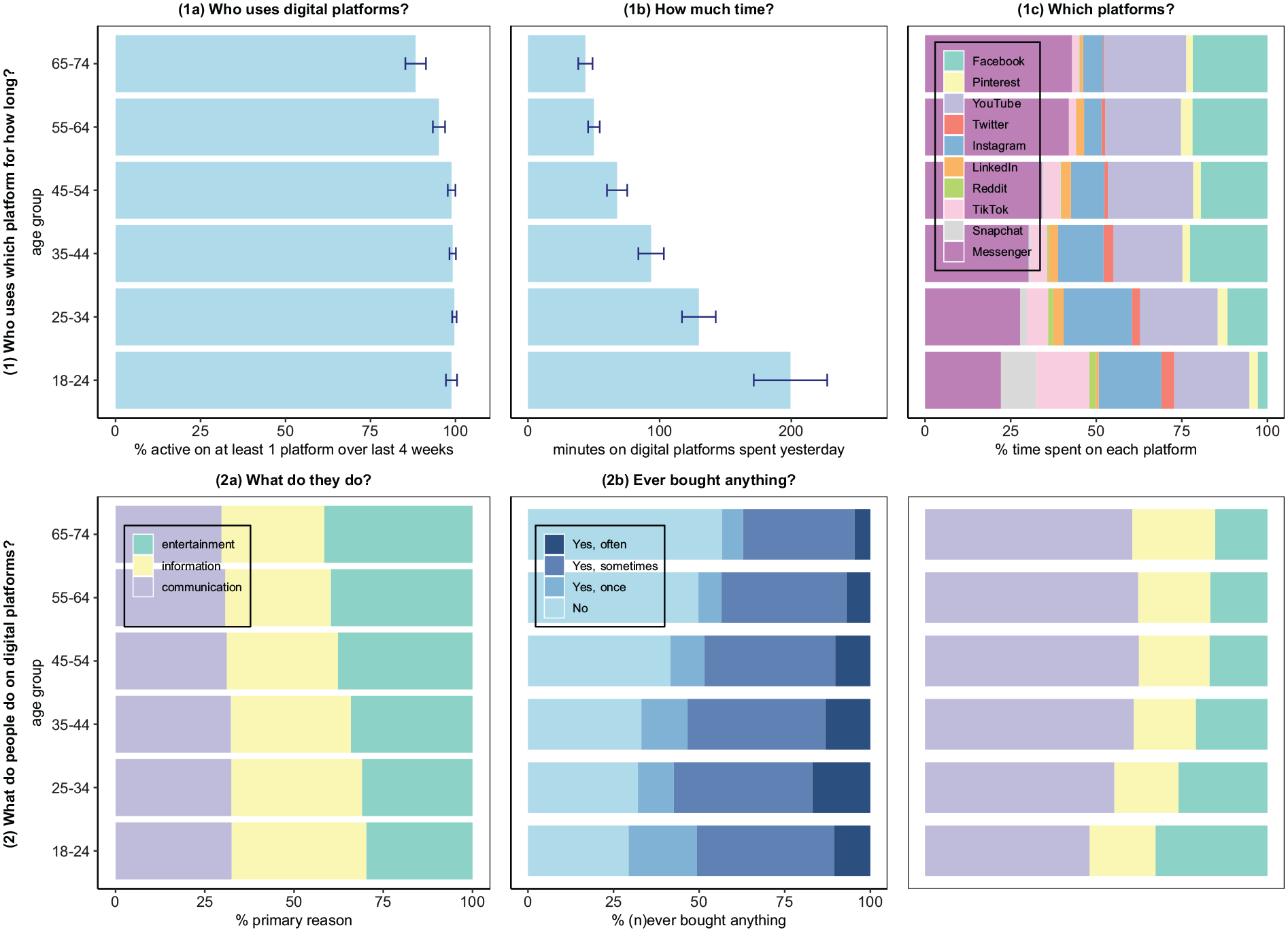
Digital platform use across age groups in Germany.
Figure 1a shows that across all age groups, the vast majority of respondents reported that they used at least one of the following platforms in the past four weeks: Facebook, Instagram, LinkedIn, messenger services such as WhatsApp and Telegram, Pinterest, Reddit, Snapchat, TikTok, Twitter, WhatsApp, and YouTube. The share is slightly smaller for older age groups: for the group aged 65 to 74 years, only 85 percent report having used at least one platform.
There is substantial variation in how much time different age groups spend on social media (Figure 1b) and how they allocate this time across different platforms (Figure 1c). Although individuals aged 18 to 24 years spent 199 minutes on these platforms the day before filling in the survey, individuals aged 65 to 74 years spent only 43 minutes on these platforms. Figure 1c shows that older age groups mainly spend their time using messenger services and that there are pronounced age differences in the use of Instagram, Snapchat, and TikTok. The relative time spent on YouTube is surprisingly similar across age groups.
Turning to the question of what different age groups do on digital platforms, Figure 2a shows the subjectively reported primary reason for why individuals use platforms. Generally, entertainment, information, and communication are mentioned equally often, with younger individuals tending to mention information slightly more often than older individuals. As a proxy for whether digital platform use also has behavioral consequences, we asked respondents whether they ever bought anything on the basis of a recommendation received from a digital platform. More than 50 percent in all age groups have done so with the proportion rising to 70 percent for individuals younger than 35 years. This highlights how technology influences behavior, shapes economic dynamics, and influences consumption patterns across various age groups.
Being asked about whether respondents consider their behavior on digital platforms as either passive or active—an active person is defined as a person who regularly posts, comments, or shares content—we see that younger age groups are less likely to consider themselves passive users than older age groups. However, also nearly half of those younger than 25 years consider themselves passive users. This highlights a significant inequality in voice, as active users represent only a small fraction of the overall user base and show a strong stratification by age.
Overall, this visualization shows that most people use digital platforms regularly, with younger age groups spending more time online and using a greater number of different platforms compared with older age groups. YouTube is popular across all ages, while Instagram and TikTok are more popular among younger users. Individuals use such platforms for different purposes, with younger age groups being more likely to use them primarily to gather information than older age groups. 2 Such differences in purposes can increase existing inequalities among different age groups by contributing to differences in the accumulation of cultural and social capital, contributing to cumulative advantages (Verwiebe and Hagemann 2024). Understanding such age-related variations, such as inequality in active use or the impact of digital recommendations on consumption behavior, is crucial to ensure equitable digital access and digital inclusion. Although our visualization contributes to understanding how different age groups are currently using digital platforms, our visualization does not make it possible to differentiate between age effects, period effects, or cohort effects. Disentangling these effects, however, may help to better understand not only how different age groups use technology but also how social transformations shape and reinforce digital behaviors over time and how such behaviors intersect with existing social structures.
Supplemental Material
sj-docx-1-srd-10.1177_23780231251319360 – Supplemental material for Visualizing Age-Specific Digital Platform Usage in Germany
Supplemental material, sj-docx-1-srd-10.1177_23780231251319360 for Visualizing Age-Specific Digital Platform Usage in Germany by Licia Bobzien, Roland Verwiebe and Fabian Kalleitner in Socius
Footnotes
Acknowledgements
We would like to thank the SOEP(-IS)-Team for surveying and preparing the data of the survey module used for this analysis and Ulrich Kohler for supporting the development of this module.
Correction (July 2025):
Figure 1 has been updated to amend the first y-axis age group to 18-24.
Correction (June 2026):
The headings for (2c) in Figure 1 were inadvertently removed during the previous correction and have now been restored.
Data Availability Statement
The data can be accessed upon registration at SOEP-IS. These data will be released in 2026 for public use. More information can be found at http://companion-is.soep.de. The statistical code underlying this data visualization can be found at  .
.
Supplemental Material
Supplemental material for this article is available online.
1
2
Such age-related differences are also observable in multivariate analyses for each variable of interest accounting for further characteristics (gender, education, income, eastern vs. western Germany) that potentially shape digital platform use. Results show that income and region play a rather minor role, whereas gender and education are important factors for platform use.
Author Biographies
References
Supplementary Material
Please find the following supplemental material available below.
For Open Access articles published under a Creative Commons License, all supplemental material carries the same license as the article it is associated with.
For non-Open Access articles published, all supplemental material carries a non-exclusive license, and permission requests for re-use of supplemental material or any part of supplemental material shall be sent directly to the copyright owner as specified in the copyright notice associated with the article.
